On 2 January 1804 the very first issue of the Giornale italiano, a newspaper published in Milan, included an unsigned review of a dramma per musica by Giovanni Simone Mayr, Alonso e Cora, premiered at La Scala the previous 26 December. Rather than discuss the performance or the work, however, the article consisted of an ironic prediction of the kind of opera that would soon be staged in Milan. If there is any truth in the saying that extremes meet – the critic argues – and if this means that when something reaches an extreme, the next step is the opposite extreme, it follows that in a short while Milan will see a really good opera: ‘I would bet that next year or the following one we will suddenly have a superb big piece.’Footnote 1 The bulk of the article, written in the future tense, is taken up by a detailed description of the conception, production and main features of this imaginary work. When its performance eventually takes places, the critic concludes:
the magnificent and overlarge theatre of La Scala will not only serve as a place for conducting business, for carrying out social duties and for generally being idle, but will be consecrated to the aim that the audience desires and purchases with its money. Thus a delirious person who entertains hopes reasoned and predicted in his dreams. Amen to that!Footnote 2
As I will argue below, this peculiar ‘review’ occupies a crucial position in the history of Italian operatic criticism. Such a position is due only partially to its content – although, as we will see, its utopian tone does matter. There are at least three further reasons for giving this article pride of place: first, the leading position that the body of criticism published in the Giornale italiano would come to occupy in the following months and years; second, the lasting influence that this criticism would have on opera reviewing in Milan; and third, the contemporary emergence of this city as the foremost political and cultural hub in the Italian peninsula. In what follows I will discuss these statements in some detail, focusing especially on the relationship between politics, society and culture in Napoleonic Milan on one hand, and opera reviews in the city’s periodical press on the other, since – I will claim – this relationship is crucial for an understanding of some of those reviews’ main features. It seems advisable, therefore, to proceed in somewhat reverse order: I will begin from the city, then narrow the focus on its periodical press, and finally concentrate on the opera reviews published in it. My main aim is to investigate a decisive moment in the development of modern Italian operatic criticism from the viewpoint of the city that started coming to the fore as Italy’s most prominent – and prominently modern – urban centre precisely at this time. What follows is not a mere case study, then; rather, it claims a not insignificant measure of exemplarity for Milan, for the reasons that I have just introduced, and that I will shortly discuss.
The present article, as a result, shares many of its concerns with several other recent texts that have set out to explore the relationship between opera and the city. Opera is an eminently urban phenomenon, of course, at least starting from the beginnings of its commercialisation in Venice in the 1630s, and therefore the city has appeared prominently in opera studies since their inception. Only recently, however, has the city been granted specific attention, becoming the point of view from which to look at opera, or at least a crucial component of historiographical and hermeneutic perspectives.Footnote 3 The periodical press has featured significantly in what, following this turn, can now be called operatic urban studies, especially those focusing on topics from the late eighteenth century onwards, when newspapers and magazines became widespread in European and Europe-influenced cities and began to discuss opera at some length.Footnote 4 The relationship between operatic criticism and the city in which and for which it was published, however, has not exactly been at the centre of operatic urban studies. More often than not, the periodical press has been used as a means to investigate the reception of a specific work or a genre in a given city: only rarely have the potential connections between some specific features of a work or genre and some specific characteristics of an urban environment as addressed in the periodical press received direct and explicit attention.Footnote 5 Newspapers and magazines have also served as privileged sources, of course, for excavating the connections between operatic institutions and the city in which they are located, especially during the nineteenth century.Footnote 6 In any case, works, genres and institutions have received the lion’s share of attention when discussing opera and the city. What is more, when the periodical press has indeed been spotlighted in operatic urban studies, the culture, society, politics and ideologies of the city in question have tended to play a lesser role than they arguably deserve.Footnote 7 In what follows I instead keep the attention firmly on the periodical press while attempting to make sense of its treatment of opera in light of a wide network of intersecting discourses of, for and about the city.
Into the vortex
Giuseppe Pecchio’s Vita di Ugo Foscolo, written when its author was in exile in England and published in 1830, justifies poet and intellectual Ugo Foscolo’s decision to move from Venice and then Florence to Milan in late 1797 in the following terms:
He was looking for another sky, a stormier one; he was looking for a vortex into which to throw himself. Milan, which had just become the capital of the newly born Cisalpine Republic, and a sort of colony bestowing citizenship upon all wandering Italian patriots, was the dwelling place he chose. Only two years earlier Milan had been calm and quiet, a place where one lived comfortably and pleasantly, but languidly and soporifically; now it suddenly became a place of continuous changes … Italians from many provinces, who had never heard of each other despite living no more than fifty, thirty, twenty miles apart, as if by magic found themselves all gathered in this city … Everything was new: people, names, language, clothes, emblems … If Foscolo had continued to live in placid Venice, he would have ended up writing a few witty tales and some sonnets for nuns; at forty he would have become a member of the Arcadian Academy, and at most would have attained the modest fame that Gozzi had, that of a good prose writer and concocter of blank verse.Footnote 8
Pecchio’s text constitutes an early and particularly explicit instance of the discourse of Milan as the first modern Italian city. It is of course impossible to separate fact from fiction in what has become known as ‘the myth of Milan’, a myth that is alive and well in present-day Italy, and that sees this city as the country’s most culturally and socially influential and advanced urban centre, the most open to innovation and change, and the most receptive to international influxes. What is undisputed is that this discourse finds its roots in the so-called Napoleonic period, which for Milan spanned the years between 1796 and 1814 (with a few short interruptions), and that at the time the city was already both conscious of its newly attained political and cultural primacy and active in advertising it to the rest of the peninsula.Footnote 9 Since this period is the focus of my attention here, I must introduce its main features, specifically those contributing most directly to Milan’s myth-making enterprise from the standpoint of operatic criticism in the periodical press.
Until 1796, Milan was the capital of a small duchy which comprised about half the present-day region of Lombardy (the present-day provinces of Milan, Lodi, Cremona, Mantua, Como, Varese and Lecco), but the holders of the ducal title had not been resident in the city since the early sixteenth century: for the previous ninety years they had been the holy Roman emperors, ruling the duchy through governors usually sent directly from Vienna. Milan was therefore a capital only by name, with the severely diminished political, social and cultural cachet that this entailed. Over the course of the eighteenth century, and especially in its second half, the city had become a leading economic centre, and its cultural life had witnessed a remarkable flowering, now known as the ‘Lombard Enlightenment’. Despite these developments, however, Milan was only one among several prominent cities in the Italian peninsula, in many ways less important than such actual capitals as Venice, Florence, Rome and Naples, even if more so than such others as Turin, Parma and Modena.
As Pecchio and countless others have argued, the arrival of Napoleon in 1796 ignited a quick process of radical change for Milan, which for the first time in almost three centuries took on a leading political role. It was a matter of course that the city would be the capital of the so-called Transpadan Republic (1796–7), since the territories of this political entity were more or less the same as those of the old duchy. The first crucial event in Milan’s ascending course took place the following year, when Bonaparte himself decided that the city should become the capital of the Cisalpine Republic, against the opinion of the French Directory (afraid of the negative reactions of the passed-over Bolognese). Napoleon’s decision was based on Milan’s florid economy, its easily defensible position and its proximity to France – Piedmont had been annexed directly to the French Republic, and therefore Turin, closer to France than Milan, was unavailable.Footnote 10 Initially the Cisalpine Republic included – beside the territories of the Transpadan Republic plus the rest of Lombardy (Bergamo and Brescia) – those of the former duchy of Modena, the parts of Emilia and Romagna formerly belonging to the Papal States (Bologna, Ferrara, Ravenna), the old duchy of Massa and Carrara (now northern Tuscany), and the territories of Verona, Mantua and Rovigo. After the temporary return of the Austrians between April 1799 and June 1800 and following the treaty of Lunéville of February 1801, the Republic made further territorial acquisitions, which continued when it was re-christened the ‘Italian Republic’ in 1802 and then transformed into the ‘Kingdom of Italy’ in 1805, by far the most important being the inclusion of the whole of the former Venetian Republic.
In the space of a few years, then, Milan found itself at the head of a incommensurably larger state than the old duchy, and the most heavily populated of the Italian peninsula: it included such important cities as Venice, Verona, Bologna and Ancona, and for a while reached as far as Montenegro. This new political and administrative prominence caused a significant influx of people more or less closely connected with it, from army suppliers to political refugees coming from those parts of the peninsula where French power was less securely rooted, and from civil servants brought in to help run the new state to intellectuals and artists in search of official sponsorship, employment and money.
Milan was not the largest Italian city – Naples was significantly bigger – but it was there that some of the defining characteristics of the modern urban centre first emerged in Italy: there one could begin to experience the sense of continuous novelty and of confusing multiplicity that Baudelaire would later indicate as essential to the idea of modernity, as Pecchio makes clear. This experience is directly connected with the unprecedented and numerically substantial arrival in the city of people from elsewhere, which did not simply translate into a considerable increase in population – although of course such an increase was a necessary condition for the experience itself. Continuous novelty and confusing multiplicity imply a measure of cosmopolitanism, or at the very least a substantial degree of diversity among the newly arrived; Pecchio insists that they were Italians ‘of many provinces’, and that their arrival meant that ‘everything was new’, including language – Italy is notoriously a place of many and very different dialects, and until the second half of the twentieth century only a small portion of the population spoke Italian. What is more, the French influx is not to be forgotten, especially of military and administrative personnel.
Fluidity and diversity, then, emerge as distinctive features of life in Napoleonic Milan, especially if compared with the city’s previous incarnation as a duke-less ducal capital. In other words, Napoleonic Milan constituted the first, embryonic instance of the modern city in Italy, since fluidity and diversity are characteristic traits of the modern urban environment. In Pecchio’s striking image, Milan became a ‘vortex’ into which Foscolo, perhaps the first Italian modern intellectual, wished to throw himself. As Pecchio spells out, there he could find the best possible standpoint from which to address a larger and more varied public than it would have ever been possible to find in ‘placid’ Venice (no longer a capital city) or in equally more provincial Florence (which remained the capital of an only partially independent Tuscany until the whole region was annexed directly to the French Empire in 1808). Foscolo had understood that Napoleonic Milan would function as a resonating chamber, where his voice would be heard more loudly and clearly than in any other Italian city at the time.
A place where voices resonate with unequalled power, even if they do so only metaphorically, seems the kind of place where opera should find an especially beneficial dwelling; this is precisely what happened in Milan. Opera’s first Italian encounter with the modern city in the form of Napoleonic Milan was advantageous first and foremost in terms of performance spaces. Before 1796 opera was regularly performed in two theatres: La Scala and La Canobbiana. At least four more opened between 1796 and 1814: the Santa Radegonda (1803), the Carcano (1803), the Lentasio (1805) and the Re (1813), which replaced the Santa Radegonda. Only La Scala was almost exclusively reserved for opera – and therefore ballet, which was still performed between the acts of the opera and after its conclusion; in all the others, opera shared the stage with spoken plays, vocal and instrumental accademie, marionette shows, circus acts and so on; in fact, opera was rarely the prevailing genre in these newer establishments. Still, the sheer number of performance spaces hosting opera is striking. The number of works performed increased accordingly, and so did that of performers active in the city, even if variations from year to year were considerable.Footnote 11 It would be difficult, however, to argue that Milan was the foremost operatic city in Italy in terms of theatres, works, performances or personnel. There were at least two other centres which equalled and probably even surpassed the Lombard capital in these terms: Venice and Naples.
There is an area, however, where Milan’s embryonic modernity did translate into operatic primacy, a realm where voices were heard more loudly and clearly than in any other Italian city: I am referring not to voices singing opera, but to voices writing about it. These voices are of course much more directly accessible to us today than those of singers, but this does not necessarily mean that what they are saying is immediately clear. Especially tricky to untangle is their relationship with other spheres of operatic activity, from composing to performing, and from financing and organising to watching and listening. This relationship, interesting as it certainly is, is not my primary concern here, however. What I want to investigate instead are some of the political, social and aesthetic meanings of operatic discourse in Napoleonic Milan as it took shape in the periodical press, focusing especially on the intersection between this discourse and the discourse of the city.
The periodical press is crucial in this context because it acted as an important link – although surely not the only one – between opera discourse and city discourse, both physically – news about opera and news about the city were printed in the same newspapers – and symbolically. According to urban historian Nick Hayes, ‘beyond the walkable city, [the press] was the primary means through which urbanites understood and communicated with each other in the sense that they could think about the same things at the same time, presenting the opportunity for a common vision of social reality. It was also a purveyor of the dominant urban narrative.’Footnote 12 Another urban historian, Daniel J. Monti, Jr., is more emphatic: ‘The secret of great cities, quite simply, is found in what we do there and in how we explain it to ourselves … The secret of who we are as people … is locked up in the city diary we call newspapers.’Footnote 13 The figure of the ‘urbanite’ is rather general, of course: in this context, it meant mostly members of the political, administrative and legal establishment, from the highest echelons down to common civil servants (in other words, all those whose professional position implied an active command of written Italian), as well as members of the middle classes not directly linked to the government apparatus but sufficiently involved in public life to take an active interest in being aware of, and possibly contributing to, what Hayes calls the dominant urban narrative. This points to a significant overlap between newspaper-reading urbanites and opera-going ones in Napoleonic Milan.
Milanese newspapers were read not only by urbanites, however, or at least not only by Milanese ones. The city’s newly acquired position as capital of an ever larger state meant that the urban narrative purveyed in its newspapers was also intended for the consumption of those who read the Milanese press in the smaller and less important cities that became part of this state. The well-documented circulation of these papers outside Milan was of course a consequence precisely of its status as the capital, and at the same time contributed to the perception of its centrality. To paraphrase Monti’s rather overblown but useful words, the secret of who we are as people might be locked up in the city diary we call newspapers, but the city in question might not be the one where we currently live – although we might aspire to moving there. In Italy this scenario was – and still is – complicated by its long-standing political, social and cultural fragmentation, and, at this particular historical moment, by the convulsively evolving political situation, which meant that the perception of what constituted centre and periphery could change swiftly and dramatically. To take the example of a provincial city whose name will return below, Brescia, located about 60 miles east of Milan and 100 west of Venice, was part of the Venetian territories until 1797, but was then immediately annexed to the Cisalpine Republic, together with Bergamo and well before the rest of the former Venetian state. Despite being Venetian since the fifteenth century, linguistically and economically Brescia gravitated ever more towards Milan, but was not in any significant sense Milan’s periphery until 1797, when suddenly what happened in the big city to its west started to matter a great deal. But hardly less crucial for the bresciani was the perception in Milan of what happened in Brescia (including operatically) as narrated in the capital’s newspapers.Footnote 14
In the light of such considerations, some questions seem worth asking: Which vision of opera did the Milanese press promote during the Napoleonic period? Which narrative did it construct about the intersection between the city and the genre? And how did this narrative evolve over the years? In order to try to answer such questions, I will now turn to a brief general survey of the Milanese press of the Napoleonic years, before exploring when and how often opera was discussed, and the tone and content of notices and reviews. Finally, I will address some possible reasons for the main features of this opera discourse, paying specific attention to the ways in which it intersected with the sociopolitical, ideological and cultural discourse of Milan as it was shaped by the press itself. My aim is to show how the kinds of journals, as well as their content and format, were crucial for constructing an image of opera that responded to the quickly evolving priorities of Milan’s various governments, and for developing new ways of talking about this artform that, I will argue, changed both its political meanings and its aesthetic standing, first for the Milanese and eventually for the rest of the opera-going and press-reading Italians.
Gazzette, giornali and in between
For most of the eighteenth century the Italian capital of the periodical press was not Milan, but Venice: there one could read the most prominent and influential gazzette and giornali. Gazzette were weeklies or bi-weeklies that gathered, magpie-like, bits of mostly political news from foreign newspapers, to which they added a few local ones (‘gazza’ is the Italian for ‘magpie’, as in Rossini’s famous ‘gazza ladra’). ‘Foreign’ meant from a different state, of course, and therefore from the perspective of, say, Venice, news from the Duchy of Milan, the Kingdom of Sardinia, or the Duchies of Parma and Modena counted as such. Gazzette were in fact usually divided in different sections whose heading corresponded with the name of the capital city of the state whence news originated: ‘Milano’, ‘Torino’, ‘Parma’, ‘Modena’, then, as well as ‘Parigi’, ‘Londra’, ‘Vienna’ and so on. More specialised giornali focused instead on literary, historical or scientific topics with varying periodicity and significantly longer articles.Footnote 15
During the final decades of the century, however, Milan came to the fore with a significant increase in quantity and quality of periodical publications. It is revealing that the best-known manifestation of the Lombard Enlightenment mentioned above is Il caffè, an influential giornale published between 1764 and 1766 on the known model of Addison and Steele’s Tatler and The Spectator, which featured articles on economics, finance, society, literature, religion and history observed with a critical eye and with the avowed intent of ‘democratising’ culture. The lateness of this development in the European context should not go unremarked: Tatler and The Spectator were published in the 1700s and 1710s, yet could act as models for Il caffè over half a century later. Nor should the precariousness of such enterprises in ancien régime Italy: after less than two years Il caffè was by all intents and purposes shut down by the Austrians, uneasy at its ‘democratising’ efforts. The age of criticism arrived late to the peninsula, and its hold was always rather precarious under absolutist governments. In this sense, it makes sense that, despite Milan’s advance, Venice remained the capital of the periodical press over the course of the eighteenth century, given its status as a ‘republic’ – scare quotes are in order, given the huge difference between the Serenissima’s form of government and the current meaning of the term.
With the arrival of the French, however, Milan witnessed a veritable explosion of periodical publications, much more so than any other city in Italy. During the so-called ‘triennio giacobino’ (the three Jacobin years) between 1796 and 1799, before the brief return of the Austrians, over forty periodicals appeared (most of them short-lived), more than are known for the entire previous history of the periodical press in the city, that is, since the mid-seventeenth century. A fundamental role in this explosion was played by the French emphasis on public information and instruction, but there is no doubt that the main reason rested in Milan’s new political prominence. After the battle of Marengo and Napoleon’s return in 1800 – this time, after the 18th Brumaire, as a rather different political figure – this convulsive expansion was followed by a considerably calmer phase, with direct and indirect censorship slowly reappearing. Still, it is significant that when in 1811 the government limited to one the number of newspapers allowed to publish political news in each department of the Kingdom of Italy, the only exception was the department including Milan, where no less than eight such newspapers were allowed. This was far more not only than any other city of the Kingdom, but also than any other where periodicals in Italian were published, including Florence, Rome and Naples.
Generally speaking, the primacy of Napoleonic Milan in terms of the periodical press is of course the most direct reason for its primacy in the public written discourse of opera, but the two intersect in unexpected ways. Opera made a more or less regular appearance in Milanese periodicals with the Gazzetta enciclopedica di Milano, published between 1780 and 1802, and the Giornale enciclopedico di Milano, which circulated between 1782 and 1797. Despite their differing names, these were both examples of what historians of the Italian press have called ‘borderline periodicals’, which featured characteristics of both gazzette and giornali, although they leaned decidedly more towards the former than the latter.Footnote 16 Operatic notices declined in both papers from around 1795, not long before the arrival of the French and in an already tumultuous political context.
This trend continued during the triennio giacobino, when the explosion of the periodical press did not translate into a comparable increase in column inches devoted to opera – this in the context of steady or only slightly declining operatic activity. The most prominent and politically engaged (and for this reason short-lived) papers, such as the Giornale de’ patrioti d’Italia and the Monitore italiano, paid virtually no attention to Milanese theatres. A little more is found in the Termometro politico della Lombardia, mostly in the form of letters and what we would now call ‘review articles’ or ‘think pieces’. In any case, the general sense is that, although the more political and social aspects of theatrical and operatic activity mattered to the version of the city discourse offered by Milanese newspapers, consistent and methodical consideration of such activity was not deemed necessary: more directly political fields of action and reflection, ones with more immediate impact on the lives of the Milanese, dominated this discourse. Francesco Saverio Salfi, the contributor to the Termometro politico who penned the few articles on theatrical matters published there, explicitly censored opera and ballet as remnants of the old order; according to him, ‘the spirit of the absent archduke’ hovered around La Scala more than that of ‘the pretended friends of liberty’; for him, castratos and their grotesque bodies exemplified all that was morally wrong with the ancien régime; female singers and dancers were explicitly likened to prostitutes; and vocal virtuosity was condemned as a repugnant form of excess.Footnote 17
Only the Corriere milanese, another gazzetta-leaning borderline periodical which had been founded in 1794 and, thanks to its avoidance of direct political debate, would survive the trienno giacobino and turn out to be the longest lived among those dating from the eighteenth century, mentioned opera with regularity. This situation would not change significantly after 1798–9, when all newspapers founded during the trienno disappeared (without reappearing with Napoleon’s return the following year), and until 1804, which proved to be a turning point for opera reviewing in Milan.
That year saw the appearance of two periodicals that devoted regular and substantial attention to opera: the Giornale italiano in January and the Corriere delle dame in October. The first, modelled on Paris’s Le Moniteur universel, was an official paper appearing tri-weekly; mostly devoted to the government’s legal and administrative acts and news from the French-dominated lands first, and then other states, it paid less attention to city life, with the exception of substantial reviews of whatever was on in Milanese theatres.Footnote 18 The Corriere delle dame was a different affair altogether: published every five days, it was aimed at a female readership, its most systematically recurring feature a fashion plate accompanied by a brief commentary. It also regularly included a so-called ‘political thermometer’, that is, a summary of the weekly news, and a variety of features: anecdotes, moral reflections, advice columns on public deportment and the education of children, poems, charades, and theatre reviews of rather variable length, from a few lines to a couple of pages.Footnote 19
For a few years, then, opera was discussed regularly and at length in at least three Milanese papers: the older Corriere milanese and the new Giornale italiano and Corriere delle dame. These were also the three periodicals with the highest circulation figures not only in the city, but, unsurprisingly, also in the whole Kingdom of Italy, and probably the entire peninsula. In the year 1811, the only one for which the figures are firm, the Corriere milanese had over 3,000 subscribers, slightly more than the Giornale italiano – we know, however, that a few years earlier it had been the other way around. The Corriere delle dame followed with about 700, a couple of hundred more than Venice’s Quotidiano veneto, the highest ranking paper outside Milan.Footnote 20 Readership figures are of course much higher: a single copy was read by many at home, in cafes, restaurants and inns, at clubs, and in other public or semi-public spaces (it might be useful to mention here that La Scala, by far Milan’s biggest theatre at the time, had a seating capacity of about two thousand). The unprecedented polyphony created by three periodicals methodically discussing opera did not last long, however: from 1808 onwards theatrical reviews in the Giornale italiano were mostly limited to a few spoken plays (in both Italian and French). For the rest of the Napoleonic years opera featured prominently only in the two Corrieri, milanese and delle dame.
This brief historical overview highlights the sharp fluctuations in the sheer quantity of column inches devoted to opera in Milanese newspapers during the Napoleonic period, from a relatively low point during the triennio giacobino to the riches, unprecedented for Italy at the time, of the years between 1804 and 1807. Even more striking, however, are the changes that emerge once we move from quantity to the length, tone and content of the reviews.
‘Sensible articles of good theatrical criticism’
The attention of the anonymous writers of the Gazzetta enciclopedica and the Giornale enciclopedico, the two earliest periodicals, was almost exclusively devoted to the performance, with words and music receiving at best as much attention as each of the principals. What is more, for the most part this attention did not consist of an evaluation presented rhetorically as ‘objective’, but took the form of a report on the audience’s reaction to words and music – which were generally dealt with separately. Given that these reviews were quite short, sentences such as ‘the music is liked’ (‘la musica piace’) or ‘the entire opera was much applauded on the whole’ (‘l’opera fu tutta in complesso grandemente applaudita’) give a fairly accurate idea of their tone and content.Footnote 21 On the contrary, principals, scenes and costumes were generally discussed at greater length: especially remarkable is the consideration given to scenography, which not infrequently takes centre stage in a review.
This state of affairs did not change significantly when, in 1794, the Corriere milanese added its voice to those of the Gazzetta enciclopedica and the Giornale enciclopedico as the operatically aware paper in Milan. The triennio giacobino introduced a few remarkable novelties, as I have mentioned above. However, after the folding of the Giornale enciclopedico in 1797, of all the periodicals which had appeared during the triennio in 1798–9, and eventually also of the Gazzetta enciclopedica in 1802, the Corriere milanese, the only city newspaper which continued to pay sustained attention to opera, did so pretty much as if nothing had happened since 1796. Here is a fairly typical sample from January 1801, which I translate in its entirety:
General anticipation has been fulfilled. The new opera I Baccanali di Roma, performed yesterday at our Teatro alla Scala, has been universally applauded. Nothing was spared by the impresarios in order to make this play worthy of the public, as had been the case with the previous one. The beautiful poetry by citizen Luigi Romanelli from Rome; the excellent music by the famous composer Nicolini; the superb scenes by citizen Landriani; the virtues, always new and always dear, of the good prima donna Catalani, who each day proves that she is unequalled for the sweetness of her harmonious voice; the singing talent and ability of the other principals Bianchi and Brizio; the efforts made by all the other performers in order to contribute to the positive outcome of the play; and eventually the richness of scenes and costumes; in a word, everything has contributed to the success of the work, and has led the courteous public to offer the impresarios and the performers many manifestations of impartial justice and of a grateful and satisfied response.Footnote 22
Not infrequently notices were shorter than this one, and sometimes the title of the work was not even mentioned. On 20 August 1801, for example, only the composer, the three principals and the stage designer apparently deserved a nod in a review of Mayr’s Il portatore d’acqua. Similarly, on 29 December 1803 the same composer’s Alonso e Cora was dealt with in a twenty-three-line notice, of which seven were devoted to the gran ballo eroico that made up the evening’s entertainment together with the opera: again, no titles were given, and the librettist went unmentioned. A few days later this same work would be the ostensible object of the Giornale italiano’s first ever opera review, the one with which I began.
As I have already mentioned, 1804 was a turning point in the history of Milanese operatic criticism not only for the number of papers featuring regular opera reviews, but also, and perhaps especially, for the kind of reviews published. Carolina Lattanzi, the compiler of the Corriere delle dame, was evidently well aware of this momentous change when, in October of that year, she began one of her very first reviews with the following words:
Gutta cavat lapidem [constant dropping wears away the stone], says sententiously the Giornale italiano, which first taught the Corriere milanese how to conceive sensible articles of good theatrical criticism. But the Corriere delle dame – which, albeit small-sized, aspires to originality for the glory of the fair sex to which it is addressed – also offers its impartial judgement, without at all concurring with the other corrieri even if they are bigger and longer.Footnote 23
The reviews published by the Giornale italiano are indeed radically different from the earlier notices: significantly longer, they are less about individual performers and more about either the work – with the interaction between words and music often addressed directly – or a general theme concerning the theatre. The second issue of the paper, dated 4 January 1804, includes a piece on Paisiello’s I zingari in fiera, revived at La Scala the previous night but first performed in 1789 and apparently already known in Milan: the critic spends more than half of the considerable space at his disposal arguing over the advantages and disadvantages of performing ‘old’ works, bravely grappling with the issues newly raised by the first stirrings of the repertory. The next article on opera (25 January) is not a review at all, but a ‘think piece’ on the problematic relationship between the exorbitant cost of operatic performances and the often rather poor quality of the final product – something that would not be out of place in a recent issue of the New York Times, The Guardian, Le Monde, the Frankfurter Allgemeine Zeitung, La repubblica or Il corriere della sera. Other topics which the Giornale italiano tackled head on include audience behaviour, the state of opera seria librettos, the best way to organise performance schedules, the drawbacks of excessive ornamentation on the part of singers, and so on, sometimes in separate articles, more often as part of reviews.
Their author was Bartolomeo Benincasa, who started signing his articles with his initials from the second issue of the Giornale. Benincasa was a polymath who, among other things, had written the libretto for Il disertore (Venice, 1784), perhaps the first opera to attempt an adaptation of the poetics of French drame onto the Italian lyric stage.Footnote 24 More important in this context, however, are the years Benincasa spent in Paris and London in the 1780s and 1790s – he apparently spoke good English, beside French of course.Footnote 25 During the final years of the eighteenth century, theatrical and operatic criticism in these two cities evolved rapidly towards the work-centred model first introduced systematically to Milan by the Giornale italiano in 1804. By c.1800 Paris was ahead of London in this respect: the British capital boasted a higher number of periodicals, but the attention that such dailies as the Morning Herald, the Morning Chronicle and The Times devoted to the operatic work was less methodical than in Parisian ones such as Le Moniteur universel and the Journal des débats. In February 1800 the Débats introduced the feuilleton, the section devoted to literary and artistic matters placed at the bottom of the front page and continuining in the same location on the following ones, separated by the news proper (political, administrative, military, diplomatic, etc.) by a thick horizontal line: while the section above this line was censored, the feuilleton was not – at least officially.Footnote 26 French newspapers made it to Milan regularly from 1796 onwards. In any case, it seems relevant that Benincasa could witness this kind of criticism up close, so to speak, in both Paris and London, being able to go to the opera and then read about not only the performance, but also the libretto and the score – albeit in varying degrees of detail – in several papers over the following days.
I will say more about Benincasa and his possible reasons for introducing this kind of criticism to Milan later on; what needs to be noted here is that such criticism caught on. Lattanzi was a little optimistic when she implied that, by the autumn of 1804, his lesson had already been learnt by the Corriere milanese, since it took this paper a bit longer to do so fully and regularly. It seems also likely, however, that she was protesting too much when she loudly proclaimed her independence: it is difficult to imagine that she had not been influenced by Benincasa’s model.Footnote 27
As early as 15 October 1804, for example, the Corriere milanese devoted over a third of its review of a revival of Giuseppe Gazzaniga’s La vendemmia to its music:
This is one of those operas to which the poet’s saying that even when repeated ten times it will please applies. Simplicity and variety are so judiciously coupled that they always keep interest alive in the souls of spectators. The melody of the accompaniment is always within the limits of proportion, so that it never drowns out or obscures the voices of singers. Nothing recherché or gothic in the introductions to arias and ensembles; none of those long and complex labyrinths in the instrumental obbligatos. In sum, this music tends towards the true aim that is common to all the simple arts, its sisters in the imitation of true and beautiful nature. The choruses, which in the two previous operas were dissonant, like the wasps and frogs of Aristophanes, here, with wise restraint, are placed only in the introduction and the two finales. What a good thing if choruses were completely excluded from our theatres, since we so lack subjects who can perform them properly!Footnote 28
This discussion of the music is followed by a few sentences on the libretto, while only the final third of the article is devoted to the performance. The difference between this review and the one from January 1801 quoted above is striking: not only has the number of words tripled, but also the effort to discuss music and words independently from the performance is evident. The work is becoming something separate from its performance; in other words, we are witnessing the birth of the idea of a discrete, abstract work that can be thought of as distinct from its realisation on stage. That this was something new and still fairly unusual for the anonymous reviewer of the Corriere milanese is revealed by the confusion that he makes in his final remark about choruses, where their presence and number in La vendemmia is assessed in terms of the low standard of their performance – as if when composing the opera in 1778 Gazzaniga had somehow been aware of the situation at La Scala twenty-six years later and decided to have as few choruses as possible.Footnote 29
The reviews in the Corriere delle dame tend to have a lighter, more jocular tone, and Lattanzi likes to style herself as a commonsensical member of the general public who just tells her readers what she liked and disliked, often presenting her critique of the music in terms of a chronicle of the audience’s reactions – when talking about the libretto, however, she voices her opinion in a rhetorically stronger manner. But there is no doubt that her reviews are much more similar to those of the Giornale italiano and of the post-1804 Corriere milanese than to the notices found in the latter’s pre-1804 incarnation, not to speak of the earlier papers.Footnote 30 In any case, by 1806, when Benincasa left the Giornale italiano and the paper’s reviews became both shorter and rarer before almost disappearing the following year (bar the odd exception), the two Corrieri continued to feature the kind of review that he had first promoted: longer and more work-orientated.
At this point a few questions clamour for attention, the most obvious being ‘why?’ – also the most interesting, I would argue, as well as the most difficult. Why was this new way of writing about opera introduced in Milan? And why did it take hold quickly and for good? As I have hinted at above, asking such questions means spotlighting the city, and in particular addressing the relationship between Milan and its newspapers. As we will see, the issue of the interaction between city politics and the aesthetic sphere will emerge as central to this relationship.
Policing borders
As a way to begin answering the questions just mentioned, I will ask another, more specific one: why was Benincasa chosen as the opera critic of the Giornale italiano? Among his manifold activities, in 1798 he had been among the founders of a previous and influential, if short-lived, Milanese periodical, the Monitore cisalpino, who proclaimed themselves as ‘penetrated by the sublime principles of constitutional liberty’, while their paper has been characterised as ‘aspiring to the function of guide and inspiration of public opinion’.Footnote 31 Furthermore, in 1803 Benincasa had published the Essay on the Genealogy, Nature and Social and Political Interests of the Italian Republic, a pamphlet described by historian Gian Franco Torcellan as
a profession of faith in the new regime, a deliberate exposition of the benefits and hopes that were attached to the Italian Republic, an invitation to social harmony and to trust in the new political forms and in those called to build them, an exhortation to leave behind internal divisions … and to dedicate one’s energy to the edification and realisation of that ‘prospect of deeply rooted hopes’ that at that moment constituted both the conviction and the political horizon of the men of the new Napoleonic regime.Footnote 32
The Giornale italiano was founded with the aim to point public opinion precisely in the direction of this kind of hopeful optimism, and to encourage its readers’ commitment to build a better society. Its instigator was Francesco Melzi d’Eril, the vice-president of the Republic, and its editor-in-chief none other than Vincenzo Cuoco, one of the foremost political thinkers of the time and author of the epoch-making Historical Essay on the Neapolitan Revolution of 1799, whose first edition (1801) was printed in Milan. For Cuoco, Benincasa and their fellow journalists, as for Enlightenment intellectuals of the previous century, working towards a better society meant, among other things, educating their readers to develop a critical attitude towards all spheres of human experience, from politics to morals, and from literature to theatre. This is what Benincasa himself and many others had tried out during the triennio giacobino. Their views of what exactly constituted a better society may have varied considerably: the Monitore cisalpino took a moderate, pro-French view if compared to the more independent position and biting tone of its predecessor the Monitore italiano – it had to, if it wanted to survive, since it was precisely on account of its position and tone that the Monitore italiano was closed down by the French. The commitment to a critical attitude, however, was undiscussed. But in 1804 Milan this kind of attitude had quickly come to be considered suspect, and what Napoleon demanded and expected from the Milanese was unconditional and unquestioning support for his regime, and especially his military enterprises. The proclamation of the Kingdom of Italy the following year and Bonaparte’s magnificent coronation ceremony in the city cathedral became the final and most evident sign of the changed priorities of the regime.
In this context, neither the Giornale italiano nor any other Milanese paper could exercise the critical muscles of its readers on political, social or administrative matters, as the periodicals of the triennio had done. But it could apparently do so on the artistic front, especially the theatre. On one hand, the theatre as a means of social and ideological education had been at the centre of political attention since the arrival of the French; hence its presence in the pages of some triennio papers. One more recent significant result of this attention was Carlo Giuseppe Londonio’s Brief Observations of a Milanese Citizen on Public Theatrical Performances in His Homeland, a ‘reform’ essay published precisely in 1804 that argued for morally uplifting plots, for music that would enhance words rather than drown them, and for historically accurate scenes and costumes, since theatre was ‘a very important component of public education’, its function ‘to point out that the desired goal of happiness resides in the practice of social duties and civic virtues’.Footnote 33 On the other hand, the theatre was evidently considered a sufficiently safe field for critical intervention even after the political landscape had changed radically from those heady early days.
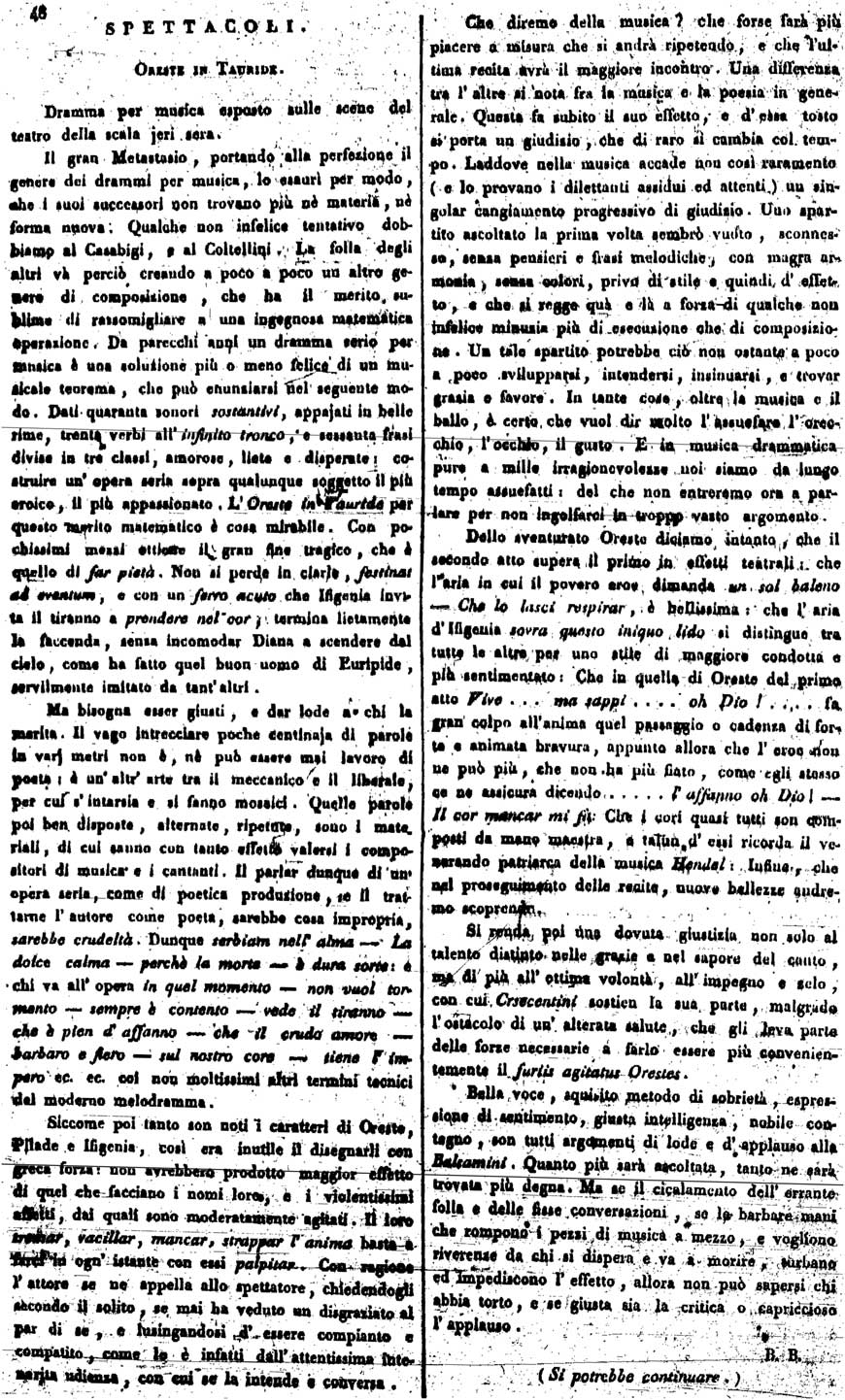
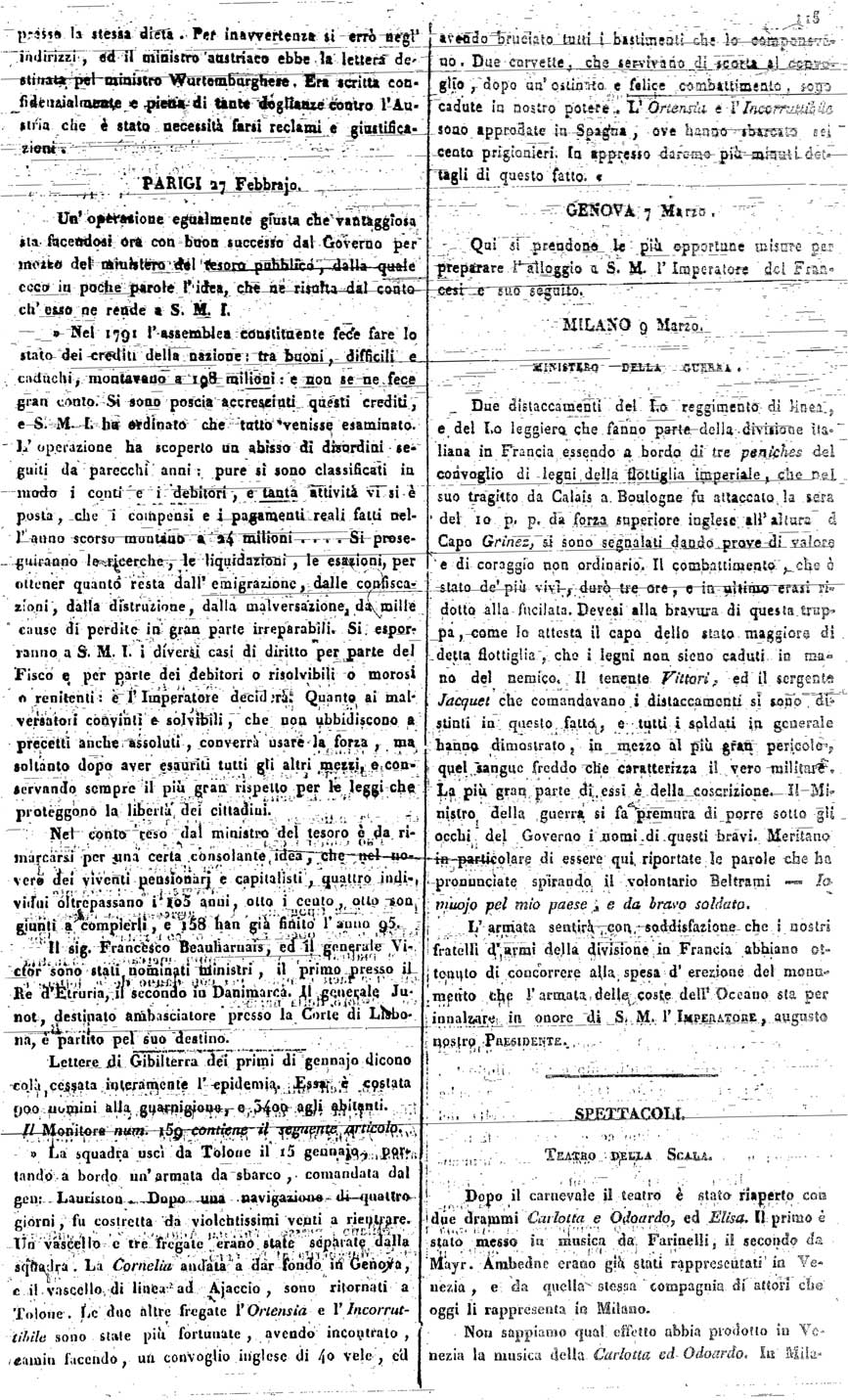
As a result, the Giornale italiano turned out an extreme case of a ‘borderline periodical’: the first pages resembled closely those of an old gazzetta, with political news given without hardly any commentary, and always with a strong pro-French orientation; the following pages featured instead articles of the kind found in the eighteenth-century giornali proper – and therefore weightier than those published in older borderline newspapers – scrutinising in detail literary, philosophical, but especially theatrical themes. This stark internal division was visual as well as substantial: the columns devoted to the ‘novelle politiche’ were organised according to the city from which the news originated, as had been the case in the old gazzette – not always the capital: ‘Nuova York’ and ‘Baltimora’ also appear, for example – with fairly limited coda space reserved for Milan. On the contrary, critical pieces, clearly separated from the ‘novelle politiche’ by a thick horizontal line, ran continuously after their initial heading, the most frequent of which was ‘Spettacoli’, as shown by the relevant pages from the issues dated 28 January 1804 and 9 March 1805 respectively (see Figs. 1 and 2). It is worth pointing out that this was not the case for Paris’s Moniteur universel, the avowed model of the Giornale italiano, in which cultural criticism was not clearly separated from political and administrative news and commentary: on 1 August 1803, for example, the critical section, which includes (in this order) ‘Littérature-Voyage’, ‘Théâtre de l’opéra-comique’, ‘Topographie’ and ‘Livres divers’, is no more emphatically set apart from the previous section, than, within the latter, ‘Paris’ is from the preceding ‘Bruxelles’, ‘Actes du gouvernement’ from ‘Paris’, or ‘Ministère de l’Intérieur’ from the said ‘Actes’. The most emphatic division is instead from ‘Extérieur’ and ‘Intérieur’, of which, evidently, ‘Ministère de l’Intérieur’ and ‘Théâtre de l’Opéra-Comique’ are equally worthy and relevant components. If anything, it might have been the feuilleton of the Journal des débats which inspired the Giornale italiano’s different yet comparable separation between political news and cultural criticism.
Il giornale italiano, 28 January 1804.

Il giornale italiano, 9 March 1805.

The clash of tones across that black line in the Giornale italiano emerges most clearly when the ‘novelle politiche’ touch on artistic matters, as they do on 2 February 1806. In this issue the section on ‘Milan’ consists entirely of a decree by Eugène Beauharnais (‘Eugenio Napoleone’), viceroy of the Kingdom of Italy, who, ‘considering that the citizens of Verona, and especially those among them who love the arts, have witnessed with sorrow’ the destruction of a monumental arch, ‘a masterpiece designed by Vitruvius’, and ‘wanting to give the city of Verona proof of [his] particular affection’, orders the reconstruction of this arch ‘with the same proportions and materials’ as before. These could easily be the words of an ancien régime prince showing his benevolence towards his subjects, a benevolence which includes caring about their aesthetic experiences. A minimal downward movement of the eye across the black line, and we are in a different world altogether: ‘Spettacoli’ contains Benincasa’s review of Romanelli and Federici’s Idomeneo and Clerico’s ballet La conquista del vello d’oro (with these titles and names heading the piece), a sarcastic and scathingly critical take on these entertainments, chastising excess for its own sake both in the music and in the way it has been performed.
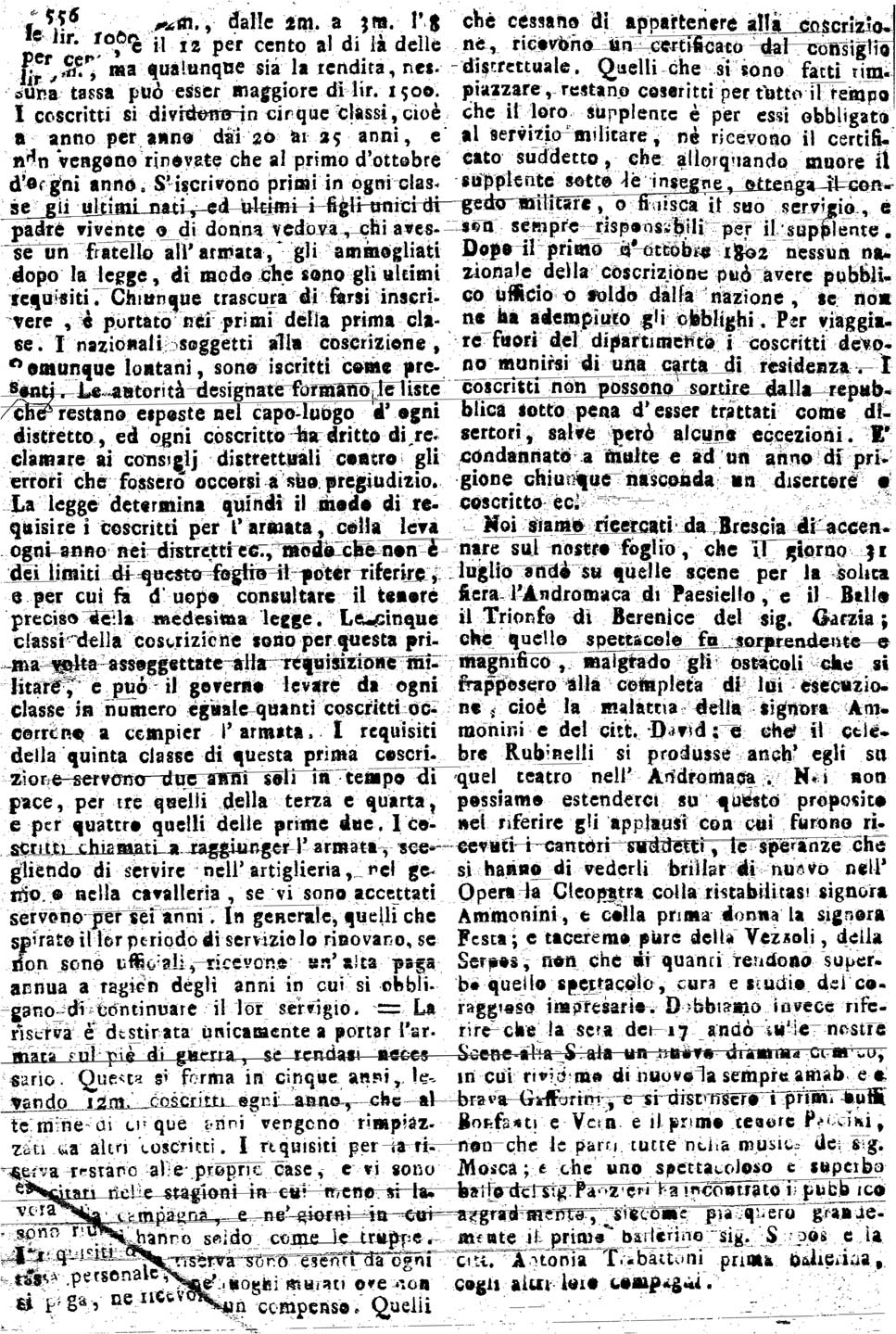
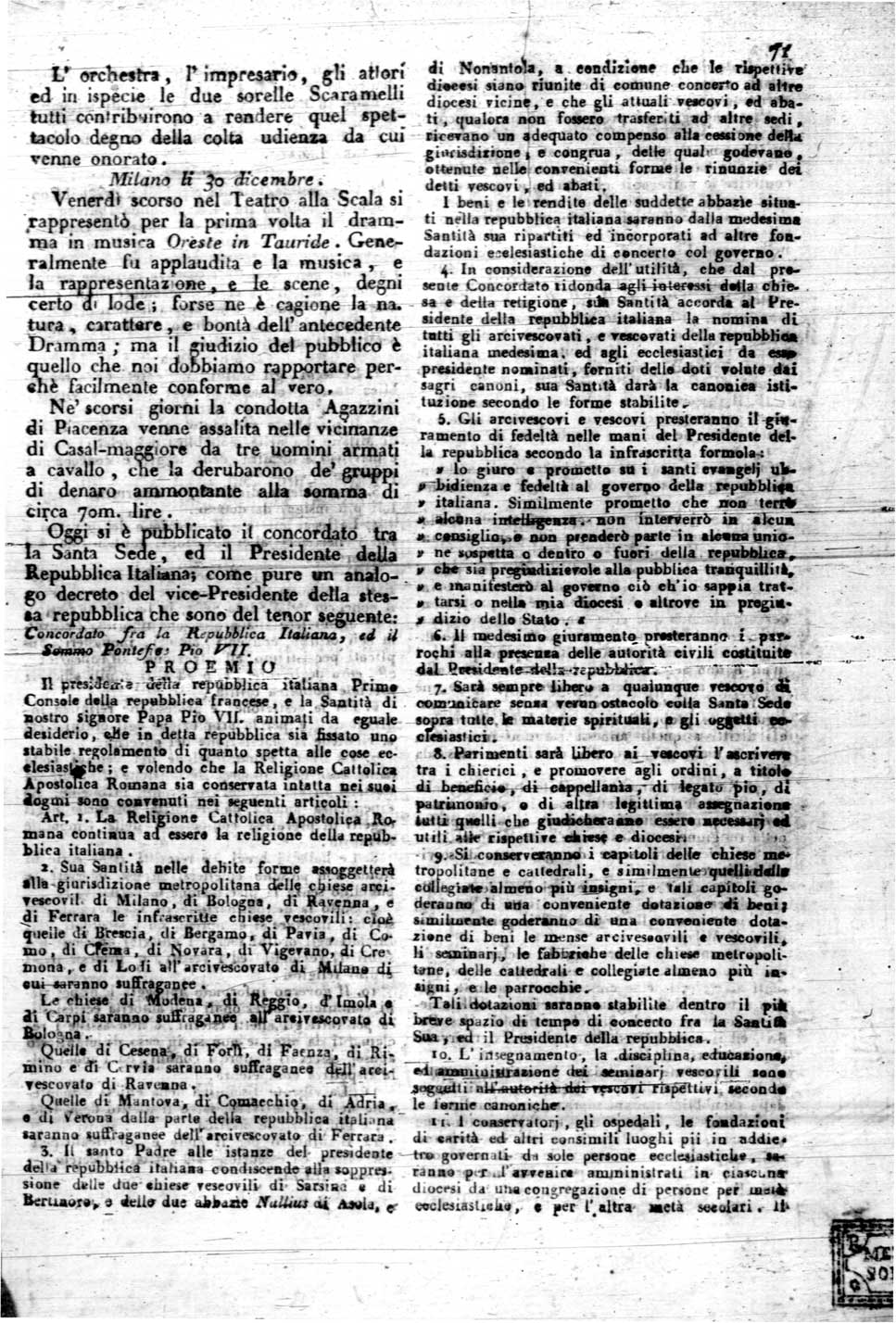
If we now turn back to the Corriere milanese up to at least 1805, we see that opera reviews appeared instead as unheaded sections of the substantial portion of the paper devoted to Milan (the whole paper was divided only by city). To take two examples, on 19 August 1802 ‘Milan’ included the full text of the new bill on universal military conscription, immediately followed by a short report on an opera performance in Brescia and an even shorter one on another show at La Scala. Reading ‘Whoever hides a deserter or a conscript is condemned to fines or a year in prison’ followed directly by ‘We are asked from Brescia to mention in your paper that on 31 July Paisiello’s Andromaca was performed on that stage for the usual fair’ brings home with startling clarity the radical alterity of this mise en page in comparison to that of modern newspapers (Fig. 3, halfway down the right-hand column).Footnote 34 Similarly, if less chillingly, on 30 January 1804 ‘Milan’ comprised ten lines on a new opera at La Scala, six on a stagecoach robbery near Casalmaggiore, and another six introducing the text of the Concordat between the Italian Republic and the Holy See, just signed (Fig. 4, upper left-hand column).
Il corriere milanese, 19 August 1802.

Il corriere milanese, 30 January 1804.

The layout of the periodicals from the triennio giacobino was not substantially different; or, at the very least, there was no clear division between gazzetta-like items and more critical pieces: news from various cities were interspersed with longer articles about politics (the large majority), society, economics, administration, literature and theatre.Footnote 35 The case of one of the only two articles on opera and ballet published in the Giornale de’ patrioti d’Italia is exemplary in this sense: ‘Ballo in Milano’ is divided into two parts – the first appears as the final item of issue no. 21 (7 March 1797), while the second opens the next issue (9 March 1797), followed by standard gazzetta items such as ‘Londra 14 febbraro’ and then ‘Aja 6 febbraro’.Footnote 36 From the point of view of such visual similarities, it seems relevant that, generally speaking, mention of title, composer or librettist was no less optional here than in the pre-1796 papers or the Corriere milanese in its pre-1804 incarnation. Apparently, a critical attitude such as the one displayed by Salfi in the Termometro politico della Lombardia, for example, did not yet necessarily require sustained focus on the operatic opus; or, at the very least, the work did not yet need to be objectified, to be clearly delineated and separated from its performance – as it will do after 1804, when Benincasa would normally begin his reviews in the Giornale italiano with the titles of the works under scrutiny and the names of their authors. A starkly divided self would only emerge with a stricter policing of borders, one put in place in order to prevent the kind of attitude promoted in the critical section from spilling over into the political one, as I will suggest.
Delirious hopes of reconciliation
If, to recall Hayes’s formulation, ‘the press … was … the purveyor of the dominant urban narrative’, which kind of narrative about opera in Milan did these different models of journalism promote? Which stories did they tell about the city and the theatre? The model of the Giornale enciclopedico and the Gazzetta enciclopedica and of the older Corriere milanese seems to suggest a narrative of integration and continuity, one in which the operatic event was one among several that came together to construct a rather fluid image of city life, of which politics, society, culture and the theatre were equally important components. This image was made up by notices, announcements and declarations presented as ‘facts’, to be accepted and believed as such, and about which there was no more to say. In this sense, 1796 did represent a watershed: all of a sudden everything was up for discussion, everything was opinion, debate, argument, from politics to society, and from culture to opera. Not everything changed with Napoleon’s arrival, however: as I have just mentioned, the layout of the papers of the triennio giacobino, though it could vary substantially from paper to paper, regularly mixed politics and society, culture and theatre in no less fluid a way as had been the case under the Austrians, even if the content and tone of its items were radically different. The Giornale italiano introduced instead a stark separation between socio-political reality and the space of the theatre: in this space, devoted to aesthetic consumption and reflection, art could and indeed should be subjected to probing criticism – an activity not exactly welcome outside this space, or at least not promoted as such from the columns of the paper.
It is in light of this aspiration towards criticism that the shift from an exclusive attention to opera as event to a partial consideration of it as work acquires meaning. Works are more amenable to being ‘owned’ discursively than events; they supply sturdier, more durable objects on which critical faculties can be exercised. Even if scores were not yet available in print beyond a few pezzi staccati, librettos certainly were, and in any case it was known that scores existed in manuscript, and therefore were literally ‘objects’. More important, beyond their physical dimension, operas were starting to circulate among different theatres and cities, and therefore focusing on them instead of on their performance implied a widening of the sphere of critical activity beyond Milan, which fits well with the city’s recently acquired prominence as the capital of an ever larger state. If events could be considered exclusive, works were, on the contrary, potentially inclusive, both of those Milanese citizens who had not attended their performance and of the many readers of the Giornale italiano who did not live in Milan, but who might have heard them already in their city, or might do so in the future. Perhaps paradoxically, then, Benincasa’s shift of focus from performance to work was in itself performative, in the sense that it was trying to create not only a new mode of listening, but also – and more relevant in this context – a new mode of thinking about opera, of reflecting upon it. No longer ‘merely’ a reporter, by displaying in writing his critical faculties at work he intended to help his readers develop a critical habitus themselves.Footnote 37
In this discursive context, a fact that I have thus far kept unmentioned acquires a particularly strong resonance: there are no opera or theatre reviews in the Monitore cisalpino, even if Benincasa was one of its founders and compilers. He was mostly responsible for a section called ‘Varietà’, which, according to the initial ‘manifesto’ of the paper, included ‘everything that can be of interest to learned citizens of the Republic in matters political, economic, moral, historical and artistic’.Footnote 38 But there is almost nothing on the arts in the Monitore cisalpino, and nothing at all on the theatre, at least in its initial months of publication.Footnote 39 What was the point? Space came at a premium, and it was evidently considered more vital to help readers develop a critical habitus on more pressing matters for these new ‘repubblicani’, such as political representation, taxation, the shape and functioning of the administrative apparatus, and so on. Why waste time with opera? As I have mentioned above, even the few other papers from the triennio giacobino that discussed opera did so only occasionally and in terms directly relevant to the immediate political and ideological context of Milan and the state of which it was the capital. It was precisely because by 1804 this context had drastically changed that Benincasa started to write extensively and, more imporant, critically about opera as work in the Giornale italiano.
The starkly divided mise en page of this paper which I have discussed above, as well as its equally extreme alternation of tones, however, implied that this critical habitus could be applied only to opera (and the arts in general): politics was not open to criticism, this was not the realm of dialogue, but of monologue. According to Terry Eagleton’s fundamental study The Ideology of the Aesthetic – which is both historically specific and theoretically wide-ranging, and which in my opinion offers a particularly compelling point of view for the case of Milan – shutting politics out, or rather substituting for it, is exactly what the aesthetic is supposed to accomplish; and of course the aesthetic had emerged as a fundamental category of European thought precisely in the second half of the eighteenth century. In Eagleton’s words, ‘if [the aesthetic] offers a generous utopian image of reconciliation between men and women at present divided from one another, it also blocks and mystifies the real political movement towards such a historical community’.Footnote 40 More specifically, Andrew Bowie, framing the issue in terms of Jürgen Habermas’s theorisation of the public sphere, has suggested that ‘the growth in the importance of music in the German-speaking public sphere in the early nineteenth century is connected to the failure to develop a politically effective public sphere … music’s growing importance can be associated with political impotence’.Footnote 41 If we substitute Bowie’s ‘music’ with ‘opera’ (while keeping in mind that ‘opera’ is probably the artistic form best placed to stand metonymically for ‘art’ south of the Alps), much the same could be said of the Italian context in the early nineteenth century, and especially of Napoleonic Milan following the intense period of the triennio giacobino. No wonder, then, that the mutually exclusive relationship between the political and the aesthetic was enacted in the starkly divided arrangement of the Giornale italiano, a newspaper that, after all, had been helped into being by the vice-president of the Italian Republic, a republic whose president was none other than Napoleon Bonaparte.
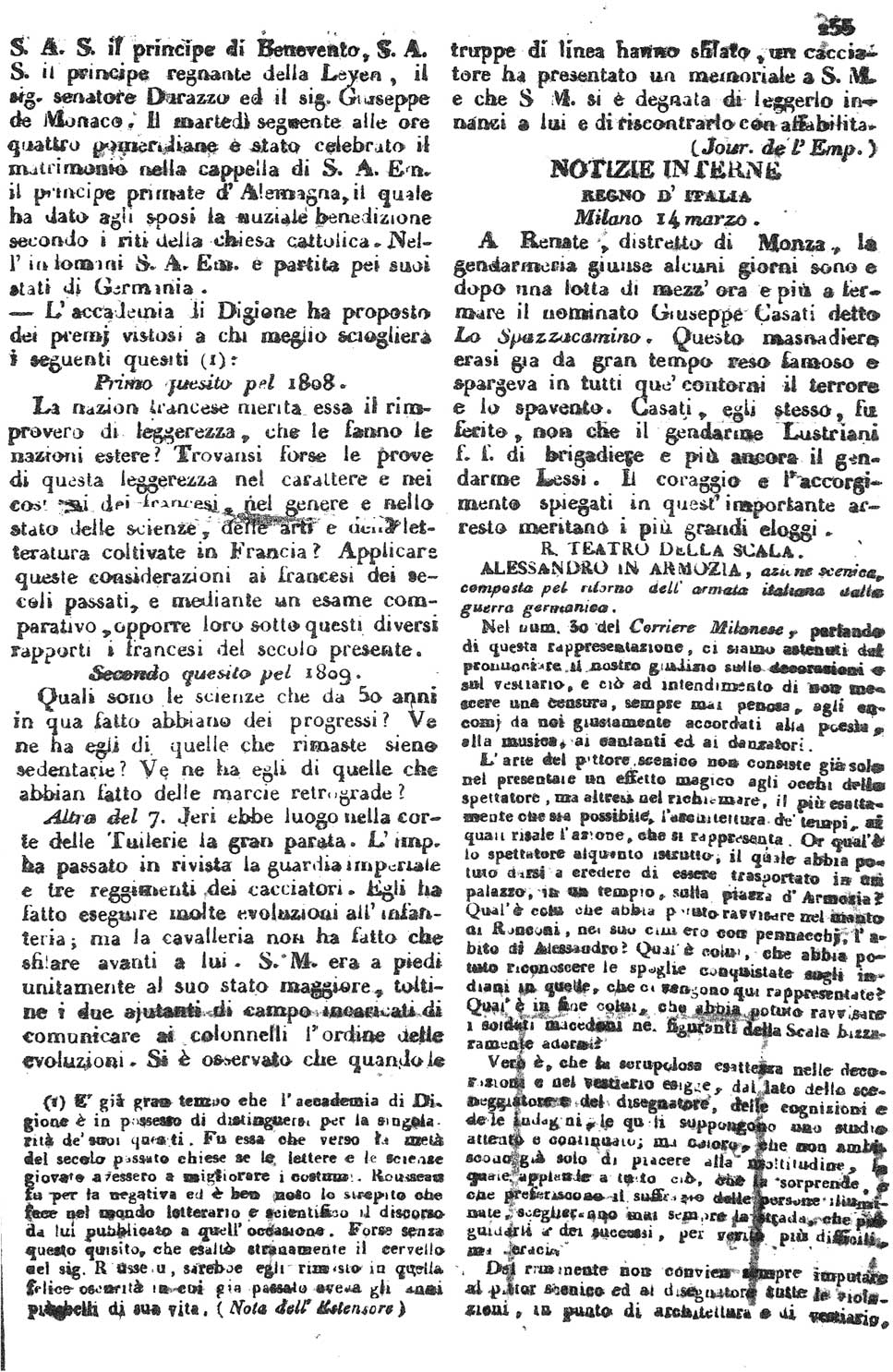
It was perhaps precisely on account of its uncompromising starkness that the model of Benincasa and of the Giornale italiano was quite influential, as we have seen. But soon enough this rigid arrangement found itself modified by the other papers. Within a few years, if opera criticism had all but disappeared from the Giornale italiano, the Corriere milanese and, in a different way, the Corriere delle dame had adopted a softer version of its visual arrangement. In the Corriere milanese, which makes for the more cogent comparison, opera reviews appeared under a heading with the name of the theatre as the final item of the section entitled ‘Notizie interne’, as a page from the issue dated 14 March 1808 shows (Fig. 5). In this light, it seems relevant that, according to historian Carlo Capra, the success of the Corriere milanese, whose sales figures overtook those of the Giornale italiano in the final years of the Napoleonic period, was due in part to the more substantial presence of city news in its pages: crime, court life, parties and theatre shows, including opera.
Il corriere milanese, 14 March 1808.

If in the Giornale italiano a barrier had been erected between the discourse of the city and that of opera, then the Corriere milanese and, in a different way, the Corriere delle dame operated a partial rapprochement between the two, keeping the theatre apart, but also opening a few of its doors and thus allowing more air to circulate. Perhaps the gap between the political and the aesthetic in the Giornale italiano was too wide to allow for the aesthetic to function as ‘a dream of reconciliation’ (Eagleton again) – a reconciliation between politics and art, but also, in another sense, between city discourse and opera discourse, and one that the two Corrieri were better at supporting.Footnote 42 Not by chance did the Corriere delle dame survive and even prosper after the return of the Austrians in 1814–15 (both the Corriere milanese and the Giornale italiano folded in 1815). And it seems equally significant that Francesco Pezzi, the editor of the Corriere milanese, took on the same role at the Gazzetta di Milano, the official paper of the new regime – a regime not that different from the Napoleonic one in its latter-day royal and imperial incarnation, after all. The Gazzetta di Milano, which began appearing on 1 January 1816, and whose layout looks exactly as that of the Giornale italiano, included from the beginning a section, headed ‘Spettacoli d’oggi’, which listed the shows being performed on the day in Milan’s theatres, but it took a little longer to publish opera and ballet reviews: only four appeared in its initial semester. Once it did, however, it showed almost the same dedication to this kind of item as its predecessor.Footnote 43 Clearly, the function performed by the aesthetic in modern society was too important for it to be ignored even by the most conservative paper in Milan.
Benincasa died in Milan in the same year of the birth of the Gazzetta di Milano. By then the city had lost its prominence as the capital of an actual state and had gone back to being just the capital of a region of the Habsburg Empire. But too much had changed in the previous two decades, and this relegation to second league in the political game did not bring with it a demotion in all the other aspects of urban life. Milan stayed at the top in various fields, including perhaps opera, and certainly the periodical press. Although an in-depth comparative perspective lies beyond the scope of this article, a few sample checks seem to suggest that the kind of opera criticism developed in Napoleonic Milan was not only a novelty for Italy, but it might have also influenced the style of reviews in other Italian cities – at the very least, elsewhere reviews evolved towards the Milanese model later on.Footnote 44 This makes sense, if we keep in mind Milan’s pre-eminent position both before and after 1814–15, albeit under changed political circumstances and in partially different terms.
Strong evidence comes from Venice, as I have said the former capital of the periodical press in Italy. The Venetian paper that devoted sustained attention to opera at the beginning of the nineteenth century (it was founded in 1802) was the Quotidiano veneto, which, as already mentioned, also boasted the highest circulation figures outside Milan at the 1811 census. This paper addressed opera more frequently than any of the Milanese papers, but up to and including 1803 did so in a fashion similar to that of the Corriere milanese in the same period. Here is the beginning of the review of a new opera at the Teatro La Fenice, the city’s most prominent, published on 16 May 1803:
On Saturday 14th the Most Noble Theatre La Fenice opened with the opera entitled Vonima e Mitridate, music by the late maestro Nasolini, into which, however, were inserted, in order to accommodate the singers’ wishes, a few pieces of music newly composed by maestro Gnecco, who distinguished himself as usual.Footnote 45
These seven lines are followed by thirty-eight on the singers. Over the next two years, however, the style and length of reviews would evolve towards that championed by the Giornale italiano in Milan: just like in the Corriere milanese, during 1804 and 1805 reports on opera in the Quotidiano veneto became significantly longer and increasingly work-centred, with specific attention devoted to libretto and score above and beyond their performance.
Evidence that this evolution was due in large part – although of course not exclusively – to the influence of the new Milanese paper is circumstantial but compelling. The compiler of the Quotidiano veneto, Antonio Caminer, doubtlessly read Benincasa’s articles with great attention: a lengthy report, published on 30 January 1804, on the production of Paisiello’s I zingari in fiera at La Scala is obviously modelled on Benincasa’s review mentioned above, for example. The strong impact of the Giornale italiano also emerges from two extraordinary gestures on Caminer’s part: direct and, as far as I can tell, almost unprecedented reference to the source of his report (‘v. Giorn. Ital.’, ‘see the Giornale italiano’, on 6 February 1804), and literal quotation of a few sentences (in a piece on the ballet Attila published on 20 March 1804).Footnote 46 In the light of such gestures, it seems highly unlikely that Caminer’s attention to opera as work to be subjected to critical scrutiny emerged independently from the example set by the Giornale italiano, even if at the time Venice was not part of the Italian Republic – it would become so in early 1806, by which time the Republic had turned into a Kingdom – and therefore Milan was not yet the political capital from which Venice depended. In any case, by the end of the Napoleonic period the Milanese model of opera criticism had caught on in all the major urban centres in the peninsula. This might have been beyond the most delirious of Benincasa’s hopes: the criticism that he so crucially contributed to promote might or might not have had an impact on actual performances (he evidently hoped it would), but it certainly had a crucial influence on how opera was discussed and conceptualised.
In my title I have characterised this kind of discourse, in which reporting on the operatic event was supplemented by critiquing and evaluating the operatic work, as ‘modern’. Far from implying a value judgement, I use this adjective in purely descriptive terms: this is the kind of operatic criticism recognised as familiar by anybody who has read opera reviews published throughout the nineteenth century and at least the first half of the twentieth. As I hope to have demonstrated, however, this criticism can be called ‘modern’ also because it first appeared in – and grew out of – the first modern Italian city, Milan, which provided the kind of political, social, cultural and ideological context in which its development was possible, and perhaps even necessary. The Milanese periodical press developed a model of partial separation between the discourse of opera and the discourse of the city that, while keeping the aesthetic and the socio-political apart, allowed the former to function as a potential substitute for the impossibility of direct intervention into the latter on the part of the vast majority of readers. This eminently modern predicament emerged first in Napoleonic Milan thanks to a combination of factors that made it the first modern Italian city, at least embryonically. That this model met with such success testifies both to the increased centrality of Milan in all matters cultural in early-nineteenth-century Italy and to the fundamental ideological function performed by modern operatic criticism in a country – or, perhaps better, a ‘geographical expression’, as Austrian chancellor Metternich famously and disparagingly called Italy – staggering in ungainly fashion towards modernity.
In this sense, it befits the nature and function of the aesthetic within modernity that not everything in Napoleonic Milan was caught up in the vortex of life in the modern city: to the regular reader of some of its periodicals, opera was among the few things that could be held steady, that could be ‘owned’ discursively. I wonder, then, whether the fantasy of opera’s relevance for political action – a fantasy that, as is well known, would play a fundamental role in the future of both Milan and Italy – might not find some of its roots in the pages of the city press in the first decade of the new century. If so, I would want to emphasise precisely its nature as a fantasy, born out of the impossibility not only of such action, but also of sustained critical reflection on the political. When the only object you feel you own discursively is art, and specifically opera, you are likely to delude yourself you can use it even where you cannot. It is also in this other, wider sense, then, that the hopes mentioned by Benincasa in that first article of January 1804 in the Giornale italiano could be considered those of a delirious person. Some might even want to suggest that delirious hopes are the very stuff of both modernity and opera.