INTRODUCTION
The Gobiidae is the largest family of marine fish in the world, and is the most speciose of all the teleostean suborders, with 210 genera and at least 1950 species (Nelson, Reference Nelson2006). There are 124 species in 33 genera reported for the Western Atlantic, and 58–62 species in 26 genera in the Gulf of Mexico (Larson & Murdy, Reference Larson, Murdy, Carpenter and Niem2001). Because of their small size and cryptic behaviour, few gobiids species have been reported from Mexican waters (Schmitter-Soto et al., Reference Schmitter-Soto, Vásquez-Yeomans, Aguilar-Perera, Curiel-Mondragón and Caballero-Vázquez2000; González-Gándara & Arias-González, Reference González-Gándara and Arias-González2001; González- Gándara, Reference González-Gándara2003; Taylor & Akins, Reference Taylor and Akins2007). In particular, species of the genus Bollmannia (in Jordan & Bollman, Reference Jordan and Bollman1890) are small cryptobenthonic fish that occur on mud or sand bottoms in 15–25 m depth, distributed in tropical marine habitats in the Indo-Pacific and Atlantic Oceans. This genus includes 15 American species, five of which are known from the western Atlantic: Bollmannia boqueronensis, B. communis, B. eigenmanni, B. jeannae and B. litura (Gobiidae.com). The known distribution for Bollmannia boqueronensis includes the United States, Puerto Rico, Cuba, Panamá, Venezuela, French Guyana and Brazil (Gbif.org; Fishbase.com; Obif; McEachran & Fechhelm, Reference McEachran and Fechhelm2005).
Two specimens of Bollmannia boqueronensis Evermann & Marsh, 1899 from the Alacranes Reef, off the north-east coast of the Yucatan Peninsula (Gulf of Mexico) are reported here. The present record extends the known distribution of this species westward and constitutes the first record from Mexican waters.
MATERIALS AND METHODS
Specimens
Two specimens of Bollmannia boqueronensis (one male and one female) were collected at 25 m depth in the Alacranes Reef Marine Park, by SCUBA diving during August 2009. Both specimens were collected using 10% diluted clove oil and a hand net during daytime in the same area (two independent holes of 10 cm in mud–sand).
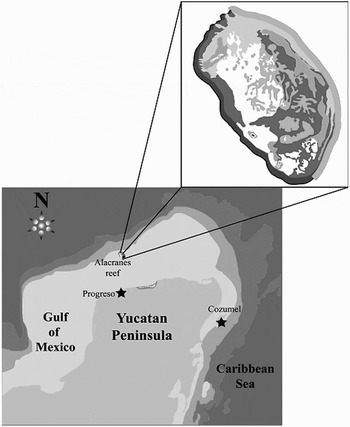
The Alacranes Reef is the most important reef structure in the southern Gulf of México and is located ~135 km north off Puerto Progreso (22°29′23″N 89°41′45″W). The Alacranes Reef presents an oval shape with a major axis north–north-west oriented along ~25 km and a minor axis of ~14 km (Figure 1).
Map showing location of the Alacranes Reef off northern Yucatan Peninsula,135 km north off Puerto Progreso (22°29′23″N 89°41′45″W).

A coral reef area of approximately 292 km2 arises from its base situated over the bottom at 52 m depth (Garduño-Andrade, Reference Garduño-Andrade1988; Rivas-Solís, Reference Rivas-Solís1990; Chávez et al., Reference Chávez, Tunnell, Whiters, Tunnell, Chávez, Withers and Eorle2007).
Morphometric and meristic measures
Among other characteristics, these gobies show a compressed body, head rounded; 1st dorsal fin with seven spines, often very elongated in both sexes; 2nd dorsal I, 11–15; anal I, 10–15; front margin of pelvic disc scalloped; large strongly oblique mouth; teeth in several rows; caudal fin long (30–50% of standard length) and strongly pointed; a few large scales on cheek, nape and operculum; scales large (23–28 rows along body), rough; 6–10 scales before dorsal fin; medium to large scales on base of pectoral fin (Bedenbaugh, Reference Bedenbaugh1988).
Both B. boqueronensis specimens were measured using a Vernier caliper following Miller (Reference Miller1988). Meristic abbreviations: A, anal fin; C, caudal fin; D1, D2, 1st and 2nd dorsal fins; P, pectoral fin; V, pelvic disc, were adopted. The description of body colour was based on live anaesthetized specimens. Both specimens were saved in the UMDI-Sisal fish taxonomic regional collection.
RESULTS
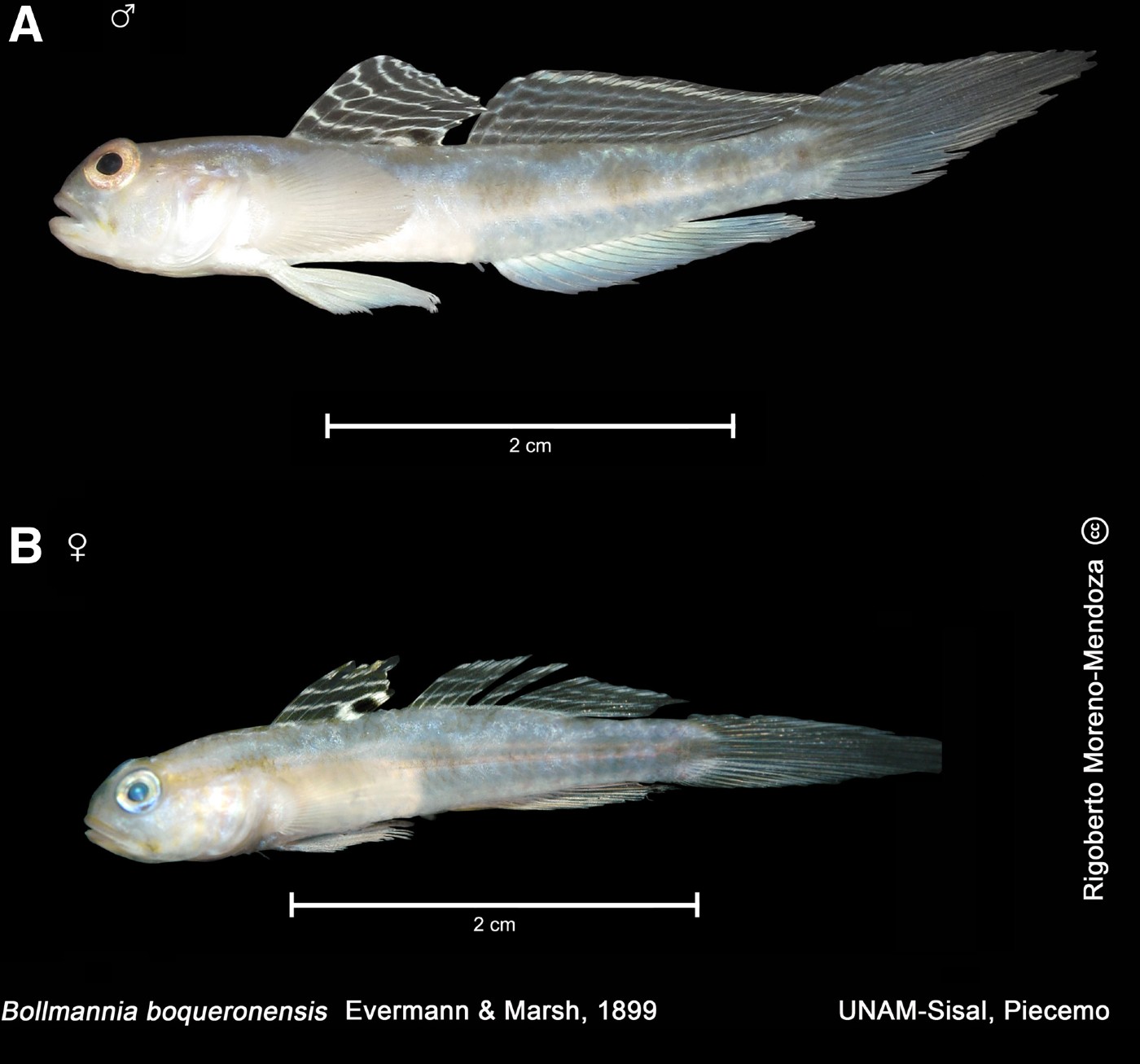
Both fresh specimens presented a light blue body with four brown blotches from the caudal peduncle to just before the pectoral fin. A brown line originates on the head above the eye and extended to just behind the pectoral fin origin. A second line originates in the middle of the eye and ends just at the pectoral fin origin. The 1st dorsal fin showed an ocellus at the base between the sixth and seventh spines; the 2nd dorsal fin presented a white border (Figure 2).
(A) Male and (B) female specimens of Bollmannia boqueronensis collected from the Alacranes Reef.
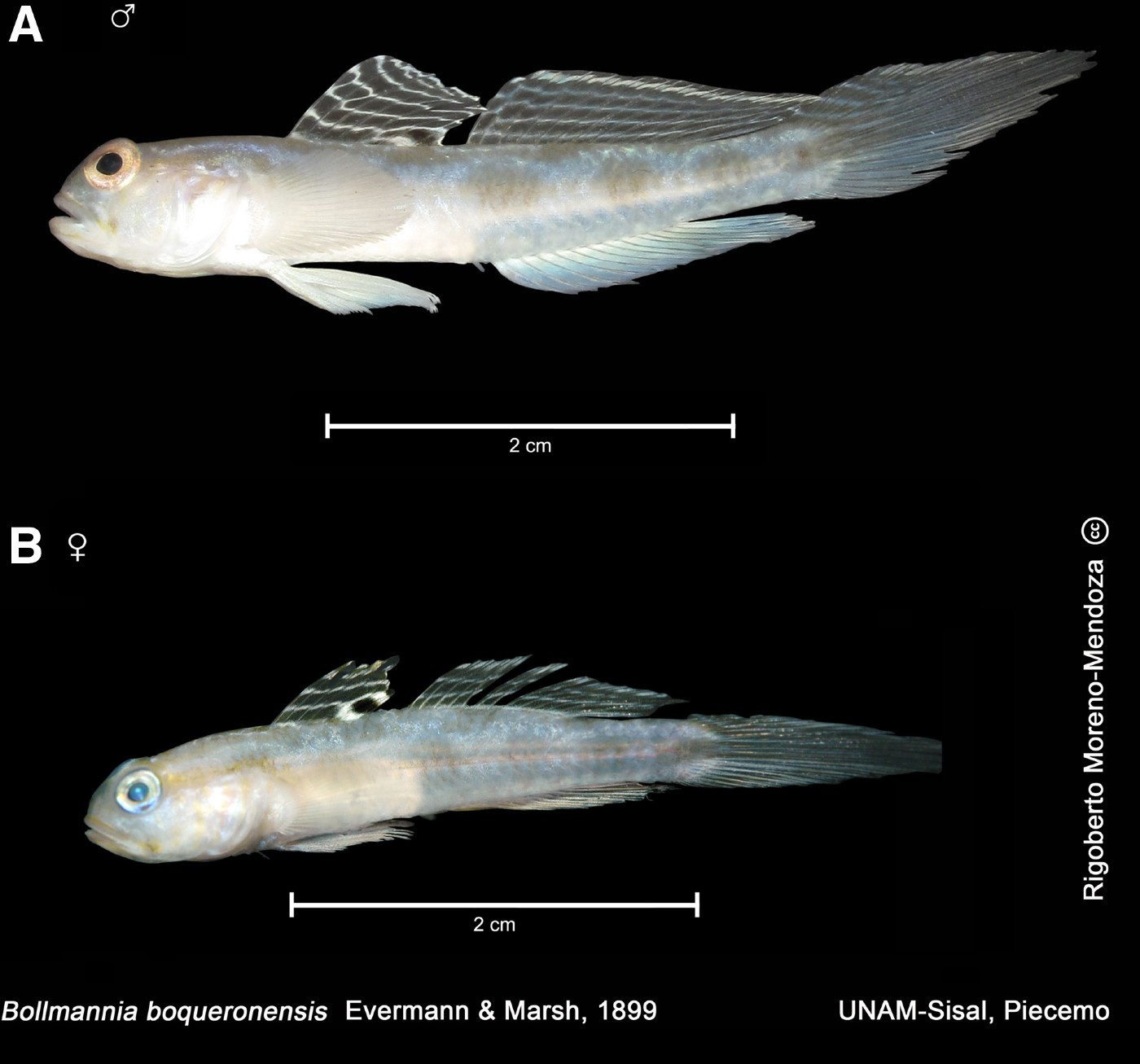
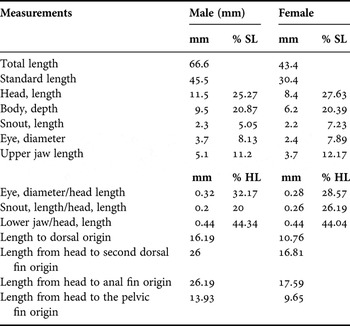
Both specimens (male and female) showed D1 VII, D2 I–13, A 14 (last ray divided to the base level), V 6, P 21. A cylindrical body, a blunt snout; large eyes and close together dorsally were observed. The origin of pectoral fins were under the posterior margin of the operculum. The caudal fin was lanceolated; mouth was terminal and moderately oblique with upper jaw extending to the posterior margin of pupil. Head was moderately elevated and convex and moderately compressed with a longitudinal row of scales along the lower margin of the cheek. Pelvic fins are joined by a membrane forming the typical disc present in the gobies. The male is distinguished by having well-developed urogenital papilla and dorsal fins 20% larger than those of the female (sexual dimorphism). Morphometric measurements for both specimens are given in Table 1. The male measured 66.6 mm total length (TL) and the female 43.4 mm TL, respectively (Table 1). The observed sizes were consistent with the maximum length (100 mm TL) reported for Bollmannia boqueronensis by Robins & Ray (Reference Robins and Ray1986).
Morphometric data from the two specimens of Bollmannia boqueronensis collected from the Alacranes Reef, southern Gulf of Mexico, off the north-west Yucatan Peninsula. Total and standard lengths are in mm; other measurements, in percentages of standard length (SL) and head length (HL).

DISCUSSION
Bollmannia boqueronensis was previously reported in the Campeche Bank by Sánchez-Gil et al. (Reference Sánchez-Gil, Yáñez-Arancibia and Amezcua-Linares1980) and Yáñez- Arancibia & Sánchez-Gil (Reference Yáñez-Arancibia and Sánchez-Gil1986). These studies, based on the same information and the same sampling event, however, are unreliable and thus of limited value for the following reasons: there is no mention of how many specimens were collected and at what depth; precise locality data are lacking; and there is no indication that voucher specimens were saved, making it difficult, if not impossible, to confirm such reports.
In addition, considering that the morphological differences between B. communis and B. boqueronensis are subtle (a radius of difference in the 2nd dorsal fin, presence of scales on cheeks), and B. communis is commonly reported on the Campeche Bank soft sediment bottoms, there is potential for misidentification of these species. There are 324 records of B. communis from the Gulf of Mexico. Of these records, 45 have no locality data, two could be considered as close-to-reef-systems, and the remaining 277 are from muddy areas, more than 2 km away from any reef habitat (Global Biodiversity Information Facility Data Portal, accessed September 2010). On the other hand, the same data source yields only 31 reports for B. boqueronensis, 26 of which are on or close to reef areas and only five are reported away from reef areas. This suggests a clearly different habitat for each species, and since the previous reports of B. boqueronensis from Mexico were specimens from muddy substrates far from any reef system, chances are that the specimens collected by Sánchez-Gil et al. (Reference Sánchez-Gil, Yáñez-Arancibia and Amezcua-Linares1980) and Yáñez-Arancibia & Sánchez-Gil (Reference Yáñez-Arancibia and Sánchez-Gil1986) were misidentified.
Although both previous reports of this species from the Campeche Bank are perhaps questionable, the occurrence of B. boqueronensis off the north-east coast of the Yucatan Peninsula (Gulf of Mexico) fills in the distribution gap existing between the Atlantic and the Caribbean records of the species. In fact, the species distribution includes localities in the Gulf of Mexico (Dry Tortugas on Florida) Caribbean Sea off Cuba, Puerto Rico, Panama, French Guyana and Brazil (Martin & Patus, Reference Martin and Patus1984; Robins & Ray, Reference Robins and Ray1986; Cervigón, Reference Cervigón1994; Smith, Reference Smith1997). That aside, B. boqueronensis is a very uncommon species in the Alacranes Reef (a relatively well sampled area) probably due to its cryptic behaviour with specimens living in deep burrows. However, the presence of this species was expected, because the Alacranes Reef is in an intermediate point between the localities where its presence was already reported. In addition, B. boqueronensis could also be distributed in other reef systems such as the Campeche Bank and the Veracruz Reef System. Furthermore, the capture of the specimens over soft mud is consistent with the reported preferential habitat for this goby (Fishbase.org).
Finally, the presence of B. boqueronensis in the Alacranes Reef raises questions on whether the species was present during the end of the 1990s but unreported by González- Salas (Reference González-Salas1999) and González-Gándara & Arias-González (Reference González-Gándara and Arias-González2001), or if it has arrived recently.
The potential dispersion of larvae between geographically proximal populations can be assessed with knowledge on oceanographic currents and pelagic larval duration (PLD) in fish species. Some species of gobies (e.g. genus Elacatinus) have a 21-day PLD, and could potentially disperse over some hundreds of kilometres. Current patterns in the Caribbean were thoroughly studied; typical current speeds average 1 to 2 km h−1 (Cowen et al., Reference Cowen, Lwiza, Sponaugle, Paris and Olson2000). Assuming passive dispersal and a conservatively estimated current speed of 1 km h−1, an individual with a 21-day PLD could potentially disperse for more than 500 km per generation (corresponding to 1 year) as reported in Taylor & Hellberg (Reference Taylor and Hellberg2003). Taking into account that the Caribbean–Yucatan–Loop currents flow from the Caribbean Sea, through the Yucatan Channel into the Gulf of Mexico (Ochoa et al., Reference Ochoa, Sheinbaum, Badan, Candela and Wilson2001), it is possible that B. boqueronensis dispersed from the Caribbean. Dispersal, however, might be influenced by factors other than PLD. Ecological requirements or behavioural attributes could cause larvae to develop near shore, rather than disperse (Riginos & Victor, Reference Riginos and Victor2001). The pelagic larvae of gobies are typically found over or close to reefs and not in open water (Leis, Reference Leis and Sale1991), suggesting limited dispersal and that the species had been present, but unreported.
ACKNOWLEDGEMENTS
This study was possible through financial support from research projects PAPIME-PE207210 and SEMARNAT- CONACyT108285, UNAM, Mexico. The field work was possible due to the help of Fernando Mex, ‘Toca’ and the other members of the 2009 Alacranes Reef Biodiversity Expedition. Laboratory space and instruments were provided by Maribel Badillo. We thank Luke Tornabene and James Van-Tassel for independent confirmation of fish identification.