Bruno Maderna's music arrived at the Darmstadt Summer Courses one year before he did. During the spring and summer of 1949, Maderna had been in contact with Darmstadt's director, Wolfgang Steinecke, about the possibility of performing one of his compositions at that year's courses. While Maderna's name appeared on the list of participants, and Steinecke had arranged to provide lodging and travel money, he sent a telegram in July or August informing Steinecke that he could not attend.Footnote 1 Instead, his Fantasia e fuga per due pianoforti was performed in his absence.Footnote 2
A year later, in 1950, Maderna arrived in person, together with his friend and compatriot Luigi Nono. The two had learned of the existence of the summer courses from the conductor Hermann Scherchen, who taught seminars in Venice during the summer of 1948. Scherchen also seems to have introduced Maderna to the works of the Second Viennese School.Footnote 3 Pierre Boulez, who also arrived in Darmstadt in 1950, had similarly learned serial techniques studying with René Leibowitz in Paris. And so while Darmstadt became known as the place where serialism would be reborn, it did so not so much because of institutional bias, but because of the shared interests of the students. The arrival of two Italians and a Frenchman effectively turned what had been an almost exclusively German affair into an international – or at least European – event.
The courses themselves had begun only a few years earlier in 1946 with the support of the American reconstruction effort. They took place every summer in the Schloß Kranichstein, just outside of the city of Darmstadt, and were also known as the Kranichstein Summer Courses. Several histories of Darmstadt point to the peculiar musical development that emerged during the courses, a development that was perhaps the most visible musical example of what has been called, in other contexts, the Stunde Null (or ‘zero hour’) phenomenon.Footnote 4 This term refers specifically to the German defeat on 8 May 1945, but has come to stand for a broader desire to overcome history and start again. The realisation that Germans were responsible for the deaths of millions of Jews had obviously left the German musical tradition in a perilous position. The government of the Third Reich, carefully controlling its cultural assets, had held up German music as an emblem of German superiority and, in the process, banned so-called Jewish music together with other forms of modernist composition.Footnote 5 Musicians and composers who stayed in Germany were thus suspected of collaboration, and traditional music came to be seen as tainted. Claims like those of conductor Wilhelm Furtwängler, who justified his own dealings with the Nazi authorities by insisting on a fundamental separation between music and politics, seemed untenable.Footnote 6 Younger musicians had no other choice than to see Germany's defeat as an opportunity to reinvent the idea of the country's music.
Within this context, the American occupying government sought to give Germans the opportunity to start again.Footnote 7 The war had devastated the country's musical infrastructure, and the Americans saw an opportunity to promote American music within an occupied Germany.Footnote 8 Many recent publications on Darmstadt are eager to emphasise the role of the American military at this early stage. One such claim is promoted by Frances Stonor Saunders, who calls the courses a ‘bold initiative of the American military government’.Footnote 9 And yet the historical evidence shows that the Americans did little more than provide funding and material support – affixing stamps to concert programmes and transporting a recovered Steinway to the site of the courses.Footnote 10 This, in a way, was enough. If the primary goal of fostering cultural activity was propaganda, to show the superiority of democratic societies in contrast to communist East Germany, then the actual content of the activity hardly mattered. What is surprising is that, with this minimal amount of support, the Darmstadt summer courses quickly became the most visible site for the promotion of modern music in the new Germany.
In the years that followed, Darmstadt would become the spiritual home of a peculiar form of post-war musical modernism. Luigi Nono would later name it the ‘Darmstadt School’ in his lecture on the development of serial technique in 1957 – thus promoting conscious allegiance with the Second Viennese School.Footnote 11 Even though such an appellation emphasised the connections with pre-war practice, by the time Nono gave his lecture the influence of serialism, and especially so-called total serialism, was already waning. In its place had emerged an active search for the next musical trend; for many, this would be John Cage's indeterminacy. Rather than coalescing around a specific movement, however, Darmstadt seemed to fragment, with each composer pursuing and promoting an individual style. There are, after all, more differences than similarities in the works of Darmstadt's key protagonists: Boulez, Cage, Nono, Maderna, Karlheinz Stockhausen, Luciano Berio, Györgi Ligeti and Mauricio Kagel. What united the various composers at Darmstadt during these years was not any single technical approach, but shared interest in redefining what music was. This is why, as Amy Beal describes, John Cage was able to find support in Germany that was denied him on the other side of the Atlantic; Darmstadt offered a context where his music could be debated, if not universally accepted.Footnote 12
By the early 1960s, partly because of this uncertainty of purpose, the sense that Darmstadt was more than just a summer festival seemed to dissolve. Maderna would later remember that Darmstadt lasted no more than ten or fifteen years (until the late 1950s or early 1960s) as an ‘ideal meeting point for the most diverse musicians’ before the ‘power-struggle began’.Footnote 13 Composer Konrad Boehmer identified one particular date as the moment when everything fell apart. A concert, not at Darmstadt but in Cologne, in 1960, featured premieres by many of the most important composers of the cohort, including Boulez, Stockhausen, Kagel and Ligeti. Stockhausen was reportedly furious that the applause for Kagel's work was longer than that of his own, and he had used a stopwatch to prove it: ‘Composers who had been close friends the minute before, became deadly enemies the minute later’.Footnote 14 The search for something new had become an attempt by each composer to assert supremacy.
But 1950 was pivotal for another reason: Theodor W. Adorno was engaged as the instructor of music criticism.Footnote 15 He had returned to Europe in 1949 from exile in America, stopping briefly in Paris where he met Leibowitz, who recommended him to Steinecke. Steinecke responded enthusiastically and extended Adorno an immediate invitation.Footnote 16 Like Maderna, his work – in this case The Philosophy of New Music – predated his actual participation at the summer courses by one year. It was published in 1949 and was widely read and distributed among the participants during the next several years. According to the conductor Michael Gielen, the book was read by all ‘interested parties’.Footnote 17
In the book, Adorno engages the work of Schoenberg and Igor Stravinsky by positing them as dialectical opposites. The work, ambitiously conceived, attempts to make aesthetic judgments by looking ‘the unique questions and antagonisms of the individual work straight in the eye without having any general theory of music or any music history’.Footnote 18 In other words, Adorno extrapolates musical philosophies from the two composers in question not by examining statements, intents or even historical circumstances, but by interpreting implications within by the works themselves. The approach could be likened to the ‘new criticism’ movement then emerging in the United States, an approach which suggested that an author's intentions and the historical circumstances surrounding a work of literature's creation were irrelevant to its interpretation. At the close of a seminal work on the topic, W.K. Wimsatt and M.C. Beardsley suggested that any analysis of a poem, any conjecture, must be found in the work itself, not, as in their hypothesised example, asked of the author. Whether the author could provide an answer is irrelevant, they say, because ‘critical inquiries, unlike bets, are not settled in this way’: there is no way of establishing whether the author is or is not the final source on the meaning of the work.Footnote 19 As it happens, though, Schoenberg did respond to Adorno's book and was none too impressed by his conclusions, stating on multiple occasions that Adorno had not properly understood his music. To that, of course, Adorno could have replied that it was Schoenberg who had failed to understand.
Most scholarship on Darmstadt has missed the shockwave caused by Adorno's Philosophy of New Music, perhaps because its impact was only tangentially related to the content of the book. Commentators seeking to determine the extent of Adorno's influence at Darmstadt tend to point to this or that interpretation – whether, for example, composers ignored the critique of late Webern and read those passages, instead, as a vindication of serial techniques.Footnote 20 Gianmario Borio offers a nuanced response, pointing out that commentators often compare Adorno's philosophy to the work of composers ‘as if they were entities of the same kind’, disregarding the ‘difference between philosophical aesthetics and musical poetics’. The focus of attention, he argues, should be on ‘the philosophical horizon outlined by the technical structures of their works’.Footnote 21 And yet, one might ask, if the impact is to be felt in the ‘philosophical horizon’ of the works, how did this horizon emerge as a component of the music itself? Borio overlooks or deems unremarkable the fundamental shift that had to happen for Adorno's influence to be felt. The philosophical horizon, after Adorno, was part of the composition.
The reception of The Philosophy of New Music at Darmstadt thus took a predictable turn in the early 1950s. Finding the potential for broader meanings, many composers, particularly the younger generation, sought to participate in the criticism of their own works. This can be seen in the large number of tracts written by composers – tracts that seek to legitimate the works in question by providing their creator's justification. Darmstadt offered a context where music was presented simultaneously with its analysis and discussion, in the form of composers' workshops and lectures, which occurred in addition to the seminars in music criticism. To put this another way, the music was written to conform to a philosophy, instead of, as in Schoenberg's and Stravinsky's cases, philosophy being extrapolated after the fact, often to the annoyance of the composers themselves. Composers like Boulez, Nono and Stockhausen began to think about the philosophical implications of their works: began, in effect, to conceive those works in light of their own musical philosophies. Such an orientation – I would like to call it a ‘philosophical turn’ – allowed composers to dictate the terms by which their works would be judged, and also allowed them to turn further away from a traditional mode of learning in which musical practice was passed down from master to apprentice. They were no longer merely learning the craft of composition, but instead learning to think about music as philosophy. The musical developments at Darmstadt – in particular serialism and John Cage's chance and indeterminacy – lent themselves to this approach precisely because they resulted from the active re-thinking of the means of composition.
Amid this new ‘philosophical music’, Maderna seems to be the composer who does not quite fit in. Not only did he largely abstain from writing theoretical texts, he seemed to reject the value of such philosophising altogether: ‘In short, I am firmly of the opinion that musicians should do rather than say: Stockhausen should avoid discourses on Aesthetics, and Nono those on Sociology, which is a highly complex subject, and act as musicians’.Footnote 22 However, and as we will see, Maderna's own musical philosophy – one that was only arrived at through the practical activity of composition – is revealed in a close reading of one key work, his 1969 radio drama, Ritratto di Erasmo.
Portrait of Erasmus
Maderna was, more than anyone except Steinecke, committed to the project of Darmstadt, and to the value of musical discourse in spite of – or perhaps because of – the fact that he largely abstained from the polemics. He was a constant presence at the courses from his arrival in 1950 until his death in 1973. He permanently relocated to Darmstadt in 1963 and is buried with his wife in the cemetery on the Nieder-Rahmstädter Straße, just a few miles from the Internationale Musikinstitut. At the courses, he was active both as a composer and as a conductor, premiering and promoting new works by most of his contemporaries across the spectrum of musical ideologies. Unlike many colleagues such as Nono, Stockhausen and Boulez, Maderna did not leave many obvious clues to his compositional philosophy. The only supporting documents that remain are a few interviews, lectures and articles. Moreover, his compositional output – at least on the surface – lacks a coherent style. This, coupled with the shortage of supporting materials, might indicate that Maderna did not have a compositional philosophy, or that it is at the least irretrievable. However, Ritratto di Erasmo – into which, as Massimo Mila remarked, ‘Maderna poured many of his most deeply held beliefs and his humanistic faith in reason and life’ – serves as a key in coming to terms with the philosophical underpinnings of his eclecticism.Footnote 23
Ritratto di Erasmo could be seen as a companion piece to his earlier collaboration with Luciano Berio and writer Roberto Leydi, Ritratto di Città. That work was completed in a mere two weeks in 1954, using equipment borrowed from a RAI (Radiotelevisione italiana) studio in Turin, and was intended to show the possibilities of the yet-to-be-founded Milan electronic studio. Berio described it as ‘a rather “Milanese” work, with some beautiful, rather surreal descriptions of a city which is very present, and active, but also secret and mysterious’.Footnote 24 The work was sufficient to convince the RAI to establish the studios, which would become one of the primary centres for the production of electronic music.
Unlike Ritratto di Città, however, Ritratto di Erasmo was not a collaborative composition, and it was conceived on a much grander scale. Maderna wrote the text (or assembled it from a variety of pre-existing sources) and music (some arrangements of Renaissance pieces, some of his previous orchestral music and some tape music), directed the actors and assembled the audio.Footnote 25 The work itself is relatively unknown. It was commissioned by the RAI to be part of the 1969 edition of Premio Italia, devoted to musical works with texts.Footnote 26 However, it was only broadcast once, in 1982, almost ten years after Maderna's death.Footnote 27 After 40 years, it has only just had its first commercial release, with a detailed commentary by Maurizio Romito. In addition to a recent dissertation by Adriana Anastasia, I know of only two other articles that deal with the work in any detail.Footnote 28
Like Glenn Gould's contemporaneous radio documentary from 1967, The Idea of North, Maderna's work hovers between radio drama, radio documentary and electronic music. Musical effects of repetition and contrapuntal treatment of texts feature in both works and distinguish them from more standard radio fare; but the reliance on texts for dramatic development moves them toward literature. Both works fit under the German genre of Hörspiel (‘audio play’), which, in Europe, has been the site of crossover endeavours for electronic musicians using a literary approach and vice versa. Maderna, for his part, called it simply a radiodramma, while Anastasia calls it an opera radiofonica.
Joachim Noller posed the reasonable question of what Maderna's motivation might have been in choosing Erasmus as a subject. His answer is that interest in music from the sixteenth century probably led the composer to the political and historical environment of that music.Footnote 29 Romito has recently discovered that Maderna was invited to participate in an event in Rotterdam celebrating Erasmus in 1967, which would be cancelled a year later.Footnote 30 It is likely, however, that preparations for the event may have sparked his interest in the Reformation, and that he may have even begun thinking about his contribution. It may also be possible – within the context of Darmstadt – to draw some conclusions about the appeal Erasmus may have held for Maderna in the first place: in particular to point to an allegorical component of Maderna's understanding of Erasmus as a figure opposed to the dogma of his contemporaries. While it seems unlikely that Maderna composed Ritratto di Erasmo with an overt allegorical programme in mind, interpreting the work in this way will allow us to discover a compositional philosophy that has previously remained hidden.
The narrative and action of the work centre on the Protestant Reformation, which Ritratto describes as the ‘defining moment in the history of the Christian church’.Footnote 31 Erasmus occupied a pivotal position in the Reformation, in that he refused to subscribe to Luther's radical stance vis-à-vis the Catholic church, while simultaneously advocating reform.Footnote 32 Hence, he found himself the subject of attacks from all sides. Moreover, in Maderna's formulation it is Erasmus the humanist – and humanism more generally – that are caught up in this controversy. Humanists, according to Erasmus, as opposed to those who took sides in the Reformation, promote tolerance and freedom.
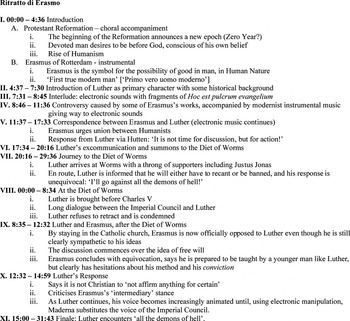
Ritratto opens with three alternating narrators setting the historical stage, suggesting that the turn of the sixteenth century represented a new epoch. While, like Darmstadt, that epoch may have appeared to be a radical ‘starting over’ at the time, it had been prepared by a long historical evolution. The Reformation began in the context of the population's ever-expanding sense of itself as autonomous. It became evident that the Catholic Church was also subject to historical development, and could no longer assert itself as the sole power over people's lives. Humanism placed man as ‘the subject of a freedom in perpetual expansion’.Footnote 33 As the concept of Humanism is introduced, a male chorus sings a fragment from a fifteenth-century vocal melody, Hoc est pulcrum evangelium.Footnote 34
In the next section (part IB of the formal scheme included at the end of this article), Maderna proposes that ‘The perfect champion of this humanism was Erasmus of Rotterdam’. The accompaniment changes to an instrumental version of Francesco Landini's Gran piant'agli occhi.Footnote 35 Maderna adds subtle reverberation to the appreciation of Erasmus that follows, setting it apart from the text that preceded it: ‘In his message there is something that exceeds the classical spirit and the principles of the Bible’.Footnote 36 In Maderna's estimation, Erasmus's insistence on tolerance and the goodness of human nature, ‘announced a new epoch, an epoch nearer to our own’.Footnote 37 His ideas would remain concealed, like a ‘subterranean river’, finally reaching the surface in the eighteenth century. The section ends with the assertion that Erasmus was the ‘first, true, modern man’.Footnote 38 Rendered in Italian, that phrase, ‘primo, vero, uomo moderno’ transitions perfectly to the rhythm of Giovanni Gabrieli's Canzone XVI that opens and is played in its entirety in the next section, performed by two oboes and two bassoons.Footnote 39
This section (II) introduces the second major character in Maderna's Hörspiel, Martin Luther. In contrast to the treatment of Erasmus, Luther is presented in more measured tones. The narrator describes the moment when Luther thrust himself into controversy by submitting a series of critiques to the bishop of Mainz protesting the sale of ‘indulgences’. His submission was made within the confines of the Catholic Church, on what he thought were sound biblical grounds, but would resonate widely and create considerable controversy.Footnote 40
The first indication that Ritratto di Erasmo will not be a straightforward historical exposition comes in the transition that follows (III). After the Canzone ends, incongruous low electronic sounds begin, reminiscent of the ‘subterranean river’ mentioned in the first section. These sounds are then coupled and partially obscured by a reprise of Hoc est pulcrum evangelium, now layered polyphonically.Footnote 41 These sounds diminish, but continue during the subsequent presentation of the text. The next section (IV) returns to Erasmus and describes the controversy created by some of his publications. Erasmus responded to his critics by modestly suggesting his works were merely practical explorations of the text, and that a true interpretation of the bible could only occur after technical work like his had been accomplished.
Section V begins with the statement that Erasmus and Luther never met in person, but maintained an epistolary relationship. This begins the process whereby the narrator recedes in favour of the principal characters speaking for themselves through letters and other writings. In the first letter, from Erasmus to Filippo Melantone, a friend of both men, Erasmus urges, ‘All of the dissensions between the humanists are fatal. We must act with skill, and not get lost in controversies that only cause other controversies, but insist on highlighting the fecundity of the new culture. Luther makes correct observations, but perhaps with too much freedom and without enough discretion.’Footnote 42 A response delivered by Ulrich von Hutten defined Luther's position, calling for outright revolt against the Church: ‘It is not time for discussion, but for action!’Footnote 43 The accompaniment in this section moves between electronic sounds, processed fragments of choral works and modernist instrumental music.
The next two sections (VI and VII) recount Luther's summons and journey to the Diet of Worms in 1521, where emissaries of Emperor Charles V would judge his religious writings. En route, Luther is informed that he will have either to recant or be banned. His response is unequivocal: ‘I'll go against all the demons of hell!’Footnote 44 After a long conversation between the Imperial Counsil and Luther (VIII), he is instructed to deliver a retraction of his writings. Luther refuses and is condemned. During this exchange, the Imperial Counsil becomes increasingly animated and angry, ending by addressing Luther, ‘Enough with your conscience! Do you presume, oh Martin, to be the only one who is right? And the sacred and holy council, with so many lords and wise bishops, would therefore always be wrong?’Footnote 45
The two sections that follow (IX and X) relax the tension built at the end of the encounter at Worms and form a transition to the final section. Erasmus and Luther continue their discussions in the form of two books published on the topic of free will, even though now Erasmus, by remaining within the Catholic Church, is officially opposed to Luther. The title of Erasmus's book, De libero arbitrio diatribe sive collatio, was – according to Maderna – intended to display ‘critical research’ rather than a ‘dogmatic affirmation’.Footnote 46 Erasmus concedes, however, that he is willing to be instructed by a younger man, to maintain discussion. Luther's response (X) is uncompromising. Rebuilding the tension, Maderna accompanies this penultimate section with low drones and layers of choral fragments. Luther tells Erasmus that ‘it is not Christian to say: I do not want to affirm anything for certain’.Footnote 47 A Christian, Luther says, must be sure of ‘his doctrine’ and ‘his cause’.
Something remarkable happens during the course of this last statement. It coincides with a deep, ominous organ pedal, which seems to signal the work's climax. As the passage progresses and Luther's argument becomes more animated, Maderna slowly manipulates the speed of the recording, gradually raising the tone of the actor's voice. Once Luther's voice is high enough, it moves seamlessly to the final section, which begins with the words of John Calvin, read by the same actor who has earlier played the Imperial Counsil. The original manuscript included a line that was cut from the recording, with the instruction that it be read ‘brutally … in a metallic, robot-like voice’: LA VOCE DI CALVINO.Footnote 48 In the final version, in which this instruction is absent, Luther's text simply becomes that of Calvin.
What follows, and continues through the final section, is a series of quotations from Calvin, which emphasise man's lack of free will and bondage to sin. Whereas Erasmus had embraced a broad humanism, placing man at the centre of his destiny, Calvin's doctrine of predestination had effectively ended man's claim to control his own fate. The implications of Maderna's manipulation of Luther's voice and substitution of Calvin are clear: in opposing free will, Luther becomes Calvin, whereas Calvin stands for a renewed oppression of the human spirit. Thus Ritratto di Erasmo enacts a principle rather like George Orwell's Animal Farm: those who attempt to exchange one dogma for another only succeed in changing the actors.
For most of Ritratto, music plays an accompanying role. The final section, however, accompanies the texts with a rich electro-acoustic texture. The words, which until this point have been presented simply and conventionally, are now layered polyphonically, repeated and subjected to electronic processing. One group of texts for this section is a set of fragments from Calvin's Institutes of the Christian Religion. These are presented at first over the organ pedal – or rather, a low organ sound that moves slowly between a few pitches and serves as a pedal point – and fragments of choral works. Shortly thereafter, a second group of texts enters, composed of descriptions of various demons from Dictionnaire infernal, first published by Jacques Collin de Plancy in 1818, and Dictionnaire du diable et de la démonologie by Julien Tondriau and Roland Villeneuve.Footnote 49
The nineteen descriptions of the demons all follow a predictable format. The name is read in a voice subjected to extreme processing such that it less sounds human than mechanical or demonic. In most cases, the description briefly gives the demon's title, the number of infernal legions it commands and its general appearance. Some descriptions also list any special powers possessed by the demon. The tenth demon in Maderna's work, Amon, may stand as an example for the rest: ‘Amon? – Marquis of Hell, commands forty infernal legions. He has the head of a wolf that vomits flames and the tail of a serpent. He sometimes appears with the head of an owl and a human body. He knows the past and the future.’Footnote 50 The other descriptions contain more or less information, but follow roughly the same format. In a few cases, Maderna inserts humorous asides, as in the description for Alocer: because that devil rides a horse, the speaker announces, ‘I would have loved to have a pony, but no one ever gave me one’.Footnote 51 There is no single voice for the demons; a collection of actors – including one voice that sounds rather like Maderna himself – reads the text, often repeating the same lines in quick succession, and often overlapping. The accompanying music moves quickly between an eclectic set of fragments: the organ pedal, choral fragments, electronic sounds and modernist orchestral music.
Because of these features and because of the constant repetition of related phrases like ‘commanda 40 legioni infernali’, the final section has something of the character of a Totentanz. The composition ends with the narrator of Calvin reaching a peak, almost screaming the final lines: ‘Let no man … flatter himself; of himself he is Satan. His blessing comes from God alone. For what do you have of your own but sin?’ and ‘Remove from yourself sin which is your own; for righteousness is of God.’Footnote 52 These last lines are then repeated several times during the final six descriptions of demons. The last of the demons is ‘Satana’. During the course of the description the various voices, which had been dedicated to reading the descriptions, finally come together to read the final line in unison, in the form of an incantation: ‘His names, his attributes, the shape of his appearances, everything about him is infinite, like the infinitude of the non-creation he represents, as opposed to the eternal and infinite continuity of creation.’Footnote 53
Ritratto – whose protagonist, Erasmus, has long since left the scene – ends with a series of bells ringing over an organ feebly rendering the melody from a two-voice organum.Footnote 54 Romito interprets this final return to music as a sign of hope, with the bells representing liberation from the demons and the music bringing ‘the listener back to this world of ours’.Footnote 55 But perhaps there is room for a somewhat different reading. Amid the swirling Totentanz, where Luther/Calvin and the demons have become almost indistinguishable, the bells and music become a final reminder of what has been lost. The cacophony of Luther's revolution had drowned out the voice of Erasmus; he emerges in the context of Ritratto as a missed opportunity for humanity.
The ‘Darmstadt School’, which has always been positioned as a radical break from the past, followed a similar trajectory from discourse to heated polemics to eventual disintegration.Footnote 56 The first such polemic came in 1952, with Pierre Boulez's provocative essay ‘Schoenberg is Dead’.Footnote 57 In this article, Boulez reproached Schoenberg for not drawing out the full consequences of his turn to twelve-tone composition. He criticised Schoenberg's discoveries for having been ‘morphological’ – merely developments of older ideas rather than anything revolutionary. But for all the hyperbole and dogma, Boulez did not in fact call for any particular new approach to serialism. The suggestions for expanding the serial method to other parameters were all framed hypothetically.Footnote 58 Boulez simply requested that composers should think through the logic of their compositional choices – should approach the act of composition philosophically. This is precisely what Boulez believed that Schoenberg had neglected. He did not accuse Schoenberg of failing to adhere to new principles, but of failing to adhere to his own. This has not, of course, stopped the provocative title from being read repeatedly as a personal attack on Schoenberg.
Darmstadt of the ‘philosophical turn’ suggested a form of music founded on discourse: music that could be appreciated as much on the strength of its ideas as its sound. And yet, the new methods and self-critical approach did not seem to bring about the utopian vision that many at Darmstadt expected, but rather led to new forms of musical oppression. Even though serialism was never as dominant as has often been portrayed, Adorno responded to the music of the younger generation in 1955, with his essay ‘The Aging of New Music’.Footnote 59 Here Adorno attacked rigid manifestations of serialism and Boulez's critique of Schoenberg. He defended Schoenberg, saying that his conservatism in preserving many traditional aspects of composition while using the twelve-tone system ‘is not attributable to a lack of consistency, but to his fear that composition would otherwise be sacrificed to the prefabrication of the material’.Footnote 60 More recent works, according to Adorno, relinquished compositional choice, or perhaps ‘free will’, to an external system. In a desire to be free of the weight of the German tradition the Darmstadt composers, in Adorno's estimation, had sought refuge in an even stricter oppression. He thought that Boulez and his followers had allowed music to become a mere epiphenomenon to an abstract philosophy.
In his 1961 lecture at Darmstadt, ‘Vers une musique informelle’ (published in 1962), Adorno makes his own case for something like philosophical music, and seems to traverse the philosophical turn in reverse.Footnote 61 The French title, Adorno said, was to be understood ‘as a small token of gratitude towards the nation for whom the tradition of the avant-garde is synonymous with the courage to produce manifestos’.Footnote 62 However, it was clearly also intended to mock Boulez, and to situate his ‘Schoenberg is Dead’ historically as just one of many such polemics, rather than as something truly novel. Instead of critiquing existing works, Adorno here turned to prescription, outlining an idealised working method for new composition. While the essay represents a dramatic shift in approach, Adorno's aesthetic values changed very little between the Philosophy of New Music and ‘Vers une musique informelle’. The primary critique in both, sustained through ‘The Aging of New Music’, was against heteronymous music. As the title suggests, Adorno imagined a music free of predefined ‘forms’, in which the form and content were fused in such a way that the work would be preceded by an idea of the work. The turn to prescription, however, placed Adorno and, indeed, all music that has autonomy as its goal, in a delicate position.
In practice Adorno cannot suggest anything as a model. Even Berg's or Schoenberg's early non-tonal works, which Adorno views as examples of informal music, could be no guide for new works. To use them would be to violate the primary rule, to compose without pre-existing forms. He accepts that music has become philosophical, but nevertheless clings to the idea that the particular philosophy must be immanent to the work in question. His suggestions instead advocate a form of nominalism, which Adorno defined in The Philosophy of New Music as ‘the annulment of all recurring formulae’.Footnote 63 Nominalism in music means that all works bear such a small resemblance to a common type that a new name would be required for each new composition: each would stand on its own and be intelligible only on its own basis. Generic names like ‘sonata’ or ‘rondo’ would be inappropriate, because each successive work would find its own category. Hence the trend in the fifties and sixties to entitle pieces with only the bare minimum of practical information. An early example would be Webern's Drei kleine Stücke für Violoncello und Klavier, op. 11 (1914).Footnote 64
What makes his proposition paradoxical is that Adorno must necessarily include his own recipe. That is to say, someone who followed Adorno's suggestions to the letter would merely be replacing one form of oppression with another; new works of this type could be named an ‘Adornian’ composition; ‘informal’ would become a just another formal category. For this reason, he is careful never to offer practical suggestions. Like Luther in Ritratto di Erasmo, if Adorno made that step toward praxis, he would have become the oppressor himself. He ends his 1964 essay, ‘Difficulties’, with the speculation, ‘Perhaps only that music is still possible which measures itself against this greatest extreme, its own falling silent’.Footnote 65
It is fitting, then, that the closest Adorno came to suggesting a real-life model for ‘informal music’ was not a composer at all. A year after ‘Vers une musique informelle’, he wrote a short essay to commemorate the untimely death in 1961 of Darmstadt's director, Steinecke.Footnote 66 The memorial shares many preoccupations with ‘Vers une musique informelle’: the creation of a music in perpetual search for itself, a music that never allows itself to sediment into new forms of oppression, that always tries to think itself in new ways. Adorno mentions Steinecke as an organiser who did not impose his will, but facilitated precisely this approach to the project of new music: ‘The memory of the great organiser is of one who was the equal of the major composers, not only because he encouraged and supported them, but because what he did, in creating a new production process, is just as important as what they wrote.’Footnote 67 The project of Darmstadt – the place where music becomes philosophy – is musique informelle, even if individual works created there are imperfect realisations; it envisions music as discourse, as a place where what constitutes music is in perpetual question.
Perhaps nothing was more troubling to that project than the fact that many Darmstadt composers so poorly represented the ideal. By the time of Steinecke's death in 1961, musical discourse was no longer valued as an end, but as a means to win and to establish one particular approach to composition as uniquely important – exactly the danger that Adorno had predicted in ‘Vers une musique informelle’. Indeed, it is at least arguable that Maderna was the only composer who continued to fit that ideal; and that he did so by stripping himself of the possibility of becoming an emblem of the Darmstadt School. In order for Maderna's ideology of non-ideology to be successful – and non-ideological – the polemic had to be launched, and launched exclusively, by means of his compositions. This was precisely the task of Ritratto di Erasmo.
In the lead-up to the final section, as we saw, Maderna exposed a subtext that linked the conflict between Erasmus and Luther to the debates at Darmstadt. The composers who sought to contribute to a musical discourse ended up declaring that their individual compositional techniques, whether serialism or indeterminacy, were the only ‘true’ paths. In a 1972 interview, Maderna – perhaps unwittingly – revealed that his interest in Erasmus was anything but accidental. Indeed, in his intermediary position at Darmstadt, Maderna seemed to have identified with Erasmus and his predicament as highlighted in Section V, in which the protagonist tried to mediate between Luther and the Catholic Church. Leonardo Pinzauti asked Maderna to reflect on some of Luigi Nono's pronouncements about ‘music and society, revolution and social necessity’. Maderna's response was telling, and shows that Erasmus and the Reformation continued to be at the front of his mind three years after completing Ritratto:
Nono's fanaticism, and that of his followers, seems to hark back to the time of the struggle between the Reformation and the Counter-Reformation. They are ‘committed’, and I think that Gigi [Nono] is, at heart, really a romantic, and I am convinced that if he had continued on the road of his Canto sospeso, he would have been just as capable of affirming those things he believes in, but as a musician.Footnote 68
These comments betray a deep distrust of dogma. The crucial point is that Maderna did not equate Nono with one particular side of the Reformation/Counter-Reformation, but criticised him for choosing sides at all: that is, for not choosing Erasmus's intermediary stance. In this context, the above quotation is the closest we have to a statement of Maderna's compositional philosophy. He believed that, as a musician, what he had to say should be expressed within the work itself; he did not state that composers should abstain from making statements, but argued that they should make them musically. If composers had a compositional philosophy, it should be found in their works, their practical activity, not in any kind of accompanying text. Maderna did not so much disapprove of the political engagement of a work like Intolleranza 1960 (see Harriet Boyd's essay on the work, elsewhere in this volume); he objected to the fact that its terms of the engagement were no longer musical.
Like the poet Paul Celan, Maderna persuasively exposes (rather than imposes) a compositional philosophy present throughout his work. His musical output as a whole could be described as eclecticism: but not so much as a genre as the necessary requirement for music that is truly autonomous – perhaps an echo of Adorno's comment that the ‘universal style, after World War II, is the eclecticism of the shattered’.Footnote 69 There is no Madernian school of composition. The composer and his Ritratto di Erasmo seem to stare at Adorno's ‘Vers une musique informelle’ across an unbridgeable chasm: Adorno described a composer or compositional approach that could not be constituted; Maderna represents a real-life compositional model that cannot be replicated.
In the disintegration of the Darmstadt School, Adorno is hardly consistent himself, in spite of his praise for Steinecke. The introduction to the Philosophy of New Music contains the following quotation from Schoenberg, which Adorno cites as support for his focus on Schoenberg and Stravinsky: ‘The middle road is the only one that does not lead to Rome’.Footnote 70 To follow a road, however, is to follow something pre-established and hence not autonomous. If we pursue the image further, even a ‘less-travelled’ path is nevertheless an established trajectory, and travellers on either path are no longer free to follow their instincts. This preoccupation with glory and musical progress is perhaps where Adorno's influence at Darmstadt can be felt most strongly. Most of the composers operated according to this paradigm. Seeking the glory of Rome, they paradoxically sought unique and radical compositional philosophies – the kind of compositional philosophy that would create the next ‘Arnold Schoenberg’ or ‘Igor Stravinsky’.
In this sense, Maderna exposed the extent to which Adorno's ‘middle road’ statement became problematic at Darmstadt. In the first half of the century, it might well have been possible to see musical production as being centred around the dominant poles of Schoenberg and Stravinsky. After the war, however, it was no longer possible to construct such a dichotomy, at least one that has anything near the plausibility of the Schoenberg–Stravinsky opposition. And yet Darmstadt composers nevertheless continued to seek the same ‘glory of Rome’. Neither has it stopped subsequent composers and critics from proposing just such pairings, for example Boulez–Cage, Boulez–Stockhausen, Nono–Cage. Just about every composer at Darmstadt seemed to be vying for the title of ‘the next Schoenberg’ or (to a lesser extent) ‘the next Stravinsky’. What happens if a plurality of composers all try to pave the next road to Rome? In the end, the Darmstadt phenomenon was not a unified event, but a site of eclecticism, with Maderna sitting happily in the middle while the more ideologically inclined composers swarmed at the periphery. He was the composer who struck a middle path; or, more precisely, he did not strike a path at all. When presented with a fork in the road he went, or perhaps wandered, straight on. Maderna remained at Darmstadt – both in the practical sense that he made it his home and in the sense the he upheld its philosophical ideals – only by renouncing the glories of Rome.
Formal scheme of Bruno Maderna's Ritratto di Erasmo. Section VIII begins again at 0:00 in my map, because the Ritratto as held in the Fondo Bruno Maderna (Bologna) is divided into two sound files.