Introduction
Population ageing is one of the most significant ongoing social transformations: the proportion of older persons in the population is rapidly growing in many countries. In France, while individuals aged 60+ represented 20.4 per cent of the population in 2000, the share reached 23.9 per cent in 2013.Footnote 1 Predictions show that in 2030 the proportion of people over 65 years of age will be, for the first time, greater than that of individuals under 20 (Libault, Reference Libault2019). In Western societies, the transition from work to retirement is experienced by most people and the retirement stage is longer than ever before.
While retirement was historically synonymous with old age, this is no longer the case. How do workers and retirees perceive retirement – defined as the transition out of work and the life phase following this transition – nowadays? On the one hand, the perception of retirement could be mainly negative. Indeed, in our work-oriented societies, retirement could be associated with a lack of purpose, a sense of loss and boredom (Arbuz, Reference Arbuz2013).Footnote 2 In addition, retirement may go hand in hand with a decrease in income and even with income precariousness. Moreover, for individuals for whom the workplace is an important context to socialise, retirement may represent a high risk of social exclusion. On the other hand, retirement may also be perceived in a more positive way, as a time of autonomy and freedom (Gestin, Reference Gestin2003; Repetti and Calasanti, Reference Repetti and Calasanti2018). As an example, for some people, retirement could represent an opportunity to spend time on things they never had time for before (Arbuz, Reference Arbuz2013). According to the recent literature, respondents generally point out that retirement represents freedom (Roland-Lévy and Berjot, Reference Roland-Lévy and Berjot2009; Quéniart and Charpentier, Reference Quéniart and Charpentier2012).
In societies stratified by multiple factors, the perception of retirement is likely to be heterogeneous rather than homogeneous. Since social conditions shape individual opportunities and constraints, they are probably important structuring principles behind perceptions. According to Pierre Bourdieu's constructivist structuralist approach, differences in social conditions of existence (due to social positions) lead to differences in perceptions, appreciations and practices (Bourdieu, Reference Bourdieu1987). Drawing on this theory, a qualitative study by Laberge et al. (Reference Laberge, Dumas, Rail, Dallaire and Voyer2003) finds differences in personal notions of ‘ageing well’ between women of low and high socio-economic status (SES) in Canada.
Gerontology researchers have argued that understanding subjective perceptions of retirement (and more generally of ageing and old age) as well as satisfaction with retirement is all the more important as they relate to future wellbeing and health. For example, poor self-perceptions of ageingFootnote 3 (i.e. dissatisfaction with one's own ageing) at baseline increase the risk of mortality in late life (Sargent-Cox et al., Reference Sargent-Cox, Anstey and Luszcz2014). Negative self-perceptions of ageing predict deterioration in general, physical and mental health (Wurm and Benyamini, Reference Wurm and Benyamini2014). Moreover, negative attitudes to ageing as regards to ‘physical and psychological loss’ strengthen the risk of becoming physically frail or pre-frail (Gale and Cooper, Reference Gale and Cooper2018).
In this article, we explore subjective perceptions of retirement in France, using recent data. Quantitative research on the relationship between social conditions and perceptions of retirement is limited for this country, as far as we know. For instance, research often collects information on these perceptions among retirees, but not younger adults. Moreover, there has been no systematic study on the link between social conditions and perceptions. Finally, whether the role of social conditions is weaker or stronger for older individuals, compared to younger ones, remains an open question. We try to fill these gaps in the literature by analysing quantitative data from an original survey, the Harmonie Mutuelle Ageing Well (Bien Vieillir Harmonie Mutuelle; BVHM) survey, carried out in 2016. This survey provides information on the customers of Harmonie Mutuelle (HM) which is the largest not-for-profit insurance company in France. The sample consists of 1,628 middle-aged and older adults aged 40–84. The data thus contain younger adults, ‘young old’ individuals and ‘old old’ persons (but not ‘oldest old’ adults). We capture subjective perceptions of retirement by asking respondents closed questions on their views of the retirement transition and on their definitions of retirement: respondents report whether they have a positive, negative or neutral view of the retirement transition, and whether they define retirement as a time of freedom, a well-deserved rest or a period with a greater risk of financial precariousness, among other things. Using this information, we first describe perceptions of retirement, on average, in our sample. Rather than focusing on retirees only, we explore these perceptions for economically active individuals and retirees separately and examine whether perceptions are the same or not in these two population groups. Our analysis thus complements previous work by Mutran et al. (Reference Mutran, Reitzes and Fernandez1997) who compare attitudes towards retirement before and after retirement, using longitudinal data from the United States of America (USA). In our cross-sectional data, differences in perceptions between the two population groups could be explained by an age and/or a cohort effect. An age effect means that perceptions would change as individuals get older. Regarding the cohort effect, groups of respondents may have been exposed to different labour markets, due to the rise of employment precarity and unemployment in recent decades in France, which could translate into different perceptions. Moreover, in a context of frequent legislation changes regarding pension age and benefits in the country, active individuals may feel less secure (regarding retirement) than already-retired individuals, which could lead to less positive perceptions of retirement in the active population.
We then investigate the role of the conditions of existence in the perception of retirement, by taking advantage of respondents’ diverse backgrounds. We specifically focus on the influence of SES, health status and social activities. SES is measured using information on education (which is a proxy for cultural capital), and income and wealth (which capture economic capital). Health and social activities are measured by indices of general, physical and mental health, and involvement in community volunteering and in associations (which are related to social capital). Importantly, we ask whether the role of social conditions weaken or strengthen with increasing age. Exploiting original information on perceptions, as well as data on a number of social indicators, we thus try to illustrate the pervasiveness of social inequalities during the ageing process. By doing so, we supplement the qualitative study of Laberge et al. (Reference Laberge, Dumas, Rail, Dallaire and Voyer2003) for Canada.
Finally, we check that the subjective perception of retirement correlates with mental wellbeing for retirees. We here analyse data on individual satisfaction in the finances, leisure, social life, health and housing domains. These satisfaction domains are widely used in the literature on economics of happiness and wellbeing (Van Praag and Ferrer-i-Carbonell, Reference Van Praag and Ferrer-i-Carbonell2004).
Background
To understand the ageing and retirement processes, theoretical insights from the model of the institutionalisation of the lifecourse may be useful. In this model, the lifecourse is structured around work and divided into three periods (which are keyed to chronological age): preparation, ‘activity’ and retirement (Kohli, Reference Kohli and Marshall1986). Pension systems played a major role in this institutionalisation. Some claim that a de-standardisation of lifecourse transitions has been taking place since the 1970s: for instance, the age boundary of retirement may have become less clear. However, there is disagreement over the extent of this de-institutionalisation process, e.g. while Kohli (Reference Kohli2007) argues that de-standardisation is limited, Guillemard (Reference Guillemard2010) highlights that the process is important and goes hand in hand with insecurity and uncertainty in biographical trajectories.
In France, the retirement age has risen over the last decades. Indeed, while the country has a long tradition of social insurance, a number of pension reforms have been implemented (in 1993, 2003, 2010 and 2014) to provide financial incentives for older workers to remain longer in the labour market. As a result of reforms, while the labour force participation of older workers was declining in the 1970s and 1980s, it has been steadily increasing since the mid-2000s, and the retirement age has risen. In 2017, people retired when they were 62.5 years old on average (including early retirement).Footnote 4 These recurring reforms have generated a feeling of uncertainty regarding retirement age and pension benefits, in particular among working-age individuals, which may partly lead to differences in retirement perceptions between working-age persons and retirees. Importantly, most people disagree with the increase in the retirement age in France. Indeed, the normative perception that retirement is a social right obtained by older cohorts of workers is widely shared, and many people wish this right was not progressively endangered. A survey on retirement intentions carried out in France in 2004–2005Footnote 5 shows that most respondents (aged 54–59) think that 60 is the ideal age to retire (Rapoport, Reference Rapoport2006). Education and income level, job satisfaction, as well as health status, are positively correlated with preferred retirement age. Aouici (Reference Aouici2016) mainly exploits qualitative data (collected in 2010) from the same survey and compares anticipated and actual retirement ages. She highlights the roles of laws, family environment and working conditions in the gap between these ages, in particular.
Our article is closely related to the interdisciplinary literature on subjective meanings and perceptions of retirement, in France and other countries. These perceptions may have changed over the past decades, due to labour market changes, the deterioration of working conditions (Askenazy, Reference Askenazy2004), the rise of ‘successful ageing’ (Rowe and Kahn, Reference Rowe and Kahn1998), retirement income growth and life expectancy increase, among other things.
More precisely, employing survey data collected in 1955 in the Paris area, an article published in the late 1950s showed that more than 40 per cent of retirees reported that they were not satisfied (Treanton, Reference Treanton1958, cited in Caradec, Reference Caradec2009). Moreover, using data from a survey carried out in 1961, a report published in the early 1960s concluded that almost one-third of individuals thought about their future retirement with apprehension (Laroque, Reference Laroque1962).
Caradec (Reference Caradec2017) argues that until the 1970s, retirement was often considered as a period of rest, but that in the 1970s it started being seen as a time of leisure, and that nowadays it is often interpreted as a period of useful activities, in the omnipresent context of ‘active’ and ‘successful ageing’ ideals.
Accordingly, the recent literature shows that the meaning of retirement is mainly positive and that retirement is often a synonym for freedom. For instance, using data from the Survey of Health, Ageing and Retirement in Europe (SHARE), Blanchet and Debrand (Reference Blanchet and Debrand2007) find that 58 per cent of French respondents aged 50–64 would like to transition to retirement as soon as possible. In addition, Crenner (Reference Crenner2006) exploits quantitative data on retirees from the French ‘Histoire de vie’ survey and highlights that transitioning to retirement is a positive experience, for most people. Two-thirds of people report that they transitioned to retirement at the right time in their life. This perception depends on the type of occupation and on demographic characteristics, but not on health status, in particular. For most people, the transition to retirement takes place during a good period in their life. Moreover, in their study on 1,686 recently retired people from six European countries, Fouquereau et al. (Reference Fouquereau, Fernandez, Fonseca, Paul and Uotinen2005) show that satisfaction with retirement is high in France. The major determinants of satisfaction with retirement are health, resources and anticipated satisfaction. In particular, French (and British) retirees are more likely to report that regaining freedom and control, experiencing a lower level of stress and responsibilities, and engaging in social activities significantly contribute to satisfaction, compared to participants from other countries. On a related matter, Roland-Lévy and Berjot (Reference Roland-Lévy and Berjot2009) investigate social representations of retirement among students (N = 100), people in the workforce (N = 200) and recent retirees (N = 50) in France. Social representations are assessed using a free association task (for the word ‘retirement’) and a characterising task. The overall representation of retirement is positive in the three population groups. However, representations are different between groups: while for students the representation is centred around ‘old age’ (which is negatively perceived) and ‘time to rest’ (positive in this study), working adults perceive retirement as a period of ‘rest’, ‘freedom’ and ‘free time’ (positive), and the representation of retirees highlights ‘freedom’, ‘less stress’, ‘inactivity’ (positive) and ‘end of work’ (neutral). The characterising task also shows that representations of students and adults are different. Note that positive perceptions of retirement do not imply that negative stereotypes have totally disappeared in France. Indeed, Macia et al. (Reference Macia, Lahmam, Baali, Boetsch and Chapuis-Lucciani2009) study stereotypes on older adults in a sample of older French (N = 260) (and Moroccan) adults. Stereotypes are measured by asking individuals whether society perceives older adults in a positive, negative or neutral way. Results show that age stereotypes are widespread in France: 40.4 per cent of respondents think that they are negatively perceived, but only 20.2 per cent think that they are positively perceived.
We take inspiration from these studies to create our measures of perceptions (see their presentation below). Consistent with these articles, our findings show that perceptions of retirement are mainly positive in our data. However, in contrast with these studies, we systematically explore heterogeneity in perceptions according to a number of social indicators and investigate whether a social convergence process takes place for older individuals.
Another strand of the literature for France provides a synthetic and general view of retirement, by presenting typologies of retirement practices (Caradec, Reference Caradec2015). In particular, using quantitative data, Guillemard (Reference Guillemard1972) developed a typology containing five types of practices and argued that the most common type is ‘retirement-withdrawal’ (‘retraite-retrait’ in French), i.e. ‘social death’, in which practices are limited to functional activities (such as bathing, sleeping, etc.). She also showed the roles of income, social relationships, health status and education in individual practices of retirement. However, since the publication of this book, the relative importance of each type of retirement practice has changed.
Even if our paper focuses on France, it is also connected to the substantial literature on the subjective perception of retirement and ageing in other countries. For example, using quantitative longitudinal data on workers aged 58–64 from the Raleigh–Durham–Chapel Hill metropolitan area in the USA in 1992 and 1994, Mutran et al. (Reference Mutran, Reitzes and Fernandez1997) show that individuals are more positive about retirement after they become retired. Authors identify some factors influencing attitudes towards retirement, among workers and retirees. For workers in pre-retirement (in 1992), these factors include social background, individual identity, self-esteem and depression. Moreover, using in-depth interviews with 14 women before and after the retirement transition in the USA, August (Reference August2011) highlights several meanings associated with retirement: a new period of life, a final phase, a period of losses, and a pinnacle of accomplishment or relief. Moreover, in their qualitative study of 25 interviews based on anchored theorisation, Quéniart and Charpentier (Reference Quéniart and Charpentier2012) explore representations of old age among women aged 65+ in Québec. Women reject the preconception of ‘older or elderly women’ and conceptions of old age are often positive. Ageing means accepting the passage of time (i.e. physical changes) and having time for oneself and for others. For women aged 65–74, retirement offers freedom: it is a period of time when people can focus on their own interests. For women over 75, old age means the opportunity to care for loved ones. In addition, Van Dyk et al. (Reference Van Dyk, Lessenich, Denninger and Richter2013) conduct 55 qualitative interviews with retirees aged 60–72 in Germany and show that the meaning of retirement is very diverse for older people and that ‘late freedom’ is highly valued. Repetti and Calasanti (Reference Repetti and Calasanti2018) conduct a qualitative analysis with 15 Swiss retirees and show that both men and women describe retirement as a time of freedom. However, using a feminist gerontological approach, they find that the meaning of freedom differs between genders and reflects the gender division of labour. Finally, the study by Laberge et al. (Reference Laberge, Dumas, Rail, Dallaire and Voyer2003) is also interesting to us because it emphasises heterogeneity in individual notions of ‘ageing well’ according to socio-economic background. Building on Bourdieu's sociological theory (Bourdieu, Reference Bourdieu1979, Reference Bourdieu1987) and using qualitative data on 36 women aged 65–75 in Canada, the authors show that high-SES women think that ageing well means accepting declining health and maintaining a positive attitude, whereas low-SES women define ageing well as having their needs met. For both low- and high-SES women, enjoying the simple pleasures of life is an important component of ageing well.Footnote 6
In a nutshell, recent studies often show that retirement is perceived in a positive way as a time of freedom. Quantitative research uncovering social differences in perceptions is limited for France. In what follows, we build on existing evidence to broaden knowledge for this country.
Data and method
Survey
Data come from the BVHM survey, which covers customers of HM and was carried out in 2016 (Apouey, Reference Apouey2019). First, 10,721 customers aged 40–84 were contacted by phone by a polling institute on behalf of HM and were asked whether they agreed to participate in the survey. 4,811 individuals answered in the positive and were sent a paper questionnaire. Finally, 1,769 individuals filled in a questionnaire and sent it back to the polling institute. The total completion rate is rather small (16.50% = 100 × (1,769/10,721)%), which is partly due to the length of the questionnaire. The sample was constructed using the quota method and the final sample is representative of the customers of HM along three criteria (gender, age group and type of insurance coverage, i.e. individual versus group insurance coverage). Importantly, the sample excludes the oldest old.
Data are unique in containing information on perceptions of retirement, SES, health status, social activities and demographic characteristics. They have been used to study preparation for old age, service needs among the elderly and perceptions of ageing well (Apouey, Reference Apouey2018a, Reference Apouey2018b, in press).
In this study, we focus on individuals who are either in the economically active population or retired. We drop the small number of individuals who are not in the labour force but not retired either. The analysis sample contains 923 active individuals and 705 retirees.
Subjective perceptions of retirement
Subjective perceptions of retirement are captured by questions on the view of the retirement transition, on the one hand, and on the definition of retirement, on the other hand. These questions on perceptions were designed by the author, in partnership with Chaire Transitions Démographiques Transitions Economiques and HM.
First, the view of the retirement transition is measured using the following question: ‘Is your view about the transition to retirement positive or negative?’, with the following possible answers: ‘Positive’, ‘Negative’ and ‘Neither positive nor negative’.Footnote 7 We code our variable in the following way: 1 = negative, 2 = neither positive nor negative and 3 = positive. Note that this question is different from a question capturing stereotypes, which would focus on perceptions in society. For instance, in his study on age stereotypes, Macia et al. (Reference Macia, Lahmam, Baali, Boetsch and Chapuis-Lucciani2009) employ the following question: ‘In your opinion, how does society perceive older adults? Rather positively, rather negatively, in a neutral way.’
Second, we measure definitions of retirement thanks to the following question: ‘In the following list of propositions, which one gives the best definition of retirement, in your opinion? (1) A well-deserved rest; (2) A period of time during which one can be bored, feel useless, or feel empty; (3) The joy of no longer hearing of work; (4) A greater risk of financial precariousness; and (5) A feeling of freedom, the feeling to start a new life.’Footnote 8 Respondents select one answer. The corresponding variable is thus a nominal variable with five categories. While ‘freedom’ is clearly a positive perception whereas ‘boredom’ and ‘precariousness’ are negative, it is unclear to us whether ‘rest’ is positive or negative. The importance of the response items has been highlighted in previous research on ageing. For instance, Caradec (Reference Caradec2017) argues that the social meaning of retirement was a time of ‘rest’ in France until the 1970s, and that this meaning is now less widespread, even if it has not completely disappeared. Moreover, in their study on social representations in France, Roland-Lévy and Berjot (Reference Roland-Lévy and Berjot2009) find that retirement means ‘time to rest’, ‘rest’, ‘freedom’, ‘inactivity’ and ‘end of work’ for a significant share of French respondents, while Van Dyk et al. (Reference Van Dyk, Lessenich, Denninger and Richter2013) highlight the importance of ‘late freedom’ for older individuals in Germany.
SES, health and social activities
We measure SES using education, income and wealth. Our SES variables thus capture both cultural capital (education) and economic capital (income and wealth). Education is coded in three categories: low education (less than ‘baccalauréat’, which serves as the reference category), medium education (‘baccalauréat’ graduate) and high education (more than ‘baccalauréat’). Finally, we measure income and wealth using the logarithm of household income and wealth (+ 1).
The data contain rich information on general, mental and physical health. General health is captured by the well-known self-assessed health measure (Idler and Benyamini, Reference Idler and Benyamini1997). Individuals indicate whether their health is very poor, poor, fair, good or very good. Because a very small number of respondents are in very poor health, we merge the very poor and poor responses into one category. Regarding mental health, we employ the Kessler Psychological Distress Scale (K6). This self-administered scale involves six questions to estimate anxiety and mood disorders. The K6 score is an abbreviated version of the K10 scale. Higher scores indicate better mental health. Finally, for physical health, we employ a dummy for whether the individual reports having high blood pressure and a dummy for whether the individual is overweight or obese.Footnote 9
Satisfaction in different domains
We gather information on satisfaction in the finances, leisure, social life, health and housing domains using the following questions: ‘On a scale from 0 to 10, please indicate your level of satisfaction with the financial situation of your household/leisure/your relationship with your family, friends and neighbours/health/housing’. These satisfaction questions are widely used in the economics and psychology literature (Van Praag and Ferrer-i-Carbonell, Reference Van Praag and Ferrer-i-Carbonell2004; Huppert et al., Reference Huppert, Marks, Clark, Siegrist, Stutzer, Vittersø and Wahrendorf2009).
Control variables
We use two sets of control variables. ‘Controls 1’ include gender, age and marital status (i.e. a dummy capturing marital life), and ‘controls 2’ include ‘controls 1’ plus education, income, general health, volunteering and involvement in an association.
When an explanatory variable (like income) has more than 75 observations with missing values, we create a dummy variable for whether information is missing and include it in our model.
Method
We estimate several regression models. First, we regress perceptions – i.e. view of the retirement transition and definition of retirement – on SES, health and social activities, adjusting for demographic characteristics, separately for retirees and younger adults. For retirement view, which is an ordered variable, we use an ordered logit model, and for the retirement definition question, in which responses are unordered, we employ a multinomial logit model. For both explained variables, we report the average marginal effect for each category of response.
To investigate whether the effect of social conditions on perceptions changes as respondents get older, we re-estimate our model including an interaction term between social condition and age. We employ a linear model (ordinary least squares).
Last, we regress satisfaction in different domains on perceptions and control variables, for retirees, using a linear model.
Our study is descriptive and shows correlations between our variables of interest. For instance, the association between SES, health, social activities and retirement perceptions cannot be interpreted as the causal effect of conditions of existence on perceptions. Indeed, some reverse causality may be at work, with perceptions influencing conditions of existence. Moreover, there may be hidden factors – such as genetic endowments, life events and preferences – influencing both right- and left-hand side variables. Omission of these factors may create a spurious correlation between variables.
Results
Sample description
Table A in the online supplementary material provides summary statistics for gender, age, marital status and conditions of existence. There are 38 per cent of males in the economically active population versus 47 per cent in the retiree sample. The average age is 51 years for active individuals and 70 years for retirees. While 77 per cent of active persons have a marital life, this is 72 per cent for retirees. There is some evidence that retirees are less educated, have a lower income but are wealthier than active individuals. In addition, retirees are less healthy (for all health variables except mental health) and more likely to be involved in community volunteering and in associations.
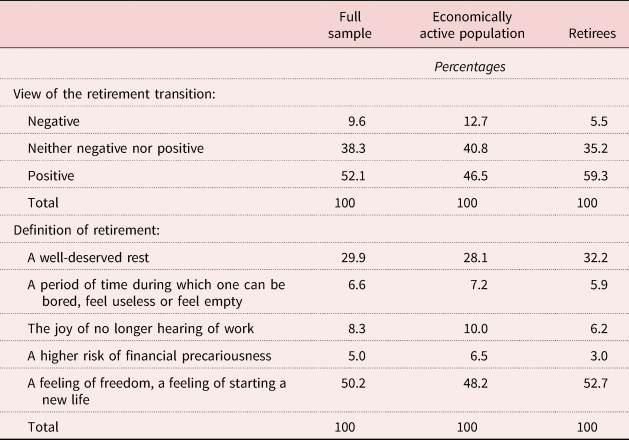
Descriptive statistics for the perception variables are presented in Table 1. In the full sample, which contains both individuals in the economically active population and retirees, more than half of the respondents have a positive view of the retirement transition (52 per cent) and less than 10 per cent have a negative view. Moreover, 38 per cent of the sample have neither a positive nor a negative view. Answers to the question on the definition of retirement are consistent with this positive view: retirement is defined as a period of freedom by half of the sample. Moreover, 30 per cent of the sample report that this is a well-deserved rest. The other three possible definitions are each chosen by less than 10 per cent of the sample.
Descriptive statistics

Notes: Differences in perceptions between the economically active population and retirees are statistically significant at conventional levels (except for ‘A period of time during which one can be bored, feel useless or feel empty’ for which the difference is not significant).
In the descriptive statistics, perceptions seem more positive among retirees than among active individuals. Indeed, 59 per cent of retirees have a positive view versus 47 per cent of active individuals. Similarly, retirement represents a period of freedom for 53 per cent of retirees versus 48 per cent of active individuals; and a risk of precariousness for only 3 per cent of retirees but for 7 per cent of active individuals. Finally, it is defined as a well-deserved rest for 32 per cent of retirees versus 28 per cent of active individuals.
However, active individuals and retirees have different socio-demographic characteristics, as shown in Table A in the online supplementary material. In a regression model that controls for gender, age, marital status and education, we find that retirees are significantly less likely to answer ‘precariousness’ and more likely to answer ‘rest’ than younger adults, all other things being equal (results available upon request). There is no significant difference between the two population groups for other perception responses. Note that the model presented in Table B in the online supplementary material, which distinguishes between the employed, the unemployed and retirees, and includes a larger number of right-hand side variables, supports these findings.
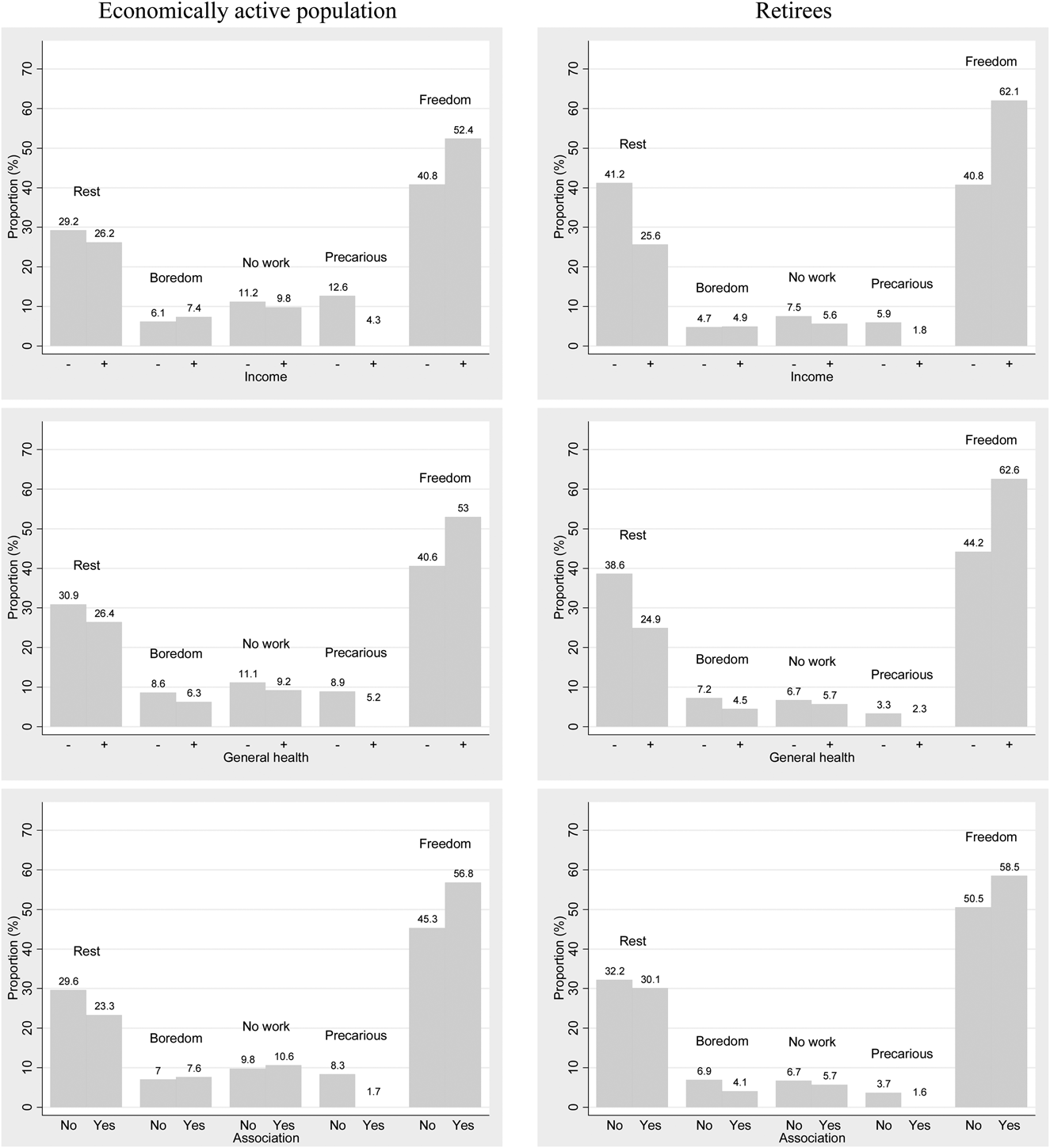
Using descriptive statistics, we also illustrate the association between better conditions of existence and more positive perceptions. Figure 1 presents the distribution of responses to the question on retirement definitions according to income level, general health and involvement in an association (graphs for the economically active population are presented on the left-hand side, while those for retirees are shown on the right-hand side). To generate the figure, we distinguish between individuals whose income is lower than median income and those whose income is greater than median income, inviduals who report very poor or poor health and those who report fair, good or very good health, and inviduals who are involved in an association and those who are not.
Retirement definitions by income level, health status and association involvement.

In the active population, high-income individuals are more likely to define retirement as a period of freedom and less likely to define it as a period of potential precariousness. Indeed, while only 41 per cent of low-income individuals answer ‘freedom’, this is the case for 52 per cent of high-income individuals. Similarly, active individuals who are in better health or who are involved in an association are more likely to mention freedom and less likely to mention the risk of precariousness.
Findings for retirees are in line with those for younger adults. However, for retirees, the gap in the definition of retirement as a period of freedom between low- and high-income individuals and between unhealthy and healthy individuals is even greater than for workers. Indeed, only 41 per cent of low-SES individuals answer ‘freedom’, versus 62 per cent of high-SES respondents. Similarly, 44 per cent of unhealthy individuals answer ‘freedom’, versus 63 per cent of healthy respondents. We also find a sizeable difference in the ‘rest’ answer between low- and high-income individuals and between unhealthy and healthy respondents. For instance, while 41 per cent of low-income individuals answer ‘rest’, this is the case for only 26 per cent of high-income persons. Finally, as in the active population, being involved in an association increases the chances of defining retirement as a period of freedom. Results on social differences in views of the retirement transition are consistent with results on definitions of retirement (results available upon request).
Regression results: social differences in the active population
Multivariate regression analysis indicates that higher SES, better health and more social activities are associated with improved perceptions of retirement, all other things being equal. This result is robust to the use of different measures for SES, health and social activities, and it holds both in the economically active population and for retirees.
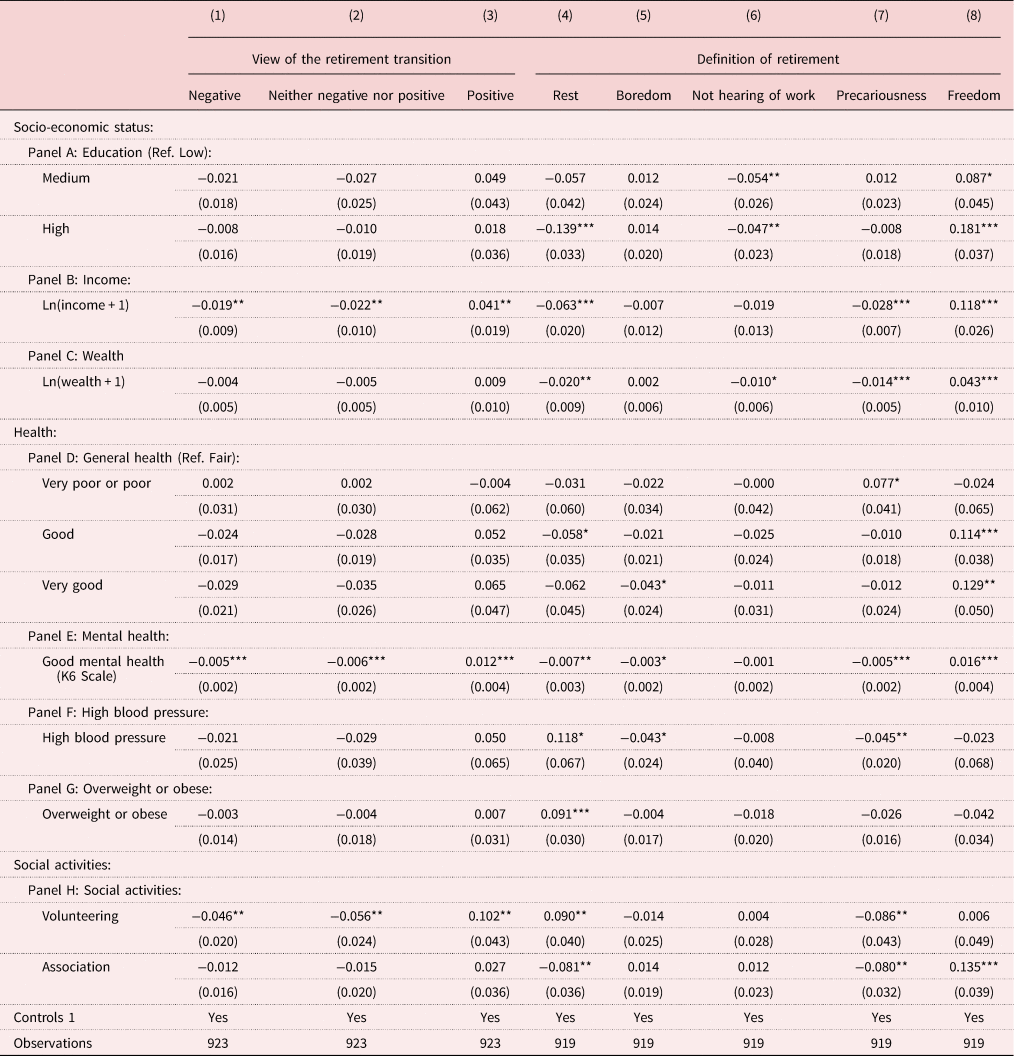
More precisely, in Table 2, we report marginal effects from an ordered logit (in columns (1) to (3)) and a multinomial logit (in columns (4) to (8)) model for perceptions of retirement, for the economically active population. For instance, Panel A shows the results of regressions of perceptions of retirement on education (and control variables). While there is no significant association between education and the view of the retirement transition, high education decreases the likelihood of defining retirement as a well-deserved rest and as the joy of not hearing of work, and increases the chance of defining retirement as a period of freedom. As an example, compared with a low level of education, a high level of education increases the probability of answering ‘freedom’ by 18 percentage points.
Correlates of perception of retirement, in the economically active population
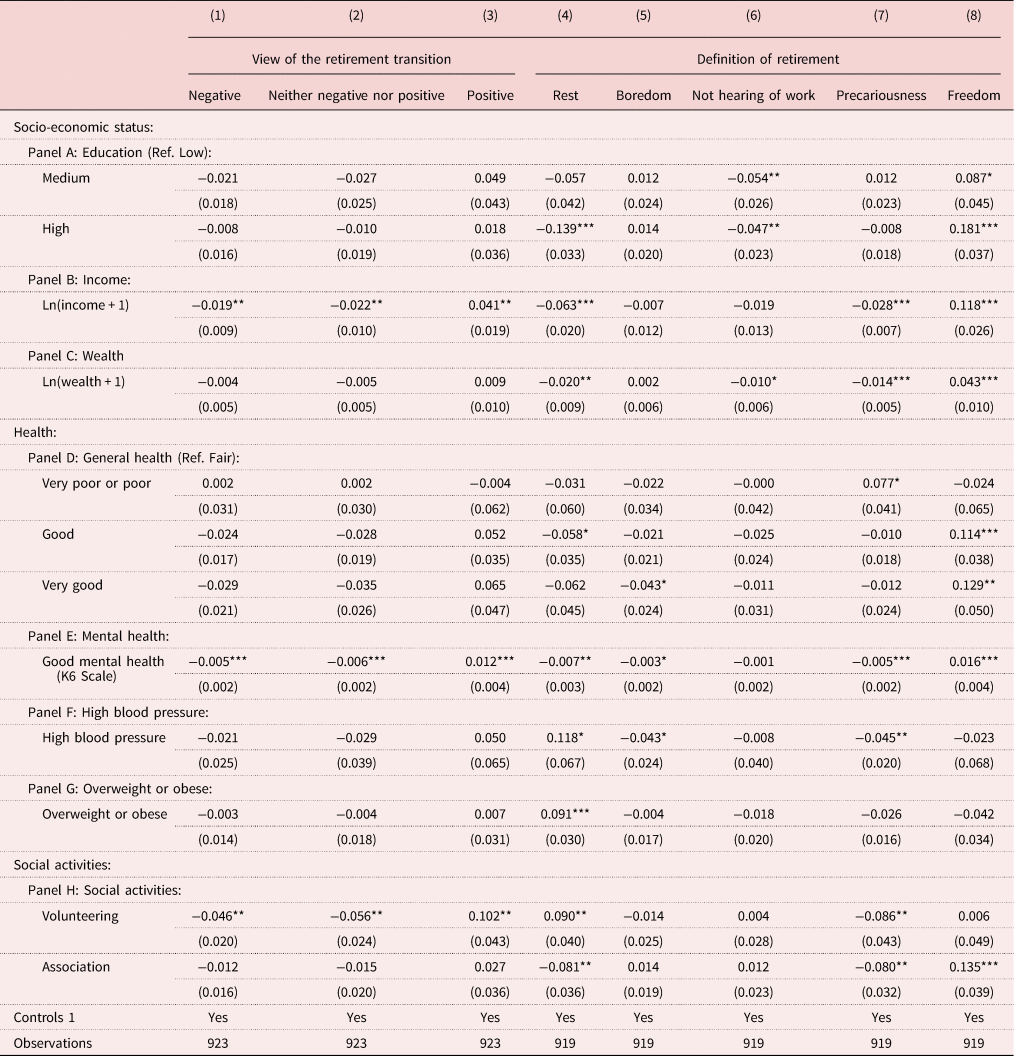
Notes: Each column and panel corresponds to a specific regression. Columns (1) to (3) contain marginal effects from an ordered logit model. Columns (4) to (8) report marginal effects from a multinomial logit model. ‘Controls 1’ are included, i.e. gender, age and marital status. Ref.: reference category. K6 Scale: Kessler Psychological Distress Scale. Standard errors are in parentheses.
Significance levels: * p < 0.1, ** p < 0.05, *** p < 0.01.
Income and wealth also play a role: while a higher income level decreases the probability of a negative view and increases that of a positive view, greater income and wealth levels decrease the chance of defining retirement as a period or precariousness and as a well-deserved rest, and increase that of defining it as a period of freedom.
With increasingly more problematic mental health, there are more negative views of the retirement transition. Moreover, (good) mental health is positively associated with a positive view of the transition and is negatively associated with the probability of mentioning ‘precariousness’. Mental and physical health are negatively associated with answering ‘rest’. For instance, the likelihood that an individual with normal blood pressure answers ‘rest’ is less than that of an individual with high blood pressure by 12 percentage points. Similarly, being overweight or obese increases the probability of answering ‘rest’ by 9 percentage points. On a related matter, better general and mental health decreases the chance of defining retirement as a period of boredom. In addition, general and mental health are positively correlated with the probability of mentioning ‘freedom’. For example, the probability that a respondent in very good health answers ‘freedom’ is greater than that of an individual in fair health by 13 percentage points.
Finally, social activities are also associated with positive perceptions. For example, compared with individuals who do not volunteer, individuals who volunteer are more likely (by 10 percentage points) to have a positive view of the retirement transition; and respondents who are involved in an association are more likely (by 14 percentage points) to define retirement as a time of freedom.
Regression results: social differences for retirees
Like in the economically active population, SES, health and social activities are positively correlated with positive perceptions, for retirees.
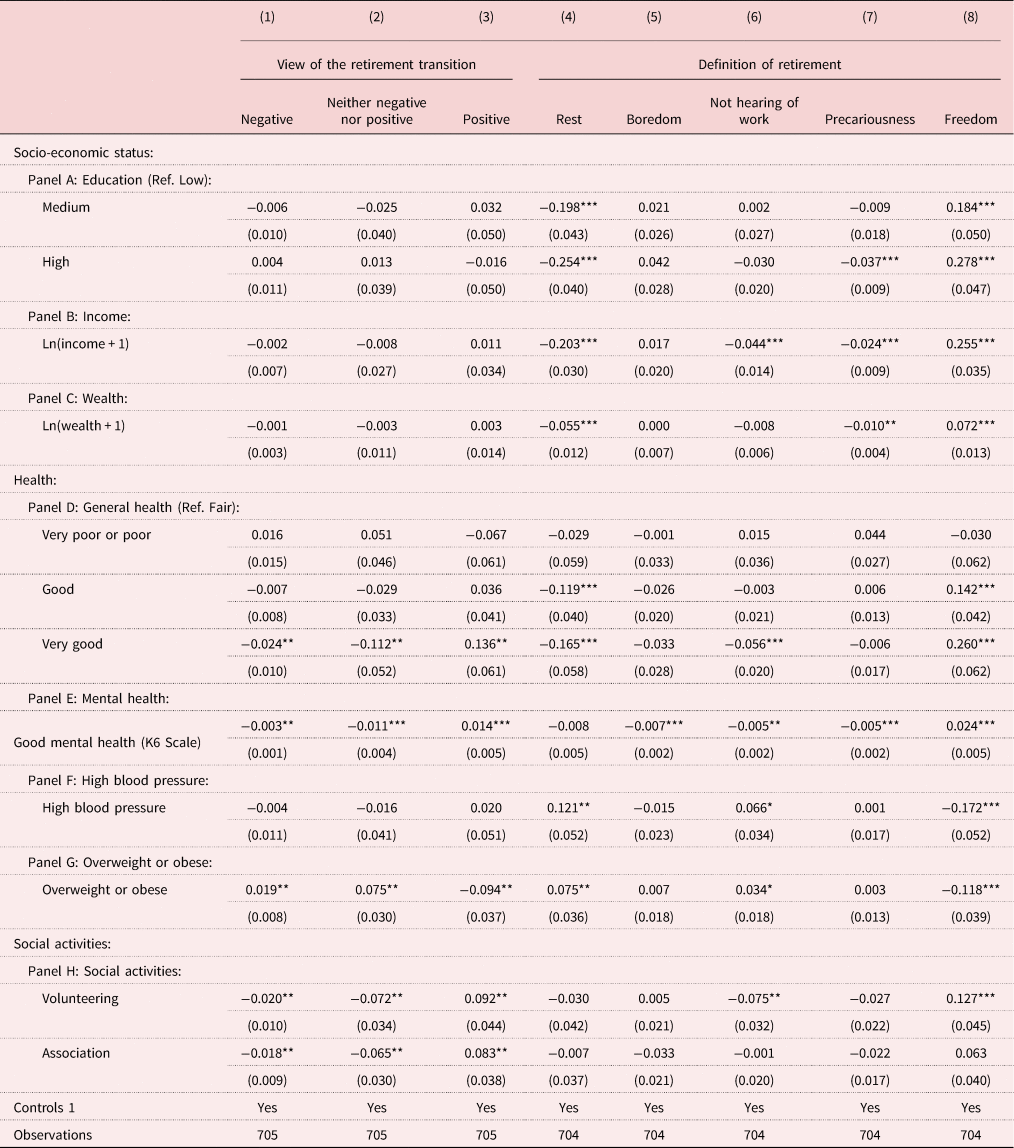
In this population group, none of the SES variables is significantly associated with views of retirement (Table 3). However, all three SES measures are negatively correlated with the definitions emphasising ‘rest’ and ‘precariousness’, and positively correlated with the definition highlighting ‘freedom’. Compared with a low level of education, a high level of education increases the probability of answering ‘freedom’ by 28 percentage points, and decreases the likelihood of answering ‘rest’ and ‘precariousness’ by 25 and 4 percentage points, respectively.
Correlates of perception of retirement, for retirees
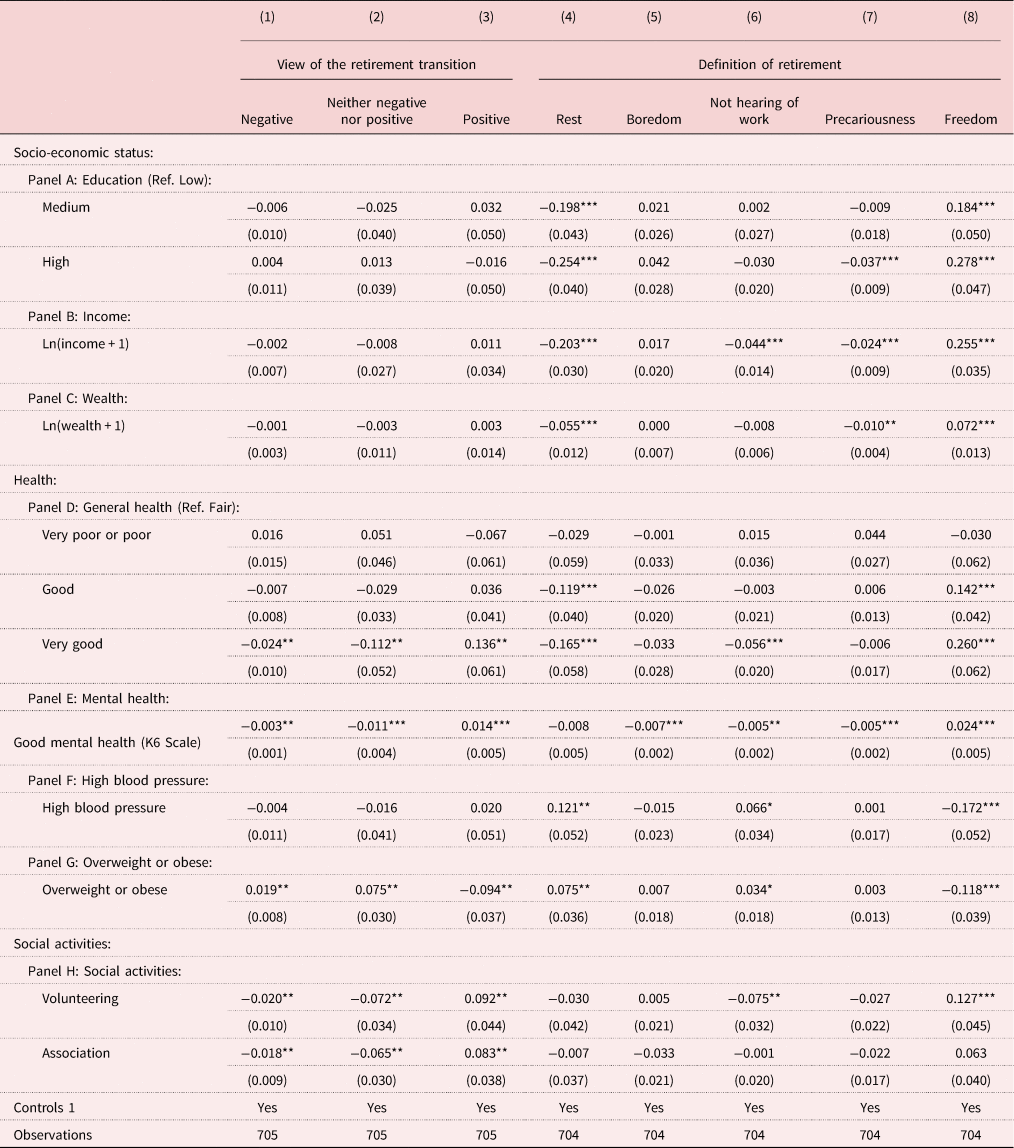
Notes: Each column and panel corresponds to a specific regression. Columns (1) to (3) contain marginal effects from an ordered logit model. Columns (4) to (8) report marginal effects from a multinomial logit model. ‘Controls 1’ are included, i.e. gender, age and marital status. Ref.: reference category. Standard errors are in parentheses. K6 Scale: Kessler Psychological Distress Scale.
Significance levels: * p < 0.1, ** p < 0.05, *** p < 0.01.
General, mental and physical health are negatively correlated with a negative view of retirement (and positively associated with a positive view). Moreover, better health decreases the likelihood of defining retirement as a well-deserved rest, a period of boredom, the joy of not hearing of work and a risk of precariousness, and increases the chance of defining retirement as a time of freedom. Very good health decreases the probability of answering ‘rest’ and ‘the joy of not hearing of work’ by 17 and 6 percentage points, resepectively, while increasing the probability of mentioning ‘freedom’ by 26 percentage points (compared to fair health).
Social activities also go hand in hand with more positive views and definitions. For example, volunteering increases the probability of answering ‘freedom’ by 13 percentage points.
Regression results: full models
In Tables 2 and 3, we explored the roles of SES, health and social activities separately. We now estimate a full model that includes several indicators of social conditions at the same time (education, income, general health, volunteering and association). Results (presented in Table B in the online supplementary material) indicate that each family of social condition variables has an independent effect on perceptions. More precisely, even when we control for health and social activities, a higher income goes hand in hand with rosier definitions. Similarly, in this full model, better health still decreases the likelihood of negative perceptions while strengthening that of positive ones. Social activities also play an independent beneficial role.
In this full model, the role of education is complex: on the one hand, high education is positively correlated with a negative view of the retirement transition (and negatively correlated with a positive view), but it also increases the likelihood of defining retirement as a time of freedom.
Although this is not our prime concern, the analysis enables us to know whether gender, age and marital status are important structuring principles behind perceptions or not. First, we generally do not find any significant difference between females and males. However, this probably does not imply that there is no gender discrepancy in perceptions. Indeed, previous research shows that ageing is a gendered process (Foster and Walker, Reference Foster and Walker2013; Bozon et al., Reference Bozon, Gaymu and Lelièvre2018), due to differences in work trajectory (Bué, Reference Bué2002), domestic and caring activities (Craig and Muller, Reference Craig and Mullan2010; Haberken et al., Reference Haberkern, Schmid and Szydlik2015), and health status and life expectancy (Van Oyen et al., Reference Van Oyen, Nusselder, Jagger, Kolip, Cambois and Robine2013; Cambois et al., Reference Cambois, Garrouste and Pailhé2017) between females and males, in particular. Moreover, the literature also finds that men and women have different retirement expectations and describe retirement in different ways (Onyx and Baker, Reference Onyx and Baker2006; Repetti and Calasanti, Reference Repetti and Calasanti2018). In our study, it may simply be the case that our variables are not precise enough to capture gender differences. Using an in-depth qualitative method may thus be useful to assess better the influence of gender on perceptions.
Second, age is positively associated with positive views of the retirement transition (and negatively correlated with negative views). Moreover, the answer ‘freedom’ becomes more common with increasing age. These changes with age could mean that individuals embrace new social norms as they get older, although our data do not enable this hypothesis to be tested.
Finally, not having a partner has a detrimental impact on perceptions, since it decreases the likelihood of positive or increases the likelihood of negative views, and increases the likelihood of defining retirement as a period of potential precariousness. This result is unsurprising, given the positive influence of having a spouse/partner while adjusting to retirement and re-organising weekly activities (Caradec, Reference Caradec2015).
Does the effect of social conditions on perceptions weaken with age? To investigate this point, we re-estimate our full model including interaction terms between social condition and age (Table C in the online supplementary material). There is some evidence that a divergence process is taking place, meaning that the relationship between social conditions and perceptions strengthens with age. For instance, the correlation between education or income and the likelihood of responding ‘rest’ (negative starting at age 41 for education and 54 for income) decreases with age, while the association between income and the likelihood of responding ‘freedom’ (positive starting at age 42) increases with age.Footnote 10 In other words, a higher income level is associated with a smaller probability of responding ‘rest’ and this negative income impact is even more negative for older individuals. Symmetrically, a higher income level increases the probability of mentioning ‘freedom’ and this effect is greater for older individuals. In contrast, the association between social activities (i.e. volunteering and association) and perceptions remains stable with age.
Rosier perceptions of retirement correlate with higher satisfaction for retirees
Finally, we check that rosier retirement perceptions are associated with higher levels of wellbeing for retirees. Specifically, we regress the satisfaction variables on the view of the retirement transition and on the definition of retirement (see Table D in the online supplementary material). We alternatively include ‘controls 1’ and ‘controls 2’ to check the robustness of findings. Compared with a view of retirement transition that is neither negative nor positive, a positive view is correlated with greater satisfaction in all domains, for the two sets of control variables. Findings on the definition of retirement support these results. People who define retirement as a period of precariousness report lower satisfaction in the finances, leisure and health domains (when either ‘controls 1’ or ‘2’ are included) and in the housing domain (when ‘controls 1’ are accounted for). In contrast, individuals who define retirement as a period of freedom report higher levels of wellbeing in all domains when ‘controls 1’ are included, and in the social life and housing domains when ‘controls 2’ are included. Surprisingly, we also find that a negative view of retirement, as well as a definition of retirement as a period of boredom, is positively associated with satisfaction with financial situation. However, our results generally show that perceptions are closely related to individual wellbeing, with the expected signs.
Discussion
Employing quantitative data on a diverse sample of French respondents, we show that perceptions are undoubtedly positive: 52 per cent of respondents have a positive view of the retirement transition (while only 10 per cent have a negative view), and the most common definition of retirement is a period of freedom, both among younger adults and retirees. Our finding is thus in stark contrast with the negative stereotype associated with age: for our respondents, retirement does not mean social exclusion or ‘social death’ (Guillemard, Reference Guillemard2002). Our result is consistent with recent qualitative findings for Switzerland that show that retirees describe retirement as a time of freedom (Repetti and Calasanti, Reference Repetti and Calasanti2018). It also corroborates earlier results on the positive social representations of retirement in France (Roland-Lévy and Berjot, Reference Roland-Lévy and Berjot2009) and old age in Canada (Quéniart and Charpentier, Reference Quéniart and Charpentier2012). These findings on the positive image of retirement are not surprising given the power of our society's norm of ‘successful ageing’ and the growing culture of personal self-fulfilment (retirement is then perceived as a period during which one may realise one's potential).
In the context of longer working lives in France (related to public policies, including pension reforms), these positive views of retirement may also mean that retirement is more rewarding than working life for some respondents. Previous research for France has highlighted that some older people are exposed to poor working conditions during the last years of their working lives, due to the general deterioration of working conditions since the 1980s (Pailhé, Reference Pailhé2005; Khireddine-Medouni et al., Reference Khireddine-Medouni, Lemaître, Homère, Plaine, Garras, Riol and Valenty2016) and to the negative perception of older workers in the workplace. For instance, some older workers are affected by negative relationships with colleagues and get boring tasks (Aouici, Reference Aouici2016). In addition, some older workers are excluded from the labour market because of forced (early) retirement or unemployment (Salembier, Reference Salembier2015). These conditions and constraints generate stress, job dissatisfaction and a feeling of being a burden in the workplace. This may partly explain the positive perception of retirement, by contrast with work (or unemployment).
Perceptions of retirement are different between retirees and younger adults in France: retirees are less likely to define retirement as a risk of financial precariousness, but more likely to define it as a period of rest (all other things being equal). Note that Mutran et al. (Reference Mutran, Reitzes and Fernandez1997) also find differences in attitudes towards retirement, using US longitudinal data: in their study, attitudes are more positive among respondents who retire than among those who continue to work. In our cross-sectional data, the difference between retirees and younger adults may be interpreted as an age and/or a cohort effect. First, it could be due to a lifestage effect: people would have different views about retirement after experiencing this new stage of life. Second, the difference between workers and retirees may also reflect differences in life trajectories, anticipations or socialisations between cohorts. In the context of recurring pension reforms (to improve sustainability) in France, younger cohorts may anticipate that their retirement income will decrease (Caradec, Reference Caradec2017), which may explain why they put more emphasis on the risk of precariousness than retirees (cohort effect). Younger cohorts may also anticipate higher risks of financial precariousness during retirement because they experience higher degrees of employment insecurity during their working life, which goes hand in hand with lower pension payments (cohort effect). Understanding the gap in perceptions between the two population groups is an important avenue for future research.
Do subjective perceptions of retirement depend on social and material circumstances? We quantitatively examine this point using a large number of social condition indicators. Indeed, social conditions (high SES, good health and social involvement) may provide resources that help individuals cope with retirement and ageing. These resources may enable individuals to prepare (financially) for retirement (Apouey, Reference Apouey2018b), to reorganise their life after retirement and to develop some (non-work) aspects of their identity. Our analysis confirms that perceptions markedly vary according to social position. Importantly, these social differences are found for both active individuals and retirees. Our result seems robust, since social heterogeneity emerges in descriptive statistics, but remains statistically significant in regression models, all other things being equal. For instance, household income, which is a proxy for economic hardship, is negatively associated with defining retirement as a period of potential precariousness. Similarly, superior economic and cultural capital allows respondents more often to perceive retirement as a period of freedom. Moreover, while these social differences are observed for a variety of social condition indicators (SES, health and social capital measures), each social condition variable plays an independent role, which points to the cumulative effects of the different forms of capital (see the full model). The effects we uncover are large: for instance, in our full model, high education increases the probability of perceiving retirement as a period of freedom by 12 percentage points (compared to low education).
While ‘rest’ was the main social meaning of retirement until the 1970s (Caradec, Reference Caradec2017), retirement still means ‘rest’ for a high share of respondents (approximately 30%) in our very recent data. Among retirees and individually active individuals, the probability of answering ‘rest’ is significantly correlated with low SES and poor health. We hypothesise that this response is linked to poor working conditions or precarity in the labour market.
More generally, our results on the role of social conditions are consistent with previous evidence on differences in personal definitions of ‘ageing well’ in France (Apouey, Reference Apoueyin press) and Canada (Laberge et al., Reference Laberge, Dumas, Rail, Dallaire and Voyer2003). It is entirely possible that social differences in perceptions of retirement and ageing echo social differences in perceptions of working life. However, longitudinal data that would follow individuals before and after the retirement transition would be necessary to test this hypothesis. In any case, using original data on perceptions, our work emphasises the persistence of social inequalities during the retirement period. We also provide evidence of divergence in perceptions of retirement between individuals from different social backgrounds with increasing age. Again, this result could be due to an age or a cohort effect. In the case of an age effect, our result may mean that the adverse effect of poor social conditions on perceptions accumulates as individuals get older.
While our analysis emphasises social differences, some common features also emerge between social classes. In particular, in both low- and high-income groups, the most common definition of retirement is a period of freedom (see the descriptive statistics).
Finally, we check that positive perceptions of retirement are associated with greater wellbeing (i.e. satisfaction in several life domains) for retirees. These associations remain significant (but are attenuated) when we adjust for covariates. This result speaks to previous findings on the link between age stereotypes and satisfaction in Germany (Kornadt and Rothermund, Reference Kornadt and Rothermund2011), for instance.
One important limitation of our study is that our sample is not representative of the entire French population, but of the customers of a large insurance company. In particular, compared with the French population of the same age group, the average individual in our sample is more likely to be married and to be a home-owner. For this reason, our results should be interpreted with some caution and further research based on a nationally representative sample is needed. Another limitation is that respondents may not understand questions on retirement perception and response categories in the exact same way. For example, in the response category ‘a feeling of freedom’, the meaning of the word ‘freedom’ could be different for low- and high-income individuals. In addition, our questionnaire lists a relatively small number of definitions of retirement, and it is thus possible that some important definitions are omitted: for instance, retirement may represent an opportunity to care for loved ones. To address this point, future quantitative research should include a broader set of definitions. Moreover, while we focus on a number of SES, health and social activities measures, other variables, such as former occupation (for retirees) and the spouse's occupation, may also shape perceptions. Finally, our results cannot be interpreted as causal relationships, as discussed above.
In closing, the strengths of our study include the description of perceptions of retirement in France, the study of heterogeneity and the use of a relatively large sample of respondents. Our findings point to the importance of social conditions in shaping perceptions of retirement. We also find that perceptions are associated with satisfaction in different domains. Future research should try to uncover the mechanisms behind these associations, in the context of successful ageing ideals.
Supplementary material
The supplementary material for this article can be found at https://doi.org/10.1017/S0144686X20001002
Acknowledgements
The author thanks Harmonie Mutuelle (HM; in particular A. Autret, G. Bonnand and A. Chompret), Chaire Transitions Démographiques Transitions Economiques (Chaire TDTE; in particular F.-X. Albouy, M. Fartaoui, M. Linger, G. Messanvi, A. Villemeur and H. Xuan), FYM Etudes (in particular G. Le Doussal) and E. Macia. The views expressed in this paper are those of the author and not necessarily those of HM, Chaire TDTE, FYM Etudes or the cited persons.
Financial support
This work was supported by Chaire Transitions Démographiques, Transitions Economiques (Chaire TDTE) hosted by Fondation du Risque. The author prepared the survey questionnaire in partnership with Chaire TDTE, Harmonie Mutuelle (HM) and FYM Etudes. HM funded data collection, which was implemented by FYM Etudes. Data were provided by HM. HM, Chaire TDTE and FYM Etudes had no role in the design, execution, analysis and interpretation of data, or writing of the study.
Conflict of interest
The author declares no conflicts of interest.
Ethical standards
Ethical guidelines have been met, including adherence to the legal requirement in France. The survey obtained ethics approval from the national ethics committee, i.e. Commission Nationale de l'Informatique et des Libertés (CNIL). The empirical work presented in the paper does not require any ethical review.