1 Introduction
It is generally agreed that each generation of taxpayers should pay the full cost of the public services it receives. If a worker's compensation includes a defined benefit pension, the cost of the benefit earned in that year should be recognized, and funded, at the time the worker performs that service, not when the pension is paid in retirement. The discipline of making state and local governments pay the annual costs also discourages governments from awarding excessively generous pensions in lieu of current wages.Footnote 1 Many states and localities also have some unfunded pension obligations from the past, either because they did not put away money at the time the benefits were earned or because they provided benefits retroactively to some participants. The cost of these unfunded liabilities also needs to be distributed in some equitable fashion.
The question of funding has gained increased urgency for two reasons. First, the collapse of the stock market reduced the value of equities held by state and local plans by about $1 trillion, substantially undermining the funded status of virtually all state and local plans. Second, baby boomers are about to begin retiring in large numbers, which means that benefits are slated to increase sharply.
This paper examines the current funding of state and local pension plans. Section 1 begins by describing the regulatory environment under which the plans operate, and Section 2 describes the actuarial cost methods employed. Section 3 then reports, using GASB accounting methods, the funded status of the 126 plans in our sample as of 2009 – the first year for which the full impact of the financial meltdown is felt, and Section 4 reports on factors associated with the variability in funded ratios across plans. Judging the long-term health of a plan, however, requires more than a snapshot of the ratio of assets to liabilities; the key issue is whether the sponsor has a funding plan and is sticking to it. So Section 5 reports on the extent to which plan sponsors are making their Annual Required Contribution (ARC), tries to identify the characteristics of sponsors who make their ARC payment, and speculates about the future of ARC payments. Section 6 looks at how the funding picture would change if liabilities were valued using the riskless rate rather than the return on assets. Finally, Section 7 addresses the question of liquidity.Footnote 2
The conclusion that emerges is that, despite not having a federal mandate, in the aggregate, state and local plans were making solid progress toward funding until they were thrown severely off course by the bursting of the dot.com bubble and the collapse of asset prices in 2008. Their funded status looks much worse, of course, if liabilities are valued using the riskless rate. They are not, however, facing a liquidity crisis; on average, plans have enough assets to pay benefits for the next 15–20 years. Most states have responded to the crisis by increasing employee contributions and reducing benefits for new employees. But the picture will not improve significantly until the economy and the stock market recover and states and localities resume paying their full ARC.
2 The regulatory environment
Funding is a relatively recent phenomenon in the public sector. Public plans were not in very good shape as recently as the late 1970s. State and local government employment had roughly doubled between the early 1960s and the mid-1970s, resulting in an enormous growth in workers participating in state and local pensions. Nevertheless, primarily for constitutional reasons, public plans were not covered by the Employee Retirement Income Security Act of 1974. ERISA did mandate a study of these plans, and the conclusions of the 1978 Pension Task Force Report on Public Employee Retirement Systems Footnote 3 were not flattering:
‘In the vast majority of public employee pension systems, plan participants, plan sponsors, and the general public are kept in the dark with regard to a realistic assessment of true pension costs. The high degree of pension cost blindness is due to the lack of actuarial valuations, the use of unrealistic actuarial assumptions, and the general absence of actuarial standards’.
Perhaps at least partly in response to the report, states and localities became increasingly aware of the importance of sound funding. Their response was a slight increase in the contribution rate during the 1980s and a shift to more risky assets (percent of portfolios invested in equities increased from 23% in 1982 to 48% in 1992). This shift combined with the long bull market greatly increased assets per worker and the funded ratios for most plans, but it also left plans extremely vulnerable to the collapse of equity markets.
The accounting organizations also encouraged funding, although as discussed in Section 6, their prescription to use projected asset returns to discounted liabilities has left plans vulnerable to financial crises. The Governmental Accounting Standards Board (GASB, 1986, 1994a, b, 2010), which came into being in the early 1980s, provided guidance for disclosure of pension information with Statement No. 5 in 1986.Footnote 4 One important requirement was that all plans report their benefit obligations and pension fund assets using uniform methods to allow observers to make comparisons across plans. In most cases, this required two sets of books, as the GASB method was very different from the approach most plan actuaries had adopted for establishing funding contributions. Also, actuaries did not apply it retroactively, which made historical comparisons impossible. As a result, when users needed information about a plan's funded status and funding progress, they generally looked to numbers generated by the plan's own methodology.
GASB Statements No. 25 and 27Footnote 5, issued in 1994, contained a key innovation: they allowed sponsors that satisfy certain ‘parameters’ to use the numbers that emerge from the actuary's funding exercise for reporting purposes. Among others, these parameters defined an acceptable amortization period, which was originally up to 40 years and reduced to 30 years in 2006, and an ARC, which would cover the cost of benefits accruing in the current year and a payment to amortize the plan's unfunded actuarial liability.Footnote 6
For measuring the funded status of a plan, GASB uses the projected benefit obligation (PBO) as the liability concept. The PBO includes pension benefits paid to retired employees, benefits earned to date by active employees based on their current salaries and years of service, and the effect of future salary increases on the value of pension rights already earned by active workers. With regard to the discount rate, GASB 25 states that it should be based on ‘an estimated long-term yield for the plan, with consideration given to the nature and mix of current and planned investments ….’
GASB provides the parameters, but plans are not required to follow them. GASB, like its private sector counterpart, the Financial Accounting Standards Board, is an independent organization and has no authority to enforce its recommendations. Many state laws, however, require that public plans comply with GASB standards, and auditors generally require state and local governments to comply with the standards to receive a ‘clean’ audit opinion. And bond raters generally consider whether GASB standards are followed when assessing credit standing (U.S. Government Accountability Office, 2008). Thus, financial reporting requirements probably have had considerable impact.
3 Determining pension costs in the public sector
The precise amount of money that state and local plans are supposed to put aside each year depends on how the actuaries allocate costs to a particular year – that is, it depends on the actuarial cost method adopted. In contrast to the private sector, the public sector relies primarily on the entry-age normal (EAN) approach for funding and reporting purposes (Public Plans Database, 2008). But 14% use the projected unit credit (PUC) and 16% the aggregate cost or other method. The aggregate cost method allocates unfunded liabilities as future normal costs, and so a plan using this method shows no current unfunded liabilities and a 100% funded ratio. GASB now requires plans using aggregate cost to also report their funding using EAN and, using this method, the aggregate cost plans turn out to be about average in terms of funding.
Both the EAN and PUC generate conventional funded ratios. A numerical example may help clarify a key difference between the costing methods. Suppose a plan sponsor needs to contribute $15,000 for a particular employee who will retire in 5 years, and that the sponsor fully funds the cost specified by either method. Under PUC, the sponsor recognizes and funds, say, $1,000 in the first year, $2,000 in the second year, $3,000 in the third year, $4,000 in the fourth year, and $5,000 in the fifth year. Under EAN, the actuary would level the contributions over the 5-year period so that the sponsor would recognize and pay a normal cost of $3,000 per year. Had the sponsor used EAN, after 3 years, the plan would have an actuarial accumulated liability of $9,000 and assets of $9,000. Had the sponsor used PUC, the plan would have a cumulative liability of $6,000 and assets of $6,000.
In other words, up to the point of retirement, the entry-age method recognizes a larger accumulated pension obligation for active employees and requires a larger contribution than the PUC. Thus, given comparable funded ratios, plans using the EAN method have recognized more liabilities and accumulated more assets than those using the PUC, which is the dominant costing method in the private sector.
4 Funded levels in the public sector
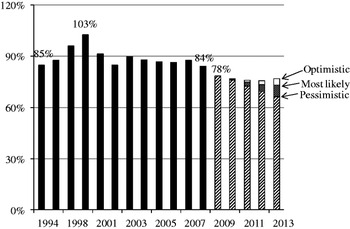
GASB requires plan sponsors to report the funded status of their plans at least every 2 years; most do so annually. These reported numbers for our sample of 126 plans over the period 1994–2008 and our estimates for 2009 are presented in Figure 2. From the mid-1990s to 2000, funding improved markedly in response to GASB guidelines and a rising stock market. In 2000, assets amounted to 104% of liabilities. With the bursting of the high-tech bubble at the turn of the century, funding levels dropped as years of low asset values replaced the higher values from the 1990s. Funding then stabilized with the run-up of stock prices, which peaked in 2007. But the collapse of asset values in 2008 has once again led to declining funded ratios.
The magnitude of that decline depends on the accuracy of our 2009 estimates. Of the 126 plans in our sample, 72 had reported their 2009 funded levels by mid-July 2010. For those plans without valuations, we projected assets on a plan-by-plan basis using the detailed process described in the valuations.Footnote 7 Applying our methodology retrospectively produced numbers for previous years that perfectly matched published asset values in half the cases and that came within 1% in the other half.Footnote 8 We projected liabilities based on the average rate of growth over the past 4 years. We then sent our proposed projections to the plan administrators and made any suggested alterations.Footnote 9 This process resulted in a complete set of plan funded ratios for fiscal year 2009. Based on those numbers, the aggregate funded ratio dropped from 84% in 2008 to 78% in 2009.Footnote 10
4.1 Projections for 2010–2013
While funded ratios for 2009 were the lowest they have been in 15 years, reported numbers are likely to decline further over 2010–2013 as gains in the years leading up to 2007 are phased out and losses from the market collapse phased in. The precise pattern of future funding will depend, of course, on what happens to the stock market. To address such uncertainty, projections were made using three sets of assumptions for the Dow Jones Wilshire 5000 Index between now and 2013. All projections assume 3% inflation. The pessimistic projection assumes that the stock market remains at its current level of roughly 12,000. The most likely projection assumes a Wilshire 5000 of 15,000 by 2013. The optimistic projection assumes a stronger economic expansion so the Wilshire 5000 reaches 18,000 by 2013. The optimistic projection is designed to exceed the central projection to the same extent that the central exceeds the pessimistic.
In order to estimate the actuarial level of assets for 2010–2013, we replicate the smoothing method of each plan in our data set as detailed in the plan's actuarial valuation, based on each of the assumptions regarding the Wilshire 5000.Footnote 11 Because, historically, contribution payments hold relatively steady for each plan, we estimate future contributions based on an average of the prior 3 years plus a modest 5% per-year increase (the average increase between 1990 and 2007). Benefit payments, which also show little variation over time, are estimated in the same manner as contributions.
The results are included in Figure 1. Certainly, the more distant the year, the more uncertain is the projection. In all likelihood, assuming any changes to benefits or contributions would have no material effect, 2010 actuarial reports will show assets equal to about 77% of promised benefits. What happens thereafter depends increasingly on the future performance of the stock market. Under the most likely scenario, the funded ratio will continue to decline as the strong stock market experienced in 2005, 2006, 2007, and much of 2008 is slowly phased out of the calculation. By 2013, the ratio of assets to liabilities is projected to equal 73%. The comparable 2013 ratio for the optimistic scenario is 76% and for the pessimistic scenario 66%.
State and local funded ratios and projections under three scenarios, 1994–2013 Note: 2009 is authors’ estimate. Sources: Public Plans Database (2001–2009) and Zorn (1994–Reference Zorn2000).

4.2 Unfunded liabilities
The unfunded liabilities for the ‘most likely’ scenario implied by these funded ratios will rise from $726 billion to about $1.0 trillion, in 2009 dollars, over the next 4 years.
5 Why does funding vary?
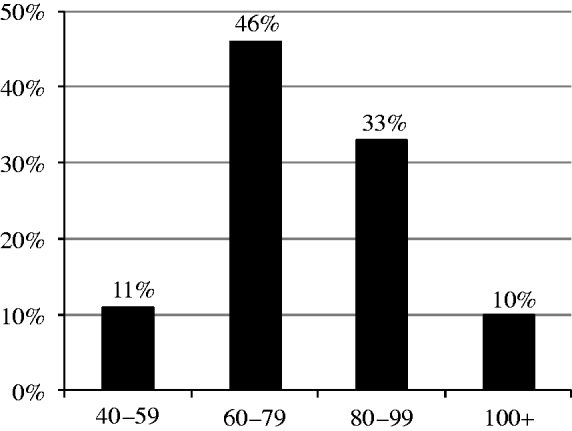
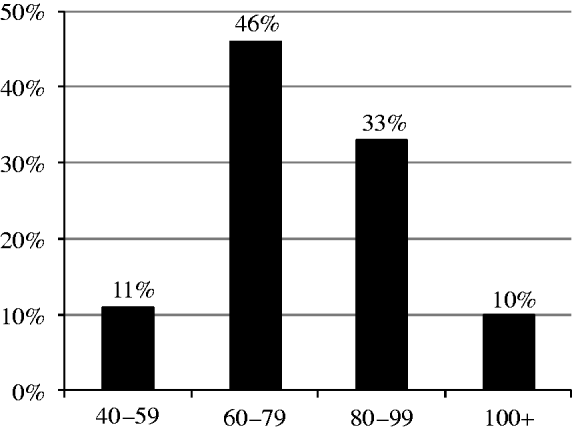
In 2009, as in earlier years, funded levels vary substantially. Fifty-seven percent of plans had funding below the 80% level (see Figure 2). Although many of the poorly funded plans are relatively small, several large plans, such as those in Illinois (SERS, Teachers, and Universities) and Connecticut (SERS), had funded levels below 60%.Footnote 12
Distribution of funded ratios for public plans, 2009 Source: Authors’ calculations based on Public Plans Database.
5.1 Factors related to funded status
Plans cannot become fully funded overnight. Establishing and maintaining a high level of assets relative to liabilities requires years of fiscal discipline and planning. In order to identify the characteristics of well-funded plans relative to their poorly funded counterparts, we estimate a simple ordinary least squares (OLS) regression that includes four categories of factors that appear related to the funded status: funding discipline, the governance of the plan, the characteristics of the plan, and the fiscal health of the state.
5.1.1 Actuarial cost method
One factor that might reflect the dedication of a plan sponsor to a funding regime is the choice of actuarial cost method. As noted earlier, up to the point of retirement, the EAN method recognizes a larger accumulated pension obligation for active employees than the PUC method. Therefore, the EAN method is a more stringent funding program. Of course, if plans start with no initial unfunded liability and are following their funding schedules, the choice of cost method should not matter – both would have a ratio of assets to liabilities of 100%. But our hypothesis is that sponsors that opted for the currently cheaper funding regime – namely, the PUC – may be less committed to funding their plans and therefore will have lower reported funded ratios.
5.1.2 Governance
How a public pension plan is managed could impact its financial health. Several studies have explored the relationship between governance and the funded status of public pension plans.Footnote 13 Based on this earlier research, two variables that might be correlated with funding are the presence of employees and/or retirees on the board that governs the plan and the existence of an investment council.
• Employees/retirees on the board. Pension boards can influence a plan's actuarial method and its investment policy. If a lot of current workers and retirees are on the board and they are more interested in benefit expansion or greater cost-of-living adjustments than in funding benefit promises, the plan is likely to have accumulated fewer assets. Also, to the extent that plan beneficiaries are not financial experts, plan assets may not be well invested. In the following analysis, board composition is represented by the percent of board seats occupied by retirees and employees. Although earlier studies have shown mixed results, we expected the effect of the number of retirees and employees to be negative.Footnote 14
• Investment council. The hypothesis with respect to an investment council is just the opposite. If a plan has a dedicated investment board or hires financial advisors in making its investment decision, the plan should have greater returns, more assets, and a higher funded ratio.Footnote 15 The variable included is a dummy variable indicating if the plan has a separate investment council that directly makes investment decisions.
5.1.3 Plan characteristics
Three characteristics of the plan would be expected to be related to the funded ratio: when the plan started, plan size, and the generosity of benefits.
• Age of system. Older plans are likely to have promised benefits over a longer period of time without putting aside funds to cover the promises, thereby creating a large unfunded liability. Therefore, the older the plan, the lower the expected funded ratio.
• Plan size. Other studies have shown that plan size and funded levels are closely related. Possible reasons for this pattern may be more sophisticated asset management, better discipline because not funding could have a huge impact on taxpayers in the future, or the effect of being more in the national political spotlight than smaller plans. In any event, a dummy variable is included for plans in the top third in terms of assets, and its impact is expected to be positive.
• Benefit levels. Some previous studies have found a negative relationship between the level of benefits and funded ratios.Footnote 16 Teachers have longer tenures than general government employees and higher earnings (due to higher education levels), and these factors translate into larger pension liabilities.Footnote 17 Thus, the equation includes information on whether or not teachers are included in a plan, and the coefficient is expected to have a negative relationship with funding.
5.1.4 Fiscal situation
The final factor that may be correlated with funding is the fiscal health of the state. The notion here is that if a state is having fiscal problems, it may meet current non-pension obligations by not making the annual contribution to the pension plan.Footnote 18 Thus, plans in states facing fiscal distress are less likely to be well funded. The measure of fiscal distress in the following analysis is the ratio of a state's debt to its gross state product (GSP).Footnote 19
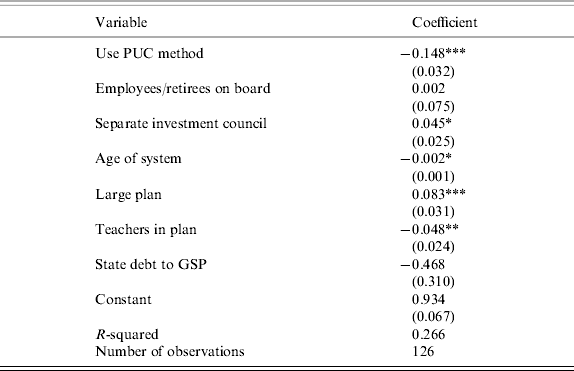
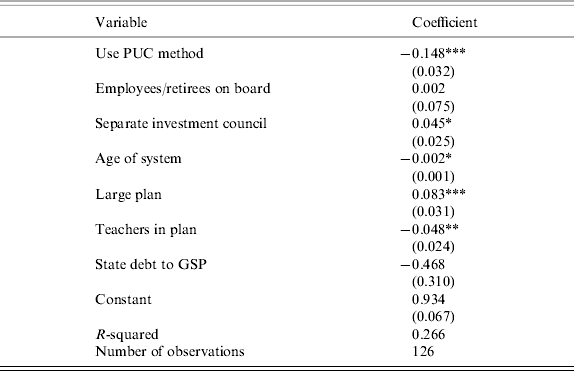
Our regression was used to show the correlation between each of the variables discussed above and the 2008 funded ratios for the 126 plans in our sample.Footnote 20 The results of the regression are shown in Table 1.Footnote 21 All of the variables except for employees on the board have the expected relationship with the funded status of the pension plan, and all relationships except for employees on the board and debt to GSP were statistically significant.
Regression results on the funded ratio of state and local pension plans, 2008
Notes: Robust standard errors are in parentheses. Coefficients are significant at the 1% level (***), 5% level (**) or 10% level (*).
Source: Authors’ calculations from Public Plan Database.
In terms of funding discipline, plans using the PUC costing method have a funded ratio 14.9% points lower than other plans, which rely primarily on EAN.
With regard to governance, having employees and/or retirees on the board does not appear correlated with the level of funding, while plans with a separate investment council are 4.5% points less well funded than comparable plans.
The characteristics of plans also have the expected signs. The older the system, the lower is the funded level. The largest third of plans do appear to have a scale advantage with an average funded ratio that is 8.3% points higher than small and medium plans.Footnote 22 And plans that include teachers have an average funded ratio that is 4.8% points lower than plans that do not cover teachers.
Surprisingly, the regression suggests that the fiscal health of the state does not play an important role. States with high levels of debt to GSP are less well funded than those with lower levels, but the coefficient is not statistically significant.
6 Making the ARC payment
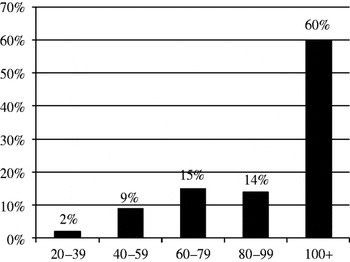
As noted in Section 1, an assessment of the funding situation requires more than a snapshot. The real question is whether sponsors have a plan and stick to it. One important component of any plan is making the ARC. In 2008, state and local governments paid 100% of the ARC for only 60% of the plans in our sample (see Figure 3). Employers that contribute less than the full ARC could still be setting aside enough money to cover currently accruing benefits. They could even be reducing the plan's unfunded liability from previous years, albeit at a slower pace than the actuary would like. Not making the full ARC payment, nevertheless, indicates a failure to follow GASB's suggested funding plan. The question is why such a large percentage of plan sponsors are not making the full ARC.
Distribution of state and local plans, by percentage of ARC paid, 2008 Note: Plans that used the aggregate cost method were coded with 100% of ARC paid. Source: Public Plans Database (2008).

Experts we spoke with suggested that a major reason that some sponsors do not pay the full ARC is that they face legal limitations on how much they can contribute. Indeed, a careful review of the annual reports found that 50% of the 40% of sponsors that did not pay 100% of the ARC were legally constrained.Footnote 23
The question is why the unconstrained plan sponsors failed to make the full contribution.
6.1 Factors that might affect making the ARC
Four types of factors might account for whether or not an unconstrained plan sponsor makes the full ARC payment: the discipline of the sponsor; the priorities of those involved in governance of the plan; the plan characteristics; and the fiscal health of the state.Footnote 24
6.1.1 Funding discipline
As discussed above, the use of the PUC actuarial cost method may signal that sponsors are less committed to funding their plans and therefore less likely to make the full ARC.
6.1.2 Governance: employees/retirees on the board
Again, the composition of the board may be important. One view is that boards with a lot of workers and retirees could be more interested in benefit expansion or greater cost-of-living adjustments than in funding benefit promises, which could lead to lower contributions. An alternative view is that workers and retirees have more of a stake in the plan's success than outside board members and, therefore, their presence on a board would tend to have a positive impact. Earlier studies have shown mixed results.Footnote 25 In the following analysis, board composition is represented by the percent of board seats occupied by employees and retirees.
6.1.3 Characteristics of the plan
Two characteristics of the plan would be expected to affect the likelihood that the sponsor paid 100% of the ARC: whether employees are covered by Social Security and the magnitude of the ARC.
• Social Security coverage. Government employers might feel an increased responsibility to fund the plan if plan benefits represent their employees’ only source of retirement income. Thus, a greater percentage of plan participants without Social Security coverage would increase the likelihood that a sponsor would pay 100% of the ARC.
• ARC as a percent of payroll. The notion is that the higher the ARC as a percent of payroll, the more costly to make the full payment and therefore the less likelihood of making 100% of the ARC.
6.1.4 Fiscal pressure
The final factor that may influence the funding of a public pension plan is the fiscal health of the state. As before, states having fiscal problems may meet current non-pension obligations by not making the annual contribution to the pension plan. The measure of fiscal distress, as in the previous analysis, is the ratio of a state's debt to its GSP.
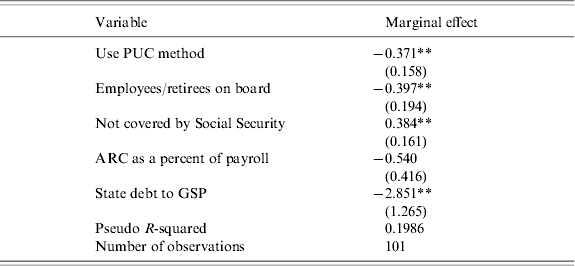
A probit regression was used to estimate the correlation of each of the variables discussed above with the probability that the sponsor made 100% of the ARC. Plans that were constrained by legal funding limitations were excluded from the analysis, which reduced the sample size from 126 to 101. The results of the regression are shown in Table 2. All variables enter with their expected signs and have statistically significant coefficients with the exception of the ARC as a percent of payroll. Plans using the PUC costing method are a whopping 37% points less likely to have made their ARC payment. Similarly, a one-standard-deviation increase in either the state's debt-to-GSP ratio or in the seats held by employees/retirees corresponded to an 11–12% point decreased probability of paying the ARC. In contrast, a one-standard-deviation increase in the percent of employees not covered by Social Security corresponded to a 10% point increased likelihood of a plan paying its ARC.
Regression results for state and local pension plans making 100% of the ARC, 2008
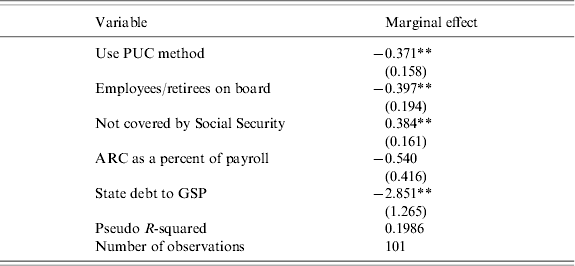
Notes: Robust standard errors are in parentheses. The marginal effects are significant at the 5% level (**). For continuous variables, the marginal effect is for a one-unit change from the mean. For dummy variables, the marginal effect is for a change from 0 to 1.
Source: Authors’ calculations from Public Plans Database.
6.2 Trends in ARC payments
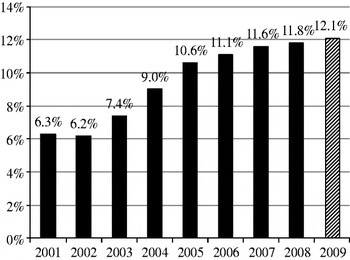
The previous analysis suggests, albeit mildly, that the probability of making 100% of the ARC payment is inversely related to the magnitude of the ARC. If this cross-sectional relationship holds over time, then the upward trend in the ARC as a percent of payroll for the 126 plans in our sample suggests that fewer and fewer plans will make the full ARC payment. As shown in Figure 4, the ARC increased from 6.3% of payrolls in 2001 to 12.1% in 2009. The increase was driven at least in part from the collapse of the dot-com bubble, which reduced asset values and increased the unfunded liabilities of the plans. The ARC as a percent of payroll increased steadily after 2002 as years of low equity values replaced earlier years of high equity values in the smoothing process. The ARC had more or less stabilized in 2008 and may well have started to decline if the funds had not been hit by another market meltdown. Instead, the ARC as a percent of payroll was higher in 2009 than 2008, and is likely to grow over the next 5 years.
ARC as a percent of payroll, 2001–2009 Source: Public Plans Database (2001–2009).

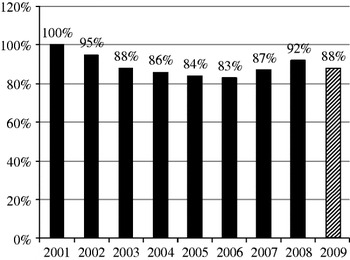
At the same time the ARC as a percent of payroll increased, the percent of ARC paid declined from 100% in 2001 to 83% in 2006 (see Figure 5). It had started to rebound in 2007 and 2008, but fell back in 2009. Without a recovery in the economy and the stock market, the percent of ARC paid is likely to decline further.
Percent of ARC paid, 2001–2009 Source: Public Plans Database (2001–2009).

7 Valuing liabilities
The entire discussion of funded status and ARC payments has been based on the liabilities reported in the plans’ Comprehensive Annual Financial Reports (CAFRs) and Actuarial Valuations. To calculate these liabilities, GASB recommends discounting the stream of future benefits by a rate based on the estimated long-term yield of plan assets – roughly 8%. Most economists contend, however, that the discount rate should reflect the risk associated with the liabilities and, given that benefits are guaranteed under most state laws, the appropriate discount factor is a riskless rate.
Just what rate best represents the riskless rate is a subject of debate. Researchers have laid out some general characteristics.Footnote 26 The rate should reflect as little risk as the liabilities themselves, be based on fully taxable securities (because pension fund returns are not subject to tax), and not have a premium for liquidity (because most pension fund liabilities are long term and do not require liquidity).Footnote 27 Among the interest rates quoted in financial markets, those on Treasury securities come the closest to reflecting the yield that investors require for getting a specific sum of money in the future free of risk. Currently, the yield on 30-year Treasury bonds, about 4%, is likely less than the riskless rate due to the valuable liquidity they offer investors.Footnote 28 Therefore, we increase the current rate by about 1% point and use 5% for 2009.Footnote 29
Some debate also surrounds the appropriate liability concept to use. The use of the PBO seems appropriate for pension plans in the public sector. Benefits promised under a public plan are accorded a higher degree of protection than those under a private sector plan, because under the laws of most states, the sponsor cannot close down the plan for current participants (NCPERS, 2010). That is, whereas ERISA protects benefits earned to date, employees hired under a public plan have the right to earn benefits as long as their employment continues (Steffen, Reference Steffen, Mitchell and Hustead2001). Since public plan sponsors cannot halt accruals under most state laws as can private sector sponsors, the PBO, which includes the effect of future salary increases on the value of pension rights already earned by active workers, seems like the correct measure of liability.Footnote 30
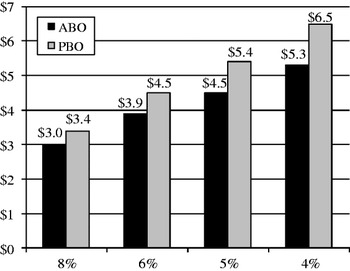
Figure 6 shows what liabilities would look like under alternative liability concepts and interest rates. In 2009, the aggregate liability for our sample of 126 state and local plans was $3.4 trillion, calculated under the guidance provided by GASB 25 – a PBO concept and a typical discount rate of 8%. Assets in 2009 for these sample plans were $2.7 trillion, yielding an unfunded liability of $0.7 trillion. Using a riskless discount rate of 5% raises public sector PBO liabilities to $5.4 trillion, which yields an unfunded liability of $2.7 trillion.Footnote 31
Aggregate state and local pension liability under alternative discount rate assumptions, 2009, in trillions Source: Authors’ calculations from Public Plans Database.

But, in reality, what would such a change mean? Under current circumstances, states and localities are not in any position to double or triple their contributions. Therefore, implementation of any change would have to wait until the economy and markets recover. Moreover, changing the discount rate would have to be considered by the community of actuaries, accountants, and sponsors in the context of other changes, such as perhaps extending the amortization period from 30 to 40 years.Footnote 32 That is, an increase in the measure of the unfunded liability need not automatically translate into an immediate and intolerable increase in annual amortization payments for states and localities.
One change that probably could not wait pertains to the normal cost. Reducing the discount rate from about 8% to 5% would raise the present value of benefits and increase the employer's normal cost from about 7% to about 15% of payroll (assuming the employer paid this full increment).Footnote 33 Since payrolls account for about 28% of state and local budgets, the impact on state finances would be considerably smaller. To estimate the impact of rising pension costs on state and local budgets, we assume that states and localities increase their contributions incrementally between 2009 and 2013, and then start to pay the full ARC, amortizing their unfunded liabilities over a 30-year period. Assuming an 8% discount rate, government contributions to pensions will rise from 3.8% of state and local budgets today to 5.0% in 2014. With a 5% discount rate, pension contributions would increase to 9.1% in 2014.Footnote 34
8 Immediacy of the problem
One of the attractive features of defined benefit plans is that they can pool investment risk across individuals and spread risk over time. Two financial crises within a 10-year period seriously stress any defined benefit system, however, and so an important question is for how long state and local plans will be able to meet their commitments. In other words, are the plans going to run out of money? And, if so, when?
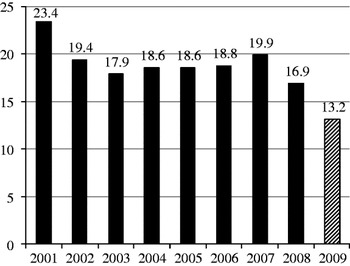
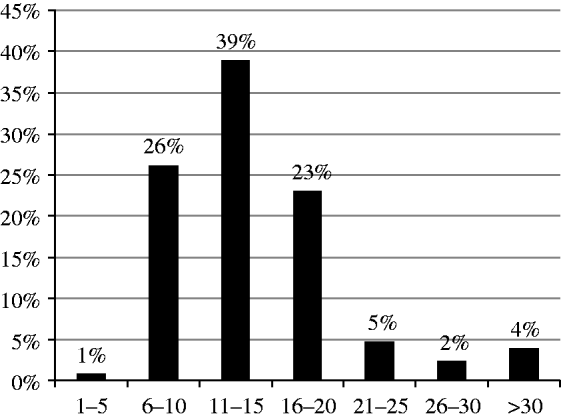
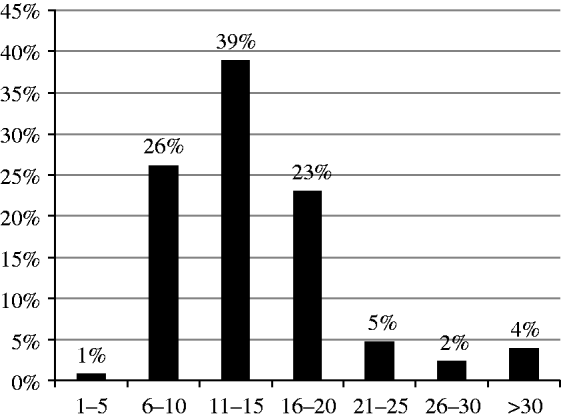
The simplest place to start is the ratio of plan assets to benefits, which shows for how many years’ plans could – with no further investment returns, no additional contributions, and no growth in benefits – continue to pay benefits. Figure 7 reveals that, in 2001, assets were 23 times annual benefit payments, suggesting that with money on hand state and local plans in the aggregate could continue to pay benefits for 23 years. In the wake of the bursting of the dot.com bubble, this ratio dropped for the next 4 years to 19, and was headed back up until the financial crisis of 2008. The ratio now stands at 13. Moreover, plans are distributed around that average ratio (see Figure 8). One plan – Kentucky ERS – has a ratio of 5, and 33 plans – including large plans such as Illinois SERS, New Jersey PERS, and New York City ERS – have ratios between 6 and 10.
Market assets over annual benefit payments, 2001–2009 Source: Authors’ calculations from Public Plans Database (2001–2009).

Distribution of plans by market assets over annual benefit payments, 2009 Source: Authors’ estimates from Public Plans Database (2001–2009).
While the simple ratio is useful for describing trends over time, in fact plan sponsors will continue to make contributions, hopefully plans will earn returns on their assets, and benefit payments will grow as the baby boom retires. Given realistic assumptions then, how long before plans run out of money?
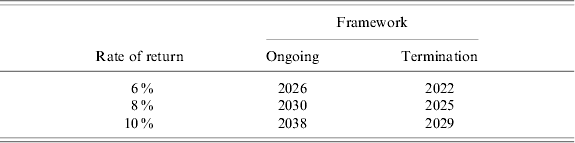
The answer to this question depends on how the exercise is structured. Rauh (Reference Rauh2009) adopts a termination approach, essentially putting benefits earned to date into one plan with the existing assets and creating a new plan where all accruing benefits are covered by future normal cost contributions. The question is then for how many years can the existing assets cover benefits promised to date. Since these plans are underfunded, without additional contributions they ultimately run out of money. The exhaustion date depends on the investment returns. We have replicated Rauh's exercise (using a combination of Rauh's and our actuarial assumptions) and find that the exhaustion dates for current assets are 2022 with returns of 6%; 2025 with returns of 8%; and 2029 with returns of 10% (see Table 3).
Exhaustion date for state and local pension plans under an ongoing and termination framework by rate of return earned on pension assets
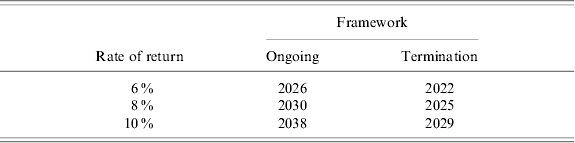
Note: ‘Ongoing’ assumes that plans pay the normal cost in future years and these monies are available to cover benefit payments for current and future employees. ‘Termination’ assumes that plans make future contributions exactly sufficient to cover the cost of future accruals. Benefit payments as calculated under an ABO concept are paid solely out of existing assets and returns on those assets.
Source: Authors’ estimates based on Public Plans Database and Rauh (Reference Rauh2009).
The alternative approach is to treat the plans as ongoing entities. This approach requires a projection of actual benefit payments for current and future employees and the assumption that plan sponsors can use future normal cost contributions to cover benefit payments. Under the ongoing scenario, the exhaustion dates are 2026 with returns of 6%; 2030 with returns of 8%, and 2038 with returns of 10%. Of course, using normal costs to cover benefits rather than accumulating contributions in anticipation of future payments will worsen the funded status of plans. But if the issue is strictly one of plans running out of money, then using normal costs to cover future benefits must be considered.
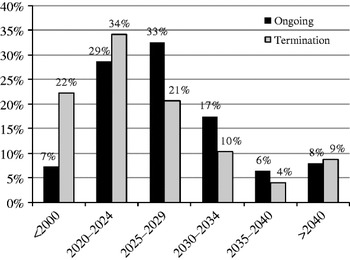
Under either the termination approach or the ongoing approach, plans are distributed around the average exhaustion dates. Assuming the 8% return, we estimated exhaustion dates for each of the 126 plans in our sample, and the results are shown in Figure 9. As expected, the ongoing scenario shows far fewer plans exhausting their assets in the next 10 years, suggesting that plans have more breathing room than the termination approach suggests.
Percent of state and local plans becoming insolvent by year under a ‘Termination’ and an ‘Ongoing’ framework Note: ‘Ongoing’ assumes that plans pay the normal cost in future years and these monies are available to cover benefit payments for current and future employees. ‘Termination’ assumes that plans make future contributions exactly sufficient to cover the cost of future accruals. Benefit payments under an ABO concept are paid solely out of existing assets and returns on those assets. Source: Authors’ estimates based on Public Plans Database and Rauh (Reference Rauh2009).

9 Conclusion
Public pension funding has recently become a front-burner policy issue in the wake of the second financial crisis in a decade. Notably, before the 2008 crisis hit, state and local plans were generally on a path toward full funding. However, the collapse of the stock market has reduced the aggregate funded ratio below 80% with some continued decline likely over the next few years. And the funded ratio looks much worse if liabilities are valued using the riskless rate of return instead of the expected return on plan assets. Not surprisingly, the individual plans in the worst shape tend to be less disciplined in their funding approach, have less access to investment professionals and economies of scale, provide higher benefit levels, and/or are in states with relatively poor fiscal health.
Yet the picture is not as bleak as it first appears. First, most plans have made great strides in improving their funding discipline and management in recent decades, meaning that they have a solid foundation in place. Second, even after the worst market crash in decades, state and local plans do not face an immediate liquidity crisis; most plans will be able to cover benefit payments for the next 15–20 years. Third, states have already begun responding to their shortfalls by increasing employee contributions and reducing benefits for new employees. Finally, once plans have regained their footing, any change in the measurement of liabilities could be handled so that increased pension contributions are manageable. Just as with private investors, though, the future outlook of public pensions is closely tied to the recovery of the economy and the stock market.