Scientific knowledge in the field of infectious diseases is in constant evolution. Emerging and evolving organisms and methods of diagnosis, prevention, or treatment keep this field in a state of flux.Reference Borio, Cox and Lurie 1 During the last decade, healthcare professionals (HCPs) worldwide have dealt with the challenges of H1N1 flu virus, Middle East respiratory syndrome coronavirus (MERS-coV), Ebola virus, and Zika virus, and they are increasingly encountering antimicrobial resistance, which is now considered a ‘crisis for humanity.’Reference O’Neill 2
The Internet presents a universal gateway and an easily accessible channel of information retrieval and communication on medical or scientific topics. With conventional websites, the flow of information is formal and unidirectional. The development of platforms such as ‘blogs’ has opened a great range of possibilities for HCPs worldwide for sharing information and experiences.Reference Cormode and Krishnamurthy 3
Healthcare personnel are proactive in the field, writing more than half of all blogs related to health.Reference Miller and Pole 4 The exponential growth in the number of blogs and other social networks (eg, Twitter, YouTube, and Facebook) with potential relevance to health care makes them worthy of consideration and analysis by healthcare systems as a potentially cost-effective option for activities such as communicating with HCPs, educating HCPs, engaging HCPs with their peers worldwide, or even conducting disease surveillance.Reference Goff, Kullar and Newland 5 – Reference Pei, Muchnik, Tang, Zheng and Makse 7
This collective intelligence network provides interactive services on a certain topic such as infectious diseases, infection control, microbiology, or epidemiology. In these fields, blogs can serve as educational tools, opportunities for reflection, information collators for emerging situations, and/or discussion forums around current controversies.Reference Mairs, McNeil, McLeod, Prorok and Stolee 8 Despite its potential utility, the exploration and analysis of the infectious diseases ‘blogosphere’ remains weak.
In this article, we aim (1) to describe the existing landscape of existing blogs for HCP in the field of infectious disease diagnosis, prevention, and treatment, (2) to assess their content through a quality criteria tool, (3) to analyze HCP interest in blogs, the impact of blogs on HCPs, and the influence of the blogger.
METHODS
This study was conducted in accordance with the Preferred Reporting Items for Systematic Reviews and Meta-analyses (PRISMA) guidelines.Reference Liberati, Alktman and Tetzlaff 9
Search Strategy
We conducted a systematic search for blogs in Google, Yahoo, Bing, and the blog aggregator “Searchblogspot.” The last search was run on October 6, 2015. Search terms (Online Appendix 1) covered (1) infectious diseases (endemic or emerging), (2) antimicrobial stewardship, (3) infection prevention and control, and (4) medical microbiology. In addition, the blogrolls (lists of related blogs or websites) of all selected blogs were scanned to identify any further relevant blogs.
Blog Selection
All blogs that focused exclusively on infectious diseases, infection prevention, treatments, and microbiology (ie, bacteriology, virology, parasitology, mycology) topics were considered. Blogs were eligible for analysis if they (1) focused on human medicine, (2) were written in English, and (3) included at least 1 new post in the 6 months prior to data collection for this study. Blogs on veterinary medicine, blogs with a clear commercial purpose, and blogs clearly targeted toward patients were excluded.
We used a snowball sampling approach to identify infectious-disease–related blogs from keyword searches in various search engines and blog aggregators.Reference Patton 10 This approach is especially appropriate for studying blogs.Reference Hindman, Tsioutsiouliklis and Johnson 11 , Reference Karpf 12 We reviewed the top 200 search-engine results for all preselected keywords. This method has been previously described to yield the most frequently linked blogs as a proxy measure of its influence.Reference Hindman, Tsioutsiouliklis and Johnson 11 From the blogrolls provided by these blogs, we identified additional blogs to consider for inclusion.
Data Collection
Architecture and content evaluation were undertaken for all blogs arising from the Web search, with subsequent full content analysis and quality assessment of those blogs fulfilling the inclusion/exclusion criteria. Moreover, 2 authors (G.B. and R.T.) independently reviewed the blog architecture and content. Disagreements were resolved by a third person (L.M.). A data extraction form was developed and validated using 10 randomly selected blogs. Data from the included blogs were recorded by 2 reviewers (G.B. and R.T.) and were then subjected to further critical appraisal during a narrative synthesis.
Blog architecture
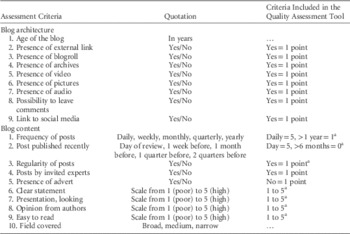
Data extraction aimed to quantify objective measures of blogger characteristics and blog architecture. Demographic information (ie, blogger gender, country, occupation, and education) were extracted. Blogger age was extracted if available or was independently categorized in age groups (10-year ranges) by the 2 reviewers using available data. Blog architecture was assessed using the 9 criteria listed in Table 1.
Criteria Selected for the Quality Assessment of the Blogs Architectures and Contents

a Criteria considered of high importance were multiplied by a factor of 2 in the formula.
Blog content
The contents of blogs and posts were explored using 9 quantitative and qualitative criteria (Table 1). We identified topics by reading blog descriptions and posts, and we coded the primary purpose of each blog. The practical or research purpose of each blog was independently categorized by the 2 reviewers, and disagreements were resolved by discussion. Blog features included the frequency and regularity of posts during the month preceding data collection and the date of publication of the last post. The traffic rank of the blog was estimated using Alexa (http://www.alexa.com/).
A qualitative assessment was also performed for 4 criteria: clear statement, overall presentation, level of analysis on post topics, and ease of reading. These variables were scored using a Likert scale varying from 1 for a poor evaluation to 5 for high-level evaluation. Agreement was reached if the 2 reviewers reported the same score or if the difference did not exceed 1 point. If the scores differed by >1 point, the third reviewer assessed the blog and an average of the 3 scores was taken. Finally, the field covered by the blog was categorized according to the number of topics covered. The field was considered narrow if it was constrained by geographic area or pathogen type or if it was only relevant to a small group of professionals. The field was considered to have a medium breadth of focus if the blog related to a general field (eg, mycology or bioinformatics), and the field was considered broad if the information presented was generally relevant to HCPs or researchers in infectious diseases.
Quality assessment tool
A tool was developed to evaluate the quality of blog architecture and content, including 17 of the 19 criteria described above. A score was derived by attributing 1 point for each item present. Points for 7 items considered highly important were multiplied by a factor of 2 (see formula in Online Appendix 2). The final score could range from 0 to 72. This tool was compared with the previously published “Quality Checklists for Health Professions Blogs and Podcasts”Reference Lin, Thoma and Trueger 13 in terms of acuity and comprehensiveness.
Perception of bloggers and readers
Perceptions of bloggers were qualitatively assessed using an online survey that was directly e-mailed to bloggers and included 10 open questions regarding their motivations, vision, and perceived impact of their blog for readers and themselves (Online Appendix 3). For readers, 10 questions were asked on their habits regarding blogs (eg, how often they comment/share and what they like about blogs) and preferences about blog topics and content. Readers were contacted either directly or indirectly through blogger posts, or via the website and newsletter of the European Society of Clinical Microbiology and Infectious Diseases.
Data Analysis
For categorical variables, χ2 tests or Fisher’s exact tests, as appropriate, were performed. For continuous variables, the median and interquartile range (IQR) were used to describe the data, and Student t test or Mann–Whitney U test, as appropriate, were used to compare value groups. These analyses were performed using Stata release 10.0 software (Stata Corp LP, College Station, TX). All P values were 2-sided, and P<.05 was considered significant. The analysis of blogger and reader answers was performed using NVivo 10 software (QSR International, Melbourne, Australia).
RESULTS
Blog Selection
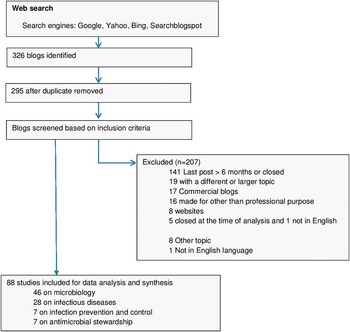
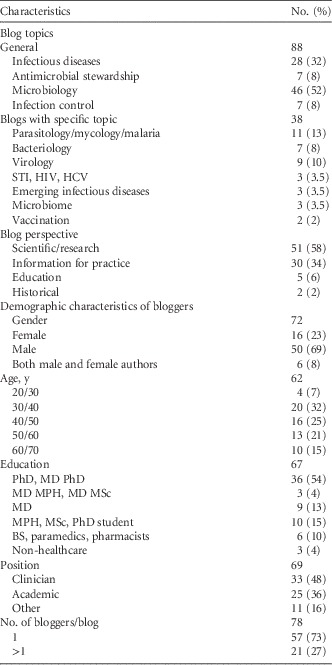
Electronic and subsequent manual searches identified 326 blogs based on the home-page content. Among these, 207 were excluded based on the inclusion/exclusion criteria described above: the most recent posts of 141 blogs were >6 months old; for 19 blogs the topic was incorrect; 17 blogs were commercial in nature; 16 blogs were aimed toward a nonprofessional audience; and the remaining were not blogs, were closed, or were not in English. Thus, 88 blogs remained for analysis (Figure 1). Overall, 46 of the selected blogs (52%) focused on microbiology (ie, 9 bacteriology, 2 mycology, 8 parasitology, 9 virology); 28 (32%) focused on infectious diseases (9 on specific topics); 7 (8%) focused on infection prevention and control; and 7 (8%) focused on antimicrobial stewardship (Table 2).
Flowchart of the search strategy.

Characteristics of Health Blogs and Bloggers, 2015

NOTE. STI, sexually transmitted infections; HIV, human immunodeficiency virus; HCV, hepatitis C virus; MD, medical doctor; PhD, philosophy doctor; MSc, master of sciences; BS, bachelor of science.
Blog and Blogger Characteristics
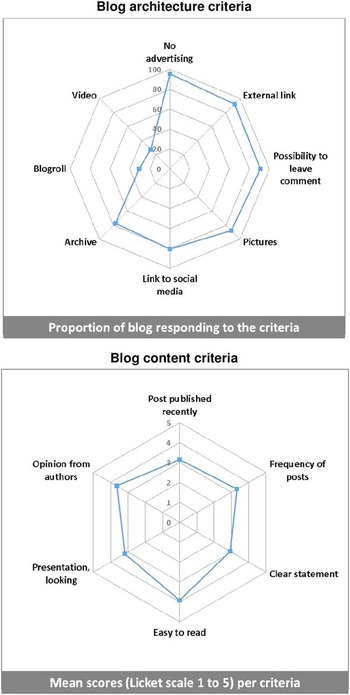
The average age of the 88 blogs we analyzed was 4.7 years (SD, 2.8; range, 0.5–11 years). Moreover, 55% of these blogs had been continuously maintained for >5 years. The selected blogs were mainly based in the United States (n=44, 51%) and the United Kingdom (n=15, 18%). Most blog architecture contained external links (n=82, 93%), archives (n=68, 77%), links with social media (n=71, 81%), pictures (n=77, 87%), or space for comments (n=80, 91%). Blogrolls, audio, and video were infrequent. The blogs were generally maintained by individual professionals (n=57, 89%); however, some blogs were maintained by organizations (n=12, 14%), universities (n=4, 5%), or noncommercial journals (n=3, 3%).
Table 2 displays blogger demographics and background. Among the 72 bloggers for whom data were available, most were male (n=50, 69%) and aged in their 30s (n=20, 32%) or 40s (n=16, 25%). Bloggers had a PhD±MD in 36 of 67 cases (54%), and 10 (15%) held a Master’s degree. Furthermore, 25 bloggers (36%) were academics; 33 (48%) were clinicians; and 19 (28%) bloggers were both academics and clinicians. We found information on the worldwide traffic rank for 65 of the 88 blogs we analyzed. Among these, the median rank was 4.9 million (0.9–10.4 million).
Quality of Blog Content
Overall, 51 (58%) blogs centered on research, whereas 30 (34%) had a more practical approach with a clear implication in routine practice. The content spectrum was considered narrow for 32 (36%) blogs and broad for 25 (26%) blogs. An in-depth analysis of content showed that 26 blogs focused on 1 specific topic, such as a particular disease or geographical area.
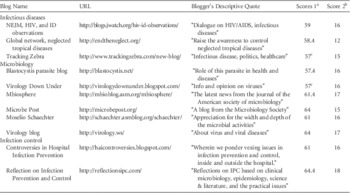
Overall, 33 bloggers (37%) posted weekly and 33 bloggers (37%) posted monthly, representing 74% of all blogs, while 9 bloggers (10%) posted daily. Moverover, blog aims were considered clear for 24 blogs (26%); the field covered was considered broad for 25 blogs (29%); presentation was good for 22 blogs (25%); 52 blogs (60%) were easy to read; and 46 blogs (53%) included expert interpretation (Figure 2). Using our development tool, the median overall score was 49 of 72 (interquartile range [IQR]: 41–55; range, 23–64.4). Blogs with a high quality level (fourth quartile in the distribution of scores) included pictures, video, blogrolls, and guest posts by experts in the field. They had a high frequency of posts, a clear mission statement, and an opinion/analysis given by bloggers. Among the top 10 blogs (2 equally ranked), 3 focused on infectious diseases, 6 focused on microbiology, and 2 focused on infection control (Table 3). The correlation between a traffic rank value and a high quality score was not statistically significant (P=.54).
Description of blog architecture and content criteria.

The Top 10 Blogs by Topic: 2015

NOTE. NEJM, New Englad Journal of Medicine; HIV, human immunodeficiency virus; ID, infectious diseases; AIDS, acquired immunodeficiency syndrome.
a Score obtained using the developed tool.
b Score obtained using the checklist including the 19 criteria (1 point for the presence of the criteria and 0 if absence) published by Lin et al.Reference Lin, Thoma and Trueger 13
c Two blogs obtained the same score and were positioned in tenth position.
Using a previously published checklist, the 88 blogs yielded the following results: a mean score of 4.6 of 9 for credibility of the resource, 6.5 of 7 for the content, and 2.9 of 3 for the design of the blog. The final mean score was 14 (median, 15; IQR, 12–16).Reference Lin, Thoma and Trueger 13 Overall, the comparison of scores between the 2 scales showed a significant difference (P<.01). Of the top 10 blogs identified using the developed tool, 8 scored ≥16 with the published checklist, which corresponded to the third quartile of the distribution (Appendices 4 and 5).
Blogger Perceptions
Among the 58 bloggers for whom contact information was available, 29 bloggers agreed to participate to the survey. This sample had a gender ratio representative of the overall study population, and this group was mainly composed of academic researchers (n=14, 48%). The analysis of verbatim responses revealed that bloggers were mainly motivated to teach, disseminate information, share their experience and opinion, and encourage discussion. The blog provided a platform for freedom of expression, and bloggers derived satisfaction from sharing information and obtaining feedback. Blogging also motivated the bloggers to remain current regarding developments in their fields, and the blogs helped them to build their profiles. Through their blogs, bloggers expected to provide easy access to relevant information that may affect the research or clinical practices of readers. When asked what they felt was unique about their blog, respondents reported that their blogs were uniquely broad or specialized or provided a unique angle due to their background, experience or discipline. The intended audiences were, in descending order, clinicians, researchers, and the public.
Reader Perceptions
Among the 106 readers who participated in the survey, 60 were female (57%) and the median age was 40.5 years (IQR, 33–51 years). Among all readers, 66 (62%) were clinicians and 33 (31%) were mainly researchers. They regularly read a median of 2.7 (IQR, 1–3) blogs: 86 (76.79%) read the latest research publications; 49 (62%) read news and developments in their field; 56 (58%) sought to read professional current opinion. Readers liked their favorite blog due to the topic or the variety of topics covered, the author’s unique viewpoint, a concise and synthesized format, and/or regular updates. Blogs represented a source of enjoyment for some readers. Most readers (n=83, 78%) never or rarely commented on blogs, and 56% often or sometimes shared blog posts with colleagues. Finally, 66 readers (62%) considered the presentation of the blog important, and 55 (52%) felt the inclusion of multimedia was important.
DISCUSSION
The content of most of the 88 infectious disease blogs we analyzed focused on microbiology and were intended for research purposes. These results suggest that some improvement may be needed regarding the presentation and attractiveness of blogs. Antimicrobial stewardship appeared to be poorly represented in the blogosphere (7 blogs; mean score, 48.6; range, 29.8–64.4) despite the large public health problem posed by antimicrobial resistance. Overall, messages impacting daily practices were delivered in 34% of the blogs analyzed. Blogs appeared to be a free medium of expression for bloggers, providing the opportunity for wide-reaching and independent visibility. For readers, these tools were an easy way to access a large amount of cutting-edge information with some expert analysis on emerging and controversial issues.
Social media is now firmly embedded within healthcare.Reference Miller and Pole 4 , Reference Mallin, Schlien and Doctor 14 , Reference Loeb, Bayne and Frye 15 In the recent global threats presented by MERS-coV, Ebola, and antimicrobial resistance, blogs have been used as a medium to instantaneously share data among professionals regarding the epidemiological situation and control measures.Reference Mackay and Arden 16 , Reference Perencevich, Edmond and Diekema 17 In this way, unpublished information, study results, analyses, and opinions have been disseminated, avoiding the comparatively long and complicated publication process required by scientific journals. Several blogs among the top 10 scored in the present study published multiple posts what address the management of these acute emerging situations.Reference Mackay and Arden 16 – Reference Adalja 21 Used synergistically with peer-reviewed journals, blogs can advertise published articles, contributing to their readership and increasing their citation. Blogs can synthesize and facilitate access to research findings in various fields (for patients and the public as well), providing a broad vision of health science and supporting the possibility of collaboration on translational projects.
This channel of communication may not present the same level of selection, quality control, or improvement process demanded by peer-review journals. Most blogs offer opportunities for comment, response, and interactions to refute or endorse the information presented in posts, but in practice, the option to comment is rarely used by readers (ie, only 32% of blogs had ≥1 comment post). Most high-level blogs included in the present study were maintained by a multidisciplinary team comprising HCPs and academics, which allows the cross-checking of post quality. During the selection process, 141 of 295 blogs (48%) did not publish posts during the 6 months prior to the data collection for this study. This raises the question of reliability of outdated information delivered by some blogs.
The quality assessment tool developed for the present study included quantitative and qualitative criteria, and it provided a frame with which to measure the value and accuracy of the message delivered. The published checklist used as a comparison to this tool focuses on the credibility, the content, and the design of blogs.Reference Lin, Thoma and Trueger 13 This checklist provides an overall estimation of blogs and evaluates their value as educational support rather than as platform for sharing information and ideas.
Regarding the format of a blog, pictures and video are becoming more widespread; they complement the text and help readers understand the message. Blogs with high quality scores also tended to invite expert guest bloggers or interviewees. This feature gives credibility to the message delivered and to the blog in general. Globally, the best blogs stand out by clearly stating their purpose, by being easy to read and well presented, and by providing a high level of analysis.
The field of antimicrobial stewardship and infection control are poorly represented in the blogosphere. With knowledge and recommendations on the efficient and accurate use of antibiotics in constant change, the creation of a blog giving clear information and understandable advice to clinicians on antimicrobial stewardship could be a valuable resource.
Previous studies assessing blogs focused on other healthcare disciplines and highlighted the concern of the medical world about blogs as a medium of communication.Reference Thoma, Chan and Paterson 22 , Reference Albright, Walker and Baird 23 To our knowledge, we are the first to provide a detailed analysis regarding and assessment of blogs, bloggers, and their audiences in the fields of infectious diseases, infection prevention and control, medical microbiology, and antimicrobial stewardship. The assessment tool we developed could be used to assess blogs in other fields of health science.Reference Lin, Thoma and Trueger 13 The PRISMA method allowed selection and analysis similar to a systematic review, reducing subjectivity. The list of blogs identified in this study can guide interested readers to the most helpful professional blogs. The qualitative view of bloggers and readers is essential to understanding how blogs may be used and how they should be structured.
This study has several limitations. First, although we identified a large proportion of the most influential blogs in infectious diseases, microbiology, and infection control using snowball sampling, some blogs may have not been captured by this approach. Second, the qualitative criteria were scored by 3 different people and reflect their own perception; thus, scoring may be subjective. However, the use of a Likert scale has been shown to reduce this bias.Reference Pittet, Simon, Hugonnet, Pessoa-Silva, Sauvan and Perneger 24 Finally, this study focused only on blogs developed for HCPs or researchers. Blogs aimed at patients and the public will become increasingly important as health care shifts toward a more patient-centered approach.
Blogs mainly aggregate relevant articles, publicize and critique important findings, and highlight implications for frontline staff or researchers. While academic journals remain the standard for disseminating scientific knowledge, blogs represent user-friendly, interactive, and efficient tools for the development of online research communities, and they are a powerful means of sharing time-sensitive information, analysis, and opinion on emerging issues. Crucial topics such as antimicrobial stewardship remain poorly represented in the blogosphere.
ACKNOWLEDGMENTS
Financial support: This research was partially funded by the National Institute for Health Research (NIHR) Health Protection Research Unit in Healthcare Associated Infection and Antimicrobial Resistance at Imperial College London, in partnership with Public Health England (PHE), and the NIHR Imperial Patient Safety Translational Research Centre. The views expressed are those of the author(s) and not necessarily those of the National Health Service (NHS), the NIHR, the Department of Health, or PHE. The authors also acknowledge the UK Clinical Research Collaboration Centre for Infection Prevention and Management, Imperial College Healthcare NHS Trust, and the NIHR Imperial Biomedical Research Centre.
Potential conflicts of interest: All authors report no conflicts of interest relevant to this article.
SUPPLEMENTARY MATERIAL
To view supplementary material for this article, please visit https://doi.org/10.1017/ice.2017.69