
I. INTRODUCTION
Nanoscale titania is now one of the most applicable heterogeneous photocatalysts.Reference Hashimoto, Irie and Fujishima1 Among 12 polymorphous modifications of titanium dioxide, three natural modifications of titanium dioxide with anatase, rutile, and brookite structures are best known; the highest photocatalytic activity was found for anatase.Reference Tanaka, Capule and Hisanaga2
Titanyl sulfate is often used for preparing nanoscale anatase.Reference Billik and Plesch3–Reference Lasfargues, Bell and Ding10 Thermal behavior of anhydrous titanyl sulfate TiOSO4 and titanyl sulfate monohydrate TiOSO4·H2O is studied in detail.Reference Hanrahan11,Reference Ahmed, Fjellvåg and Kjekshus12 On heating, anhydrous titanyl sulfate undergoes a reversible phase transition at ∼330 °C and decomposes into anatase at ∼525 °C. Titanyl sulfate monohydrate loses its crystal water at ∼310 °C; liberation of sulfur trioxide starts at ∼40 °C lower temperature than for anhydrous titanyl sulfate. Thermal decomposition of titanyl sulfate dihydrate TiOSO4·2H2O is also well studied.Reference Reynolds and Wiseman13–Reference Reynolds, Bhargava, Antolasic and Tade15 Upon heating, titanyl sulfate dihydrate exhibits two mass losses, the loss of two water molecules and evolution of sulfur trioxide between 560 and 650 °C; at 650 °C, a crystalline phase starts to appear; at 700 °C, anatase is the major phase and the formation of rutile becomes apparent; upon further heating, anatase is converted to rutile, at 900 °C little or no anatase can be detected. Temperatures of anatase–rutile transformations obtained by numerous authors are summarized in the review.Reference Hanaor and Sorrell16 In mesoporous TiO2/SiO2 (5 wt% TiO2), which was synthesized by the sol–gel method, anatase remains stable up to 1000 °C.Reference Strauss, Maroneze, de Souza e Silva, Sigoli, Gushikem and Mazali17
Hydrogen peroxide has been often used for titania preparation by wet syntheses including various sol–gel methods.Reference Fattakhova-Rohlfing, Zaleska and Bein7,Reference Kumar and Rao8,Reference Ge, Xu, E, Tian and Fang18–Reference Lee, Sato and Mohamed25 The common hydrogen peroxide route is based on hydrolysis of a Ti(IV) compound, treatment of the resulting gel by hydrogen peroxide, and thermal decomposition of so-formed peroxo–titanate producing the photocatalyst.Reference Štengl, Grygar, Henych and Kormunda26 High temperature stable anatase was prepared by annealing amorphous titania, which was pretransferred to a colloidal state with the H2O2 solution, at 900 °C; under the same conditions, but without H2O2, rutile formed.Reference Etacheri, Seery, Hinder and Pillai27 We have found earlier that treatment of titanyl sulfate with hydrogen peroxide produces anatase, hydrous titania, and the [TiOx(O2)2−x(H2O)m] phase.Reference Savinkina, Obolenskaya and Kuzmicheva28,Reference Savinkina, Obolenskaya, Kuzmicheva, Kabachkov, Gainanova, Zubavichus, Murzin and Sadovskaya29
Other peroxo compounds were seldom used for preparing titanium dioxide. Persulfate solution was used as a sulfating agent for producing pure anatase phase.Reference Ma, Guo, Jiang, Ma, Ma, Ye and Li30 Titania nanoparticles were prepared from titanium tetrachloride in CH2Cl2 at 80 °C with the use of urea hydrogen peroxide (UHP) as an oxygen donor.Reference Watanabe, Kaneko, Uchimaru, Yanagida, Yasumori and Sugahara31 Nanorice-shaped N:TiO2 photocatalysts were prepared by the peroxo-assisted hydrothermal method using stabilized titanium complex as a precursor and urea as a nitrogen source.Reference Abu Bakar and Ribeiro32
In this work, we have combined thermal decomposition of titanyl sulfate and its reaction with various peroxo compounds in one pot. Here, we report a one-step synthesis of nanoscale titania (anatase or anatase + rutile) with high photocatalytic activity by annealing of titanyl sulfate dihydrate treated with hydrogen peroxide H2O2, ammonium persulfate (NH4)2S2O8, and UHP (NH2)2CO·H2O2.
II. EXPERIMENTAL
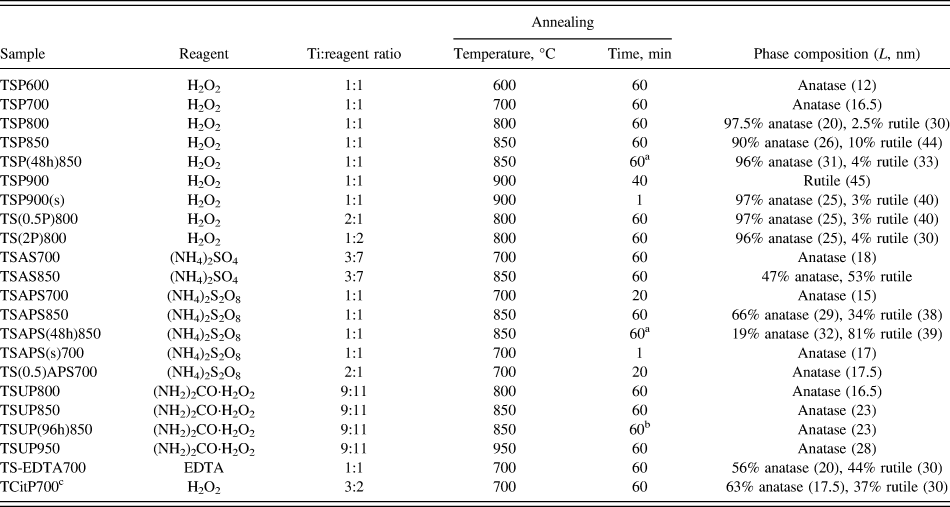
Samples of titanium dioxide were prepared by treatment of titanyl sulfate dihydrate (technical, Sigma Aldrich, St. Louis, MO, USA) with peroxo or nonperoxo reagents followed by annealing in air at various temperatures. Sample numeration, details of syntheses, and phase compositions of the products are given in Table I.
Numeration of the samples, details of synthesis, and phase composition.

a After keeping for 2 days at 20 °C under visible light.
b After keeping for 4 days at 20 °C under visible light.
c From TiO(C6H6O7)·H2O.
Most samples of the TSP (Titanyl Sulfate + Hydrogen Peroxide) series were prepared by mixing 0.4 g titanyl sulfate dihydrate (2 mmol) and 0.2 mL 30% hydrogen peroxide (2 mmol) followed by annealing at corresponding temperatures (marked after TSP) for 60 min. For TS(0.5P)800 and TS(2P)800, 0.1 and 0.4 mL hydrogen peroxide were used, respectively. The TSP900(s) sample was annealed for 1 min.
Samples of the TSAS (Titanyl Sulfate + Ammonium Sulfate) series were prepared by annealing of the mixtures of 0.55 g titanyl sulfate dihydrate (3 mmol) and 0.91 g ammonium sulfate (NH4)2SO4 (7 mmol) at corresponding temperatures for 60 min.
Most of the TSAPS (Titanyl Sulfate + Ammonium PerSulfate) series samples were prepared by annealing of the mixtures of 0.4 g titanyl sulfate dihydrate (2 mmol) and 0.46 g ammonium persulfate (2 mmol) at corresponding temperatures for 20–60 min. For preparing TS(0.5)PSA700, half quantity of ammonium sulfate was used. Sample TSAPS(48h)850 was annealed after keeping the mixture at room temperature for 2 days. Sample TSAPS700(s) was annealed for 1 min.
Samples of the TSUP series (Titanyl Sulfate + UHP complex) were prepared by annealing of the mixtures of 1.7 g titanyl sulfate dihydrate (9 mmol) and 1.0 g UHP (11 mmol) at corresponding temperatures for 60–330 min.
For comparison, several samples were prepared in similar conditions without any treatment. In addition, some chelating compounds were used. For example, titanyl sulfate dihydrate (0.4 g, 2 mmol) was treated with ethylenediaminetetraacetic acid (EDTA, 0.68 g, 2 mmol) and annealed at 700 °C (sample TS-EDTA700). Furthermore, H2O2-treated (30%, 0.4 mL, 2 mmol) titanyl citrate TiO(C6H6O7)·H2O (0.73 g, 3 mmol) was annealed to compare it with titanyl sulfate dihydrate.
All the samples were characterized by X-ray diffraction (XRD) patterns, which were recorded with sample rotation on an HZG-4 (Ni filter) diffractometer: Cu Kα radiation in the diffracted beam, stepwise mode (counting time 10 s, a step of 0.02°). Special programs for the analysis of XRD patterns and calculation of substructure parameters allowed describing profiles of diffraction reflections of amorphous and nanoscale subjects by various functions with correction of background, distinction of overlapping peaks, recovery of reflection shapes, and calculating elements of nanoparticle substructures including crystallite sized. Qualitative XRD phase analyses were carried out using JCPDS PDF-2 and literature data with the special program for multiphase samples. The phase ratio of anatase and rutile was calculated using the formulae x R, % = [1 + 0.65(I A/I R)]−1, x A, % = 100 − x R, where I A and I R are integral intensities of the 101 reflection for anatase and 110 reflection for rutile.
The average crystallite sizes were calculated (excluding possible microstrains) according to the formula L = Kλ/β cos θ, where λ = 1.54051 Å is the wave length (Cu Kα), 2θ–25° (θ is the scattering angle), β is the integral width of the peak, and the particle shape factor (Scherrer ratio) K was taken to be 0.9. The standard deviation is ±5%.
A study of the microstructure of the samples was performed by scanning electron microscopy (SEM) using a JSM 7500F (Tokyo, Japan) high resolution electron microscope. For the analysis of photographs obtained by SEM, the authors used the specialized program.Reference Obolenskaya, Gaynanova, Kravchenko, Kuz’micheva, Savinkina, Domoroshchina, Tsybinsky and Podbelsky33
Chemical qualitative and quantitative composition was determined by X-ray microanalysis (XRMA) at four points, using an energy dispersive X-ray microanalyzer, established in the same high-vacuum chamber of the microscope. Quantitative analysis was performed using the INCA Penta FET (Oxford, GB) mathematical program for all elements with atomic number >3.
The microstructure of the samples was also studied using a Carl Zeiss NVision 40 (Jena, Germany) scanning electron microscope (micrographs were obtained at 1 kV acceleration voltage) equipped with an Oxford Instruments X-MAX (Oxford, GB) energy-dispersive X-ray (EDX) analyzer operating at 30 kV acceleration voltage. The samples were not specially prepared (e.g., coated with conducting material) for the measurements. Before EDX analysis, samples were coated with ∼5 nm Au/Pd.
IR spectra were recorded with an Infralum FT-02 (St. Petersburg, RF) spectrometer. The IR spectra of untreated and H2O2-treated titanyl sulfate were recorded at low temperature since their spectra recorded at room temperature were poorly resolved; the samples of reagents (and nujol) were precooled at −21 °C.
Raman spectra were analyzed using an RFS 100/S FT Raman spectrometer (Bruker, Karlsruhe, Germany) with a 1060 nm Nd laser (the power density on the sample surface did not exceed 50 W/cm2) with a spectral resolution of 2 cm−1.
X-ray photoelectron spectra were obtained using a PHOIBOS 150 MCD (Berlin, Germany) spectrometer with monochromatic Mg Kα radiation (hν = 1253.6 eV). The powder was placed onto the holder surface. The pressure in the sample chamber did not exceed 3 × 10⁻⁹ torr, and the power of the source was 225 W. An X-ray source was placed at 45° with respect to the sample surface. The spectra were recorded with constant transmission energy (30 eV, step 1 eV for a survey spectrum and 10 eV, step 0.1 eV for peaks), 10 atomic layers depth, and 1 cm2 surface area. The C1s peak (284.8 eV) was used for calibration.
Electronic absorption spectra were recorded with an Aquilon CF 103 UV/vis spectrophotometer. For calculating direct band gap energies, spectral curves were plotted as (A·E)2 = f(E 2).Reference López and Gómez34
Properties of the samples were compared in the model reaction of color removal from aqueous solution containing methyl orange (MO) under UV radiation (Camelion UV lamp, 26 W; λ = 250–400 nm) in a photoreactor system with continuous stirring. The MO dye discoloration was monitored by absorbance at λ = 495–515 nm or 450–470 nm (pH ∼ 3 or pH ∼ 5, respectively). The photocatalytic discoloration of the MO dye can be described by the first-order kinetic model, ln(c 0/c) = kt, where c 0 is the initial concentration and c is the concentration at time t.Reference Brown and Darwent35 Uncertainties in determining rate constants are ∼10%. For comparison, we have studied activity of commercial titania samples, Hombikat UV100, and Hombifine N (Sachtleben), which are also synthesized from titanyl sulfate and show higher activity in the model reaction described above than the more commonly used photocatalyst Degussa (Evonik, Essen, Germany) P25.Reference Savinkina, Obolenskaya and Kuzmicheva28
III. RESULTS
A. Treatment with hydrogen peroxide
Treatment of titanyl sulfate dihydrate with 10 M hydrogen peroxide at room temperature results in dissolution of the solid reagent caused by complexation of Ti(IV) with hydrogen peroxide producing bright red sol followed by hydrolysis of titanium compounds and partial decomposition of peroxo complexes.
After rolling on a slide, initial viscous liquid formed a transparent film 5–8 μm thick. Its transformations were monitored by optical microscopy. In 30 s, gaseous products evolving from the film, which was prepared with the use of 10 M hydrogen peroxide, formed red bubbles; they did not change on further storage.
The intensity of light scattering (∼700 nm) in the UV/vis spectrum of the mixture decreases and the intensity of the absorption bands at ∼305 and 440–450 nm increases during the reaction (30–600 s). Two latter bands can be caused by formation of the [TiOx(O2)2−x(H2O)m] phase.Reference Savinkina, Obolenskaya, Kuzmicheva, Kabachkov, Gainanova, Zubavichus, Murzin and Sadovskaya29
Annealing of H2O2-treated titanyl sulfate at 250 °C for 1 h (sample TSP250) results in partial dehydration of TiOSO4·2H2O and formation of [TiOx(O2)2−x(H2O)m] (2θ ∼ 26°, L ∼ 1–2 nm) (see the Supplementary Material). Annealing of H2O2-treated titanyl sulfate at 600 °C for 1 h (sample TSP600) produces anatase (L ∼ 12 nm), probably, with very small quantity of TinO2n−1 (n = 9–10). IR spectra support dehydration and destruction of titanyl sulfate; the increase of annealing temperature from 550 to 700 °C results in disappearing of the bands assigned to sulfate (1030–1210 cm−1) and hydroxyl (3200 cm−1) groups.
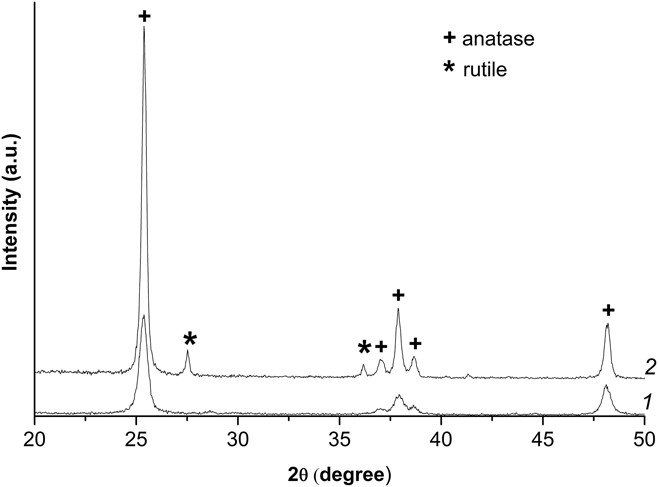
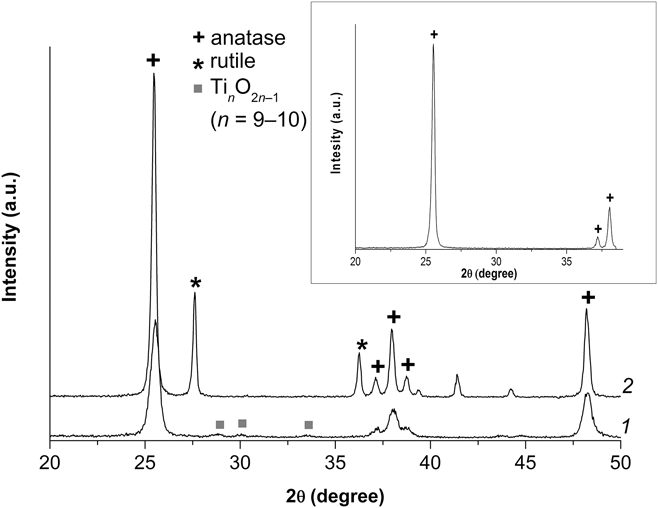
The sample annealed at 700 °C consists of anatase with L ∼ 16.5 nm (Fig. 1, curve 1). The peak at 2θ ∼ 38° splits in three peaks, indicating the phase transition of nanoscale anatase accompanied by the change of symmetry. Annealing at 800 °C for 1 h (sample TSP800) gives the mixture of nanoscale anatase (97.5%, L ∼ 20 nm) and rutile (2.5%, L ∼ 30 nm) (see the Supplementary Material). Variations of the TiO2:H2O2 ratio [samples TS(0.5P)800 and TS(2P)800] give minor effect on resulting compositions. The increase of the annealing temperature up to 850 °C (TSP850) results in enlargement of anatase crystallites up to 26 nm and increase of rutile content up to 10% (Fig. 1, curve 2). However, storage of titanyl sulfate treated with H2O2 at room temperature for 48 h followed by annealing at 850 °C decreases rutile content down to 4%.
XRD patterns of titanyl sulfate treated with hydrogen peroxide and annealed at 700 °C (TSP700) (1) and 850 °C (TSP850) (2).

A similar product was obtained on annealing the reaction mixture at 900 °C [TSP900(s)] for 1 min; it consists of nanoscale anatase (97%, L ∼ 25 nm) and rutile (3%, L ∼ 40 nm). However, further annealing at this temperature (TSP900) produced pure rutile with L ∼ 45 nm.
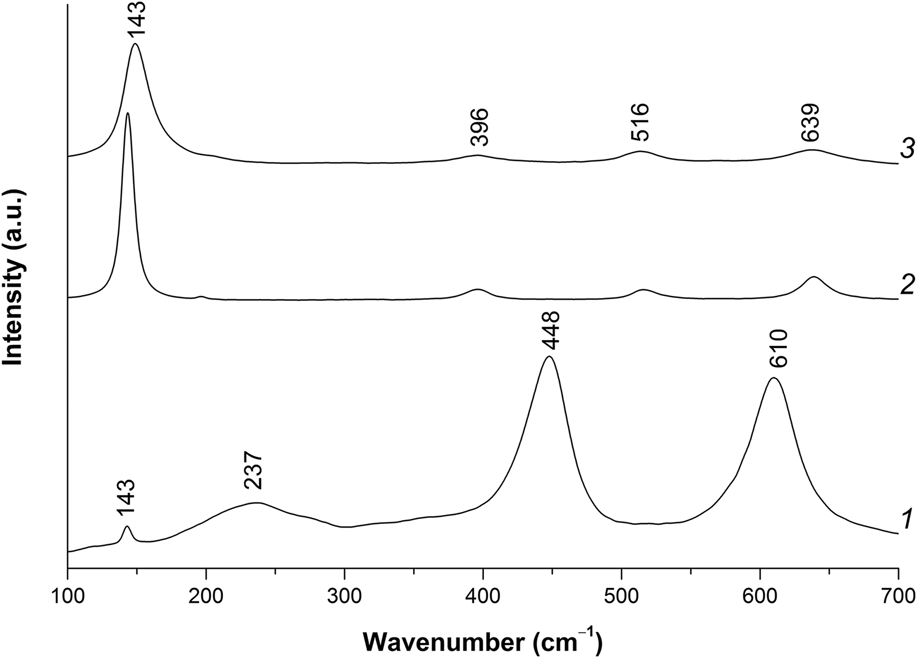
Raman spectra of titanyl sulfate treated with hydrogen peroxide and annealed at 800 °C (TSP800) and Hombikat UV100 showed typical bands of nanoscale anatase at 144 (Eg), 396 (B1g), 516 (A1g + B1g), 639 (Eg) cm−1.Reference Strauss, Maroneze, de Souza e Silva, Sigoli, Gushikem and Mazali17 By contrast, the sample prepared at similar conditions without hydrogen peroxide (TS800) showed bands of rutile at 143 (A1g), 237 (B1g), 448 (Eg), and 610 (B2g) cm−1 (Fig. 2).
Raman spectra of titanyl sulfate annealed 800 °C: naked (TS800) (1), treated with hydrogen peroxide (TSP800) (2), and Hombikat UV100 (3).

Therefore, the [TiOx(O2)2−x(H2O)m] phase formed on treatment of titanyl sulfate with hydrogen peroxide promotes its decomposition producing anatase, but prevents transformation of anatase to rutile.
Four main methods of improving temperature stability of anatase are known.Reference Periyat, Naufal and Ullattil36 They are (i) doping with metal ions, (ii) doping with nonmetal ions, (iii) co-doping with metal and nonmetal ions, and (iv) dopant free stabilization by oxygen richness. The latter approach was described for the synthesis of high temperature stable visible light active anatase by the in situ generation of oxygen through the thermal decomposition of the peroxo–titania complex.Reference Etacheri, Seery, Hinder and Pillai27 However, the role of chelating ability of peroxo groups was not studied. Therefore, we tested other chelating reagents. Annealing titanyl sulfate dihydrate treated with EDTA or titanyl citrate at 700 °C for 1 h produced mixtures of anatase (56%, L ∼ 20 nm and 67.5%, L ∼ 15 nm, respectively) and rutile (44%, L ∼ 30 nm and 32.5%, L ∼ 25 nm, respectively). Pretreatment of titanyl citrate with hydrogen peroxide led to increase of the anatase:rutile ratio (63%, L ∼ 17.5 nm and 37%, L ∼ 30 nm); however, it was significantly lower than for titanyl sulfate treated with H2O2. Therefore, treatment with hydrogen peroxide is much more effective for preparing thermally stable anatase as compared to other chelating agents.
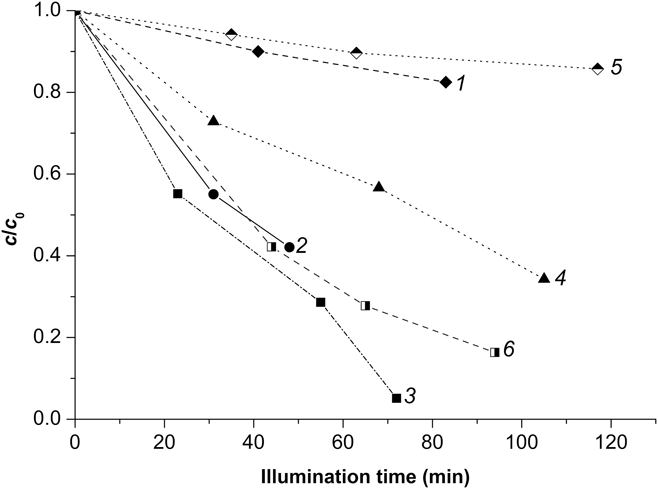
The samples of H2O2-treated titanyl sulfate, which were annealed at 250 and 550 °C, show lower activity for discoloration of MO under UV irradiation than commercial Hombikat UV100. The activity significantly increases for the sample, annealed at 700 °C (TSP700); it is higher than for commercial Hombikat UV100, which is also manufactured from titanyl sulfate but at lower temperature (Fig. 3, curves 1, 2).
MO relative concentrations against the illumination time of the various photodegradation experiments using Hombifine N (1) and titanyl sulfate annealed at 700 °C after treatment with hydrogen peroxide (TSP700) (2), annealed at 850 °C after treatment with ammonium persulfate (TSAPS850) (3), after treatment with ammonium persulfate and storage for 2 days [TSAPS(48h)850] (4), after treatment with ammonium sulfate (TSAS850) (5), and UHP (TSUP850) (6).

Further increase of the annealing temperature decreased the rate of discoloration of MO; this may be caused by transformation of anatase to rutile. The H2O2:TiOSO4 molar ratio of 1:1 seems to be optimal since variations of the H2O2:TiOSO4 ratio also decrease the activity of the products.
B. Treatment with ammonium persulfate
The interaction of powdered titanyl sulfate dihydrate and ammonium persulfate on grinding at room temperature results in similar processes as with the use of solution of hydrogen peroxide, but the rates of both stages (formation of peroxo compounds and hydrolysis) are lower due to the absence of a liquid phase. Light coloration appears only after 3–4 min grinding. The film prepared with the use of ammonium persulfate became red and nontransparent in 48 h. These changes are caused by hydrolysis of titanyl sulfate, which results in precipitating a solid and lowering pH (yellow peroxo complexes become red). The [TiOx(O2)2−x(H2O)m] phase can be found in the UV/vis spectra in two days after mixing reagents.
The thermal curve for TiOSO4·2H2O treated with (NH4)2S2O6(O2) shows maxima of mass loss at 99 (evaluation of oxygen), 215, 323, 376, 442 (decomposition of ammonium bisulphate), and 504 °C (decomposition of titanyl sulfate and formation of titania).Reference Obolenskaya, Savinkina, Kuzmicheva and Istomin37
Annealing of the mixture of the titanyl sulfate dihydrate and ammonium persulfate powders at 700 °C (sample TSAPS700) produces anatase (L ∼ 15–17.5 nm) and, probably, TinO2n−1 (n = 9–10) (Fig. 4, curve 1). Only anatase forms on annealing of the reaction mixture at 700 °C for 1 min [TSAPS700(s)] and annealing of the mixture with lower content of ammonium persulfate [TS(0.5)PSA700]. The product of annealing of the same mixture at 850 °C (TSAPS850) contains rutile (Fig. 4, curve 2); its content increases on keeping the initial mixture TiOSO4·2H2O + (NH4)2S2O8 at room temperature for 48 h [TSAPS(48h)850]. This can be caused by partial destruction of peroxo groups on storage of the mixture and decrease of residual oxygen content.
XRD patterns of titanyl sulfate treated with ammonium persulfate and annealed at 700 °C (TSAPS700) (1) and 850 °C (TSAPS850) (2) and treated with UHP and annealed at 950 °C (inset).

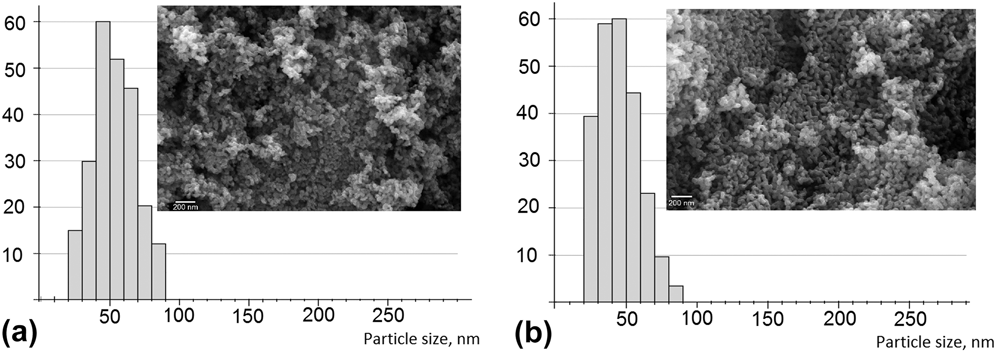
Annealing of titanyl sulfate dihydrate at 850 °C in the presence of ammonium persulfate (TSAPS850) or ammonium sulfate (TSAS850) produced particles of similar sizes (Fig. 5).
SEM images and size distribution of titania samples, annealed at 850 °C after treatment with ammonium persulfate (TSAPS850) (a) or ammonium sulfate (TSAS850) (b).

Specific surfaces for TSAPS850 and TSAS850 are 44 and 36 m2/g (BET), 33 and 24 m2/g (comparative method), respectively. Specific pore volumes are 0.021 and 0.017 cm3/g, average pore sizes are 1.901 and 1.927 nm, respectively.
The samples of titanium dioxide prepared by annealing of the TiOSO4·2H2O + (NH4)2S2O8 mixtures discolor MO under the UV irradiation with higher rate, as compared to the TiOSO4·2H2O + H2O2 mixtures (Fig. 3). In contrast to the H2O2-treated samples, the increase of the annealing temperature from 700 to 850 °C for the samples of (NH4)2S2O8-treated titanyl sulfate results in increase of the rate of discoloration of MO by ∼14%. It is noteworthy that keeping the TiOSO4–(NH4)2S2O8 reaction mixture for 48 h at room temperature before annealing at 850 °C [TSAPS(48h)850] decreases resulting activity. However, the sample is still more active than the sample prepared with adding ammonium sulfate containing no peroxo groups (TSAS850) or Hombifine N (Fig. 3).
C. Treatment with UHP
In the mixture of white solid titanyl sulfate dihydrate and UHP, orange coloration appears on the second minute of grinding at room temperature. The mixture becomes plastic; in 20 min, it transforms to a solid monolith. The films prepared from the plastic mixtures remain transparent for several months; no gas bubbles can be seen by optical microscopy. It seems that titanyl sulfate dihydrate transforms to a stable polymeric Ti(IV) complex with peroxo or/and urea bridges.
On dispersing the sample in water, yellow powder immediately forms. It’s XRD pattern shows poorly formed amorphous phase (2θ ∼ 11°) with ambiguous composition TiO2−x(OH)2x·yH2O (y ∼ 1), which can be described as a mixture of various acidic phases, (H2TiO3 and H4TiO4) and can transform to the anion-mixed phase (TiO)(HSO4)x(OH)y in the presence of sulfate ions,Reference Vasilyeva, Kuz’micheva, Pochtar, Gainanova, Timaeva, Dorokhov and Podbel’skiy38 and peroxo phase [TiOx(O2)2−x(H2O)m] (2θ ∼ 26°); reflections of titanyl sulfate dihydrate are absent.
The thermal curve for titanyl sulfate dihydrate treated with the (NH2)2CO·H2O2 powder shows maxima of mass loss at 94 (evaluation of oxygen), 156 (removal of water), 180 (decomposition of urea), and 513 °C (decomposition of titanyl sulfate and formation of titania).Reference Obolenskaya, Savinkina, Kuzmicheva and Istomin37
Annealing the mixture of the titanyl sulfate dihydrate and UHP powders at 800 °C and 850 °C for 1 h (TSUP800 and TSUP850, respectively) gives the products, which consist of anatase (L ∼ 17 nm and 23 nm, respectively). The XRD patterns contain no reflections of rutile. No rutile was found in the product of annealing this mixture up to 950 °C (Fig. 4, inset).
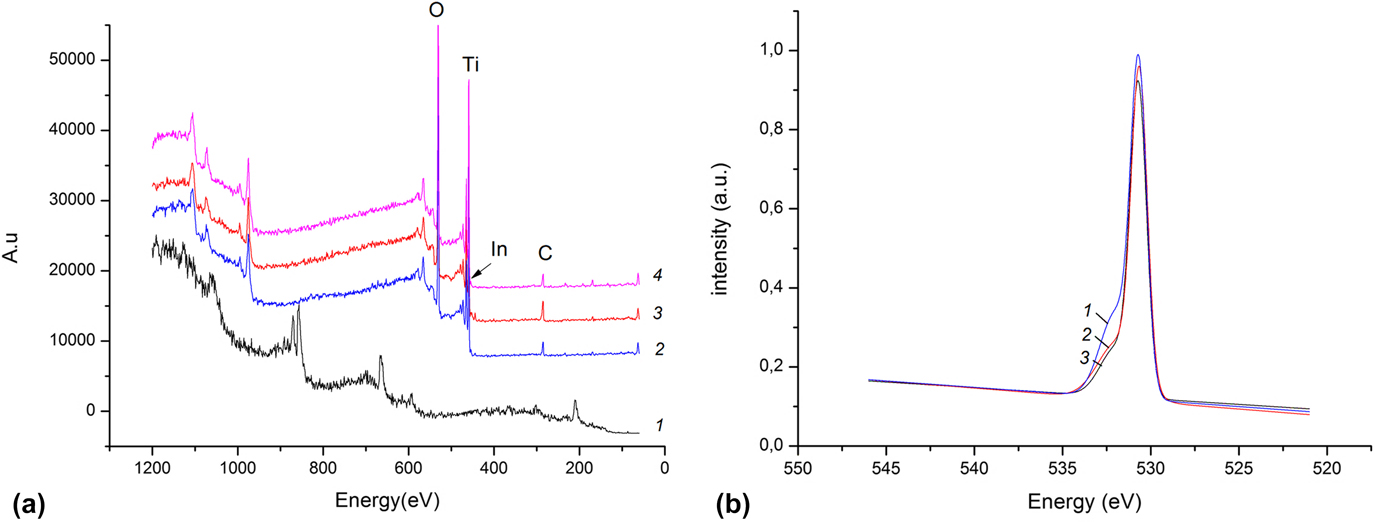
The IR spectra of UHP and its mixtures with titanyl sulfate dihydrate before and after annealing are presented in the Supplementary Material. In the mixture of titanyl sulfate dihydrate and UHP (TSUP25), there are the bands of sulfate ions (1030–1050, 1130–1140, and 1210–1230 cm−1) and of UHP. The IR spectrum of the sample annealed at 185 °C (TSUP185) contains the same bands; however, most of them become wider and less intensive. Annealing at 515 °C (TSUP515) leads to disappearance of the bands of urea and decrease of intensity of the bands of sulfate. The broad adsorption band at 3300–3400 cm−1 and the band at 1620–1640 cm−1 can be assigned to the stretching and bending modes of water. The band at approximately 2350 cm−1 is caused by adsorbed carbon dioxide. Carbon dioxide reacts with the titania powder with formation of bicarbonate, uni-, and bi-dentate carbonate species.Reference Ono and Hattori39 The presence of adsorbed hydroxide и carbonate ions on the surface of the annealed samples was supported by X-ray photoelectron spectra of TSUP850, which show the presence of titanium as titanium dioxide (the main phase), oxygen (63% as Ti–O and 37% in the form of adsorbed OH− and CO32−), carbon (7% as CO32−, 83% as C–C, and 10% as C–O–C) and admixtures of sulfur (as SO42−) and nitrogen.
For the results of the XRMA and elemental analysis data, see the Supplementary Material. Urea and peroxo groups do not destroy up to 185 °C. It is noteworthy that the XRMA shows the presence of excess oxygen even after annealing the mixture of the titanyl sulfate dihydrate and UHP powders at 515 °C (TSUP515). Urea is absent in the sample annealed at 515 °C; however, TSUP515 contains residual nitrogen.
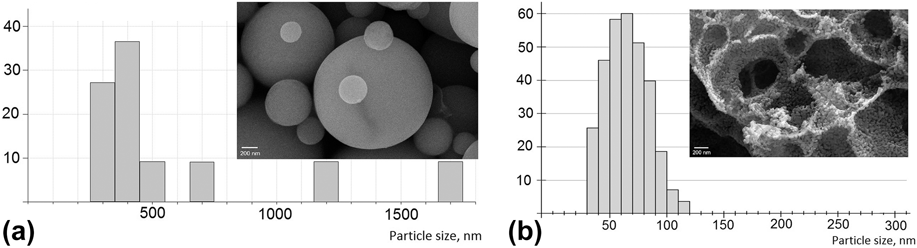
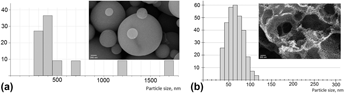
The morphology in the sample prepared by annealing the mixture of titanyl sulfate dihydrate and UHP at 850 °C (Fig. 6) differs from the samples prepared with the use of ammonium persulfate or ammonium sulfate (Fig. 5). Titania particles form walls of microscale spheroid cavities. This can be caused by preformation of microspheres on mixing the reagents at room temperature (TSUP25), see Fig. 6(a). Similar microspheres were found for titanium dioxide prepared by hydrolysis of titanium tetrachloride both in the presence and in the absence of urea.Reference Tarasov, Trusov, Minnekhanov, Gil, Konstantinova, Goodilin and Dobrovolsky40 After annealing, nanoparticles form; their sizes vary in wider range (30–120 nm), see Fig. 6(b), than for the samples prepared with the use of ammonium persulfate or ammonium sulfate (20–90 nm), see Fig. 5.
SEM images and size distribution of titania samples, prepared by treatment with UHP, before annealing (TSUP25) (a) and after annealing at 850 °C (TSUP850) (b).

It seems that solidity, plasticity, and stability of the freshly prepared mixture of titanyl sulfate dihydrate and UHP lead to low rate of decomposition bridging peroxo ligands and removal of oxygen. As a result, titania nanoparticles form simultaneously with destruction of initial microspheres and replicate their shape.
Specific surfaces of the product of annealing the mixture of titanyl sulfate dihydrate and UHP are 34 and 29 m2/g (BET and comparative method, respectively). Specific pore volumes are 0.016 cm3/g; pore sizes are ∼1.911 nm.
The samples of titanium dioxide prepared by annealing of the TiOSO4·2H2O + (NH2)2CO·H2O2 mixtures discolor MO under the UV irradiation with lower rate, than the samples prepared from titanyl sulfate treated with ammonium persulfate at the same temperature of 850 °C (TSUP850 and TSAPS850, respectively) (Fig. 4). However, the increase of the annealing temperature of the TiOSO4·2H2O + (NH2)2CO·H2O2 mixtures from 850 to 950 °C (TSUP950) increases the rate of discoloration of MO; it becomes close to the rate for TSAPS850.
IV. DISCUSSION
The modification of titanyl sulfate dihydrate with various peroxo compounds decreases the temperature of its transformation to nano-anatase from 700 to 600 °C due to formation of the intermediate [TiOx(O2)2−x(H2O)m] phase. Annealing of the presynthesised [TiOx(O2)2−x(H2O)m] phase produced pure anatase even at 400 °C.
Stabilization of anatase at high temperature can be caused by complete transformation of microparticles of titanyl sulfate dihydrate to nanoparticles of [TiOx(O2)2−x(H2O)m] (sizes of crystallites ∼1–2 nm) on its treatment with peroxo compounds. The product of annealing of the presynthesised [TiOx(O2)2−x(H2O)m] at 800 °C contained less than 1% rutile. It is known that when titania particles are small (<25 nm), anatase is more stable than rutile. We have shown that average crystallite sizes of the phase with anatase structure vary in the 12–25 nm range, while average crystallite sizes of the phase with rutile structure are larger (30–45 nm); this agrees with the earlier obtained data.Reference Vasilyeva, Kuz’micheva, Pochtar, Gainanova, Timaeva, Dorokhov and Podbel’skiy38 Higher stability of anatase structure as compared to rutile for very small titania particles (<25 nm) is confirmed by the absence of anatase to rutile transformation on annealing commercial superfine anatase Hombifine N up to 850 °C.
On the other hand, oxygen excess produced on thermal decomposition of peroxo groups prevents polymorphic transformation.Reference Ge, Xu, E, Tian and Fang18,Reference Etacheri, Seery, Hinder and Pillai27 The content of rutile in the product of annealing titanyl sulfate dihydrate at 850 °C depends on the added compound and decreases in the row ammonium sulfate (53%) > ammonium persulfate (34%) > hydrogen peroxide (10%) > UHP (0%). It seems that thermal stability of resultant anatase correlates with ability of initial reagents to transform titanyl sulfate to [TiOx(O2)2−x(H2O)m]. Ammonium sulfate cannot produce the peroxo phase; therefore, the product of annealing its mixture with titanyl sulfate dihydrate contains a lot of rutile. The reaction of titanyl sulfate with ammonium persulfate at room temperature, as well as its further hydrolysis is rather slow. It is noteworthy that addition of ammonium persulfate to the sol of partially hydrolyzed titanyl sulfate does not give orange colored Ti(IV) peroxo complexes. As a result, the product of annealing titanyl sulfate treated with ammonium persulfate at 850 °C contains maximal amount of rutile as compared to other peroxo reagents. The rates of the reaction of titanyl sulfate with 10 M hydrogen peroxide producing titanium(IV) peroxo complexes and their hydrolysis are higher. However, the [TiOx(O2)2−x(H2O)m] phase forms in a noticeable quantity either on annealing at 250 °C or on prolonged storage of the reaction mixture in an auto thermal mode.Reference Savinkina, Obolenskaya, Kuzmicheva, Kabachkov, Gainanova, Zubavichus, Murzin and Sadovskaya29 As a result, annealing of this mixture after 2 days aging produces less rutile than its annealing immediately after mixing reagents. It is noteworthy that pure rutile formed when titanyl sulfate dihydrate was short-time annealed at 250 °C, then treated with hydrogen peroxide and annealed at 800 °C. Probably, [TiOx(O2)2−x(H2O)m] does not form in such conditions. The reaction of titanyl sulfate with UHP in aqueous solution instantly produces [TiOx(O2)2−x(H2O)m]. As a result, all products of annealing titanyl sulfate treated with UHP contain pure anatase.
It is interesting that mixing ammonium disulfate with concentrated solution of titanyl sulfate in sulfuric acid instead of solid titanyl sulfate dihydrate followed by annealing at 850 °C for 60 min also produced pure anatase. This may be caused by high rate of interaction between ammonium persulfate and titanyl sulfate in solution resulting in better complexation of titanium(IV) by peroxo ligands, as compared to solid reagents.
We have found some correlations between thermal stability of anatase and stability of precursors, which was monitored by optical microscopy. Dispersion of titanyl sulfate dihydrate with peroxo compounds (10 M hydrogen peroxide, solid ammonium sulfate, or solid UHP) led to transformation of nontransparent white solid particles of titanyl sulfate dihydrate to yellow viscous liquids (due to formation of titanium(IV) peroxo complexes); after rolling on a slide, they formed transparent films. Annealing at 850 °C of the TiOSO4·2H2O–CO(NH2)2·H2O2 precursor, which gave a stable yellow transparent micron film, produced pure anatase. Annealing of other precursors, whose films became red and nontransparent on storage, at 850 °C produced anatase–rutile mixtures. Therefore, monitoring color and transparency of precursor films with the use of optical microscopy allows predicting phase composition of the products of their annealing at 850 °C.
Annealing of the mixture of titanyl sulfate dihydrate with 10 M hydrogen peroxide at 900 °C for 40 min produces pure rutile. Therefore, stabilizing effect of hydrogen peroxide (and oxygen as a product of its decomposition) disappears at this temperature. On annealing of the mixture of titanyl sulfate dihydrate with ammonium persulfate at the same conditions, about 1.5% of anatase transforms to rutile. However, annealing of the mixture of titanyl sulfate dihydrate with UHP at 950 °C for 60 min produced pure anatase.
We can conclude that the modification of titanyl sulfate with peroxo compounds results in decreasing temperature of transformation of titanyl sulfate to nano-anatase and increasing the temperature of transformation of anatase to rutile. The best results for preparing thermally stable anatase were obtained with the use of UHP.
It seems that the anatase phase retention may be the key reason for high photocatalytic activity of peroxo-modified samples annealed at high temperatures.Reference Etacheri, Seery, Hinder and Pillai27,Reference Periyat, Naufal and Ullattil36 The 2-fold increase of photocatalytic activities of the commercial P25 samples on calcining at 500 °C was explained by enhancement of anatase crystallization and the optimal mass ratio of rutile to anatase (1:2); decrease of photocatalytic activity of nanoscale titania P25 on annealing at >500 °C is caused by further transformation of anatase to rutile.Reference Wang, Xu, Zhang, Yin and Han41 We have found that anatase produced by annealing titanyl sulfate dihydrate at 700 °C shows in half higher rate of MO discoloration than rutile prepared by annealing of the same reagent at 900 °C. The same result was obtained for titanyl sulfate dihydrate treated with hydrogen peroxide. The increase of rutile content from 3 to 100% on increase of the annealing temperature from 800 to 900 °C resulted in similar decrease of the rate of MO discoloration. By contrast, the increase of annealing temperature of the mixture of titanyl sulfate dihydrate and UHP from 850 to 950 °C resulted in 2-fold increase of the rate of MO discoloration; both samples contained no rutile.
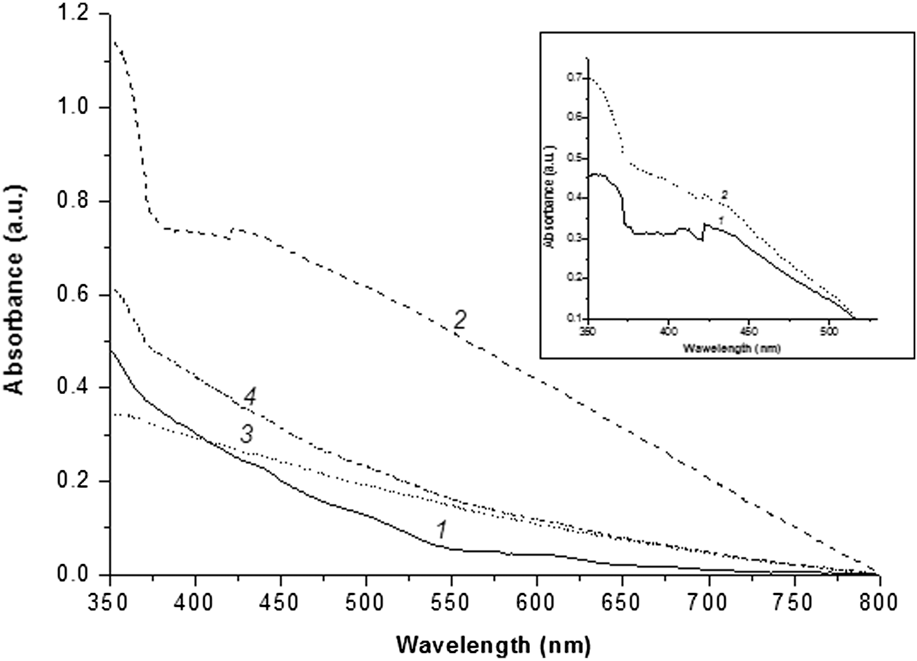
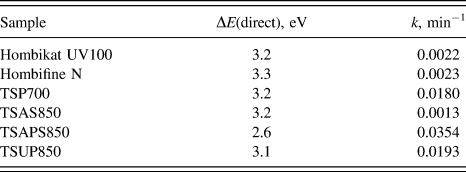
Band gaps, which were calculated from UV-vis spectra (Fig. 7), and constant rates for discoloration of MO (Table II) for the samples with highest activity in each series (see Table I for details) are compared to commercial titania photocatalysts Hombikat UV100 and Hombifine N (titanium dioxide of anatase modification with primary crystal size according to Scherrer <10 nm, specific surface area according to BET >250 m2/g). The comparison shows that constant rates, as a rule, increase with the decrease of the band gap energy. Activity of commercial P25 and its band gap ΔE(direct) = 3.68 eV also fit this row.Reference Savinkina, Obolenskaya and Kuzmicheva28,Reference López and Gómez34 The direct, and not indirect, transition is more favourable in anatase TiO2 nanoparticles.Reference Madhusudan Reddy, Manorama and Ramachandra Reddy42
Normalized UV-vis diffusion reflectance spectra of samples TSP700 (1), TSAS850 (2), TSAPS850 (3), and TSUP850 (4). Inset: spectra of commercial nanoscale anatase Hombifine N (1) and Hombikat UV100 (2).

Band gaps (ΔE) and constant rates for MO discoloration (k) for selected samples.

The band gap narrowing in oxygen-rich titania was earlier explained by the formation of interstitial oxygen excess defects by in situ generation of oxygen from peroxo–titania complexes.Reference Etacheri, Seery, Hinder and Pillai27,Reference Tan, Ong, Chai and Mohamed43 These defects interact with lattice oxygen atoms, which results in an increase of lattice parameters and a consequent band gap lowering. The oxygen excess defects in titanium dioxide can also form additional energy levels above the valence band resulting in a band gap narrowing. Formation of interstitial excess oxygen defects can also accelerate the formation of titania vacancies.Reference Etacheri, Seery, Hinder and Pillai27,Reference Tan, Ong, Chai and Mohamed43 Defect concentration in oxygen-rich compounds also plays an important role in photocatalysis.Reference Etacheri, Seery, Hinder and Pillai27 Oxygen defects serve as electron scavengers, which can reduce the recombination rate of electron–hole pairs and prolong the lifetime of the charges for them to participate in the MO photodestruction process.Reference Tan, Ong, Chai and Mohamed43
Our results also show the decrease of the band gap energy for some samples, which were prepared with the use of peroxo compounds. Maximal decrease of the band gap energy (down to 2.6 eV) was found for the sample prepared with the use of ammonium persulfate (TSAPS850); and this sample showed maximal photocatalytic activity in discoloration of MO. The band gap energy for the sample prepared with the use of UHP (TSUP850) is slightly lower (3.1 eV) than for Hombikat UV100 and Hombifine N; the sample prepared with the use of hydrogen peroxide (TSP850) has the same band gap energy as Hombikat UV100 (3.2 eV). However, both peroxo modified samples show higher rates of MO discoloration as compared to commercial photocatalysts. The sample prepared with the use of ammonium sulfate (TSAS850) has the same band gap energy (3.2 eV), but its photocatalytic activity is noticeably lower (Table II). Therefore, the products of decomposition of peroxo compounds give much more effect of photocatalytic activity as compared to sulfate or ammonium ions.
A detailed study of the O peak in the X-ray photoelectron spectra of the surface of nanoparticles for samples TSAPS700, TSP700, and TSUP700 shows that it consists of two well-resolved peaks at 530 and 532 eV, which can be assigned to the oxo (larger peak) and peroxo (smaller peak) groups, respectively (Fig. 8).
X-ray photoelectron spectra: (a) survey spectra of peroxo titania (1), TSAPS700 (2), TSP700 (3), and TSUP700 (4); (b) high-resolution spectra of TSAPS700 (1), TSP700 (2), and TSUP700 (3) in the energy range of the O signal.

A comparison of their intensity allows concluding that content of oxo oxygen increases and content of peroxo oxygen on the surface of nanoscale particles decreases in the TSUP700 ∼ TSP700 > TSAPS700 row. The constant rates of discoloration of MO increase in the same row, TSUP700 ∼ TSP700 < TSAPS700; therefore, the activity of the samples correlates with the oxo:peroxo ratio on the surface of nanoparticles.
No noticeable quantity of paramagnetic species was found by EPR, indicating the presence of only Ti(IV) in the bulk titania samples showing the absence of oxygen vacancies in the sample bulk.
In summary, the production of photoactive TiO2 nanoparticles was successfully achieved by treatment of an inexpensive precursor (titanyl sulfate dihydrate) with various peroxo compounds followed by annealing of the reaction mixture. The [TiOx(O2)2−x(H2O)m] phase, which forms on the first stage of the reaction, contains small crystallites (∼1–2 nm) and promotes formation of anatase. Thermal decomposition of the peroxo containing phase results in formation of titania with residual peroxo groups on the surface of nanoparticles. Oxygen excess prevents transformation of anatase to rutile (as suggested by Shannon and Pask,Reference Shannon and Pask44 the anion vacancy nucleates the anatase/rutile transformation), decreases band gap, and increases the activity of titania in the model reaction of MO destruction.
The most promising modificator for preparing thermally stable anatase (up to 950 °C) is UHP, and for producing photocatalysts, which are active in the UV region, by annealing at 700–850 °C are hydrogen peroxide and peroxosulfate. The best results were achieved for the samples prepared by annealing of the mixture of titanyl sulfate dihydrate and ammonium persulfate at 850 °C (TSAPS850) and by annealing of the mixture of titanyl sulfate dihydrate and UHP at 950 °C (TSUP950); these samples show the highest rate of MO discoloration.
The authors declare that they have no conflict of interest.
Supplementary Material
To view supplementary material for this article, please visit https://doi.org/10.1557/jmr.2018.52.
ACKNOWLEDGMENT
This research did not receive any specific grant from funding agencies in the public, commercial, or not-for-profit sectors.