


1. Introduction
The Dehn quandle of a group with respect to a subset is the union of conjugacy classes of elements of the set equipped with the operation of conjugation. It turns out that these are precisely the quandles that embed into their enveloping groups, and many well-known classes of quandles satisfy this property [Reference Dhanwani, Raundal and Singh9]. The first is the class of free quandles, where a free quandle on a set is simply the union of conjugacy classes of the free generating set in the corresponding free group. The second interesting class of examples, which is also the focus of this paper, is given by surfaces. Let
 $\mathcal {M}_g$
be the mapping class group of a closed orientable surface
 $S_g$
of genus
 $g \ge 1$
, and
 $\mathcal {D}_g^{ns}$
the set of isotopy classes of nonseparating simple closed curves on
 $S_g$
. It is well known that
 $\mathcal {M}_g$
is generated by Dehn twists along finitely many simple closed curves from
 $\mathcal {D}_g^{ns}$
[Reference Farb and Margalit12, Theorem 4.1]. The binary operation
 $\alpha * \beta = \tau _\beta (\alpha )$
, where
 $\alpha , \beta \in \mathcal {D}_g^{ns}$
and
 $\tau _\beta $
is the Dehn twist along
 $\beta $
, turns the set
 $\mathcal {D}_g^{ns}$
into a quandle called the Dehn quandle of the surface
 $S_g$
. In fact,
 $\mathcal {D}_g^{ns}$
can be viewed as a subquandle of the conjugation quandle of
 $\mathcal {M}_g$
, by identifying the isotopy class of a nonseparating simple closed curve with the isotopy class of its corresponding Dehn twist. These quandles originally appeared in the work of Zablow [Reference Zablow29, Reference Zablow30]. It turns out that two surfaces of genus more than two are homeomorphic if and only if their Dehn quandles are isomorphic [Reference Dhanwani, Raundal and Singh9, Proposition 6.5]. A homology theory based on Dehn quandles of surfaces has been derived in [Reference Zablow31] and it has been shown that isomorphism classes of Lefschetz fibrations over a disk correspond to quandle homology classes in dimension two. In a related direction, the papers [Reference Kamada and Matsumoto19, Reference Yetter27, Reference Yetter28] considered a quandle structure on the set of isotopy classes of simple closed arcs on an orientable surface with at least two punctures, referred as the quandle of cords. In the case of a disk with n punctures, this quandle is simply the Dehn quandle of the braid group
 $B_n$
on n strands with respect to its standard set of generators. It turns out that Dehn quandles of groups with respect to their subsets include many well-known constructions of quandles from groups including conjugation quandles of groups, free quandles, Coxeter quandles, Dehn quandles of closed orientable surfaces, quandles of cords of orientable surfaces, knot quandles of prime knots, core quandles of groups and generalised Alexander quandles of groups with respect to fixed-point free automorphisms (see [Reference Dhanwani, Raundal and Singh9] for more details). A presentation for the quandle of cords of the plane and the 2-sphere has been given in [Reference Kamada and Matsumoto19]. Beyond these cases, not much was known about presentations of Dehn quandles until the work [Reference Dhanwani, Raundal and Singh10], wherein two approaches to writing efficient presentations for Dehn quandles using presentations of their underlying groups have been given. Several computations of presentations have been given, including Dehn quandles of spherical Artin groups, surface groups and mapping class groups of orientable surfaces for small genera.
Since link quandles are always infinite except for the unknot and the Hopf link, it is natural to explore finiteness of n-quandles of link quandles. It had been conjectured by Przytycki that the n-quandle of an oriented link L in the
 $3$
-sphere is finite if and only if the fundamental group of the n-fold cyclic branched cover of the
 $3$
-sphere, branched over L, is finite. The conjecture has been proved by Hoste and Shanahan in [Reference Hoste and Shanahan14], wherein they use Dunbar’s classification [Reference Dunbar11] of spherical
 $3$
-orbifolds to determine all links with a finite n-quandle for some n. In this paper, we consider the analogous problem for Dehn quandles of surfaces. The two families of quandles have a rather curious intersection. Thanks to the work of Niebrzydowski and Przytycki [Reference Niebrzydowski and Przytycki23], where they proved that the knot quandle of the trefoil is isomorphic to the Dehn quandle of the torus, the problem can be thought of as a quandle analogue of [Reference Birman5, Problem 28], which asks whether the normal closure of squares of Dehn twists in the mapping class group of a closed orientable surface is of finite index. See also [Reference Funar13, Reference Humphries16] for further work on the problem.
The paper is organised as follows. In Section 3, we establish some general results on finiteness of n-quandles of Dehn quandles. We prove that if the n-quandle of the Dehn quandle of a group is finite, then a certain canonical quotient of the group is finite (Theorem 3.4). We consider Dehn quandles of Artin groups in Section 4 and prove that the involutory quandle of an Artin quandle is the corresponding Coxeter quandle (Theorem 4.3). We also determine the size of the smallest nontrivial quandle quotient of the Dehn quandle of the braid group with respect to its standard generating set (Proposition 4.5). In Section 5, we discuss finiteness of n-quandles of Dehn quandles of surfaces. For a closed orientable surface of positive genus, we give a precise description of its 2-quandle (Theorem 5.4). Further, with some exceptions for genus more than two, we determine all values of n for which the n-quandle of the Dehn quandle is finite (Theorem 5.6). As a final result, we also determine the size of the smallest nontrivial quandle quotient of the Dehn quandle of a surface (Proposition 5.8).
2. Preliminaries
Throughout the paper, we consider right-distributive quandles. Recall that, a quandle is a nonempty set Q equipped with a binary operation
 $*$
satisfying the following axioms:
-
(i)
 $x*x=x$
for all
$x\in Q$
;
-
(ii) for each
$x, y \in Q$
, there exists a unique
$z \in Q$
such that
$x=z*y$
; -
(iii)
$(x*y)*z=(x*z)*(y*z)$
for all
$x,y,z\in Q$
.


The second quandle axiom implies that there exists a dual binary operation
 $*^{-1}$
on Q such that
 $$ \begin{align*}(x*y)*^{-1} y= x=(x *^{-1} y) * y\end{align*} $$
for all
 $x, y \in Q$
. Topologically, the three quandle axioms correspond to the three Reidemeister moves of planar diagrams of links in the 3-space. Though quandles are ubiquitous, groups and knots are prominent sources of quandles. For instance, if G is a group, then the binary operation
 $x*y=y x y^{-1}$
turns G into the quandle called the conjugation quandle of G. Concerning knot theory, every link can be assigned a quandle called the link quandle, which is a complete invariant of nonsplit links up to weak equivalence. This fundamental result appeared independently in the works of Joyce [Reference Joyce17, Reference Joyce18] and Matveev [Reference Matveev21], and has led to much of the recent work on the subject.
Morphisms and automorphisms of quandles are defined in the obvious way. Note that the quandle axioms are equivalent to saying that for each
 $y\in Q$
, the map
 ${S_y:Q\to Q}$
given by
 $S_y(x)=x* y$
is an automorphism of Q fixing y. The group
 $\operatorname {Inn}(Q)$
generated by such automorphisms is called the group of inner automorphisms of Q. The group
 $\operatorname {Inn}(Q)$
acts on the quandle Q and the corresponding orbits are referred as connected components. For example, knot quandles are connected, whereas link quandles of split links are not connected.
The enveloping group
 $\operatorname {Env}(Q)$
of a quandle Q is the group with the set of generators as
 $\{e_x~|~x \in Q\}$
and the defining relations as
 $$ \begin{align*} e_{x*y}=e_y e_x e_y^{-1} \end{align*} $$
for all
 $x,y\in Q$
. For example, the enveloping group of the link quandle of a link in the 3-space is the corresponding link group [Reference Joyce17, Reference Joyce18]. The natural map
 $$ \begin{align*} \eta: Q \to \operatorname{Env}(Q) \end{align*} $$
given by
 $\eta (x)=e_x$
is a quandle homomorphism with
 $\operatorname {Env}(Q)$
viewed as the conjugation quandle. The map
 $\eta $
is not injective in general. In fact, Dehn quandles are precisely those for which this map is injective [Reference Dhanwani, Raundal and Singh9, Proposition 3.9]. The functor from the category of quandles to that of groups assigning the enveloping group to a quandle is left adjoint to the functor from the category of groups to that of quandles assigning the conjugation quandle to a group. Thus, enveloping groups play a crucial role in the understanding of quandles themselves.
Using defining axioms [Reference Winker26, Lemma 4.4.7], any element of a quandle Q can be written in a left-associated product of the form
 $$ \begin{align*} ((\cdots((a_0*^{\epsilon_1}a_1)*^{\epsilon_2}a_2)*^{\epsilon_3}\cdots)*^{\epsilon_{n-1}}a_{n-1})*^{\epsilon_n}a_n, \end{align*} $$
where
 $a_i \in Q$
and
 $\epsilon _i \in \{ 1, -1 \}$
. For simplicity, we write the preceding expression as
 $$ \begin{align*} a_0*^{\epsilon_1}a_1*^{\epsilon_2}\cdots*^{\epsilon_n}a_n. \end{align*} $$
Let
 $n \ge 2$
be an integer. A quandle Q is called an n-quandle if
 $$ \begin{align*}x*\underbrace{y *y*\cdots *y}_{n ~\mathrm{times}}=x\end{align*} $$
for all
 $x, y \in Q$
. Equivalently, a quandle is an n-quandle if and only if each basic inner automorphism
 $S_x$
has order dividing n. A 2-quandle is also called involutory. For example, the core quandle of any group is involutory.
3. Finiteness of n-quandles of Dehn quandles
Let G be a group, A a nonempty subset of G, and
 $A^G$
the set of all conjugates of elements of A in G. The Dehn quandle
 $\mathcal {D}(A^G)$
of G with respect to A is defined as the set
 $A^G$
equipped with the binary operation of conjugation, that is,
 $$ \begin{align*}x*y=yxy^{-1}\end{align*} $$
for all
 $x, y \in \mathcal {D}(A^G)$
. The class of Dehn quandles contains many well-known constructions of quandles from groups. Note that
 $\mathcal {D}(G^G)$
is the conjugation quandle of G. If
 $F(S)$
is the free group generated by S, then
 $\mathcal {D}(S^{F(S)})$
is the free quandle on S. If
 $(W, S)$
is a Coxeter system, then
 $\mathcal {D}(S^{W})$
is the so called Coxeter quandle [Reference Akita2, Reference Nosaka24]. Let
 $S_{g}$
be a closed orientable surface of genus g and
 $\mathcal {M}_{g}$
its mapping class group. If S is the set of Dehn twists about nonseparating simple closed curves, then
 $\mathcal {D}(S^{\mathcal {M}_{g}})$
is the Dehn quandle of the surface [Reference Kamada and Matsumoto19, Reference Zablow29, Reference Zablow30].
Given a quandle Q and an integer
 $n \ge 2$
, the n-quandle
 $(Q)_n$
of Q is defined as the quotient of Q by the relations
 $$ \begin{align*}x*^n y:=x*\underbrace{y*y*\cdots*y}_{n~ \mathrm{times}}=x\end{align*} $$
for all
 $x,y \in Q$
. Note that there is a natural epimorphism
 $\pi : Q \to (Q)_n$
. Further, the construction satisfies the universal property that for any quandle homomorphism
 $f:Q \to Y$
, where Y is an n-quandle, there exists a unique quandle homomorphism
 $\bar {f}: (Q)_n \to Y$
such that
 $\bar {f} ~\pi = f$
. The construction is of particular interest from the point of view of knot theory. Since link quandles are always infinite except for the unknot and the Hopf link, it is interesting to explore finiteness of n-quandles of link quandles. Using Thurston’s geometrisation theorem and Dunbar’s classification of spherical 3-orbifolds, a complete classification of links whose n-quandles are finite for some n has been given in [Reference Hoste and Shanahan14].
We begin with the following general observation.
Proposition 3.1. Let Q be a quandle with a presentation
 $\langle S \mid R \rangle $
. Then, for each
 $n \ge 2$
,
 $(Q)_n$
has a presentation
 $\langle S \mid R \cup T \rangle $
, where
 $T=\{x*^n y=x \mid x,y\in S\}$
.
Proof. Let
 $n \ge 2$
and X be the quandle with presentation
 $\langle S \mid R\, \cup \, T \rangle $
. First, we claim that X is an n-quandle. Consider elements
 $x\in X$
and
 $y\in S$
. We write
 $x=a_1*^{\epsilon _1}a_2*^{\epsilon _2}\cdots *^{\epsilon _{l-1}}a_l$
, where
 $a_i\in S$
and
 $\epsilon _i\in \{1,-1\}$
. By right distributivity, we obtain
 $$ \begin{align*}x*y=(a_1*y)*^{\epsilon_1}(a_2*y)*^{\epsilon_2}\cdots*^{\epsilon_{l-1}}{(a_l*y)}\end{align*} $$
and a repeated application of the property further gives
 $$ \begin{align*}x*^ny=(a_1*^ny)*^{\epsilon_1}(a_2*^ny)*^{\epsilon_2}\cdots*^{\epsilon_{l-1}}{(a_l*^ny)}=a_1*^{\epsilon_1}a_2*^{\epsilon_2}\cdots*^{\epsilon_{l-1}}a_l=x,\end{align*} $$
which is desired.
Now take
 $x, y\in X$
, and use induction on the word length of y. When y is of word length one, we are in the preceding case. We assume that
 $y=a_1*^{\epsilon _1}a_2*^{\epsilon _2}\cdots *^{\epsilon _{k-1}}a_k$
, where
 $k>1$
. Then we write
 $y=y_1*^{\epsilon _{k-1}}a_k$
, where
 $y_1:=a_1*^{\epsilon _1}a_2*^{\epsilon _2}\cdots *^{\epsilon _{k-2}}a_{k-1}$
is of word length less than k. By the induction hypothesis, the assertion holds for all words of length less than k. Then, using [Reference Winker26, Lemma 4.4.7],
 $$ \begin{align*} x*^ny &=x*^n(y_1*^{\epsilon_{k-1}}a_k ) \\ &=(x*^{-\epsilon_{k-1}} a_k *y_1 *^{\epsilon_{k-1}} a_k ) *^{n-1}(y_1*^{\epsilon_{k-1}}a_k) \\ &=(x*^{-\epsilon_{k-1}} a_k *^2y_1 *^{\epsilon_{k-1}} a_k) *^{n-2}(y_1*^{\epsilon_{k-1}}a_k) \\ &=((x*^{-\epsilon_{k-1}} a_k) *^ny_1) *^{\epsilon_{k-1}} a_k \\ &=(x*^{-\epsilon_{k-1}} a_k) *^{\epsilon_{k-1}} a_k, \quad \textrm{by induction hypothesis}\\ &=x. \end{align*} $$
Thus, X is an n-quandle, proving our claim. Finally, it follows from the universal property that
 $(Q)_n\cong X$
.
Corollary 3.2. If the n-quandle of a quandle is finite for some integer
 $n \ge 2$
, then its d-quandle is also finite for each divisor d of n.
The presentation of the enveloping group of a quandle can be reduced substantially [Reference Winker26, Theorem 5.1.7].
Corollary 3.3. Let
 $Q=\langle S \mid R\rangle $
be a quandle presentation. Then

where
 $\tilde {S}= \{ e_x \mid x \in S \}$
,
 $\tilde {T}=\{e_x^n e_ye_x^{-n}e_y^{-1} \mid x,y\in S\}$
and
 $\tilde {R}$
consists of relations of R with each
 $x \ast y$
replaced by
 $e_{y} e_x e_y^{-1}$
.
Given a quandle Q, define a map
 $\nu :Q\to \mathbb {N}\cup \{0\}$
by setting
 $$ \begin{align*}\nu(x)=\begin{cases} \text{order of~}S_x &~\textrm{if order of}~S_x~ \textrm{is finite},\\ 0 &~\textrm{if order of}~S_x~ \textrm{is infinite}.\\ \end{cases}\end{align*} $$
Consider the subgroup
 $Z(Q)= \langle e_x^{\nu (x)} \mid x\in Q \rangle $
of
 $\operatorname {Env}(Q)$
. It follows from the construction of
 $Z(Q)$
that it is a central subgroup of
 $\operatorname {Env}(Q)$
[Reference Akita, Hasegawa and Tanno3, Lemma 2.1]. Let
 ${F(Q)=\operatorname {Env}(Q)/Z(Q)}$
be the corresponding quotient group. It is known that if Q is a finite quandle, then
 $F(Q)$
is a finite group [Reference Akita, Hasegawa and Tanno3, Proposition 3.1].
Theorem 3.4. Let G be a group generated by a set S and  . Then there exists a surjective group homomorphism
 $F((\mathcal {D}(S^G))_n )\to G_n$
. In particular, if
 $(\mathcal {D}(S^G))_n$
is finite, then
 $G_n$
is finite.
Proof. It follows from [Reference Dhanwani, Raundal and Singh9, Theorem 3.6] that the map
 $\Phi :\operatorname {Env}(\mathcal {D}(S^G))\to G$
, given by
 $\Phi (e_x)=x$
, is a surjective homomorphism. By Corollary 3.3, we have a surjective homomorphism
 $\tilde {\Phi }:\operatorname {Env}((\mathcal {D}(S^G))_n)\to H_n$
, where
 . This, in turn, gives a surjective homomorphism

The assertion now follows from the fact that  .
4. Involutory quotients of Artin quandles
Recall that an Artin group
 $\mathbf {A}$
is a group with a presentation
 $$ \begin{align*}\mathbf{A}=\{\mathbf{s}_1, \mathbf{s}_2,\ldots, \mathbf{s}_n \mid (\mathbf{s}_i \mathbf{s}_j)_{m_{ij}}=(\mathbf{s}_j \mathbf{s}_i)_{m_{ij}}, ~\textrm{where}~m_{ij}\in \{2,3,\ldots\} \cup \{ \infty\}\},\end{align*} $$
where
 $(\mathbf {s}_i \mathbf {s}_j)_{m_{ij}}$
is the word
 $\mathbf {s}_i \mathbf {s}_j \mathbf {s}_i \mathbf {s}_j \mathbf {s}_i \cdots $
of length
 $m_{ij}$
if
 $m_{ij} < \infty $
and there is no relation of type
 $(\mathbf {s}_i \mathbf {s}_j)_{m_{ij}}=(\mathbf {s}_j \mathbf {s}_i)_{m_{ij}}$
if
 $m_{ij}=\infty $
. We set
 $\mathbf {S}= \{\mathbf {s}_1, \mathbf { s}_2,\ldots , \mathbf {s}_n \}$
. The corresponding Coxeter group W is the quotient of
 $\mathbf {A}$
by imposing additional relations
 $\mathbf {s}_i^2=1$
for all
 $\mathbf {s}_i \in \mathbf {S}$
.
To distinguish the presentation of
 $\mathbf {A}$
from that of its corresponding Coxeter group W, we write the presentation of W without using bold letters. More precisely,
 $$ \begin{align*}W=\{s_1,s_2,\ldots,s_n \mid s_i^2=1, \ (s_is_j)_{m_{ij}}=(s_js_i)_{m_{ij}}, \textrm{where}~m_{ij}\in \{2,3,\ldots\} \cup \{ \infty\}\}.\end{align*} $$
Setting
 $S= \{ s_1, s_2,\ldots , s_n \}$
, the pair
 $(W, S)$
is referred to as a Coxeter system and elements of W that are conjugates of elements of S are called reflections. Following [Reference Dhanwani, Raundal and Singh9], Dehn quandles of Artin and Coxeter groups with respect to their standard generating sets are referred to as Artin and Coxeter quandles, respectively. In this section, we prove that the involutory quandle of an Artin quandle is the corresponding Coxeter quandle.
To prove the result, we must first understand centralisers of Coxeter generators, for which we follow [Reference Allcock4]. Let
 $(W,S)$
be a Coxeter system and
 $\triangle $
the labelled graph with vertex set S such that there is an edge between s and
 $s'$
with label
 $m_{ss'}$
whenever
 $m_{ss'} < \infty $
. Let
 $\triangle ^{\mathrm {{odd}}}$
be the subgraph of
 $\triangle $
consisting of only odd labelled edges. It is easy to see that connected components of
 $\triangle ^{\mathrm {{odd}}}$
correspond to conjugacy classes of reflections in W. For each
 $s \in S$
, let
 $\triangle _{s}^{\mathrm {{odd}}}$
denote the connected component of
 $\triangle ^{\mathrm {{odd}}}$
containing s.
Let
 $(W, S)$
be a Coxeter system and
 $\gamma = (t_0, t_1, \ldots ,t_n)$
an edge-path in
 $\triangle ^{\mathrm {{odd}}}$
with the edge joining
 $t_{i-1}$
and
 $t_i$
labelled
 $2l_i + 1$
. We set
 $$ \begin{align*} p_\gamma:=(t_1t_0)^{l_1}(t_2t_1)^{l_2}\cdots(t_nt_{n-1})^{l_n}\end{align*} $$
if
 $n>0$
and
 $p_{\gamma }=1$
if
 $n=0$
. If u is a vertex of
 $\triangle $
such that there is an edge joining u and
 $t_n$
with even label
 $2\lambda $
, then we define
 $$ \begin{align*} r_{\gamma,u}:=p_{\gamma}~(ut_n)^{\lambda-1}u~ p^{-1}_{\gamma}.\end{align*} $$
Henceforth, the notation
 $r_{\gamma ,u}$
means that the vertex u is joined to the end point of
 $\gamma $
by an even labelled edge. We need the following results [Reference Allcock4, Corollaries 6 and 8]. See also [Reference Brink6, Reference Brink and Howlett7, Reference Howlett15].
Theorem 4.1. Let
 $(W,S)$
be a Coxeter system,
 $s\in S$
and
 $\operatorname {C}_{W}(s)$
the centraliser of s in W.
-
(1) Let
$W_{\Omega }$
be the subgroup of
$\operatorname {C}_{W}(s)$
generated by all the reflections it contains except s. Let
$\Gamma _{\Omega }$
be the subgroup of W generated by elements
$p_\gamma $
, where
$\gamma $
is an edge-loop in
$\triangle ^{\mathrm {{odd}}}$
based at s. Then
$\operatorname {C}_{W}(s) = \langle s \rangle \times (W_{\Omega }\rtimes \Gamma _{\Omega })$
. -
(2) Let Z be a set of edge-loops in
$\triangle ^{\mathrm {{odd}}}_s$
generating the fundamental group
$\pi _1(\triangle ^{\mathrm {{odd}}},s)$
. Then
$\{p_\gamma \mid \gamma \in Z\}$
generates
$\Gamma _\Omega $
. -
(3) Let Y be the set consisting of one edge-path
$\delta _t$
in
$\triangle ^{odd}_{s}$
from s to t for each vertex
${t\in \triangle ^{odd}_{s}}$
, and let X be the set of vertices u of
$\triangle $
such that there is an even labelled edge joining u to the end point of some
$\delta _t$
. Then
$\{p_\gamma {\kern-1.2pt}\mid{\kern-1.2pt} \gamma {\kern-1.2pt}\in{\kern-1.2pt} Z\}$
and
$\{r_{\delta _t,u} {\kern-1.2pt}\mid{\kern-1.2pt} \delta _t {\kern-1.2pt}\in{\kern-1.2pt} Y, u {\kern-1.2pt}\in{\kern-1.2pt} X \}$
together generate
$W_{\Omega }\rtimes \Gamma _{\Omega }$
.


Let
 $\nu : \mathbf {A} \to W$
be the natural surjection given by
 $\nu (\mathbf {s})=s$
. Clearly,
 $\ker (\nu )$
is normally generated by
 $\{\mathbf {s}^2 \mid \mathbf {s} \in \mathbf {S}\}$
.
Lemma 4.2. The restriction map
 $\operatorname {C}_{\mathbf {A}}(\mathbf {s})\to \operatorname {C}_{W}(s)$
is surjective for each
 $\mathbf {s}\in \mathbf {S}$
.
Proof. Let
 $\mathbf {s}\in \mathbf {S}$
be fixed such that
 $\nu (\mathbf {s})=s$
. Let
 $\gamma = (t_0, t_1, \ldots ,t_n)$
be an edge-path in
 $\triangle ^{\mathrm {{odd}}}$
with the edge joining
 $t_{i-1}$
and
 $t_i$
labelled
 $2l_i + 1$
, and let
 ${p_{\gamma }=(t_1t_0)^{l_1}(t_2t_1)^{l_2}\cdots (t_nt_{n-1})^{l_n}}$
be the corresponding element. Let
 $\mathbf {p}_{\gamma }=(\mathbf {t}_1\mathbf {t}_0)^{l_1}(\mathbf {t}_2 \mathbf {t}_1)^{l_2}\cdots (\mathbf {t}_n \mathbf {t}_{n-1})^{l_n}$
denote the lift of
 $p_{\gamma }$
in
 $\mathbf {A}$
. If we set
 $\bar {\mathbf {p}}_{\gamma }=(\mathbf {t}_{n-1} \mathbf {t}_n)^{l_n}(\mathbf {t}_{n-2} \mathbf {t}_{n-1})^{l_{n-1}}\cdots (\mathbf {t}_0 \mathbf { t}_1)^{l_1}$
, then it follows that
 $\nu (\bar {\mathbf {p}}_\gamma )=p_{\gamma }^{-1}$
. It is easy to see that the identities
 $$ \begin{align*}\mathbf{p}_{\gamma} \mathbf{t}_n = \mathbf{t}_0 \mathbf{p}_{\gamma} \quad \textrm{and} \quad \bar{\mathbf{p}}_{\gamma} \mathbf{t}_0 = \mathbf{t}_n \bar{\mathbf{p}}_{\gamma}\end{align*} $$
hold in
 $\mathbf {A}$
. Thus, if
 $\gamma $
is an edge loop based at s, then both
 $\mathbf {p}_{\gamma }$
and
 $\bar {\mathbf {p}}_{\gamma }$
commute with
 $\mathbf {s}$
. Similarly, let
 $\delta _t$
be a edge-path in
 $\triangle _{s}^{odd}$
from s to t and u a vertex of
 $\triangle $
that is joined to the end point of
 $\delta _t$
with an edge labelled
 $2\lambda $
. If we set
 $\mathbf {r}_{\delta _t,u}=\mathbf {p}_{\delta _t}~(\mathbf {u} \mathbf {t})^{\lambda -1} \mathbf { u}~ \bar {\mathbf {p}}_{\delta _t}$
, then we can see that
 $$ \begin{align*} \mathbf{r}_{\delta_t,u} \mathbf{s} &= \mathbf{p}_{\delta_t}~(\mathbf{u} \mathbf{t})^{\lambda-1} \mathbf{u}~ \bar{\mathbf{p}}_{\delta_t} \mathbf{s}\\ &= \mathbf{p}_{\delta_t}~( \mathbf{u} \mathbf{t})^{\lambda-1} \mathbf{u}~\mathbf{t}~ \bar{\mathbf{p}}_{\delta_t}\\ &= \mathbf{p}_{\delta_t}~\mathbf{t}~(\mathbf{u} \mathbf{t})^{\lambda-1} \mathbf{u}~ \bar{\mathbf{p}}_{\delta_t}\\ &= \mathbf{s} \mathbf{p}_{\delta_t}~(\mathbf{u} \mathbf{t})^{\lambda-1} \mathbf{u}~ \bar{\mathbf{p}}_{\delta_t}\\ &= \mathbf{s} \mathbf{r}_{\delta_t,u}, \end{align*} $$
and hence
 $\mathbf {r}_{\delta _t,u}$
commutes with
 $\mathbf {s}$
. By Theorem 4.1, the group
 $\operatorname {C}_{W}(s)$
is generated by
 $\{ s, p_\gamma , r_{\delta _t,u}\}$
. Since each generator has a pre-image under
 $\nu $
that lies in
 $\operatorname {C}_{\mathbf {A}}(\mathbf {s})$
, the assertion follows.
We now prove the main result of this section.
Theorem 4.3. The involutory quandle of an Artin quandle is the corresponding Coxeter quandle, that is,
 $(\mathcal {D}(\mathbf {S}^{\mathbf {A}}))_2 \cong \mathcal {D}(S^W).$
Proof. The surjection
 $\nu : \mathbf {A}\to W$
induces a surjective quandle homomorphism
 ${\tilde {\nu }: \mathcal {D}(\mathbf {S}^{\mathbf {A}}) \to \mathcal {D}(S^{W})}$
. Since
 $(\mathcal {D}(\mathbf {S}^{\mathbf {A}}))_2$
is involutory,
 $\tilde {\nu }$
descends to a surjective quandle homomorphism
 $$ \begin{align*}\overline{\nu}:(\mathcal{D}(\mathbf{S}^{\mathbf{A}}))_2\to \mathcal{D}(S^{W}).\end{align*} $$
If
 $\pi :\mathcal {D}(\mathbf {S}^{\mathbf {A}})\to (\mathcal {D}(\mathbf {S}^{\mathbf {A}}))_2$
is the natural surjection, then
 $\overline {\nu } ~\pi = \tilde {\nu }$
. We claim that
 $\overline {\nu }$
is an isomorphism. Suppose that
 $\tilde {\nu }(\mathbf {x})=\tilde {\nu }(\mathbf {y})$
for some
 $\mathbf {x},\mathbf {y}\in \mathcal {D}(\mathbf {S}^{\mathbf {A}})$
. Since
 $\tilde {\nu }$
preserves orbits (under action of the inner automorphism group), it follows that
 $\mathbf {x}$
and
 $\mathbf {y}$
must be in the same orbit. Thus, we can write
 $\mathbf {x}= \mathbf {s}_{i_k}^{\epsilon _k} \cdots \mathbf {s}_{i_1}^{\epsilon _1} \mathbf {s} \mathbf {s}_{i_1}^{-\epsilon _1} \cdots \mathbf {s}_{i_k}^{-\epsilon _k}$
and
 ${\mathbf {y}=\mathbf { s}_{j_r}^{\delta _r} \cdots \mathbf {s}_{j_1}^{\delta _1} \mathbf {s} \mathbf {s}_{j_1}^{-\delta _1} \cdots \mathbf {s}_{j_r}^{-\delta _r}}$
for some
 $\mathbf {s}, \mathbf {s}_{i_t}, \mathbf {s}_{j_t}\in \mathbf {S}$
and
 $\epsilon _t, \delta _t \in \{ 1, -1 \}$
. Now
 $\tilde {\nu }(\mathbf {x})=\tilde {\nu }(\mathbf {y})$
implies that
 $\nu (\mathbf {s}_{j_1}^{-\delta _1} \cdots \mathbf {s}_{j_r}^{-\delta _r} \mathbf {s}_{i_k}^{\epsilon _k} \cdots \mathbf { s}_{i_1}^{\epsilon _1})$
commutes with
 $\nu (\mathbf {s})=s$
. In view of Lemma 4.2, the short exact sequence
 $1\to \text {ker}(\nu ) \to \mathbf {A} \stackrel {\nu }{\to } W\to 1$
induces a short exact sequence
 $$ \begin{align*} 1\to \text{ker}(\nu)\cap\operatorname{C}_{\mathbf{A}}(\mathbf{s})\to \operatorname{C}_{\mathbf{A}}(\mathbf{s})\to \operatorname{C}_{W}(s)\to 1. \end{align*} $$
Thus, we can write
 $\mathbf {s}_{j_1}^{-\delta _1} \cdots \mathbf {s}_{j_r}^{-\delta _r} \mathbf {s}_{i_k}^{\epsilon _k} \cdots \mathbf {s}_{i_1}^{\epsilon _1}=\mathbf {u} \mathbf {v}$
for some
 and some
 $\mathbf {v} \in \operatorname {C}_{\mathbf {A}}(\mathbf {s})$
. Thus,
 $$ \begin{align*} & \pi( \mathbf{s}_{j_1}^{-\delta_1} \cdots \mathbf{s}_{j_r}^{-\delta_r} \mathbf{s}_{i_k}^{\epsilon_k} \cdots \mathbf{s}_{i_1}^{\epsilon_1} ~\mathbf{s}~ \mathbf{s}_{i_1}^{-\epsilon_1} \cdots \mathbf{s}_{i_k}^{-\epsilon_k} \mathbf{s}_{j_r}^{\delta_r} \cdots \mathbf{s}_{j_1}^{\delta_1})\\&\quad =\pi(\mathbf{u} \mathbf{v} \mathbf{s} \mathbf{v}^{-1} \mathbf{u}^{-1})\\&\quad =\pi(\mathbf{u} \mathbf{s} \mathbf{u}^{-1}), \quad \text{since } \mathbf{v} \in \operatorname{C}_{\mathbf{A}}(\mathbf{s})\\&\quad = \pi(\mathbf{s}), \quad \text{since}\ \mathbf{u} \in \ker(\nu), \end{align*} $$
which shows that
 $\pi (\mathbf {x})=\pi (\mathbf {y})$
and hence
 $\overline {\nu }$
is an isomorphism.
As a consequence of Propositions 3.1 and 4.3, we obtain a presentation of the enveloping group of the Coxeter quandle, which extends [Reference Akita2, Proposition 3.3].
Corollary 4.4. Let
 $(W, S)$
be a Coxeter system. Then
 $\operatorname {Env}(\mathcal {D}(S^{W})) \cong \mathbf {A}/\mathbf {N}$
, where
 $\mathbf {A}$
is the corresponding Artin group and
 .
Our next result gives the size of the smallest nontrivial quandle quotient of the Dehn quandle of the braid group with respect to its standard generating set. The proof is essentially rephrasing [Reference Kolay20, Lemma 8] in the language of quandles.
Proposition 4.5. Let
 $n\geq 5$
and
 $f:\mathcal {D}(S^{B_n}) \to Q$
be a surjective quandle homomorphism onto a quandle with at least two elements. Then,
 $|Q|\geq {n(n-1)}/{2}$
and the bound is sharp.
Arcs
 $c_{i, j}$
on the disc for
 $n=6$
.

Proof. We view the braid group
 $B_n$
as the mapping class group of the disc
 $\mathbb {D}^2$
with n marked points. Consider the set
 $\{c_{i, j} \mid 1 \le i < j \le n \}$
of
 $n(n-1)/2$
arcs on
 $\mathbb {D}^2$
as shown in Figure 1 for
 $n=6$
. Let
 $\sigma _{i, j}$
denote the isotopy class of the (anti-clockwise) half Dehn twist along the arc
 $c_{i, j}$
and let
 $X= \{\sigma _{i, j} \mid 1 \le i < j \le n \}$
. Then
 $B_n$
is generated by the subset
 $S=\{\sigma _{1, 2}, \sigma _{2, 3}, \ldots , \sigma _{n-1, n} \}$
of X. Note that all the elements of X are conjugate to each other in
 $B_n$
and hence lie in
 $\mathcal {D}(S^{B_n})$
. Let
 $f:\mathcal {D}(S^{B_n}) \to Q$
be a surjective quandle homomorphism onto a quandle with at least two elements. Then we have the following cases:
Case (1): Suppose that f is not injective on S, that is,
 $f(\sigma _{i, i+1})=f(\sigma _{j, j+1})$
for some
 $i\neq j$
. Since
 $n \ge 5$
, by construction of X, we can choose an arc
 $c_{k, k+1}$
such that it has exactly one end point in common with precisely one of
 $c_{i, i+1}$
or
 $c_{j, j+1}$
and no end point in common with the other. Without loss of generality, we can assume that
 $c_{k, k+1}$
and
 $c_{j, j+1}$
have one end point in common, while
 $c_{k, k+1}$
and
 $c_{i, i+1}$
are disjoint. Then, the half Dehn twists satisfy the relations
 $$ \begin{align*}\sigma_{k, k+1} \sigma_{j, j+1} \sigma_{k, k+1} = \sigma_{j, j+1} \sigma_{k, k+1}\sigma_{j, j+1} \quad \textrm{and} \quad \sigma_{k, k+1} \sigma_{i, i+1}= \sigma_{i, i+1}\sigma_{k, k+1} .\end{align*} $$
Applying f to the preceding relations and using the equality
 $f(\sigma _{i, i+1})=f(\sigma _{j, j+1})$
, we obtain
 $f(\sigma _{k, k+1}) =f( \sigma _{i, i+1})$
. Proceeding in this manner, we show that f is constant on S. Since S also generates
 $\mathcal {D}(S^{B_n})$
as a quandle [Reference Dhanwani, Raundal and Singh9, Proposition 3.2], it follows that f is constant on
 $\mathcal {D}(S^{B_n})$
, which is a contradiction. Hence, f is injective on S.
Case (2): Suppose that f is not injective on X. There are two possibilities here.
Subcase (2a): Suppose that
 $f(\sigma _{i, i+1})=f(\sigma _{k, l})$
where
 $\{i, i+1 \} \ne \{k, l \}$
as sets. Since
 $n \ge 5$
, we can choose an arc
 $c_{r,r+1}$
such that it has exactly one end point in common with precisely one of
 $c_{i, i+1}$
or
 $c_{k, l}$
, and no end point in common with the other. If
 $c_{r, r+1}$
and
 $c_{i, i+1}$
have one end point in common, then as in Case (1), we obtain
 $f(\sigma _{i, i+1}) =f( \sigma _{r, r+1})$
. Similarly, if
 $c_{r, r+1}$
and
 $c_{k, l}$
have one end point in common, then as in Case (1), we get
 $f(\sigma _{i, i+1}) =f( \sigma _{r, r+1})$
. Again, proceeding as in Case (1) leads to a contradiction.
Subcase (2b): Suppose that
 $f(\sigma _{i, j})=f(\sigma _{k, l})$
where
 $\{i, j\} \ne \{k, l\}$
. Since
 $n \ge 5$
, we can choose an arc
 $c_{r,r+1}$
such that it has exactly one end point in common with precisely one of
 $c_{i, j}$
or
 $c_{k, l}$
, and no end point in common with the other. Proceeding as before, we deduce that
 $f(\sigma _{i, j})=f(\sigma _{k, l})= f(\sigma _{r,r+1})$
, which is Subcase (2a).
Hence, it follows that the map f must be injective on the set X, and therefore
 ${|Q|\geq n(n-1)/2}$
. For sharpness of the bound, consider the surjective group homomorphism
 $B_n \to \Sigma _n$
, where
 $\Sigma _n$
is the symmetric group on n symbols. The group homomorphism induces a surjective quandle homomorphism
 $\mathcal {D}(S^{B_n}) \to \mathcal {D}(T^{\Sigma _n})$
, where
 $T=\{(i, i+1) \mid 1 \le i \le n-1 \}$
is the image of S. Since
 $|\mathcal {D}(T^{\Sigma _n})|= n(n-1)/2$
, the assertion follows.
Remark 4.6. It follows from Theorem 4.3 that
 $\mathcal {D}(T^{\Sigma _n})$
is precisely the 2-quandle of
 $\mathcal {D}(S^{B_n})$
. It is intriguing to know the smallest quandle quotients of general Artin quandles.
5. Finiteness of n-quandles of Dehn quandles of surfaces
In this main section, we consider finiteness of n-quandles of Dehn quandles of closed orientable surfaces. For each genus, with some exceptions, we determine all values of n for which the n-quandle of the Dehn quandle of the surface
 $S_g$
is finite. We also determine the explicit structures of their 2-quandles.
5.1. 2- and 3-quandles of Dehn quandles of surfaces
Let
 $S_g$
be a closed oriented surface of genus
 $g \ge 1$
and
 $$ \begin{align*}\Psi : \mathcal{M}_g \to \text{Sp}(2g, \mathbb{Z})\end{align*} $$
the symplectic representation of the mapping class group
 $\mathcal {M}_g$
of
 $S_g$
. For an integer
 $n \ge 2$
, let
 $\psi _n:\text {Sp}(2g,\mathbb {Z}) \to \text {Sp}(2g,\mathbb {Z}_n)$
be the mod n reduction homomorphism and
 $$ \begin{align*}\Psi_n:= \psi_n \Psi :\mathcal{M}_g \to \text{Sp}(2g, \mathbb{Z}_n)\end{align*} $$
the mod n reduction of the symplectic representation. Given a simple closed curve a in
 $S_g$
, let
 $\tau _a$
denote the (right-hand) Dehn twists about a. Consider the surface
 $S_g$
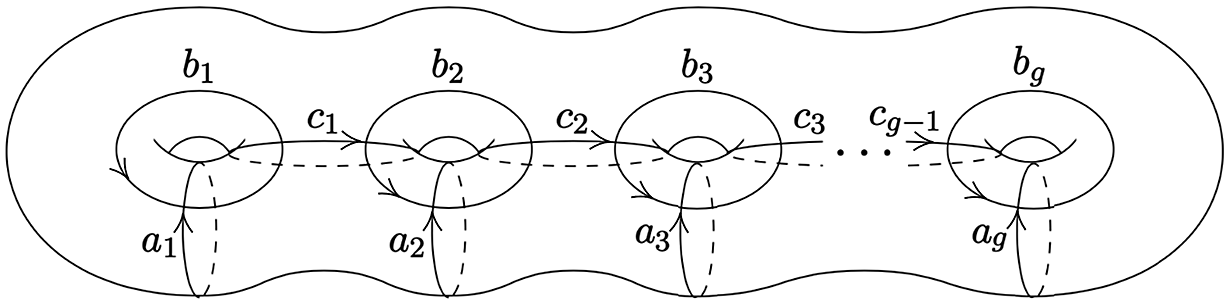
with curves
 $a_i, b_i, c_i$
as in Figure 2.
Surface of genus g with curves
 $a_i$
,
 $b_i$
and
 $c_i$
.

Lemma 5.1. Let p be a prime and
 $g \ge 1$
. Then, an element
 $A\in \mathrm {Sp}(2g,\mathbb {Z}_p)$
lies in the centraliser of
 $\Psi _p(\tau _{a_1})$
if and only if A has first column
 $(a,0,0,\ldots ,0)$
and second row
 $(0,a,0,0,\ldots ,0)$
, where
 $a \equiv \pm 1\, (\mathrm{mod} \, p)$
.
Proof. Let
 $E_{i,j}$
denote the elementary matrix with
 $(i,j)$
-entry as
 $1$
and each other entry as
 $0$
. Observe that
 $\Psi _p(\tau _{a_1})=I_{2g}-E_{1,2}$
. If
 $A\in \mathrm {Sp}(2g,\mathbb {Z}_p)$
commutes with
 $\Psi _p(\tau _{a_1})$
, then it follows from elementary linear algebra that A has first column
 $(a,0,0,\ldots ,0)$
and second row
 $(0,a,0,0,\ldots ,0)$
for some
 $a\in \mathbb {Z}_p^\times $
. Since
 $A^{t}JA=J$
, where J represents the symplectic form, we obtain
 $a^2 \equiv 1\, (\mathrm{mod} \, p)$
. Since
 $a^2 \equiv 1\, (\mathrm{mod} \, p)$
if and only if
 $ a \equiv \pm 1\, (\mathrm{mod} \, p)$
, the assertion follows. Conversely, any symplectic matrix of this form commutes with
 $\Psi _p(\tau _{a_1})$
.
Lemma 5.2. Let p be a prime and
 $g \ge 1$
. Then the centraliser of
 $\Psi _p(\tau _{a_1})$
in
 $ \mathrm {Sp}(2g,\mathbb {Z}_p)$
is generated by
 $\Psi _p(S)\cup \{-I_{2g}\}$
, where
 $$ \begin{align*}S=\{ \tau_{a_1},\tau_{a_2},\ldots,\tau_{a_g},\tau_{b_2},\ldots,\tau_{b_g},\tau_{c_1},\tau_{c_2},\ldots,\tau_{c_{g-1}} \}.\end{align*} $$
Proof. For
 $g=1$
, a direct computation shows that the centraliser of
 $\Psi _p(\tau _{a_1})$
in
 $ \mathrm {Sp}(2,\mathbb {Z}_p)$
is generated by
 $\Psi _p(\tau _{a_1})\cup \{-I_{2g}\}$
. We assume that
 $g \ge 2$
. Clearly,
 $\Psi _p(S)\cup \{-I_{2g}\}$
is a subset of the centraliser of
 $\Psi _p(\tau _{a_1})$
in
 $ \mathrm {Sp}(2g,\mathbb {Z}_p)$
. If
 $A=(A_{i,j})$
lies in the centraliser of
 $\Psi _p(\tau _{a_1})$
in
 $\mathrm {Sp}(2g,\mathbb {Z}_p)$
, then Lemma 5.1 implies that
 $A_{1,1}= \pm 1$
. Multiplying A by
 $-I_{2g}$
, we can assume that
 $A_{1,1}=1$
. It remains to prove such an A can be written as a product of elements from
 $\Psi _p(S)$
. Consider the curves
 $d_1,d_2,\ldots ,d_{g-1}$
as shown in Figure 3. For each
 $1 \le i \le g-1$
, let
 $M_i:=\Psi _p(\tau _{d_i}\tau _{a_1}^{-1}\tau _{a_{i+1}}^{-1})$
. Then, we can see that
 $$ \begin{align*}M_i=I_{2g}+E_{2i+1,\,2}+E_{1,\,2i+2}.\end{align*} $$
Let
 $N_i:= \Psi _p(\tau _{a_{i+1}}\tau _{b_{i+1}}\tau _{a_{i+1}})^{-1} M_i ~\Psi _p(\tau _{a_{i+1}}\tau _{b_{i+1}}\tau _{a_{i+1}})$
. Then, a direct computation shows that
 $$ \begin{align*}N_i=I_{2g}-E_{2i+2,\,2}+E_{1,\,2i+1}.\end{align*} $$
Now, consider the matrix
 $$ \begin{align*}B:=\bigg(\prod_{i=1}^{g-1}N_{g-i}^{A_{2(g-i)+2,2}}M_{g-i}^{-A_{2(g-i)+1,2}} \bigg)A,\end{align*} $$
where a matrix raised to the power by the entry
 $A_{i,j}$
represents the same matrix raised to the power by a representative of
 $A_{i,j}$
in the subset
 $\{ 0, 1, 2, \ldots , p-1 \}$
of integers. By the choice of matrices
 $M_i$
and
 $N_i$
, it follows that the second column of B is
 $(B_{1,2},1,0,0,\ldots ,0)$
. Next, take
 $$ \begin{align*}C:=\Psi_p(\tau_{a_1})^{B_{1,2}} B.\end{align*} $$
It is easy to see that the first two columns of C are
 $(1, 0, 0, \ldots , 0)$
and
 $(0, 1, 0, \ldots , 0)$
, respectively. Since C is symplectic, it has the form
 $$ \begin{align*}C=\begin{bmatrix} I_2 & O_{2,2g-2}\\ O_{2g-2,2} & D \end{bmatrix}, \end{align*} $$
where
 $O_{m,n}$
is the
 $m\times n$
null matrix and
 $D \in \text {Sp}(2g-2,\mathbb {Z}_p)$
. Note that
 $\text {Sp}(2g-2,\mathbb {Z}_p)$
is generated by
 $\Psi _2(\{\tau _{a_2},\ldots ,\tau _{a_g},\tau _{b_2},\ldots ,\tau _{b_g},\tau _{c_2},\ldots ,\tau _{c_{g-1}} \}) $
. We claim that each
 $\tau _{d_i}$
can be written as a product of elements from S, which would complete the proof. Since
 $d_1=c_1$
, the claim follows when
 $g=2$
.
Surface of genus g with curves
 $d_i$
.

Let
 $\mathcal {M}_g(\overrightarrow {\alpha })$
be the subgroup of
 $\mathcal {M}_g$
consisting of all elements that preserve a nonseparating simple closed curve
 $\alpha $
with orientation. Let
 $\mathcal {M}_{g,\alpha }$
be the mapping class group of the surface
 $S_{g, \alpha }$
(which is homeomorphic to a surface of genus
 $g-1$
and two boundary components) obtained by cutting the surface
 $S_g$
along the curve
 $\alpha $
and then taking its closure. Let
 $\{\delta _1,\delta _2\}$
be the two boundary components of
 $S_{g, \alpha }$
. Then, by [Reference Putman25, Lemma 1.20], there is a short exact sequence of groups
 $$ \begin{align*}1\to \langle \tau_{\delta_1}\tau_{\delta_2}^{-1} \rangle \to \mathcal{M}_{g,\alpha} \to \mathcal{M}_g(\overrightarrow{\alpha})\to 1,\end{align*} $$
where
 $\langle \tau _{\delta _1}\tau _{\delta _2}^{-1} \rangle \cong \mathbb {Z}$
. Applying this result to the oriented curve
 $a_1$
and using the generating set for
 $\mathcal {M}_{g, a_1}$
(see [Reference Farb and Margalit12, Corollary 4.16 and Figure 4.10]),
 $$ \begin{align*}\mathcal{M}_g(\overrightarrow{a_1})= \langle \tau_{a_1},\tau_{a_2},\ldots,\tau_{a_g},\tau_{b_2},\ldots,\tau_{b_g},\tau_{c_1},\tau_{c_2},\ldots,\tau_{c_{g-1}} \rangle.\end{align*} $$
Since each
 $\tau _{d_i}$
preserves the curve
 $a_1$
with orientation, the claim follows.
Using Lemma 5.2 and choosing the hyperelliptic involution as a pre-image of
 $-I_{2g}$
, the short exact sequence
 $$ \begin{align*}1\to \ker(\Psi_p) \longrightarrow \mathcal{M}_g \stackrel{\Psi_p}{\longrightarrow} \text{Sp}(2g,\mathbb{Z}_p)\to 1\end{align*} $$
induces the following short exact sequence at the level of centralisers.
Corollary 5.3. For each prime p and each
 $g \ge 1$
, there is a short exact sequence of groups
 $$ \begin{align} 1\to \ker(\Psi_p) \cap\operatorname{C}_{\mathcal{M}_g}(\tau_{a_1})\to \operatorname{C}_{\mathcal{M}_g}(\tau_{a_1})\to \operatorname{C}_{\mathrm{Sp}(2g,\mathbb{Z}_p)}(\Psi_p(\tau_{a_1}))\to 1. \end{align} $$
We briefly recall from [Reference Dhanwani, Raundal and Singh9, Section 7] the construction of the projective primitive homological quandle
 $\mathcal {P}_{g,n}$
of the surface
 $S_g$
, where
 $g \ge 1$
and
 $n \ge 2$
. Let
 $\mathcal {P}^{\prime }_g$
denote the set of all primitive elements in
 $\mathrm {H}_1(S_g, \mathbb {Z})$
and
 $\mathcal {P}^{\prime }_{g,n}$
denote the set of all primitive elements in
 $\mathrm {H}_1(S_g,\mathbb {Z}_n)$
. The algebraic intersection number
 $\hat {i}(-, -)$
gives a skew-symmetric (in fact, symplectic) bilinear form on the
 $\mathbb {Z}$
-module
 $\mathrm {H}_1(S_g,\mathbb {Z})$
. For
 $x, y \in \mathcal {P}^{\prime }_g$
, the binary operation
 $$ \begin{align*}x*y :=x + \hat{i}(x,y) y\end{align*} $$
gives a quandle structure on
 $\mathcal {P}^{\prime }_g$
. Similarly, reduction modulo n defines a quandle structure on
 $\mathcal {P}^{\prime }_{g,n}$
.
Let
 $\mathcal {P}_g:=\mathcal {P}^{\prime }_g/\mathbb {Z}_2$
and
 $\mathcal {P}_{g,n}:=\mathcal {P}^{\prime }_{g,n}/\mathbb {Z}_2$
be quotients under the natural involutory action of
 $\mathbb {Z}_2=\{1,-1\}$
. It is clear that quandle structures descend to quandle structures on
 $\mathcal {P}_g$
and
 $\mathcal {P}_{g,n}$
. Further, reduction modulo n gives a surjective quandle homomorphism
 $ \mathcal {P}^{\prime }_g \to \mathcal {P}^{\prime }_{g,n}$
, which further induces a surjective quandle homomorphism
 $\mathcal {P}_g \to \mathcal {P}_{g,n}$
. The quandles
 $\mathcal {P}_g$
and
 $\mathcal {P}_{g,n}$
are called projective primitive homological quandles of
 $S_g$
. Note that
 $\mathcal {P}_{g,2}$
is an involutory quandle of order
 $2^{2g}-1$
.
Recall from [Reference Farb and Margalit12, Proposition 6.2] that a nonzero element of
 $\mathrm {H}_1(S_g, \mathbb {Z})$
is primitive if and only if it is represented by an oriented simple closed curve. For the isotopy class a of an oriented simple closed curve in
 $S_g$
, we denote by
 $[a] \in \mathrm {H}_1(S_g, \mathbb {Z})$
its homology class. Since
 $\mathcal {D}_g^{ns}$
consists of isotopy classes of unoriented simple closed curves, there are two choices for the homology class
 $[a] \in \mathcal {P}_g'$
for each
 $a \in \mathcal {D}_g^{ns}$
. We choose
 $[a]$
such that the entry in its first nonzero coordinate (from left) is positive. This gives a surjection
 $\mathcal {D}_g^{ns} \to \mathcal {P}^{\prime }_g$
given by
 $a \mapsto [a]$
. Composing the surjections
 $\mathcal {D}_g^{ns} \to \mathcal {P}^{\prime }_g$
,
 $\mathcal {P}^{\prime }_g \to \mathcal {P}_g$
and
 $ \mathcal {P}_g \to \mathcal {P}_{g,n}$
gives a surjection
 $$ \begin{align*}\phi: \mathcal{D}_g^{ns} \to \mathcal{P}_{g,n},\end{align*} $$
which is a quandle homomorphism due to [Reference Dhanwani, Raundal and Singh9, Theorem 7.1]. Let
 $(\mathcal {D}_g^{ns})_n$
denote the n-quandle of the Dehn quandle
 $\mathcal {D}_g^{ns}$
and
 $$ \begin{align*}\pi : \mathcal{D}_g^{ns}\to (\mathcal{D}_g^{ns})_n\end{align*} $$
the natural quotient map.
Theorem 5.4. Let
 $\mathcal {D}_g^{ns}$
be the Dehn quandle of the closed orientable surface
 $S_g$
of genus
 $g \ge 1$
. Then the following assertions hold:
-
(1)
$(\mathcal {D}_g^{ns})_2 \cong \mathcal {P}_{g,2}$
for each
$g \ge 1$
; -
(2)
$(\mathcal {D}_2^{ns})_3 \cong \mathcal {P}_{2,3}$
.


Proof. Let
 $\phi : \mathcal {D}_g^{ns} \to \mathcal {P}_{g,2}$
be the surjective quandle homomorphism as discussed above. Since
 $(\mathcal {D}_g^{ns})_2$
is involutory,
 $\phi $
induces a surjective quandle homomorphism
 $$ \begin{align*}\overline{\phi}:(\mathcal{D}_g^{ns})_2\to \mathcal{P}_{g,2}\end{align*} $$
such that
 $\overline {\phi } ~\pi = \phi $
. We claim that
 $\overline {\phi }$
is an isomorphism. Suppose that
 $\phi (x)=\phi (y)$
for
 $x,y\in \mathcal {D}_g^{ns}$
. It suffices to prove that
 $\pi (x)=\pi (y)$
. We identify elements of
 $\mathcal {D}_g^{ns}$
with corresponding Dehn twists in
 $\mathcal {M}_g$
with the quandle operation as conjugation. Since
 $\mathcal {D}_g^{ns}$
is a connected quandle, we have
 $x=\tau _{a_1}*^{\epsilon _1}\tau _{z_1}*^{\epsilon _2}\tau _{z_2} * \cdots *^{\epsilon _k}\tau _{z_k}$
and
 $y=\tau _{a_1}*^{\delta _1}\tau _{w_1}*^{\delta _2}\tau _{w_2}* \cdots *^{\delta _r}\tau _{w_r}$
for some
 $z_i, w_j \in \mathcal {D}_g^{ns}$
and
 $\epsilon _i, \delta _j \in \{ 1, -1 \}$
, where
 $a_1$
denotes the usual curve (see Figure 2). Since
 $\phi (x)=\phi (y)$
, we have
 $$ \begin{align*}\phi(\tau_{z_k}^{\epsilon_k}\cdots \tau_{z_2}^{\epsilon_2}\tau_{z_1}^{\epsilon_1}\tau_{a_1}\tau_{z_1}^{-\epsilon_1} \tau_{z_2}^{-\epsilon_2}\cdots \tau_{z_k}^{-\epsilon_k})= \phi(\tau_{w_r}^{\delta_r}\cdots \tau_{w_2}^{\delta_2}\tau_{w_1}^{\delta_1}\tau_{a_1}\tau_{w_1}^{-\delta_1} \tau_{w_2}^{-\delta_2}\cdots \tau_{w_r}^{-\delta_r}).\end{align*} $$
It follows from [Reference Dhanwani, Raundal and Singh9, Proposition 7.6(ii)] that
 $\phi $
is simply the restriction of
 $\Psi _2:\mathcal {M}_g \to \text {Sp}(2g,\mathbb {Z}_2)$
. Thus, the preceding equation can be written as
 $$ \begin{align*}\Psi_2(\tau_{z_k}^{\epsilon_k}\cdots \tau_{z_2}^{\epsilon_2}\tau_{z_1}^{\epsilon_1}\tau_{a_1}\tau_{z_1}^{-\epsilon_1} \tau_{z_2}^{-\epsilon_2}\cdots \tau_{z_k}^{-\epsilon_k})= \Psi_2(\tau_{w_r}^{\delta_r}\cdots \tau_{w_2}^{\delta_2}\tau_{w_1}^{\delta_1}\tau_{a_1}\tau_{w_1}^{-\delta_1} \tau_{w_2}^{-\delta_2}\cdots \tau_{w_r}^{-\delta_r}),\end{align*} $$
which implies that
 $\Psi _2(\tau _{w_1}^{-\delta _1}\tau _{w_2}^{-\delta _2} \cdots \tau _{w_r}^{-\delta _r} \tau _{z_k}^{\epsilon _k} \cdots \tau _{z_2}^{\epsilon _2} \tau _{z_1}^{\epsilon _1})$
commutes with
 $\Psi _2(\tau _{a_1})$
. Using Corollary 5.3, we can write
 $\tau _{w_1}^{-\delta _1}\tau _{w_2}^{-\delta _2} \cdots \tau _{w_r}^{-\delta _r} \tau _{z_k}^{\epsilon _k} \cdots \tau _{z_2}^{\epsilon _2} \tau _{z_1}^{\epsilon _1}=u v$
such that
 $\Psi _2(u)=I_{2g}$
and v commutes with
 $\tau _{a_1}$
(by choosing an appropriate section to (5-1)). By [Reference Humphries16, Proposition 2.1], we know that
 $\ker (\Psi _2)$
is generated by squares of Dehn twists along nonseparating curves. Thus,
 $$ \begin{align*} & \pi(\tau_{a_1}*^{\epsilon_1}\tau_{z_1}*^{\epsilon_2}\tau_{z_2} * \cdots *^{\epsilon_k}\tau_{z_k}*^{-1}*^{-\delta_r} \tau_{w_r}* \cdots *^{-\delta_2} \tau_{w_2}*^{-\delta_1} \tau_{w_1})\\&\quad =\pi(\tau_{a_1}*v*u)\\&\quad =\pi(\tau_{a_1}*u), \quad \text{since}\ v\ \text{commutes with}\ \tau_{a_1}\\&\quad =\pi(\tau_{a_1})*\pi(u)\\&\quad = \pi(\tau_{a_1}), \end{align*} $$
which implies that
 $\pi (x)=\pi (y)$
. This completes the proof of assertion (1).
For assertion (2), we claim that a kernel of
 $\Psi _3:\mathcal {M}_2 \to \text {Sp}(4,\mathbb {Z}_3)$
is generated by cubes of Dehn twists along nonseparating curves. Let
 be the normal closure in
 $\mathcal {M}_2$
of the set of cubes of Dehn twists along all nonseparating simple closed curves on
 $S_2$
. By [Reference Humphries16, Proposition 2.1],
 $\ker (\Psi ) \le N$
. Let
 be the normal closure of
 $I_4 + 3 E_{1,2}$
in
 $\text {Sp}(4,\mathbb {Z})$
and
 $\psi _3:\text {Sp}(4,\mathbb {Z}) \to \text {Sp}(4,\mathbb {Z}_3)$
be the mod 3 reduction homomorphism. By [Reference Mennicke22, Hilfssatz 9.2],
 $\ker (\psi _3)= M$
. Hence, it follows that
 $$ \begin{align*}N/\!\ker(\Psi) \cong \Psi(N)=M=\ker(\psi_3).\end{align*} $$
This gives
 $$ \begin{align*}\mathcal{M}_2/N \cong (\mathcal{M}_2/\!\ker(\Psi))/(N/\! \ker(\Psi) ) \cong \text{Sp}(4,\mathbb{Z})/\! \ker(\psi_3) \cong \text{Sp}(4,\mathbb{Z}_3).\end{align*} $$
Since
 $\Psi _3= \psi _3 \Psi $
, the preceding isomorphism is, in fact, induced by
 $\Psi _3$
. Hence, it follows that
 . The proof of assertion (2) now follows analogously to that of assertion (1).
Remark 5.5. Lemma 5.2 is inspired by [Reference Agarwal, Dey, Dhanwani and Rajeevsarathy1, Reference Dey, Dhanwani, Patil and Rajeevsarathy8], wherein similar arguments have been used to understand the stabiliser of a homological vector in the mapping class group
 $\mathcal {M}_g$
, which also preserves the fibre over that homological vector under the homomorphism
 $\phi : \mathcal {D}_g^{ns} \to \mathcal {P}_{g,n}$
.
5.2. n-quandles of Dehn quandles of surfaces
We now present our main result, which can be thought of as the Dehn quandle analogue of a similar result of Hoste and Shanahan [Reference Hoste and Shanahan14] for link quandles.
Theorem 5.6. Let
 $\mathcal {D}_g^{ns}$
be the Dehn quandle of the closed orientable surface of genus
 $g \ge 1$
. Then the following assertions hold:
-
(1)
$(\mathcal {D}_1^{ns})_n$
is finite if and only if
$n=2,3,4,5$
; -
(2)
$(\mathcal {D}_2^{ns})_n$
is finite if and only if
$n=2,3$
; -
(3) if
$g\geq 3$
, then
$(\mathcal {D}_g^{ns})_n$
is finite for
$n=2$
and infinite for
$n \neq 2, 3, 4, 6, 8, 12$
.


Proof. It follows from [Reference Niebrzydowski and Przytycki23] that
 $\mathcal {D}_1^{ns} \cong Q(3_1)$
, the knot quandle of the trefoil knot
 $3_1$
. Further, it follows from [Reference Hoste and Shanahan14, Section 5] that
 $(Q(3_1))_n$
is finite if and only if
 $n=2,3,4,5$
, which proves assertion (1).
By Theorem 5.4, we obtain that
 $(\mathcal {D}_2^{ns})_n$
is finite for
 $n=2, 3$
. Let
 $\mathcal {M}_g^b$
be the mapping class group of the surface
 $S_g^b$
of genus g with
 $b \ge 0$
boundary components and let
 $(\mathcal {M}_g^b)_n$
be the quotient of
 $\mathcal {M}_g$
by the normal closure of n th powers of Dehn twists along nonseparating simple closed curves. We avoid writing b in the notation whenever
 ${b=0}$
. It is proved in [Reference Humphries16, Theorem 4] that
 $(\mathcal {M}_2^b)_n$
is infinite for
 $b \ge 0$
and
 $n>3$
. Taking
 ${b=0}$
, it follows from Theorem 3.4 that
 $(\mathcal {D}_2^{ns})_n$
is infinite for
 $n>3$
, which proves assertion (2).
Assume that
 $g \ge 3$
. By Theorem 5.4,
 $(\mathcal {D}_g^{ns})_2$
is finite. However, [Reference Funar13, Corollary 1.2] gives that
 $(\mathcal {M}_g)_n$
is infinite for
 $n \neq 2, 3, 4, 6, 8, 12$
. Thus, Theorem 3.4 implies that
 $(\mathcal {D}_g^{ns})_n$
is infinite for
 $n \neq 2, 3, 4, 6, 8, 12$
.
Remark 5.7. We do not know whether
 $(\mathcal {D}_g^{ns})_n$
is finite for
 $g\geq 3$
and
 $n=3, 4, 6, 8, 12$
.
We conclude with a bound on the size of the smallest nontrivial quandle quotient of the Dehn quandle of a surface. The proof is based on [Reference Kolay20, Lemma 11].
Proposition 5.8. Let
 $g\geq 1$
and
 $f:\mathcal {D}_g^{ns} \to Q$
be a surjective quandle homomorphism onto a quandle with at least two elements. Then,
 $|Q|\geq 2^{2g}-1$
and the bound is sharp.
Proof. By [Reference Dhanwani, Raundal and Singh9, Theorem 7.1], there is a surjective quandle homomorphism from
 $\mathcal {D}_g^{ns}$
onto the projective primitive homological quandle
 $\mathcal {P}_{g,2}$
of order
 $2^{2g}-1$
. It follows from [Reference Farb and Margalit12, Proposition 6.2] that a nonzero element of
 $\mathrm {H}_1(S_g,\mathbb {Z}_2)$
is primitive if and only if it is represented by an oriented simple closed curve on
 $S_g$
. Following [Reference Kolay20, Section 5], we suitably choose simple closed curves on
 $S_g$
such that they represent all primitive vectors in
 $\mathrm {H}_1(S_g,\mathbb {Z}_2)$
. Let X be the set of isotopy classes of (right) Dehn twists about these suitably chosen curves. Viewing
 $\mathcal {D}_g^{ns}$
as a subquandle of the conjugation quandle of
 $\mathcal {M}_g$
, let
 $f:\mathcal {D}_g^{ns} \to Q$
be a surjective quandle homomorphism. Suppose that
 $f(\tau _\alpha )~=~f(\tau _\beta )$
for some
 $\tau _\alpha , \tau _\beta \in X$
with
 $\tau _\alpha \neq \tau _\beta $
. Then, by the construction of X, one can find a simple closed curve
 $\gamma $
such that
 $\tau _\gamma $
commutes with precisely one of
 $\tau _\alpha $
or
 $\tau _\beta $
and satisfies the braid relation with the other. Without loss of generality, suppose that
 $$ \begin{align*}\tau_\gamma \tau_\alpha \tau_\gamma= \tau_\alpha \tau_\gamma \tau_\alpha \quad \textrm{and} \quad \tau_\gamma \tau_\beta= \tau_\beta\tau_\gamma.\end{align*} $$
Applying f to the preceding relations and using the equality
 $f(\tau _\alpha ) =f(\tau _\beta )$
, we obtain
 $f(\tau _\alpha ) =f( \tau _\gamma )$
. Proceeding in this manner, we show that f is constant on X. Since X also generates
 $\mathcal {D}_g^{ns}$
as a quandle [Reference Dhanwani, Raundal and Singh9, Proposition 3.2], it follows that f is constant on
 $\mathcal {D}_g^{ns}$
, which is a contradiction. Hence, f must be injective on X, and therefore
 $|Q|\geq 2^{2g}-1$
.
Acknowledgements
The authors thank Prof. Louis Funar for pointing out an oversight in our earlier proof of assertion (3) of Theorem 5.6. Some of the ideas in this paper were developed by the authors during the preparation of [Reference Dhanwani, Raundal and Singh9, Reference Dhanwani, Raundal and Singh10]. They thank Dr. Hitesh Raundal for his interest in the ideas.