Introduction
Given the rapid ageing of the population worldwide, global estimates of prevalence of Alzheimer's disease (AD) – generally considered to be the commonest subtype of dementia – are expected to increase from the current estimated 25 million to 63 million in 2030, and to a staggering 114 million by 2050 (Wimo et al., Reference Wimo, Winbald, Aguero-Torres and von Strauss2003). Over the last two decades, in particular, modest but significant developments in pharmacological treatment of this devastating condition have occurred. In order to assess the overall cost-effectiveness of various therapeutic and program interventions, there is a pressing need for reliable country-specific data on costs of care at different stages of dementia (Schwarzkopf et al., Reference Schwarzkopf2011) in addition to information on clinical efficacy.
Apart from the direct cost of dementia, the informal cost of community-living persons with dementia constitutes a substantial proportion (54%) with mean annual cost of care estimated at around €7,820 in the European population. There are substantial differences in total resource utilization and balance between formal and informal care in Northern, Western, and Southern Europe (Gustavsson et al., Reference Gustavsson2010). The annual cost of providing informal care to elderly community-dwelling veterans with dementia in United States was US$18,385 in 1998 (Moore et al., Reference Moore, Zhu and Clipp2001). Many of the previous published studies have looked at aggregated costs of care, without accounting for variables such as disease severity and problem behaviors in dementia. There is a paucity of data outside the Western population looking at the cost of dementia care. Recent studies conducted in Europe and United States concluded that patient's Activities of Daily Living (ADL) predict informal care hours and along with behavioral disturbances, contribute to caregiver burden (Small et al., Reference Small, McDonnell, Brooks and Papadopoulos2002; Mauskopf et al., Reference Mauskopf, Racketa and Sherrill2010; Bergvall et al., Reference Bergvall2011; Gustavsson et al., Reference Gustavsson, Cattelin and Jonsson2011). This presents an interesting perspective to explore any cultural differences in patient- or disease-related factors (Leicht et al., Reference Leicht2011), which can influence cost of informal care and perceived care burden.
A unique aspect in the Asian country-state of Singapore is that informal care for frail older persons with dementia is not only provided by the family members but also supplemented or even replaced by a live-in foreign paid domestic help from neighboring Southeast Asian countries. This will impact on cost of informal care, as the hourly wage of informal care provided by a foreign paid domestic help is vastly different from that of a family caregiver.
Our primary aim is to quantify the informal cost of care for mild to moderate dementia patients in the country-state of Singapore. Second we wanted to examine the extent by which patient's disease indicators (such as disease severity, ADL ability, and behavior) were associated with informal cost estimates. Finally, we sought to quantify the impact of having a live-in paid domestic help, given their unique role in care provision for the elderly people in not just Singapore but also in other more affluent Asian countries.
Methods
We recruited 165 mild to moderate community-dwelling dementia patient–caregiver dyads attending the Memory Clinic in Tan Tock Seng Hospital, Singapore from June 2011 to September 2012. We included patients aged ≥55 years who met Diagnostic and Statistical Manual of Mental Disorders, Fourth Edition (DSM-IV) criteria for dementia with a Clinical Dementia Rating (CDR) (Morris, Reference Morris1993; Lim et al., Reference Lim, Chin, Lam, Lim and Sahadevan2005) global score of >0 and ≤2, indicating the dementia to be of mild to moderate severity. They had to be accompanied by a reliable caregiver or informant and be fluent in either English or Mandarin. The caregiver or informant had to be the primary caregiver of the patient and be ≥21 years of age. We excluded dementia patients with a CDR score of ≥3 (severe dementia) or 0 (no dementia) and patients with no reliable informant or caregiver. We also excluded patients with mild cognitive impairment and those living in an assisted living facility or nursing home. Ethics approval was obtained from the National Healthcare Group Domain-Specific Review Board. Consent for the study was taken from the caregiver.
We collected data on baseline demographics (age, gender, ethnicity, and educational level), socioeconomic status, and household data. The research assistant also performed cognitive assessment on dementia patients (using Chinese Mini-Mental State Examination (CMMSE); total score = 28 (Sahadevan et al., Reference Sahadevan, Tan, Tan and Tan1997)) and administered the Bristol ADL scale (Bucks et al., Reference Bucks, Ashworth, Wilcock and Siegfried1996). The Zarit Caregiver Burden (Zarit et al., Reference Zarit, Reever and Bach-Peterson1980) assessed caregiver burden, while behavioral symptoms were assessed using the Neuropsychiatric Inventory Questionnaire (NPI-Q) (Cummings, Reference Cummings1997). We also collected caregiver demographic data and their level of contribution to patient care. We assessed monthly informal care time based on patients’ (1) basic ADL; (2) instrumental ADL (iADL); and (3) degree of supervision for the person with mild–moderate dementia (at a single time point). This was done using time estimates with the Resource Utilization in Dementia instrument (RUD)-Lite, where the validity of assessing informal care time in community-living persons with dementia has been established (Wimo et al., Reference Wimo, Jonsson and Zbrozek2010). The RUD is a structured interview, where the caregiver is asked a number of questions regarding the amount of time spent helping the patient with basic ADL (toilet visits, eating, dressing, grooming, walking, and bathing) and iADL (shopping, food preparation, housekeeping, laundry, transportation, taking medication, and managing financial matters). The components of care were recorded separately.
We also collected information on use of paid domestic help and their level of contribution to care of patients with dementia. Valuation approaches were operationalized within the cohort of mild–moderate dementia patients (n = 165). Base-case analyses, grounded in human capital theory (Drummond, Reference Drummond, O'Brien, Stoddart and Torrance1997) applied earning estimates to caregiving time to impute the market value of time lost from labor. The human capital approach takes the patient or caregiver's perspective and counts any hour not worked as an hour lost. When we think about the cost of live-in foreign domestic help as described below, we are not really looking at societal cost but more of cost to the family. If we want to adopt a societal perspective, the opportunity cost (value) of a foreign domestic help can also be viewed in terms of the income derived from the caregiver not having to give up his/her job.
Time taken from paid employment was valued by using the 2011 census median income data from the Ministry of Manpower, Singapore, where SG$17.50/hour (US$14.30/hour) represented the median wage earnings of the Singapore population. The median gross monthly income from work of full-time employed residents obtained from the Labour Market Statistical Information of the Ministry of Manpower, Singapore is SG$3249 with an assumption of a 46.2-hour work/week. We also valued foreign domestic time for informal care at SG$2.84/hour (US$2.33/hour). Cost incurred in hiring a live-in paid domestic help, including fixed cost (administrative fees, agency fees, security bond, medical insurance, personal accident insurance, medical examination, cost of attending/settling in program, cost of employer's orientation program) and variable cost (monthly food, basic necessities and lodging cost, foreign domestic help levy together with salary and gross monthly income) works out to be SG$953.27 with an assumption of a 84-hour work/week with Sundays off) (derived from http://twc2.org.sg/wp-content/uploads/2011/12/Madetowork-Dayoff-Report-2011.pdf).
Statistical analysis
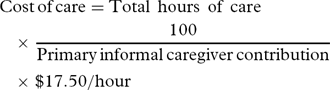
We compared patient demographic, cognitive, functional, and behavioral status between mild (CDR = 0.5–1) and moderate (CDR = 2) dementia patients using t-test and chi-square test for continuous and categorical variables respectively. Caregiver demographics, level of contribution in care and caregiver burden, were analyzed similarly. Total monthly time costs were computed based on total hours of care for basic ADL, independent ADL, and supervision of dementia patient as illustrated below:
If absence of foreign domestic help:
 \begin{eqnarray*}
&&{\rm Cost}\,{\rm of}\,{\rm care} = {\rm Total}\,\;{\rm hours}\;\,{\rm of}\;\,{\rm care}\\
&&\quad \times \;\frac{100}{{{\rm Primary}\,{\rm informal}\,{\rm caregiver}\,{\rm contribution}}}\\
&&\quad \times \;\$ 17.50/{\rm hour}
\end{eqnarray*}
If presence of foreign domestic help:
 \begin{eqnarray*}
&&{\rm Cost}\,{\rm of}\,{\rm care} = {\rm Total}\,\;{\rm hours}\;\,{\rm of}\;\,{\rm care}\\
&&\quad \times \;\frac{{100 - {\rm foreign}\,{\rm domestic}\,{\rm help}\,{\rm contribution}}}{{{\rm Primary}\,{\rm informal}\,{\rm caregiver}\,{\rm contribution}}}\\
&&\quad \times \;\$ 17.50/{\rm hour}\; {\rm plus} \\
&&{\rm Total}\,{\rm hours}\,{\rm of}\,{\rm care}\\
&&\quad \times \;\frac{{{\rm Maid}\,{\rm contribution}}}{{100}}\; \times \;{\rm \$ 2}{\rm .84/hour}{\rm .} \\
\end{eqnarray*}
We employed a generalized linear model (GLM) assuming a log link and gamma family of error distribution to examine the association between costs of informal care and cognitive impairment as assessed by CMMSE. The GLM analysis took into account concomitant influences of patient demographics (age, gender), daily life-functioning (ADL), neuropsychiatric disturbances (NPI-Q), caregiver burden (Zarit caregiver burden), and the use of paid domestic help to supplement caregiving. The appropriateness of alternative error distributions was examined using Park's test (Park, Reference Park1966) in line with the recommendations given in Manning and Mullahy (Reference Manning and Mullahy2001). The results supported the use of gamma family for GLM. Scatter plots of residuals against the predicted cost values also did not reveal significant concerns about our judgment.
Given the nonlinear nature of the model, the log coefficients do not provide a straightforward reflection of the substantive significance of predictors (for instance, interpreting log coefficients; LaFortune et al., Reference Lafortune, Beland, Bergman and Ankri2009). Consequently, we obtained marginal estimates to illustrate predicted costs for a “typical” study participant with mild (CMMSE = 20) and moderate (CMMSE = 15) cognitive impairment (Sahadevan et al., Reference Sahadevan, Tan, Tan and Tan1997) with and without the use of paid domestic help. Termed as marginal effect at a representative value (MER) by Cameron and Trivedi (Reference Cameron and Trivedi2010), these estimates reflect the total costs of informal care for each case type (i.e., CMMSE = 15 with maid vs. CMMSE = 15 without maid vs. CMMSE = 20 with maid vs. CMMSE = 20 without maid) as predicted by the model that has adjusted for the influences of a range of pertinent factors (i.e., model predictors).
The MERs were generated in the following two ways:
• Average marginal effect (AME): Average marginal estimates, which represent the average of the marginal effect of a predictor across the individuals in the sample (therefore allowing the value of the predictors to vary from one individual to another).
• Marginal effect at mean (MEM): Marginal estimates at the sample average, which represent the marginal effect of a given predictor holding the values of the remaining predictors at the average of the sample.
AME addresses the following question: “What is the average difference in informal care costs with and without the use of paid domestic help among individuals in the sample?” These estimates are most appropriate when an “average” person in the sample represents a typical member of the study population. If this premise is not tenable, MEM should be considered. MEM addresses the following question: “What is the difference in informal care cost for the average patient (i.e., other predictors fixed at sample mean value) with and without the use of paid domestic help? While some guidance exists in the literature on the appropriateness of MEM versus AME (Bartus, Reference Bartus2005), we reported both sets of estimates in the present study so that our conclusions may be critiqued from both perspectives.
Marginal estimation was carried out using the margins command that was introduced in Stata version 11 (see Williams, Reference Williams2012 for a review). For the eventual task of interpretation, all marginal estimates were bootstrapped 10,000 times to obtain confidence intervals. In the same process, we also bootstrapped the cost difference between case types for the purpose of discussion with regard to the impact of CMMSE on costs.
Results
One hundred and sixty-five dementia patient–caregiver dyads were studied. We included 127 mild dementia patients (CDR 0.5–1) and 38 moderate dementia (CDR 2) patients. Of the mild dementia patients, 22 had a CDR score of 0.5, and 105 had a CDR score of 1.0.
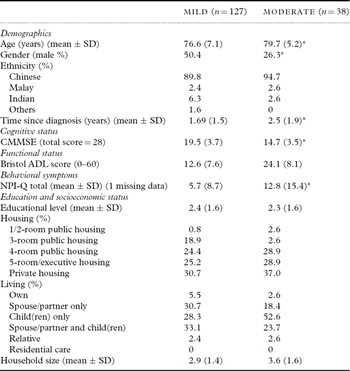
There were significant age and gender differences between mild and moderate dementia patients (Table 1). There was no difference in dementia etiologies between the two groups with majority of them having AD diagnoses. Most dementia patients lived with their spouse and/or children.
Baseline demographic details of study patients

Note: *p < 0.05.
CMMSE = Chinese Mini-Mental State Examination; Bristol ADL = Bristol Activities of Daily Living scale (0 = fully independent; 60 = fully dependent); NPI-Q = Neuropsychiatric Inventory Questionnaire.
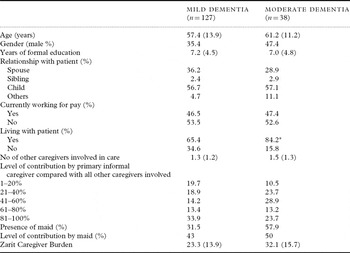
The caregivers interviewed were mostly middle-aged persons (mean age 57.4 ± 13.9 years and 61.2 ± 11.2 years for mild and moderate dementia patients respectively) with majority being women (64.6% and 52.6% for mild and moderate dementia patients respectively). They had mean education of 7.0–7.2 years (compared with 2.3–2.4 years in dementia patients). Altogether 65.4% of caregivers lived with mild dementia patients, while 84.2% of caregivers lived with moderate dementia patients (p < 0.05). For the majority of patients, more than one caregiver was involved in giving care with the proportion of contribution by various caregivers being fairly diverse (see Table 2). Altogether 31.5% of mild dementia patients and 57.9% of moderate dementia patients had paid domestic help to assist in care.
Caregiver characteristics

Note: *p < 0.05.
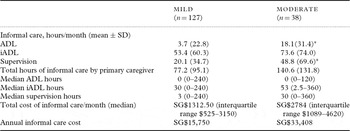
Total hours of informal care by the primary caregiver doubled in moderate dementia patients where significantly longer times were needed to help with ADL and supervision compared with patients with mild dementia. The median total annual cost of informal care was SG$15,750 (US$12,897) per patient/year in mild dementia patients compared with SG$33,408 (US$27,358) per patient/year in moderate dementia patients (Table 3).
Informal care and annual total cost of informal care information

Note: *p < 0.05.
ADL = Activities of Daily Living, iADL = independent Activities of Daily Living.
Results of the GLM analysis (Appendix) indicated that costs of informal care tended to be higher among female patients, those with more impairment in daily living and neuropsychiatric disturbances, and those whose caregiver reported greater caregiving burden. On the other hand, costs of informal care tended to be lower among older patients, those with more cognitive impairment, and those who had paid domestic help. Notably, however, only age, ADL, and the use of paid domestic help had statistically significant associations with costs of informal care. While statistical significance has to be interpreted with caution in light of the small sample size (n = 165), the association between costs and paid domestic help is considerably stronger than that observed for demographic and clinical factors as well as caregiver burden.
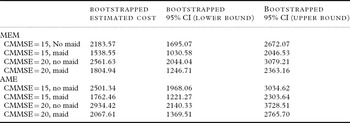
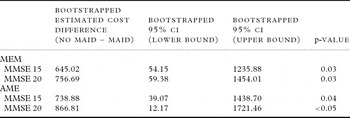
Table 4a presents marginal estimates of GLM for four case types. As both sets of estimates (MEMs and AMEs) did not differ dramatically, we henceforth make reference to MEMs only. Among those with moderate cognitive impairment (CMMSE = 15), the model predicted that costs of informal care in the absence of paid domestic help (SG$2183.57, 95% CI = 1695.07–2672.07) were higher than when such paid services were in use (SG$1538.55, 95% CI = 1030.58–2046.53). Bootstrapped results (Table 4b) indicated that this difference in costs averaged at SG$645.02 and was statistically significant despite the wide confidence interval (95% CI = 54.15–1235.88). Among those with milder cognitive impairment (CMMSE = 20), the marginal estimates suggest a similar conclusion.
Marginal estimates of costs of informal care for four case types

Note: Maid refers to live-in foreign workers engaged for paid domestic help.
MEM = Marginal effect at mean; AME = Average marginal effect; CMMSE = Chinese Mini-Mental State Examination.
Estimated difference in costs of informal care between case types

Note: Maid refers to live-in foreign workers engaged for paid domestic help.
MEM = Marginal effect at mean; AME = Average marginal effect; CMMSE = Chinese Mini-Mental State Examination.
Discussion
This is the first published study of informal costs of dementia in a Southeast Asian developed country involving mild–moderate dementia patients living in the community. Singapore's annual informal care cost of mild–moderate dementia patients (US$12,897–27,358) is comparable to those reported in the European and US studies (US$9950–18,385) (Moore et al., Reference Moore, Zhu and Clipp2001; Gustavsson et al., Reference Gustavsson2010). This is despite the prevalent employment of cheaper foreign paid domestic help for informal care and may be contributed by the difference in sampling era as well as the disparate costing methods employed. Thus, Singapore is unique in its ability to provide informal care with the help of lower wage foreign domestic workers from neighboring Southeast Asian countries. In line with reports from Western countries, we similarly demonstrated a near doubling of informal care costs with disease stage (from mild to moderate dementia; Quentin et al., Reference Quentin, Riedel-Heller, Luppa, Rudolph and Konig2010; Leicht et al., Reference Leicht2011).
We demonstrated ADL and presence of paid domestic help to be significantly associated with informal care costs. This is similar to studies in Western populations (Bergvall et al., Reference Bergvall2011; Gustavsson et al., Reference Gustavsson, Cattelin and Jonsson2011), which have shown ADL abilities to predict informal care time, and hence costs. In addition, our study demonstrated a novel finding of cost savings with the presence of live-in paid domestic help. Interestingly, this was more evident in the mild dementia group (Table 4b) despite the presence of milder disease-related factors and caregiver burden. Subsequent analyses did not find significant differences in gender or relationship of caregiver, and hours of care differences to account for the apparent larger cost savings for informal care in the mild dementia subgroup. Further work with larger sample size for the mild and especially moderate dementia subgroups would be needed to further confirm this unexpected finding.
An important caveat in interpreting current study finding would be that it is conducted exclusively in a Memory Clinic population, where the patients maybe from a higher socioeconomic class (as evidenced by their housing class type and willingness to seek specialist healthcare). A more comprehensive approach could be to include dementia patient–caregiver dyads seen in psychogeriatric or neurology clinics as well as those managed in the home care setting by community programs. There needs to be future extension of the current study to the aforementioned groups, including advanced dementia patients living in the community. Another limitation is the uniform costing of caregiver time (excluding foreign domestic help), but this maybe partially justified as majority of caregivers were still in the productive working age (see Table 2). Also, the human capital approach values productivity losses incurred by caregivers as the average wages they earn, including all the benefits associated with those wages. We did not distinguish the cost between paid and unpaid labor. Usually, the replacement method is used to cost unpaid labor lost. However, in our setting the realistic substitute for unpaid labor is often a foreign domestic help. Because of policy-driven low cost of foreign domestic help labor force, the unit cost is not a good proxy estimate. We acknowledge that other methods may generate lower cost savings.
In summary, this study demonstrates the informal care cost of caring for mild–moderate dementia patients in an Asian community with the unique contribution of foreign domestic helps. Informal caregiver in the form of live-in domestic help is not a complete substitute for family caregiver. Given significant ageing of the population, caregiver time spent on dementia care is likely to increase. Human resource policies, and tax policies, should reflect this changing demographic landscape in order to alleviate the burden of caregiving for this group of individuals that is predominately female. Most of such healthcare costs are borne out-of-pocket, although very recent government initiatives, such as the Foreign Domestic Worker Grant, a monthly grant of SG$170 (approx US$140) for care of frail older persons with disability and dementia, have been implemented to offset some costs associated with informal care in the community. As continued efforts develop to maintain the care of society's elderly people in the community, this study will aid policy-makers in allocation of resources and support to caregivers. Crucially, this data will be useful for understanding ethnic and cultural differences in resource utilization and care costs, with potential implications on cost-effective assessments in international clinical trials.
Conflict of interest
All the authors have no financial conflict of interest. The funding organization had no role in the research study.
Description of authors’ roles
M. S. Chong and K. C. Chua designed the study, supervised the data collection, performed statistical analysis, and wrote the manuscript. W. S. Tan contributed to statistical analysis and writing the manuscript. M. Chan, W. S. Lim, N. Ali, and Y. Y. Ang helped in patient recruitment, and contributed to writing the manuscript.
Acknowledgments
This study was funded by the National Healthcare Group (NHG) Small Innovative Grant 2011/005. Dr M. S. Chong is supported by the NHG Clinician Scientist Career Scheme 2012/12002. We would like to extend our thanks to Ms Shirley Tan and Ms May Wong for their assistance in data collection.
Appendix
GLM model (gamma, log) for costs of informal care (n = 165)