Introduction
Psychiatric comorbidity, the co-occurrence of more than one mental health problem, is the rule rather than the exception in the general population (Andrews, Slade, & Issakidis, Reference Andrews, Slade and Issakidis2002; Caspi et al., Reference Caspi, Houts, Ambler, Danese, Elliott, Hariri and Moffitt2020; Kessler, Chiu, Demler, & Walters, Reference Kessler, Chiu, Demler and Walters2005b; Plana-Ripoll et al., Reference Plana-Ripoll, Musliner, Dalsgaard, Momen, Weye, Christensen and McGrath2020). More than 40% of adolescents and adults with at least one mental health problem will subsequently accumulate one or more additional lifetime diagnoses (Kessler et al., Reference Kessler, Chiu, Demler and Walters2005b; Merikangas et al., Reference Merikangas, He, Burstein, Swanson, Avenevoli, Cui and Swendsen2010; Plana-Ripoll et al., Reference Plana-Ripoll, Musliner, Dalsgaard, Momen, Weye, Christensen and McGrath2020). An increase in the number of comorbid mental disorders is associated with greater clinical severity (e.g. work disability, suicide attempt, and use of psychiatric services) (Angst, Sellaro, & Ries Merikangas, Reference Angst, Sellaro and Ries Merikangas2002; Kessler et al., Reference Kessler, Chiu, Demler and Walters2005b) and a reduction in life expectancy (Plana-Ripoll et al., Reference Plana-Ripoll, Musliner, Dalsgaard, Momen, Weye, Christensen and McGrath2020; Weye et al., Reference Weye, Momen, Christensen, Iburg, Dalsgaard, Laursen and Plana-Ripoll2020). To date, we know little about how to prevent the development of comorbidity within mental disorders.
Peer victimization is a potentially modifiable factor associated with virtually all commonly occurring mental health problems, both on the internalizing (e.g. depression, anxiety, and suicidality) and externalizing (e.g. antisocial personality, violence, and criminal offending) spectra (Arseneault, Reference Arseneault2018; Moore et al., Reference Moore, Norman, Suetani, Thomas, Sly and Scott2017; Reijntjes, Kamphuis, Prinzie, & Telch, Reference Reijntjes, Kamphuis, Prinzie and Telch2010; Reijntjes et al., Reference Reijntjes, Kamphuis, Prinzie, Boelen, van der Schoot and Telch2011; Schoeler, Duncan, Cecil, Ploubidis, & Pingault, Reference Schoeler, Duncan, Cecil, Ploubidis and Pingault2018; Ttofi, Farrington, & Lösel, Reference Ttofi, Farrington and Lösel2012; van Geel, Vedder, & Tanilon, Reference van Geel, Vedder and Tanilon2014). Peer victimization is an umbrella term used to describe the experience of being the target of peers' hostile behaviors done intentionally to inflict harm upon another (Finkelhor, Turner, & Hamby, Reference Finkelhor, Turner and Hamby2012). Peer victimization can take different forms, such as physical (e.g. hitting, and kicking), verbal (e.g. name-calling), and relational (e.g. social exclusion and spreading false rumors or lies) victimization. Across cultures and countries, about 30% of children report having experienced peer victimization at some point during their schooling (Analitis et al., Reference Analitis, Velderman, Ravens-Sieberer, Detmar, Erhart and Herdman2009; Craig et al., Reference Craig, Harel-Fisch, Fogel-Grinvald, Dostaler, Hetland, Simons-Morton and Pickett2009; Jadambaa et al., Reference Jadambaa, Thomas, Scott, Graves, Brain and Pacella2019; Modecki, Minchin, Harbaugh, Guerra, & Runions, Reference Modecki, Minchin, Harbaugh, Guerra and Runions2014). Peer victimization is a heterogeneous experience which varies in terms of intensity (i.e. how frequently it happens), and timing (i.e. when it happens during development and for how long it lasts). For example, studies describing patterns of stability and change in peer victimization during school years identified groups of children for whom the experience of peer victimization was transitory (4.5–31%) as well as groups of children who reported chronic exposure (2–24%); the proportions varied depending on the developmental period studied, the length of the follow-up, and the statistical method used (Bowes et al., Reference Bowes, Maughan, Ball, Shakoor, Ouellet-Morin, Caspi and Arseneault2013; Goldbaum, Craig, Pepler, & Connolly, Reference Goldbaum, Craig, Pepler and Connolly2003; Ladd, Ettekal, & Kochenderfer-Ladd, Reference Ladd, Ettekal and Kochenderfer-Ladd2017; Oncioiu et al., Reference Oncioiu, Orri, Boivin, Geoffroy, Arseneault, Brendgen and Côté2020; Smith, Talamelli, Cowie, Naylor, & Chauhan, Reference Smith, Talamelli, Cowie, Naylor and Chauhan2004).
Most studies investigated separately the association of intensity (frequency) and chronicity of peer victimization with mental health problems. First, frequent occurrence of peer victimization (e.g. at least a few times a month) was found to be associated with more symptoms of anxiety, depression, and cigarette smoking (Bouman et al., Reference Bouman, van der Meulen, Goossens, Olthof, Vermande and Aleva2012; Moore et al., Reference Moore, Norman, Suetani, Thomas, Sly and Scott2017; van der Ploeg, Steglich, Salmivalli, & Veenstra, Reference van der Ploeg, Steglich, Salmivalli and Veenstra2015). However, there is also evidence suggesting that less frequent occurrence of peer victimization (e.g. a few times during the past 12 months) is also associated with a higher likelihood of mental health problems relative to no exposure to bullying victimization (Goldbach, Sterzing, & Stuart, Reference Goldbach, Sterzing and Stuart2018; Gower & Borowsky, Reference Gower and Borowsky2013; Klomek, Marrocco, Kleinman, Schonfeld, & Gould, Reference Klomek, Marrocco, Kleinman, Schonfeld and Gould2008). Second, regarding timing, robust evidence indicates that chronic exposure to peer victimization is associated with serious short- and long-term mental health problems (Arseneault, Reference Arseneault2018; Geoffroy et al., Reference Geoffroy, Boivin, Arseneault, Renaud, Perret, Turecki and Côté2018; Schreier et al., Reference Schreier, Wolke, Thomas, Horwood, Hollis, Gunnell and Harrison2009). However, studies about mental health outcomes following transient experiences of peer victimization are scarce and have conflicting results, showing either lingering negative effects on mental health (Bogart et al., Reference Bogart, Elliott, Klein, Tortolero, Mrug, Peskin and Schuster2014; Bowes et al., Reference Bowes, Maughan, Ball, Shakoor, Ouellet-Morin, Caspi and Arseneault2013; Hoffman, Phillips, Daigle, & Turner, Reference Hoffman, Phillips, Daigle and Turner2016) or no increased risk relative to no exposure to peer victimization (Smith et al., Reference Smith, Talamelli, Cowie, Naylor and Chauhan2004). Finally, evidence from studies describing developmental trajectories of peer victimization which characterize simultaneously the timing and intensity of peer victimization have shown that children who experienced high-intensity peer victimization only during childhood did not exhibit more mental health problems than non-victimized children (Goldbaum et al., Reference Goldbaum, Craig, Pepler and Connolly2003; Ladd, Ettekal, & Kochenderfer-Ladd, Reference Ladd, Ettekal and Kochenderfer-Ladd2019). Conversely, adolescence-emerging peer victimization showed similar associations with mental health problems as chronic peer victimization (Goldbaum et al., Reference Goldbaum, Craig, Pepler and Connolly2003; Smith et al., Reference Smith, Talamelli, Cowie, Naylor and Chauhan2004).
Furthermore, to date, evidence about the association of peer victimization with comorbid presentation of mental health problems is scarce. Studies looking at internalizing-only problems (e.g. depression and anxiety) found associations between peer victimization and internalizing comorbidities (Forbes, Fitzpatrick, Magson, & Rapee, Reference Forbes, Fitzpatrick, Magson and Rapee2019; Ranta, Kaltiala-Heino, Pelkonen, & Marttunen, Reference Ranta, Kaltiala-Heino, Pelkonen and Marttunen2009; Stapinski et al., Reference Stapinski, Bowes, Wolke, Pearson, Mahedy, Button and Araya2014). We identified five studies which analyzed the relationship between peer victimization and latent patterns of internalizing and externalizing (e.g. aggression, inattention, and delinquency) problems in childhood (Hanish & Guerra, Reference Hanish and Guerra2002) and adolescence (Eastman et al., Reference Eastman, Foshee, Ennett, Sotres-Alvarez, Reyes, Faris and North2018; Forbes, Magson, & Rapee, Reference Forbes, Magson and Rapee2020; Kretschmer, Barker, Dijkstra, Oldehinkel, & Veenstra, Reference Kretschmer, Barker, Dijkstra, Oldehinkel and Veenstra2015; Rijlaarsdam, Cecil, Buil, van Lier, & Barker, Reference Rijlaarsdam, Cecil, Buil, van Lier and Barker2021). These studies reported associations between peer victimization and patterns of mental health problems characterized predominantly by internalizing symptoms (Kretschmer et al., Reference Kretschmer, Barker, Dijkstra, Oldehinkel and Veenstra2015), as well as associations between transient peer victimization and mental health profiles with predominant externalizing symptoms (Hanish & Guerra, Reference Hanish and Guerra2002), or between persistent (Hanish & Guerra, Reference Hanish and Guerra2002) and intense (Eastman et al., Reference Eastman, Foshee, Ennett, Sotres-Alvarez, Reyes, Faris and North2018) victimization with comorbid internalizing–externalizing symptoms. More recently, two studies shown that the association of peer victimization with internalizing or externalizing symptoms is non-specific, being accounted for by a general factor for psychopathology (Forbes et al., Reference Forbes, Magson and Rapee2020; Rijlaarsdam et al., Reference Rijlaarsdam, Cecil, Buil, van Lier and Barker2021). However, such prior studies did not measure internalizing–externalizing comorbidities in young adulthood. The co-occurrence of mental health problems during young adulthood could be particularly detrimental, as this period lays the foundations for adaptation to adult roles, such as integration into workforce, financial independence, the formation of lasting intimate partnerships, and parenthood. Therefore, it is crucial to understand if experiences of peer victimization with different timing and intensity are associated with different mental health comorbidity profiles in this key life period.
The objective of this study was to examine the association between timing and intensity of peer victimization and number and type of comorbid mental health problems in young adulthood.
Method
Study sample
We used data from the Quebec Longitudinal Study of Child Development (QLSCD), an ongoing population-based birth cohort established in 1997, conducted by the Institut de la Statistique du Québec. The study follows the development of 2120 children born between October 1997 and July 1998 to mothers residing in the Canadian province of Quebec, who gave birth after 24 weeks and not later than 42 weeks' gestation, and who spoke English or French. The participants were selected from the Quebec Master Birth Registry through a stratified three-stage sampling design based on geographical location (remote/non-remote region) and the birth rate (low/high) of regional municipalities. The study website (https://www.jesuisjeserai.stat.gouv.qc.ca/default_an.htm) and previous publications contain detailed information on the QLSCD (Jetté, Reference Jetté2002; Orri et al., Reference Orri, Boivin, Chen, Ahun, Geoffroy, Ouellet-Morin and Côté2020). The QLSCD protocol was approved by the Institut de la Statistique du Québec and the Sainte-Justine Hospital Research Center ethics committees. Written informed consent was obtained from all participating families at each assessment. A total of 1760 participants had at least one measure of peer victimization between 6 and 17 years. Of those, 1216 participants [517 boys (42.5%) and 699 girls (57.5%)] answered the mental health questionnaire at 20 years old, and were selected as study sample for our analyses. Compared to participants included in the study sample, non-included participants (i.e. excluded because of attrition) were more likely to be males, to come from non-intact and socioeconomically disadvantaged families and be exposed to higher levels of parental overprotection during early childhood. Non-included participants were also more likely to have parents with low education and mothers who were younger, had depressive symptoms and smoked during the entire pregnancy (online Supplementary Table S1). Table 1 presents the characteristics of the participants included in this study.
Early childhood characteristics and mental health in young adulthood by peer victimization trajectories

Data were compiled from the final master file of the Québec Longitudinal Study of Child Development (1998–2018), ©Gouvernement du Québec, Institut de la statistique du Québec.
Mental health outcomes at age 20 years
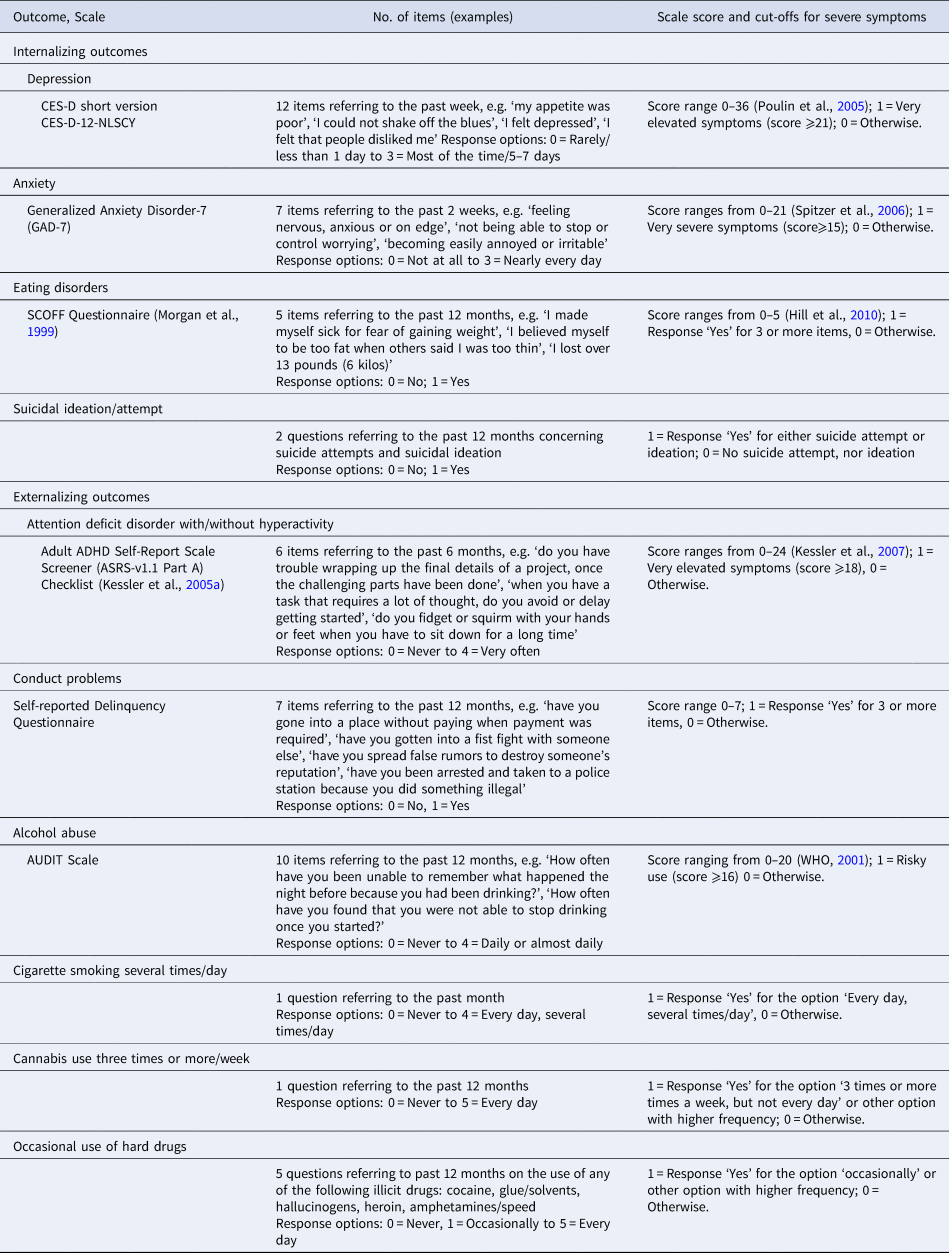
At age 20 years, participants reported on their mental health during the past year through confidential online questionnaires. We assessed symptoms of internalizing (i.e. depression, anxiety, eating disorders, and suicide attempt/ideation), and externalizing problems [i.e. attention deficit disorder with/without hyperactivity (ADHD), antisocial behavior, alcohol abuse, daily cigarette smoking, cannabis use three times/week or more, and occasional use of hard drugs]. The classification of mental health problems into internalizing and externalizing was done in line with DSM-5 guidance and previous studies (e.g. Caspi et al., Reference Caspi, Houts, Ambler, Danese, Elliott, Hariri and Moffitt2020; Schaefer et al., Reference Schaefer, Moffitt, Arseneault, Danese, Fisher, Houts and Caspi2018). To identify participants with severe symptoms, we used standard cut-offs of the continuous scales for depression (Poulin, Hand, & Boudreau, Reference Poulin, Hand and Boudreau2005), anxiety (Spitzer, Kroenke, Williams, & Löwe, Reference Spitzer, Kroenke, Williams and Löwe2006), and alcohol use (WHO, 2001). When standard cut-offs (Kessler et al., Reference Kessler, Adler, Ames, Demler, Faraone, Hiripi and Walters2005a; Morgan, Reid, & Lacey, Reference Morgan, Reid and Lacey1999) led to a high proportion of participants being classified as presenting elevated symptoms (about 30%), we selected stricter cut-offs of the validated scales, i.e. eating disorders (Hill, Reid, Morgan, & Lacey, Reference Hill, Reid, Morgan and Lacey2010) and ADHD (Kessler et al., Reference Kessler, Adler, Gruber, Sarawate, Spencer and Van Brunt2007). However, analyses with standard cut-offs yield consistent results (data not shown). For categorical (i.e. cigarette smoking, cannabis use, and hard drug use) and count (i.e. antisocial behavior) outcomes, we grouped response options to derive dichotomous variables that reflected severity while ensuring a reasonable sample size to perform the analyses (i.e. more than five participants in each trajectory group). A detailed description of the assessment instrument for each outcome as well as the cut-offs for severe symptomatology is presented in Table 2. Our primary outcomes were (1) the number of mental health problems with elevated symptoms in the past 12 months (count variable, range 0–10) and (2) the type of mental health comorbidities in the past 12 months, with four possible categories: (a) no mental health problems, (b) internalizing-only problem(s) – severe symptoms for one or more internalizing problems in the absence of externalizing problems, (c) externalizing-only problem(s) – severe symptoms for one or more externalizing problems in the absence of internalizing problems; and (d) internalizing–externalizing comorbidity – severe symptoms for at least one internalizing and one externalizing problem.
Description of instruments used for the assessment of mental health at 20 years old

Exposure to peer victimization from age 6 to 17 years
When participants were aged 6, 7, 8, 10, 12, 13, 15, and 17 years, we collected information on peer victimization using six items of a modified version of the Self-report victimization scale (Ladd & Kochenderfer-Ladd, Reference Ladd and Kochenderfer-Ladd2002). Participants reported how often (0 = never to 2 = often) they experienced physical (i.e. being pushed, hit, and/or kicked), verbal (i.e. being called names and/or insulted and being teased in a mean way), relational victimization (i.e. being excluded from a group), and property attacks (i.e. being forced to give personal belongings to be left alone). At each wave, we calculated the mean of the items (range 0–2) which was then rescaled (multiplied by 5) to range from 0 to 10. At each wave, the score of peer victimization described the intensity (the frequency) of peer victimization experienced in the past 6 months, with high scores indicating high intensity. Using these longitudinal data, we derived developmental trajectories which captured both the timing and intensity of peer victimization. We identified the following four trajectories: (1) low peer victimization across the entire period (n = 415, 34.1%) (2) childhood-limited peer victimization, characterized by a relatively high level of victimization at age 6, followed by a progressive sharp decline from age 6 to 17 years, and no victimization at age 17 (n = 310, 25.5%); (3) moderate adolescence-emerging peer victimization, characterized by steady levels of victimization from age 6 to 12 years and the second highest level of victimization across adolescence (n = 360, 29.6%); and (4) high-chronic peer victimization, characterized by persistently higher levels of victimization relative to the other groups, despite a decline from age 6 to 17 years (n = 131, 10.8%) (Fig. 1). It is worth noting that, due to the self-report assessment, the trajectories captured perceived peer victimization, i.e. a subjective account of the actual peer victimization experience. However, for the sake of simplicity throughout the text, we will refer to it as ‘peer victimization’. Further details about the estimation of these developmental trajectories of peer victimization can be found elsewhere (Oncioiu et al., Reference Oncioiu, Orri, Boivin, Geoffroy, Arseneault, Brendgen and Côté2020 and online Supplementary Table S2).
Trajectories of self-reported peer victimization from 6 to 17 years of age. Reprinted from Oncioiu et al. (Reference Oncioiu, Orri, Boivin, Geoffroy, Arseneault, Brendgen and Côté2020). Dashed lines represent trajectories for the observed values and solid lines represent trajectories as estimated by our model. To model the slope of the trajectories we used linear term for the low trajectory and quadratic terms for the other trajectories. Fit indices of the model include: Bayesian information criterion: −21,168.9; entropy: median 0.75, range 0.66–0.80 (i.e. quality of the classification; adequate if >0.70) and odds of correct classification: median 7.3, range 4.7–31.7 (i.e. the model classifies the participants 7.3 times better than the classification by chance; adequate if >5.0). Data were compiled from the final master file of the Québec Longitudinal Study of Child Development (1998–2018), ©Gouvernement du Québec, Institut de la statistique du Québec.

Background individual, familial, and behavioral characteristics
Children exposed to peer victimization substantially differ from those not exposed on a range of individual, familial, and behavioral characteristics (Cook, Williams, Guerra, Kim, & Sadek, Reference Cook, Williams, Guerra, Kim and Sadek2010; Schoeler et al., Reference Schoeler, Choi, Dudbridge, Baldwin, Duncan, Cecil and Pingault2019). These characteristics may confound the association between peer victimization and later mental health problems. Therefore, we considered a wide range of background characteristics putatively associated with peer victimization, which were measured between 5 months and 5 years after birth: sex, socioeconomic status, family structure, maternal and paternal mental health (i.e. depression, anxiety, and antisocial behavior) and parenting (i.e. positive and coercive), mother's alcohol use and cigarette smoking during pregnancy, and child's behavior problems rated by the mother and the father (i.e. overall aggression, hyperactivity, internalizing behavior – depression and anxiety symptoms, and social withdrawal), child's pre-school peer victimization, and child's participation in childcare. For variables measured repeatedly, we calculated the mean across early childhood if information was available at minimally two waves. A detailed description of these measures is available in online Supplementary Table S3.
Statistical analyses
We conducted two main analyses. First, we used a negative binomial regression to estimate the association between peer victimization trajectories and the number of severe mental health problems at 20 years old (count variable). Second, we used a multinomial logistic regression to estimate the association between peer victimization trajectories and type of comorbidity (reference group for the outcome: ‘no mental health problems’ category). In both regression models, the reference group for the exposure was the category ‘low peer victimization’.
For each analysis, we reported both the crude and adjusted models. In adjusted models, we used propensity score (PS) inverse probability weighting (IPW) (Austin, Grootendorst, & Anderson, Reference Austin, Grootendorst and Anderson2007; Stuart, Reference Stuart2010) to account for the differences in terms of early childhood characteristics across the four peer victimization trajectories. We proceeded as follows. First, we calculated the standardized mean difference (SMD) for each background variable between children in the four trajectories of peer victimization for all six possible subgroups comparisons (e.g. low v. childhood-limited, moderate adolescence-emerging v. high-chronic, etc.) (online Supplementary Fig. S1). Variables showing an SMD >0.10 in at least one of the six comparisons were included in the PS model. Second, the PS for peer victimization trajectories was estimated using multinomial regression (R package MatchThem). Third, we assessed the success of the PS in reducing background differences between children in the different peer victimization trajectories by comparing SMD in the weighted and non-weighted datasets. The IPW significantly reduced the differences in terms of background characteristics across the four peer victimization trajectories, thus increasing their comparability (online Supplementary Fig. S1). Finally, we applied the PS weights to the outcome model using the IPW procedure. Despite a general reduction in the SMDs, the following variables were left unbalanced (i.e. SMD >0.10) after the use of the PS IPW: socioeconomic disadvantage, maternal and paternal anxiety, and hyperactivity rated by the father. To account for this unbalance, these variables were additionally adjusted for by inclusion as adjustment factors in the PS IPW models. This additional adjustment, did not modify the results; therefore, we presented only the results from PS IPW models. To account for missing data in the background variables (below 3% for the majority and between 10 and 17% for father parenting and father-rated early childhood behavior), associations were estimated across 50 multiple imputed datasets (R package mice) and the results pooled.
In complementary analyses, we re-ran the multinomial and negative binomial regressions, by changing the reference category for the exposure to test all possible contrasts (e.g. high-chronic v. moderate adolescence-emerging, high-chronic v. childhood-limited, and childhood-limited v. moderate-emerging peer victimization). Also, to contrast comorbid internalizing–externalizing with internalizing-only and externalizing-only problems, we changed the reference group for the outcome from no mental health problems to externalizing-only and internalizing-only problems (keeping the low peer victimization group as reference for the exposure). Additionally, we used binary logistic regression to estimate the association between peer victimization trajectories and severe symptoms for each specific mental health problem.
Results
Peer victimization trajectories and rate of comorbid mental health problems in young adulthood
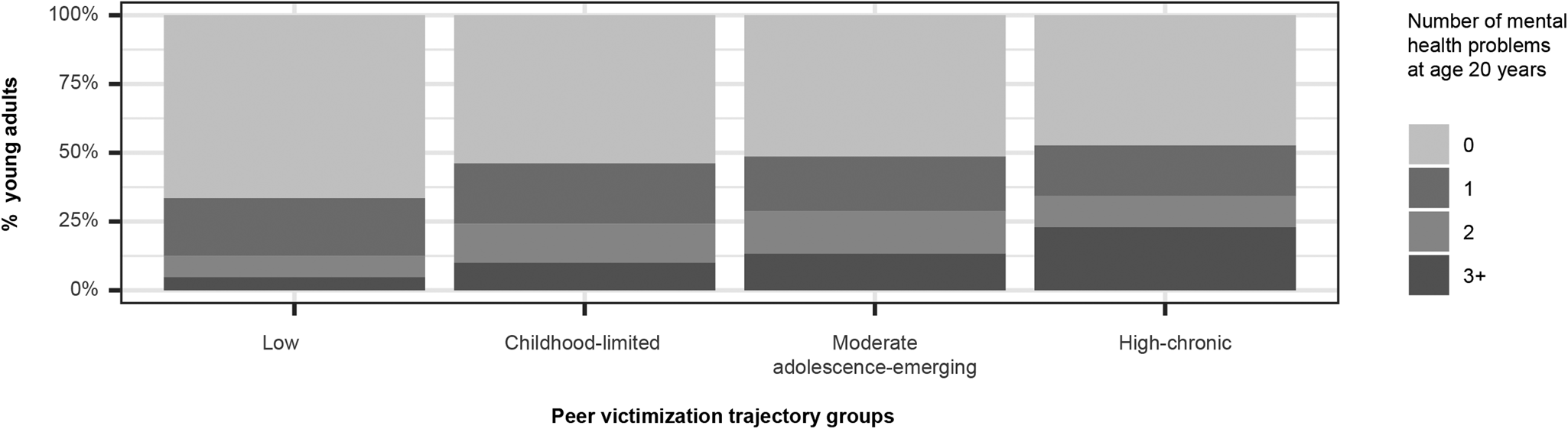
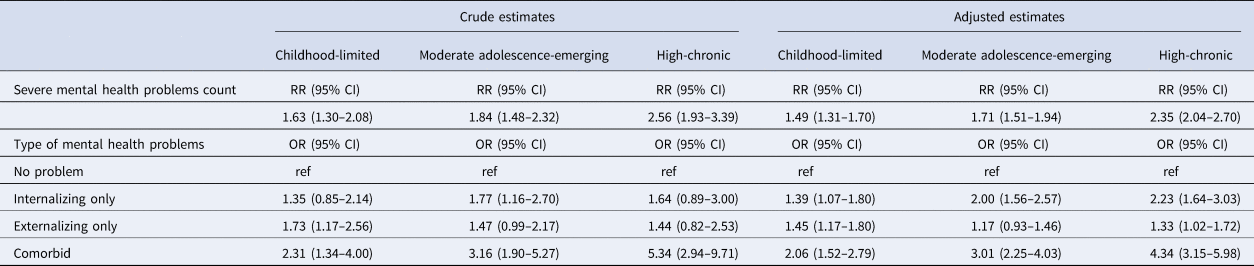
The number of participants reporting exactly 1, 2, or 3 or more severe mental health problems was 250 (20.6%), 147 (12.1%), and 129 (10.6%), respectively. As shown in Fig. 2, 20 (4.8%) of the participants in the low peer victimization group, 31 (10.0%) in the childhood-limited, 48 (13.3%) in the moderate adolescence-emerging, and 30 (22.9%) in the high chronic group presented high levels of symptoms for three or more mental health problems. Relative to low peer victimization, any other experience of peer victimization increased the rate of comorbid mental health problems both in the crude and adjusted models – in which familial and parental factors as well as child behavior in early childhood were taken into account. In adjusted models, over a period of 12 months in young adulthood, youth in the childhood-limited, moderate adolescence-emerging, and high-chronic trajectories presented an increase of 49% [risk ratio (RR) 1.49, 95% confidence interval (CI) 1.31–1.70), 71% (RR 1.71, 95% CI 1.51–1.94), and 135% (RR 2.35, 95% CI 2.04–2.70] in the rate of comorbid mental health problems, respectively, relative to participants in the low peer victimization trajectory (Table 3).
Mental health comorbidities in young adulthood according to trajectories of peer victimization from 6 to 17 years of age. Data were compiled from the final master file of the Québec Longitudinal Study of Child Development (1998–2018), ©Gouvernement du Québec, Institut de la statistique du Québec.

Association of peer victimization trajectories for 6–17 years of age with mental health comorbidities at 20 years of agea

a Reference group for exposure: low peer victimization trajectory; adjusted estimates for parent, family, and child behavioral characteristics using PS inverse probability weights. Data were compiled from the final master file of the Québec Longitudinal Study of Child Development (1998–2018), ©Gouvernement du Québec, Institut de la statistique du Québec.
Peer victimization trajectories and type of comorbid mental health problems in young adulthood
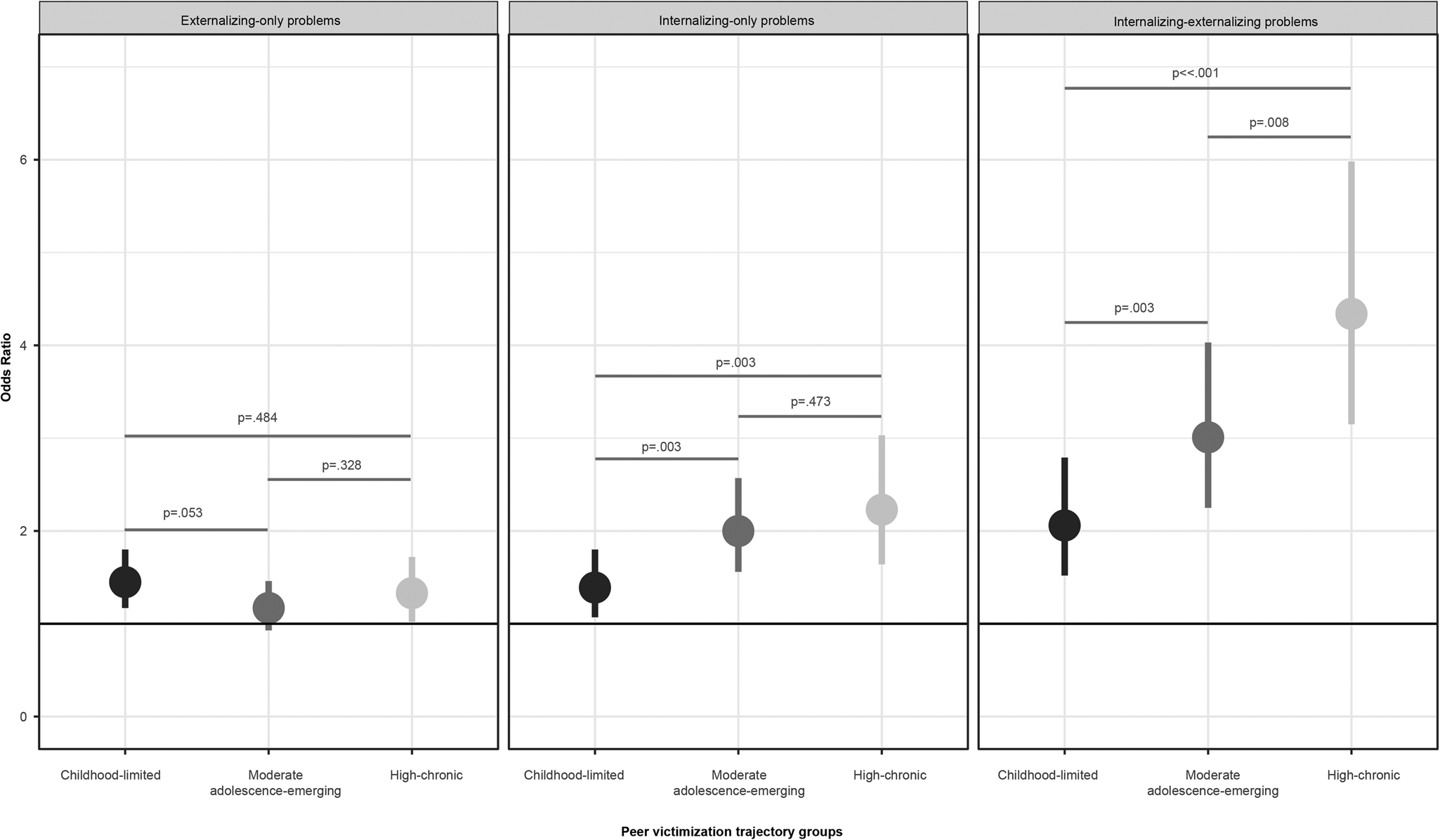
A total of 165 (13.6%) participants presented internalizing-only problem(s), 218 (17.9%) externalizing-only problem(s), and 143 (11.8%) comorbid internalizing–externalizing problems. A description of the type of mental health problems in the overall sample and by peer victimization trajectory is presented in Table 1. Relative to low peer victimization, all the other experiences were associated with an increased likelihood of comorbid internalizing–externalizing, internalizing-only, and externalizing-only problems both in the crude and adjusted models, but not all associations reached statistical significance. In adjusted models, relative to children in the low peer victimization trajectory, those in the childhood-limited, moderate adolescence-emerging and high-chronic trajectories had a two-fold [odds ratio (OR) 2.06, 95% CI 1.52–2.79], three-fold (OR 3.01, 95% CI 2.25–4.03), and four-fold (OR 4.34, 95% CI 3.15–5.98) increase in the likelihood of presenting comorbid internalizing–externalizing problems relative to no mental health problems, respectively. In adjusted models, relative to low peer victimization, all other experiences increased the likelihood of internalizing-only (OR ranging from 1.39, 95% CI 1.07–1.80 for childhood-limited to 2.23, 95% CI 1.64–3.03 for high-chronic victimization) and externalizing-only (OR ranging from 1.17, 95% CI 0.93–1.46 for moderate adolescence-emerging to 1.45, 95% CI 1.17–1.80 for childhood-limited victimization) problems; for externalizing-only problems the association with moderate adolescence-emerging peer victimization was not statistically significant (Table 3, Fig. 3).
Association between peer victimization trajectories and type of mental health comorbidities at age 20 years. The figure shows OR and 95% CIs (y-axis) for the association between peer victimization trajectories (x-axis) and type of mental health comorbidity (panels). Estimates are from the adjusted multinomial regression. The reference category for the exposure was the low peer victimization group, whereas the reference category for outcome was the group with no mental health problems. p values refer to contrasts (OR and 95% CI) between the peer victimization groups available in online Supplementary Table S4. Data were compiled from the final master file of the Québec Longitudinal Study of Child Development (1998–2018), ©Gouvernement du Québec, Institut de la statistique du Québec.

Complementary analyses
The strength of the association for the rate of comorbid mental health problems (online Supplementary Table S4) and the likelihood of presenting comorbid internalizing–externalizing problems (online Supplementary Table S4 and Fig. 3) increased from childhood-limited to moderate adolescence-emerging and high-chronic peer victimization. Moreover, all peer victimization groups (v. the low group) were more likely to present comorbid internalizing–externalizing problems relative to externalizing-only symptoms. The moderate adolescence-emerging and high-chronic groups had higher likelihood of presenting internalizing-only problems relative to externalizing-only problems (online Supplementary Table S5). The results of the association of peer victimization trajectories with each severe mental health problem separately were consistent with the main analyses. Of note, after accounting for early childhood factors, children in the childhood-limited group relative to those in the low trajectory presented higher likelihood of reporting suicidal ideation/attempt and smoking several cigarettes/day, while children in the moderate adolescence-emerging and high-chronic groups presented higher likelihood for several separate outcomes both on the internalizing and externalizing spectra (online Supplementary Table S6).
Discussion
This study investigated the association of different timing and intensity of peer victimization experiences across childhood and adolescence with mental health comorbidity in young adulthood. Three main findings emerged.
First, we showed that participants who experienced peer victimization, compared to those who did not, reported higher rates of comorbid mental health problems in young adulthood and were more likely to present a pattern of comorbid internalizing–externalizing problems, regardless of the intensity and timing of peer victimization exposure – i.e. moderate or high intensity; during childhood and/or adolescence. Furthermore, we showed that children who experienced peer victimization were more likely to present externalizing problems in combination with internalizing problems, rather than externalizing-only problems. These results are in line with studies showing that peer victimization (Forbes et al., Reference Forbes, Magson and Rapee2020; Kretschmer et al., Reference Kretschmer, Barker, Dijkstra, Oldehinkel and Veenstra2015; Rijlaarsdam et al., Reference Rijlaarsdam, Cecil, Buil, van Lier and Barker2021), as well as other forms of interpersonal violence (e.g. domestic violence and sexual abuse) (Schaefer et al., Reference Schaefer, Moffitt, Arseneault, Danese, Fisher, Houts and Caspi2018) are associated with general psychopathology, rather than specific mental health problems. This may indicate that peer victimization, similar to other forms of childhood maltreatment (McLaughlin, Colich, Rodman, & Weissman, Reference McLaughlin, Colich, Rodman and Weissman2020), is a transdiagnostic risk factor, associated with problems across the entire spectrum of psychopathology. Importantly, we showed that the persistence and intensity of peer victimization influence the strength of the association with serious mental health problems, such as internalizing–externalizing comorbidities. We found that persistent peer victimization of high intensity (i.e. high-chronic group) had the highest rate of comorbid mental health problems and strongest associations with comorbid internalizing–externalizing problems, followed by persistent peer victimization of moderate intensity (i.e. moderate adolescence-emerging group) and childhood-limited peer victimization. These findings corroborate those pointing out that persistent and high-intensity peer victimization experiences have the most pervasive impact on mental health (Arseneault, Reference Arseneault2018; Geoffroy et al., Reference Geoffroy, Boivin, Arseneault, Renaud, Perret, Turecki and Côté2018; Hanish & Guerra, Reference Hanish and Guerra2002; Hong, Wang, Pepler, & Craig, Reference Hong, Wang, Pepler and Craig2020; Moore et al., Reference Moore, Norman, Suetani, Thomas, Sly and Scott2017). Moreover, the relative weak association of childhood-limited peer victimization with mental health comorbidities could be interpreted as a dissipation over time of the effect of transient peer victimization on mental health, which has already been documented separately for externalizing and internalizing symptoms in recent quasi-experimental studies (Schoeler et al., Reference Schoeler, Choi, Dudbridge, Baldwin, Duncan, Cecil and Pingault2019; Singham et al., Reference Singham, Viding, Schoeler, Arseneault, Ronald, Cecil and Pingault2017). However, it is possible that this association of childhood-limited peer victimization with lingering mental health comorbidities may have been observed in our study due to residual confounding (i.e. genetic and unmeasured environmental factors).
Second, our results indicated that youth who reported persistent (i.e. moderate adolescence-emerging and high-chronic) and childhood-limited peer victimization experiences had different profiles in terms of internalizing-only and externalizing-only symptoms. We showed that similarities between moderate adolescence-emerging and high-chronic peer victimization groups, reported in previous studies in relationship with anxiety (Goldbaum et al., Reference Goldbaum, Craig, Pepler and Connolly2003; Hoffman et al., Reference Hoffman, Phillips, Daigle and Turner2016; Ladd et al., Reference Ladd, Ettekal and Kochenderfer-Ladd2019; McDougall & Vaillancourt, Reference McDougall and Vaillancourt2015), extend broadly to internalizing-only problems as well as to externalizing-only problems. On the contrary, relative to youth reporting persistent peer victimization, those in the childhood-limited peer victimization group were protected against internalizing-only problems, in line with studies showing decreasing levels of anxiety associated with desisting trajectories of peer victimization (Hoffman et al., Reference Hoffman, Phillips, Daigle and Turner2016; Ladd et al., Reference Ladd, Ettekal and Kochenderfer-Ladd2019; McDougall & Vaillancourt, Reference McDougall and Vaillancourt2015). However, childhood-limited peer victimization was associated with higher likelihood of externalizing-only problems relative to low peer victimization. A closer look at the association with each mental health outcome separately, showed that childhood-limited peer victimization was associated with suicidal ideation/attempt and cigarette smoking relative to low peer victimization, after accounting for early childhood factors. These results mirror those from studies showing associations with higher rates of substance abuse, violence, and instances of arrests for childhood peer victimization (Hanish & Guerra, Reference Hanish and Guerra2002; Hoffman et al., Reference Hoffman, Phillips, Daigle and Turner2016; McDougall & Vaillancourt, Reference McDougall and Vaillancourt2015). Although the mechanisms of these associations should be better investigated, it is possible that negative environmental experiences such as exposure to peer victimization in childhood may increase individual pre-existing vulnerabilities (e.g. impulse-control deficits) and eventually manifest in later mental health problems (Forte et al., Reference Forte, Orri, Turecki, Galera, Pompili, Boivin and Geoffroy2021).
Third, we showed that pre-existent vulnerabilities only accounted for part of the association between the trajectories of peer victimization and later mental health comorbidities. When covariates were taken into account in our models, the largest changes in the associations were observed for the high-chronic victimization group across the majority of the outcomes. Previous studies have shown that liability for psychopathology accounted for a part of the association between peer victimization and later mental health problems, but did not explain it totally (Bowes et al., Reference Bowes, Maughan, Ball, Shakoor, Ouellet-Morin, Caspi and Arseneault2013; Schoeler et al., Reference Schoeler, Choi, Dudbridge, Baldwin, Duncan, Cecil and Pingault2019).
This study has implications for prevention. We showed that the experiences of peer victimization most strongly associated with complex mental health comorbidities in young adulthood, i.e. persistent peer victimization, start early in childhood. Therefore, parents, educators, and health professionals should monitor the persistence and severity of peer victimization since school entry. Early identification of such experience of persistent peer victimization may create opportunities for the prevention of future mental health problems which share many early risk factors with peer victimization, but usually have their onset in adolescence. Moreover, our findings suggest that future prevention efforts should take into account the diversity of the perceived peer victimization experiences and their risk factors (Oncioiu et al., Reference Oncioiu, Orri, Boivin, Geoffroy, Arseneault, Brendgen and Côté2020) to personalize interventions. For example, complementing universal bullying prevention interventions, which show only modest effects in reducing mental health problems (Gaffney, Ttofi, & Farrington, Reference Gaffney, Ttofi and Farrington2019), with selective and indicated prevention on the basis of children’ characteristics (Bradshaw, Reference Bradshaw2015; Salmivalli, Kärnä, & Poskiparta, Reference Salmivalli, Kärnä and Poskiparta2011) may enhance intervention effectiveness.
This study has also implication for research. Future studies are needed to understand the mechanisms through which different peer victimization experiences lead to different mental health comorbidities in young adulthood. For instance, there is an indication in the literature that, together with genetic factors, shared-environmental factors explain chronic peer victimization, while non-shared environmental factors explain adolescence-emerging peer victimization (Bowes et al., Reference Bowes, Maughan, Ball, Shakoor, Ouellet-Morin, Caspi and Arseneault2013). Importantly, future study should explore the factors enabling some children to escape early severe peer victimization. Finally, future studies should assess to what extent genetic factors explain the association between peer victimization timing and intensity and mental health comorbidity.
Limitations
Our findings should be considered in the context of the study's limitations. First, both the outcomes and the exposure were self-reported by the participants. Therefore, associations might be overestimated because of the same-rater bias. Although other raters' assessments may avoid this bias, subjective experience is a critical element in the evaluation of peer victimization as it captures experiences that other raters may have difficulties observing (because of its nature, e.g. relational victimization, or context, e.g. school yard, bus, etc.) and offers an account of the experience as lived by the child/adolescent which is essential when studying psychosocial functioning. Evidence from maltreatment literature suggests that subjective experiences are more predictive of mental health outcomes than objective experiences (Danese & Widom, Reference Danese and Widom2020). Second, although for the majority of the outcomes, validated scales based on the symptoms described in the DSM-5 were used, we did not have access to formal diagnoses. However, our internalizing–externalizing outcome most likely reflects severe mental health problems owing to both the strict cut-offs used and the diversity of the mental health outcomes analyzed (including substance use – see Plana-Ripoll et al., Reference Plana-Ripoll, Musliner, Dalsgaard, Momen, Weye, Christensen and McGrath2020). Third, by accounting for children's behavior prior to school entry, it is possible that behaviors which become apparent at older ages (e.g. internalizing behaviors) or proximal behaviors which entertain bi-directional relations with peer victimization (e.g. social isolation and friendlessness – Cantin, Brendgen, Dussault, & and Vitaro, Reference Cantin, Brendgen, Dussault and Vitaro2019), may still play a role in the investigated associations. However, since our exposure captured the evolution of peer victimization from ages 6 to 17 years, we could not isolate the contribution of behaviors which are simultaneous. Fourth, because of attrition, our study was based on 57% of the original representative sample; hence, generalizability to the whole Québec population must be prudent. Fifth, we did not exclude children who were bullies at any time point from our study, therefore bully-victims are represented in the trajectories, but we cannot be certain to which trajectories they belong. Additionally, it is very likely that over the course of the 12 years, some of the children have not been only exposed to victimization, but have also been perpetrators. Sixth, the PS only account for measured confounding factors, therefore unmeasured factors (including genetic vulnerability) may still explain the observed association. This calls for cautious interpretations of the causal nature of our associations. Seventh, we did not have enough power to test sex differences.
Conclusion
Our study showed that transient and persistent peer victimization experiences across childhood and adolescence were associated with mental health comorbidities in young adulthood, with the strongest associations observed for persistent peer victimization of high intensity. Youth who experienced persistent peer victimization of any intensity had a particularly high likelihood of presenting internalizing problems with or without externalizing problems. These findings suggest that peer victimization, especially when persistent over time should be considered as a potential intervention target when addressing severe and complex mental health problems in youth.
Supplementary material
The supplementary material for this article can be found at https://doi.org/10.1017/S0033291721003822.
Acknowledgements
The authors thank the children and parents of the Québec Longitudinal Study of Child Development (QLSCD) and the participating teachers and schools, the Québec Statistics Institute and the Research Unit on Children's Psychosocial Maladjustment (GRIP) for their support in data collection and management.
Financial support
This research was supported by the Quebec Government Ministry of Health, the Canadian Institute of Health Research; the Quebec's Health Research Fund; the Canadian Social Science and Humanities Research Council; Ste-Justine Hospital's Research Center, the University of Montreal; the University of Bordeaux via the grant IDEX ‘Origin’ (Investissements d'avenir). Massimiliano Orri receives a grant from the European Union's Horizon 2020 research and innovation program (no. 793396). Michel Boivin is supported by the Canada Research Chair Program. Louise Arseneault is the Mental Health Leadership Fellow for the UK Economic and Social Research Council (ESRC).
Conflict of interest
The authors have no financial relationships relevant to this article to disclose. The authors have no conflicts of interest relevant to this article to disclose.