INTRODUCTION
The whitenose shark (Nasolamia velox) is an endemic species of the Eastern Tropical Pacific (ETP), however very little is known about the biology and distribution of this species. The whitenose shark was previously known as Carcharhinus velox. Compagno & Garrick (Reference Compagno and Garrick1983) determined that the species differs externally from all other carcharhinids by very wide, transversely oriented nostrils placed close together so that the internarial width is only slightly greater than the width of each nostril, hence, they proposed a new genus Nasolamia. Recent molecular phylogenetic studies suggest that this species might be closely related to Carcharhinus acronotus (Naylor et al., Reference Naylor, Caira, Jensen, Rosana, White and Last2012).
Nasolamia velox (Gilbert, 1898) is a medium-sized shark that reaches a maximum of 165 cm total length (TL) (Ruiz et al., Reference Ruiz, Arauz, Pérez-Jiménez, Castillo-Geniz and Soriano-Velásquez2009). The species is viviparous, with a yolk-sac placenta (Ruiz-Alvarado & Mijangos-López, Reference Ruiz-Alvarado and Mijangos-López1999; Compagno, Reference Compagno2001). It feeds mainly on anchovies and crabs. The size at birth is about 53 cm TL. Size at maturity in the male is 114 cm and in the female 130–162 cm (Compagno, Reference Compagno2001). The usual reproduction, mating and birth season for N. velox is May–July, although recent births have been observed toward the end of March (Ruiz-Alvarado & Mijangos-López, Reference Ruiz-Alvarado and Mijangos-López1999; Mendizábal et al., Reference Mendizábal, Vélez-Marín, Soriano-Velásquez and Castillo-Géniz2000; Villavicencio, Reference Villavicencio-Garáyzar2000; Bizzarro et al., Reference Bizzarro, Smith, Hueter, Tyminski, Márquez-Farías, Castillo-Géniz, Cailliet and Villavicencio-Garayzar2007). The species N. velox is classified as highly vulnerable and its conservation is critical as it requires very specific nursery areas and has a low fecundity rate (four individuals per female with 9 months’ gestation period; Soriano-Velásquez et al., Reference Soriano-Velásquez, Acal-Sánchez, Castillo-Géniz, Vázquez-Gómez, Ramírez-Santiago, Arreguín-Sánchez, Beléndez-Moreno, Méndez Gómez-Humarán, Solana-Sansores and Rangel-Dávalos2006).
Nasolamia velox is commonly reported among fishery landings of the Eastern Pacific Coast, such as Mexico (Saucedo-Barrón, Reference Saucedo-Barrón1982; Cabrera, Reference Cabrera2000; Soriano et al., Reference Soriano-Velásquez, Acal-Sánchez, Castillo-Géniz, Vázquez-Gómez, Ramírez-Santiago, Arreguín-Sánchez, Beléndez-Moreno, Méndez Gómez-Humarán, Solana-Sansores and Rangel-Dávalos2006; Bizzarro et al., Reference Bizzarro, Smith, Hueter, Tyminski, Márquez-Farías, Castillo-Géniz, Cailliet and Villavicencio-Garayzar2009; Walther-Mendoza et al., Reference Walther-Mendoza, Ayala-Bocos, Hoyos-Padilla and Reyes-Bonilla2013), Panama (Compagno & Garrick, Reference Compagno and Garrick1983), Costa Rica (Garro et al., Reference Garro, Vargas, Zanella and Le Foulgo2011), Peru (Kato et al., Reference Kato, Springer and Wagner1967), Colombia (Mantilla, Reference Mantilla1998; Mejía-Falla et al., Reference Mejía-Falla, Tobón-López, Navia, Narváez, Lozano, Mejía-Falla, Narváez, Bohórquez, Osaer, Ramírez and Hleap2010) and Ecuador (Bearez, Reference Bearez1996). In Mexico, the distribution of N. velox ranges from Baja California (Walther-Mendoza et al., Reference Walther-Mendoza, Ayala-Bocos, Hoyos-Padilla and Reyes-Bonilla2013), south of Sinaloa (van der Heiden & Findley, Reference Van der Heiden and Findley1988), east coast of Baja California Sur (Bizzarro et al., Reference Bizzarro, Smith, Hueter, Tyminski, Márquez-Farías, Castillo-Géniz, Cailliet and Villavicencio-Garayzar2007), Michoacan (Madrid-Vera et al., 1998), Oaxaca (Alavez-Jiménez, Reference Alavez-Jiménez2006) to the Gulf of Tehuantepec, Chiapas (Soriano-Velásquez & Acal-Sánchez, Reference Soriano-Velásquez and Acal Sánchez2003). In the Gulf of California, N. velox has also been reported in the outer Gorda Banks, Cabo San Lucas, and Santa Maria Bay in Baja California Sur, San Felipe, Bahia Las Animas in Baja California, Guaymas in Sonora, Mazatlan and Bahia Topolobampo in Sinaloa (Compagno & Garrick, Reference Compagno and Garrick1983).
Some reports have been published about the presence of this species in insular areas of the ETP. In Galapagos, reports show evidence of records at the northern end of Isabela (1987) and Baltra Island (1989) (Grove & Lavenberg, Reference Grove and Lavenberg1997). In Guadalupe Island, tourists and fishermen have reported the presence of N. velox, however there are no records in the formal literature (Walther-Mendoza et al., Reference Walther-Mendoza, Ayala-Bocos, Hoyos-Padilla and Reyes-Bonilla2013). The goals of this study were to describe an extension in the range of N. velox and examine their movements at the Revillagigedo Archipelago, a group of oceanic islands off the west coast of Mexico.
MATERIALS AND METHODS
Study site
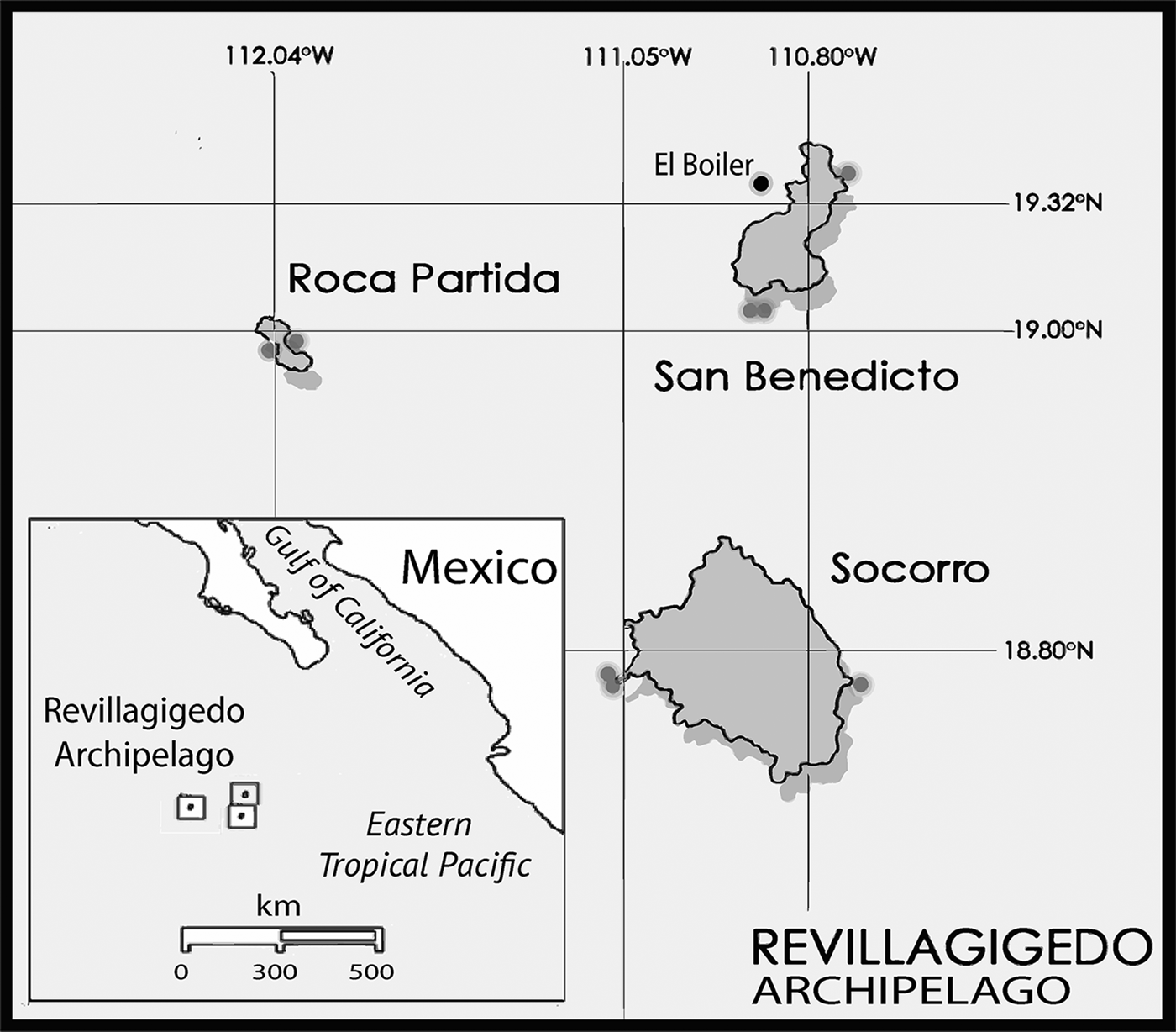
The Revillagigedo Archipelago, located 400 km south of Baja California, Mexico, is a Marine Protected Area composed of four islands: Socorro, Clarion, San Benedicto and Roca Partida (Figure 1). Prevailing currents in the Gulf of California favour chance dispersal of organisms to these islands, particularly of reef fauna (Bizzarro et al., Reference Bizzarro, Smith, Hueter, Tyminski, Márquez-Farías, Castillo-Géniz, Cailliet and Villavicencio-Garayzar2009). Due to the large percentage of endemic biota and high biodiversity, the Revillagigedo Biosphere Reserve was listed as a UNESCO World Heritage site in July 2016. The MPA includes a 9.5 nautical mile no-take zone from the coast of the islands to the surrounding waters. The oceanographic conditions of the Revillagigedo Archipelago support one of the most diverse shark communities in the world and the greatest diversity of these species in the ETP (IUCN, 2016), where nine species of sharks are frequently observed (Galeocerdo cuvier, Carcharhinus falciformis, Carcharhinus albimarginatus, Carcharhinus galapagensis, Carcharhinus limbatus, Carcharhinus obscurus, Sphyrna lewini, Rhincodon typus, Triaenodon obesus) and another eight species of sharks are occasionally found (Alopias pelagicus, Alopias superciliosus, Alopias vulpinus, Echinorhinus cookei, Isurus oxyrinchus, Nasolamia velox, Prionace glauca) (CONANP, 2005; M. Hoyos, unpublished data).
Locations of acoustic receivers (grey dots) and the sighting during a shark survey (El Boiler, SB) in the Revillagigedo Archipelago (black dot).

Shark tagging and acoustic receivers
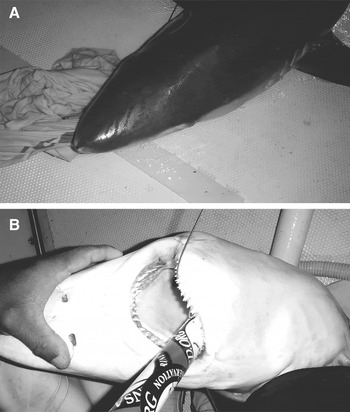
During a study on shark movements and residency in Cabo Pulmo National Park, Mexico in March 2013, a N. velox was captured using hand-lines baited with fish. The individual shark was fitted with a coded acoustic transmitter (V16, 69.0 kHz, Vemco, Halifax), which emitted a uniquely coded acoustic signal at random intervals between 60–120 s. The shark was brought onto a small fishing boat, immobilized on the deck, and a hose placed in the mouth with running saltwater to pump through the gills while the shark was manipulated. The coded transmitter was implanted surgically into the body cavity of the shark through a small 2 cm incision and then the wound was closed with three sutures. In addition, total, fork and precaudal lengths of the shark were measured, sex determined by the presence of claspers, and location recorded with a GPS. The identification of N. velox was determined on the basis of videos and pictures that highlighted the diagnostic characters (Figure 2, described by Compagno & Garrick, Reference Compagno and Garrick1983).
Nasolamia velox tagged in Cabo Pulmo National Park, Mexico (March 2013). (a) Dorsal view showing the white colouration in the tip of the snout, (b) Ventral view showing the particular nostrils position that differentiated the genus Nasolamia from other Carcharhinidae.

Since 2009 Pelagios Kakunjá and University of California-Davis have set an array of eight autonomous acoustic receivers (VR2W, Vemco, Halifax) in different sites around the Revillagigedo Archipelago at depths easily reached by scuba divers (average 25 m below the surface). These receivers were designed to listen for coded transmitters and to record the date and time of arrival and departure of individual sharks. The acoustic range of each receiver varied depending on water depth, tide and neighbouring reef structure. Range tests at other sites indicated transmitter detection ranges of 200–300 m. Therefore, as long as a shark tagged (with a unique acoustic signal code) was within the detection range of one of the acoustic receivers, we were able to determine the presence of this shark. If the shark was recorded in two or more receivers, we knew that the individual was moving between two or more of the monitored sites.
The sighting recorded on video
During a shark survey performed on 5–13 March 2014, visual censusing was conducted by scuba divers. A total of 22 observations were taken at six different areas of the Archipelago: Socorro Island (Punta Tosca and Cabo Pearce), Roca Partida and San Benedicto (Cuevitas, El Boiler and El Canyon). Each survey lasted ~45 minutes. Information on depth and temperature were recorded and a number of images and videos of the sharks were taken using a GOPRO 3+ camera.
The identification of the whitenose shark was made on the basis of photographs and videos that documented diagnostic evidence of this species. Once the species was confirmed, we verified its geographic range using specialized literature and revised data on collected specimens from worldwide museums in order to confirm that there was no existing record of this species from the Revillagigedo Archipelago. This specialized literature and revised data were available on the International Centre for Living Aquatic Resources Management website (htttp:// www.fishbase.org; Froese & Pauly, Reference Froese and Pauly2016).
RESULTS
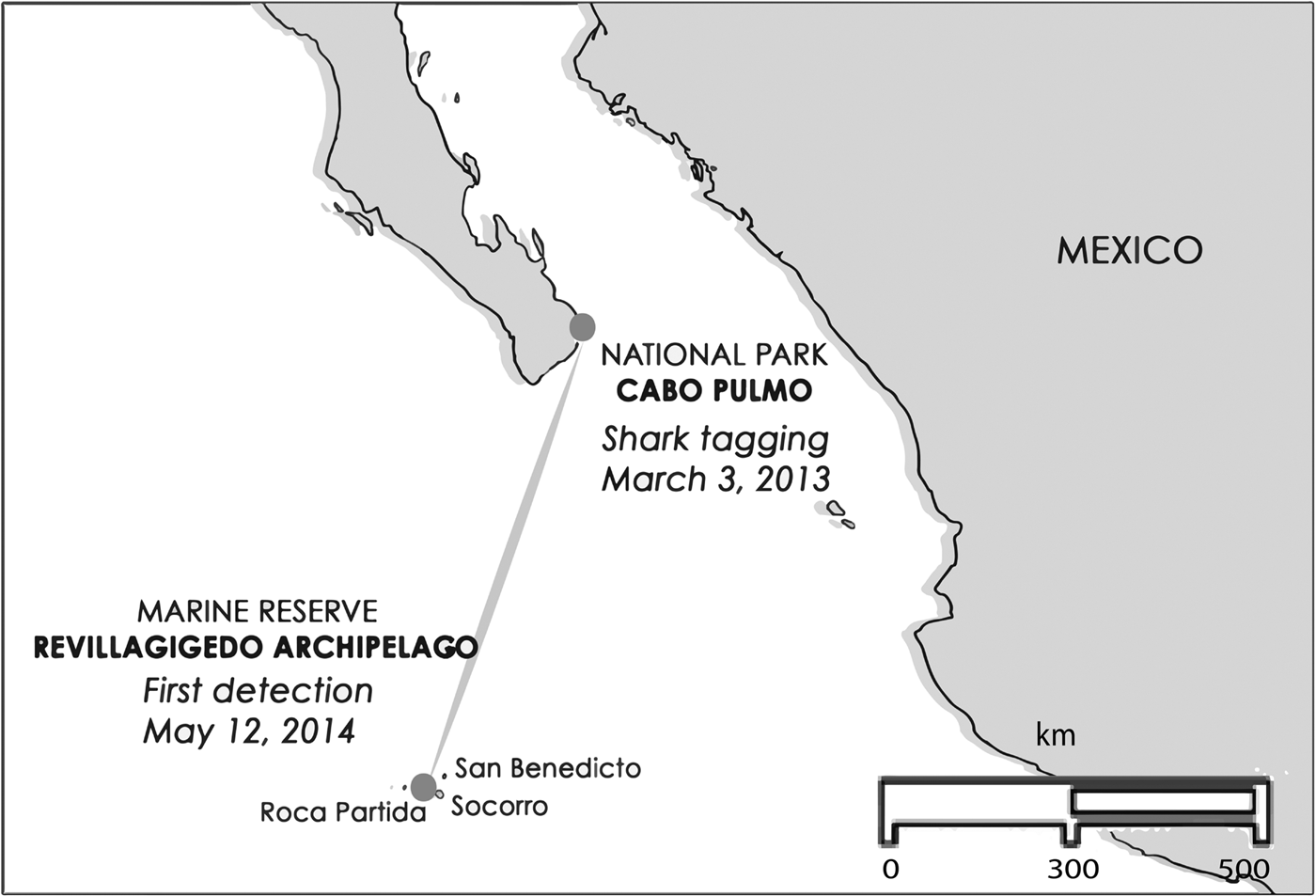
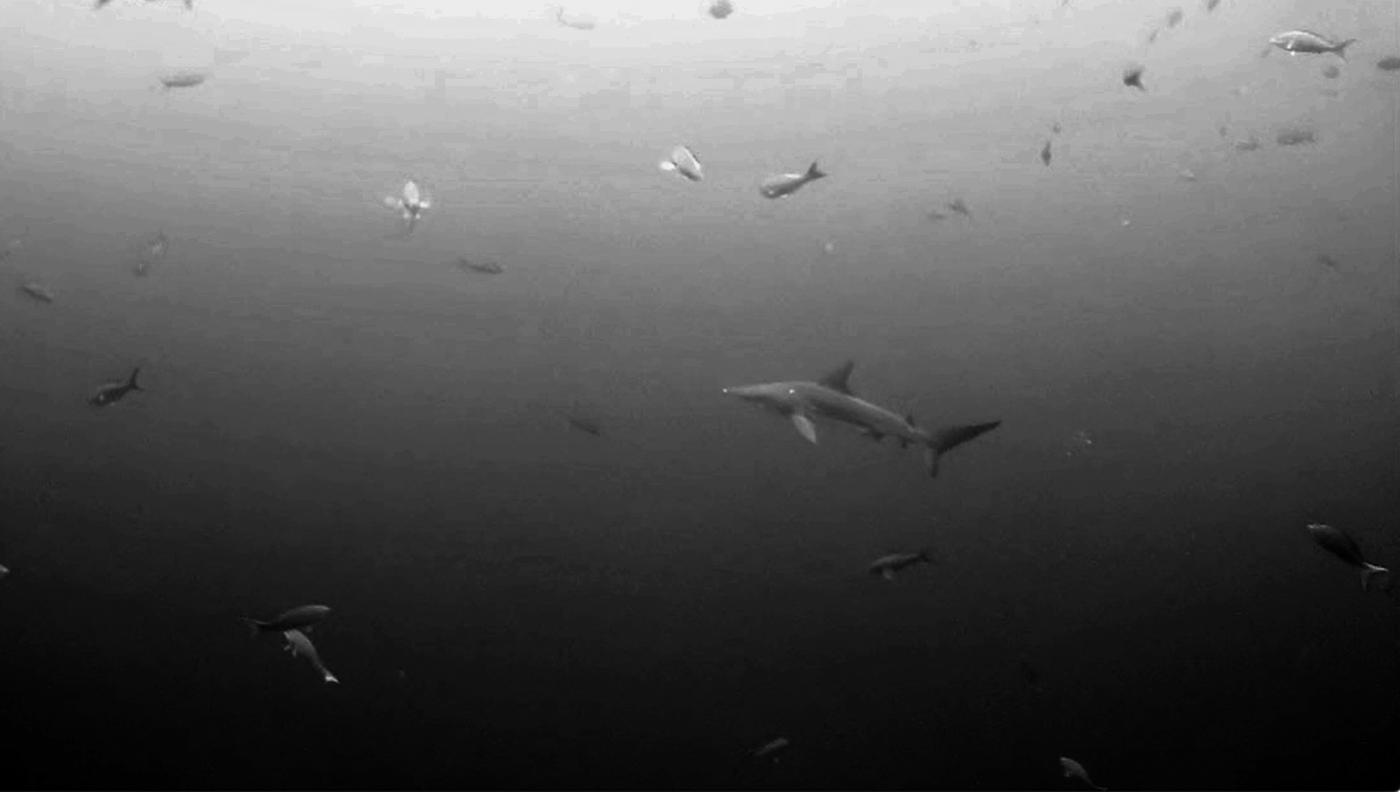
The presence of N. velox was recorded by acoustic telemetry and video in the Revillagigedo Archipelago. The first record occurred at the receiver located at the east side of Roca Partida Island (18°99′186″N 112°08′44″W) at a depth of 33 m. The tagged individual was first detected on 12 May 2014 and last detection was on 22 February 2016, hence total duration of monitoring was 646 days, however this individual was only present 14% of the time (96 days; Figure 3). The second record occurred at San Benedicto Island at 24 m on 6 March 2015, at the dive site known as ‘El Boiler’ (19°19′57″N 110°49′211″W). Water temperature was 25.5°C. The identified specimen was ~120 cm in length. In both cases (telemetry and video records) the sharks were not collected, but positive identification was based on a single high-definition video of one of the sharks by observing diagnostic characteristics (Figures 2 & 4; Compagno, Reference Compagno2001).
Map showing the movement from where the shark was tagged (National Park Cabo Pulmo, March 2013) to where it was first detected (Roca Partida, Revillagigedo Archipelago, May 2014).

The shark N. velox sighting during a survey at El Boiler, San Benedicto Island (6 March 2015). Individual of ~120 cm TL.

DISCUSSION
We report here for the first time, the occurrence of N. velox in Cabo Pulmo and the Revillagigedo Archipelago, and movements from a coastal location (Cabo Pulmo reef) to a group of oceanic islands (Revillagigedo). We provide evidence that the movement patterns of N. velox are longer and more complex than what was previously considered for this species, and its distribution range is extended over 487 km.
According to the literature and museum records, the distribution range of N. velox is restricted to the Eastern Pacific, from Mexico (Saucedo-Barrón, Reference Saucedo-Barrón1982; van der Heiden & Findley, Reference Van der Heiden and Findley1988; Gilbert, 1898; Cabrera Reference Cabrera2000; CONANP 2005; Soriano et al., Reference Soriano-Velásquez, Acal-Sánchez, Castillo-Géniz, Vázquez-Gómez, Ramírez-Santiago, Arreguín-Sánchez, Beléndez-Moreno, Méndez Gómez-Humarán, Solana-Sansores and Rangel-Dávalos2006; Bizzarro et al., Reference Bizzarro, Smith, Hueter, Tyminski, Márquez-Farías, Castillo-Géniz, Cailliet and Villavicencio-Garayzar2009; Walther-Mendoza et al., Reference Walther-Mendoza, Ayala-Bocos, Hoyos-Padilla and Reyes-Bonilla2013; Madrid-Vera et al., Reference Madrid Vera, Luna and Bravo2015) to Panama (Compagno & Garrick, Reference Compagno and Garrick1983), Costa Rica (Garro et al., Reference Garro, Vargas, Zanella and Le Foulgo2011), Peru (Kato et al., Reference Kato, Springer and Wagner1967), Colombia (Mejía-Falla et al., Reference Mejía-Falla, Tobón-López, Navia, Narváez, Lozano, Mejía-Falla, Narváez, Bohórquez, Osaer, Ramírez and Hleap2010) and Ecuador (Bearez, Reference Bearez1996). Previous records at insular locations of the Eastern Pacific included the Galapagos Archipelago, 3150 km south of Revillagigedo Archipelago. There were no previous records from the Revillagigedo Archipelago, and the closest records were from Cabo San Lucas, 487 km north-east of the Revillagigedo Archipelago (Bizzarro et al., Reference Bizzarro, Smith, Hueter, Tyminski, Márquez-Farías, Castillo-Géniz, Cailliet and Villavicencio-Garayzar2007).
The whitenose shark is frequently classified as a tropical inshore and offshore shark, normally found over the continental shelves in shallow coastal waters at depths of 15–24 m, but occasionally it can be found down to 192 m (Compagno, Reference Compagno2001). In Guatemala, this species has been reported 30–100 km off the coastline on the continental slope (Porras, Reference Porras1997; Ruiz-Alvarado & Mijangos-López, Reference Ruiz-Alvarado and Mijangos-López1999). In Costa Rica, N. velox is found in offshore fisheries 80–120 km off the coast and in demersal fisheries on the slopes of the continental shelf (Garro et al., Reference Garro, Vargas, Zanella and Le Foulgo2011).
Our findings show evidence that there may be potential connectivity of sharks between the Gulf of California and the Revillagigedo Archipelago, however population level observations are needed to confirm this idea. Previous studies have also found other species such as tiger shark, Galeocerdo cuvier, moving between Cabo Pulmo and Revillagigedo (J. Ketchum, unpublished data), and the giant manta, Manta birostris, using both areas as part of their life cycle (R. Rubin, Pacific Manta Research Group personal communication, 2015).
Very little is known about the biology, reproduction and ecology of N. velox, therefore, future research on this species is necessary. It has been reported that the species has a low fecundity rate and very specific nursery areas (Compagno, Reference Compagno1988; Ruiz-Alvarado & Mijangos-López, Reference Ruiz-Alvarado and Mijangos-López1999). Because of these characteristics this species has been classified as vulnerable to habitat degradation and marine pollution (Alavez-Jiménez, Reference Alavez-Jiménez2006). Responses to the El Niño–Southern Oscillation (ENSO) were documented with high catch per unit effort (CPUE) in landings off the Pacific Coast of Mexico during 1998, prompting the dispersal of a larger number of whitenose sharks (Soriano-Velásquez et al., Reference Soriano-Velásquez, Acal and Castillo-Géniz2004). It is necessary to increase our understanding of this species and to generate effective management and conservation strategies for vulnerable shark species in the region.
Acknowledgements
Thanks to National Geographic and Fischer Productions.
Financial Support
We thank the World Wildlife Fund–Gulf of California Program for providing funds to carry out the first shark-tagging project in Cabo Pulmo. We would also like to acknowledge The International Community Foundation and UC Davis for supporting the deployment of the first array of acoustic receivers at Cabo Pulmo and the Revillagigedo Islands. Finally, we thank the Instituto Politecnico Nacional (COFAA, EDI) and the Comisión Nacional para la Ciencia y Tecnología (CONACYT) of Mexico that supported FLL to carry out this work.