



1 Introduction
Bubbles rarely collapse spherically; they often induce liquid jets at the last stage of their collapse. Rapid microjets are generated when bubbles collapse near rigid (Blake, Taib & Doherty Reference Blake, Taib and Doherty1986; Vogel, Lauterborn & Timm Reference Vogel, Lauterborn and Timm1989), elastic (Brujan et al. Reference Brujan, Nahen, Schmidt and Vogel2001) and free boundaries (Blake, Taib & Doherty Reference Blake, Taib and Doherty1987), which can penetrate into biological tissue (Kodama & Tomita Reference Kodama and Tomita2000; Tezel & Mitragotri Reference Tezel and Mitragotri2003) or damage hydraulic machinery (Arndt Reference Arndt1981). Jets generated during the collapse of cavitation bubbles have been studied extensively in the literature through experiments, numerical simulations and modelling (Blake & Gibson Reference Blake and Gibson1987; Philipp & Lauterborn Reference Philipp and Lauterborn1998). During stable bubble oscillations, constant streaming is observed in the liquid surrounding the bubble (Riley Reference Riley2001; Tho, Manasseh & Ooi Reference Tho, Manasseh and Ooi2007). This microstreaming is comprehensively reported in the literature (Elder Reference Elder1959; Davidson & Riley Reference Davidson and Riley1971; Longuet-Higgins Reference Longuet-Higgins1998) and applied to poration of biological cells (Marmottant & Hilgenfeldt Reference Marmottant and Hilgenfeldt2003), selective particle trapping (Rogers & Neild Reference Rogers and Neild2011), micromixing (Liu et al. Reference Liu, Yang, Pindera, Athavale and Grodzinski2002) and a variety of applications in lab-on-a-chip devices (Hashmi et al. Reference Hashmi, Yu, Reilly-Collette, Heiman and Xu2012).
While streaming from small-amplitude bubble oscillations is well known, it has received less attention with regard to strongly collapsing cavitation bubbles, i.e. inertial cavitation. These bubbles can be conveniently generated using pulsed lasers (Zwaan et al. Reference Zwaan, Le Gac, Tsuji and Ohl2007; Lauterborn & Vogel Reference Lauterborn and Vogel2013), shock waves (Apfel Reference Apfel1981; Coleman et al. Reference Coleman, Saunders, Crum and Dyson1987), electrical discharge (Buogo & Cannelli Reference Buogo and Cannelli2002) or localised heating (Azam et al. Reference Azam, Karri, Ohl, Klaseboer and Khoo2013; Li et al. Reference Li, Gonzalez-Avila, Nguyen and Ohl2017). Inertial cavitation is applied in various therapeutic and diagnostic medical procedures (Coussios & Roy Reference Coussios and Roy2008), for instance in laser surgeries and tissue ablation, such as ocular surgery (Vogel et al. Reference Vogel, Hentschel, Holzfuss and Lauterborn1986), fragmentation of urinary stones (Vassar et al. Reference Vassar, Chan, Teichman, Glickman, Weintraub, Pfefer and Welch1999) and removal of arterial blood clots (Jean & Bende Reference Jean and Bende2003). In most applications involving laser-induced cavitation, the laser repetition period is much larger than the bubble lifetime. Yet, in some applications, such as nanoparticle synthesis, kilohertz or even megahertz laser systems are used (Barcikowski & Compagnini Reference Barcikowski and Compagnini2013).
In this work, we study the flow induced by steadily generated cavitation bubbles at the cross-over where the repetition period of the cavitation event is of the same order as the lifetime of the bubble. An experimental set-up is presented to generate high-frequency cavitation and visualise the cavitation-induced flow using particle image velocimetry. We characterise the flow field as a synthetic jet and conclude with a model for the bubble formation process.
2 Experimental set-up
To generate cavitation bubbles with high spatial and temporal repeatability, we use a pulsed thulium (Tm) laser (wavelength
 $\unicode[STIX]{x1D706}=1.96~\unicode[STIX]{x03BC}\text{m}$
) running at a high repetition rate (Tang et al.
Reference Tang, Li, Yan, Yu, Zhang and Wang2014). The pulsed laser is delivered with a single-mode optical fibre of diameter
 $d=250~\unicode[STIX]{x03BC}\text{m}$
into a transparent glass container (
 $75~\text{mm}\times 45~\text{mm}\times 20$
mm) filled with deionised water. The linear absorption of mid-infrared light by the liquid layer adjacent to the fibre tip leads to heating and eventually vaporisation, i.e. generation of a cavitation bubble. The dynamics of this bubble is recorded using a high-speed camera (Photron, FASTCAM SA-X2) with diffused back-illumination from an LED light source (REVOX, SLG-150V). The experimental set-up is shown schematically in figure 1.
The flow field is visualised by seeding water with fluorescent microparticles which are
 $5~\unicode[STIX]{x03BC}\text{m}$
in diameter and
 $1050~\text{kg}~\text{m}^{-3}$
in density (Thermo Scientific, Fluoro-Max 36-2). Particle fluorescence is excited with a green light sheet from a continuous (CW) laser (Nd:YAG,
 $\unicode[STIX]{x1D706}=532$
nm) focused with a cylindrical lens. The laser sheet illuminates the flow along the fibre axis in the axial and radial directions. Specular reflections are absent in the images due to a filter blocking the laser wavelength. The velocity field is extracted from the microparticle images through standard particle image velocimetry (PIV) analysis using the PIVLab toolbox (Thielicke & Stamhuis Reference Thielicke and Stamhuis2014).
Before each experiment, the laser pulse duration,
 $\unicode[STIX]{x1D70F}$
, and its repetition rate,
 $f$
, are measured with an InGaAs photodiode (Thorlabs, FGA20) connected to an oscilloscope (LeCroy, WaveRunner 64Xi-A). The average power of the laser,
 $P$
, is measured with a power meter (Opir, 30A-BB-18), determining the energy of each pulse as
 $E=P/f$
. The experiments are conducted with three different laser repetition rates, namely
 $f=20$
, 30 and 40 kHz. The laser power is varied between
 $P=2.5$
and 20 W for each repetition rate and the pulse duration
 $\unicode[STIX]{x1D70F}$
is between 800 ns and
 $1~\unicode[STIX]{x03BC}\text{s}$
.
3 Jet generation by high-frequency cavitation
3.1 Bubble formation
Experimental set-up for high-speed photography and particle image velocimetry.

High-speed recordings of bubble formation with a high-repetition-rate pulsed laser delivered through an optical fibre. High-frequency cavitation occurs due to linear absorption of the laser energy by the liquid layer adjacent to the fibre tip, forming bubbles that expand and collapse before arrival of the subsequent laser pulse. The laser is operating at
 $f=40$
kHz repetition rate and
 $P=5$
W average power.
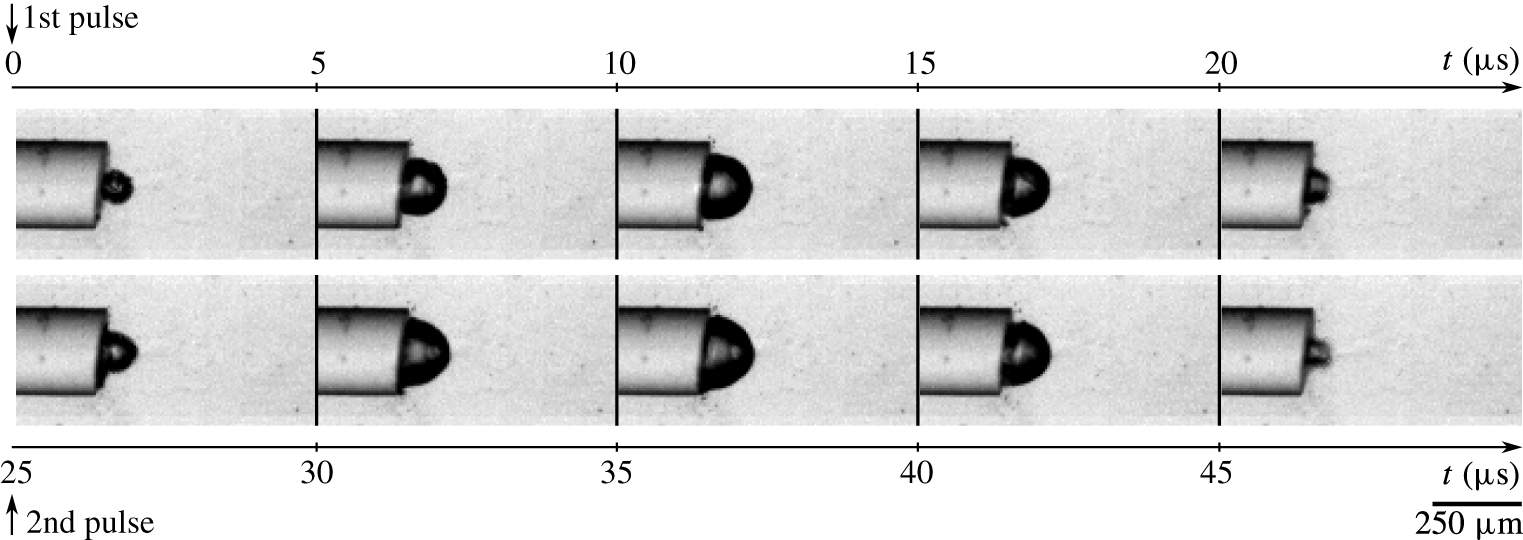
Repetitive cavitation is realised with the pulsed laser running at a high repetition rate, as shown in figure 2. Upon delivery of the laser pulse, the liquid layer adjacent to the fibre tip absorbs the pulse energy and undergoes explosive vaporisation, forming an almost hemispherical bubble. This bubble rapidly expands before collapsing under the ambient pressure. At this laser setting, the bubble has already collapsed before an identical bubble is generated with the next laser pulse.
The mechanism of laser-induced cavitation depends on the pulse duration, the irradiation volume and the absorption coefficient of the irradiated medium (Vogel & Venugopalan Reference Vogel and Venugopalan2003). In our experiments, the pulse duration
 $\unicode[STIX]{x1D70F}$
is longer than the stress relaxation time
 $\unicode[STIX]{x1D70F}_{st}=d/c$
, but shorter than the thermal relaxation time
 $\unicode[STIX]{x1D70F}_{th}=d^{2}/4k$
, i.e.
 $\unicode[STIX]{x1D70F}_{st}<\unicode[STIX]{x1D70F}<\unicode[STIX]{x1D70F}_{th}$
. Here,
 $c$
is the speed of sound and
 $k$
is the thermal diffusivity in the liquid medium. This condition, known as thermal confinement, means that strong shock waves are not emitted from the irradiation site, yet the temperature in the irradiated volume can increase above the spinodal limit before phase explosion forms a vapour bubble (Frenz et al.
Reference Frenz, Könz, Pratisto, Weber, Silenok and Konov1998).
A few seconds after switching on the laser, the bubble formation process becomes highly repeatable. Meanwhile, by increasing the laser power, the bubble may show a different periodicity from the laser pulse. We discuss the effects of laser power and repetition rate on bubble dynamics in § 4, but first we focus on the flow field induced by cavitation in the experiments.
3.2 Jet characteristics
(a) Time-averaged velocity field induced by high-frequency cavitation visualised by PIV. The time-averaged flow field resembles a continuous free jet directed away from the cavitation site. Semi-transparent photos of the bubble dynamics and the optical fibre are shown to scale. The velocity magnitude, vector field and axial velocity profiles are plotted. (b) Transient and time-averaged axial and radial velocity,
 $u$
and
 $v$
, at point (
 $x=2$
mm,
 $r=0$
) along the jet over a few periods of the cavitation event
 $T=f^{-1}$
. The laser is operating at a repetition rate of
 $f=40$
kHz with an average power of
 $P=20$
W.

(a) Comparison between the self-similar velocity profile of the continuous free jet (solid line) and the time-averaged cavitation-induced jet (symbols). The laser is operating at
 $f=40$
kHz and
 $P=20$
W. (b) Decay of the jet centreline velocity
 $u_{m}=u(x,r=0)$
for free jets (lines) and cavitation-induced jets (symbols). The origin of the free jets is fixed at the fibre tip and the cone angles are obtained from the experimental data.

Flow field visualisation reveals a stream of particles moving in the axial direction away from the fibre tip, as seen in supplementary movie 1 available athttps://doi.org/10.1017/jfm.2017.358. Close to the fibre tip, the motion is complex, with particles following the oscillatory bubble expansion and collapse. Particles that are away from the fibre tip in the radial direction become gradually attracted towards the fibre axis, accelerating as they approach the tip. Since the flow varies with time, we resort to analysing the time-averaged flow field to characterise the stream. Due to imaging limitations, we analyse the flow starting from a distance of approximately three fibre diameters from the fibre tip.
Figure 3(a) shows the time-averaged flow field, while the time-variant velocity at a sample point along the stream is plotted in figure 3(b). On the left of figure 3(a), snapshots of the bubble and fibre tip are overlaid to scale. The time-averaged velocity field reveals a pronounced jet directed away from the fibre tip with an almost axisymmetric flow field, as indicated by the radial profiles of the axial velocity
 $u(x,r)$
. The velocity profiles demonstrate that the jet expands as it travels away from the cavitation site. While the cavitation-induced jet is transient, the time-averaged flow field resembles a steady jet (Rajaratnam Reference Rajaratnam1976).
To study this flow field in more detail, we compare the cavitation-induced jet with a free axisymmetric jet without swirl. Sufficiently far from the origin, free jets are characterised by a self-similar velocity profile (Schlichting & Gersten Reference Schlichting and Gersten2017); i.e. their axial velocity is
 $u/u_{m}=(1+\unicode[STIX]{x1D702}^{2})^{-2}$
, where
 $\unicode[STIX]{x1D702}=\unicode[STIX]{x1D70E}r/x$
is the similarity variable. Here,
 $\unicode[STIX]{x1D70E}$
is a constant and
 $u_{m}$
is the axial velocity along the jet centreline, i.e.
 $u(x,r=0)$
. This similarity solution is plotted in figure 4(a) with a solid line, i.e.
 $u/u_{m}=f(r/b)$
. Here,
 $b$
represents the jet half-width, where the velocity drops to half of the jet centreline velocity
 $u_{m}$
, marked in figure 3(a). The jet half-width grows linearly along free jets, i.e.
 $b\propto x$
(Rajaratnam Reference Rajaratnam1976). The time-averaged velocity profile of the cavitation-induced jet in the experiments matches well with the similarity solution for the axisymmetric free jet, particularly close to the jet centreline,
 $r=0$
. This is shown in figure 4(a), where the symbols represent various cross-sections along the flow marked in figure 3(a).
A second prominent property of the similarity solution for a free jet is that the centreline velocity drops as
 $u_{m}\propto 1/x$
along the jet (Rajaratnam Reference Rajaratnam1976). We put this property to test for jets generated at different laser powers. By placing the origin of the free jet at the centre of the fibre tip and estimating the cone angle of the jet from the experimental data (Schlichting & Gersten Reference Schlichting and Gersten2017), agreement is obtained for the time-averaged velocity drop
 $u_{m}(x)$
along cavitation-induced jets. The agreement closer to the tip improves as the laser power increases. Additionally, figure 4(b) reveals that with increasing laser power, the cone angle of the continuous jet decreases; i.e. a stronger more slender jet is produced.
3.3 Mechanism of synthetic jet generation
Schematic illustration of a collapsing bubble that directs the flow away from a rigid boundary. Important flow features are marked in red. (a) The collapsing bubble generates a rapid microjet towards the boundary. (b) After jet impingement, remnants of the microjet compete with a strong radial inflow, forming an annular stagnation ring and a rebounding splash. (c) The splash develops into a toroidal vortex. (d) The vortex moves away from the boundary and carries the bubble fragments along the axis of symmetry.

Despite the transient cavitation activity at the fibre tip, a time-averaged jet is produced which resembles an axisymmetric free jet. Looking in closer detail at the bubble dynamics, shown in figure 2, the cavitation bubble expands with its centre of mass moving away from the fibre tip, and during shrinkage moves towards it. During the collapse of a translating cavitation bubble, a re-entrant microjet is generated in the direction of its motion (Blake et al. Reference Blake, Taib and Doherty1986; Zhang, Duncan & Chahine Reference Zhang, Duncan and Chahine1993; Zhang & Duncan Reference Zhang and Duncan1994), which is towards the fibre tip. Yet, we observe a large-scale flow away from the fibre. The mechanism that drives the flow away from the boundary may be explained by the repelling motion of a stable vortex ring. The course of events leading to the generation of this vortex ring after each cavitation event is schematically illustrated in figure 5. After jet impingement on a boundary due to the collapse of a sufficiently close bubble, the re-entrant jet competes with the radial inflow as the bubble is still shrinking. This leads to the formation of an annular stagnation ring. We speculate that the radial inflow is reflected away from the boundary as a splash (Tong et al. Reference Tong, Schiffers, Shaw, Blake and Emmony1999; Brujan et al. Reference Brujan, Keen, Vogel and Blake2002). This flow may then close into a vortex ring which moves away from the fibre tip due to its rotation direction. An experimental visualisation of a similar process is reported by Reuter et al. (Reference Reuter, Gonzalez-Avila, Mettin and Ohl2017) in front of a large rigid boundary.
Streaming driven by trains of vortices has been comprehensively studied in the literature under the title of synthetic jets (Glezer & Amitay Reference Glezer and Amitay2002). Synthetic jets are usually generated by alternating suction and ejection of fluid across an orifice (Mallinson, Reizes & Hong Reference Mallinson, Reizes and Hong2001). In contrast to continuous jets, synthetic jets are produced without injecting mass into the system. These jets work merely due to transfer of momentum, typically by oscillations of a membrane or diaphragm (Smith & Swift Reference Smith and Swift2003). In the current set-up, high-frequency cavitation provides the momentum for a synthetic jet, generating a stream with zero net mass flux. As the jet travels away from the cavitation site, it eventually spreads out, directing streamlines back to the cavitation site which complete a loop and feed the jet. In addition to pulsed lasers, spark generators and microheaters may be used to generate cavitation-based synthetic jets.
4 Bubble formation and dynamics
4.1 Secondary bubble formation
The effect of increasing laser power on bubble formation with a high-repetition-rate pulsed laser operating at
 $f=40$
kHz. By increasing the average laser power from top to bottom, the bubble size increases. Above a certain threshold, the formation of a secondary bubble at the tip of the initial hemispherical bubble is observed. This occurs when the lifetime of the first bubble is larger than the period of pulse repetition.

An increase in the energy input to the system not only strengthens the jet, as shown in figure 4(b), but also affects the bubble dynamics (Mohammadzadeh et al.
Reference Mohammadzadeh, Chan, Gonzalez-Avila, Liu, Wang and Ohl2016). Figure 6 shows five series of images of bubble formation and collapse, where the laser power is increased from
 $P=2.5$
to 20 W. The results are shown at a repetition rate of
 $f=40$
kHz, but identical bubble dynamics are observed at other tested repetition rates. As is shown in the two top rows of figure 6, at low laser power, a small bubble forms and collapses on the tip before the next laser pulse arrives. An increase in the laser power may drastically affect the bubble dynamics, as shown in the bottom three rows of figure 6. If the pulse energy is sufficiently high, the initial bubble does not collapse when the next pulse arrives. This allows the laser pulse to be transmitted through the shrinking bubble, leading to vaporisation of the liquid at its distal end and formation of a secondary bubble. A close-up of this process is shown at the bottom of figure 6. While the first bubble shrinks and collapses on the fibre tip, the second one expands and moves away. This repelling motion, caused by out-of-phase oscillation of the two bubbles, may affect the jet generation mechanism (Tomita, Sato & Shima Reference Tomita, Sato and Shima1994; Yuan, Sankin & Zhong Reference Yuan, Sankin and Zhong2011; Han et al.
Reference Han, Köhler, Jungnickel, Mettin, Lauterborn and Vogel2015). Small vapour fragments of the secondary bubble are still visible when the next laser pulse is absorbed by the liquid layer adjacent to the fibre tip, restarting the bubble formation cycle. As seen in supplementary movie 2, this double-bubble system, composed of the initial and secondary bubbles, follows a cycle with twice the period of pulse repetition.
4.2 Model for bubble growth
Here, we develop a model to predict the growth of the vapour bubble to its maximum size based on the laser pulse energy. Under thermal confinement, the laser pulse heats up the liquid over the fibre core to the critical point, where there is no phase boundary between the liquid and the vapour (Cleary Reference Cleary1977). Thus, we start from an initial nucleus at the critical state where the pressure and density are
 $p_{i}=218$
atm and
 $\unicode[STIX]{x1D70C}_{i}=322~\text{kg}~\text{m}^{-3}$
. The growth dynamics is modelled as a hemispherical cavitation bubble undergoing explosive expansion without heat transfer. Therefore, the evolution of the bubble radius,
 $R(t)$
, can be modelled with the Rayleigh–Plesset equation (Brennen Reference Brennen2013),
 $$\begin{eqnarray}R\ddot{R}+\frac{3}{2}{\dot{R}}^{2}=\frac{-p_{\infty }+p_{g}}{\unicode[STIX]{x1D70C}_{l}}-\frac{4\unicode[STIX]{x1D708}_{l}{\dot{R}}}{R}-\frac{2\unicode[STIX]{x1D70E}}{\unicode[STIX]{x1D70C}_{l}R},\end{eqnarray}$$
where dots denote derivatives with respect to time. The material properties are the density of the liquid,
 $\unicode[STIX]{x1D70C}_{l}=10^{3}~\text{kg}~\text{m}^{-3}$
, the kinematic viscosity of the liquid,
 $\unicode[STIX]{x1D708}_{l}=10^{-6}~\text{m}^{2}~\text{s}^{-1}$
, and the surface tension,
 $\unicode[STIX]{x1D70E}=0.072~\text{N}~\text{m}^{-1}$
. With negligible heat transfer and phase change over the bubble interface due to its rapid growth, the pressure in the bubble,
 $p_{g}$
, evolves adiabatically, i.e.
 $p_{g}=p_{i}(R_{i}/R)^{3\unicode[STIX]{x1D6FE}}$
, where
 $\unicode[STIX]{x1D6FE}=4/3$
is the adiabatic exponent. The bubble expansion is countered by the ambient pressure,
 $p_{\infty }=1$
atm.
If we have the initial state of the vapour, the initial bubble radius
 $R_{i}$
can be determined from the absorbed energy of the laser pulse
 $E_{abs}$
, which is used to raise the state of the liquid to the critical point. The specific energy, i.e. energy per unit mass of the liquid, needed for this change of state is
 $h=2.84\times 10^{3}~\text{kJ}~\text{kg}^{-1}$
. To calculate this, we use a thermodynamic path in which water is first heated up isobarically from ambient conditions to 373 K, phase change from liquid to vapour occurs at 373 K, the vapour is heated up under ambient pressure to the critical temperature of 647 K and finally the steam at critical temperature is pressurised isothermally to the critical pressure of 218 atm (Gerstman et al.
Reference Gerstman, Thompson, Jacques and Rogers1995). Assuming that the initial vapour bubble at the fibre tip has a hemispherical shape, we can write the energy balance as
 $$\begin{eqnarray}{\textstyle \frac{2}{3}}\unicode[STIX]{x03C0}R_{i}^{3}\unicode[STIX]{x1D70C}_{i}h=E_{abs}.\end{eqnarray}$$
In the current experiments, the liquid absorbs the laser energy through linear absorption, i.e.
 $E_{abs}=\unicode[STIX]{x1D6FC}H_{0}V_{irr}$
, where
 $\unicode[STIX]{x1D6FC}$
is the linear absorption coefficient,
 $H_{0}$
is the laser fluence and
 $V_{irr}$
is the irradiated volume. For water, the absorption coefficient at
 $\unicode[STIX]{x1D706}=1.96~\unicode[STIX]{x03BC}\text{m}$
is
 $\unicode[STIX]{x1D6FC}\approx 100~\text{cm}^{-1}$
. Using the fibre core radius
 $l_{i}=25~\unicode[STIX]{x03BC}\text{m}$
as the irradiation length scale, the laser fluence
 $H_{0}$
is
 $E/\unicode[STIX]{x03C0}l_{i}^{2}$
. Approximation of the irradiated volume as a hemisphere,
 $V_{irr}=2/3\unicode[STIX]{x03C0}l_{i}^{3}$
, results in an absorbed energy of
 $E_{abs}=2/3\unicode[STIX]{x1D6FC}l_{i}E$
, which combined with (4.2) gives an estimation for the initial bubble radius,
 $$\begin{eqnarray}R_{i}^{3}=\frac{\unicode[STIX]{x1D6FC}l_{i}}{\unicode[STIX]{x03C0}\unicode[STIX]{x1D70C}_{i}h}E.\end{eqnarray}$$
Inserting the laser pulse energy from the experiments (
 $0.0625~\text{mJ}<E<1$
mJ), we use the initial bubble radius
 $R_{i}$
from (4.3) as the initial condition for the cavitation model in (4.1). After numerical integration, we obtain the maximum bubble radius
 $R_{max}$
, which is compared with the experiments in figure 7(a). The maximum bubble radii from the experiments are estimated by averaging the bubble extensions in the radial and axial directions over multiple cycles. In general, the model agrees well with the experiments, despite some discrepancy at the lowest pulse energy. This model also allows us to determine the laser settings that lead to secondary bubble formation. As shown in figure 6, a secondary bubble forms when the initial bubble is large enough such that it has not collapsed when the next laser pulse arrives. This condition can be quantified as
 $2t_{c}>1/f$
. Here,
 $t_{c}$
is the Rayleigh collapse time of a bubble, which is known to increase linearly with the maximum bubble radius, i.e.
 $t_{c}=0.915\sqrt{(\unicode[STIX]{x1D70C}_{l}/p_{\infty })}R_{max}$
(Brennen Reference Brennen2013). For a given laser repetition rate
 $f$
, the pulse energy
 $E$
that is sufficiently large for secondary bubble formation is calculated from the Rayleigh–Plesset model and plotted as a function of the repetition rate
 $f$
in figure 7(b). Overall, we find excellent agreement with the cavitation regime observed experimentally.
(a) Maximum bubble radius
 $R_{max}$
as a function of the laser pulse energy
 $E$
. The experimental results are compared with the model presented in § 4.2 for three different laser repetition rates. (b) The laser pulse energy
 $E$
needed for secondary bubble formation as a function of the pulse repetition rate
 $f$
. The grey colour marks the region and experimental data with only hemispherical bubble formation, and white denotes the formation of secondary bubbles.

5 Discussion and conclusion
Synthetic jets are advantageous in various flow control applications as they eliminate the need to inject mass into the system. For instance, synthetic jet actuators can be mounted on an object to affect the hydrodynamic forces by interacting with the cross-flow over the object (Glezer & Amitay Reference Glezer and Amitay2002). Slow synthetic jets of millimetres per second velocity have been produced by oscillating sessile bubbles through the control of surface wetting (Ko, Lee & Kang Reference Ko, Lee and Kang2009). In this article, we present a unique synthetic jet in which high-frequency cavitation provides the momentum for a jet of up to
 $1.2~\text{m}~\text{s}^{-1}$
in velocity, which speeds up with increasing laser power. The time-averaged velocity field for this synthetic jet agrees well with the self-similar velocity profile of the axisymmetric free jet, particularly along the axis and for stronger jets. The strength of a free jet is inversely proportional to its cone angle and is determined by its kinematic momentum
 $K_{a}$
(Schlichting & Gersten Reference Schlichting and Gersten2017). We speculate that for the cavitation-induced jet,
 $K_{a}\propto U_{v}^{2}R_{max}^{2}$
, where
 $U_{v}$
is the velocity of the collapse-induced toroidal vortex as it travels away from a rigid boundary. The motion of this vortex core depends on the bubble size and its distance from the boundary (Reuter et al.
Reference Reuter, Gonzalez-Avila, Mettin and Ohl2017).
Synthetic jet generation from cavitation bubbles could be advantageous for flow actuation in microfluidics by eliminating the need for a mass source. By directing the flow, these jets can also reduce the need for microchannel fabrication (Marmottant et al. Reference Marmottant, Raven, Gardeniers, Bomer and Hilgenfeldt2006). Additionally, streaming from cavitation bubbles is relevant in medical applications, since these bubbles play an important role in laser surgeries by acting as transmission channels to ablation targets (Vogel & Venugopalan Reference Vogel and Venugopalan2003). In particular, bubbles formed with mid-infrared lasers, such as the thulium laser used in the current study, are known to significantly affect the mass removal efficiency and resolution (Pratisto et al. Reference Pratisto, Frenz, Ith, Altermatt, Jansen and Weber1996) and motion of the ablation target (Kang et al. Reference Kang, Lee, Teichman, Oh, Kim and Welch2006; Mohammadzadeh, Mercado & Ohl Reference Mohammadzadeh, Mercado and Ohl2015). We have found the strength of the synthetic jet to be proportional to the laser power, which in turn determines the bubble size. A model is presented to estimate the bubble size and determine the energy needed for secondary bubble formation, a cavitation regime that allows the generation of non-spherical bubbles with short energy impulses and leads to strong bubble–bubble interactions.
Acknowledgement
The authors gratefully acknowledge the financial support from Nanyang Technological University, Singapore.
Supplementary movies
Supplementary movies are available at https://doi.org/10.1017/jfm.2017.358.



