There is a widespread consensus on recognizing school discipline as a necessary tool to guarantee the quality of coexistence and to teach students to respect limits, as impunity tends to increase transgressions and weakens the value of rules as references to structure life in society (Curran Reference Curran2016). In this sense, adolescence poses a special difficulty due to the greater tendency to transgress the rules imposed by adults that occurs at this stage (Kohlberg, Reference Kohlberg and Mosher1980; Power & Power, Reference Power and Power1992). In the National Study of School Coexistence carried out in 301 secondary education schools in Spain on a large sample of students, teachers, guidance teams, management teams and families (Díaz-Aguado, Martínez Arias, & Martín Babarro, 2010), 63% of adolescents recognized that students do not obey school rules. This result may be related to the fact that 71% of adolescents stated that their opinion was not taken into account when school rules were elaborated or changed. The results of this study reflect that school punishment does not seem to be effective; this fact was recognized by 67.2% of the students.
Moreover, it was observed that the schools with higher punishment rates also used worse punishments. It was highlighted as a possible explanation that the repeated application of punishments may involve a lot of time and resources and could trigger an automatic reaction in the teams responsible of applying such punishments that would hamper their educational effectiveness.
Research on school discipline in other contexts also reflects that coercive measures, especially those based on expulsion, actually increase disruption instead of reducing it (Baroni, Day, Somers, Crosby, & Pennefather, Reference Baroni, Day, Somers, Crosby and Pennefather2016; Wolf & Kupchik, Reference Wolf and Kupchik2016), making the classroom environment and the relationship between students and teachers worse (McGrath & van Bergen, 2015), increasing the risk of school dropout (Hemphill, Plenty, Herrenkohl, Toumbourou, & Catalano, Reference Hemphill, Plenty, Herrenkohl, Toumbourou and Catalano2014), hampering the development of skills used to positively participate in society (Kupchik & Catlaw, Reference Kupchik and Catlaw2015), increasing the risk of drug consumption (DuPont et al., Reference DuPont, Caldeira, DuPont, Vincent, Shea and Arria2013) and favoring the development of violent behaviors and the commission of crimes (Fabelo et al., Reference Fabelo, Thompson, Plotkin, Carmichael, Marchbanks and Booth2011; Fernández-Suárez, Herrero, Pérez, Juarros-Basterretxea, & Rodríguez-Díaz, Reference Suárez, Herrero, Pérez, Juarros-Basterretxea and Rodríguez-Díaz2016; Jaggers, Robison, Rhodes, Guan, & Church II, Reference Jaggers, Robison, Rhodes, Guan and Church2016).
In this sense, the conclusions drawn by the American Psychological Association Zero Tolerance Task Force (2008), which was created to assess the effectiveness of the basically coercive discipline policy developed in the United States after the strong social alarm arisen from a number of serious cases of school violence that had taken place, become especially relevant. These conclusions emphasized that the results obtained across five decades should lead to a lot of skepticism about the effectiveness of punishment, as the punished student tends to respond by escaping from the context and the agent who is punishing him/her, developing very negative attitudes of fear and hostility towards the agent. The fact that the student seems immune to coercion often triggers a reactive escalation of increasingly severe punishments, causing the school to devote more time and resources to the application of these coercive measures with little or no efficacy (Skiba, Reference Skiba2014). Fortunately, there are effective alternatives based on intervention programs at different levels, with: 1) school-wide primary prevention, involving families and training teachers in proactive classroom management and care of difficult students; 2) specific prevention programs with students at risk of violence, helping them to develop other alternatives; and 3) discipline programs that can be applied when transgressions occur that include collaboration between the school and other contexts (American Psychological Association Zero Tolerance Task Force, 2008; Boccanfuso & Kuhfield, 2011; Cerezo & Méndez, Reference Cerezo and Méndez2012; Díaz-Aguado, Reference Díaz-Aguado2005; Petras, Masyn, Buckley, Ialongo, & Kellam, Reference Petras, Masyn, Buckley, Ialongo and Kellam2011; Skiba, Reference Skiba2014; Sugai & Horner, Reference Sugai and Horner2006; Trianes, Reference Trianes2000). Furthermore, the American Academic of Pediatrics (2003) has also warned about the adverse effects of strictly coercive measures, which deteriorate the school environment and increase the risk of delinquency and drug consumption, which become considerably worse when the offenders are out of school. These authors proposed as an alternative the reduction of the causes that lead to punished behaviors, among which are: family problems, abuse and emotional or behavioral disorders.
A possible explanation for the adverse effects of the exclusively coercive measures can be found in social learning (Bandura, Caprara, Barbaranelli, Pastorelli, & Regalia, Reference Bandura, Caprara, Barbaranelli, Pastorelli and Regalia2001; Garrido, Herrero, & Masip, Reference Garrido, Herrero and Masip2002) and social development (Catalano, Haggerty, Oesterle, Fleming, & Hawkins Reference Catalano, Haggerty, Oesterle, Fleming and Hawkins2004) theories, which show that maladjustment and exclusion from the school system can generate a perception of lack of self-efficacy in academic performance and positive relationships within the school context, producing a disengagement from school values, a desire for revenge, and links to violence and drug abuse contexts (Catalano et al., Reference Catalano, Haggerty, Oesterle, Fleming and Hawkins2004; Díaz-Aguado & Martínez Arias, 2013); These behaviours, once initiated, tend to repeat themselves as they provide a perception of self-efficacy to transgress that the individual does not otherwise achieve (Bandura et al., Reference Bandura, Caprara, Barbaranelli, Pastorelli and Regalia2001; Garrido et al., Reference Garrido, Herrero and Masip2002).
The exclusion from standardized environments as the only procedure has also shown little effectiveness in the re-education of juvenile offenders. In this sense, the studies carried out in Spain show that the severity of the first crimes and the harshness of the internment sanctions with which they are associated are two of the main predictors of criminal recidivism. Accordingly, it has been concluded that extending the severity and duration of punishments, as is sometimes proposed, does not favor the prevention of recidivism, warranting broader interventions with both, the sanctioned individual and the context with which he/she must interact in order to overcome delinquency (Bravo, Sierra, & del Valle, Reference Bravo, Sierra and Del Valle2009; Rose, Reference Rose2002).
To our knowledge, no research has been carried out in Spain regarding the relationship between the punishments suffered throughout life at school and the psychosocial risk in adolescence. Most of the studies performed in recent decades have been conducted in the United States in order to delve into the consequences of the so-called Zero Tolerance policy developed in response to gun violence. The main objective of this present study carried out in Spain is to find out whether there is a relationship between school punishments and psychosocial risk in adolescence within a different sociocultural context, where it is perceived from different perspectives that the current punishments are not effective in improving the behavior of the punished student. The present study aims to contrast the following hypotheses:
-
1. The adolescents of the three groups at risk (those that have lived through family abandonment, those who have committed crimes or those suffering from drug addiction) will have experienced more school punishments, both mild and severe, than the adolescents in the comparison group.
-
2. Punishments suffered at school will predict drug consumption in adolescence, with the expectation that the higher the incidence of punishments, the greater the consumption.
-
3. Punishments suffered at school will predict the violence that occurs in adolescence. It is expected that the higher the incidence of punishments is, the more frequent this violence will be.
-
4. Punishments suffered at school will predict crimes committed during adolescence. It is expected that the higher the incidence of punishments is, the greater the number of offenses will be.
Method
Participants
The sample was composed of 507 participants, consisting of two groups, 318 in the study group (62.7%) and 189 in the comparison group (37.3%), of which 62.9% were male and 37.1% were female. The mean age of the sample was 16 years (SD = 1.89; minimum = 12 and maximum = 19).
The at-risk group was composed of three subgroups (1) adolescents who live in protection centers as a result of a situation of abadonment, generally due to abuse or neglect suffered in their family environment and that usually lead to behavior problems, i.e. under social protection (González, Fernández, & Secades, Reference González, Fernández and Secades2004), (n = 189, 37.2%); 2) adolescents in compliance with custodial measures under a closed regime, i.e. those under court orders (n = 104, 20.5%); 3) adolescents under treatment for drug consumption (n = 25, 4.9%).
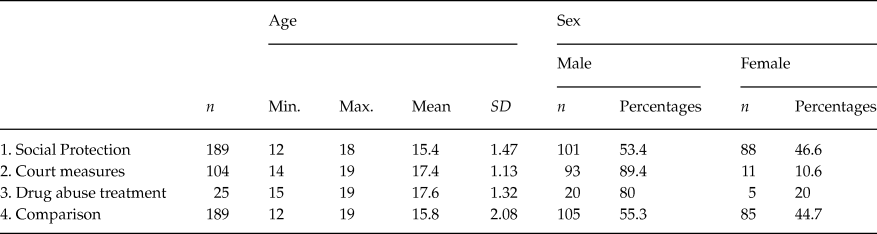
The members of the comparison group were selected to pair up to the participants from the other groups, following the inclusion criteria of age, sex, attending a public school and being of medium-low socio-economic level. (n = 190, 37.4%). To this end, Secondary Education, (professional) training and employment centers were visited in order to recruit the sample. Table 1 shows the distribution of each group according to age and sex.
Age and Sex Distribution for Each Group

The greater percentage of male participants in the groups of juvenile offenders and drug users corresponded to their greater presence within the population belonging to the chosen groups, which prevented analysing the results according to the sex of the participants (Instituto Nacional de Estadística (INE) a,b, 2013).
Procedure
A cross-sectional, comparative study was carried out, combining qualitative and quantitative approaches. In the first qualitative stage, sixteen in-depth interviews were carried out, for which a theoretical, flexible, iterative and continuous sampling was formulated, taking into account the criterion of typological representation and saturation point (Valles, Reference Valles2014). Those selected responded to the typology: adolescents under treatment for drug consumption; adolescents in compliance of court orders and adolescents in social protection. The content of the collected experiences was systematized and the analytical categories were constructed: violence, drug consumption and commission of crimes. These results were then used to develop a second quantitative phase in which a questionnaire was constructed in order to test the hypotheses of the study on an incidental sample.
The at-risk group was selected through collaboration agreements between the Universidad Complutense and the institutions responsible for the care and custody of the participants in the Comunidad Autónoma de Madrid. The selection of the centers and the total number of subjects in each group depended on the decision of each entity. These centers were distributed as follows: 11 juvenile protection centers, 6 custodial enforcement centers and 8 outpatient treatment centers for drug consumption.
The questionnaire was applied collectively, with the presence of the researcher. The size of the groups ranged between 5 and 25. The instructions were provided by the researcher, who resolved any issues that arose during the application.
An information letter was drawn up describing the terms of the study which also included an informed consent form for the guardians or parents of the adolescent. In the case of protected minors, the consent was granted by the responsible entity.
Variables and assessment instruments
Sociodemographic variables: Sex, age and group.
School punishments: The punishment scale was inspired by the sanctioning regulation, Decree 15/2007, which establishes the regulatory framework for coexistence in schools of the Community of Madrid, set out in the colloquial form in which adolescents express themselves. Due to the lack of a theoretical model, it could be considered a formative variable. For its study, a Likert-type scale was elaborated with a response range of 0 (never) to 4 (many times) for the six types of punishment included in the sanctioning regulation (Decree 15/2007): to notify the family; to be sent to the Principal’s office; to repair the damage caused; a temporary removal from the center; a disciplinary record; and final expulsion. In order to reduce dimensionality, an unweighted least squares factor analysis of the indicators, followed by a Promin rotation were performed. The Kaiser-Meyer-Olkin (KMO) statistic reached an acceptable value (.65). Several solutions were examined, opting for the two factor solution that was the one informed by previous research and recommended by Horn’s parallel analysis (1965).
The factors extracted explained 66% of the total variance and can be interpreted as light punishments, formed by four items: to notify the family; to be sent to the Principal’s office; to repair the damage caused; and a temporary removal from the center, which obtained reliability coefficient of (α = .88) 95% CI [.86, .89]; and severe punishments, consisting of two items: a disciplinary record, and final expulsion, with a coefficient (α = .63) 95% CI [.57, .68].
Violence: An ad-hoc, 10-item Likert-type scale was created from the content analysis of the interviews using a response range of 0 (never) to 4 (almost always/always). A confirmatory factor analysis was performed to show the internal structure. A well-defined solution and an adequate fit of three first-order latent variables and one second-order varible were obtained. The first variable could be defined as a disposition towards violence, and consisted of five items, such as “when someone is looking for a fight, he will find me” (R 2 = .47), “I`ll join my friends in a fight even if I don’t know what caused it” (R 2 = .56); the second variable was defined as Intra-family violence, consisting of two items: “I have caused physical violence situations with my family” (R 2 = .80) and “I have caused situations of non-physical violence with my family” (R 2 = .49); and the third variable was defined as Group violence, consisting of three items: “I have taken part in violent actions against homeless people” (R 2 = .48), “I have taken part in violent actions against ethnic minorities” (R 2 = .63) and “I have taken part in violent actions against gangs” (R 2 = .57). The second-order latent variable was defined as violence (Model fit indexes: χ2(32) = 146.85, p < .001; IFI = .96; RMSEA = .072; RMR = .041; CFI = .96; GFI = .96). The reliability coefficient for the scale was .86; 95% CI [.84, .87]; M = 17.68 and SD = 7.21. All items had a high level of significance p < .001; the minimum value of the t-statistic was 11.11.
Drug Consumption. It refers to the consumption or abstinence, during the last 30 days, of legal (a checklist with three drugs) and illegal (a checklist with 10 drugs) substances included in the questionnaire with the following order and nomenclature: tobacco, alcohol, cannabis, glue, cocaine, pills, magic mushrooms, meth, acid, ketamine, GHB, heroin and others. This selection coincides with most epidemiological studies (e.g., European Monitoring Centre for Drugs and Drug Addiction, 2014; Observatorio Español de las Drogas y Toxicomanías, 2013). In order to facilitate analysis, three variables were constructed by adding the corresponding indicators: alcohol, tobacco and cannabis consumption, (starting drugs) consumption of illegal drugs (except cannabis) and drug consumption, which included all substances.
Commission of Crimes. For the construction of this variable, a checklist with 22 types of crimes was created to evaluate the commission or not of the most frequent crimes among the study groups Footnote 1 (Agencia de la Comunidad de Madrid para la Reeducación y Reinserción del Menor Infractor (ARRMI), 2014).
Data analysis
Descriptive analyzes were carried out to determine the characteristics of the participants, the risk index for the analysis of categorical variables, and the differences among interest groups; an exploratory factor analysis was used to reduce dimensionality in the variable punishments and a confirmatory factor analysis was performed to establish the latent dimensions of the Violence variable, the reliability of the dimension scores. A logistic regression analysis was used to assess the relationship between school punishments, drug consumption and commission of crimes, and a linear regression analysis to assess the relationship between such punishments and violent behavior.
The IBM-SPSS (v.21) statistical package was used to perform the statistical analyses of the data, the Factor (v.10.3) program was used for the exploratory factor analysis and the Lisrel (v.9.2) program for the confirmatory factor analyzes.
Results
Differences between groups and school punishments
A 29.2% of the total sample had suffered at least one serious punishment at school and 63.1% had had minor sanctions. Contingency tables were created between the severe and mild punishments and the study and comparison groups. The probability of receiving mild punishments was 3 times higher if the adolescent belonged to the study group (or = 2.90); the relationship between the two variables was statistically significant N = 507; χ2(1) = 36.01; V = .248; p < .001. The risk increased in the case of severe punishments: 11 times greater if the adolescent belonged to the study group (or = 11.08); the relationship between both variables was statistically significant N = 507; χ2(1) = 76.06; V =.38; p < .001.
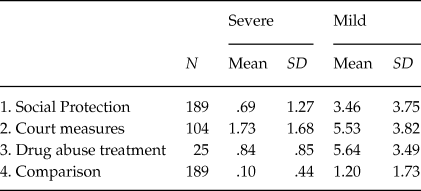
Table 2 presents the descriptive statistics of each of the interest groups for the three variables.
Descriptive Statistics of the Punishments According to Group

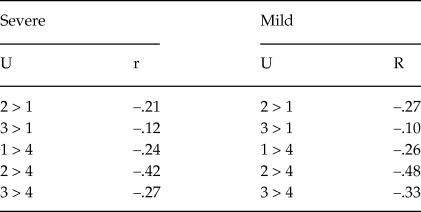
The non-parametric Kruskal-Wallis test was performed, as the severe and mild punishment variables did not fulfill the normality assumption. It was not necessary to eliminate the effect of age since the correlations were very low between mild punishments and age .11 p = .01, and between severe punishments and age .16, p < .01. Significant differences were found between groups for the two variables: severe punishments χ2(2) KW = 38.05 p < .001 and mild punishments χ2(2) KW = 24.87, p < .001. For a posteriori contrast, the Mann-Whitney U-statistic with Bonferroni correction and Rosenthal’s statistic were used for the calculation of effect sizes. As can be observed in Table 3, these statistics described small and medium effect sizes for the differences between interest groups (Cohen, Reference Cohen1988).
Diferences between Groups in Punishments and Effect Sizes

1: Protecction; 2: Court measures; 3: Drugs; 4: Control.
Tables 2 and 3 show that the groups at risk have received more punishments than the control group, as can be observed from the means of each group. The most punished group was the one under court orders, difference due to the severe punishments. The second most punished group was the one being treated for drug consumption, due to the mild punishments, and the third most punished group was the one in social protection. The largest effect sizes correspond to the differences in the severe punishments and the mild punishments between the groups of custodial measures (2), the drug consumption group (3), and the social protection group (1) with the comparison group (4).
Predictive analyses based on punishments
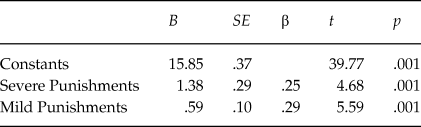
A linear regression analysis was performed to evaluate the effect of school punishments on violent behavior. The severe and mild punishment variables were introduced into a single block. School punishments are considered predictors of the violence variable; the model explains 24% of the criterion variable (adjusted R 2 = .24; SE = 6.29; F(2, 504) = 80.39, p < .001). See table 4.
Prediction of Violent Behavior from the Severity of School Punishments

To evaluate the relationship between school punishments and the probability of drug consumption and the commission of crimes, a logistic regression analysis was performed. The strong positive asymmetry of both dependent variables advised their dichotomization. The severe and mild punishments variables were defined as 1 = punished and 0 = not punished and were introduced into a single block. The consumption of alcohol, tobacco and cannabis, and illegal drugs variables were analyzed for the whole sample and the commission of crimes variable was chosen for those over 13 years old (minimum age to demand sanctioning responsibility according to LO 5/2000 on 12th January). The results are presented in Tables 5, 6 and 7.
Logistic Reggression for the Prediction of Alcohol, Tobacco and Cannabis Consumption according to the Severity of School Punishments

Logistic Reggression for the Prediction of Illegal Drug Consumption according to the Severity of School Punishments

Logistic Reggression for the Prediction of Commission of Crimes according to the Severity of School Punishments

The results of the logistic regression show that the mild punishments variable predicted in a statistically significant way the consumption of drugs χ2(2) = 63.16, p ≤ .001. The mild punishments variable increased the probability of consuming alcohol, tobacco and cannabis by 34% (95% CI [1.1, 1.5]). The likelihood ratio indicated the superiority of the final model over the null model χ2(1) = 48.82, p ≤ .001. The overall percentage of correct classifications was 79.3%, and the correct classification of cases of those that consume these substances was 100%. The effect size was small (or = 2.48). The pseudo-R 2 were also low, between .12 (Cox & Snell R 2 ) and .18 (Negelkerke R 2 ). The severe punishments variable was not significant for prediction.
It was also shown that the punishments significantly predicted the consumption of illegal drugs χ2(2) = 131.85, p ≤ .001. The mild punishments variable increased the probability of using illegal drugs by 11% (95% CI [1.11, 1.30]), and the severe punishments variable by 86% (95% CI [1.41, 2.49]). The likelihood ratio indicated the superiority of the final model over the null model χ2(1) = 101.16, p ≤ .001. The overall percentage of correct classifications was 73.6%, correctly classifying 60% of the cases that use these substances and 86.7% that do not consume them. The effect size was mild (or = 9.60 for those who had severe punishments and 4.48 for those who had mild punishments). The pseudo-R 2 were large, between .23 (Cox & Snell R 2 ) and .31 (Negelkerke R 2 ).
Similar results were obtained for the commission of crimes variable. Punishments were significantly related to the probability of committing offenses χ2(2) = 57.84. p ≤ .001. The analysis showed that having been subjected to severe punishments increased the probability of committing crimes by 40% (95% CI [1.13, 1.73]) and 14% (95% CI [1.05, 1.24]) if they had been mild. The likelihood ratio indicated the superiority of the final model over the null model χ2(1) = 62.85, p ≤ .001. The overall percentage of correct classifications was 82.2%, correctly classifying 14% of the cases that committed crimes and 96.2% of cases that did not. The effect sizes were medium (or = 6.69 for severe punishments and small (or = 4.41 for mild punishments), as well as the pseudo-R 2 that were between .11 (Cox & Snell R 2 ) and .18 (Negelkerke R 2 ).
Discussion
The results obtained confirm the hypothesis about the relationship between the frequency with which school punishment has been experienced and the membership of a psychosocial risk group, noting that the relationship was much greater when considering severe punishments (disciplinary report and final expulsion from the center) than when considering mild punishments (notifying the family, being sent to the Principal’s office, repairing the damage caused and temporary removal). In addition, when comparing each risk group with the control, the differences were larger, especially in the case of adolescents under court measures, both in severe and mild punishments and, secondly, with drug consumption.
The results of the regression analyzes also confirm the hypotheses about the relationship of violence, drug consumption and the commission of crimes with the punishments experienced at school, resulting in this sense specially significant the severe punishments with respect to the consumption of illegal drugs other than cannabis and also with the commission of crimes. These results lead us to emphasize that having suffered serious punishments at school, based on expulsion from the center and the disciplinary records that preceded it, are a very visible indicator of psychosocial risk, a cry for help that should alert us to the need to intervene with whom expresses it in order to help them avoid that risk. Although the results cannot confirm that punishments are the source of the risk, since frequently punished students, especially with severe punishments, have often experienced serious problems, which are at the origin of the behavior for which they are sanctioned, as noted by Bravo et al., (Reference Bravo, Sierra and Del Valle2009), they do confirm that only with punishment (and especially with the expulsion from the center), the behavior that originated it cannot be changed. In fact, it can even be aggravated, as with the expulsion important risk conditions can be increased: time out of school (as the American Academy of Pediatrics, 2003, warns), disengagement from the values and rules that the school tries to teach as well as the linkage with values and behaviors of antisocial groups with which they become related to when they are expelled (as Catalano et al. Reference Catalano, Haggerty, Oesterle, Fleming and Hawkins2004 confirm) and the opportunities to feel effective with behaviors, such as violence, drug consumption or crime (as found by Bandura et al., Reference Bandura, Caprara, Barbaranelli, Pastorelli and Regalia2001). It should be borne in mind that the repetition of mild punishments, although to a lesser extent, is also a risk indicator, so the alert should start from this indicator.
The results suggest that traditional school punishments that continue to be used in schools are not effective in changing the behavior of the punished adolescent, as is recognized in Spain by families, students, teachers as well as by management and guidance teams (Díaz-Aguado et al., Reference Díaz-Aguado, Martínez Arias and Martín Babarro2010). In the direction proposed by the American Psychological Association Zero Tolerance Task Force (2008), it is also necessary to sensitize society and those responsible for education, about the need to adopt a preventive perspective, working with the entire school, training teachers in proactive conflict management, articulating a much closer collaboration with families, detecting as early as possible the at-risk students to help develop competences that allow them to succeed, integrate themselves into positive peer groups and form links with the values that the school tries to promote. Coercive measures must be accompanied when they are unavoidable with an educational intervention that helps the punished adolescent to understand why what he did is wrong, repent and initiate behaviors that repair the damage caused.
Although absent from most of the analyzes on school discipline cited above, it is important to bear in mind that another important line of intervention to improve discipline is to involve all members of the school, including students, in the development and application of School rules, so that their fulfillment will be much more than mere obedience to authority, becoming loyal to a group to which the adolescent feels attached to and loves, as has been proven for decades in both schools and correctional facilities (Kohlberg, Reference Kohlberg and Mosher1980; Power & Power, Reference Power and Power1992).
Most of the previous research carried out on this subject has been performed in the United States, in response to the extreme violence with firearms produced in that context. The main contribution of this study is to have been carried out in Spain, a very different context, but in which students, teachers and management teams recognize the ineffectiveness of the punishments to improve the behavior of the punished. The present research delves further into this topic, its results suggesting that students who receive severe punishments often appear to be initiating antisocial behaviors, possibly related to behavior problems and family difficulties, which should be diagnosed accurately as soon as possible to help the adolescent out of a path that can lead to delinquency and illegal drug consumption. This goal is not only achieved with the type of discipline they are currently receiving.
Among the main limitations of this study, which should be overcome in future research, are that the characteristics of the sample should be noted, which should be extended to other Autonomous Communities, and that the need to carry out a longitudinal follow-up that allows to relate the type of school discipline suffered with later development should be taken into account, as well as the convenience of completing the evaluation of the discipline with qualitative measures based on the account of those who receive it.