INTRODUCTION
The nineteenth-century Kidichi baths on the island of Zanzibar are a legally protected historic monument, but surprisingly have never been recorded in detail beyond an unpublished tape and plane-table survey in 1984.Footnote 1 The preliminary surveys conducted by the authors in June 2017 were undertaken as part of a Global Challenges Research Fund (GCRF) workshop to explore the tangible and intangible threats facing heritage in Africa, and to explore the use of modern and ancient technologies to facilitate heritage engagement. The site was selected primarily as a convenient location to demonstrate to invited workshop participants a range of archaeological methodologies, including ground penetrating radar (GPR), terrestrial laser scanning (TLS), unmanned aerial vehicle (UAV) and photogrammetry, to promote understanding of their utility in African contexts. Given the international scope of the meeting, a short site summary was produced in conjunction with the Department of Antiquities in Tanzania to facilitate a site tour prior to the practical demonstrations and survey. In doing this, and through surveying, it swiftly became apparent that information about the baths was disparate and limited. Numerous questions arose, including, for example, the exact date of their construction. This was surprising given their recent age in archaeological terms, their mention as a key tourist attraction on numerous websites and in popular guidebooks, and their use as a key stop during the ‘spice tours’ of Zanzibar that have proliferated since the late 1980s. This article aims to redress this situation, provoke discussion about heritage construction and present a fuller narrative based on new research as a basis for future research. Following a review of the site’s historical context, a summary of the scientific survey is presented. The materiality of the baths is then used to present a series of new interpretations that inform the historical narratives, before concluding with a consideration of the wider theoretical implications of this research.
ZANZIBAR: A CULTURAL ENTREPÔT
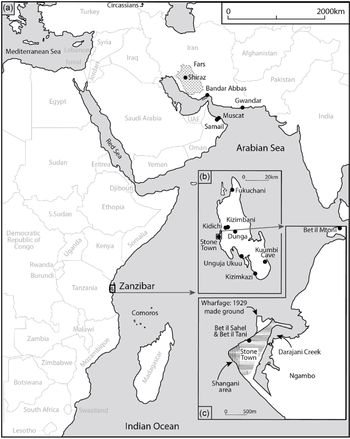
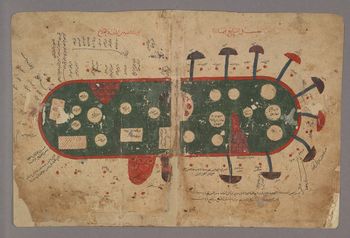
The island of Zanzibar (also known as Unguja) lies 40km off the east coast of Africa, and is part of the United Republic of Tanzania (fig 1). It is known to have been populated since 40,000 bce, probably by Late Stone Age hunter-gatherersFootnote 2 and in recent years has become a popular tourist destination, with the number of international visitors more than doubling since 2013 to over 350,000 by 2016.Footnote 3 Excavations at Unguja Ukuu demonstrate that by the seventh century Zanzibar was part of a major maritime trading network connecting the peoples of eastern Africa, India, Oman and Persia.Footnote 4 It is likely that Arab, Persian and Somali traders were living along the Zanzibar Channel at this time. Unguja Ukuu is also mentioned on a Fāṭimid map c 1060 ce (fig 2).Footnote 5
Location map (a) shows location of Zanzibar. Inset (b) shows the sites mentioned in the text. Inset (c) shows the modern coastline, but incorporates the old extent of Stone Town and location of Darajani Channel based on Oscar Baumann’s map of Zanzibar City, 1892. Darajani Channel was filled in by 1956. Drawing: Libby Mulqueeny and Laura Basell.

Fāṭimid map from the anonymous Medieval Islamic manuscript, Kitāb Gharā’ib al-funūn wa-mulaḥ al-ʿuyūn (The Book of Curiosities of the Science, and Marvels for the Eyes). This map, which mentions Unguja Ukuu, was copied in the late twelfth or early thirteenth century from a work first compiled c 1060 ce. Photograph: Reproduced with permission of the Bodleian Libraries, University of Oxford, shelfmark: ms Arab c 90, fols 29b–30a; in Fromherz Reference Fromherz2018.

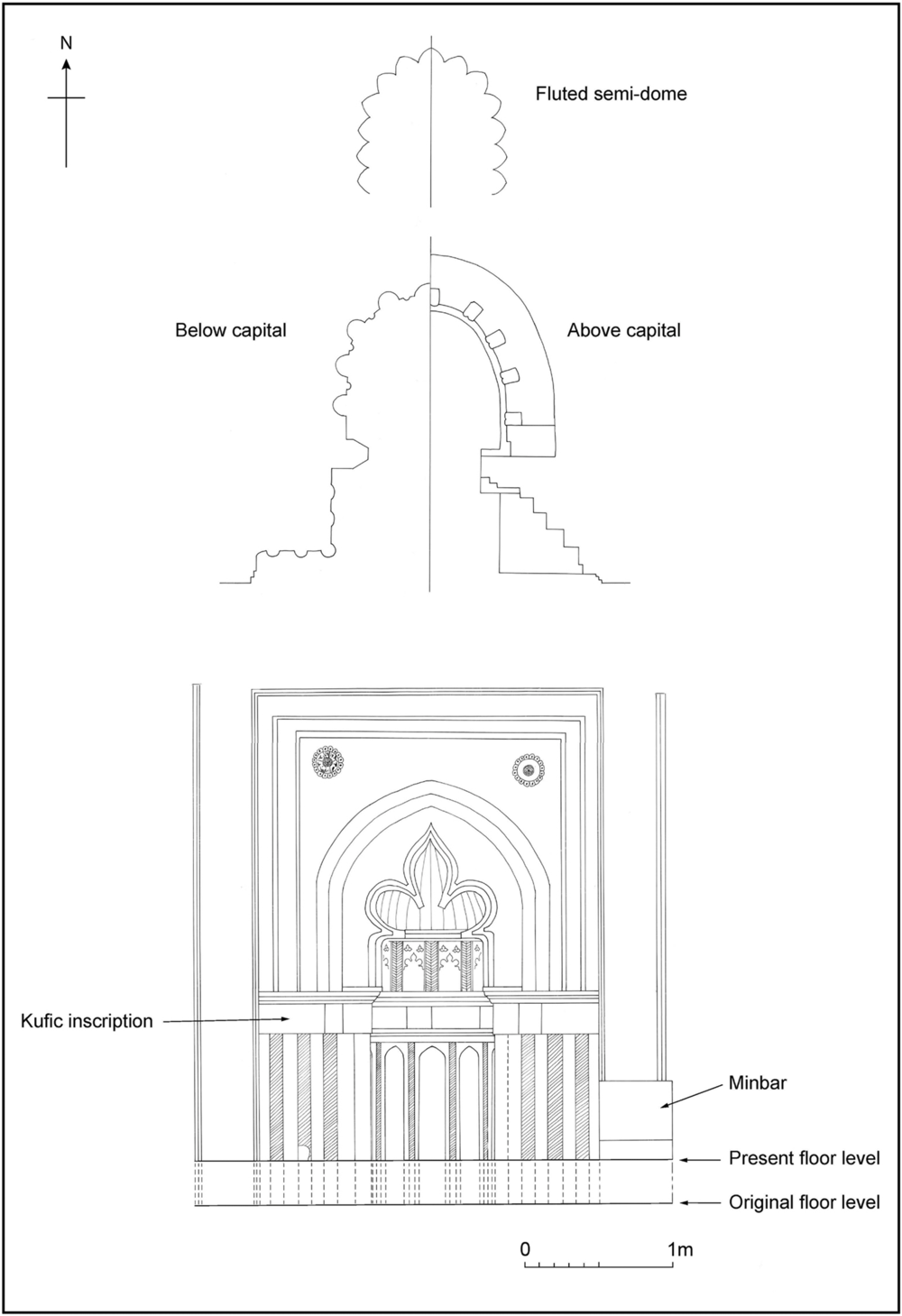
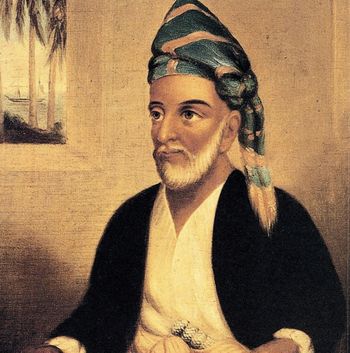
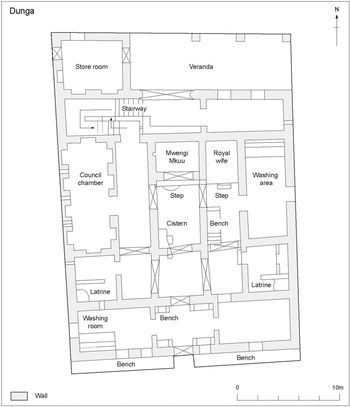
The earliest surviving mosque on the island is located in the south, at Kizimkazi, with a dated mihrab of 1107 ce (fig 3). Today, the capital of Zanzibar is located in the Stonetown in the central west coast, and the oldest part, known as Shangani, has its origins as a Swahili settlement in the eleventh or early twelfth century. Following the arrival of Vasco da Gama, in 1498, Zanzibar did not feature significantly in the Portuguese colonisation of East Africa until the establishment of a factory or trading post c 1571 and an Augustinian mission in 1612 that survived until the murder of its vicar in 1694. The factory and the mission were taken over by the Arabs, who constructed a small fort re-using the old buildings. This fort became the centre of power for the emerging Busaidi clan, who came to rule Oman and develop an East African coastal empire. Zanzibar became the centre of a vibrant trading network throughout this period and by 1810 up to 8,000 slaves had passed through it.Footnote 6 Trade (mostly ivory and slaves) increased during the reign of Said bin Sultan (1806–86) (fig 4), alongside the creation of plantations of spices and coconuts. After initial visits in 1828 and 1830, in 1832 Said relocated the sultanate’s capital from Muscat to Zanzibar, moving there permanently in 1840.Footnote 7 Mohammed bin Ahmed, the indigenous ruler (or Mwinyi Mkuu), was exiled to the centre of the island, where he built an African palace at Dunga in an Arab style (fig 5).Footnote 8 He retained a degree of local authority power akin to that of a regional governor until the last Mwinyi Mkuu (Mohammed’s son) died of smallpox and the line ended.Footnote 9
Kizimkazi mihrab. Drawing: Laura Basell 1997 for Mark Horton.

Portrait of Said bin Sultan painted by an American sailor, possibly Lieutenant William F. Lynch, c 1855 and published at least as early as 1921. Image: Public domain, available online at https://www.wikidata.org/wiki/Q506193.

Plan of Dunga Palace. Drawing: Mark Horton and Laura Basell 1997.

SAID BIN SULTAN AND SHIHRAZAD: THE HISTORICAL CONTEXT
The surviving range of Persian baths at Kidichi are the most ornate in Zanzibar and are notable for their elaborate plaster stucco decoration. They once formed part of a nineteenth-century palace complex dating to the period of Said bin Sultan’s rule (1804–56) and were built for or, as argued here, by his third wife. The site of the palace has been lost, although the Zanzibar guide notes a mound nearby that is reputed to be its site.Footnote 10 No archaeological investigations have taken place at Kidichi.
Said bin Sultan was born in Samail, Oman, in 1788 and was the second son of the Sultan of Muscat and Oman.Footnote 11 He became joint ruler with his brother in 1804 and sole ruler in 1806.Footnote 12 There are numerous sources of information about him, including the remarkable Memoirs of an Arabian Princess from Zanzibar originally published in 1888 by his daughter Salme, who was born in Zanzibar in 1844 and spent her childhood years in the royal harem.Footnote 13 Accounts of explorers, missionaries, seafarers, traders and politicians (for example, two Memoranda written in 1842 by James Silk Buckingham, a journalist working for the East India CompanyFootnote 14 ) often contain contradictory information, especially concerning dates and names, but an overview of Said’s personal life based on these various accounts was written by Romero.Footnote 15
Said first visited Zanzibar when he was aged eleven. He had three free wives (Harīno), seventy-five secondary or slave wives (Sarari) at the time of his death, and once made an unsuccessful proposal to the Queen of Madagascar.Footnote 16 Said’s harem included numerous nationalities, including women from Iran, India, Turkey, Ethiopia, Nubia, the Black Sea region (Circassians) and, presumably, Swahili women. His thirty-six children, whose specific social and legal status are elucidated by Sheriff,Footnote 17 were all from these Sarari. The eldest of them were Hilal (b. c 1815) and Khalid (b. c 1819).Footnote 18 Said was an Ibadi and fluent in Persian, Hindustani and Arabic – though on Zanzibar he insisted that only Arabic be spoken in his presence and that his Sarari and children dressed in Arab fashion whatever their nationality.Footnote 19 By most accounts he was a good-looking but unaffected and modest man. He was described as generous, a brave but reluctant warrior and loved horses, keeping a fine stable of Arabian thoroughbreds. He travelled extensively during his lifetime, was an excellent seafarer and died in 1856 at sea.Footnote 20
Said’s first wife was his cousin, Azze, the daughter of Said’s aunt, a politically powerful and influential woman, and Moza bint Azza bin Ahmed. Azze was Said’s lifelong and most respected companion, whom he married sometime before 1825.Footnote 21 Azze lived at the Mtoni palace on Zanzibar (see fig 1), and she died before 20 July 1860 having had only one child, who died young. She is described as strict, regal and of noble manners.Footnote 22 Said took a second legitimate wife in 1827 in Bandar Abbas, Iran. Sources vary, but she was either the daughterFootnote 23 or a sister called Fatah of Shahzada Muhammad Husain ‘Ali Mirza, Tau’aman ul-Mulk, Farman Farma, Governor-General of Fars and Governor of the Persian Gulf Ports.Footnote 24 Burton refers to her as the grand-daughter of Fath ‘Ali Shah Qajar of Persia (r 1797–1834).Footnote 25 The marriage was agreed on condition that she could spend the summer with her family at Bandar Abbas or Shiraz when not with her husband in Muscat, but following an argument in 1832 she never returned.Footnote 26 She subsequently wrote letters to her husband calling him a ‘Sunni dog’ and possibly suggesting that Said bin Sultan’s son Khalid had betrayed him in his own harem.Footnote 27 Ultimately, they divorced. There is no record of her having visited Zanzibar.
There are also inconsistencies between sources about his third legitimate wife, who is variously referred to as Shahruzad bin Irish Mirza bin MuhammedFootnote 28 or Binti Irich Mirza (nicknamed Shesade),Footnote 29 with both ‘Irish’ and ‘Irich’ appearing on the information boards at the Kidichi baths. This may be a phonetic spelling of the Persian name, ‘Iraj’, though Romero (using several sources) refers to her as Shihrazad bint Arish Mirza ibn Mohammed Shah, and states she was the grand-daughter of Mohammed Shah. This is improbable as Mohammed Shah was not born until 1808,Footnote 30 so for her to be his grand-daughter and of an age to marry by 1847 (that is, pubertyFootnote 31 ), both her father and grandfather must have been siring children by their early teens. Interestingly, Burton casts doubt on this genealogy, stating that Irich Mirza was a ‘suppositious [emphasis added] son of Mohammed Shah, and hardly a second class noble’.Footnote 32 Burton reports the arrival of Irich Mirza’s daughter, whom he does not name, in Zanzibar as 1849.Footnote 33 An alternative explanation of her genealogy is given in the supplementary material accompanying this article online.
Whatever her parentage, Shihrazad was considered Persian royalty, a member of the Qajar dynasty. Like Said’s second wife, she would have been a Shi’a. For Said, marrying a non-Ibadi was allowed, and especially when diplomatic or trade relations could be improved by such a match.Footnote 34 Shihrazad came from Shiraz, which was a well-established centre of learning, poetry, music and the arts,Footnote 35 and her arrival on Zanzibar in 1847 or 1849 was certainly dramatic. Her entourage included her groom, carpet spreaders and private executioner.Footnote 36 Burton states:
She astonished the Arabs by her free use of the dagger whilst her intense relish of seeing her people ride men down in the bazar, and of superintending bastinadoes administered with Persian apparatus, made the Banyans crouch in their shops with veiled faces, and the Arabs thank Allah that their women were not like those of the A’ajám.Footnote 37
In accordance with Persian tradition, Said gave his third free wife her own rooms in a new palace, Bet il Tani, which was connected by a suspension bridge (over the hammam or ‘steam baths’) to Bet il Sahel. Both these palaces were in Shangani. Said’s daughter, Salme, never met Shihrazad, but when she was aged nine she was moved to Bet il Tani and told that the upper floors were once occupied by a woman of ‘entrancing beauty’ who hunted with her retinue of 150 Persian horsemen.Footnote 38 That Shihrazad rode is not unusual. Salme herself was taught to ride and to shoot by her brother. What was shocking was that Shihrazad rode in broad daylight, with her male entourage and hunted, which was unheard of for Omani or Zanzibari women at this time.Footnote 39 Salme wrote:
The Persian women are subjected to quite a Spartan training in bodily exercise; they enjoy great liberty, much more so than Arab women, but they are also much more rude in mind and action.Footnote 40
Shihrazad’s first stand against her husband was to refuse to adopt Arab dress, refuse to veil, and to continue to wear the Persian style. This vibrant, wild, horse-riding, hunting bride must have been a stark contrast to Azze, who was seldom seen outside her palaces,Footnote 41 but Shihrazad’s behaviour would probably not have been that unusual for a woman of her class in Persia. For example, Jayran, a favourite slave wife of the Persian Qajar Shah, Nasir al Din (r 1848–96), hunted and rode with her face-cover wrapped around her head.Footnote 42 Sheriff argues that in the mid-nineteenth century, sea travel would have been one of the most common ways of moving around the island as the streets in Shangani were filthy and there were no proper roads.Footnote 43 From a practical perspective, if Shihrazad wanted to explore the island, probably one of the easiest ways would have been on horseback.
Like all royal women from Persia, Oman and Zanzibar at this time, Shihrazad was richly jewelled. Her clothes would have included fine embroidered silk and she would have worn loose trousers that were the fashion in Persia. Salme records an anecdote that Shihrazad’s clothes were covered with pearls, and that these were collected by the servants when they dropped off, but which Shihrazad refused to take back.Footnote 44 Shihrazad did not have any children (though she was kind to the children in the harem), and she may never have had sexual relations with her fifty-nine-year-old husband.Footnote 45 Her date of birth is not known, but it is likely she was in her late teens or early twenties.Footnote 46 The impression that emerges from the descriptions of Shihrazad is of a beautiful, imperious, rather bored, but demanding young woman.Footnote 47
Salme writes that Shihrazad was enormously extravagant, ‘wantonly draining’ Said’s exchequer. However, it was not these excesses of expenditure that led to the break-up of the marriage by 1850. The details are unclear, but it has been repeatedly suggested that Shihrazad fell in love with, or engaged in a relationship with, Said’s eldest son, Hilal, who would have been aged about thirty-three and was reputedly handsome.Footnote 48 Romero suggests that alcohol may have been involved, for though alcohol was forbidden by the Qur’an, Hilal had become accustomed to drinking with the French Consul at Zanzibar, and was disinherited by his father in 1844 for alcoholism.Footnote 49 Alternative explanations concerning Hilal’s disinheritance suggest that he had violated his father’s harem, but it is also possible this was a malicious rumour deliberately spread by his aunt, to promote the second son, Khalid.Footnote 50
In 1845 Hilal travelled in secret to England to petition the British government to intercede on his behalf.Footnote 51 The British government wrote to Said requesting him to restore Hilal to favour, but this only served to annoy Said, who then exiled his son in 1849.Footnote 52 Whether Hilal’s disinheritance is related to a dalliance with Shihrazad, or whether the combination of a beautiful and energetic princess and an alcoholic, handsome prince simply proved a powerful source of inspiration for rumour-mongering and politicking in the harem (and beyond), remains unknown. By 1850, both Shihrazad and Hilal had left Zanzibar, to Shiraz and Muscat respectively.
By 1851, Hilal was dead ‘of a long disease said to be caused by sorrow’, according to a Frenchman, Guillain, writing at the time.Footnote 53 Said divorced Shihrazad, which was permissible by law, though it would have required Said to pay the bridewealth to her in full (an important asset to a divorced or widowed woman) and would probably have required her father’s permission to return to his court.Footnote 54 Said was obliged to spend much of his time moving back and forth to maintain governance, particularly between Bandar Abbas in the Gulf, the port of Gwandar on the Arabian Sea and Zanzibar.Footnote 55 Said went away to settle affairs at Suhar, returning to Zanzibar in 1852, but left again in 1854 in part to settle a dispute with Persia.Footnote 56 The last written record of Shihrazad relates to these journeys. Salme mentions rumours that Said saw Shihrazad at Bandar Abbas fort in 1854, where she was leading troops and where she took aim at members of the family herself.Footnote 57 Once again, it is unclear whether there is any truth in these rumours.
KIDICHI BATHS: TOPOGRAPHIC AND ARCHAEOLOGICAL CONTEXT
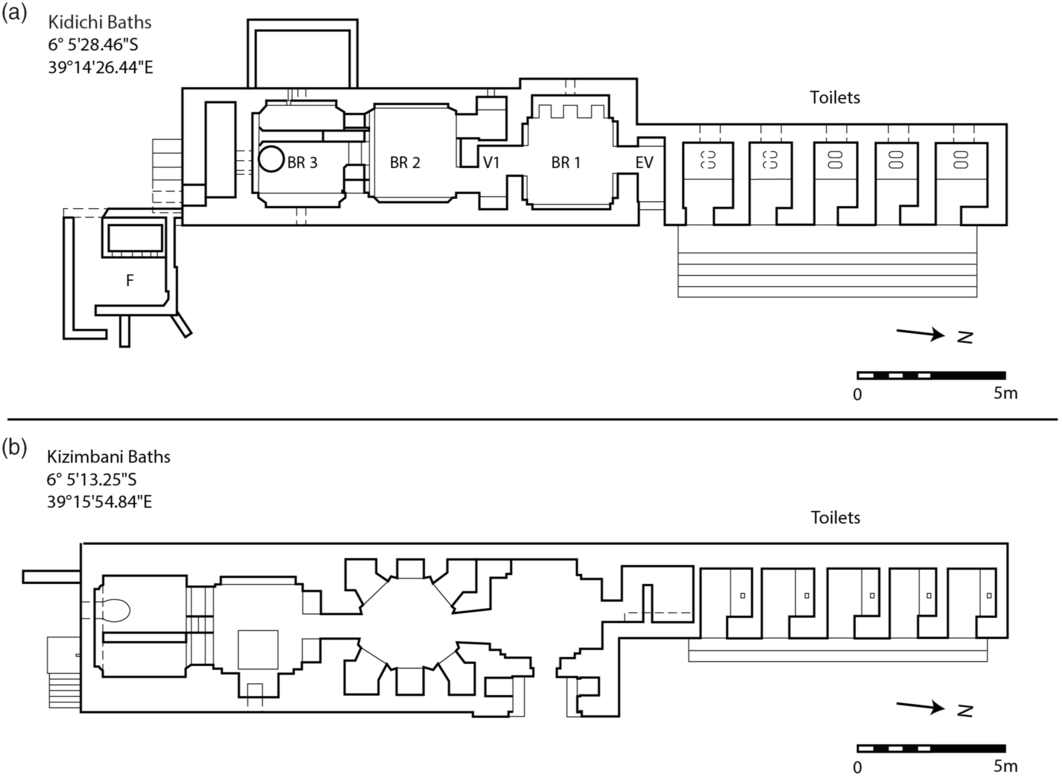
Kidichi baths lie to the north-east of Zanzibar Town, about 4km inland from the main coast road, in the island’s main clove and coconut plantation area (see fig 1). Further along the road, is another set of baths at Kizimbani, very similar to Kidichi in design, though they lack the same stucco decoration and contain an additional room and more elaborate entrance (fig 6). The date of construction is presumed to be similar to Kidichi, but again no archaeological research has been done here. Sources vary concerning who built the Kidichi baths. Some say Said built them for Shihrazad, whilst others suggest Shihrazad had the baths built both at Kidichi and at Kizimbani. She is certainly recorded as having brought craftsmen from Persia especially to decorate themFootnote 58 and she may have introduced the fashion for Persian bathing among the Arab elite in Zanzibar. As a royal bride, she would have had the power and funds to undertake such a task.Footnote 59
Plans of (a) Kidichi baths and (b) Kizimbani baths. EV = Entrance Vestibule, BR = Bathroom, V = Vestibule, F = Furnace area. Drawings: Mark Horton and Kate Clark Reference Horton and Clark1985. Digitisation: Laura Basell 2019.

Located on a ridge, Kidichi was therefore a little cooler and commanded views down to the coast. The baths form a long corridor, with toilets at one end, and a series of rooms ending in the hot bath at the other end. This was heated by an external furnace that would have been operated by slaves. The plasterwork is exceptional, and includes representations of foliage and birds. The information board at Kidichi indicates that a date of 1247 ah (1832 ce) is inscribed in the plasterwork, suggesting the baths may have been constructed prior to Shihrazad and Said’s marriage. No date was immediately obvious in the plasterwork, and although text was visible, no-one could read it as it was written in an ‘old’ text.
KIDICHI BATHS: SURVEY METHODOLOGY AND RESULTS
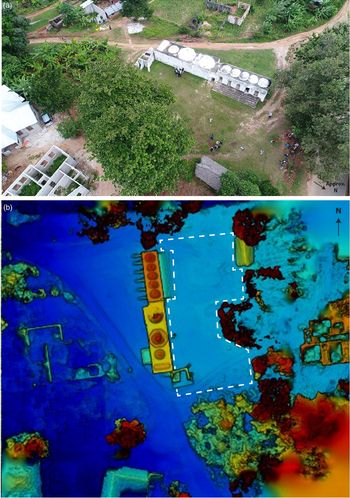
During the workshop in June 2017, several surveys were completed, the technical details of which may be found in the online supplementary material. Geospatial control was established using a differential global positioning system (GPS) to which other surveys were related. UAV survey, often referred to as drone survey, is a method of collecting geomatics and other imagery aerially to provide information not visible from the ground. The results of the UAV survey show the extent of the baths, and the increasing encroachment of cultivation and building on the monument (fig 7). The situation is worse at Kizimbani, with maize cultivation directly in front of the baths (Basell, pers obs, 2017).
(a) UAV aerial photographs of Kidichi showing encroachment of modern buildings. (b) elevation model where red is high and blue is low. All imagery was processed in Drone Deploy. Data collected by N. Mellor and workshop participants, July 2017. Area of GPR survey is indicated by the white line. Images: Nicholas Mellor 2018, annotated by Laura Basell 2019.

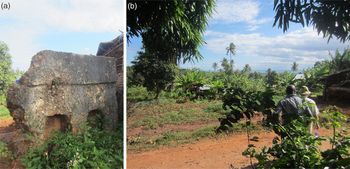
GPR is a non-destructive method of geophysical survey that can be used to map subsurface archaeological features. Figure 7 shows the GPR area surveyed to determine whether further structures could be identified, but the results were inconclusive. However, one of the workshop participants, Father Patrick Devine, noticed a small part of an old building nearby (fig 8) in an area with clear views down to the sea, and near a very large, old tree. This area has been developed in recent years, so if this was the location of a palace or other buildings associated with the baths, it is likely that modern building has destroyed them.
(a) Wall fragment of old ruined structure possibly associated with the baths, located c 15m due south of Kidichi baths. (b) View to the sea from location of ruin, under huge old tree. Photographs: Laura Basell, June 2017.

Digital photogrammetry is when overlapping photographs of an object, structure or space are taken and geometric information obtained by processing measurements and imagery through computational models. This allows the creation of 2D or 3D digital models. Limited photogrammetry was undertaken inside the baths, but, due to the high humidity, echoing acoustic, and confined space, most of the photogrammetry demonstration occurred outside. As the results are not methodologically or theoretically significant, they are not presented here, although this low-cost approach may be useful in future research. General photographs were also taken.
The external plan form and wider context of the site had been surveyed using the plane-table and UAV survey, so the TLS survey focused primarily on capturing the internal form of the baths. TLS survey is a method of geodetic imaging which permits 3D digital recording of topographic and other surfaces (including vegetation and cultural objects) at sub-centimetre resolution. By active scanning with a laser, clouds of points are generated from the surfaces it hits, each of which has an x, y and z co-ordinate. These point clouds can be combined and manipulated to generate high resolution models, cross-sections, measurements, 3D-dynamic fly throughs and 2D outputs. Typically, scanners simultaneously take photographs or videos that then allow the point clouds or models generated from them to be realistically coloured.
The toilet block was not scanned internally, but the ornate plaster stucco work inside the first bathroom (BR1) was captured in detail at high resolution with photographs using the Leica P40 TLS. The vestibule linking the main baths, V1, and BR2 and BR3 were also scanned at high resolution, but without photographs due to time constraints and fading light. Part of the rationale for the internal TLS survey was that the inside of the baths had very recently been whitewashed with a thick layer of paint, presumably to address the issue of mould growing on the stucco work reported in several of the travel guides since 2006 and still visible, especially in BR3. Who had authorised and paid for the painting was not clear, but the stucco relief and clarity had been significantly reduced as a result.
The laser scan allowed the rapid acquisition of point clouds fully georeferenced in real-world co-ordinates via the differential GPS control points. When manipulated in relevant software, ‘Cyclone’, the rapid creation of cross-sections, novel view-points and precise measurements becomes possible. This would take days of work using more traditional survey methodologies. The method of survey is of value in that it also permits the remote interpretation of data (though admittedly only to those with appropriate software), and more widely when the data are disseminated in readily accessible digital or hardcopy formats. Nonetheless, it should be emphasised that any remote sensing data is best interpreted in conjunction with extensive ground-truthing, first-hand observation and discussion. The length of time it takes to process and interpret data depends largely on the questions being asked and desired outputs; and the questions often change and proliferate as the data are explored. Analysis of the Kidichi TLS data are a case in point, so results focus on a limited range of observations and interpretations based on a preliminary analysis of the dataset.
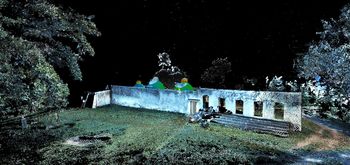
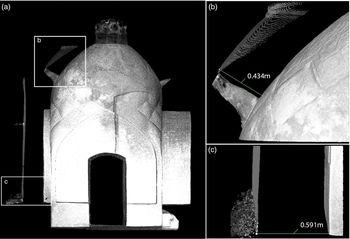
The wider extent of the point cloud is shown in figure 9. This shows that the scan incorporated the external wall of the baths and some parts of the external dome. The main scanning focus was inside the bath rooms (BR), but generating cross-sections through the areas that had captured both the internal and external surfaces allowed the precise measurement of the wall and dome thickness. Figure 10 shows the BR1 dome thickness to be 434mm in the area of the vent shaft, and the distance between the external wall surface and the internal wall at the same level in BR1 to be c 600mm. Figure 10 also illustrates well the precision and symmetry of the construction, and that the floor level inside the baths is below ground level. The entrance vestibule (EV) is reached by descending two steps.
TLS of Kidichi baths showing capture of surrounding topography and vegetation. External point clouds have been draped with photographs. Internal point clouds (bright colours) are displayed using intensity values. Image: Laura Basell.

(a) TLS of Kidichi baths BR1 rendered in black and white to show in inset (b): dome thickness and in inset (c): wall thickness. Image: Laura Basell.

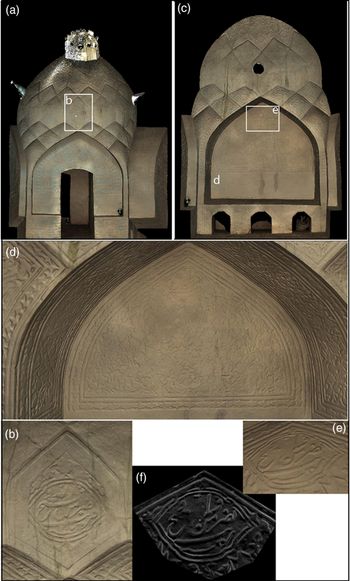
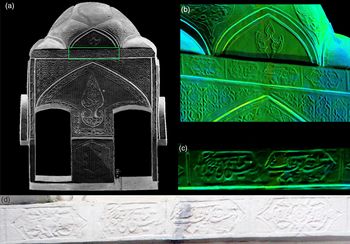
The walls of all rooms were examined for text. Two instances were found in BR1, which is the most ornate room. On entering the room, the text is directly ahead of the observer, above the door into the next vestibule (V1). To the observer’s right, there is a seat with three niches underneath and elaborate decoration above the seat. The second cartouche containing text is at the top of this panel (fig 11). On entering BR2 from BR1, the observer is struck by the decrease in the quantity of decoration. No text is immediately apparent and the whitewashing in this room was not as thick as in BR1. Large areas of wall are undecorated and several large areas have blank cartouche panels. Turning back to face the doorway from V1, a panel of writing is found at the top of the wall/base of the dome (fig 12). Adjacent to the V1 entrance is a second entrance leading to a small room (Room 2a), currently used to store the jerry cans of whitewash. All the script was indecipherable to readers of modern Arabic and their meaning had faded from local memory.
TLS of Kidichi baths BR1. (a) and (c): general location of text in BR1; (b) to (e): specific detail of text; (e) and (f) are of the same text from the location shown in (c) – (e) is an oblique view to show the lettering. All point clouds, except for (f), are draped with photographs. Images: Laura Basell.

TLS of Kidichi baths. (a): silhouette rendering of BR2 south-facing wall showing location of poem text; (b) and (c): back-lit and silhouette rendering of point clouds displayed using intensity value colour map to clarify lettering; (d): photograph of text and adjacent decorative cartouches. Images: Laura Basell.

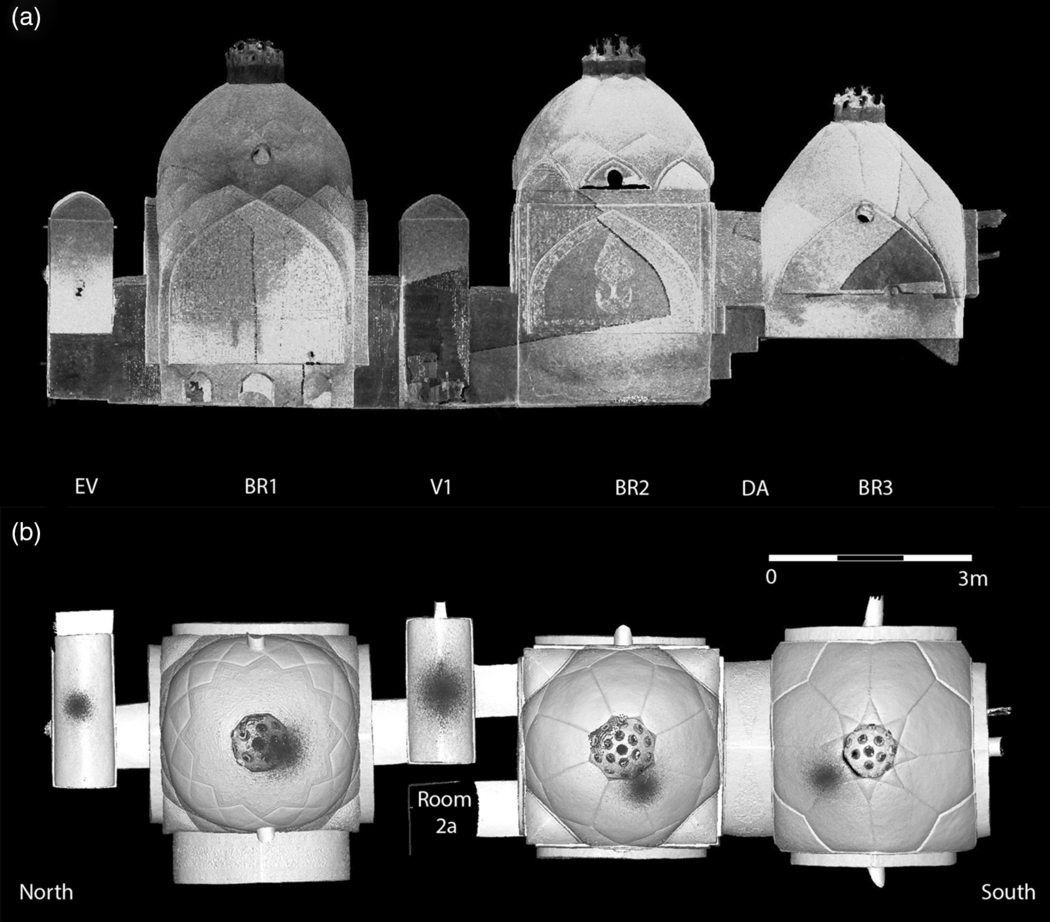
BR3 is not separated from BR1 by a vestibule but accessed via three steps beneath an arch, the underside of which is richly and symmetrically decorated with images contained within stylised cypress tree motifs (DA in fig 13). The dome of the ceiling in BR3 has some simple decoration, but is otherwise plain. The room has a circular deep well in the floor and is built up on the western side to form a bath. The ceilings of the three rooms are each slightly different in form, as can be seen from the side and plan views (fig 13). All three domes have a single central ‘Jakhaneh’Footnote 60 as well as angled tunnel vents on their western and eastern sides. BR3 has southerly links to the furnace area.
(a): Cross-section through point cloud data of internal laser scan of baths rendered in black and white showing differences in internal dome ceiling design and floor heights. (b): Plan (aerial) view of highlighting differences in the geometric designs of the ceilings. EV = entrance vestibule, BR = bathroom, V = vestibule, DA = decorative archway. Images: Laura Basell.

INTERPRETATION AND DISCUSSION
Structure and function
Islamic society took over the idea of public baths (hammam) from Byzantines (and, ultimately, the Romans).Footnote 61 Examples are known from the early eighth century, of which the most famous, Qusayr Amra in Jordan, is extensively decorated with Persian-inspired mural paintings.Footnote 62 Bath houses are generally rare between the ninth and twelfth centuries, but the idea was revived by the Ayyubids in the thirteenth century. These baths used a central flue as heating rather than classical hypocausts, and the plan evolved as a central warm room, from which side rooms led off. By the eighteenth century, the central room, which was generally octagonal in plan, became the main focus of the baths, particularly in the Ottoman world. Baths were often associated with female bathing and sociability, as was observed by foreign travellers to Istanbul, Aleppo and Damascus such as Lady Mary Montague.Footnote 63
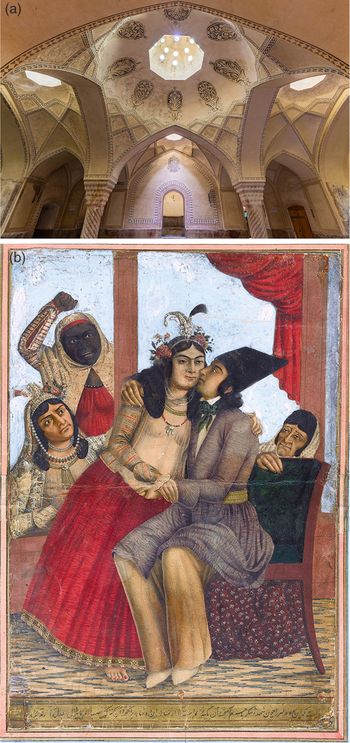
In Iran, the notion that purity of the body and soul is closely associated with washing has great antiquity. Hejazi and Mehdizedeh Saradj have argued that evidence of washing ceremonies can be traced back to a time before Zoroaster.Footnote 64 Islam also emphasises the importance of washing and ablution before each of the five times for prayer, such that public baths with complex designs became widespread in Iran, with improved construction methods emerging during the Seljuk (1000–1157 ce) and Safavid (1491–1722 ce) periods.Footnote 65 Of particular relevance here is the hammam i-Vakil (c 1776) built in the royal quarter of Shiraz, which can still be seen today and, like Ottoman baths, has a central warm room (fig 14). It is likely that Shihrazad and her craftsman would have been familiar with its beautiful interior, and it is possible that elements of the design of these baths inspired the much smaller ones on Kidichi, although the plan there is based on a succession of rooms rather than a central warm room.
(a): The inside of the Vakil bath at Shiraz. Photograph: Diego Delso, delso.photo, licence CC-BY-SA. (b): Embracing Lovers Caught by Housemaids, signed by Mirza Baba Naqqashbashi, Persia, Qajar, c 1860. Gouache on paper, a line of text in Nastaʿlīq script in black ink beneath the painting. Photograph: © and courtesy of Sotheby’s, 2019.

By the twentieth century the use of traditional public baths discontinued, with private baths becoming more popular.Footnote 66 On Zanzibar the opposite occurred. The Hamamni baths in Shangani were built during the reign of Sayyid Barghash (r 1870–88) and subsequently became a public bath.Footnote 67 Kidichi baths are comparatively small in size and, although the number of toilets indicate they were part of a larger palace complex, the baths were probably designed for private use by a limited number of people. They are likely to have functioned in a similar way to the Hamamni described by Rajabi,Footnote 68 with fabric covering the doorways and specific areas and rooms reserved for particular activities such as eating, massage and shaving, as well as for ablutions. In Persia, winter and summer palaces were common for the wealthy.Footnote 69 Although Azze remained at Mtoni, Shihrazad may well have felt her status entitled her to two palaces, and it is easy to imagine such a free-spirited woman desiring a retreat from the claustrophobia of Shangani and prying eyes.
In Persia, baths were carefully designed to control the temperature and moisture in each room and were generally divided into three parts: semi hot and semi humid; hot and humid; and very hot and very humid.Footnote 70 The Kidichi baths conform in part to the Persian plan, but BR2 and BR3 are not connected via an indirect tunnel or vestibule.Footnote 71 From an engineering perspective, the flow of water and heat was critical to ensure that the heat gradient was not too drastic between rooms and that sewage was washed away. In Persia, fuel would have been burned to heat both water and the floors of the baths. This would have been necessary in Iran, where temperatures drop to freezing during the winter, but in Zanzibar, the temperature range is consistently between 20–30˚C with high humidity. It was beyond the scope of this research, but it would be interesting to compare the architectural design and engineering of the baths to see whether compensations were made for the local conditions in Zanzibar, particularly with respect to air flow, and the degree to which local construction techniques were incorporated in the design. Qajar art is characterised by an exuberant style and flamboyant use of colour.Footnote 72 Many public baths dating to this period in Iran are tiled and brightly coloured. There is no evidence of tiling at Kidichi, but it seems highly likely, given the vibrant colours found in most Qajar art and the large blank panels in BR2, that the plasterwork may have been painted to highlight and supplement specific elements.
From as early as 900 ce, geometry has been used to communicate ideas, instructions and to send messages using the abjad numerological system.Footnote 73 The design and structure of Kidichi is full of meaning. There are eight domes in total, a number that is associated with Heaven in the same way that seven is associated with Hell.Footnote 74 The dome itself was considered as the infinite unity of centrality. Domes were symbolically important because they solidified and joined four-sided chambers, which represented the four natures of human beings.Footnote 75 Pre-Islamic domes often figured Paradise, and the House of God (Heaven).Footnote 76 The morphology of domes changes through time, but further analyses are needed to relate Kidichi to these developments. Variation in thickness of the dome and the wall would be a key part in determining this (see fig 10), and also whether interconnecting wooden struts had been used between the inner and outer shell.Footnote 77
Looking at the ceiling plan of each of the domes, some key differences can be seen (see fig 13). In BR1, the Jakhaneh has eight sides, referencing Heaven. From this central point expands highly decorative stucco work featuring birds and flowers within a twelve-pointed star. Twelve-pointed stars are known on Kharraqan tombs in Iran as early as the eleventh century,Footnote 78 but at Kidichi the reference is most likely to be to Twelvers. This term describes the largest branch of Shi’a Islam and each of the twelve points represents the spiritual and political successors of the Prophet Mohammed. The association with prophets is further emphasised with the presence of a rose at the tip of each point (discussed below). Twelvers are virtuous humans who rule with justice and are able to interpret the esoteric meaning of the Qur’an. In BR2, the Jakhaneh evolves into an eight-pointed star and in BR3 the points grow so that it resembles a sun and Heaven, as well as being a metaphor for the increasing heat between the three baths rooms. The number ‘8’ is also associated with wind, so the location of this eight-sided shape between the two ventilation shafts in the dome again consolidates and emphasises the meaning.Footnote 79 In producing a repeated star shape in a dome, other geometric patterns are created, and, like domes, they have meanings and change through time. It is beyond the scope of this article to explore the quantities of motifs and minor differences between the dome ceilings at Kidichi, but, because in abjad the numbers of sides of polygons, rosettes and other design forms encode meanings, and the numbers alone can be symbolic, it is likely that continued research will reveal additional meanings.Footnote 80
Design imagery
Much of the imagery at Kidichi is of plants, flowers and birds. This naturalistic theme, whilst common in Qajar art,Footnote 81 has deep roots in Iranian culture and is highly symbolic and representative of Paradise.Footnote 82 It is no coincidence that this was chosen to decorate a building designed for bathing. The Persian garden was considered as an image of Paradise on Earth, and in ancient Iran the scarcity of water rendered it particularly significant. It was a central element in Persian gardens, and culture.Footnote 83 Anahita was considered by Zoroastrians as the goddess of all waters, and had the power of purification and of life-giving. With the rise of Islam in Iran, water remained of central importance as a means of cleaning and purification. The Qur’an describes Paradise as a garden beneath which the rivers flow,Footnote 84 and the Iranian garden may be considered a canal towards the most inner layers of thought and dream, inextricably bound with the Persian philosophy of life and divinity.Footnote 85 In addition, Shihrazad’s home town of Shiraz was considered a ‘City of Gardens’.Footnote 86
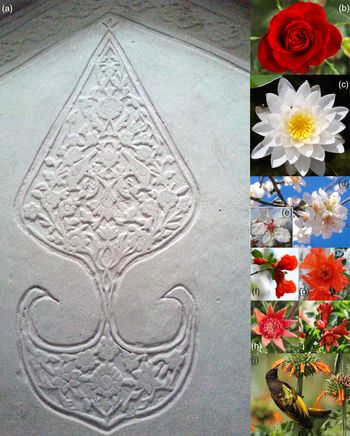
Flowers and birds are common in all the decorated panels at Kidichi. Examination of the Kidichi panels reveals a range of different forms, which includes roses, pomegranate flowers, lotus flowers and almond tree flowers (fig 15). This bird-flower theme is traditional, known in both Persian painting and poetry since the pre-Safavid era (c 710–1501 ce).Footnote 87 The theme was popular due to its earthly and divine meanings and because of its stylistic versatility.Footnote 88 A sub-theme known as gol o bolbol, which focuses on the rose and the nightingale, was the principal decorative subject of the Safavid (1501–1722) and Qajar (1785–1925) eras and was applied to many objects from ceramics to carpets, woodwork to manuscripts.Footnote 89 In the Safavid period roses symbolised courtly elegance, refinement and idealised beauty, and in the seventeenth century Persia was known for its magnificent gardens and horticultural prowess. By the late Qajar period, the rose-and-nightingale theme had become so dominant that it became synonymous with the land of Persia and its culture, with Shiraz playing a key role in this development.Footnote 90 Roses were also associated with the Prophet Mohammad, who was said to have created the rose from a drop of his perspiration.Footnote 91
(a): Detail of cartouche in BR2 enclosing sun birds drinking from plants and a variety of flower motifs; (b): rose; (c): lotus flower; (d): almond blossom with inset (e) showing frontal form; (f)–(i): the different flowering stages of a pomegranate flower; (j): a sun bird drinking. Main photograph: Laura Basell 2017. Small photographs from top: (a)–(i) freely available under creative commons licencing; (j) Steve Garvie.

Diba suggests that the enduring popularity of the rose may also be linked to the socio-economic importance of rose petals and rose water, noting that rose water is a common ingredient in Persian sweets, sherbets and preserves.Footnote 92 On Zanzibar, the use of rose petals and an attar of roses for use in the hair, as well as the consumption of sweets, is recorded by Salme.Footnote 93 In her description of bathing at Mtoni, Salme describes regular massages; clothes and bathwater strewn with jasmine and orange blossom; and clothes being scented with amber and musk.Footnote 94
Stylised cypress trees are also present in the detail at Kidichi. These trees are representative of eternal life that comes after death, and later become stylised into the paisley design commonly seen in kanga patterns today.Footnote 95 Due to their ability to survive and remain green in very dry climates, they are a symbol of agelessness and longevity, and in Persian culture were sometimes included in dowries.Footnote 96 In the design of Persian gardens, they often border watercourses that divide the garden into plots; in Kidichi they are being used in the decorative archway (DA) that divides BR2 from BR3.Footnote 97 Similarly, the flowering almond was seen as a symbol of regeneration of the earth and the date palm as a source of year-round sustenance.Footnote 98 A huge almond tree continues to flourish directly outside Kidichi, and it would be interesting to explore whether particular species were planted in the immediate vicinity of the baths for practical purposes. Stylised palm fronds are also identifiable.Footnote 99
It is likely that many of these plants (like baths) gained significance not only because of their scents and visual beauty, but also due to their medicinal properties. For example, pomegranate flowers have been used historically for a range of medicinal purposes, including the treatment of diarrhoea, ulcers and hypertension; cypress oil is known to have antioxidant and anti-inflammatory properties.Footnote 100 If the streets of Stone Town and Darajani Creek (see fig 1) were as dirty as reported in travellers’ accounts, and the risk of disease as feared as Salme suggests, then it is unsurprising that baths became popular.Footnote 101 There were respected traditional healers on Zanzibar, but no physician until 1866.Footnote 102
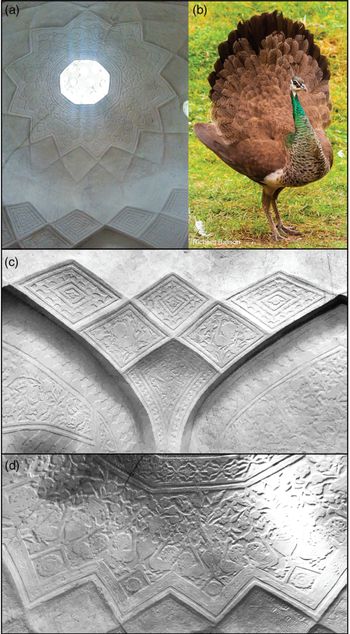
At least three types of bird are shown in the Kidichi baths, and their size is disproportionate to the foliage that surrounds them. In BR1, there is a frieze around the Jakhaneh of peafowl facing each other, either side of a stylised vase of profuse blossoms. The shape of the vase is very similar to a samovar (a container traditionally used to heat water). This image of animals facing each other with the tree of life between them can be found in a variety of myths, religions and symbolisms.Footnote 103 The placing of peafowl near the tree of life signifies them as guardians and the symbology is closely related to growth, fertility and Heaven.Footnote 104 The rooting of the tree in a vase suggests the elixir of mortality; the vase symbolises ascension and the divine threat, or sometimes the myth of creation of the cosmos.Footnote 105 In ancient Iran, peacocks were representative of man’s dual psychic nature, and they drew their life force from the principle of unity.Footnote 106 This notion of unity is consolidated by their positioning on the dome (discussed above). They were also associated with royalty and with the sun.
A Sufi legend suggests that a peacock sweated when shown its own divine image in a mirror. The drops that fell from its brow caused all other beings to be created.Footnote 107 This resonates with the story of Prophet Mohammad’s sweat yielding a rose, as well as the famous Conference of the Birds by the Persian poet, Farid ud-Din Attar. Since this would be the coolest of the three rooms, it may be that water would have condensed on the ceiling and walls when the baths were in use, and that the metaphor became a physical reality with drops falling or running down the wall from the peacocks’ brows. In Islam the spreading tail of the peacock was a symbol of the dual aspects of light, both the full moon and the midday sun, and symbolises the cosmic deployment of spirit.Footnote 108 Its powerful symmetry and beautiful colours mean that it was a popular and enduring symbol in both Persia and in Islamic art more widely. Salme writes about the peacocks at Mtoni, so they were physically present on Zanzibar and in Said’s palaces at this time. The frieze is likely to be referencing the twelve virtuous men, as discussed above, especially as each pair of peafowl is accompanied by a rose. The design is very similar to the royal tent made for Muhammed Shah.Footnote 109
The peafowl are shown from a combined profile and oblique-frontal perspective, with the heads of the birds extending disproportionately above the fanned train feathers, and with the wing tips protruding at the rear beyond the fan. The depictions are clearly of displaying peafowl. Displaying occurs most commonly during courtship by both peacocks and peahens. With peacocks the wing tips are only clearly visible in profile when the train is fully extended and arches forward. The globular tips to the train feathers in the stucco work may represent train feather eyespots only present on peacocks, but these are not especially clear. Overall the proportion of the fan in relation to the body is much closer to a female’s fanned train feathers. This raises the intriguing possibility that these peafowl may be depictions of peahens rather than peacocks. The other birds seen in the Kidichi plasterwork are, unsurprisingly, the nightingale, which seems to be looking over its shoulder at the peacock in several panels (fig 16), and in BR2 sun birds drinking nectar (see fig 15). The reference to birds drinking in this particular room is related to the transcription of the text.
(a) Domed ceiling in BR1; (b) peahen displaying; (c) and (d) laser scan detail of bird motifs in panels where point clouds have been draped with photographs then images changed to black and white to draw out patterns. Photograph and images: (a), (c) and (d) Laura Basell; (b) © R. Balison 2010, reproduced with permission.

Text
The reason that no-one could read the inscriptions in BR1 is that although the text is Arabic, it was written in  or Nastaʿlīq (Persian:
 , from
 Naskh and
 Taʿlīq). This is a type of calligraphic hand commonly used in writing the Persian script, and developed in Iran in the fourteenth and fifteenth centuries, but is sometimes used to write Arabic language text. Court poets and calligraphers were returning to earlier classical styles for inspiration during the Qajar period, and the Vesal (or Visal) family of Shiraz were masters of revivalNastaʿlīq scripts.Footnote 110 There were three generations of artists in the family. Both inscriptions in BR1 are the same and translate as ‘Help from God and victory is coming soon’, which is a phrase from the Qur’an (see fig 11). Interestingly, the same phrase is found on a nineteenth-century canvas thought to have decorated the ceiling of a royal Persian palace, now housed in the Doris Duke Foundation for Islamic Art (DDFIA) collection (Shangri La Museum, Honolulu, Hawaii, object 34.9).Footnote 111 This painting includes the standard Persian motif of a female sun and additional cartouches and arabesques decorated with floral patterns birds and landscapes. The Quranic inscription on the painting is translated as ‘Help from God and a speedy victory’ (61:13). This demonstrates that the choice of text in conjunction with the broader design theme was not unique, and would have been familiar to Shihrazad and her master craftsmen from multiple media in Persia.
The text in BR2 is particularly interesting, being a poem written in Persian (see fig 12). It includes the words  , which means ‘happiness’, and
 , which means ‘sāqī’ or ‘wine-bearer’. The poem translates thus:
It has not yet been possible to find the author of this poem. The famous fourteenth-century poet Hafez of Shiraz wrote on similar themes, but equally it could have been written by a nineteenth-century poet of the bazgasht, or ‘return’, literature movement.Footnote
112
There also remains a possibility that the poem contains a date, through an alpha-numeric coding system known as abjad, but initial attempts at ‘translating’ the poem for a date have not been conclusive. Abjad numerals are a decimal numeral system in which the twenty-eight letters of the Arabic alphabet are assigned numerical values. Not only is this science of letters concerned with the numerological aspect of letters, but also with the study of the shapes of letters and their cosmological significance. The poem is layered with meanings. Shihrazad’s name in Persian is  . In Arabic, if her name is
 , then, using abjad, it means, ‘woman filled with desire’.
The reference to alcohol is interesting because, historically, most Muslims, and particularly women, did not drink.Footnote 113 However the word ‘alcohol’ is derived from the Arabic ‘al-kohl’, which refers to antimony used to darken the eyes, and Iranians are known to have developed the distilling process early.Footnote 114 From the tenth century, wine drinking was closely associated with the theme of love, as well as being associated with loyalty and trust.Footnote 115 Matthee explores the many examples of alcohol consumption in Muslim countries through history, particularly with respect to rulers and elites, including those in Persia.Footnote 116 He notes that, in the Qajar period, alcohol consumption amongst the elite continued and included drinking parties, but that Iranians also associated alcohol with European sexual debauchery and, in an attempt to establish religious credibility, many adopted sobriety or moved drinking to private places.Footnote 117
According to Salme, Shihrazad definitely broke the rules in Said’s household, and made him so angry that it was only the actions of a faithful servant, Nubi, that prevented him from committing a terrible crime against his young wife.Footnote 118 It is reasonable to assume that Shihrazad was sexually informed to some degree, as an early nineteenth-century treatise by educated upper-class women was in circulation at this time which explained how to flirt, get around husbands and engage them in other pleasurable activities,Footnote 119 and she is also likely to have been familiar with the Shiraz watercolour depicting illicit love (see fig 14).Footnote 120 Indeed, there was an enduring preoccupation with amorous affairs among the Qajar nobility.Footnote 121
Could the Kidichi baths poem support the rumours of Shihrazad’s own illicit love with Hilal and alcohol consumption? Was its message intended for her husband, or for her sāqī? He was certainly an educated and intelligent man, and abjad is closely related to mysticism and Sufism – something that Said’s older brother was interested in, although he always remained an Ibadi.Footnote 122 Said was open to ‘other’ ideas about religion. For example, Burton notes that Said would never flog a medicine man or cut down a ‘devils tree’, believing in the African Fetish and in the Arab Sahir’s power of metamorphosis.Footnote 123 It cannot be ignored, however, that much of the iconography depicted at Kidichi harks back to pre-Islamic Persia. Perhaps Shihrazad or her master craftsman/men designed this simply as an innocent reminder of home; or because that was the accepted way of doing things for royalty, at a time when artists sought inspiration from the past.
It certainly suggests that Shihrazad could read, but if others could also read it, perhaps this poem was the very root of the rumours that spread about Shihrazad? It is notable that the poem is hidden from view physically as well as linguistically, from anyone approaching from ‘outside’. This sits well with Schiewiller’s exploration of sexuality and gender in Qajar Iran, which, she argues, was an ocular-centred society, predicated on binary oppositions of public/private, seen/unseen, accessible/forbidden places.Footnote 124 Whatever the case, it is clear that as one progresses deeper into the hotter, steamier and more hidden parts of the baths, the themes shift from religion, Heaven and Paradise, to the pleasures of (illicit?) love, alcohol, food and fecundity, and conclude by ascending three steps to the hottest room of all, decorated only by the sun. There are multiple references to femininity, royalty and Shihrazad herself. Collectively, the themes work together to emphasise Kidichi as a place of Paradise, and the metaphors and symbolism are so rich, they allow significant freedom of interpretation, but on balance it is difficult to imagine these baths were conceived and built by Said.
CONCLUDING REMARKS AND HERITAGE POTENTIAL
The survey of the Kidichi baths employed new technologies that allowed new perspectives on this legally protected, historic monument. The data presented here were gathered in one day by five people. The use of such technologies is often justified as permitting the rapid acquisition of huge volumes of data from site to landscape scale. They are ‘cost effective’ and are said to be accessible in terms of outputs and data production, especially with methods like photogrammetry being put forward as something that ‘anyone can do’. Undoubtedly, they allow new perspectives – from aerial to beetle’s eye views, and even in spectral ranges that the authors could not otherwise experience – which permit new questions to be asked. The digital ‘capture’ of sites allows dissemination to large numbers of people, the justification being that this will increase the site’s or the landscape’s importance, facilitate its protection and allow the site’s degradation to be monitored. Ultimately this will promote tourism.
Conversely, however, these data need storing, which raises questions of who should house the data, and where, and whether rapid acquisition of large quantities of data is ‘good’. Data storage often comes at a cost, and access to it may not be open to all with an interest in using it. Equipment accessibility is certainly improving, but new equipment requires learning new skill sets, and much of the equipment remains prohibitively expensive. Ultimately, such data are gathered by a select few who have the equipment and the expertise. Although new perspectives can be generated, it is important to consider the relevance of these perspectives. It could be argued these are very specific (Western) views that are irrelevant or simply a fleeting novelty for many of the people whose heritage is being recorded in this way, and that traditional and often marginalised intangible heritages should be prioritised.Footnote 125 Although data acquisition is rapid, data processing remains time consuming. The reality is that such capture methods simply defer part of the analysis. The ‘remoteness’ of the acquisition and processing/analysis off-site is a removal from the very materiality that lies at the core of archaeology. The wide array of output options permit dissemination to large numbers of people, but this potentially puts sites at risk, commoditises and ‘de-values’ them, especially in the absence of financial and infrastructural support. Tourism is not always positive and brings with it a host of additional issues.
Having deliberately presented the Janus faces of ‘democratisation’ and ‘commoditisation’ in relation to modern survey methodologies, where does this leave this survey of Kidichi? Unusually, researching the baths was a secondary consequence of the visit, but, in conducting the demonstrations, archaeology was practised. Through the physical presence, engagement and need to set up equipment in particular ways, the researchers were forced to look at the building and its surroundings differently. Because of the need to ‘tell its story’, questions were asked, and the more that was asked, the less certain the facts became. Boswell has argued that tourism is not just about consumption. This seems equally applicable to heritage, if it is accepted that heritage is as much a creative process as a protective and preserving one. She writes:
it is also an imaginarium, an entity that allows one to re-imagine aspects of one’s past or present and to temporarily express aspects of one’s identity that under ‘normal’ circumstances one would not entertain.Footnote 126
Such imaginings are not fantastic. They are constrained by the materiality or the sensuality of the objects, stories, scents and actions that inform them. In the same way, the materiality of this small building made the authors look differently and opened an unimagined book of stories of truly global connections and relevance. It is now possible to develop the historic narrative presented at the start of this article and to supplement the accounts with a range of possibilities generated from interpretations of the baths themselves. The narratives touch on and feed into intangible heritages of scentFootnote 127 and dress;Footnote 128 they engage with contentious topics such as race and class in politics,Footnote 129 gender and sexual agency.Footnote 130 They speak to the highly topical themes of globalisation, migration and blurred identities.Footnote 131 And, if it is so desired, the Kidichi baths could be read as other worldly; an interface between the earthly and the divine, and a commentary on the fluidity of religious interpretations.Footnote 132
The baths stimulate us to move beyond the central, powerful individuals, to think of daily life on Zanzibar and the culturally diverse array of people that incorporated. This includes the craftsmen who built the baths, the slaves who operated them and the people who used them. No longer are they the mould-covered disappointment of recent travel guides. Here is a building that saw hard work, love, laughter, politicking and intrigue; a building which would have been enlivened by bright colours, strong scents, sounds and flavours; a building carefully designed to steer and stimulate its users’ thoughts; and possibly one that sought to emphasise Shihrazad’s new power, position and identity. Despite being of the Arab elite (and thus not necessarily representative of East African women generally), Shihrazad’s story helps to subvert notions of the subjugated status of women in the Islamic civilisation. Such colonial ideas are European prejudices born of a desire to portray the West as culturally superior and justify the colonial enterprise.Footnote 133
It is impossible to view Shihrazad simply as a passive sexual or exotic object, an ignorant wife reduced to servitude beneath a veil or as a producer of heirs. Instead, Shihrazad seems rational, powerful, creative, educated, intelligent and sometimes cruel. As a young woman she travelled thousands of miles on long sea voyages. Like other migrants, including the women of the harem, these travels would have exposed her to a wealth of new experiences and people. As was the case elsewhere during the nineteenth century, the result of such travels followed by a new life on Zanzibar may well have been a reconfiguration of the symbolic features of collective identity and reworkings of gender relations.Footnote 134 Shihrazad’s agency echoes through time. In this article it is suggested that this agency, and potentially her reconfigured identity, is manifest in the choice of images, design and non-Arabic text in the baths. This supports the historic records of her refusal to veil, her daylight horse-riding with men and choice of a lover. She is a rare find in African archaeology – an ‘outlaw’Footnote 135 who resists the constraints of interpretations that expound male dominance and gender segregation;Footnote 136 yet, she is also a woman of her time and experiences who epitomises Zanzibar as a cultural crucible. That said, she and her lover are criminalised for their actions by Said and ultimately banished. She is a fabulous counterpoint to Azze, the first harīno who spends nearly her whole life on Zanzibar and rarely strays from her palace. Neither woman can be cast in the role of mother, and both raise a myriad of questions relating to their political influence and power. Comparing and considering these women and those in the harem confound attempts of ethnic categorisation; they may originally have come from distant corners of the globe, but whilst on Zanzibar it could be argued that what they all become is Swahili.Footnote 137
Reflecting on this brief analysis of preliminary data, it is possible to see what incredible potential the baths offer in terms of heritage tourism. Zanzibar has long been known for its diverse population. Here is a wonderful opportunity to imagine what it must have been like to be a third legitimate wife, or a Circassian Sarari, for example. Here is an opportunity to debunk common misconceptions about life in a harem, or to discuss, in the face of increasing religious conservatism, the many ways the Qur’an has been interpreted, and the long history of multi-culturalism and religious tolerance in Zanzibar. As Ghazal has noted, it is this fusion of identities, networks and encounters that has allowed communities to thrive.Footnote 138 Through hybridity, materiality, historically and archaeologically informed imagination, borders are broken down, new frontiers are created and 1001 tales become possible.
SUPPLEMENTARY MATERIAL
The supplementary material can be found online at https://doi.org/10.1017/S0003581520000013.
ACKNOWLEDGEMENTS
This research was conducted through a GCRF grant awarded to L S Basell (PI) and M Horton (Co-I) administered by the Northern Ireland Department of Environment and Queen’s University Belfast. The work would not have been possible without the collaboration and support of the Department of Antiquities, Zanzibar, and SUZA. Many thanks are due to Reza Tabibi for assisting with the translations, to Henry Webber for conducting the GPR survey, to Fergus Hooper for the photogrammetry demonstration and to SUZA for allowing the authors to use its drone licence. Thanks are also due to the participants of the workshop who came from four different continents, over ten different countries and from many different backgrounds to explore some of the themes touched upon in this paper. Without their participation, the authors would never have conducted a demonstration at Kidichi or had the opportunity to learn so much. Thanks to Libby Mulqueeny, QUB, for creating fig 1 and to the editor Lavinia Porter and two anonymous reviewers for their helpful comments.
ABBREVIATIONS AND BIBLIOGRAPHY
Abbreviations
- AH
-
Anno Hegirae (Islamic calendar)
- GCRF
-
Global Challenges Research Fund
- GPR
-
ground penetrating radar
- GPS
-
global positioning system
- SUZA
-
The State University of Zanzibar
- TLS
-
terrestrial laser scanning
- UAV
-
unmanned aerial vehicle