This year marks the two hundredth anniversary of the birth of one of the most important British musicians, composers, pianists and professors of the nineteenth century: Sir William Sterndale Bennett. On 26 June 1833 during a stay in London, Felix Mendelssohn Bartholdy heard Bennett perform his Piano Concerto Op. 1 at the Royal Academy of Music’s midsummer night’s concert. Deeply impressed, he invited Bennett to visit Germany. As Bennett’s eldest son notes in his biography of the father, the first exchange between the two musicians was revealing: ‘If I come […] may I come to be your pupil?’ Bennett asked. ‘No, no,’ was the reply, ‘you must come to be my friend.’Footnote 1
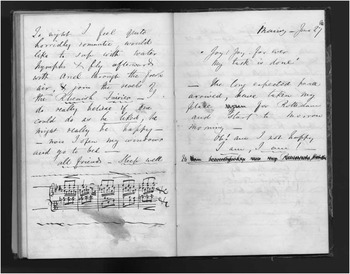
In the spring of 1836, after completing his studies at the Academy, Bennett embarked on his first brief journey to the continent. This would be the preparing prologue to a series of three extended stays in Leipzig that were to follow between 1836 and 1842. For each of these subsequent journeys, Bennett kept a detailed diary. This is remarkable in itself as the young artist had not before kept a journal and would not do so again after 1842. The three travel diaries have remained unpublished and in family possession to this day. My deepest gratitude, therefore, goes to Mr Barry Sterndale-Bennett, the composer’s great-great-grandson, for inviting me to transcribe these historical sources and to prepare a critical and annotated edition for publication.Footnote 2 The first travel diary dates from 20 October 1836 to 8 July 1837 (Figure 1), the second from 4 October 1838 to 28 January 1839 and the last diary dates from 5 January to 12 March 1842. Bennett’s very first visit to the continent, however, was to Düsseldorf in May of 1836, where he attended the Lower Rhine Music Festival under Mendelssohn’s artistic leadership and at which the latter’s oratorio Paulus was premiered. It was here that he began to develop a friendship with Mendelssohn that would strengthen considerably as well as mature into a professional relationship over the course of the next decade. This first journey to the Rhineland also ignited a fascination for German Romanticism in Bennett, which would find expression in his subsequent musical works (such as his Romances Op. 14 for piano solo) and reflection in his diaries. Upon Bennett’s return to London on 28 May 1836, Mendelssohn addressed the following words to Mozart’s former pupil Thomas Attwood: ‘I avail myself of Mr Bennett’s departure for London to send you these lines, and to tell you how grateful I am to you for having procured me his acquaintance. I know it is owing to your advice, that he went to visit the festival, and therefore it is to you that I ought to address my thanks for all the pleasure he gave me by his compositions and his playing. I think him the most promising young musician I know, not only in your country but also here, and I am convinced if he does not become a very great musician, it is not God’s will, but his own.’Footnote 3
Bennett, first travel diary, folio 73 recto/74 verso. Courtesy of Mr Barry Sterndale-Bennett.

This glowing praise contrasts sharply with the gloom Bennett felt in London, where the relative emptiness of the musical scene was made all the more apparent after his return from the Lower Rhine Music Festival. In an unpublished letter to Mendelssohn from 2 October 1836, Bennett describes the mood in London, using rather depressed language: ‘London looks at this time most miserable [as] we have had nothing but rain during the last month – As for Music there is none to be heard for Love or for Money – [Mr] Attwood has been out of Town for Three Months but I believe he returned yesterday – Since I left Dusseldorf I am sorry to say I have been idle, but I must make up my lost time when I get over to Leipsic –.’Footnote 4
A few weeks later William Sterndale Bennett found himself in the midst of his long journey to the newly formed centre for musical Romanticism, Leipzig. Felix Mendelssohn had just accepted the position of conductor of the Gewandhaus Orchestra concerts, beginning in the 1834–1835 season, while Robert Schumann was leading the way intellectually in terms of musical journalism with his innovative Neue Zeitschrift für Musik, offering original and open-minded interpretations of old works as well as contemporary music-making. This was the stage for Bennett’s first arrival, upon which he began journaling and meticulously recording his observations. The nature of his entries is at times spontaneous, at times thought-out and reflective – sometimes in real time, sometimes in retrospect. His attempt is to keep a true diarium, that is, write in the book daily. Like most diarists, he treats it as a personal medium, but despite that clearly implies an audience or reader (as can be seen from excerpts that follow). The narrative he creates is replete with vivid impressions of a wide array of experiences – ranging from profound to prosaic and from life-changing to mundane. Without these historical sources, we would lack the testimony of an attentive observer of contemporary musical culture in Central Europe and, in particular, the rise of Leipzig as a newly formed focal point for instrumental music.Footnote 5 When considering Bennett’s three travel diaries as an entity, two main aspects stand out: his personal relationships on one hand and his artistic activities on the other. Both are linked. The journals provide insight into Bennett’s development as an artist under the influence of this period of High Romanticism in music, literature and the arts. They reflect his professional activities and reveal the extent to which he gained access to the prominent cultural salons and exclusive groups devoted to music and the arts. Furthermore, they reveal an enthusiasm that the young pianist-composer felt at his encounters with the leading artists of the day. Concerning his personal relationships, of particular meaningfulness are the congenial connection with Robert Schumann and the increasingly close partnership with Felix Mendelssohn Bartholdy. While the latter may not be surprising, Bennett’s relationship with Schumann has not previously been investigated in a way that fully takes into consideration pertinent historical evidence. It stands out as most enigmatic and intriguing. There appears to be an ad hoc affinity between the two artists firmly rooted in the Romantic concept of friendship. This affinity runs like a golden thread through Bennett’s diaries, particularly during the first stay, and can be traced throughout their correspondence as well. Bennett’s first encounter with Felix Mendelssohn had occurred in London on the 26 June 1833. His first encounter with Robert Schumann took place in Leipzig, immediately following Bennett’s arrival in town: ‘Sunday October /30. 1836\ […] ½ past 3 – I have just been to dine again with Mendelssohn at the [fol. 10r] HotelFootnote 6 & met also the Musicians amongst whom, is M r David (Concert-Meister), Brother to Mad me Dulcken – & Monsieur Stamity [recte: Stamaty] a young French Pianist – They have since been to take Coffee with me, at my Hotel & I find that I am making acquaintances at the rate of ten miles an hour – (not German miles)!! I am to see Mend.[elssohn] again at his house this afternoon to be introduced to an Englishman. here I begin to find myself more at home – xxxxx.’ Although the entry does not mention Robert Schumann, the latter was indeed present. As Schumann notes in his very own diary on 30 October 1836: ‘Bei Tische Bennett zum I°. Mendelssohn liebenswürdig.’Footnote 7 – which translates to: ‘At the table, Bennett for the first time. Mendelssohn amiable.’ He continues with a summarizing entry for the month of November 1836, as follows: ‘Bund mit Bennett’ – translating to bond or union with Bennett.Footnote 8 This mysteriously formulaic phrase not only implies that Sterndale Bennett had instantly become a member of Schumann’s imaginary Davidsbund, the League of David fighting against the philistines in music and for a seriousness of purpose in music-making, but also alludes to a profound personal bond with Bennett. Schumann’s diary entry for 2 November 1836 explicates their creative endeavours (performing works of Bennett) linked with social activities. It reads as follows: ‘Am 2. Mittwoch. [...] Nachmittag bei Stamati Comp.[ositionen] v. Bennett gespielt. Nach d. Concert Champagnerorgie mit Franck. Bennet u. Groß. [...] Viel Champagner.’Footnote 9 Likewise, Bennett elaborates on this occasion in his own journal: ‘November 3 rd – I went last night to sup at the Hotel de Baviere where I met two of my new friends – Mess rs Schumann & FrankFootnote 10 & another MusicianFootnote 11 who was a stranger to me – However we became friends over a glass of Champagne – The four of us managed 3 Bottles – but it was very week [sic] stuff – I got home to my new Lodgings at 11 oclock – which is considered monstrously late in this part of the world – I slept very well –.’ Following this he writes on 13 November 1836, ‘I dined at the Hotel & afterwards took a walk with Schumann to the Cafe Français Footnote 12 & then to his house –.’ We can only imagine the musical ideas and possible pieces they exchanged. Two days later Schumann informed his sister-in-law Therese in Zwickau of an upcoming planned visit together with Bennett, whom he described as a ‘poetic, beautiful soul’. These exuberant words not only evoke Schiller’s aesthetic ideal of the Schöne Seele,Footnote 13 but also represent and reflect Schumann’s mission to work for a renewed artistic seriousness in his own time and to create an in fact ‘new poetic age’ in the art of music, as Schumann would pronounce retrospectively in 1854 in connection with his ground-breaking NZfM. Intertwined with artistic aspirations and philosophical musings, however, both Bennett and Schumann whole-heartedly engage in excessive outpourings of a different kind. The former bluntly confides the following to his diary three days later: ‘18. Novr I feel devilish queer to day, dull & stupid & to mend the matter it is a saints day – all the shops and places of amusement are shut & it begins to rain I cannot buy any Cigars – I expect Schumann to call for me directly to go & attack the Bavarian Beer – Horrid Stuff.’ Apart from that, he takes care of Schumann when he is unwell. As he states on 28 November 1836: ‘– To day went to Schumann to see him he being very ill – The Weather is very hot & oppressive –’. Schumann, in turn, notes this aphoristic expression: ‘Viel mit Bennett’ [Much with Bennett] in his own diary, for a summary of the month of December.Footnote 14 All these references reveal a conscious and congenial connection between the two artists, and the quality of their bond surpasses either one’s with Mendelssohn. What Bennett and Schumann shared was indeed a poetic relationship, deeply rooted in the Romantic friendship cult. It is no surprise, then, to see the creation of such works as Bennett’s Romances for piano, his aphoristic Sketches – ‘The Lake’, ‘The Millstream’ and ‘The Fountain’, – his piano Fantaisie dedicated to Schumann and so on. A characteristic element of this friendship cult in the Romantic era was a pronounced expressivity. Beginning in and growing out of the eighteenth century, there was an intensive development of cultivating personal friendships, circles and secret associations, which was especially important for the young generation and came to a climax in the first half of the nineteenth century.Footnote 15 This Romantic expressivity can be concluded from the following excerpts. Anticipating his departure from Leipzig in June 1837, Bennett notes in his diary: ‘June 10th [...] Evening. Schumann has been to spend an hour with me and drink a bottle of Porter, I am so sorry to part from him for I think he is one of the finest hearted fellows I ever knew – My heart springs up, when I think that I leave Leipzig on Monday.’ Ten days later, journeying back to England, he writes to Schumann from Mainz: ‘Deutschland ist doch ein sehr schönes Land – und wenn im ganzen es wie in diesem Theil wäre, dann wäre es zu schön – [...] Ich habe von meinem Zimmer ein wunderschöne Ansicht am Rhein, und wenn ich nur England hierher bringen könnte würde ich sehr froh sein hier zu bleiben – Gewiß die Rhein und der Thames sollten heirathen, denn die Rhein eine schone Frau sein würd – und wir wurden viele hübsche, kleine Bachlein als Kinder sehen –’.Footnote 16 (Germany really is a very beautiful country – and if it is like this in the rest of the country, then it would be too beautiful – I have a wonderful view of the Rhine from my room, and if only I could bring England here I would be so happy to stay – Certainly the Rhine and the Thames should marry, as the Rhine would be a beautiful wife – and we would see many pretty little streamlets as children.) Interestingly, this correlates with a diary entry from Bennett which uses almost identical wording: ‘Mainz. Monday 19. th 8 oclock /Evening/ – Another day nearly gone at this beautiful place – Took a Bath as usual, & worked at my OvertureFootnote 17 – I was just thinking what a Capital wife the Rhine would make for Father Thames – If I had a P. Forte here just now, how happy I could be –.’ The lack of a piano to channel his inspiration musically leads to an exuberant expression in the evening of 26 June: “To night I feel quite horridly romantic, would like to sup with Water Nymphs & fly afterwards with Ariel through the fresh air, & join the revels of the Rhenish Fairies – I do really believe if One could do as he liked, he might really be happy – now I open my windows and go to bed – all friends – Sleep well.’ It becomes apparent from this how Bennett’s musical thoughts, verbal thoughts and friendship are intergradient, how indeed they lead and flow into one another.
Over the course of the subsequent months and years, Bennett tried in vain to persuade Schumann to come to England. This visit was never realized. Robert Schumann, on the other hand, urged Bennett to join him during his stay in Vienna. Bennett shares with his friend very soon after arriving back in England following his first long residence in Leipzig, Bennett shared with his friend: ‘Sehr oft habe ich an Sie gedacht und auch gewünscht, daß Sie hier mit mir waren – Ach! England! liebes Land für Whig & Tory […] ich bitte Sie, kommen und wohnen bei mir für ein halbes Jahr, wenn Sie j a saggen, werde ich Sie abholen –’Footnote 18 (Very often have I thought of you and wished you would be here with me – Ach! England! beloved land for Whig & Tory. I beg you, come and stay with me for half a year, if you say yes, I will come and fetch you.) In the meantime, Schumann recommends his friend’s music to others: ‘Sehen Sie sich doch Bennetts Compositionen an, Sie werden viel für sich und das Herz finden’Footnote 19 he writes from Leipzig a mere few days later, on 31 August 1837, to Adolph Henselt in Breslau (Take a look at Bennett’s compositions, you will find much for yourself and your heart). In the following April, Bennett exclaims, ‘Ach! Schumann! Sie Sollen England ein Mal sehen – Wir würden ihr Leben glücklich machen wenigstens nicht ganz unglucklich – daher, kommen Sie recht bald’Footnote 20 (Ach! Schumann! You ought to see England for once – We would make your life happy, at least not completely unhappy – therefore, come very soon). But Schumann was pursuing his plans for an extended residence in Vienna in the autumn of 1838, hoping for Bennett’s companionship. He writes to Ignaz Moscheles in London on 8 August 1838: ‘Von Bennett erwarte ich einen Brief; ich bat ihn, mit mir nach Wien zu gehen. Sehen Sie ihn, so stellen Sie ihm das Schöne des dortigen Lebens vielleicht vor. Leider fürchte ich in Wien sonst ziemlich allein zu stehen’Footnote 21 (I expect a letter from Bennett; I begged him to go to Vienna with me. Should you see him, please portray the beauty of life there to him. I fear to be very lonely in Vienna otherwise). In fact it appears that Schumann is privately planning on Bennett’s company, prompting him to inform the Austrian diplomat and lawyer Johann Vesque, Freiherr von Püttlingen on 26 August 1838: ‘Vielleicht kömmt auch Sterndale Bennett mit mir nach Wien; ich werde mir erlauben, Ihnen ihn vorzustellen; das ist ein englischer Tonkünstler, ein Engel von einem Musiker’Footnote 22 (Perhaps Sterndale Bennett will come with me to Vienna. I will take the liberty of introducing him to you; this is an English artist-composer, an angel of a musician). Meanwhile, however, Bennett writes from London informing his friend, ‘Lieber Freund, es thut mein Herz wohl als ich an Sie denke – und bald werde ich Sie Sehen – Ich habe ein neues Concert für Leipzig componirt, und Sie müssen es hören und ihre Meinung mir Saggen, also bleiben Sie – ich bitte Sie tausend Mal.’Footnote 23 (Dear friend, it touches my heart to think of you – and soon I will see you – I have composed a new concerto for Leipzig, and you must hear it and tell me your opinion, so stay – I beg you a thousand times.) Schumann, however, leaves for Vienna as planned and in October 1838 confides to his diary: ‘Gestern Abends war mir, als wäre ich Bennett auf d. Stephansplatz begegnet.’Footnote 24 (Yesterday, in the evening, it felt as if I encountered Bennett on the Stephansplatz.) He shares with Clara Wieck the following, writing to her from Vienna, ‘einen Bennett habe ich noch nicht finden können und ich muß meine besten Gedanken für mich behalten’Footnote 25 – (Someone like Bennett I have not been able to find, and thus I have to keep my best thoughts to myself). We can assume that Schumann is referring to his best compositional and perhaps philosophical thoughts he misses exchanging with his friend, and it is equally revealing how Bennett begs Schumann to stay in Leipzig in order to hear his latest musical creations and ideas. Schumann’s personal feedback on those appears crucial to Bennett. These references are particularly illuminating as they imply a mutual artistic appreciation between Schumann and Bennett which is deeply intellectual and inspired. This finally brings to the forefront an aspect of their relationship which has been implied throughout the present article but heretofore overlooked and even denied:Footnote 26 that it was as much a personal connection as it was an artistic kinship that shared a high appreciation for each other’s compositional work. Bennett held an admiration for Schumann’s music as much as Schumann admired Bennett’s work. In the opening article of the 1837 New Year’s edition of Neue Zeitschrift für Musik Schumann proclaims that if there were more musicians as sincere and aesthetically aware as Bennett, ‘all fears for the future progress of our art will be silenced’. With these profound and very public words did he welcome William Sterndale Bennett to his and Mendelssohn’s artistic network in Leipzig as well as the contemporary German musical scene at large.Footnote 27 Soon after his first arrival in Leipzig in 1836, Bennett notes in his diary: ‘23. November. Went with Schumann this morning to be introduced to one M r Kistner, a Music Publisher here.’ Precisely one week later, at 11 o’clock in the evening, Kistner visits Bennett to surprise him with a reprint of the latter’s Three Musical Sketches for Piano (‘The Lake’, ‘The Millstream’, ‘The Fountain’) Op. 10. In addition, Kistner then proceeds to publish the Op. 12 Three Impromtus for Piano as well. Likewise, Bennett is committed to helping Schumann get published in England: ‘Coventry & Hollier werden gleich ihre Etuden drücken, ich habe sie sehr viel gespielt und viele vergnugen gehabt –’ (Coventry & Hollier will soon print your Etudes, I have played them very many times and had much delectation and delight in doing so –). Following this an excerpt from Schumann’s Études Symphoniques Op. 13, Etude X, bar 11, is inserted. ‘Diese Tackte ist wahrhaftig sehr schön – ich spiele es wenigstens hundert Mal im Tag –’ (This bar is veritably very beautiful – I play it at least a hundred times a day –). And at the end of the letter he states: ‘schreiben Sie mir bald wieder und glauben, daß ich Sie n i e vergessen werde – Ich erwarte ein exemplar von ihrer Etuden und auch der Carnival [sic]’Footnote 28 (Write to me soon again and believe me that I will never forget you – I expect a copy of your Etudes presently and also of your Carnival). The discussion of course is about Schumann’s Symphonic Etudes Op. 13, written expressly for the pianist William Sterndale Bennett and dedicated to him. The phrase ‘I play it at least a hundred times a day’ could not be any more pronounced. Not only does this reaction demonstrate the fact that Bennett thought highly of Schumann’s music, but it also reveals how he was indeed enchanted by it and proudly cherished the very personal musical gift from his friend. And of course it leads to Sterndale Bennett’s composition of a similarly personal gift for Schumann – the Fantaisie for Piano Solo in A major Op. 16, of 1837, intended for Schumann’s own playing.
Foreshadowing Bennett’s second journey to and stay in Leipzig, he writes in April of 1838 in equally glowing terms to Schumann: ‘Ihre neue Sachen habe ich mit viele Vergnugen gespielt – besonders No 1 u. 9 erstes Heft [Davidsbündlertänze, op. 6] und No 8. zweites – Sie sind recht characteristisch und originel […] Sie haben gewiß was weiter neulich componirt, doch habe ich nicht davon gehört – und ihre Zeitschrift habe ich nicht seit ich Leipzig verließ, gesehen – Schreiben Sie mir bald alles’Footnote 29 (Your new pieces I have played with much enjoyment indeed – especially No. 1 and 9 from the first volume and No. 8 from the second – They are fittingly characteristic and original … You certainly must have composed more things recently, but I haven’t heard about them – and I have not seen your music journal since I left Leipzig – Write me about everything soon). Once Bennett arrives in Leipzig for the second time, he laments Schumann’s absence, in fact complains in November 1838, ‘Warum sind Sie nicht hier? Ich habe hier zuerst ihre Fantasie Stücke [Op. 12] können lernen, und sie gefallen mir sehr. –’ (Why are you not here? For the first time now have I been able to study your Fantasiestücke here, and they please me a great deal.)Footnote 30 And on another occasion he shares with Schumann that ‘Von ihren neueren Compositionen stehe ich immer die “Davidsbundlert[änze”] erst – Sie sind wahrhaftig sehr scharmant [sic] –’Footnote 31 (Of your latest compositions I always hold the Davidsbündler Dances paramount – they really and truly are very charming). He concludes the letter by stressing: ‘Sie müssen wirklich nach England Kommen [,] wir würden Sie gut empfangen –’Footnote 32 (You really must come to England, we would receive you well –).
What Schumann and Bennett had in common was a similar understanding of friendship, namely the nineteenth-century concept of friendship as a phenomenon of the private rather than public sphere, and as a catalyst to true artistry by means of mutual intellectual inspiration and elevation, following Schleiermacher’s model of an ‘innige Gemeinschaft der Geister’.Footnote 33 It is telling that Bennett’s interaction with Mendelssohn remains more distanced, ‘polite’ and reserved, especially in the early years. By 1842 the two had grown closer, but Bennett never reached the same outspoken kinship as with Schumann. Passionate comments addressed to Schumann such as ‘Sie werden noch immer mehr Romantische[r]’Footnote 34 (You are becoming more and more Romantic indeed), or ‘Sie schreiben nicht mehr wie ein Redacteur, sondern wie ein hübsches Mädchen von 18 Jahre’Footnote 35 (You really don’t write like an editor anymore, you write like a pretty girl of 18 years) seem inconceivable in Bennett’s relationship to the respected musical leader of the city, Felix Mendelssohn. This is also not surprising from a psychological perspective, as Schumann and Bennett shared similar personality traits, at least with regard to introversion and extroversion. Like Schumann,Footnote 36 Bennett was rather ‘inward’, to use one of Schumann’s favourite terms, and quiet. Thus, he tended to avoid occupying centre stage, if at all possible, and suffered from intense fear of performing in public. He lets us know: ‘Feel very uncomfortable at the thoughts of playing next Thursday – But now for a Pipe, and – “Away with Melancholy”’ (diary entry from 15 January 1837) and a few days later continues: ‘Thursday – Good God! – To day I must play in the Gewandhause – horrible thought – however I must – I hate playing in Public, because I think that one plays in an unnatural manner – in constant fear, & what he is obliged to give to carefulness, he takes from his enthusiasm –’. On the following day he reviews the experience and comes to the conclusion: ‘Last night I played in the Concert at the Gewandhause,Footnote 37 & according to all accounts made a satisfactory debut – I did not play so well as I can do when I am thoroughly comfortable – I had a bad Clavier (or P.Forte) not strong enough –’. From these rather strong statements it becomes evident that in addition to characteristic personal inclinations, he rejected the arena-like public ceremonies of concert-giving from a truly Romantic aesthetic point of view; namely, as anti-musical in essence, since the intimacy and earnestness of music-making do not align with the act of public posing (which indeed is a rather progressive artistic attitude). Against this aesthetic backdrop it is revealing to read Bennett’s assessment of the virtuoso Sigismond Thalberg, who was greatly celebrated at the time, when he merely and matter-of-factly notes how Thalberg is ‘a wonderful P.F. player as far as difficulty is concerned’ and almost disparagingly notes how after a dinner party ‘Thalberg […] came home with me and ran over my Pianoforte for two hours –’,Footnote 38 so much so that the next day he refuses to attend Thalberg’s Gewandhaus concert: ‘Dec 28th – 1838. Dined at Mendelssohn’s – Thalberg, & Dreischock there – also Chappell – Music Seller – Bond St[reet] – In the Evening – Thalberg’s Concert – did not go –’.Footnote 39 Along the same lines is the following occurrence, underlining Bennett’s serious aesthetic aspiration: ‘– November. 234 th 1836 – This morning, a Pole* came to me & favoured me by playing some damned Mazurka’s & a Fantastic Overture – Yea more than that – came again after dinner &, brought the Score & repeated his performance – Yea more than that, – has offered to come again to morrow morning – I had my revenge on him by obliging him to listen to a dozen of Bach’s Fugues.’Footnote 40 Likewise, he seems not too impressed by another virtuoso, Franz Liszt, who ‘made some very bad speeches and abused England to me, said there was nothing but “manufacturing and brutality” to be found in our Country – […] – A Medal was presented to this Hero of the day (not Wellington) – Saw more Madmen to day than I ever saw in my life at one time.’Footnote 41
Generally and contrary to any virtuoso’s sense of mission, Bennett was reluctant to perform for others, and this reluctance to play publicly even entered the semi-private realm, which can be gleaned from the following remarks: ‘Wednesday /15/ [February 1837] Went last night to spend the Evening at D r Härtel – I like this kind of Society very much – No Music – & little Ceremony – a Fine house, & a nice wife.’ ‘– Tuesday 21. [March 1837] – Spent the Evening last night with Von Goethe & saw his Mother & two new Englishmen from Wiemar [sic] [.] Talked & drank tea, but would not play P. Forte – What a fool I am!’ Nonetheless, Bennett enjoyed great success with his public musical appearances. However, his humility constantly tends to downplay this success. This is remarkable given the inherent privacy of a personal journal: ‘Tuesday –14. th – My Overture, – was recieved [sic] with good applause last night, I directed it myself & did not know what to do with my left hand – I rather liked it myself, but I do not think the people understood it, with all the Compliments which were paid me –’.
It then seems logical that William Sterndale Bennett’s compositional endeavours largely happened in quiet as well; rarely and subtly does the diarist let them shine through in his pages. Interspersed throughout his many social and private activities, he gives us occasional hints of his creative process, for instance, concerning the piano sonata he prepared as a surprise wedding gift for Felix Mendelssohn: ‘29 th – March [1837] – To day the Weather begins to change – Went yesterday a little way out of Town with Schumann, where we dined […] – Have been writing to day the last movement of my Sonata Footnote 42 – March 30 – […] Doing my Sonata, which gives me much annoyance.’ Or in December 1838, as he notes in very humble terms – ‘have been writing a little Caprice in A MajorFootnote 43 which I do not dislike altogether – I feel in a much better humour for writing than I ever did in my life before – So ye stars be propitious. […] Monday 17.th 1838. ½ past 10 Evening – Spent this Evening at M r Schunkes, with Monicke – Came home rather soon having forgotten my Key – have finished my Caprice which I call “Allegro Grazioso”.’ On the following day he continues, ‘Tuesday 18 /Dec/ 1838 Written a studyFootnote 44 this Morning – in A Major – 3/8 time – rather piquant.’ And in 1842, over the course of two days he records: ‘Have been writing a little this Evening and must now go to bed. […] Berlin – Friday. Feby 19 Six O’clock 1842 Up at Eight Oclock this Morning and wrote for nearly five hours, Good boy! – Dined at Mendelssohn’s, and played a piece of Bach with him – Had a letter from Pearson from Dresden enclosing me a translation of My Uhland Song.Footnote ’45 We can conclude from this that Bennett was simultaneously involved in multiple creative projects and indeed processes. Several compositions or compositional ideas were begun and worked out at the same time. In some cases, they were not finished until much later, as if the experiences of his travels required time to mature in order to bring about the desired product. The aforementioned Uhland song, for instance, refers to Bennett’s composition of part of a bilingual song collection based on German and English poems, which would not appear for a long time until after his return to England. They could be considered as composed remembrance.
Another common theme that is reflected in Bennett’s travel diaries is the German Kleinstaaterei with all its idiosyncrasies and peculiar infrastructure – behind the times industrially and technologically compared to England. It proved nevertheless to be a cultural and musical magnet that attracted Bennett for three consecutive times. Or perhaps it was precisely because of this specific lack of advancement that the cultural centre for music founded on the heritage of J. S Bach was preserved. As stated before, Bennett never succeeded in convincing Schumann to cross the North Sea and visit England. Their relationship was trapped in letters and Bennett’s words ‘And now, dearest Schumann, before you disappear from this World, come to England – I think of Zwickau very often’Footnote 46 rang all too true. But just as Robert Schumann had praised Bennett’s artistry and worked to propel his musical success, the latter returned the compliment. Ironically, Clara Schumann came to London multiple times upon Bennett’s invitation and assistance to perform her late husband’s works together with him. Her first journey – in the spring of 1856 – took place while Robert was still alive. Although her playing was initially received well, it took the joint efforts of her and Bennett to make Robert Schumann’s music gain widespread acceptance and popularity with the English audiences in the following decade. Clara continued to travel to London after Bennett’s death, thus carrying on the artistic relationship Robert and William had begun in the 1830s. And this dedication to their relationship is all the more evident in her correspondence with Bennett’s son, James Robert, well after William’s death.