Introduction
With advances in cancer treatments and outcomes, there are increasing numbers of people living with advanced cancer requiring palliative care services. particularly over the final stages of life. Coinciding with this is an increasing number of family caregivers who, alongside health professionals, provide much of the essential informal daily care and assist with decision-making. They are a major source of support to the patient with advanced cancer and are an integral component of health care services. Although more recently the significant contribution of caregivers has been recognized, less attention has been given to the considerable physical and psychological costs shouldered by caregivers who experience bereavement.
Grief is a normal reaction to loss and refers to the distress resulting from bereavement. Although there are individual differences in the intensity and duration of grief and expressions of grief (Christ et al., Reference Christ, Bonanno, Malkinson, Field and Berhman2003), most bereaved people show similar patterns of intense distress, anxiety, yearning, sadness and preoccupation, and these symptoms gradually settle over time without adverse health-related effects (Allumbaugh & Hoyt, Reference Allumbaugh and Hoyt1999; Bonanno et al., Reference Bonanno, Wortman and Nesse2004). For some, however, grief does not settle over time, with between 4% and 10% of people experiencing abnormal grief, specifically called complicated grief (CG) or prolonged grief disorder (PGD) (Kersting et al., Reference Kersting, Brähler and Glaesmer2011; Lundorff et al., Reference Lundorff, Holmgren and Zachariae2017; Newson et al., Reference Newson, Boelen and Hek2011; Prigerson et al., Reference Prigerson, Bierhals and Kasl1996; Stroebe et al., Reference Stroebe, Hansson and Schut2008). Cancer caregivers are vulnerable to PGD, with Guldin et al. (Reference Guldin, Vedsted and Zachariae2011) reporting rates of 40% at 6 months, 28% at 13 months, and 27% at 18 months after bereavement. There has been considerable debate in the literature associated with PGD, CG, and persistent complex bereavement disorder terminology (American Psychiatric Association, 2013; Crunk et al., Reference Crunk, Burke and Robinson2017; Maciejewski et al., Reference Maciejewski, Maercker and Boelen2016). This manuscript will use PGD to reflect all three terms.
People with PGD report experiencing persistent and disturbing disbelief regarding the death of their relative or friend and resistance in accepting the reality. Symptoms include intense yearning and longing for the deceased, preoccupying thoughts of the loved one, and continued distressing, intrusive thoughts related to the death. Situations and activities that serve as a reminder of the loss are avoided and interest and engagement in life is limited or absent (Shear & Shair, Reference Shear and Shair2005). In these circumstances, a normal grief adjustment does not occur, and debilitating grief is experienced for an extended period.
The short-term impact of PGD following bereavement is well documented (Shear et al., Reference Shear, Simon and Wall2011); however, the longer term sequelae are poorly documented, possibly unrecognized, and may be incorrectly attributed to other mental health disorders and hence undertreated (Maciejewski et al., Reference Maciejewski, Maercker and Boelen2016; Maercker & Lalor, Reference Maercker and Lalor2012; Shear et al., Reference Shear, Simon and Wall2011). It is clear that if left untreated, PGD can become entrenched. The work of van der Houwen et al. (Reference van der Houwen, Stroebe and Schut2010a) has highlighted the importance of identifying risk factors for PGD, particularly because evidence suggests that interventions for all bereaved are ineffective, and in some cases, potentially damaging. Certainly, proponents of a public health model of bereavement support would endorse targeted interventions for only those considered at risk (Aoun et al., Reference Aoun, Breen and Howting2015; Lundorff et al., Reference Lundorff, Holmgren and Zachariae2017).
Unfortunately, there are conflicting findings as to what may be considered risk factors for the development of PGD, making early identification and intervention for those at risk imprecise. Although the evidence now suggests that the circumstance of the death is not a risk factor, a lack of preparedness may be (Barry et al., Reference Barry, Kasl and Prigerson2002). Barry et al. (Reference Barry, Kasl and Prigerson2002) found prior psychiatric history was not predictive of CG at 9 months, yet Kapari et al. (Reference Kapari, Addington-Hall and Hotopf2010) found that caregiver mental health was a significant predictor of PGD at 6 months postbereavement. It is possible that retrospective data may be contributing to the conflicting findings.
The aims of the current study were therefore to prospectively evaluate the prevalence of PGD three years after bereavement and to examine the predictors of long-term PGD in a population-based cohort of bereaved cancer caregivers.
Methods
This article reports on the longer term follow-up of a cohort of cancer caregivers recruited before the patients’ deaths into a study examining the well-being, mental health, and bereavement of the caregivers of patients receiving palliative care (time 1, T1) (Hudson et al., Reference Hudson, Thomas and Trauer2011). In this cohort study, caregivers were followed up at six months (time 2, T2) (Thomas et al., Reference Thomas, Hudson and Trauer2014), 13 (time 3, T3) (Thomas et al., Reference Thomas, Hudson and Trauer2014), and then, building on the existing study, at 37 months (time 4, T4) postbereavement. The relevant human research ethics committees approved the study.
Sample and setting
Primary family caregivers of patients admitted to one of three palliative care services in Melbourne, Australia, were invited to participate in the study. All services were delivered by multidisciplinary palliative care specialists with the aim of providing comprehensive support to patients with advanced, life-threatening, noncurable disease and their families. Primary caregivers were identified by patients as the person (friend or relative) who had prime responsibility for their day-to-day care.
The inclusion criteria for caregivers were: identified as a primary caregiver by a patient; older than 18 years of age, and able to speak, read, and understand English (to participate in the interview at T1 and subsequent data collection). Caregivers were excluded if they had cognitive impairment that would influence their ability to understand the consent process.
Procedure
Upon the patient's entry into palliative care services, all eligible caregivers were invited by telephone by an independent research assistant to participate in the project. Those who gave verbal consent were given the option of having the research assistant meet with them at either in their home or at the palliative care service to administer the T1 survey. The T1 survey took between 45 and 60 minutes to complete. At T1, data were collected by the research assistant, and subsequently by self-report questionnaires.
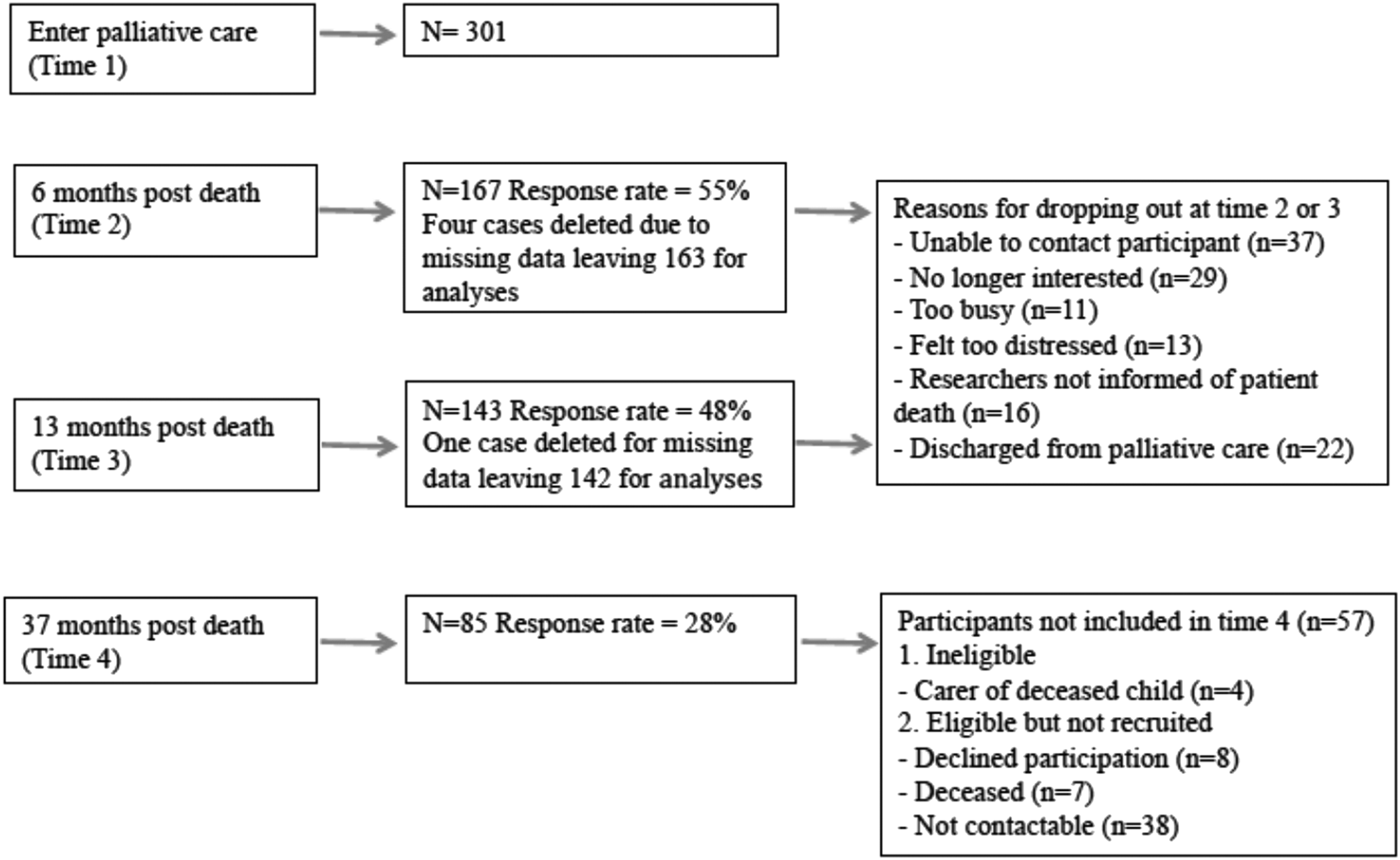
All participants were recontacted by telephone at six, 13, and 37 months after bereavement. Verbal consent to continue participating in this study was sought ahead of being mailed the time specific questionnaire. If the questionnaire was not returned to the research group within two weeks, the participant was contacted to encourage them to complete and return the questionnaire and to offer assistance if required. Figure 1 shows the recruitment diagram for data on participants at each time point.
Recruitment at each time point.

Measures
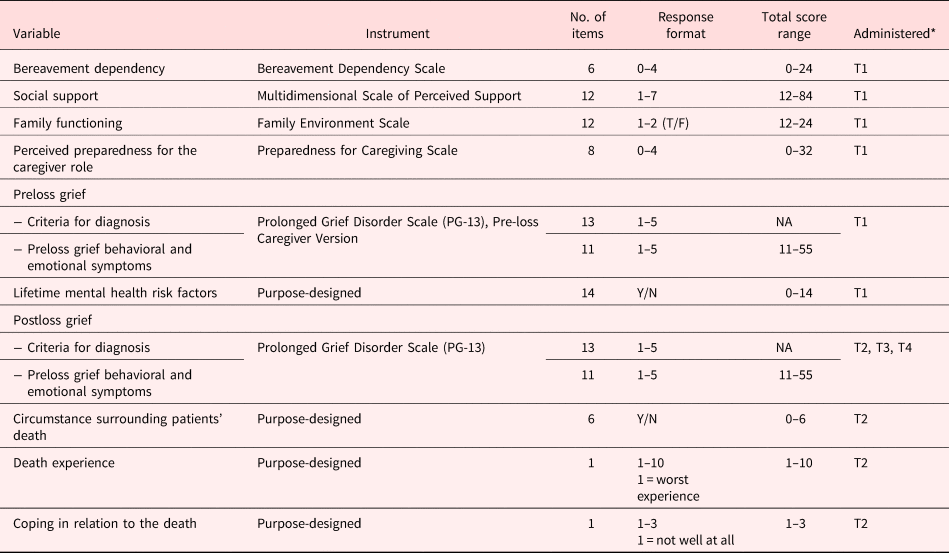
Validated and purpose-designed self-report measures administered at each time point and relevant to the current study are listed in Table 1. Relevant sociodemographic data were collected from both carers and patients at T1. A complete list of all measures administered to participants (cohort profile) has been reported (Hudson et al., Reference Hudson, Thomas and Trauer2011).
Summary of measures administered at each time point

F, false; N, no; T, true; T1, time 1; T2, time 2; T3, time 3; T4, time 4; Y, yes.
*T1, before the patient's death; T2, six months post bereavment; T3, 13 months post bereavment; T4, 37 months post bereavment.
PGD scale
PGD was measured using the Prolonged Grief Disorder Scale (PG-13) (Prigerson et al., Reference Prigerson, Horowitz and Jacobs2009; Prigerson & Maciejewski, Reference Prigerson and Maciejewski2006) a 13-item self-report questionnaire, including PGD symptoms, including feelings, thoughts, and actions. Each item was scored on a 5-point Likert scale from 1 (not at all) to 5 (very much). Respondents were categorized as noncases, subthreshold cases, or cases, based on an algorithm developed by the scale authors. In brief, PGD cases met the following four criteria: (1) at least daily separation distress (score of 4+ on item 1 or 2); (2) at least five cognitive, emotional, or behavioral symptoms (score of 4+ on at least five of nine items from 3 through 11); (3) symptoms for 6+ months (item 12); and (4) significantly impaired social, occupational, or other important areas of functioning (score of 4+ on item 13) (Prigerson et al., Reference Prigerson, Horowitz and Jacobs2009). The nine symptoms of PGD include: feeling stunned/dazed, intense emotional pain/pangs of grief, bitterness, numbness, and confusion/a loss of self, trouble accepting the reality of the loss, a mistrust of others, difficultly moving on, and that life is meaningless. PGD subthreshold cases met three of the four PGD criteria. Noncases included all others.
A total prolonged grief symptom score was also calculated by summing the scores of the symptom items 1–11. Possible scores range between 11 and 55, with higher scores reflecting greater symptoms of PGD (Prigerson et al., Reference Prigerson, Horowitz and Jacobs2009).
Preloss prolonged grief score
Because there was not a specific measure available to assess preloss prolonged grief, items 1–11 of the PG-13 were adapted for this purpose. For example, “In the past month, how often have you tried to avoid reminders that the person is gone?” was replaced with “In the past month, how often do you try to avoid reminders of your relative's diagnosis or prognosis?” to reflect the grief experienced related to the illness rather than the death of the person being cared for. A total preloss prolonged grief scores was calculated by summing the scores of items 1–11.
Mental health risk factors
Fourteen mental health lifetime risk factors were identified from key articles in the literature (Andershed, Reference Andershed2006; Docherty et al., Reference Docherty, Owens and Asadi-Lari2008; Eagar et al., Reference Eagar, Owen and Williams2007; Kristjanson et al., Reference Kristjanson, Lobb and Aoun2006; Smith et al., Reference Smith, Kalus and Russell2009). These were then reviewed by experts in psychiatry, psychology, and bereavement, and through an iterative approach, the final 14 risk factors were agreed upon. These were: (1) sleeplessness, (2) serious financial problems, (3) drug or alcohol dependency, (4) cumulative multiple losses, (5) multiple stressful situations, (6) seen a counselor, (7) general practitioner, (8) psychologist, (9) psychiatrist for mental health problems, (10) taken medication for mental health problems, (11) family history of mental illness, (12) death of a parent during childhood, (13) overly controlling parents, and (14) childhood abuse or neglect. Participants were asked whether they had ever in their lifetime experienced each of these factors and were asked to respond in a yes/no format. Data were also collected on the participants mental health service use in the previous six months that allowed for an understanding of mental health concerns developed in the caregiving role versus a lifetime risk factor.
Circumstances surrounding death
Information regarding the circumstances surrounding the patient's death were collected at T2. These included: (1) the opportunity to say goodbye (yes/no) and (2) discuss death with the patient (yes/no); (3) present at the time of death (yes/no); (4) attendance at the funeral (yes/no); and (5) a three-part question about the location of the patient's death (home, hospital, aged care facility, palliative care unit, other) and congruence between the carer's ideal location and patient's ideal location of death (answered yes/no). Participants were also asked to rate the dying experience on a Likert scale from 1 to 10, with 10 indicating the best experience possible.
Self-report measure of coping
Finally, participants were asked to rate how well they thought they were coping in relation to their relative's death with a response format of “not well at all,” “quite well,” and “very well.”
Statistical methods
All models were prespecified to guard against spurious findings (Harrell et al., Reference Harrell, Lee and Mark1996). The primary outcome was the total score for prolonged grief at T4, and was modelled with linear regression. The first set of models focused on the traditional risk factors, as identified in the literature, for prolonged grief: serious financial problems, drug or alcohol dependency, cumulative losses, multiple stressful situations, seen mental health professional, medication for mental health problem, family history of mental illness, experienced the death of a parent in childhood, overly controlling parents, and experienced childhood abuse or neglect. These risk factors were considered univariately and in a multiple linear regression with all risk factors.
The second set of models aimed to explore predictors from T1 and T2 of prolonged grief at T4. Family functioning, social support, bereavement dependency, death circumstances (as a total score from 5 items), and preloss grief were used in a multiple linear regression.
Because there was a substantial amount of missing data at T4, and because restricting analysis to those who had complete data is inefficient and can seriously bias results, we used multiple imputation for the primary analysis (Bell & Fairclough, Reference Bell and Fairclough2014). Multiple imputation is a method of “filling in” missing data from a plausible distribution that validly accounts for the uncertainty associated with both sampling and imputation and yields unbiased estimates for data that are missing completely at random and at random (Little & Rubin, Reference Little and Rubin1987). As recommended, we used an “inclusive” strategy for the imputation model, including all outcome and predictor variables that would then be used in the analysis models (Collins et al., Reference Collins, Schafer and Kam2001). Fifty datasets were multiply imputed, and results of the various analyses combined by using SAS Proc MI and MIANALYZE.
Sensitivity analyses
We undertook sensitivity analyses by comparing the primary results, which used multiple imputation, with results from a complete case analysis and results obtained with different multiple imputation models. All analyses were performed in SAS v9.2, tests were two-sided, and statistical significance was set at 0.05.
Results
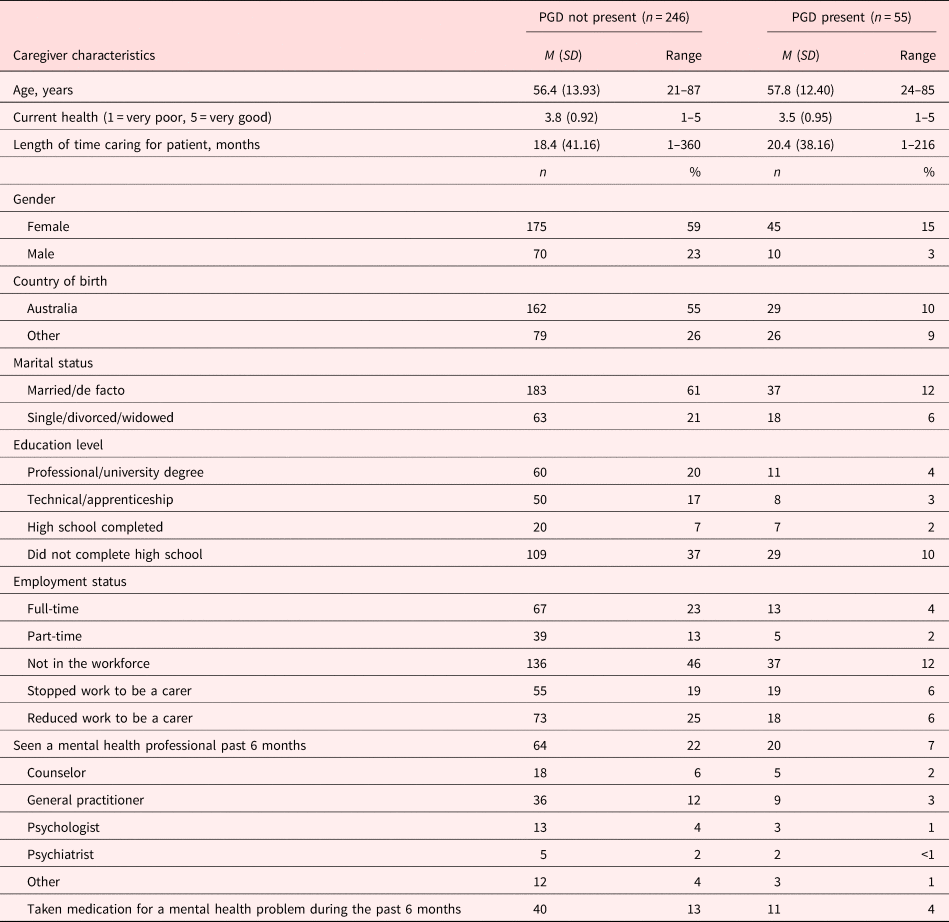
Of the 992 caregivers who were eligible for the study, 381 agreed to participate. Of these, 301 completed the questionnaire, corresponding to a response rate of 30%. Figure 1 shows the sample size, response rates, and reasons for refusal at T2, T3, and T4. For more information about T1, T2, and T3 reasons for refusal, please refer to the associated publications (Hudson et al., Reference Hudson, Thomas and Trauer2011; Thomas et al., Reference Thomas, Hudson and Trauer2014). Participant demographic data are presented in Table 2 and divided by those who made criteria for preloss PGD or PGD at any time point (T1, T2, T3, or T4) and those who did not.
Descriptive data for caregiver sociodemographic variables by presence of Preloss Prolonged Grief Disorder/Prolonged Grief Disorder at T1, T2, T3, or T4 versus no Prolonged Grief Disorder

PGD, prolonged grief disorder; T1, time 1; T2, time 2; T3, time 3; T4, time 4.
PG and subthreshold PG
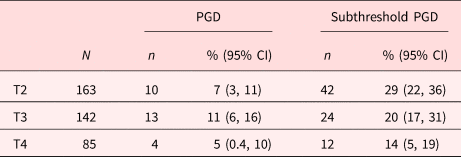
The prevalence of PGD and subthreshold PGD postbereavement were determined using the PG-13 as a binary measure, and presented in Table 3.
Prevalence and CI 95% of PGD and subthreshold PGD

PGD, prolonged grief disorder; T2, time 2; T3, time 3; T4, time 4.
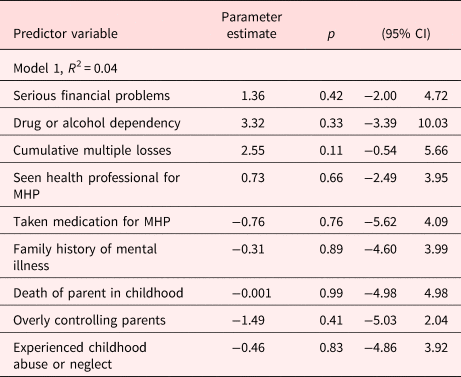
In a regression model for PGD at T4 with traditional risk factors (serious financial problems, drug or alcohol dependency, cumulative losses, multiple stressful situations, seen mental health professional, medication for mental health problem, family history of mental illness, experienced the death of a parent in childhood, overly controlling parents, experienced childhood abuse or neglect), none was found to be significant, either in a multiple regression model (Table 4) or univariately (results not shown). The explained variance of the model was R 2 = 0.04.
Regression analyses of predictor variables on PGD at T4 using traditional risk factors (n = 85)

MHP = mental health problem; PGD = prolonged grief disorder.
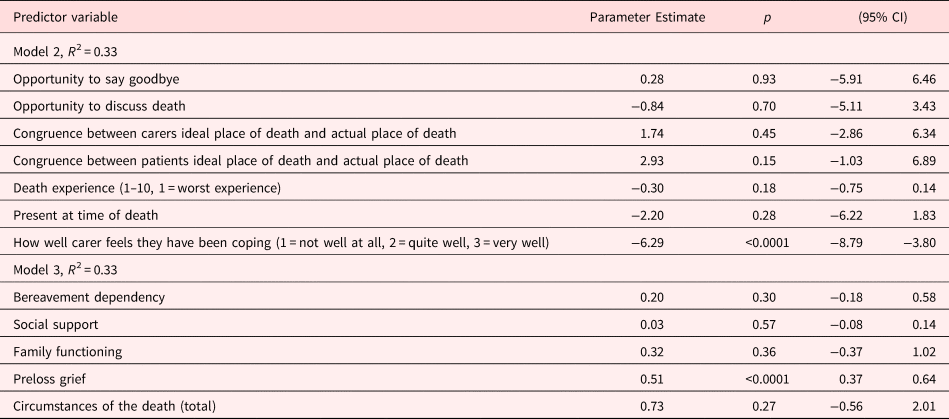
The second model included the circumstances surrounding the death, the carer's rating of the death experience, and a self-report measure of coping. The explained variance of the model was R 2 = 0.33, and the self-report measure of coping was a highly statistically significant predictor in this model (p < 0.0001) (Table 5).
Regression analyses of predictor variables on PGD at T4

PGD = prolonged grief disorder; T4 = Time 4.
A final model, including family functioning, social support, bereavement dependency, death circumstances, and preloss anticipatory grief, found that preloss anticipatory grief measured at T1 was a highly statistically significant predictor of PGD at T4 (p < 0.0001), (Table 5). The explained variance was R 2 = 0.33. All results from sensitivity analyses were similar to the primary analysis.
Discussion
To our knowledge, this is the first prospective study examining a cohort of primary caregivers of cancer patients in the final stages of life, enabling the collection of prebereavement mental health data with systematic follow-up of the cohort up to three years after bereavement. Unlike other longitudinal studies of this population, where participants are self-selected via internet notices (van der Houwen et al., Reference van der Houwen, Stroebe and Stroebe2010b), this cohort of caregivers was a predefined homogenous group of primary caregivers of patients with cancer in need of palliative care services in which patient deaths were anticipated. This provides a scenario in which the focus of examination is on the mental health factors of caregivers in predicting outcomes, removing the variability in the data associated with unanticipated deaths, and sudden deaths through natural causes, accident/homicide, and suicide in the same group (van der Houwen et al., Reference van der Houwen, Stroebe and Stroebe2010b). The true strength of this study design is the comprehensive preloss caregiver data, missing in most studies of this kind that rely on patient data as a proxy for caregiver data.
The number of caregivers experiencing PGD decreased with time and at 37 months postloss, four caregivers met the criteria for PGD. A recent meta-analysis of prevalence data for PGD suggests approximately 5% of the bereaved population will be affected, (Lundorff et al., Reference Lundorff, Holmgren and Zachariae2017), which is what was found in this study. The number of caregivers with subthreshold PGD at 37 months was high (n = 12; 14%) therefore and worthy of attention. For almost 20% of caregivers, the symptoms of PGD appear to persist at least three years postbereavement. It is possible that these numbers underestimate the number of bereaved caregivers affected by PGD. One of the distinguishing features of PGD is avoidance of any reminders of the loss, and it is highly probable that those experiencing PGD would avoid participating in T4 of the study. Certainly, there is anecdotal evidence to support this.
Caregiver preloss PG at T1 (patient admission to palliative care) was highly predictive of PGD in the longer term, building on existing findings in this area (Kapari et al., Reference Kapari, Addington-Hall and Hotopf2010). In the second set of models, there were two highly statistically significant predictors (preloss grief and “how have you been coping in the past month?”) that was asked at T2.
These results suggest value in screening caregivers upon the patient's admission to palliative care, which is in keeping with international guidelines (World Health Organization, 2002). Included in this model were social support, family functioning, bereavement dependency, and circumstances surrounding the death that were not predictive of PGD in the longer term. These findings support the work of other researchers in this area (Barry et al., Reference Barry, Kasl and Prigerson2002; Kapari et al., Reference Kapari, Addington-Hall and Hotopf2010). Contrary to expectation, social support did not predict PGD. This is supported by the findings of van der Houwen et al. (Reference van der Houwen, Stroebe and Stroebe2010b), who also found that social support did not have the protective effect against PGD. The authors conclude the reasoning for this finding is unclear. One possibility may be that the caregiver has lost their major source of support through the death of the person they are grieving for. Additionally, it is possible that social support received upon entry to palliative care may decrease over time, particularly in individuals who have symptoms of PGD, which include social isolation or withdrawal.
The caregiver's experience of the death was not predictive of PGD, indicating that, in this study, the quality of the patient's death is not a contributing factor in the development of PGD in caregivers. Because palliative care services were involved, aspects of the death experience that could lead to caregiver distress, such as poor symptom management, should have been minimized. Because participants were recruited upon the patient's admission to palliative care, all deaths were anticipated and (we expect) the caregivers were supported by palliative care staff both before, during, and after death. This supports the finding of van der Houwen et al. (Reference van der Houwen, Stroebe and Stroebe2010b), who also found that bereavement-related factors, except the expectedness of the death (which was not a factor in our study), did not contribute to CG.
Caregiver self-assessment of coping six months postbereavement was highly predictive of PGD in the long-term. It appears that simply asking caregivers how they are coping at six months postbereavement may be effective in identifying those at high risk of PGD in the longer term. Far from being a complicated questionnaire, this self-report measure was a simple question with a choice of answers on a 3-point Likert scale ranging from “not well at all” to “very well.” In hospitals where there are few resources available to provide bereavement services and staff are unable or ill-equipped to administer standardized questionnaires assessing mental health, this may be a useful screening instrument to identify those likely to benefit from early intervention.
Bereaved caregivers may realize that they are not coping well, but may not be aware that this is reflecting symptoms of a mental health disorder that can benefit from bereavement care, and that such care is available, either through the palliative care services or through community-based services. Indeed, of the four participants who matched criteria for PGD at T4, only one reported receiving psychological treatment in the form of antidepressant medication. Palliative care bereavement services are potentially well placed to conduct such screening preloss and six months after bereavement, and when required, institute early intervention including referral to specialist mental health professionals.
None of the traditional risk factors for PGD analyzed in this study were statistically or clinically significant. This supports previous findings that a prior psychiatric history in caregivers is not predictive of PGD (Barry et al., Reference Barry, Kasl and Prigerson2002); however, it is important to note that psychiatric history may predict other bereavement-related mental health outcomes, such as major depressive disorder.
This further supports the importance of screening caregivers upon the patient's admission to palliative care and at six months after bereavement to ascertain their current mental health, as it appears this may be more relevant to their ongoing mental health than history. This also lends support for a less invasive approach to the screening of caregivers.
There are a number of strengths and limitations associated with this study. This study is limited by the usual challenges associated with recruitment and retention of participants to bereavement studies. Many caregivers declined participation at T1, and we are unable to comment on their experience. Additionally, caregivers did not complete all surveys; however, the statistical analysis conducted aimed to directly address these missing data. This study was extremely comprehensive, including sociodemographic, mental health, circumstances related to the death, and relationship factors in the design. It did not investigate all the factors that may contribute to the development of PGD, for example, family conflict and attachment style. It is possible these factors may contribute to PGD in this population.
Future research should aim to develop and evaluate a screening process for prolonged grief in palliative care and bereavement settings. Based on the findings of the current study, caregivers should be screened for prolonged grief symptoms preloss and at 6 months after bereavement. The evidence presented here indicates that this screening does not need to be arduous or overburden already struggling palliative care services. Additionally, research should follow the work of van der Houwen et al. (Reference van der Houwen, Stroebe and Schut2010a), who have moved beyond merely identifying risk factors for PGD and toward an understanding of mediating factors, including rumination and threatening grief interpretations. This provides an understanding of the etiology and maintenance of PGD in specific populations. In this way, we can move beyond just identifying those at risk of developing PGD and ideally prevent PGD before it is established.
Acknowledgments
This work was supported by the Victorian Cancer Agency in the form of an Early Career Seed Grant awarded to Rachel Zordan (ESCG09_12_Zordan) and beyondblue: the national depression initiative. The authors would like to acknowledge the commitment and contribution to this study of Dr. Melanie Price (1965–2018). Dr. Price was a respected member of the psycho-oncology and palliative care community in Australia for over 22 years. She was a tireless advocate for people affected by cancer, their families and psycho-oncology as a discipline.
Conflicts of interest
None.