Introduction
What explains mass party formation? Prevailing approaches to the understanding of mass party emergence fall within two camps. A representational approach sees mass parties as reflections of preexisting social constituencies (Engels Reference Engels2003 [1895]; Marx Reference Marx1994 [1848]; similarly Kirchheimer Reference Kirchheimer, La Palombara and Weiner1966; Lipset and Rokkan Reference Lipset and Rokkan1967; Neumann Reference Neumann1956: 403; more recently Katz and Mair Reference Katz and Mair1995). A state modernization approach focuses on the role played by the rise of the bureaucratic state and in particular the advent of universal suffrage (Aldrich Reference Aldrich1995: 103–4; Duverger Reference Duverger1962; Epstein Reference Epstein2000 [1980]: 19; Michels Reference Michels1949 [1911]: 21–41; Ostrogorski Reference Ostrogorski1964 [1902]: 1; Panebianco Reference Panebianco1988: 103, 268; Sartori Reference Sartori1976: 18, 36; Slez and Martin Reference Slez and Martin2007: 65; Weber Reference Weber1946 [1919]: 102). These approaches cannot explain why mass party formation fails or succeeds in cases in which similar sectors are available for mobilization, and a similar state structure and electoral arrangements are present. In this article I develop an original framework that both builds on a tradition that has emphasized parties’ capacities to shape their constituency and engage in state building (De Leon et al. Reference De Leon, Desai and Tuğal2009, Reference De Leon, Desai and Tuğal2015; Desai Reference Desai2001; Eley Reference Eley2002; Huntington Reference Huntington1968: xix, 11; Ware Reference Ware1996: 184–213), and synthetizes Antonio Gramsci’s (Reference Gramsci1971) theory of political parties and Barrington Moore’s (Reference Moore1967) emphasis on the relationship between agrarian class struggle and regime formation.
I examine the rise of the Partido Revolucionario Institucional (PRI) as a mass party in some regions of Mexico but not others, after the country’s revolutionary upheaval in the early twentieth century. Prevailing approaches to party formation would not expect subnational variation in Mexico, where an overwhelmingly peasant population provided a vast seemingly preconstituted social sector available for mobilization, and identical electoral arrangements existed. Why was the PRI able to achieve incorporation of the peasantry in some regions—hence becoming a mass party—after the revolutionary upheaval of the early twentieth century? Through the analysis of agrarian census data and extensive archival research, I show the PRI during its formative years (1929–46) was able to build new peasant organizations, absorb existing ones, and mobilize people to the polls, in areas where land privatization had been significant. These findings suggest that party formation requires the absorption of a civil societal realm, which in turn is facilitated where erosion of “traditional” “pre”-capitalist agrarian structures is present. A representational approach and state-centered approach would in fact expect village erosion to be an obstacle for the party, making it harder to establish relationships with local leaders, to coordinate and discipline increasingly disjointed citizens. Instead I show the party emerging precisely where erosion is strongest.
Approaches to Mass Party Formation
Mass parties—as opposed to parties of the elite (parliamentary cliques, clubs of notables)—are oriented toward mobilizing and incorporating increasingly broader sectors of society (Weber Reference Weber1946 [1919]). In essence, the mass party creates links with the population and it is this linkage—“its connecting network” (Sartori Reference Sartori2005: 16)—that distinguishes this organizational form from strictly parliamentary politics.
Two broad approaches have developed to explain the emergence of mass parties. On the one hand, a representational approach sees parties as reflections of preexisting social constituencies. For example, classical Marxist accounts see political organizations as the carapace of a class that has become sufficiently developed and self-aware that it creates an electoral arm to fight for its interests (Kautsky Reference Kautsky1996; Marx Reference Marx1994 [1848])Footnote 1; similarly Pluralist political science in the second half of the twentieth century saw parties emerging as translations of “latent conflicts” in society (Lipset and Rokkan Reference Lipset and Rokkan1967). Both classical Marxism and Pluralism share a “representational” approach to party emergence.Footnote 2 Political parties arise in relation to preconstituted sources of division in society; and these divisions correspond to social groups. From this perspective, party organizations map onto social sectors, often classes, already undergoing a separate process of politicization, or with enough objective interests so as to find in the party a representative. In this sense, a representational approach would expect peasant cohesion to be an advantage to party building. The approach is limited when confronted with variation in cases in which very similar sectors are available for mobilization.
On the other hand, an implicitly state-centered approach sees mass parties emerging in response to changes in state structure (Aldrich Reference Aldrich1995: 103–4; Duverger Reference Duverger1962; Epstein Reference Epstein2000 [1980]: 19; Michels Reference Michels1949 [1911]: 21–41; Ostrogorski Reference Ostrogorski1964 [1902]: 1; Panebianco Reference Panebianco1988: 103, 268; Sartori Reference Sartori1976: 18, 36; Slez and Martin Reference Slez and Martin2007: 65; Weber Reference Weber1946 [1919]: 102). This current sees the transition from elite parties to mass mobilizing organizations as an effect of institutional restructuring: the appearance of universal suffrage creates a competition for voters at the same time it channels masses to engage in politics through party representatives as a technical necessity (Michels Reference Michels1949 [1911]; Panebianco Reference Panebianco1988: 103, 268). Aldrich (Reference Aldrich1995: 103), from a rational-choice theory perspective, has iterated the argument: for him, parties emerge as solutions to the collective action problem introduced by suffrage expansion. Hence, for Weber (Reference Weber1946 [1919]: 102): “modern [parties] are the children of democracy.” From this approach we would expect successful mass parties in places where state modernization is underway and universal suffrage is present (or the electorate is being broadened). Peasant village erosion would be an obstacle to party building from this perspective—the absence of firmly established local brokers could complicate state (and therefore party) building because brokers provide information and strike deals.
These approaches cannot explain why the PRI emerged as a mass party in some regions of Mexico but not others despite the fact that seemingly preconstituted social groups (i.e., peasants) were available for mobilization, and the places shared identical electoral-bureaucratic structures. Both representative and state-centered approaches conceive of parties as aftereffects, overshadowing the active role of political organizations in constituting and shaping their social bases (rather than simply reflecting), and in many instances engaging in state building. I propose an approach that acknowledges party agency but relates this agency to structural limitations and openings.
Land, Civil Society, and Political Organization
Building on a party-centered point of view that has critiqued the approaches outlined in the preceding text for overlooking the active role of parties in the creation of social divisions (De Leon et al. Reference De Leon, Desai and Tuğal2009, Reference De Leon, Desai and Tuğal2015; Desai Reference Desai2001; Eidlin Reference Eidlin2016; Huntington Reference Huntington1968: xix, 11; Ware Reference Ware1996: 184–213), I develop an approach that places party agency at the center of mass party formation. However, finding insights in Gramsci (Reference Gramsci1971) and Moore (Reference Moore1967), I go further by analyzing the structural conditions for the party to constitute its social base or engage in state building during its process of emergence. And, while the party-centered literature places emphasis on discursive articulatory agency of parties, here I focus primarily on party practices and organizational processes.
Gramsci (Reference Gramsci1971: 152–53) contends that for “a party to exist … three fundamental elements have to converge”: (1) a “mass element” that is composed of ordinary people who provide discipline and loyalty. This mass is not a preconstituted group, rather “they are a force in so far as there is somebody to centralize, organize and discipline them,” in the absence of which “they would scatter into an impotent diaspora and vanish into nothing” (ibid.: 152); (2) a “cohesive element”—a leadership structure that centralizes, provides direction, and renders effective a complex of forces; and (3) finally, “an intermediate element” that “articulates the first element with the second and maintains contact between them, not only physically but also morally and intellectually.” A Gramscian theory of party formation suggests that parties are not direct reflections of the mass element but require an intermediate sphere as a mediating mechanism. This “intermediate element” can be thought of in terms of what Gramsci refers to as “civil society,” a realm of voluntary organizations different from the state or the business sector, through which consent to political control is obtained. If the mass party is in essence its linkages, we can say that the party requires the presence—through construction or absorption—of a civil societal realm.
But how is the construction and absorption of a civil societal realm possible in the first place? Moore’s (Reference Moore1967: 415) central question is whether there are “structural differences in agrarian societies that might in some cases favor subsequent development toward parliamentary democracy while other starting points would make this achievement difficult or rule it out altogether?” The resolution of agrarian class struggle was key in the development of liberal democracy: for example, enclosures in England—the destruction of communal agrarian structures—left no massive reservoir of autonomous peasants to serve reactionary ends of the landed upper classes, or to serve as a base for peasant revolutions, yielding dictatorships of right and left respectively (ibid.: 426). Putting aside the concern with “democracy” as an outcome, Moore’s work points to the importance of land tenure arrangements as a central variable in the understanding of political mobilization (Migdal Reference Migdal1974; Paige Reference Paige1975; Scott Reference Scott1976; Skocpol Reference Skocpol1979; Wolf Reference Wolf1969). The question becomes whether there are structural differences in agrarian societies that favor the development of mass parties by facilitating the construction and absorption of peasant civil society?
Methods and Case Selection
I rely on comparative-historical methods of inquiry (Moore Reference Moore1978: 376; Weber Reference Weber1949: 164) to develop an explanatory account of mass party formation by comparing cases that are similar on theoretically relevant grounds but present variation in outcomes that cannot be accounted for by existing theories. I treat variation in party formation within Mexico as a “negative case” (Bartram Reference Bartram2000; Emigh Reference Emigh1997; Riley Reference Riley2005), where an outcome predicted by theory did not occur. Existing approaches would not expect variation in cases with similar sectors available for mobilization and similar state structure and electoral arrangements. The goal is not to develop an explanation that is generalizable for all existing cases of party emergence, rather, it is to show (1) the limits of existing approaches, and (2) provide evidence consistent with the causal relevance of agrarian structures when mass party formation is attempted.
To undertake these tasks, I engage in two types of data analysis: first, through the use of agrarian census data I identify areas where land privatization had been more and less intensive during the PRI’s process of emergence. Second, through the use of archival materials, I show how these areas correspond to the party’s capacity for construction of new, and absorption of existing, peasant organizations, as well as electoral mobilization. The period studied (1929–46) encompasses the different phases of formation of the party, beginning in 1929 as the Partido Nacional Revolucionario (PNR), then in 1938 becoming the Partido de la Revolucion Mexicana (PRM), and finally emerging in 1946 as the Partido Revolucionario Institucional (PRI).
Studying the PRI in and of itself is particularly important for understanding mass political organizations. The renowned political scientist Giovanni Sartori (Reference Sartori1976: 232) has written that: “All sorts of conceptual, interpretive, and predictive errors have resulted from our inability to accommodate into an appropriate framework the Mexican PRI.” The PRI was a particularly strong mass party that stayed in power by building extensive patronage and clientelar networks within popular classes and successfully pushed for compromises and resolutions between conflicting sectors of society (Cordova Reference Cordova1974; Huntington Reference Huntington1968; McDonald Reference McDonald1971; Middlebrook Reference Middlebrook1995; Story Reference Story1986). The party was central to one of the longest-lived regimes of the twentieth century (Magaloni Reference Magaloni2006: 1). Not surprisingly, it has been a common case treated in comparative studies of parties (Almond and Verba Reference Almond and Verba1965; Collier and Collier Reference Collier and Collier1991; Greene Reference Greene2007; Huntington Reference Huntington1968; Levitsky and Way Reference Levitsky and Way2002; Linz Reference Linz2000; Linz and Stepan Reference Linz and Stepan1996; Magaloni Reference Magaloni2006; Rustow Reference Rustow1967; Sartori Reference Sartori1976). In other words, the emergence of the PRI is a particularly fruitful object of analysis: subnational variation constitutes a “negative case” in relation to the expectations of existing theory, while its condition as a particularly strong mass party makes it a strategic research site (Merton Reference Merton1987: 1) because the phenomenon to be explained is exhibited in a concentrated manner. If existing theories cannot explain the PRI, there are serious limitations to their explanatory power.
This case selection offers controls for causal variables posited as central in representational and state-modernization arguments about party emergence. The peasantry constituted a vast sector available for mobilization through most of the country. Peasants were the majority of the country’s population until the 1950s and a critical component of regime support (Ames Reference Ames1970; Reyna and Weinert Reference Reyna and Weinert1977). Explaining the formation of the PRI as a mass party depends unequivocally on understanding how it incorporated the peasantry. To focus on the relationship between agrarian structures and party building, I draw a sample of states with a high concentration of peasants. The 17 states in this sampleFootnote 3 were the most overwhelmingly agrarian in the country in the period studied: the rural population was above the national average of 68 percent. By excluding from the sample states that were not predominantly rural, I am able to examine the specific relationship between agrarian forms and party building sought out in this article.Footnote 4
These 17 states constitute about half of the country’s 31 states and shared similar bureaucratic structures (Hamilton Reference Hamilton1982; Medina Peña Reference Medina Peña1994) and identical electoral rules (male suffrage until 1953 and universal suffrage thereafter). Postrevolutionary state building was a national process that restructured key institutions such as the army, the school system, and administrative posts, along the lines of a modern bureaucratic state. The postrevolutionary state formally begins with the drafting of the 1917 Constitution that secured a wide array of workers’ rights (unionization, collective contracts, strikes, etc.) and political rights (e.g., freedom of expression and freedom of association), operative in the period studied (contrary to subsequent stages in the PRI’s tenure). The 1920–45 period saw 5 presidential elections and 10 federal legislative elections, and many more at the state and municipal level (Medina Peña Reference Medina Peña1994: 162). While tension with local power holders (“caciques”) was present throughout the period, gradual centralization of power did take place (ibid.: 17). Similarly, after a recurrence of military insurrections in 1920 and 1924, the military was tamed, and gradually incorporated as a subordinated sector of the central bureaucratic state.
I make use of available agrarian census data as well as extensive archival material from Mexico’s National Archive, for example the documents coming from the defunct Direccion General de Investigaciones Politicas y Sociales (General Directorate of Political and Social Investigation). This directorate was a network of political spies, whose confidential and highly descriptive reports of both PRI and opposition activities from the period 1929–65 were made available to researchers in 1999. While the perspective of these government informants is obviously biased, the reports were by no means reproducing party propaganda because they were meant for an audience of high-level state bureaucrats. The reports are particularly useful considering that several agents were deployed to cover different regions during the same time frame allowing for comparison and constituting a unique look into the everyday of party formation.
Mass Party Emergence in Mexico
In what follows, first, I identify regional variation in agrarian structures by constructing an indicator for land privatization (which will be explained in detail in the following text). Second, I show the connection between regional variation in privatization and mass party formation in three spheres: the construction of new peasant associations, the absorption of existing ones, and electoral mobilization.
Traditional Village Cohesion and Erosion
Land tenure structure in Mexico developed unevenly throughout the nineteenth and early twentieth century. The Spanish rule (1519–1821) had allowed the existence of large estates while tolerating communal property (Florescano Reference Florescano1986: 109); state strategies for preserving rural stability were largely based on the existence of the self-governing landholding village; and Spanish courts often came down on the side of village landholding rather than individual landholding (Van Young Reference Van Young2006: 295). Land privatization in Mexico took a serious boost during the Comonfort presidency in the mid-1800s when he instituted a series of liberal reforms that affected both the property of the Catholic Church and village lands held collectively (Servín et al. Reference Servín, Reina and Tutino2007: 234). Liberal ideologues set out to foster the emergence of individual small property owners—a project that achieved limited pockets of success (ibid.). The Diaz dictatorship (1876–1911) that preceded the revolutionary outbreak, however, developed new ways to speed communal expropriation and transfer vast amounts of land into a few private hands (Kouri Reference Kouri2004; Servín et al. Reference Servín, Reina and Tutino2007: 7). Land became increasingly concentrated in market-oriented haciendas with labor-intensive arrangements (Wilkie and Hammond Reference Wilkie and Hammond1998).
Three basic categories of land tenure existed prior to land reform process put in place by the postrevolutionary government in Mexico: sole owned-and-worked small plots, haciendas with either peons living inside the estate or under sharecropping arrangements, and communally owned land. While individual small plots were concentrated in the north of the country, the two latter forms of tenure were more common in the center and south of the country (Tutino Reference Tutino1986: 233, 298, 313). Peasants in communally owned land were often struggling against expansionist landowners; occasionally work in the family plot was complemented with work in the neighboring haciendas (Womack Reference Womack1969: 6, 61). In 1810, 40 percent of arable lands in the center and south of the country (where the peasantry was concentrated) were held communally (Warman Reference Warman1980: 16–17). By 1910, this number was down to 5 percent, and 91 percent of peasants had no property rights (ibid.). More than half of the national territory was under capitalist hacienda ownership (Vázques Castillo Reference Vázquez Castillo2004: 26). The legacies of land privatization would manifest in the postrevolutionary period in counterintuitive ways. One of the central planks of the revolutionary government was land reform, instituting a system of collective ownership known as “ejido” (Cornelius and Mhyre Reference Cornelius and Myhre1998). But in most regions, postrevolutionary land reform did little to reinvigorate the eroded village and in some sense reenforced this erosion. The postrevolutionary ejido was in fact sui generis (Díaz y Díaz Reference Díaz y Díaz1987), as it fused individualized tenure and state tutelage (Torres-Mazuera Reference Torres-Mazuera2012: 1). The land was “owned” collectively but could not be bought or sold, and ejido grantees could decide whether to work the land collectively or as individual parcels. According to the 1950 Agrarian Census, 96 percent of the ejido hectares were worked as individual parcels (Dirección General de Estadística 1950a). Furthermore, land reform governmental agencies promoted concepts of capitalist efficiency, and were organized to orient production toward the market (through credits and loans, subsidized machinery, and creating incentives for production cooperatives). In this sense, land reform was not a restitution of precapitalist tenure arrangements. Land privatization had a permanent effect.
Nevertheless, the efforts to build the PRI and incorporate the peasantry took place on an uneven terrain as there were clear regional patterns in penetration of land privatization. I use the term “cohesion” as a shorthand for the permanence of traditional peasant structures, and concomitantly use “erosion” for the absence of these structures. Conceptually, cohesion/erosion refers to the level of communal landholding arrangements. A peasant village in its most cohesive format is organized around communal property and subsistence agriculture. An eroded village is organized around private property, wage labor, and commercially oriented production. Given the existence of the ejido in postrevolutionary Mexico, looking simply at landownership would be extremely limiting. As suggested in the preceding text, postrevolutionary legal collective ownership says little about whether the land was worked in individualized, market-oriented fashion. In other words, these lands would appear as collectively owned in the postrevolutionary land reform period, but still exhibit features of privatized ownership (individual parcels were often worked by paid journeymen, and illegally sold or rented out).
To identify this variation, I constructed an indicator of erosion that synthetizes the following variables: lands privatized by the outset of the revolution,Footnote 5 rural townships created after 1930,Footnote 6 lands worked collectively post–land reform,Footnote 7 and the percentage of family members over 15 years of age working ejido lands without a salary post–land reform.Footnote 8 Each variable is meant to touch on an aspect of cohesion. Land privatized refers to instances of land enclosures before the outset of the revolution in 1910. The more rural townships created post-1930, the more eroded is the state: dwellers in new rural townships were often migrating from another part of the state or even the country, or were people who could no longer count on an ancestral family plot. Looking at land worked collectively is important because, as mentioned in the preceding text, after land reform, a large portion of the land was owned collectively for legal purposes, but was rarely worked communally. The indicator of family member labor is meant to get at the permanence of traditional labor exchange systems. The most eroded states would be the ones where the most land had been privatized, the more new rural townships were created post-1930, the less land was worked collectively, and the less family work without salary was present. The most cohesive would be the ones where the least land had been privatized, less new rural townships were created, more land was worked collectively, and more work was done by family members without a salary.
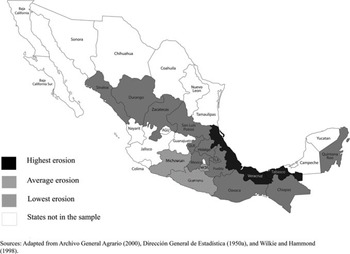
Figure 1 represents a composite indicator (Bandura Reference Bandura2006; Spector Reference Spector1992) of erosion.Footnote 9 Focusing only on the states with a concentration of peasants, figure 1 shows the regional patterns of cohesion: the Gulf states of Veracruz and Tabasco were the most eroded, while the Central Pacific states of Michoacan, Morelos, and Tabasco were the most cohesive. Indeed a review of the agrarian history of these areas shows the long legacy of land privatization in Veracruz and Tabasco, and moderately successful peasant resistance to land encroachment in Michoacan and Morelos. Communal holdings in Veracruz suffered a serious decline beginning 1889 with the passage and enforcement of state legislation requiring village governments to sell off communal land within a two-year period (Salamini Reference Salamini1971: 4). The pressure for privatization increased as a market around coffee, tobacco, and sugar developed. By the turn of the twentieth century, the majority of the rural population in the state was composed of “free” peasants (small property holders, tenant farmers, sharecroppers, and day laborers) (ibid.: 7). In Tabasco, the process of “deslinde” (“delinking”), as privatization of communal lands was known at the time, was also extensive since at least 1877 (Tostado Gutierrez Reference Tostado Gutierrez1985: 30); the elimination of excise taxes pushed by the state’s governor in the late nineteenth century fostered a relatively strong market system as well (Balcazar Reference Balcazar2003: 137). In the case of Morelos and Michoacan, similar market pressures were contained by the moderate successes of the local peasantry. Indeed, in many ways the eruption of the Zapatista rebellion in Morelos at the outset of the Mexican Revolution is explained as an attempt by peasants to preserve their way of life in the face of land grabbing (Gonzales Navarro 1969: 119; Womack Reference Womack1969).
Erosion in peasant states.

In the following sections I will show how this variation in terms of cohesion—the permanence of traditional agrarian structures—corresponded to variation in party formation.
Organizational Construction
In this section I show how regional variation in peasant organizational construction maps onto regional variation in erosion. The importance of peasant civil society construction was clear to party leaders at the time. Certainly, organizational presence was central to party electoral mobilization (an issue that will be covered in detail in a subsequent section)—as an early 1940s report from Michoacan put it “it is noteworthy that only the peasants who are members of a league took active part in the local elections” (AGN DGIPS, box 51; emphasis mine). The PRI by the late 1930s was fostering all sorts of organizations providing ideological orientation: the “Juventud Agrarista” (“Agrarianist Youth”) promoted sports teams in the ejidos for “the moral and spiritual improvement of the peasantry” (El Nacional 1937a); the “Social Action Committee” of the party gave “orientation to form social action women’s leagues” to “elevate the moral condition of the peasant woman, of her children and men, following the ideological actions of the president of the Republic” (El Nacional 1937b).
Organizations were important in developing grassroots leaders. According to a 1932 party plan, “cultural missions” deployed in the countryside were to form what was called “rural organization agents,” who, in addition to learning agronomy, the handling of field machinery, and public speaking, would take courses in “social-economic orientation (knowledge about the economic and social problems faced by the peasantry)” and “propaganda methods.” As the plan conceived it:
The agent is the social leader who breaks the inertia of the peasant mass…. [T]he peasant origin of the candidates [to become agents] must be confirmed, they must be selected carefully and systematically, and must be given an adequate technical and social education … the leader that has undergone this, will in turn select, as part of his work of penetration in strategic places and for concrete goals, other secondary leaders amongst the peasants who are the most progressive and with the most vision. (AGN PRES)
This plan trained peasants in an activism compatible with party organization. These incipient local leaders fostered by the party were to be intermediary agents between PRI leadership and the masses.
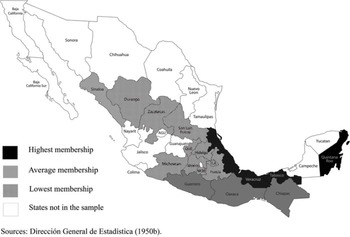
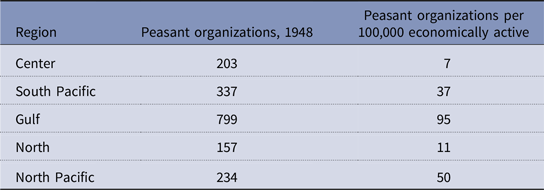
According to the argument developed in this article, I expect that areas where land privatization had been more intensive (Veracruz and Tabasco) were also areas where the party was able to more easily build peasant organizations, while regions in which communal structures remained were areas of relatively weak organizational presence. Figure 2 shows the regionsFootnote 10 where membership in peasant organizations constructed by the party was highest by 1948.Footnote 11 The organizations comprise all unions and leagues formed by ejido tenants and day laborers, as well as production and credit cooperatives.Footnote 12 Although the available data offers limited possibilities for a nuanced analysis (e.g., landless peasant unions and smallholders leagues are lumped together), it captures the broad landscape of agrarian civil society built by the PRI. Figure 2 shows that the area of the Gulf Coast is the area of highest formal peasant organizational membership, while the central states are the ones with the lowest membership rates. About 800 peasant organizations existed in the gulf region by 1948, considerably more than any other region. This represented approximately 95 organizations per 100,000 of those economically active, making it by far the organizationally densest region (see table 1). The data presented here is consistent with the indicator of erosion presented in the preceding text. While Veracruz and Tabasco were part of the region with the highest membership ratio, states like Morelos and Michoacan were part of the region with the lowest membership ratio. The PRI was successful at building a peasant civil societal realm in areas where land privatization had been more intense.
Membership levels in peasant organizations: 1948.

Organizational density: 1948

Organizational Absorption
The relationship between the PRI and peasant unions is complex but can be understood as the product of two parallel processes taking place: on the one hand, the party is actively creating peasant organizations as illustrated in the previous section and, on the other hand, peasant organizations already formed independently of the party during the 1920s and 1930s are gradually joining its ranks. The Confederacion Nacional Campesina (National Peasant Confederation, or CNC) created by the party in 1938, exemplifies this complexity because it is both meant to create new organizations, and serve as an umbrella metaorganization (channeling existing unions into one confederation under the control of the party).
The CNC operatives were aware at the time that erosion facilitated their goal of absorbing existing organizations. Take, for example, a government informant on the ground in the period, reporting about the CNC’s attempt to incorporate 16 ejidos not yet under its control in the state of Sonora. These ejidos were worked collectively, but as the report pointed out: “not all ejido-holders agree in working the land collectively and there are those whom incited by elements from the CNC wish to get an individual parcel” (AGN PRES MA). This created two conflicting camps within the ejido holders, the “colectivistas” (“collectivists”) and the “individualistas” (“individualists”). The individualistas were supported by the CNC. As another informant reported: “about two or three weeks ago, CNC delegates came to agitate the peasants promising that under the individualist or parcel system, they could obtain 20 hectares for each ejido-holder” (ibid.). The CNC’s push for individual parceling as a political strategy is telling—CNC delegates were seasoned activists who had identified the effect of erosion on political organization.
The system of individual parcels had been a political issue beforehand. A report from an agrarian league’s 1933 statewide convention in Veracruz shows an internal split precisely over the “problema parcelario [the parcel problem]” (AGN DGIPS, box 65). One side considered it “detrimental for the organized peasant … since that system comes to disintegrate solidarity”—the other side, a faction linked to the party refuted the point and explained to the assembly that parceling land “leads to the peasant’s economic liberation” and advised peasants to ignore “the speeches of false leaders who say otherwise … creating difficulties for the Federal government.” Here again we see a party-linked organization (in this case a faction within a broader group) pushing for erosion. The passage suggests also that this push was interpreted by opponents as having consequences for the political organization of the peasantry.
Absorbing existing organizations was easier where land privatization had been more intensive. While no statistical indicator of absorption is available for this study, it is possible to develop two qualitative case studies that illustrate the difficulties the PRI had in absorbing peasant groups in areas where communal property was stronger and the relative easiness with which the party absorbed peasant organizations in eroded regions.
Failed Absorption: Agrarismo in Morelos and Michoacan
How did party attempts to absorb existing peasant organizations fare in cohesive state like Morelos and Michoacan? Take for the purpose of comparison the relationship between the party and the “agrarista” movement in different regions. “Agrarismo” was a grassroots movement that pushed for land redistribution through a wide range of tactics during the period studied (Silva Herzog Reference Silva Herzog1964). Agrarismo in Michoacan developed as a fragmented movement, “a myriad of village and subregional assemblages that for the most part acted independently of one another” (Boyer Reference Boyer2003: 114). Attempts at agrarista unification at the state level failed (ibid.). In Michoacan, agrarismo was sporadic, and in many places, peasants resented some of its main tenets at the national level: they often rejected the anti-Catholic educational programs and new productive techniques promoted by party activists as more efficient (Butler Reference Butler2007: 52). In Morelos, agrarismo was also disjointed and very independent from the state and party (Knight Reference Knight1986: 186). A newspaper article from 1924 quotes a peasant in the region denouncing “outside politicians who call themselves agraristas” and criticizes “agrarismo politico” (“political agrarismo”)—the intermingling of the agrarista movement in party and electoral squabbles. Instead of agrarismo politico—this person is quoted as saying—“the people of Morelos want an agrarismo without pillaging the peasants who want to work the land without the intervention of leaders.” The contempt here signals a rejection of the notion that their interests can and should be translated into party politics. Indeed, significant guerrilla uprisings were a fixture in Morelos all through the period of formation of the PRI (the Jaramillo rebellion in the 1940s was arguably the most sustained [Padilla Reference Padilla2008]).
Northern Michoacan was a hotbed for the peasant antigovernment uprising known as the Cristiada during the late 1920s and 1930s. This uprising has often been characterized as a counterrevolutionary reaction given its overtly clerical discourse (the revolutionary government was emphatically anti-Catholic). But scholars agree that the Cristero fighters were, to an important degree, peasant villagers who interpreted land reform promoted by the party as a state incursion into their way of life (Meyer Reference Meyer2008; Purnell Reference Purnell1999). Explanations for the regional dimension of the uprising have looked at the institutional strength of the Catholic Church in the area and local histories of agrarian conflict, but, ultimately, the sustained character of the tension has been linked to the survival of a significant amount of traditional communities with their own political and economic institutions (Purnell Reference Purnell1999: 22).
A report from a military general in charge of pacifying areas of Morelos in 1934 points to the particularity of the region:
[G]iven the knowledge and experience I have acquired about rebel groups in the area and of the inhabitants’s idiosyncrasies and ideology, my opinion is this: that it is proverbial that in the state of Morelos—at least in the mountainous region—people lack culture, and due to an itch for adventure, atavistic in them, they join any disorderly group, no matter what flag they follow. (AGN PRES LC EM, doc. D/041)
What is striking here is the general’s inability to understand why the rebellion is taking place: the permanence of communal structures in the region forces the outside observer to explain a rejection of state (and party) as an “atavistic itch for adventure proverbial in the area.”
Peasant unions were, of course, present in these states but (as illustrated in the preceding text) to a lesser extent than in other regions. More importantly, when present these organizations seemed distanced from their base. Consider, for example, an informant from Morelos who in 1938 reported that while the party’s candidate for state governor was supported by the League of Agrarian Communities in the state, “the majority of members of that league did not heed the instructions of their leaders, and hence the [candidate] only received 6,600 votes” (AGN DGIPS, box 171). Another report from the same year gives a sense of the gap between base and organizational leadership: “the performance of the current leaders in the league, according to the opinion of most ejido-holders who are members of it, is that nothing has been done for the peasantry since leaders have … imposed municipal presidents that don’t have the support of the majority of the ejidatarios and [have bypassed] candidates with majority support also members of the league” (ibid.). Reports from Michoacan also signal a tension within existing peasant organizations and their putative constituents. As an informant reported from the municipality of Zitacuaro in the mid-1930s: “I received information that even though all organized peasants belong to the same agrarian league in the state, the upcoming election has accentuated their political differences” (AGN DGIPS, box 51). The examples presented here illustrate the difficulties encountered by the party when attempting the absorption of the peasantry in areas where communal arrangements were stronger.
Indeed, in reports from the party’s so-called cultural missions of party activists traveling to the countryside, it is clear that they were aware of the obstacles posed by cohesive communities—albeit through the Eurocentric developmentalist prejudice of the times, these communities were thought of as “Indian.”Footnote 13 A 1932 plan for an extension of these missions in Michoacan laments their limitations in reach and reports the creation of a “Indian Research Committee” that would aim to “get a deep knowledge of the characteristics of their social organisms: family, community, systems of government that might predominate in certain [peoples] that live at the margins of the country’s political life.” Cohesive regions posed a problem for party incorporation.
Successful Absorption: Agrarismo in Veracruz
In contrast to Michoacan and Morelos, the PRI was successful in absorbing peasant groups in eroded regions like Veracruz. The government informant’s accounts of party activism in Veracruz present an organization in the process of becoming a mass party. Reports from 1934 help us see this: “in the district of Misantla, almost all of them [the peasants] have joined the [party]” (AGN DGIPS, box 66). Or, “[in the El Modelo sugar mill] the efficient and active labor of rapprochement with the workers that the [party’s] municipal committee has undertaken is noticeable, getting the majority to join its ranks” (ibid.). Yet another informant reports: “In the district of Huatusco the majority is addicted to the [party]” (ibid.). The “addiction” reported by the preceding informant in Veracruz was, of course, an overstatement. But the enthusiasm regarding the party’s advances in this eroded region is undeniable—especially when compared to the reports coming from Morelos and Michoacan discussed previously.
Compare as well the character of agrarismo in cohesive regions in the previous section with that of Veracruz. In many ways, the project for nationwide congress of agrarian leagues that would be materialized by the CNC, the aforementioned umbrella organization, began in Veracruz (Falcón Vega Reference Falcón Vega1979; Salamini Reference Salamini1971). The CNC, created in 1938 under the auspices of President Lazaro Cardenas and party leadership, was meant as an organization that would consolidate a myriad of existing peasant associations (Garrido Reference Garrido1991). Landless field laborer’s unions, cooperatives, regional ejido-holder leagues, and so forth were linked to the party through the CNC. In Veracruz, an important organization that would later merge with the CNC—the Liga Nacional Campesina Ursulo Galvan (LNC)—began efforts in 1924 toward statewide unification (contrast to the localism of organizations in Michoacan and Morelos described in the preceding text); the LNC gradually gained influence outside Veracruz as well. Initially, the LNC possessed absolute independence from the party (Falcón Vega Reference Falcón Vega1979: 674), but over the course of a decade it grew increasingly intertwined with it: in 1929, the LNC provided armed help against a military revolt (Bethell Reference Bethell1998: 305), and was subsequently central to the guerrilla disarmament process carried out by the government in the state. They had a very different relationship to the state than what we saw in cohesive regions. As an informant’s report from a statewide agrarian convention in 1933 claimed:
They [LNC leaders] showed me letters from the country’s president, saying that they were going to cooperate with the federal army in disarming guerrillas in the state of Veracruz … that they recognized that the country has entered in a new phase of peace and that the federal forces are the only ones in charge of keeping safety. (ibid.)
The LNC’s organizational structure was to be the model if not direct precedent of the peasant unions attached to the PRI. As one historian has put it: “the limited ‘interest-group’ successes of the LNC ‘Ursulo Galvan’ appealed to peasant leadership as a model of future collaboration with a reformist state” (Sanderson Reference Sanderson1981: 99). The relationship between the LNC and the party is illustrated by the following report from a party agent in 1939:
I visited the league’s president … he told me that [their last meeting] had been a success in regards to the issues discussed, none of which was about local or general politics and that [staffers from different internal party candidates] approached them and all were told that they could be present in the meeting and take notes and see that they were only going to deal with issues affecting workers and not any political issues. (AGN DGIPS, box 65)
Here we see a recasting of the role of the LNC as an apolitical organization, with a narrow interest-based focus; this redrawing of the parameters of political activity provided the PRI with an almost ready-made organizational infrastructure waiting for their political direction. In eroded Veracruz we see then the beginning stages of an organizational structure that allows for mass party formation.
Two forms of relationship with the party are suggested in the preceding discussion, in Veracruz one of incorporation—where peasant sectors are, gradually, formalizing arrangements of interest-negotiation, simultaneously facilitating mass party formation—and in Morelos and Michoacan one of conflict, impositions, feeble alliances, offering fragile grounds for party organization. These two modes of political activity are connected to the degree of absorption of agrarian civil society; in turn, the process of absorption is facilitated where traditional village structure is eroded.
Electoral Mobilization
Having established the relationship between erosion and the construction and absorption by the party of peasant organizations, in this final section I illustrate the effect of land tenure structures on electoral mobilization.
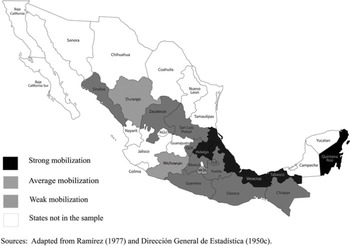
The PRI ran as such for the first time in 1946. The presidential elections of that year are important because they serve as a gauge of what the party had accomplished during the formative period that began in the end of the 1920s. There were clear regional dimensions to the relative electoral strength of the party. Figure 3 synthetizesFootnote 14 the overall pro-PRI voting results and turnout rates for the 17 states in the sample. Electoral data should not be taken as a measure of individual support for the party (as in a liberal democratic model)—results should be interpreted as a rough measure of the party’s effectiveness to put its political machine in operation (hence the importance of looking at turnout as well because there were cases of high pro-PRI vote but very low turnout).
Electoral mobilization in peasant states: 1946.

Based on the indicator of cohesion presented in the preceding text, I expected the PRI to show weakness in Michoacan, Morelos, and Guerrero, and show strength in Veracruz and Tabasco. As figure 3 shows, my expectations are consistent with the data: Veracruz and Tabasco, the states with highest levels of erosion, are also the areas where the PRI was electorally stronger in the period studied. Vice versa, Michoacan and Morelos, states with the highest levels of cohesion, presented the lowest levels of strength for the PRI.Footnote 15 A partial exception is Guerrero, which shows average levels of mobilization (instead of high levels). Two other states, Hidalgo and Quintana Roo, also show PRI strengthFootnote 16—while these two states are not classified as most eroded, they do show an average level of erosion. In other words, none of the highly eroded states show low support for the PRI, and, vice versa, none of the states showing strong support for the PRI had a highly cohesive peasantry.Footnote 17
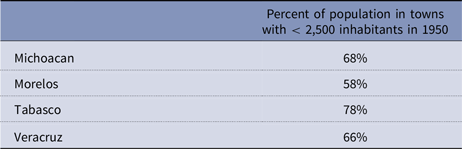
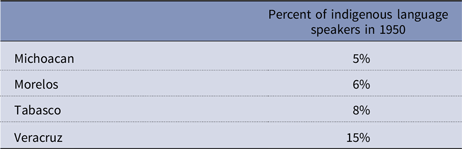
Michoacan and Morelos, and Veracruz and Tabasco—the states at opposite sides of the spectrum of electoral mobilization—share important characteristics, starting with the fact that these were places with a particularly high agrarian population, averaging a peasant population of more than 75 percent, with very similar levels of population density (see table 2). Tabasco and Morelos, on opposite ends of the spectrum of cohesion, had similar percentages of indigenous populations (8 percent and 6 percent, respectively, according to the 1950 Census, see table 3). Veracruz, a very eroded state, has the highest percentage of indigenous-speaking peoples in the states considered. Morelos and Tabasco were both significantly tied to sugar production (Aurrecoechea Reference Aurrecoechea1993; Warman Reference Warman1980). Important regional strong men—“caciques”—connected to the party where a fixture in each state, particularly Michoacan (Lazaro Cardenas), Tabasco (Garrido Canabal), and Veracruz (Adalberto Tejeda). And in fact, the amount of land redistributed by 1940 (after the big push of the Cardenas’s government) was considerably higher in Michoacan and Morelos than it was Veracruz (where my argument would predict the PRI to be stronger).

Indigenous language speakers: 1950

Source: Censo General 1950.
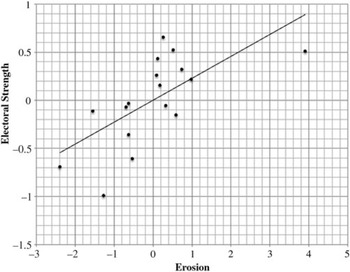
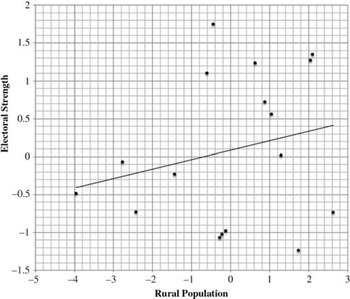
The correlation between erosion and PRI electoral strength holds when the data is analyzed as continuous variables. Figures 4 and 5 explore this bivariate relationship in greater detail (all the measures have been converted into standardized z-scores to ease comparison). Figure 4 represents the relationship between erosion and the 1946 electoral results. This correlation has a coefficient of .6, suggesting the centrality of erosion in understanding the level of mobilizational strength that the party had achieved at the moment it takes it final form. It is important to point out that contrary to representational approaches to party formation, peasantry levels within the sampled states have little effect on electoral mobilization: Figure 5 presents the bivariate relationship between peasantry levels and electoral results in highly agrarian states, which has a correlation coefficient of .2. As the plot shows, the effect of peasant concentration on mobilizational strength is marginal.
PRT’s electoral strength in states as a function of erosion: 1946.

PRT’s electoral strength in states with a concentration of peasants as a function of the percentage of rural population in each state: 1946.

As evidenced in the preceding discussion there were clear regional dimensions to the relative electoral strength and weakness of the party: the Gulf region—the most eroded in the country—was the area where the PRI concentrated its mobilizational capacity, while the Central-Pacific area—the most cohesive in the country—remained a considerably difficult place for the party.
Elections on the Ground in Cohesive Morelos and Michoacan
To further explore the relationship between erosion and electoral mobilization and give a sense of how mobilization looked on the ground, consider the case of Morelos, a particularly cohesive state. The tenuous nature of the relationship between peasantry and party is quite explicit in the following excerpt from a 1935 government informant’s report to the State Department on the party’s internal elections to select a candidate for the upcoming gubernatorial race. The informant describes an incident during election day in Cuautla, Morelos:
After 7am, several buses with peasant contingents started arriving, coming from towns near Cuautla, brought by orders of [the candidates] Mendoza, Heredia, and Abundez; I saw how Heredia’s [staffers] would house them in house no. 9 of Escolta street, locking them inside; later on [the peasants] started leaving, at the same time arguing that they were not pigs to be locked up like that. (AGN DGIPS, box 68)
Whatever the level of support garnered it appears to be highly conditional. In fact, many informants’ reports contend that people were being bused in from other places (from outside a given municipality or even the state), suggesting that even this form of coordination was impossible in the area.
The municipality of Jojutla was particularly troubling for authorities setting up elections there. As one informant reported: “it should be warned, that this is considered one of the most difficult municipalities when it comes to electoral issues, due to its inhabitants’s proneness to uprisings” (AGN DGIPS, box 164). Interestingly, the available 1940 agrarian census data, suggests that Jojutla was particularly “cohesive.” For example, out of its nine ejidos, four reported no sale whatsoever of their products, signaling little connection to market-oriented production (only 15 other ejidos in the state—out of a total of 200—reported a similar situation). This insularity and self-sufficiency is also evident when looking at the amount of communally owned machinery and implements: the average worth of communal machinery by ejidos at the statewide level was around $2,800 pesos, while ejido holders in Jojutla alone owned an estimated $13,000 pesos worth of communal machinery.
As tough as the process was for the party in mid-1930s Morelos, some evidence suggests that setting up elections in this state had been a more serious problem before. A 1924 newspaper report (sent to the Department of State by a government agent) contended that “authorities had ordered the poor police men to install the polling stations [and] forcefully bring out the town’s dwellers, whose abstention was causing the failure of local political authorities” (AGN DGIPS, box 162). The lackluster participation in electoral politics is a sign of the failure of mobilization in the area. Another report from the 1930s contended that “[the] official candidate … completely lacks any political force … he is actually hated, first because he is considered an imposition, and secondly, because he is unknown” (ibid.).
It is telling that the reach of the party in the region discussed remained spotty up through the end of the 1930s. According to government informants, at least until 1938 few major population centers in Michoacan had permanently stationed party agents. As a bewildered informant lamented in a report: “in Uruapan … there is yet to be organized any sort of committee of the [Party] and no orders have been given to do so by the State’s committee” (AGN DGIPS, box 60). This situation was not, as I will show in the following text, the state of electoral mobilization in eroded regions.
Elections on the Ground in Eroded Veracruz
Compare the scenario described in the preceding text with that in Veracruz. Government informants just like the ones reporting from Morelos and Michoacan, presented a very different image of the mid-1930s local elections. For the most part, reports about the mood surrounding the 1935 electoral process and election day in Veracruz contrast those described previously: “the election took place in perfect calm and was even somewhat boring” (AGN DGIPS, box 171) and “none of the polling stations reported disagreements or complaint” (ibid.). In Veracruz, for starters, party committee seemed to be pervasive by 1935: a report informs that rallies for the party’s candidate were organized by the local committee in each and every municipality (AGN DGIPS, box 66). A description of one of these rallies is illustrative of the confidence in public displays of strength:
At the head [of the march] goes the committee’s president, carrying a great tricolor flag with a PNR symbol in the center. He is followed by the municipal employees and people by foot, and at the end, the horsemen … this rally took place in absolute order. It was composed of 600 or 700 men on foot and 93 on horse, I counted each one—according to people who know these individuals perfectly well, the former are peasants, servants in the ranches and workers for the cattle-ranchers in the nearby estates. (AGN DGIPS, box 171)
The march offers a visual representation of party mobilization: the peasantry leading a cross-sectoral coalition that cuts across classes but does so under the banner of the party’s flag, held not by peasant leaders but by party officials. This is a strikingly different image from that of the busing incident discussed in the preceding text.
Conclusion
This article has argued that existing approaches to explaining party emergence fail to account for subnational variation in a critical case: Mexico’s PRI. A representational approach has seen parties as reflections of preexisting latent social divisions, mainly class. A state-modernization approach developed Weber’s view that changes in the institutional framework of the state introduce incentives for party building. These approaches cannot account for variation between cases with similar sectors available for mobilization and identical state arrangements. I develop a different approach: parties emerge as mass organization through a process of constitution of the very social base they claim to represent, but their constitutive powers are conditioned by fundamental economic structures.
I showed the connection between erosion and party formation in three realms of political activity. First, in terms of the construction of peasant organizations to serve as intermediaries between party leadership and the mass. Pointing to regional variation in membership rates, I showed how the party was able to build peasant associations in areas where land privatization had been more intense, and how it was less successful in areas where communal landholding was stronger. Second, I showed how erosion mattered for the absorption of existing organization: I illustrated how, in cohesive regions, the agrarista movement developed in a fragmented form, distant from party and state. However, in eroded regions, such as Veracruz, the agrarista movement took the form of groups like the LNC, which was the model of future collaboration with party and state. Finally, in the relationship to electoral mobilization, I showed that cohesive regions were places where the PRI struggled electorally and, vice versa, how well the party did in eroded regions. I illustrated how electoral mobilization looked on the ground in these two regions: in cohesive states like Morelos, the PRI had difficulty mobilizing turnout, dealt with outright contempt for their politicians, while eroded regions like Veracruz saw successful mobilization at the polls, and visible gains obtained through party activism.
When the party was pushing forth parceling, when it was channeling the LNC to become apolitical, and when it was building new intermediary organizations, it was not mapping unto a preexisting social group, it was shaping a constituency—it was shaping a political actor, not reflecting one. And, of course, institutional restructuring was not enough to get the party going in places where it encountered a disjointed, highly localized agrarista movement, or when it was unable to mobilize people to the polls in cohesive regions. And the party was not an aftereffect of changes in the formal electoral process. Suffrage expansion might have created the incentive to incorporate broader sectors of society, but there were limitations and openings that preceded, or were independent of, the process of state formation. A representational approach and state-centered approach would expect cohesion to be an advantage for the party and erosion an obstacle, making it harder to establish relationships with leaders, to coordinate and discipline increasingly atomized citizens. Instead I show the party emerging where there was a form of disintegration. The dissolution of village identity and solidarity, of traditional authority—underpinned by the destruction of communal property—permitted a reorganization of peasants on the basis of a national party program. Arguably, the very appearance of the campesino (the “peasant”) as an interest group (Boyer Reference Boyer2003) is linked to the decline of traditional village structure.
Why does erosion matter? What intervening mechanisms does it facilitate? Erosion of communal property regimes and organization of production changed rural peoples’ sense of themselves in relation to their communities, their work, in ways that made it easier for them to ally or participate in unions, leagues, and commercial co-opts. Erosion generated the types of interests that transcended the immediate community, and “freed” a mass of individuals available for new forms of political organization that corresponded to the pursuit of these transcommunal interests. A national party could interact with these unions and organizations to shape and channel the demands of this sector in a way compatible with party organization. The interests negotiated might take the form of a more protracted programmatic agenda, postponing immediate rewards for mid-term or long-term goals. This condition enabled the party to articulate its interests with them and absorb these groups. This associational structure could not exist in the context of highly localized interests with no market orientation, where the biggest demand that could be made to the state was its retraction, hence limiting the intervening role of the party. Erosion does not automatically lead to the existence of a civil society. It is its condition of possibility—and in so far as it is, it is also a condition of possibility for the mass party.
Acknowledgments
Thanks to Dylan Riley for his invaluable advice on earlier drafts of this article. Cedric De Leon, Peter Evans, Margaret Chowning, Graham Hill, Jonah Stuart Brundage, and William Welsh provided detailed comments that greatly improved it. I am also grateful to audiences at UCLA, UC Irvine, Johns Hopkins, and the Watson Institute at Brown University. Thanks as well to Jennifer Siqueira for her help with the maps.