




No CrossRef data available.
Government Spending and Public Support for Trade in the OECD: An Empirical Test of the Embedded Liberalism Thesis
Published online by Cambridge University Press: 17 May 2005
Abstract
According to the embedded liberalism thesis, governments committed to free trade provide insurance and other transfers to compensate those who lose economically from expanded trade. The goal of this spending is to maintain public support for trade liberalization. We provide a micro-level test of the critical assumption behind the embedded liberalism thesis that government programs designed to protect individuals harmed by imports reduce opposition to free trade. Our micro results have important implications for the macro relationship between trade and government spending, which we also test. We find empirical support for the embedded liberalism thesis in both our micro- and macro-level analyses.Earlier versions of this article were presented at the Midwest Political Science Association's 2002 Meeting and at the University of Illinois during summer 2003. We thank the respective panel and seminar participants for their feedback. In addition, we want to acknowledge valuable comments from William Bernhard, Rebecca Blank, Kerwin Charles, Alan Deardorff, John DiNardo, John Freeman, Brian Gaines, Jim Granato, Nathan Jensen, William Keech, Layna Mosley, Robert Pahre, Ken Scheve, Marina Whitman, two anonymous reviewers, and Lisa Martin. They, of course, are not responsible for any errors.
Information
- Type
- Research Article
- Information
- Copyright
- © 2005 The IO Foundation and Cambridge University Press
According to Ruggie, the international community learned two important lessons from the collapse of the gold standard and interwar global economy. First, the international economy would break down if states pursued unilateral, beggar-thy-neighbor trade policies. As a result, postwar governments around the Organization for Economic Cooperation and Development (OECD), by and large, have committed themselves to pursuing free trade through multilateralism. Second, governments could not ignore the internal costs of adjusting to external economic shocks. Because trade causes economic dislocations and exposes workers to greater risk, it generates political opposition that democratically elected leaders ignore at their peril. Thus, one important implication of the commitment to free trade is that political leaders have had to be aware of and actively manage public support for economic openness. To do this, governments have exchanged welfare state policies that cushion their citizens from the vagaries of the international economy in return for public support for openness.
Ruggie has termed this exchange the bargain of embedded liberalism.1
According to this story of postwar reconstruction, a link between trade and welfare state spending was established soon after World War II ended. Of course, the specific form this bargain takes is both geographically and historically contingent. The Keynesianism that emerged in the United States, for example, differed from the social democratic corporatism that developed in Sweden and Austria, and the demand management policies of the Bretton Woods era have given way to the active (supply-side) labor market policies of the so-called Third Way. But the idea that there is a more or less universal expectation held by citizens in the developed democracies that their governments will limit the costs and distribute the benefits of open markets through some kind of government intervention and spending, and that public support for liberalism depends on the willingness and ability of governments to do this successfully, is the core of the embedded liberalism thesis. This is what distinguishes the embedded liberalism of the postwar period from the ideology of pure laissez-faire that guided economic policy under the gold standard.2See Blyth 2002. Blyth argues that liberal capitalism has become less embedded since the Ronald Reagan and Margaret Thatcher period, but the changes, in his view, do not amount to a return to pre–World War I policies. Others argue that the significance of the Reagan and Thatcher “revolutions” has been exaggerated—for example, Pierson 1994.
Recently, the argument that trade and government spending go hand in hand because governments have to compensate market losers has come under attack. Several studies claim that the relationship between trade and spending is weak at best and largely attributable to omitted variable bias. We have three criticisms of this research, which has focused almost entirely on the macro-level (country) empirical relationship. First, this research rarely distinguishes between imports and exports. Most studies use the summed value of imports and exports as a percentage of gross domestic product (GDP)—trade openness—as an independent variable in their respective regression analyses. This constrains the effects of imports and exports on government spending to have the same sign. We suspect these flows should have opposite signs. Second, it fails to consider the varying degrees of labor market exposure to international trade. We argue the postindustrial shift in production from tradables to nontradables should reduce the effect that trade has on government spending, because it reduces the number of workers employed in import-competing sectors of the economy.
Our final and most important criticism is that no one has tested the micro-foundations of the embedded liberalism thesis. The key assumption is that government policies can build public support for trade. We believe macro-empirical studies that put spending on the left-hand-side of regression models will always be vulnerable to claims of omitted variable bias and that to make a convincing empirical case for the free trade–welfare state linkage, it is necessary to examine data at a lower level of aggregation. In this article, we provide a micro-level test of the embedded liberalism thesis. Our results have important and testable implications for the relationship between aggregate trade and government spending.
The article is organized as follows. In the first section, we briefly review and critique the literature on trade and government spending. In the second section, we present an empirical examination of the determinants of individual support for protectionism. Our results show that individuals employed in import competing industries are the strongest opponents of trade, but unemployment insurance and active labor market programs can moderate their opposition. Based on these findings we argue that (1) politicians respond to surges in imports and not necessarily to expanding trade if it is balanced, and (2) the extent to which politicians respond to rising imports will be a function of how many workers are employed in tradable industries. We test these two macro-level hypotheses in the third section of the article as a way to check the significance of our micro-level results for the trade–welfare state debate. We conclude in the final section.
Trade and Government Spending in the Developed Democracies
It is well known that countries with open economies have bigger governments.3
See, for example, Cameron 1978; Katzenstein 1985; and Rodrik 1998.
By short-term we mean changes in trade at time t − 1 have a discernible effect on government spending at time t.
This position has been challenged in two ways. First, Garrett and Mitchell argue the relationship between trade and welfare state effort is long-term and historically contingent.6
For the small economies of Western Europe, trade dependence facilitated unionization, which, in turn, created strong social democratic parties that built large welfare states when they came to power. They distinguish this argument from Ruggie's:
With respect to trade, for example, Cameron (1978) and Katzenstein (1985) both argue that there is a historical relationship between trade and welfare state effort…. This is a very different argument from another perspective with which it is often conflated—Ruggie's (1982) notion of embedded liberalism. For Ruggie, the American welfare state expanded immediately after World War II because the government chose to liberalize trade, and realized they had to compensate market losers directly for the dislocations liberalization generated.7
Ibid., 163. We believe both short-term and long-term historical forces are operating. Our empirical analysis bears this out.
Garrett and Mitchell contend that when country dummies (fixed-country effects) are added to regression models, the analyst can distinguish between the long-term historical argument of Cameron and Katzenstein and Ruggie's notion of embedded liberalism. In Garrett and Mitchell's analysis, the positive relationship between trade openness and government spending disappears.8
In fact, they find that the relationship is negative and statistically significant.
The strongest challenge to the embedded liberalism thesis, however, has come from Iversen and Cusack, who argue the post–World War II growth of the welfare state is a product of deindustrialization not globalization.9
They posit that workers who move from manufacturing and agriculture to services cross significant skill boundaries that make the transition difficult and uncertain. These problems, in turn, create demands for government spending. Iversen and Cusack show that the relationship between trade and spending is either statistically or substantively insignificant after controlling for deindustrialization. Moreover, they claim that deindustrialization and globalization are largely independent processes.Garrett and Mitchell and Iversen and Cusack raise serious questions about the validity of the embedded liberalism thesis. Thus the causal mechanisms identified by Ruggie and others deserve closer empirical scrutiny. We believe it is difficult to do this effectively by working only with data at the country level, and so in the next section, we test the microfoundations of the embedded liberalism argument using survey data. However, before moving on, we note two important criticisms of the research described in this section.
First, the research fails to adequately distinguish between imports and exports. Most studies use trade openness—the summed value of exports and imports as a percentage of GDP—as the key independent variable.10
In addition to trade openness, Garrett and Mitchell, 169–70, include the value of imports from low-wage countries in their analysis. They find these imports are weakly positively correlated with higher government spending and transfers. They do not examine the effects of total imports on spending and transfers.
This is true unless one is interested in measuring a country's exposure to external risk. To do this, one would interact a country's trade openness—a measure of how exposed it is to the international economy—with a measure of external risk like its terms of trade volatility. See Rodrik 1997, 1998. By itself, trade openness is not a good measure of risk.
Second, the research also fails to recognize that the impact of trade flows on government spending depends on the underlying structure of the economy, in particular how many workers are employed in vulnerable traded industries. Because democratically elected governments are sensitive to numbers of votes, ceteris paribus, their response will be conditioned by the scope of threatened industries. If imports displace a large number of workers/voters, governments will have little choice but to provide compensation. If a small number of workers are displaced, politicians will face less pressure to respond.12
The ceteris paribus condition is important. We are assuming that the ability of those employed in traded industries to organize remains constant. Because small groups may find it easier to engage in collective action, they are often able to exert political influence that is disproportionate to their numbers. For a discussion of the importance of collective action issues in trade policy politics, see Alt and Gilligan 1994.
In the next section, we test whether government policies can build support for economic openness among groups that oppose it. If government spending on programs such as unemployment insurance and active labor market programs successfully reduces the level of opposition, there is micro-level evidence that the embedded liberalism compromise is a viable solution to the political problems faced by democratically elected leaders who commit their countries to free trade.
Unemployment Benefits and Individual Attitudes Toward Trade
A flurry of research on the determinants of individual support for trade has been published in the last couple of years. Most of it, drawing on international trade theory, focuses on how skill level and sector of employment determine an individual's support for protectionism. Examples include studies by Scheve and Slaughter, O'Rourke and Sinnott, and Mayda and Rodrik.13
The main conclusion of this research is that groups adversely affected by international economic competition are less likely to support policies of free trade. If government spending is driven partly by the need to generate public support for economic openness, this micro-level research has significant implications for the macro debate over trade and government spending. Yet none of these studies examine the impact of government programs on support for trade. It is surprising that few scholars have tried to bridge the micro-macro divide.The exception is new work being done by Aldrich, Lange, and others at Duke University, who, picking up where the economists leave off, show that objective conditions of vulnerability translate into subjective feelings of insecurity and strong policy preferences that then determine an individual's party identification and ideology, variables that significantly affect vote choice.14
For a summary of this research, see Aldrich et al. 2002. One of the underlying motivations behind this project is that the macro-level literature on globalization rests on simple micro-level assumptions that have not been tested.
We focus much more on the “supply side” of the welfare state/trade openness nexus. We suspect that those adversely affected by trade are more likely to demand tariff protection than welfare state compensation. Governments that want to maintain free trade policies supply compensation as a compromise solution. Our “supply side” focus leads us to ask: If governments provide compensation in the form of unemployment insurance or active labor market programs, will it effectively build support for free trade among those who are likely to oppose it otherwise? This relationship between government spending and support for trade is essential to the embedded liberalism thesis, and it has yet to be tested directly.
Before turning to our empirical analysis, we note another strength of the Duke project—its attention to the role of institutions in shaping individual policy preferences. Drawing on important insights from the varieties of capitalism literature, the Duke project examines the effects of different national production regimes on policy attitudes.15
See Hall and Soskice 2001 for an exposition of the varieties of capitalism argument.
We do not doubt that a country's institutional structure plays an important role in shaping individual attitudes toward trade, but we believe there are more general forces at work as well. We begin with these and leave the effects of production regimes and other important national differences (beyond welfare state policies) for future research. Institutions also constrain how governments respond to changes in the policy preferences of organized interests and voters. We return to this topic in our conclusion.
Data and Methods
The data we use is from the International Social Survey Program's (ISSP) 1995 survey on national identity. This data set, used by both Mayda and Rodrik and O'Rourke and Sinnott, provides information about individuals' attitudes toward free trade. The countries in our sample are Australia, Germany, the United Kingdom, the United States, Austria, Hungary, Norway, Sweden, the Czech Republic, Poland, New Zealand, Canada, and Spain.16
We included all countries reporting occupational categories that allowed us to determine a respondent's industry of employment.
How much do you agree or disagree with the following statement: (Respondent's Country) should limit the import of foreign products in order to protect its national economy.
- Agree strongly
- Agree
- Neither agree nor disagree
- Disagree
- Disagree strongly
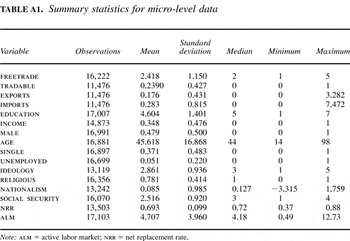
We assigned a value of 1 to respondents who answered, “agree strongly,” a 2 to those who answered, “agree,” etc. Thus, high values of freetrade reflect protrade attitudes whereas low values reflect support for protectionism.
Our baseline regression is grounded in trade theory.17
See Alt and Gilligan 1994; and Hiscox 2002.
These models tell us the direct effect of trade on income earned from employing different factors of production. It is also possible that trade affects the wealth and (unearned) income of asset owners. For example, Scheve and Slaughter 2001 find that home owners who live in import competing regions of the United States are, ceteris paribus, more likely to oppose trade than renters. Unfortunately, the data that we would need to test this and similar hypotheses on a cross-national basis is not readily available.
In our analysis, we use an income dummy variable as a proxy for one's capital endowment. We gave everyone in our sample whose annual family income was greater than $35,000 a score of one and everyone else a score of zero.19
Local currencies were converted into dollars using the appropriate exchange rate; monthly income was converted to annual income when necessary. This is the same income measure used by Hiscox and Burgoon 2003.
The industries are (1) agriculture, hunting, forestry, and fishing; (2) mining and quarrying; (3) food products, beverages, and tobacco; (4) textiles, textile products, leather, and footwear; (5) wood and products of wood and cork; (6) paper and paper products; (7) publishing, printing, and reproduction of recorded media; (8) chemical, rubber, plastics, and fuel products; (9) other nonmetallic mineral products; (10) basic metals; (11) fabricated metal products, except machinery and equipment; (12) machinery and equipment; (13) transport equipment; and (14) manufacturing not elsewhere classified.
To this list we add several demographic and ideological variables used by Hiscox and Burgoon.21
They identify gender, age, employment status, and marital status as important determinants of trade preferences. They also focus on an individual's political ideology and whether or not the respondent self-identifies with a particular religious faith. For ideology we use a five-point party affiliation scale provided in the ISSP data set that ranges from far left (1) to far right (5). For our religion variable, we use a dummy that takes a value of one for individuals who self-identify with a religious denomination and zero for everyone else. We also include whether one holds nationalist attitudes, which was found by both Mayda and Rodrik and O'Rourke and Sinnott to be an important determinant of trade policy preferences. In their analysis, Mayda and Rodrik use four separate questions that gauge whether one holds patriotic, nationalistic, and/or chauvinistic attitudes. Using factor analysis, we extract a single component from the answers to these four questions that measures the degree to which an individual holds nationalist attitudes.Finally, we include three policy variables in our analysis. Two of the three variables are objective measures of government policy: the net replacement rate for unemployment insurance (nrr) and the amount of government spending on active labor market programs per unemployed worker (alm). The former measure varies across individuals within countries while the latter does not. We also include a subjective evaluation of the social security system (social security). This variable is based on a question that asks respondents how proud they are of the social security system in their country. Respondents can answer “very proud,” “somewhat proud,” “not very proud,” or “not proud at all.” We scored these responses from 1 to 4, giving those who were not proud at all a 1 and those who were very proud a 4. We included a subjective measure out of concern that respondents might not be aware of the details of the unemployment insurance and active labor market policies in their countries. We assume that respondents who are “very proud” of their social security system feel that they are well protected by it, and those who are “not proud at all” feel that they are not.22
We realize that this measure has its limitations. Political conservatives, for example, might not say they are proud of their country's social security system even if it offers generous protection. However, if conservatives are more supportive of trade, this will bias against finding a positive relationship between this subjective evaluation and support for free trade.
Turning to the objective measures, we calculated each country's spending on active labor market programs per unemployed worker (alm) using data from the OECD's Social Spending and Labor Force databases. These active labor market programs, which are designed to improve job seekers' prospects of finding employment and increase the earning potential of workers, include spending on public employment, labor market training, and other policies intended to promote employment among the unemployed. We include the net replacement rate of each respondent's government-provided unemployment benefits (nrr). The 1998 OECD's Benefit Systems and Work Incentives calculates net replacement rates for four family types at two income levels.23
OECD 1998. See tab. 3.1, 30, for these net replacement rates.
We used single, number of persons in household, and the household cycle variables from the ISSP data set (v202, v293, and v294 respectively) as well as the family income dummy variable (income) to identify each survey respondent's net replacement rate. The household cycle variable indicates whether there are children in the household. There are no problems identifying singles and married couples without children. In many instances it is not difficult to identify lone parents and married couples with children because these family types are included in the household cycle variable. The difficult cases arise when singles live in households with more than one adult and couples live in households with more than two adults. In these cases, parental status is unknown. We gave all identified married respondents with children the married two-child net replacement rate. Similarly, we gave all lone parents the lone parent two-child net replacement rate. When we could not identify parental status, we gave the respondent the average value of their no dependent and two-child net replacement rate.
The household cycle variable was not available for the United Kingdom, Austria, the Czech Republic, and Poland. For the respondents in these countries, we used the number of persons in household variable to identify cases where there are no children living in the household (for example, a single respondent living in a household with only one person). When we could not determine whether or not children were living in the household, we used an average net replacement rate. In most countries net replacement rates are higher for low-income individuals. We used our existing income dummy variable (income) to assign average income and below average net replacement rates. The main advantage of our nrr variable is that, with eight replacement rates, it provides substantial within country variation in unemployment insurance coverage.24
In terms of research design, this variable is an improvement over countrywide measures of unemployment protection because it allows the analyst to incorporate fixed country effects into the regressions. The fixed-effects model allows us to control for unobservable or otherwise omitted country-level factors that correlate with a country's average net replacement rate.
We estimate ordered probits because the dependent variable, freetrade, is ordinal. Ordinal dependent variables can create problems for linear models because these models assume that the intervals between adjacent categories are equal. If this assumption does not hold, the estimated coefficients will be biased and misleading.25
Also, because many individuals in each country are exposed to the same “treatment” (for example, the same active labor market programs) and cannot be considered independent trials, we have to be careful estimating the standard errors for our regression coefficients.26 We reported robust “clustered” standard errors as a way to address the “duplication” problem.27For a discussion of this problem, see Steenbergen and Jones 2002, 219–20. In calculating our standard errors, we assume respondents are clustered by country.
Results
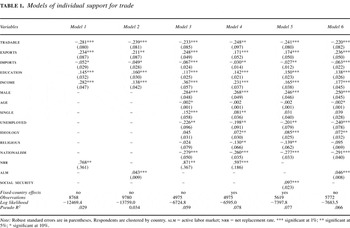
The regression results are presented in Table 1.28
The cut-point estimates are omitted from the table to save space.
We get similar results when we interact our measures of trade exposure with the social protection variables. For example, in Model 4, if we make the effect of trade exposure on support for trade dependent on the level of social protection, we continue to find that employment in import competing sectors of the economy has a large negative impact. The size of this effect declines, however, as the level of social protection rises.
Because this variable is constant across individuals within countries, we cannot include it in a model with fixed country effects.
Models of individual support for trade

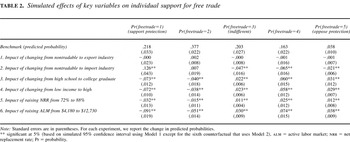
In order to demonstrate the size of the effects that the key variables have on individual support for free trade, we conduct several counterfactual experiments using simulation methods.31
These experiments were conducted using the software developed by Tomz, Wittenberg, and King 1999.
This number is calculated by totaling the first two columns of Table 2. In our experiment, we define import competing as a sector with imports worth 184 percent of value added. The two percentages—118 percent (exports) and 184 percent (imports)—are at the 95th percentile in our sample. Note that this percentile is for our entire sample and most respondents are employed in nontraded industries. These numbers are more representative for the subsample of respondents employed in tradable industries.
Simulated effects of key variables on individual support for free trade

Overall, our results are very supportive of the embedded liberalism thesis. The strongest opposition to trade comes from individuals employed in sectors of the economy that have the highest levels of imports. Yet, these results demonstrate that politicians can, in fact, build support for trade, even among these sectors. Politically feasible policy reforms can offset declines caused by increased exposure to international competition.
Imports and Government Spending in Postindustrial Economies
Our micro results confirm the significance of the tradable/nontradable and import/export distinctions. Politicians who want to maintain support for trade will have to respond to surges in imports. This is particularly true if there are a large number of individuals employed in tradable sectors of the economy. However, as individuals move out of tradable industries it becomes less important for politicians to respond to increased imports. Thus, our micro results suggest that the movement of workers from tradable to nontradable sectors will increase support for trade. Therefore, globalization and deindustrialization should have interdependent effects on government spending.33
Many believe that globalization and deindustrialization are interdependent processes in the sense that expanding trade explains the decline of manufacturing among the OECD economies. Iversen and Cusack reject this argument. See Iversen and Cusack 2000, 339–45. We are not arguing that trade causes deindustrialization but rather deindustrialization conditions the effect of trade on government spending. A similar argument is made by Mares 2004.
Data and Methods
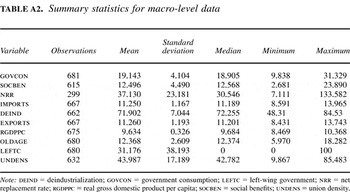
Our sample, which spans from 1960 to 2000, includes seventeen OECD countries: Australia, Austria, Belgium, Canada, Denmark, Finland, France, Germany, Ireland, Italy, Japan, the Netherlands, New Zealand, Norway, Sweden, the United Kingdom, and the United States. The key independent variable is the natural log of imports measured in millions of 1995 U.S. dollars.34
OECD's Economic Outlook Database. See OECD 2003b.
Their measure is 100 minus the workers employed in manufacturing and agriculture as a percentage of the working age population.
We include three separate dependent variables in our analysis. The first two are common in the literature: government consumption as a percentage of GDP (govcon) and social benefits as a percentage of GDP (socben).36
This data is from OECD's Economic Outlook Database. See OECD 2003b.
The variables used to construct NRR are from the OECD's Social Spending, Labor Force, and Economic Outlook Databases. See OECD 2001, 2003a, and 2003b. For a critique of the research using government consumption and social benefits as dependent variables, see Burgoon 2001; and Mares 2004. Mares argues that all expenditure-based measures are problematic because they do not reflect politically salient aspects of policy design. We disagree because expenditures are directly related to the generosity of benefit payments, and the generosity of benefits is as politically salient as (if not more salient than) any other feature of welfare state policy.
We add five control variables to our analysis: GDP per capita; the percentage of the population above the age of sixty-five; the percentage of cabinet seats held by left-wing parties; union density; and exports.38
The sources are OECD 2003b; Franzese 2002, and Swank 2002b.
See, for example, Pierson 2001.
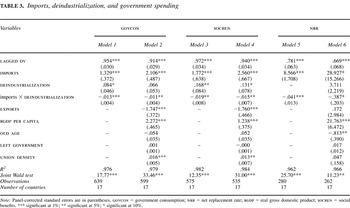
We estimate six panel regressions, two for each of our dependent variables. One model includes the controls; the other does not. As do many political scientists, we include the lag of the dependent variable and country dummies in all of our models to control for persistence and unit heterogeneity respectively. In other words, we estimate a dynamic panel model using the least squares with dummy variables (LSDV) estimator.40
For a good introduction to the LSDV estimator, see Hsiao 2003, chap. 3.
Results
The regression estimates are reported in Table 3. In short, we find that the effect of imports on a country's level of government spending depends on how exposed the domestic labor market is to trade.42
This is similar to Mares's finding for the interwar period that both terms-of-trade and unemployment volatility have a larger impact on the coverage of unemployment insurance when the percentage of the workforce employed in manufacturing is high. See Mares 2004.
We do not include deindustrialization as a stand-alone regressor in Model 5 because it is highly collinear with the interaction term and we have a small sample. Our estimates of the other coefficients are much more precise when deindustrialization is omitted from the model. We feel comfortable dropping the variable because its coefficient is not statistically significant. In other words, we cannot reject the hypothesis that deindustrialization does not have a direct effect on net replacement rates. Excluding deindustrialization as a stand-alone regressor does not change the results in a qualitative sense though it does make them stronger.
Imports, deindustrialization, and government spending

To demonstrate the implications of the regressions, we conduct a set of counterfactual experiments that compare the effects of increasing imports on government spending in a hypothetical industrial and postindustrial economy.44
For the experiments, we use regressions 1, 3, and 5.
Each trial involves drawing a new vector of parameters from the multivariate sampling distribution defined by the coefficient estimates and the estimated variance-covariance matrix.
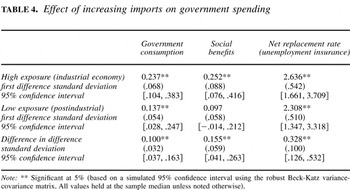
We set the deindustrialization variable to its sample values at the 10th (62.32) and 90th percentiles (80.32) to simulate our industrial and postindustrial economies respectively. In each experiment we increase the logged level of imports from $9.111 to $9.551. This is the size of the import surge New Zealand experienced between 1973 and 1974.47
This is the largest one-period increase in imports experienced by a country in our sample. We prefer to use this within country change rather than, for example, the difference from the 25th to 75th percentile, which is a much larger difference but one that is only observed across countries in our sample.
The results, which are reported in Table 4, are similar for all three types of government spending. The short-term effect of increasing a country's imports is larger for industrial than postindustrial economies. The difference in first differences is statistically and politically significant for each measure of government spending. The short-term effect of an import surge on government consumption is 0.100 higher for our hypothetical industrial economy when compared to its postindustrial counterpart. If the increase in imports were sustained, after three years the gap would increase to 0.287 (0.679–0.392). The differences for social benefits and net replacement rates are 0.155 and 0.328 respectively. Again, these differences would grow over time with a sustained increase in imports.
Effect of increasing imports on government spending

Our macro results demonstrate the significance of our individual-level findings for the trade/welfare state debate. Previous research has concluded that the short-term relationship between trade and government spending is an artifact (caused by omitted variable bias) that disappears when fixed-country effects and deindustrialization are taken into account. Our results show that this is not the case. The relationship between trade and government spending is robust when imports and exports are distinguished and the interactive effects of trade and deindustrialization are recognized.
Conclusion
Ruggie's embedded liberalism involves a political compromise in which leaders commit their countries to freer trade while managing the dislocations that follow. Our empirical tests—the first of the microfoundations of this theory—demonstrate that this compromise is a politically feasible one. Citizens' attitudes toward trade are malleable and well informed by their self-interest according to the predictions of trade theory. Workers who compete against imports tend to oppose free trade, but their opposition can be reduced with policies designed to protect them like unemployment insurance and active labor market programs.
We suspect many readers will be persuaded by our statistical results. Others will be skeptical because our results do not square with their previous beliefs about the importance of trade in determining government spending. If it is such a good idea politically to compensate those who lose from trade, why does it not happen more often? We have three responses to this query. First, it happens more often than many realize. The bargain of embedded liberalism is alive and well even in countries where we might not expect to find it. In the United States, for example, the Bush administration and free trade proponents in the Congress recently bought off opposition to Trade Promotion Authority by increasing the size of trade adjustment assistance and providing wage insurance for older workers displaced by trade.
Second, our results suggest that governments are less responsive to imports today than in the past. As OECD countries have moved more toward service economies, the effect of import surges on spending has declined because fewer citizens work in import-competing sectors. Having made this point, we want to stress that this situation is unlikely to persist. There is every reason to believe those employed in services sectors of the economy will become increasingly exposed to international competition over time, especially if trade in services is effectively incorporated into the General Agreement on Tariffs and Trade (GATT) and the World Trade Organization (WTO). Some of the recent U.S. backlash against Indian phone centers, for instance, shows that service industries are increasingly competitive across borders. Therefore, it is likely that the bargain of embedded liberalism will remain politically significant well into the twenty-first century.
Finally, even though our analysis in this article largely avoids institutions, we believe national institutions play an important role in determining if, when, and how the bargain of embedded liberalism is implemented in different countries. Cross-national variation in a number of political and economic institutions ranging from national production regimes to electoral systems is likely to be important. Welfare state policies are likely to be more attractive to politicians in coordinated market economies and majoritarian political institutions can insulate politicians from the pressures of trade losers. Future research should focus on how these and other institutions shape individual attitudes toward trade and constrain policy responses to economic globalization.
Appendix
Summary statistics for micro-level data

Summary statistics for macro-level data

References
REFERENCES
Adserà, Alicia, and
Carles Boix.
2002.
Trade, Democracy, and the Size of the Public Sector: The Political
Underpinnings of Openness.
International Organization
56 (2):229–62.Google Scholar
Aldrich, John H.,
Claire Kramer,
Peter Lange,
Renan Levine,
Jennifer Merolla,
Laura Stephenson, and
Elizabeth Zechmeister.
2002.
In Pursuit of the Missing Link: Do Voters Make the Connection
Between Macroeconomic Change and Welfare State Growth?
Paper presented at the 98th Annual Meeting of the American
Political Science Association, August–September, Boston.
Alt, James, and
Michael Gilligan.
1994.
The Political Economy of Trading States: Factor Specificity,
Collective Action Problems and Domestic Political Institutions.
Journal of Political Philosophy
2 (2):165–92.Google Scholar
Blyth, Mark.
2002.
Great Transformations: Economic Ideas and Institutional Change in
the Twentieth Century.
Cambridge:
Cambridge University Press.
Burgoon, Brian.
2001.
Globalization and Welfare Compensation: Disentangling the Ties that
Bind.
International Organization
55 (3):509–51.Google Scholar
Cameron, David.
1978.
The Expansion of the Public Economy: A Comparative Analysis.
American Political Science Review
72 (4):1243–61.Google Scholar
Franzese, Robert J.
2002.
Macroeconomic Policies of Developed Democracies.
Cambridge:
Cambridge University Press.
Garrett, Geoffrey, and
Deborah Mitchell.
2001.
Globalization, Government Spending and Taxation in the OECD.
European Journal of Political Research
39 (2):145–78.Google Scholar
Hall, Peter, and
David Soskice, eds.
2001.
Varieties of Capitalism: The Institutional Foundations of
Comparative Advantage.
New York:
Oxford University Press.
Hiscox, Michael.
2002.
International Trade and Political Conflict: Commerce, Coalitions,
and Mobility.
Princeton, N.J.:
Princeton University Press.
Hiscox, Michael, and
Brian Burgoon.
2003.
Trade Openness and Political Compensation: Explaining Labor Demands
for Adjustment Assistance.
Unpublished manuscript.
Cambridge, Mass.:
Harvard University.
Hsiao, Cheng.
2003.
Analysis of Panel Data.
2d ed.
Cambridge:
Cambridge University Press.
Iversen, Torben, and
Thomas R. Cusack.
2000.
The Causes of Welfare State Expansion: Deindustrialization or
Globalization?
World Politics
52 (3):313–49.Google Scholar
Judson, Ruth A., and
Ann L. Owen.
1999.
Estimating Dynamic Panel Data Models: A Guide for
Macroeconomists.
Economic Letters
65 (7):9–15.Google Scholar
Katzenstein, Peter.
1985.
Small States in World Markets: Industrial Policy in Europe.
Ithaca, N.Y.:
Cornell University Press.
King, Gary,
Michael Tomz, and
Jason Wittenberg.
2000.
Making the Most of Statistical Analyses: Improving Interpretation
and Presentation.
American Journal of Political Science
44 (2):347–61.Google Scholar
Mares, Isabela.
2004.
Economic Insecurity and Social Policy Expansion: Evidence from
Interwar Europe.
International Organization
58 (4).Google Scholar
Mayda, Anna M., and
Dani Rodrik.
2002.
Why Are Some People (and Countries) More Protectionist than
Others? Unpublished manuscript.
Cambridge, Mass:
Harvard University.
McKelvey, Richard, and
William Zavoina.
1975.
A Statistical-Model for Analysis of Ordinal Level Dependent
Variables.
Journal of Mathematical Sociology
4 (1):103–20.Google Scholar
Moulton, Brent R.
1990.
An Illustration of a Pitfall in Estimating the Effects of Aggregate
Variables on Micro Units.
Review of Economics and Statistics
72 (2):334–38.Google Scholar
Organization for Economic Cooperation and Development
(OECD).
1998.
Benefit Systems and Work Incentives.
Paris:
OECD.
Organization for Economic Cooperation and Development
(OECD).
2001.
Social Spending Database.
Paris:
OECD.
Organization for Economic Cooperation and Development
(OECD).
2003a.
Labor Force Database.
Paris:
OECD.
Organization for Economic Cooperation and Development
(OECD).
2003b.
Economic Outlook Database.
Paris:
OECD.
O'Rourke, Kevin H., and
Richard Sinnott.
2002.
The Determinants of Individual Trade Policy Preferences:
International Survey Evidence. In
Brookings Trade Forum: 2001, edited by
Susan M. Collins and
Dani Rodrik,
157–206.
Washington, D.C.:
Brookings Institution.
Pierson, Paul.
1994.
Dismantling the Welfare State? Reagan, Thatcher, and the Politics of
Retrenchment.
Cambridge:
Cambridge University Press.
Pierson, Paul.
2001.
The Dynamics of Welfare State Expansion: Trade Openness,
De-industrialization, and Partisan Politics. In
The New Politics of the Welfare State, edited by
Paul Pierson,
80–104.
New York:
Oxford University Press.
Rodrik, Dani.
1997.
Has Globalization Gone Too Far?
Washington, D.C.:
Institute for International Economics.
Rodrik, Dani.
1998.
Why Do More Open Economies Have Bigger Governments?
Journal of Political Economy
106 (5):997–1032.Google Scholar
Ruggie, John G.
1982.
International Regimes, Transactions, and Change: Embedded Liberalism
in the Postwar Economic Order.
International Organization
36 (2):195–231.Google Scholar
Ruggie, John G.
1994.
Trade, Protectionism, and the Future of Welfare Capitalism.
Journal of International Affairs
48 (1):1–11.Google Scholar
Ruggie, John G.
1997.
Globalization and the Embedded Liberalism Compromise: The End of an
Era?
Working Paper 97/1.
Cologne, Germany:
Max Planck Institut für Gesellschaftsforschung.
Ruggie, John G.
2003.
Taking Embedded Liberalism Global: the Corporate Connection.
In
Taming Globalization: Frontiers of Governance, edited by
David Held and
Mathias Koenig-Archibugi,
93–129.
Oxford:
Polity Press.
Scheve, Kenneth, and
Matthew Slaughter.
2001.
Globalization and the Perceptions of American Workers.
Washington, D.C.:
Institute for International Economics.
Steenbergen, Marco R., and
Bradford S. Jones.
2002.
Modeling Multilevel Data Structures.
American Journal of Political Science
46 (1):218–37.Google Scholar
Swank, Duane.
2002a.
Global Capital, Political Institutions, and Policy Change in
Developed Welfare States.
Cambridge, UK:
Cambridge University Press.
Swank, Duane.
2002b.
21-Nation Pooled Time-Series Data Set, 1950–1999: Political
Strength of Political Parties by Ideological Group in Capitalist
Democracies.
Milwaukee, Wis.:
Marquette University.
Available at
〈www.marquette.edu/polisci/Swankpart5099.xls〉. Accessed
January 18, 2005.
Tomz, Michael,
Jason Wittenberg, and
Gary King.
1999.
Clarify: Software for Interpreting and Presenting Statistical
Results. Version 1.2.1.
Cambridge, Mass:
Harvard University.
Updated version 2.1 (produced 5 January 2003).
Available at
〈http://gking.harvard.edu/stats.html〉. Accessed
January 18, 2005.
Models of individual support for trade
Simulated effects of key variables on individual support for free trade
Imports, deindustrialization, and government spending
Effect of increasing imports on government spending
Summary statistics for micro-level data
Summary statistics for macro-level data
 You have
Access
- 199
- Cited by