Implications
The bacterial chondronecrosis with osteomyelitis (BCO), also known as femoral head necrosis (FHN), is one of the most important leg disorders occurring on commercial broilers, affecting animal welfare and leading to economic losses. To better understand the genetic mechanisms involved in BCO in chickens, the differential expression of 13 genes were evaluated. Out of them, two (RUNX2 and SPARC) were downregulated in BCO-affected chickens, indicating that low levels of their expression might contribute to skeletal problems in broilers by reducing vascularization and bone mineralization. This study provided information on how these genes can act on bone metabolism.
Introduction
In the last decades, the poultry production system has focused on intense selection for heavier and faster growing broilers (Havenstein et al., Reference Havenstein, Ferket, Scheideler and Larson2003). The intense selection for rapid growth and the intensification of the production system in the poultry industry have negatively impacted the quality of the skeleton structure in meat-type chickens. This has resulted in an increased number of animals with bone-related problems (Cook, Reference Cook2000; Havenstein et al., Reference Havenstein, Ferket, Scheideler and Larson2003). As a consequence, the incidence of locomotor problems has increased significantly, causing a negative impact on welfare, feed efficiency, growth performance and other traits (Cook, Reference Cook2000). In the last decade, the estimated annually economic losses due to those problems was over $100 million dollars (Cook, Reference Cook2000). Nowadays, bone disorders are still being considered one of the main concerns to the poultry industry (Li et al., Reference Li, Zhou, Shi and Hou2015).
Bacterial chondronecrosis with osteomyelitis is one of the most important leg disorders in commercial broilers and it has been diagnosed worldwide (McNamee and Smyth, Reference McNamee and Smyth2000). This pathology is also known as FHN and its genetic mechanisms involved are not completely understood. The pathogenesis of BCO appears to be initiated by mechanical damage to poorly mineralized columns of chondrocytes (cartilage cells) in the epiphyseal and physeal growth plates of the leg bones, followed by colonization of osteochondritic clefts by opportunistic bacteria (Wideman et al., Reference Wideman, Hamal, Stark, Blankenship, Lester, Mitchell, Lorenzoni and Pevzner2012; Wideman and Prisby, Reference Wideman and Prisby2013). Numerous bacterial species of opportunistic organisms in mixed cultures have been isolated from BCO lesions, including predominantly Staphylococcus spp., Escherichia coli and Enterococcus spp. (Wideman et al., Reference Wideman, Hamal, Stark, Blankenship, Lester, Mitchell, Lorenzoni and Pevzner2012). Recently, Mandal et al. (Reference Mandal, Jiang, Al-Rubaye, Rhoads, Wideman, Zhao, Pevzner and Kwon2016), studying blood microbiota in chickens, observed an enrichment of some bacteria gender such as Staphylococcus, Granulicatella and Microbacterium in BCO-affected animals when compared with blood of healthy animals. Bacterial chondronecrosis with osteomyelitis is the most common cause of lameness and is an important cause of mortality in fast-growing broilers, affecting ~1.5% of slaughtered chickens at 42 days of age in the United States (Wideman et al., Reference Wideman, Hamal, Stark, Blankenship, Lester, Mitchell, Lorenzoni and Pevzner2012; Wideman and Prisby, Reference Wideman and Prisby2013). In Brazil, there is no consistent data on the incidence of this problem.
The bone is considered a dynamic tissue influenced by many physical, physiological and nutritional factors (Rath et al., Reference Rath, Huff, Huff and Balog2000). Genetics plays a considerable role in the development of the skeletal system (Cook, Reference Cook2000). Genetic variation has been observed, since the heritability for an index combining several bone integrity traits has been estimated around 0.4 (Bishop et al., Reference Bishop, Fleming, Mccormack, Flock and Whitehead2000). Also, according to the chicken QTL database (http://www.animalgenome.org/cgi-bin/QTLdb/GG/index), quantitative trait loci (QTL) for morphometric, mineral composition and strength characteristics of tibia and femur have been mapped on several chicken chromosomes, indicating important regions related to skeletal system. A potential large number of functional candidate genes involved with bone metabolism can be found in the QTL regions previously cited. However, there are few association studies with bone integrity traits in chickens (Fornari et al., Reference Fornari, Zanella, Ibelli, Fernandes, Cantão, Thomaz-Soccol, Ledur and Peixoto2014). Furthermore, the functional pathways, especially those related to BCO, are still unknown in chicken, as the studies are available mostly in humans and rodents. Also, it is known that chickens have different bone physiology, with quicker bone remodeling when compared with mammals (Johnsson et al., Reference Johnsson, Jonsson, Andersson, Jensen and Wright2015). Therefore, attempting to clarify the pathways involved with BCO in chickens, the expression profile of 13 functional candidate genes at the femur growth plate of normal and affected broilers with BCO at 45 days of age were evaluated in this study.
Material and methods
Experimental animals and sample collection
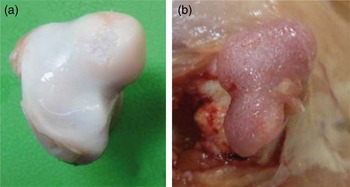
In this study, Cobb500 male broilers vaccinated against fowl pox and Marek disease at the hatchery were used. Approximately 60 chicks were reared at Embrapa Swine and Poultry National Research Center with a density of 12 broilers/m2 with infrared lamps, being the height adjusted for birds comfort. Water and feed were supplied ad libitum during the experiment. The drinkers, feeders, curtains, light and chickens were managed following the recommendations for this commercial line. At 45 days of age, chickens were weighted, evaluated for body conditional score and submitted to necropsy. Slaughter was carried out by cervical dislocation, according to the ethical guidelines of the Embrapa Swine and Poultry Ethics Committee on Animal Utilization, under the protocol number 011/2011, following the international guidelines for animal welfare. At the time of sample collection, femurs were classified by presence or absence of BCO according to Wideman et al. (Reference Wideman, Hamal, Stark, Blankenship, Lester, Mitchell, Lorenzoni and Pevzner2012). Femoral samples, specifically from the proximal growth plate, were collected from 10 healthy (control group) and from 10 affected chickens (case group), presenting the first stage of BCO (Figure 1). Samples were placed in microcentrifuge tubes, stored in liquid nitrogen and then transferred to −80°C freezer until the RNA extraction.
Femur proximal growth plate of normal (a) and bacterial chondronecrosis with osteomyelitis first stage affected (b) chickens.

RNA extraction and complementary DNA synthesis
Frozen tissues (−80°C) were grinded in a mortar containing liquid nitrogen, and 100 mg from femoral head tissue was mixed to 1 ml of Trizol© (Invitrogen, Carlsbad, CA, USA) reagent for total RNA isolation. Briefly, after incubate the homogenized sample for 5 min at room temperature (RT), 200 μl of chloroform were added and then samples were shaken vigorously. Samples were centrifuged at 12 000×g for 15 min at 4°C to phase separation. RNA in the aqueous phase was collected and precipitated with 1 volume of 100% isopropanol, incubated at RT for 10 min and centrifuged at 12 000×g for 10 min at 4°C. Then, the RNA pellet was washed using 1 ml of 75% ethanol, followed by centrifugation at 7500×g for 5 min at 4°C. Pellet was dried for 15 min at RT, and RNA was resuspended in diethyl pyrocarbonate (DEPC)-treated water.
RNA samples were quantified using a Nanodrop (Thermo Fisher Scientific, Waltham, MA, USA) spectrophotometer and those with OD260 : OD280 ratio >1.9 were considered for further analyses. The integrity was confirmed in 1.5% agarose gel. The complementary DNA (cDNA) was synthetized from 3 µg of total RNA using SuperScript III First-Strand Synthesis SuperMix® kit (Thermo Fisher Scientific), following the manufacturer’s instructions.
Real-time quantitative PCR
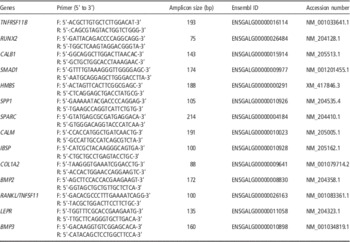
The relative expression of 13 candidate genes, chosen based on their function on bone development and ossification, was evaluated in this study: SPP1 (protein coding osteopontin), TNFRSF11B (osteoprotegerin), SPARC (osteonectin), CALB1 (calbidin 1), CALM (Calmodulin 2), IBSP (sialoprotein), COL1A2 (collagen, type I, α 2), BMP2 (bone morphogenetic protein 2), BMP3 (bone morphogenetic protein 3), RANKL (κ-B nuclear factor ligand), SMAD1 (SMAD family member 1), LEPR (leptin receptor) and RUNX2 (related transcription factor Runt 2). The sequences were obtained from Gallus gallus v. 4.0 on Genebank (http://www.ncbi.nlm.nih.gov/gene/) and Ensembl (http://www.ensembl.org/index.html) databases. Primers were designed using the primer-BLAST (Ye et al., Reference Ye, Coulouris, Zaretskaya, Cutcutache, Rozen and Madden2012), in exon–exon junctions to avoid DNA amplification (Table 1). In addition, primer sequences were evaluated for the presence of secondary structures in the Netprimer software (http://www.premierbiosoft.com/netprimer/). Amplification efficiencies were obtained using the LinRegPCR (Ruijter et al., Reference Ruijter, Ramakers, Hoogaars, Karlen, Bakker, van den Hoff and Moorman2009) and specificities were evaluated by melting curve analysis using the program from 70°C to 95°C at 0.1°C/s for all genes studied.
Primer sequences, Genbank accession number, Ensembl ID and amplicon sizes

The reverse transcription real time PCR reactions were carried out in 15 μl final volume containing 1× of Maxima SYBR Green/ROX qPCR Master Mix® (2×) (Thermo Fisher Scientific), 0.133 μl of each primer and 20 ng of cDNA. The analysis was performed on ABI Prism 7500 Real Time PCR System (Thermo Fisher Scientific) using SYBR Green as fluorescent dye (Thermo Fisher Scientific).
Gene expression analysis
Samples were analyzed in duplicate and the cycle threshold (Ct) mean for each sample was obtained and normalized to a reference gene. The HMBS (hydroxymethylbilane synthase; Table 1) was the reference gene used, as it was the most stable gene according to the RefFinder online tool (Xie et al., Reference Xie, Xiao, Chen, Xu and Zhang2012) (data not shown).
The relative quantification was performed using the Relative Expression Software Tool (REST©) that uses a mathematic modeling based on PCR efficiencies and Cts variation of experimental groups. To obtain a differential expression, this software applies the non-parametric statistical test: Pair Wise Fixed Reallocation Randomization Test© (Pfaffl et al., Reference Pfaffl, Horgan and Dempfle2002).
Identification of gene interactions and enrichment analysis
To improve the interpretation of the results, a gene interaction analysis was performed in the STRING database (http://string-db.org/). This database allows to obtain the protein–protein interactions, considering physical and functional associations (Szklarczyk et al., Reference Szklarczyk, Franceschini, Wyder, Forslund, Heller, Huerta-Cepas, Simonovic, Roth, Santos, Tsafou, Kuhn, Bork, Jensen and Von Mering2015). Also, an enrichment analysis using gene ontology classification system was performed with the Panther classification system (http://pantherdb.org/) to verify in which other molecular functions/biological processes the selected genes could be involved, besides bone metabolism.
Results
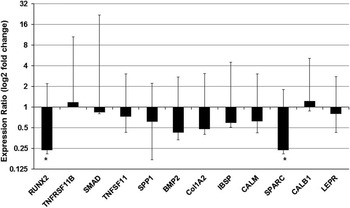
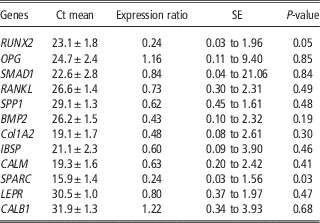
The messenger RNA (mRNA) expression of all 13 genes studied was obtained from the bone tissue of the femur growth plate of 45 days old broilers affected or not by BCO, and their relative expressions are shown in Table 2. The amplification of 12 genes from the 13 analyzed was detected. The SPARC had the lowest Ct (mean=15), and the CALB1 gene had the highest Ct mean, indicating, respectively, high and low levels of expression (Table 2). BMP3 had no amplification at this age in both affected and unaffected chickens. Regarding the differential expression of genes, the RUNX2 and SPARC were downregulated (P<0.05) in the BCO-affected group when compared with the control group. These two genes were about four times less expressed in chickens with BCO (Figure 2). For the other nine genes evaluated, no differential expression was observed (Table 2).
Ratio of gene expression in femur between chickens affected and non-affected with bacterial chondronecrosis with osteomyelitis, normalized with the HMBS reference gene (*P<0.05). HMBS=hydroxymethylbilane synthase.

Relative gene expression (fold-change) and amplification cycle threshold (Ct) mean for all genes studied between chickens affected with bacterial chondronecrosis with osteomyelitis and control groups

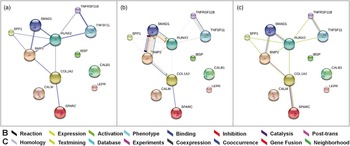
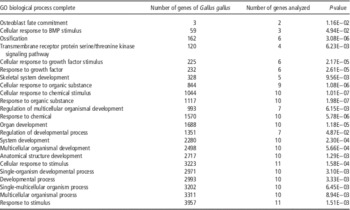
To broaden the knowledge about the selected genes, the STRING analysis was performed to verify known interactions among them. Stronger interactions were observed among TNFSF11, RUNX2, SMAD1, BMP2, CALM and SPARC genes, whereas LEPR, CALB1 and IBSP genes seem to be in different metabolic pathways (Figure 3a). Also, according to the evidence of shared functions analysis, the binding functions were predominantly found in those interacting genes (Figure 3b and c). Furthermore, an enrichment analysis was carried out to verify if the genes evaluated in this study could be related to other molecular functions/biological processes besides ossification, which could influence other metabolic processes important to keep animals healthy. The results have shown that the 12 genes studied were involved in >23 biological processes, including osteoblast fate commitment, cellular response to bone morphogenetic protein (BMP) stimulus, ossification, transmembrane receptor protein serine/threonine kinase signaling pathway, cellular response to growth factor stimulus, response to growth factor, skeletal system development, cellular response to organic substance, cellular response to chemical stimulus, response to organic substance, regulation of multicellular organism and regulation of developmental process (Table 3). The molecular functions were mainly binding, transcription factor, receptor and transporter activities (Figure 3c).
Gene network among all genes evaluated. Circles represent genes and connecting lines represent interactions between genes, according to the active prediction methods of Stringdb (homology, textmining, databases, experiments, coexpression, coocurrence, gene fusion or neighborhood). (a) Thicker lines represent strong associations. (b) The different colors of the lines show the modes of action. (c) The colors of the lines represent the associations according to different types of evidence.

Gene ontology (GO) of biological processes overrepresentation test obtained according to the Pantherdb

Discussion
Bacterial chondronecrosis with osteomyelitis is one of the main emergent conditions that have been affecting poultry welfare and production in the last years. Despite the advances in the identification of bacteria species related to this pathology, the genetic mechanisms involved with BCO are unknown. Here, the mRNA profile of 12 candidate genes functionally important for bone development and maintenance were investigated for putative associations with BCO in chickens.
In this study, most of the genes evaluated pointed out a tendency of downregulation (P>0.05) in the BCO-affected group when compared with the normal group. Two genes, RUNX2 and SPARC, were significantly downregulated in BCO animals (P<0.05). The other genes evaluated had no differential expression possibly due to high variation within groups and also the low magnitude of the fold-change (Table 2).
The RUNX2 gene belongs to the Runt transcription factor family, being considered one of the most important transcription factors that control osteoblast shape and differentiation (Ma et al., Reference Ma, Liu, Ma, Han and Zang2010). It has been reported that RUNX2 is expressed as fetal period inducing cell proliferation growth plate and being essential to endochondral ossification, especially on chondrocyte maturation and hypertrophy (Karsenty, Reference Karsenty2001). Rats with induced femoral osteonecrosis showed a decline in RUNX2 expression with aging (Ma et al., Reference Ma, Liu, Ma, Han and Zang2010). In this work, just one age was evaluated and the same pattern of RUNX2 expression related to femoral osteonecrosis was observed, being fourfold less expressed in the BCO-affected group. RUNX2 downregulation can result on blocking of osteoblasts and chondrocytes differentiation and impairing the correct ossification. Furthermore, it has been shown that the expression of RUNX2 was involved in initiating bone matrix protein-related genes and mineralization in immature mesenchymal cells (Fujita et al., Reference Fujita, Azuma, Fukuyama, Hattori, Yoshida, Koida, Ogita and Komori2004).
Besides the functions related to osteogenesis, RUNX2 has also a role in the VEGF (vascular endothelial growth factor) pathway and bone vascularization (Zelzer et al., Reference Zelzer, Glotzer, Hartmann, Thomas, Fukai, Soker and Olsen2001). Defects on the RUNX2 can possibly explain a reduced expression of VEGF, causing lack of angiogenic processes like blood vessels and extracellular matrix invasion (Kwon et al., Reference Kwon, Zhao, Yang, Li, Ge, Zhao and Franceschi2011). Similar results were demonstrated by Kido et al., (Reference Kido, Bossini, Tim, Parizotto, da Cunha, Malavazi and Renno2014), which observed tibiae bone problems in mice when RUNX2 was downregulated. In chickens, the downregulation of FGF (basic fibroblast growth factor), a gene involved in the VEGF-dependent angiogenesis, was already associated with BCO (Li et al., Reference Li, Zhou, Shi and Hou2015), reinforcing the importance of the correct bone vascularization to avoid bone disorders. Thus, it is possible that low levels of RUNX2 can affect the ossification in chickens in two manners: hindering the osteoblast maturation and reducing vascularization in the femur.
Another downregulated gene found in BCO chickens in our study was the SPARC, which is a calcium‐binding matricellular glycoprotein, considered one of the leader genes on the osteogenesis process (Orlando et al., Reference Orlando, Giacomelli, Ricci, Barone and Covani2013; Ribeiro et al., Reference Ribeiro, Sousa, Brekken and Monteiro2014). Its function is involved in bone development, repair and tissue remodeling and controlling the adhesion, synthesis and binding collagens type I and other proteins in the bone extracellular matrix (Orlando et al., Reference Orlando, Giacomelli, Ricci, Barone and Covani2013). In the present study, a fourfold decrease of SPARC expression was observed in the BCO-affected group when compared with non-affected chickens. Several studies have found that this gene could be related to bone disorders (Delany et al., Reference Delany, Amling, Priemel, Howe, Baron and Canalis2000; Mendoza-Londono et al., Reference Mendoza-Londono, Fahiminiya, Majewski, Tétreault, Nadaf, Kannu, Sochett, Howard, Stimec, Dupuis, Roschger, Klaushofer, Palomo, Ouellet, Al-Jallad, Mort, Moffatt, Boudko, Bächinger and Rauch2015), which reinforces its participation on BCO genesis or development. A decrease in the number of bone cells, bone formation and prevention of the mature collagen formation was observed in SPARC-null mice (Boskey et al., Reference Boskey, Moore, Amling, Canalis and Delany2003). Moreover, the therapeutic effects of high expression of SPARC have been associated to confer bone strength as the presence of its product enables the bone calcification on the extracellular matrix (Ribeiro et al., Reference Ribeiro, Sousa, Brekken and Monteiro2014; Parvaneh et al., Reference Parvaneh, Ebrahimi, Sabran, Karimi, Hwei, Abdul-Majeed, Ahmad, Ibrahim and Jamaluddin2015). Therefore, reduced expression of SPARC could affect bone mineralization and collagen deposition favoring BCO in chickens. Wu et al. (Reference Wu, Pines, Gay, Hurwitz and Leach1996) found a reduction in osteonectin levels in the cartilage of chickens affected with tibial dyschondroplasia. Carbonare et al. (Reference Carbonare, Matte, Valenti, Siciliano, Mori, Schweiger, Zampieri, Perbellini and De Franceschi2015), observed that sickle cell disease mice with severe bone loss and increased bone turnover presented downregulation of RUNX2 and SPARC, and upregulation of RANK (Receptor Activator of Nuclear Factor-κB) and RANKL (Receptor Activator of Nuclear Factor-κB Ligand). These findings evidenced the importance of high levels of the SPARC product on bone matrix development and to prevent BCO and other locomotor problems in broiler chickens.
Beyond the SPARC function on bone mineralization and remodeling, some studies indicate that this gene has pleiotropic effects on angiogenesis VEGF-dependent (Cydzik et al., Reference Cydzik, Abdul-Wahid, Park, Bourdeau, Bowden, Prodeus, Kollara, Brown, Ringuette and Gariepy2015). This function still remains to be clarified, although it is believed that SPARC, by interacting with VEGF and its receptors, is an essential element to confer proangiogenic (receptor R2) or antiangiogenic (receptor R1) activities (Nozaki et al., Reference Nozaki, Sakurai, Raisler, Baffi, Witta, Ogura, Brekken, Sage and Ambati2006). In most of the studies, an antiangiogenic SPARC effect by binding in the VEGF factors was shown (Kato et al., 2001; Cydzik et al., Reference Cydzik, Abdul-Wahid, Park, Bourdeau, Bowden, Prodeus, Kollara, Brown, Ringuette and Gariepy2015). However, in this study, SPARC was downregulated in BCO-affected chickens, which would be compatible with increased vascularization. Probably, in broilers, the role of SPARC is more related to ossification in this age than its function in the VEGF-dependent pathway. The age-dependent SPARC expression pattern has been previously described in mice (Reed et al., Reference Reed, Bradshaw, Shaw, Sadoun, Han, Ferara, Funk, Puolakkainen and Sage2005). The SPARC production depends on the equilibrium of soluble and collagen-bound forms, which can interfere on the VEGF interaction (Reed et al., Reference Reed, Bradshaw, Shaw, Sadoun, Han, Ferara, Funk, Puolakkainen and Sage2005). Nevertheless, in the present study, the genes were evaluated at the mRNA level, and the SPARC function on VEGF pathways might occur in post-transcriptional stages. Therefore, in chickens, additional studies are needed to understand the role of SPARC on the vascularization of BCO broilers and at different ages.
In some species, like rat, mouse and humans, bone and immune cells may share regulatory mechanisms (Mori et al., Reference Mori, Amelio, Faccio and Brunetti2013). Moreover, the presence of bacteria in different bone types has been associated with increased inflammation and bone loss, possibly due to biofilm formation close to the extracellular matrix, one of the possible mechanisms developed by bacteria to maintain the infection (Bandow et al., Reference Bandow, Maeda, Kakimoto, Kusuyama, Shamoto and Ohnishi2010; Pugin, Reference Pugin2012; Park et al., Reference Park, Kim, Yang and Yun2015). A recent study showed that the expression of some key genes on bone regeneration and turnover, including those differentially expressed in this study (RUNX2 and SPARC), are reduced in the presence of Staphylococcus aureus biofilm, facilitating osteomyelitis (Sanchez et al., Reference Sanchez, Ward, Romano, Hurtgen, Hardy, Woodbury, Trevino, Rathbone and Wenke2013). In humans’ periodontal diseases, Enterococcus faecalis was also associated to downregulation of RUNX2, attenuating bone regeneration (Park et al., Reference Park, Kim, Yang and Yun2015). The downregulation of these genes may reduce the osteoblast viability, consequently, limiting bone formation, and also increasing bone resorption (Sanchez et al., Reference Sanchez, Ward, Romano, Hurtgen, Hardy, Woodbury, Trevino, Rathbone and Wenke2013). In broilers, the presence of bacteria in the femur, for instance, Staphylococcus spp. and Enterococcus spp. has already been related to BCO (Jiang et al., Reference Jiang, Mandal, Wideman, Khatiwara, Pevzner and Min Kwon2015). Therefore, besides the mechanisms described previously, the presence of bacteria species and its biofilm formation could also contribute to the downregulation of SPARC and RUNX2 genes. However, more studies are needed as we did not quantify bacteria, neither the biofilm formation on the samples analyzed in this study.
Scarce information is available regarding the genetic pathways involving the evaluated genes in chickens. Here, a total of 12 functional candidate genes were chosen based on their role in the normal development of bone metabolism. In silico analyses of these genes and their biological processes in other species were performed, and a diversity of pathways involved with ossification and other functions were highlighted (Table 3). In mammals, most of the processes found in our study are closely related to endochondral ossification, imbalance of the osteoblasts–osteoclasts formation, lack of matrix metalloproteinase family and blood vessels (Mackie et al., Reference Mackie, Ahmed, Tatarczuch, Chen and Mirams2008). These biological processes can favor the occurrence of BCO in chickens. In addition, it is important to note that some of the genes are involved in biological processes other than ossification and bone development, and could influence important metabolic processes. One example is the cellular response to growth factors, which has already been associated to stress response in humans, as well as other crucial regulatory processes, such as immunological responses, bone fractures and tissue healing (Poniatowski et al., Reference Poniatowski, Wojdasiewicz, Gasik and Szukiewicz2015). Thus, the animal homeostasis and welfare could be important issues to avoid the BCO condition in broilers.
Finally, we provided significant information on how the RUNX2 and SPARC genes influence the bone metabolism as in broilers their roles are still not properly settled and scarce information is available about their mRNA or protein levels in chickens affected or not by any skeletal problem. Our findings suggest that the downregulation of RUNX2 and SPARC expression could favor BCO in chickens. It is believed that low levels of RUNX2 and SPARC might reduce vascularization and bone mineralization, increasing skeletal problems in broilers. Nonetheless, further studies are needed to specify on which biological phases these gene expression alterations occur and thus help to elucidate BCO pathogenesis.
Acknowledgments
The authors are grateful to Alexandre L. Tessmann for technical assistance and Marina Schmitt for the graphic design. This work was supported by project number 02.10.06.003.00 from the Brazilian Agricultural Research Corporation (EMBRAPA). E. Paludo was supported by CAPES.