Introduction
For educational institutions, engaging meaningfully with Aboriginal and Torres Strait Islander peoples in education is vital to achieving the high expectations placed on students by Elders, community, teachers and Government (Sarra et al., Reference Sarra, Spillman, Jackson, Davis and Bray2018). Engagement with Aboriginal and Torres Strait Islander peoples in areas such as health is associated with a range of factors, such as social, economic and health status, and the disparities between Aboriginal and Torres Strait Islander peoples when compared to non-Indigenous people are clear through campaigns such as Close the Gap (Commonwealth of Australia, 2018). The same factors contribute to the engagement of Aboriginal and Torres Strait Islander peoples in education. The continued negative impact of colonisation is evident when considering the engagement of Aboriginal and Torres Strait Islander peoples in contemporary education (Gee et al., Reference Gee, Dudgeon, Schultz, Hart, Kelly, Dudgeon, Milroy and Walker2014). Existing programs aimed at enhancing Aboriginal and Torres Strait Islander peoples' engagement with education that tends to be reactive in nature and based on a deficit discourse (Shay, Reference Shay2017). Importantly, there is a paucity of the published literature investigating what the impact of cultural engagement, as part of a wider educational system, has on the empowerment of Aboriginal and Torres Strait Islander peoples in their learning. There exist few published examples of effective strategies and programs aimed at enhancing Aboriginal and Torres Strait Islander educational empowerment and the role cultural engagement plays in facilitating deeper engagement in learning. This paper explores the career and educational progression of Aboriginal and Torres Strait Islander students from the Fraser Coast and as such, it was deemed appropriate by the Butchulla Elders that the study be given a Butchulla title. The term ‘Ghundus’ comes from the Butchulla language and means ‘children’, hence ‘Where are the children?’ is a longitudinal study of the educational pathways of young Aboriginal and Torres Strait Islander people, post schooling.
Literature review
The importance of building meaningful partnerships between Elders and their communities, schools, non-government organisations and public institutions has been highlighted as an integral component contributing to enhanced educational outcomes for Aboriginal and Torres Strait Islander peoples (Milliken and Shea, Reference Milliken and Shea2007). Representing Aboriginal and Torres Strait Islander cultures in the curriculum and other educational engagement programs is accepted as an important factor in enhancing educational engagement (Australian Curriculum Assessment and Reporting Authority, 2012). There are examples of good practice in the sector but a lack of transparency and a reliance on short-term funding models means the opportunity for empirical and cultural validation is limited and negatively impacts the delivery of educational engagement programs. The resulting outcome for Aboriginal and Torres Strait Islander peoples is that real progress in educational engagement is diminished.
The lack of appropriate knowledge from teachers and engagement facilitators has been identified as a limiting factor in the engagement of Aboriginal and Torres Strait Islander peoples in education (Helme and Lamb, Reference Helme and Lamb2011). This has led to a rise in cultural learning opportunities for teachers and facilitators and the development of culturally appropriate communication guidelines when working with Aboriginal and Torres Strait Islander peoples (Australia Government, 2016). Cultural knowledge and communication skills are a priority in improving professional competencies but there are issues at the coalface where teachers and facilitators are frustrated by the lack of empirical grounded conceptual frameworks with proven efficacy.
The success of education engagement strategies and programs can be measured using student records of attendance and associated marks in various areas. The question must be asked as to whether this is the most appropriate way to measure educational engagement. There is a lack of published research that has assessed educational engagement from a holistic or cultural viewpoint and its impact over time. Clearly, a more holistic assessment framework would consider the ability of the engagement strategy or program to develop student sense of belonging (Zyngier, Reference Zyngier2008). Further to this, there is considerable scope to explore if there have been long-lasting impacts on student engagement through the use of culture as a catalyst for educational engagement (Kahu, Reference Kahu2013).
Several studies have investigated educational outcomes for Aboriginal and Torres Strait Islander students and drawn positive connections between self-identity and educational attainment (Purdie et al., Reference Purdie, Tripcony, Boulton-Lewis, Fanshawe and Gunstone2000; McRae, Reference McRae2002). Further studies have identified similar strategies to share Aboriginal and Torres Strait Islander cultures in schools, which have had a positive influence on the educational outcomes for Aboriginal and Torres Strait Islander students (Spencer, Reference Spencer2000; Garnett et al., Reference Garnett, Sithole, Whitehead, Burgess, Johnston and Lea2009). Other projects have developed community-wide respect for culture and fostered a positive sense of self-efficacy within Aboriginal and Torres Strait Islander communities as a stepping stone to increasing educational outcomes for Aboriginal and Torres Strait Islander students (Garrett and Wrench, Reference Garrett and Wrench2010; Louth, Reference Louth2012, Reference Louth2013). The combined findings of these researchers provide a blueprint to work towards sharing and celebrating Aboriginal and Torres Strait Islander cultures in order to build identity and self-efficacy and thereby establish opportunities to enhance educational aspirations for Aboriginal and Torres Strait Islander people. However, little research has been conducted to determine if the identity building and positive self-efficacy have had a long-lasting impact on the educational outcomes of Aboriginal and Torres Strait Islander peoples.
The purpose of this follow-up longitudinal study Where are the Ghundus? is to develop a greater understanding of the long-lasting impact an educational aspirations program (Burunga M Gambay (BMG)) had on the educational pathways taken by the participants in subsequent years.
The term Burunga M Gambay comes from the Butchulla language and means ‘learning together’. Since the educational aspirations program was situated within the Butchulla and Fraser Coast community, it was deemed appropriate by the Butchulla Elders that the study be given a Butchulla title.
The project team comprised a Butchulla Elder and two academics from the University of the Sunshine Coast, one working within the Aboriginal and Torres Strait Islander student success unit and the other in education. The impetus for this study and the resultant formulation of the research questions arose from the research teams’ focus on inclusion and social justice, specifically relating to improving educational outcomes and aspirations within the Aboriginal and Torres Strait Islander population.
The project will attempt to provide answers to the following research questions: How did experiencing the BMG culture and aspirations program influence the participants' educational engagement? What have been their educational and work experiences since the program? How can the University build educational connections with, and increase the educational outcomes for Aboriginal and Torres Strait Islander peoples?
The results of such an inquiry will help to inform further University projects that provide sustainable programs, informed by the direct experiences of Aboriginal and Torres Strait Islander peoples, to enhance their educational outcomes and have a long-lasting effect on their educational and career prospects. If Universities are to provide sustainable opportunities for Aboriginal and Torres Strait Islander peoples to improve their educational outcomes, then an exploration of the impact previous projects have had on their education pathways is crucial.
Methodology
Original intervention program
The BMG project was conducted over a one-year period in 2012, within the Fraser Coast Campus at the University of Southern Queensland. The Fraser Coast is recognised as a low socio-economic region, with unemployment at 6.5% (Australian Bureau of Statistics, 2011) compared with a 5.2% national average. Aboriginal and Torres Strait Islander peoples comprise 3.6% of the population within the Wide Bay region yet make up 0.07% of adults undertaking tertiary studies (Australian Bureau of Statistics, 2011). A review of Australian Universities (Behrendt et al., Reference Behrendt, Larkin, Griew and Kelly2012) supports these data and identified Aboriginal and Torres Strait Islander peoples, people of low socio-economic status and those from regional areas as being under-represented in higher education.
The original BMG project sought to provide the avenues of awareness and participation for young people in the Fraser Coast region regarding their educational outcomes. The BMG program consisted of three workshops held over the course of a year, conducted primarily at the Fraser Coast Campus of the University of Southern Queensland. The first workshop was a two-day event held in May 2012, the second was a five-day event held in July 2012, and the final workshop was a one-day event held in October of the same year. A total of 24 Aboriginal and Torres Strait Islander students aged between 14 and 18 years, from five local high schools within the Fraser Coast district, participated in the BMG program. Of the 24 students who participated, there was a close gender balance of males (48%) to females (51%).
The BMG program was developed in partnership with local Aboriginal Elders, who identified mentors from the community for the program. Meetings were held with the mentors to ensure all targeted similar outcomes for the participants. Mentors conducted meaningful cultural activities using culturally appropriate and capable ways. For example, at times, groups were split by gender, whereby ‘men's business’ and ‘women's business’ could be conducted separately. This enabled smaller groups to focus on culturally sensitive topics that were not appropriate within a mixed-gender environment.
Further examples of cultural activities included story-telling from Elders as well as drawing learning journeys and circles of influence and mapping educational pathways. There were 12 mentors in the BMG program of which 10 were Aboriginal and Torres Strait Islander peoples, whilst two from the University were non-Indigenous.
Motivational speakers conducted mentoring sessions in several ways, through formal whole group sessions, then informally in small groups and individual meetings. The activities in these sessions consisted of academic, leadership and cultural activities. Participants in the BMG program were then invited to share their cultural identity journey with younger students who identified as an Aboriginal and Torres Strait Islander person. This activity afforded the young Aboriginal and Torres Strait Islander mentees taking part in BMG the opportunity to act as mentors and tested their communication and leadership skills. Participants of the BMG program then reflected on this experience and the impact it had on their confidence and self-efficacy. Program effectiveness was evaluated quantitatively through surveys and qualitatively through semi-structured interviews at the conclusion of the program. Survey data were collected using a five-point Likert scale and frequency distributions were produced. Participant responses from the semi-structured interviews allowed qualitative data to be coded with common themes identified using the nVivo10 software package.
Preliminary data from the BMG program evaluation survey indicated that the BMG program achieved specific goals relating to building relationships with local Aboriginal and Torres Strait Islander young peoples; engaging the Aboriginal and Torres Strait Islander community in meaningful and culturally appropriate activities; and regional capacity building through inspiring Aboriginal and Torres Strait Islander youth to consider furthering their educational aspirations.
At the conclusion of the BMG program, 27 of the participating students were surveyed and 21 (or 78%) indicated that the BMG program had impacted them in a positive way. Of the 21 students who indicated that the BMG program had impacted them, 62% identified its influence on their attitudes regarding their culture and being Indigenous. Of those students, 85% were female compared to 15% male. Students commented that before the BMG program they considered being Indigenous ‘uncool’, and ‘like a barrier, you were kind of overlooked’, but being involved in the BMG program, learning about the history and cultures, and working with younger students at the National Aboriginal and Islander Day Observance Committee (NAIDOC) festival increased their own cultural pride, ‘it made me feel better about myself’, and ‘I feel more important now’ (Table 1).
Responses of impacted student participants (N = 21) from the original BMG study (adapted from Louth, Reference Louth2012)

The principles on which the BMG program was developed in terms of preparing students academically; engaging the community Elders and leaders; creating culturally relevant learning environments; and establishing role models for Aboriginal and Torres Strait Islander students, which was a major factor in the success of the program. It appeared that the use of role models had a particularly powerful effect on participants and helped to provide positive messages about successfully combining culture, family and education.
The purpose of this follow-up longitudinal study ‘where are the Ghundus’ was to see if the positive effects of the original BMG program reported by participants had a long-lasting impact on their cultural identity, their educational and career choices since the program and how the University can seek to build educational outcomes for Aboriginal and Torres Strait Islander peoples.
Participants
The central Queensland coast of Australia (Fraser Coast), around Hervey Bay and Maryborough, was the site of the longitudinal study and the original aspirations project, BMG. The current qualitative study was conducted with six participants (five females and one male) who were part of the original BMG educational aspirations project. The original project involved 24 Aboriginal and Torres Strait Islander students and the follow-up longitudinal project attempted to contact all students. Individuals who had participated in the original educational aspirations program were invited to participate in the longitudinal study. It was not possible to contact some of the original participants and so the sample size for the current study was six participants.
Procedures
Permission to conduct this longitudinal study was granted by the local Butchulla Elders and ethics approval was obtained from the University Human Research Ethics Committee. Where are the Ghundus? follows a phenomenological research design as it seeks to describe and interpret an Aboriginal and Torres Strait Islander educational aspirations project by determining the meaning of the experience as perceived by the people who participated (Ary et al., Reference Ary, Jacobs and Sorensen2010). The aim of the current project was to review the long-term effectiveness of an educational aspirations and careers program, BMG, which was specifically aimed at Aboriginal and Torres Strait Islander secondary school students (Louth, Reference Louth2013).
Community Elders were involved in the project as co-researchers who worked to locate past participants of BMG and then conducted the interviews with the participants. Interviews were audio-recorded, followed by transcripts of interviews, which assisted the research team to analyse the data. The results of the data analysis were reviewed by the relevant Elders who interviewed students and checked for consistency and accuracy in the analysis and discussion of the results.
Qualitative data were obtained from the participants through semi-structured interviews as it enabled participants to describe their experiences and aspirations and relate them to their current achievements. The collection and analysis of these subjective data followed a phenomenological approach, since the impact of the educational aspirations program was examined through the eyes of the participants (Ary et al., Reference Ary, Jacobs and Sorensen2010). The semi-structured interviews explored the experience of students who participated in the original program and any resulting impact it made on the career and educational pathways they have followed since. All qualitative data collected were transcribed and imported into the nVivo 11 software package (QSR, 2015).
The phenomenological analysis was conducted by examining significant statements iteratively, where specific themes emerged and then were tagged with a meaningful code and ascribed to a node (Bassett, Reference Bassett, Mills, Durepos and Wiebe2012). In responding to the first research question relating to the impact of the original program, it was appropriate to conduct word frequency queries to explore what words were used in each context from each theme (node). These results were represented visually in the form of TAG clouds where the greater the size and boldness of the font, the more often these words were used within the interviews by the participants (Ary et al., Reference Ary, Jacobs and Sorensen2010; Maddern, Reference Maddern2011). Perception checks were conducted on the qualitative data to ensure the original context of the participants' statements was maintained. Additionally, direct quotes were used to demonstrate the context and validity of the analysis, to directly address the research questions and to give further depth to the study.
Results
The phenomenological analysis developed clusters of meanings and themes which followed six broad topics: identity, sharing culture, motivation, education and work, future aspirations and recommendations. Since the study targeted past participants of the educational aspirations program BMG, when comments pertaining to these dimensions were made, they were grouped together and named accordingly, that is education and work, future aspirations, and recommendations. It is interesting to note the development of three additional themes, namely identity, sharing culture and motivation that arose through the analysis of the data.
The appearance of these additional themes would suggest that the initial conceptualisation of the BMG program may have been proposed under the assumption that participants were already connected to their culture. On reflection, this was not the case and the BMG program should have been initially framed as a culture and identity program, which later would expand to include educational and career aspirations and pathways.
An analysis of all six themes provided responses for each of the three research questions addressed in turn as follows:
How did experiencing the BMG aspirations program influence the participants?
When the participants were asked to recall the program and if they gained anything from it, four major themes emerged: identity, sharing culture, motivation and future aspirations.
Identity
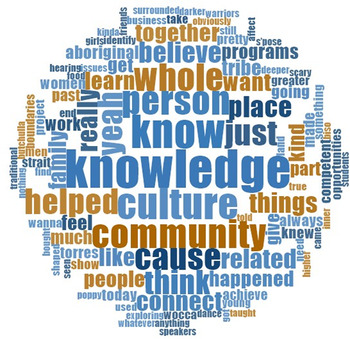
A word frequency was conducted on the identity node and presented in the form of a tag cloud (figure 1) where the most common words used to describe the impact of the program were: knowledge, culture, community, helped, person and whole. Other words arose which described the positive impact of the program on their identity included believed, learn, together, think and connect. Explicit statements made by the participants bore testimony to the positive impact the program had on their sense of identity and engendered their confidence. For example: ‘Knowing my Aboriginality made me feel whole…it helped me find my identity and my place’ (Ghundus 3); ‘Learning about my culture and my history helped me realise who I am and what my people have gone through’ (Ghundus 4); and, ‘helped me realise we are all one community and we all can work together’ (Ghundus 6).
Tag cloud of participants’ perceptions of the impact of Burunga M Gambay on their identity.

In summary, all students emphasised the power of the project in relation to building their sense of self- and cultural identity, along with enhancing their confidence and taking pride in their Aboriginality.
Sharing culture
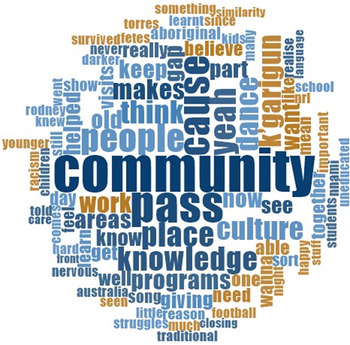
Similarly, a word frequency analysis and tag cloud representation (figure 2) were conducted on the sharing culture node, where positive words such as passing on to the community, learning about people and place, knowledge of culture and dance occurred most often. Specific in-text comments participants made relating to this theme can be seen in the following quotes: ‘I want to learn my culture and share it with other people as well’ (Ghundus 1); ‘sharing my culture gave me confidence and opened my eyes up to opportunities’ (Ghundus 2); and, ‘being a part of this program helped me learn my culture, know my culture and be able to pass it on to other people’ (Ghundus 3).
Tag cloud of participants’ perceptions of the impact of Burunga M Gambay on sharing their culture.

Overall, most participants felt the opportunity to share their culture provided them with a greater understanding of their culture and how it influenced the decisions they had made.
Motivation
Data coded to the motivation node were analysed using a word frequency query and presented in a tag cloud (figure 3). The most common words to arise relating to motivation were: see, know, going and like, in the context of opportunities and possibilities for work and school. The following direct quotes from the participants reflected the program's success in motivating students to strive to succeed. For example: ‘when you see and know the opportunities for them, that they have gone further into their studies, that you can do it too’ (Ghundus 1); ‘it showed us that you gotta get out there, you gotta go get it…it gave us the boost and motivation that was needed’ (Ghundus 2); ‘if he can do it with what he was going through then I can do it with my easier life…it just made you believe in yourself more’ (Ghundus 5); and, ‘seeing that it was possible to go to uni and do what you want to do, it made me straighten out and actually focus on school instead of stuffing around at school!’ (Ghundus 6).
Tag cloud of participants’ perceptions of the impact of Burunga M Gambay on motivating them to engage in education.

It was clear from the results that participants felt the program motivated them and inspired them to work hard to achieve their goals.
Future aspirations
All students have talked about the value of understanding their career options the project addressed and how it impacted on their future aspirations. Word frequencies and tag clouds of data coded into the future aspirations node (figure 4) demonstrate how the program impacted their plans for their future with the most common words and phrases as follow: going, knowing, wanting, seeing, University in the context of being open to possibilities.
Tag cloud of participants’ perceptions of the impact of Burunga M Gambay on their plans and aspirations for their future careers.

The positive impact of the program on their career aspirations is evidenced with comments: ‘opened our eyes to what we can achieve after school… and the great opportunities for a lot of Indigenous people…being part of the project has given me the way to go about it’ (Ghundus 1); ‘gave me confidence and opened my eyes to any opportunities that are out there’(Ghundus 2); ‘opened up my eyes to see that there are more opportunities now for Aboriginal and Torres Strait Islander peoples at University, made it more of an aspiration for me to attend university’(Ghundus 3); ‘it pushed me to realise that you can do whatever you want if you put your mind to it’ (Ghundus 4); ‘made me more aware of my options’ (Ghundus 5); and, ‘helped to focus on what I wanted to do instead of just trying to get through school’ (Ghundus 6).
What have been their educational and work experiences since the program?
Data from the interviews that related to this question were coded into one theme: education and work. In general, all students outlined the value they placed on education, as a consequence of their exposure to the University in the program. When reviewing comments students made regarding their current work commitments, it was notable that all students involved in the study went on to complete senior school, were in paid employment and had added to their educational qualifications since completing senior school. To date, two of the participants who were interviewed have gone on to University studies and one has enrolled in a tertiary preparation program.
How can the University build educational connections with, and increase educational outcomes for, Aboriginal and Torres Strait Islander peoples?
The final theme, recommendations, identified key elements participants felt would be effective for future programs run by the University aimed specifically to connect with Aboriginal and Torres Strait Islander peoples. Specifically, all students felt this type of program was needed on a regular basis for Aboriginal and Torres Strait Islander peoples to enhance their educational outcomes and career pathways. Some felt it was important to share their culture with the wider community to foster respect and understanding. For example: ‘don't stop sharing the cultural knowledge out there cause the kids need it more now… we need to keep spreading the culture to our younger people so that they can keep passing it on’ (Ghundus 3).
Some recommended the use of local Elders, community leaders and role models in subsequent programs so students could better relate to the speakers as role models and tertiary education was seen to be achievable. For example: ‘People that have done it from community that the kids would know… if they had them in the classroom I think it would register better because they know her’ (Ghundus 6).
Furthermore, some participants suggested it would be good to target younger students, particularly Year 8 and 9 so students had more time to work harder at school to improve their results. That is, ‘go lower before they get into senior, it's too late then because we have already gone for the VET classes’ (Ghundus 6).
These direct comments from the participants demonstrate their enthusiasm for the program and attest to the need for continuous and sustainable intervention programs to build educational pathways.
Discussion
The analysis of the interview data collected from the longitudinal study with participants of the original program, BMG indicated the positive and long-lasting effects of this program (Louth, Reference Louth2012). The original project was created in partnership with the local Aboriginal and Torres Strait Islander community in response to their needs and aspirations and formally recognising the specialist skills and knowledge people within the community possessed. In taking this approach, a playing field was developed, where respect and value were cultivated, thereby empowering Aboriginal and Torres Strait Islander peoples to share and celebrate their culture. It seems this approach had a long-lasting effect on the participants' confidence and pride in their indigeneity, since all longitudinal participants stressed the important role the project played in building their confidence, self-efficacy and cultural pride.
The background for each of the participating students was varied. Some had strong connections to family and culture within the Butchulla community, whilst others came from other Aboriginal nations including the Torres Strait Islands. Results seem to indicate that students who were living in the Fraser Coast Aboriginal and Torres Strait Islander community, but separate from their home nation, were able to better connect with the Butchulla community. Through these connections, experienced greater confidence in exploring their indigeneity, particularly when considering cultural identity relating to home nations. This is particularly evident where one of the students returned to their home community to connect with the Elders and the family following the completion of BMG.
The sense of pride and confidence students gained from the original project enabled them to feel empowered by their identity, rather than constrained. Participants felt confident and connected to their culture and were able to transfer these positive outcomes to their career aspirations and implemented a plan to achieve these. The value given to Aboriginal and Torres Strait Islander peoples, knowledge and cultures through the original project, helped to inspire and motivate the students to plan, strive and achieve their career goals and is evidenced through the results of this longitudinal study. Showcasing Aboriginal and Torres Strait Islander perspectives to the wider community developed a deeper understanding and respect for Aboriginal and Torres Strait Islander cultures. The long-lasting and deep-reaching impact of the original project, where respect and understanding were key imperatives, is demonstrated through the findings of this longitudinal study.
On reflection, the findings of this longitudinal study are limited in terms of participant numbers, since we were unable to locate and interview all of the original BMG participants, even with the help of community Elders within the time constraints of this study. However, the study does provide us with a snapshot of the aspirations of young Aboriginal and Torres Strait Islander people, which functions to strengthen the cultural validity of future student engagement initiatives. A further limitation of this study relates to the gender imbalance of the participants. It is recognised that interviewing all original participants and getting an even gender spread would have provided a wider representation of the population; however, personal factors affecting the lives of the participants and their ability to take part in the research were outside the control of the researchers. As the recruitment of the participants was ongoing, it was envisaged that the research team would be able to contact most of the original student participants and follow the original methodological format of the study. However, with natural attrition, this was not the case, hence any further investigations of this nature might consider a case study approach when dealing with a smaller number of participants.
Common themes from the original study were around cultural capability, cultural content, cultural learning styles and culturally responsive pedagogies which were brought together to develop Aboriginal and Torres Strait Islander cultural understandings, as proposed by Nakata (Reference Nakata2010). Adopting a conceptual framework around ways of knowing and building identity and connectedness has enabled Aboriginal and Torres Strait Islander students to explore their rich cultures and apply these to their education and career contexts.
The relationships between Aboriginal and Torres Strait Islander students, their teachers or facilitators and those who are the empowering students in their educational institutions and career pathways play a vital role in promoting educational engagement. It is imperative that all stakeholders understand the importance of country, land and kinship and feel comfortable discussing the connection to their country (Haslett et al., Reference Haslett, Harrison, Godfrey, Partington and Richer2000).
Subsequent mentoring programs which target Aboriginal and Torres Strait Islander young peoples may need to go further into the community by involving parents, caregivers and family in the process. Future mentoring programs might consider creating shared understandings of the concepts of establishing a sense of self across the community and family. Further research into promoting culturally relevant learning environments for Aboriginal and Torres Strait Islander peoples within a university setting through mentoring programs is needed to construct a program where the community are more engaged and provide a greater sense of place, purpose and self-worth.
In addition, several participants refer to the timing of such programs, hence it is critical educational aspirations programs begin early in middle school, that is pre-teen students and that programs focus on culture and identity as a first step to developing strong educational pathways. This study highlights the strength of culture in laying the foundations for career and educational aspirations. Educational frameworks should reflect the multifaceted nature of student engagement and its intrinsic links with an identity that is essential for Aboriginal and Torres Strait Islander communities to thrive.
Furthermore, stakeholders need to explore pedagogical practices that are inclusive and consider the diverse needs of Aboriginal and Torres Strait Islander peoples (Yunkaporta, Reference Yunkaporta2009). The high cultural validity with which the BMG program was conducted has resulted in long-lasting and meaningful engagement through culturally appropriate methods, which has been central to enhancing the educational attainment of Aboriginal and Torres Strait Islander peoples.
Conclusion
Engaging with Aboriginal and Torres Strait Islander peoples meaningfully at all levels is a vital strategy given mainstream educational systems have a responsibility to deliver Aboriginal and Torres Strait Islander knowledge and perspectives through culturally appropriate education programs (Gay, Reference Gay2010). Sustainable cultural engagement must value knowledge and perspectives taught through an Aboriginal and Torres Strait Islander lens and be implemented sector-wide. The long-lasting and deep-reaching impact of the BMG program is the result of a harmonious relationship between the student, culture, community and the educational system involved in the program. The intersection between knowledge and perspectives and the representation of Aboriginal and Torres Strait Islander peoples through culture needs to be evident in educational engagement programs and strategies if there are to be wide-reaching and lifelong improvements in educational outcomes. There is no doubt representing knowledge and perspectives through culturally appropriate ways is an important step to improving the long-term engagement of Aboriginal and Torres Strait Islander peoples in education.
Sharon Louth is a Senior Lecturer in the School of Education at the University of the Sunshine Coast and is the Program Coordinator at Fraser Coast. Sharon's research and teaching practices involve the use of inclusive, cooperative and motivational learning strategies which generate self-efficacy and empower students to become successful learners. Sharon is passionate about increasing educational outcomes for Aboriginal and Torres Strait Islander people. Sharon has collaborated with the community to facilitate intervention programs for children and professional development workshops for teachers from primary, secondary and tertiary institutions and is committed to the ongoing development of increasing educational aspirations at both undergraduate and postgraduate levels.
Keane Wheeler provides expert advice and contributes to strategic decision-making regarding programs that build the academic preparedness of Aboriginal and Torres Strait Islander students, and assist in retaining students in Higher Education. Dr Wheeler applies current professional theory and best practice regarding Aboriginal and Torres Strait Islander education and cultural capability to maintain, develop and evaluate services and engagement practises. He collaborates with the relevant work areas to assist in the development and delivery of multi-disciplinary empowerment programs addressing identified and emerging needs of Aboriginal and Torres Strait Islander students.
Joyce Bonner is a Butchulla Elder and founder of Nyanga Baranga Barangam (Look, listen, learn/know) Butchulla Language Program. Joyce currently works with the Central Queensland Indigenous Development at the Fraser Coast as a Family Support Officer. Joyce has a Degree in Linguistic, comparative and related language studies and services and a Diploma of Education. Joyce has been crucial to the revival of the Butchulla language and has been intricately involved in teaching language and song to young people. Joyce has also been involved in multiple research projects and is passionate about sharing and celebrating Aboriginal and Torres Strait Islander culture.