Introduction
Cytokines are proteins or peptides secreted by cells that play a vital role in inflammatory reactions by activating and regulating others cells of the immune system (Curtis and Way, Reference CURTIS and WAY2009; Ivashkiv and Donlin, Reference IVASHKIV and DONLIN2014; Zhou et al., Reference ZHOU, CHEN, WANG and CHENG2014). The role of cytokines in mammals is well defined, with a large number of publications describing the structure of cytokines and their role in health and disease. In contrast, avian cytokines have been poorly defined, both in terms of structure and function. However, in recent years, advances in avian immunology and genetics have led to the discovery of a range of cytokines mainly in the chicken and other avian species (Redmond et al., Reference REDMOND, CHUAMMITRI, ANDREASEN, PALIC and LAMONT2009; Abdelwhab and Hafez, Reference ABDELWHAB and HAFEZ2012). Although only relatively few recombinant cytokines or monoclonal antibodies against avian cytokines have been produced, the availability of new technologies such as real-time quantitative PCR allow the quantification of the expression of messenger RNA from cytokine genes without the need for protein or antibodies (De Boever et al., Reference DE BOEVER, CROUBELS, DEMEYERE, LAMBRECHT, DE BACKER and MEYER2010; Downing et al., Reference DOWNING, LLOYD, O'FARRELLY and BRADLEY2010). This has opened up possibilities for determining cytokine levels in disease, giving increased understanding of the mechanisms of both pathogenesis and immunity. As such, cytokines have potential in the control of infectious disease in poultry (Kalaiyarasu et al., Reference KALAIYARASU, KUMAR, KUMAR, SANKAR, ELAMURUGAN and KARIKALAN2013; Yao et al., Reference YAO, FISCHER, ARNESEN, TYRRELL and GUTFREUND2014), and their use as novel therapeutic agents in diseases has begun to be explored. Cytokines may have the prospective to act as vaccine adjuvants activating immune cells for better protection against infections (Wigley and Kaiser, Reference WIGLEY and KAISER2003; Li et al., Reference LI, MA, MI, JIN, XU and WANG2006).
The main function of cytokines is the activation and regulation of the cells of the immune system (Meng et al., Reference MENG, YANG, XU, QIN, XU, WANG, SUN and LIU2011; Abdelwhab and Hafez, Reference ABDELWHAB and HAFEZ2012). All cytokines regulate cell functions by acting through receptors on the surface of the target cells (De Boever et al., Reference DE BOEVER, CROUBELS, DEMEYERE, LAMBRECHT, DE BACKER and MEYER2010). Cytokines have been classified into a number of groups on the basis of their functions. These groups include tumour necrosis factors (TNF), interferons (IFN), interleukins (IL), migratory inhibitory factors, transforming growth factors (TGF), and the smaller chemokines. However, there is a considerable overlap between each of these categories. The names are often based on a particular property, e.g. TNF was named for its ability to act upon tumours, and do not always reflect the pleiotropic effects of many cytokines (Kalaiyarasu et al., Reference KALAIYARASU, KUMAR, KUMAR, SANKAR, ELAMURUGAN and KARIKALAN2013).
The poultry broiler industry is continuously growing in size, with an annual production of approximately 40 billion birds worldwide (Asif et al., Reference ASIF, JENKINS, HILTON, KIMPTON, BEAN and LOWENTHAL2004). One of the major problems faced by the poultry industry is a loss of productivity due to disease, requiring prudent health management (Qu et al., Reference QU, YANG, MENG, XU, BI, JIA, LI, SUN and LIU2013). Birds that are reared under intensive conditions which contribute to infection by pathogens need strategies for the prevention of infection through effective vaccination is vital to minimise diseases and promote welfare.
In-feed antibiotics have been used extensively to overcome the infection and to maintain the health status of animals (Xu et al., Reference XU, YANG and LIU2013). However, the long-term use of in feed antibiotics, particularly those used in human medicine, has raised many issues by consumers regarding the emergence of antibiotic resistant bacteria (Meng et al., Reference MENG, YANG, XU, QIN, XU, WANG, SUN and LIU2011). The move away from the use of in-feed antibiotics critically increases the emphasis on the use of more effective vaccine strategies. The use of veterinary vaccines has different requirements to the use of human vaccines. Vaccines, particularly for poultry, must be cost-effective, particularly when they are required on a large scale annually. Therefore, veterinary adjuvants must be designed based on the current economics of immunisation, with the most common adjuvants found in licensed veterinary vaccines being aluminium salts and oil emulsions (Redmond et al., Reference REDMOND, CHUAMMITRI, ANDREASEN, PALIC and LAMONT2009). Veterinary and human vaccine manufacturers have commonly used aluminium hydroxide (alum) adjuvant because of its relative safety. Comparative studies show that alum is a weak adjuvant for the induction of antibody responses to recombinant protein vaccines, and a bias towards Th2 rather than Th1 responses has been shown in mice (Meng et al., Reference MENG, YANG, XU, QIN, XU, WANG, SUN and LIU2011). Alum poorly induces cell-mediated immunity, particularly cytotoxic T-cell responses (Wigley and Kaiser, Reference WIGLEY and KAISER2003), which is a significant drawback for its use in vaccines against intracellular parasites and some viruses. Alum adjuvants have a capability to provoke IgE-mediated immune responses and may promote IgE-mediated allergic reactions (Hilton et al., 2002). The use of oil-based adjuvants, in contrast, is limited by induction of side-effects and adverse site reactions, as it induces ulceration and inflammation at the site of injection along with fever and sensitivity reactions (Lawson et al., Reference LAWSON, ROTHWELL, LAMBRECHT, HOWES, VENUGOPAL and KAISER2001; Downing et al., Reference DOWNING, LLOYD, O'FARRELLY and BRADLEY2010; Yao et al., Reference YAO, FISCHER, ARNESEN, TYRRELL and GUTFREUND2014). Hence, choosing the right adjuvant is important in terms of industrial production requirements and is critically important to animal welfare. The poultry industry strongly relies on meat quality, and injection site reactions which lead to carcass damage affect the meat quality, resulting in economic losses. Site reactions induced by adjuvants such as alum or oil lead to animal distress and discomfort, which compromises welfare. From these issues it is clear that there is a need for effective, better vaccine adjuvants that avoid animal discomfort.
In this review, the structure and functions of cytokines and the main types of cytokines found in the chicken and their potential as adjuvants or therapeutic agents are discussed. In addition, some of the work that determines the role of cytokines in the pathogenesis of infectious diseases, such as salmonellosis, and in other diseases, such as autoimmune thyroiditis, are covered.
Cytokines and avian immune system
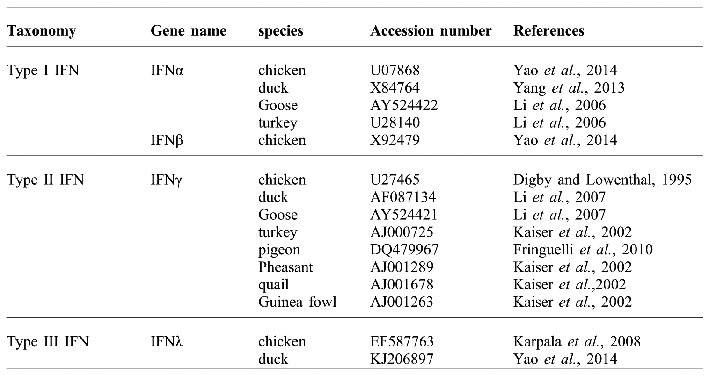
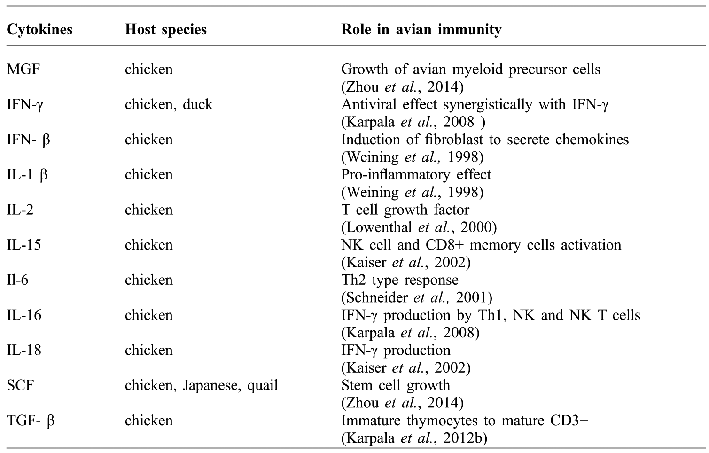
Similar to mammalian systems, Th2 cytokine responses (IL-4, IL-13, IL-19) are mainly produced in response to extracellular pathogens and Th1 cytokine responses (IFN-γ, IL-12, and IL-18) produced in response to intracellular pathogens in chicken. Although chickens lack lymph nodes, they have the specific bursa of Fabricius instead. Chickens possess a small number of cytokine genes than mammals. Recent advances in molecular fields of research have discovered several new cytokine receptor genes in the chicken genome. As chickens show homology with mammals for disease reaction and vaccination, they can be good models for the efficacy and potential of cytokines as therapeutic agents and in vaccines. Cytokines are categorised as Th1 cytokines (IL-2, IFN-γ, TNF and lymphotoxin (LT) which play a role in cell mediated immunity and Th2 cytokines (IL-4, IL-5, IL-6, IL-10 and IL-13) for the regulation of humoral immunity (Hillier et al., Reference HILLIER, MILLER, BIRNEY, WARREN, HARDISON, PONTING, BORK, BURT and GROENEN2004; Karpala et al., Reference KARPALA, BAGNAUD-BAULE, GOOSSENS, LOWENTHAL and BEAN2012a; Reference KARPALA, LOWENTHAL and BEAN2012b). On the basis of function, chicken cytokines are characterised as pro-inflammatory (IL-1β, IL-6, IL-8), Th1 (IFN-γ, IL-2, IL-8), Th2 (not shown), Th3/Tr1 (TGF-β) and others (IFN-γ, IFN-β, IL-15, IL-16, chemokines) as shown in Table 3. Interferons of chicken and ducks have been mainly studied (Table 1).
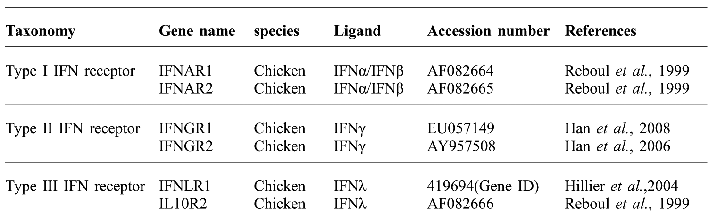
Data for other avian species is scarce, and further studies are needed to elucidate detailed information about avian interferons. In birds, only the chicken interferon receptor has been reported (Table 2).
Interferons identified in avian species.

Interferon receptors identified in avian species.
Interferon receptors in birds have not yet been characterised at the molecular level. The various types of interferon receptor may be regulated in various, connected ways. Determining the levels of human and murine cytokines is relatively easy as there are commercially available systems, particularly ELISA for many cytokines. Perhaps not surprisingly, there is only one such commercial product currently available for avian cytokines (an IFN-γ ELISA). In addition the relative lack of reliable antibodies to avian cytokines makes development of immunoassays difficult. The development of molecular techniques and in particular reverse transcriptase PCR (RT-PCR) has allowed cytokine production to be detected without the requirement for the protein, just needing cDNA. The recent development of quantitative RT-PCR has allowed cytokines to be quantified in chicken (Han et al., Reference HAN, ZHANG, DONG, HAN and WANG2006; Downing et al., Reference DOWNING, LLOYD, O'FARRELLY and BRADLEY2010; Haq et al., Reference HAQ, WOOTTON, BARJESTEH, ST PAUL, GOLOVAN, BENDALL and SHARIF2013; Reuter et al., Reference REUTER, SOUBIES, HARTLE, SCHUSSER, KASPERS, STAEHELI and RUBBENSTROTH2014).
Avian cytokines and their role in immune system.
Cytokines as therapeutic agents and vaccine adjuvants
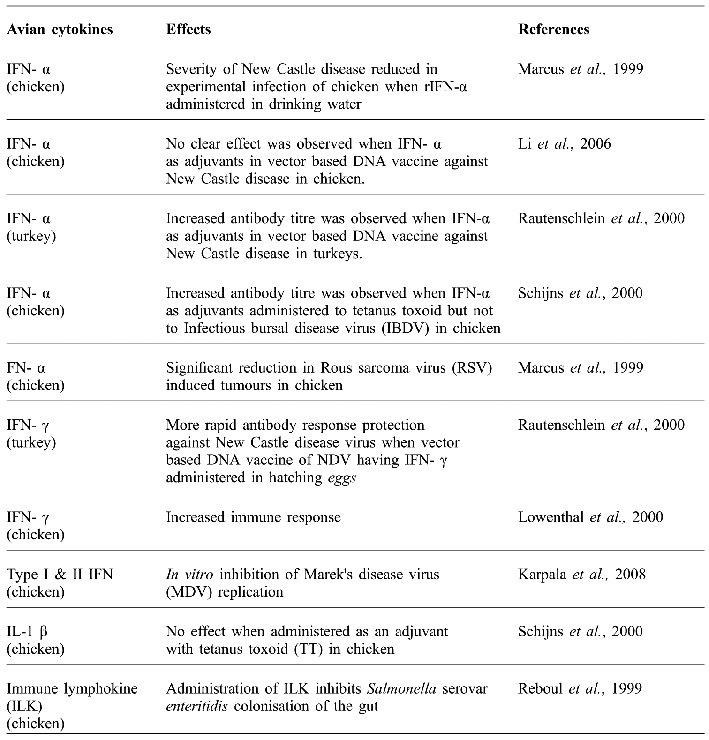
Avian cytokines can be used in three ways to restrict infectious agents in chicken i.e. as adjuvants with vaccines, as a shield against pathogen activities and to stimulate and activate the host immune system (Zhou et al., Reference ZHOU, CHEN, WANG and CHENG2014). Extensive experimental and clinical studies have been made regarding the therapeutic use of cytokines in mammals in conditions ranging from infectious disease to cancer, often with mixed results. Vaccines and antibiotics may not be feasible and economic to use against every pathogen infecting poultry. Therefore, cytokines are potential candidates to enhance host immunity and protect poultry from infections. Higher production of IFN-γ and macrophage activation have been achieved by incorporating IL-18 along with attenuated vaccine strain 9R to destroy and clear salmonella from macrophages in experimental studies (Kalaiyarasu et al., Reference KALAIYARASU, KUMAR, KUMAR, SANKAR, ELAMURUGAN and KARIKALAN2013). Cytokine administration in poultry has shown cross protection against salmonella serotypes in contrast to salmonella vaccines (Curtis and Way, Reference CURTIS and WAY2009). Moreover, cytokine have potentially activated heterophils against salmonella (Redmond et al., Reference REDMOND, CHUAMMITRI, ANDREASEN, PALIC and LAMONT2009). In the same way, pathogenic activities of Newcastle's disease (ND) virus were reduced significantly by experimental injection of IFN in poultry (Lowenthal et al., Reference LOWENTHAL, LAMBRECHT, VAN DEN BERG, ANDREW, STROM and BEAN2000). Table 4 lists the various published work regarding these benefits.
Applications of avian cytokines as therapeutic agents or adjuvants.
The use of interferons as adjuvants or therapeutics has been most widely investigated, with some success. One particular approach of interest is to incorporate the gene encoding the cytokine of interest into a DNA vaccine or into a viral or bacterial vaccine vector, e.g. the incorporation of IFN-α into a ND vaccine carried in a fowl pox vector in turkeys (Haq et al., Reference HAQ, WOOTTON, BARJESTEH, ST PAUL, GOLOVAN, BENDALL and SHARIF2013; Zhou et al., Reference ZHOU, CHEN, WANG and CHENG2014). This approach led to a more rapid onset of antibody production and increased protection despite subsequent disease challenge. Such an approach may be effective in diseases such as fowl typhoid. During Salmonella enterica serovar gallinarum infection, survival within macrophages is crucial to disease progression (Fringuelli et al., Reference FRINGUELLI, URBANELLI, THARUNI, PROIETTI, BIETTA, DAVIDSON and FRANCIOSINI2010). Incorporation of IL-18 into an attenuated vaccine strain such as the 9R vaccine (Hilton et al., 2002) caused an increased Th1-type response in turn leading to the production of IFN and macrophage activation, with subsequent clearance of Salmonella spp. from macrophages. A possible problem with such an approach is that interference from a protective antibody response may occur, reducing the long-term efficacy of the vaccine. The use of recombinant cytokines as adjuvants is attracting attention and may provide alternatives to existing adjuvants (Kalaiyarasu et al., Reference KALAIYARASU, KUMAR, KUMAR, SANKAR, ELAMURUGAN and KARIKALAN2013). Cytokines provide signals that help in regulation and activation of immune cells leading towards antibody-mediated or a cell-mediated response in mammals (Lowenthal et al., Reference LOWENTHAL, LAMBRECHT, VAN DEN BERG, ANDREW, STROM and BEAN2000; Diaz-San Segundo et al., Reference DIAZ-SAN SEGUNDO, WEISS, PEREZ-MARTIN, KOSTER, ZHU, GRUBMAN and DE LOS SANTOS2011; Yang et al., Reference YANG, XU, LI, LI, BI and LIU2013). Cytokines have been shown to be effective adjuvants in several studies (Kalaiyarasu et al., Reference KALAIYARASU, KUMAR, KUMAR, SANKAR, ELAMURUGAN and KARIKALAN2013). IL-2, as a potential adjuvant in mouse models, have been shown to enhance immunity when incorporated with inactivated rabies vaccine and a herpes simplex virus antigen (Zhou et al., Reference ZHOU, CHEN, WANG and CHENG2014). The role of IL-2 as a potential vaccine adjuvant has been extensively studied due to its pleiotropic properties and activity in T-cell proliferation (Downing et al., Reference DOWNING, LLOYD, O'FARRELLY and BRADLEY2010; Schoggins et al., Reference SCHOGGINS, WILSON, PANIS, MURPHY, JONES, BIENIASZ and RICE2011). The potential adjuvant effects of IL-2 have been demonstrated in vaccine model systems in cattle (Kalaiyarasu et al., Reference KALAIYARASU, KUMAR, KUMAR, SANKAR, ELAMURUGAN and KARIKALAN2013). Similarly, several human and animal studies involving the adjuvant efficacy of IFN have been reported. IFN has been shown to be an effective adjuvant in immuno-compromised mice when delivered with a malarial or an influenza vaccine (Schneider et al., Reference SCHNEIDER, KLAA, KASPERS and STAEHELI2001; Wigley and Kaiser, Reference WIGLEY and KAISER2003; Goodman et al., Reference GOODMAN, ZENG, PROLL, PENG, CILLONIZ, CARTER, KORTH, TUMPEY and KATZE2010). Other mouse studies have demonstrated that cytokines such as IL-1 act as adjuvants in the up-regulation of humoral and cellular responses to antigens.
In livestock, cytokine therapy has been shown to be effective in several animal models. In cattle, the administration of recombinant bovine IL-2 or IFN-α and greatly reduces mortality and the severity of clinical disease in vaccinated calves when challenged with bovine herpes virus-1 (Kalaiyarasu et al., Reference KALAIYARASU, KUMAR, KUMAR, SANKAR, ELAMURUGAN and KARIKALAN2013). Similarly, other researchers showed that IL-1α and -1β act as adjuvants in sheep to significantly enhance the secondary humoral immune response to experimental antigens (De Boever et al., Reference DE BOEVER, CROUBELS, DEMEYERE, LAMBRECHT, DE BACKER and MEYER2010).
Due to the recent discovery of a number of chicken cytokine genes, studies have been performed to assess cytokine adjuvant activity. In comparison to mammalian cytokines, the adjuvant activities of chicken cytokines are less well characterised, nevertheless, there are some chicken cytokines that have been examined for their potential use as vaccine adjuvants. One such cytokine is chicken IL-1 β (ChIL- β), whereby its immuno-adjuvant activity has been assessed using tetanus toxoid as an antigen. ChIL-1β increased antibody responses when administered in vivo as a recombinant protein compared to antigen alone (Schijns et al., Reference SCHIJNS, WEINING, NUIJTEN, RIJKE and STAEHELI2000) Combined administration of ChIFN-α, ChIFN-γ and ChIL-1β increased antibody responses to tetanus toxoid in an additive manner (Schijns et al., Reference SCHIJNS, WEINING, NUIJTEN, RIJKE and STAEHELI2000; Wilson and Brooks, Reference WILSON and BROOKS2013). This supports the possibility that cytokines in synergy could be effective adjuvants and immune responses may be better when they are used in combination. Similarly, the therapeutic and antiviral effect of ChIFN-α has been demonstrated, whereby co-expression of ND virus and ChIFN-α in a fowl pox vector (FPV) protected birds from ND challenge (Karaca et al., Reference KARACA, SHARMA and WINSLOW1998; Marcus et al., Reference MARCUS, VAN DER HEIDE and SEKELLICK1999; Susta et al., Reference SUSTA, CORNAX, DIEL, GARCIA, MILLER, LIU, HU, BROWN and AFONSO2013). When delivered by FPV, ND viral genes gave protection to birds after challenge; however, the chickens had lost weight due to the fowl pox virus. When ChIFN-α was co-administered with the ND viral gene in FPV, the birds did not lose bodyweight compared to non-vaccinated birds. This supports the concept that ChIFN-α treatment prevents diseases through its antiviral activity whilst maintaining vaccination potential.
Most chicken cytokines are at the stage of in vitro characterisation before assessment of activity as adjuvants in vivo. The adjuvant efficacy of IL-2 has not been demonstrated in chickens as yet. One study has reported that ChIL-2 could not enhance the efficacy of a vaccine against Eimeria acervulina (Hilton et al., 2002). To assist our understanding of its role and evaluate its activity as a potential adjuvant, the effects of ChIL-2 on immune cell populations in vitro and in vivo need correlation (Hilton et al., 2002). In vivo administration of ChIL-2 and changes in T-cell populations showed that it induced the expression of cell surface IL-2 receptor (CD25) on peripheral blood lymphocytes as well as increasing the proportions of CD4+ and CD8+ T cells. ChIL-2 increased T cell proliferation as measured by incorporating bromodeoxyuridine (BrdU). ChIL-2 enhanced T-cell activation and proliferation, suggesting its potential as an adjuvant to augment the immune response.
In addition, the adjuvant ability of ChIFN-γ when chickens were injected with SRBC with or without ChIFN-γ has been demonstrated (Lowenthal et al., Reference LOWENTHAL, LAMBRECHT, VAN DEN BERG, ANDREW, STROM and BEAN2000; Smith et al., Reference SMITH, M.S. WASH, FERRARA, WRIGHT, TEMPERTON, KELLAM and FIFE2013). Although ChIFN-γ has no significant effect on the primary antibody response, it increases secondary (IgG) antibody response. Furthermore, ChIFN-γ allowed a 10-fold lower dose of antigen to be used. These studies support IFN-γ as having adjuvant activity and its use in vaccine formulations for better protection against disease. Until recently, the adjuvant function of chicken myelomonocytic growth factor (cMGF) was not characterised, although it has been established that cMGF regulates the propagation of macrophages and granulocytes from avian bone marrow progenitor cells (Kalaiyarasu et al., Reference KALAIYARASU, KUMAR, KUMAR, SANKAR, ELAMURUGAN and KARIKALAN2013). The macrophage activating ability of cMGF is potentially important in controlling viral disease, and exploration of its role as an adjuvant is of particular interest. The in vivo biological activity of cMGF delivered via a live fowlpox virus (fp/cMGF) had been demonstrated previously (see above), and a more recent study has indicated the adjuvant potential of cMGF (Djeraba et al., Reference DJERABA, MUSSET and LOWENTHAL2002). Birds highly susceptible to Marek's disease virus (MDV) were treated with fp/cMGF. The birds were vaccinated with a commercial vaccine against herpes-virus of turkeys (HVT) four days later and challenged with a virulent (RB-1B) strain of MDV one week after cytokine treatment. In this trial, non-vaccinated birds suffered 100% mortality after challenge. Birds vaccinated with HVT alone suffered 33% mortality, whereas vaccinated birds that were treated with cMGF had zero mortality. These results showed improved protection with the vaccine and less tumour incidence in MDV-challenged birds, and clearly indicates the potential use of cMGF as a vaccine adjuvant for viral strains used in vaccines to increase protection against MDV (Kalaiyarasu et al., Reference KALAIYARASU, KUMAR, KUMAR, SANKAR, ELAMURUGAN and KARIKALAN2013).
Delivering vaccinations and adjuvants
When using cytokines as adjuvants in livestock, special consideration must be taken with regards to delivery. The poultry industry relies on cost-effective methods of vaccine and adjuvant delivery. The use of in ovo vaccination has increased in recent years, and may eventually be a preferred means of immunisation in poultry, due to reduced labour costs and animal handling. In ovo administration involves the injection of vaccine/adjuvant into the embryo either into the amniotic sac, the allantoic sac or intravenously. Many studies have shown that a number of vaccines have been safely administered in ovo. The development of automated systems for vaccine and adjuvant administration on a commercial scale introduces a new method of delivery of cytokines as vaccine adjuvants for future research. Automated machines can safely inject large numbers of eggs, ensuring accurate and consistent dosage (Rautenschlein et al., Reference RAUTENSCHLEIN, SHARMA, WINSLOW, MCMILLEN, JUNKER and COCHRAN2000; Abdelwhab and Hafez, Reference ABDELWHAB and HAFEZ2012). Cytokines delivered as adjuvants in ovo could reduce the cost of vaccines by increasing the effectiveness of the vaccine and reducing labour costs associated with post-hatch vaccination.
Conclusions
Antibiotic resistance and vaccination cost for the prevention or treatment of viral and bacterial infections are two major issues for the poultry industry. Delivery of recombinant cytokine proteins in the form of injection is not feasible in commercial poultry, highlighting one of the main drawbacks of cytokine therapy in poultry. Alternative methods such as in-ovo injection of protein or targeted vectors via automated egg injection system need to be explored in future. Advances in nanotechnology can make it possible to administer single or multiple cytokine with the immunogen. More effective vaccine and vaccination strategies can be designed for poultry by enhancing the knowledge of adjuvants property of cytokines along with DNA vaccines. Their potential use as adjuvants, particularly incorporated within DNA vaccines or vaccine vectors, is also being investigated. Chickens can be a good avian model system to study efficacy and role of cytokines as therapeutic agents for the control of animal and avian diseases. It is also likely that gaps in our knowledge regarding avian cytokines will be filled, particularly the Th2 cytokines. This will lead to further understanding of the role of the immune system in avian health and disease.