In 1892, in the aftermath of the Baring financial crisis, the German chancellor appointed a Börsen-Enquête-Kommission to investigate the functioning of the German stock exchanges and recommend new regulations to protect investors from unscrupulous company promoters and the effects of market manipulations. The resulting Börsengesetz passed into law in 1896, and academics and practitioners have debated the costs and benefits of the regulation, with a common conclusion that the law hurt the competitiveness of the markets. At the time of the law's promulgation, and for decades before that, Germany's securities markets played a significant role in the financing of corporate firms. In the historical literature on German industrialization, however, the stock markets have traditionally taken a back seat to the large, universal banks. Recent research has begun to amend the picture, highlighting the importance of financial markets in the development of Germany's corporate economy.
A small subset of this research examines the new issues markets as a key means by which firms could access new capital. This article examines the process through which companies issued new stock in Germany's premier prewar market and evaluates the severity of information problems in that market.Footnote 1 The cost of “going public” comes both from direct commissions that issuing firms pay to underwriters as well as from any potential proceeds forgone: the difference between the offer price paid to the issuer by initial investors and the price paid for the same equity shares when they start trading in the market. In the post-World War II era, new issues almost always appreciated in value on the first day of exchange trading.Footnote 2 This so-called “underpricing” represents both an enormous potential return to the primary purchasers of new issues and a good deal of “money left on the table” for issuers.
The underpricing of new equity provides one metric for assessing how efficiently the financial system operated. Excessive issues costs signal a number of potential problems: information asymmetries among underwriters, investors, and issuers; market power in the underwriting business; or underwriter price manipulations to support high after-market prices. High issuing costs constrain the ability of companies to access external finance in order to expand. They also make it more difficult for founders and initial financiers to cash out their investments and finance new ventures. The functioning of German new issues markets in the late nineteenth century depended heavily on the universal banks, as those institutions served as the underwriters of new securities and also provided much of the earlier-stage financing for companies that ultimately went public. Thus, the efficiency of the new issues market reflects on the functioning of both the financial markets and the universal banking system.
In addition to its contribution to the historical literature, the current study also sheds light on the broader questions of underpricing theories and their dependence on institutional conditions. Economists have formulated numerous theories to explain the phenomenon of underpricing, but most are set in the context of recent U.S. underwriting practices and institutions and have not worried about how other institutional settings influence assumptions and predictions of the theory. In order to test the theories, we need first to assess whether their assumptions hold in Germany in the late nineteenth century.
The institutions engaged in new issues markets in Germany during the late nineteenth century differed substantially from those of the United States in the past several decades. The information setup of most modern models assumes that underwriters are uninformed, but historical evidence on the roles played by universal banks in Germany suggests quite the opposite. Similarly, modern winner's curse models assume that investors possess markedly varying levels of information about new issues, but compared to the modern era, new issues in 1880s Germany were marketed among a much narrower investor population with more homogeneous information sets. Thus, some of the information problems that may produce underpricing now may have been less prevalent then.
In the German context, it is important to differentiate between returns to the purchasers of the stock from the underwriters and the spread that accrued to underwriters. Unlike modern American investment banks, German universal banks often undertook considerable risk as the initial investors and made markets in the shares they placed. Thus, the large spreads paid to underwriters could be likened in part to modern-day underpricing. These spreads could reflect an agency problem based on the underwriter's better access to information or the exercise of market power.
I also study both primary and secondary offers to examine differences in spreads related to differences in information about the issuing company. This separate identification of costs provides important clues to the location of information asymmetries and thereby simultaneously contributes to our historical understanding and permits better differentiation among the various theoretical models—an issue that plagues the theoretical literature on underpricing.
The analysis shows that the investors purchasing the new shares from underwriting banks earned low initial returns on average, particularly when weighted by the length of time between the filing of the offer and the first official trading of shares in the Berlin Stock Exchange. These initial returns also varied little with the prestige and market power of the lead underwriter. Both results suggest that the universal banks in their roles as underwriters might have resolved many of the information problems that would have allowed investors to demand high risk premia. Although the universal banks reduced some information problems that have been the focus of the modern literature, other agency problems and market power seem to have persisted nonetheless. German firms paid substantial underwriting premia and typically paid even more when using the largest, most prestigious investment bank underwriters.
THE NEW ISSUES MARKET IN BERLIN, 1870–1913: CONCEPTUAL ISSUES
By the 1880s, just ten to twenty years after the arrival of general incorporation rights, the German stock exchanges listed hundreds of companies and promoted many new issues, both initial public offerings and seasoned equity offerings, each year. Berlin listings grew from 612 to 1,005 share issues between 1880 and 1890.Footnote 3
Regulators worked to facilitate the functioning of the stock exchanges by ensuring confidence in the quality of claims traded there. The 1870 company law required new issues to be fully subscribed and at least 25 percent paid up before a new company (Aktiengesellschaft or Kommanditgesellschaft auf Aktien) could be founded; shares issued at higher than nominal value required 50 percent payment. The revision of the company law in 1884 worked to strengthen corporate governance institutions and the liability of company promoters to their investors, in an attempt to improve the quality of traded shares.Footnote 4 Even before that law, the shakeout of new companies during the stock market crisis of the mid- to late 1870s, already encouraged some self-regulation and higher standards among underwriters and investors. Carsten Burhop argues that the 1884 law increased the return demanded by investors because of the heightened litigation risk created by the liability clauses.Footnote 5
The universal banks underwrote the majority of new securities in Germany. They used either direct subscription of shares (Zeichnungsgründung or successive founding) or the more typical underwriting process (Übernahmegründung or simultaneous founding), in which the underwriter bought the shares and gradually sold them off to the public. The latter approach prevailed in Germany during the period of this study, and it meant that underwriters bore the risk that an issue might fail. Underwriting banks periodically held unwanted equity stakes until the market rebounded. Moreover, shares frequently traded through the universal banks and their networks of clients—particularly in the first year of a new corporation's existence.Footnote 6 After the levying of transaction taxes in the early 1880s, and before the closure of tax loopholes in 1900, the large, Berlin-based universal banks economized on taxes by offsetting their customers’ buy and sell orders and taking the net position to the exchange. Thus, banks participated considerably in the setting of prices during the period studied here.Footnote 7
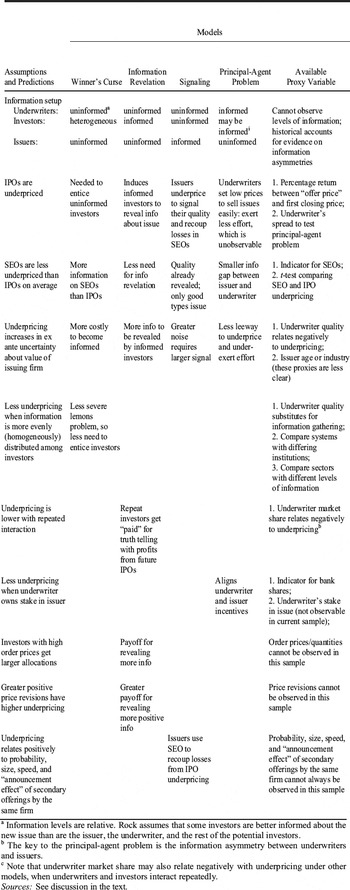
The institutional design of the new issues market very likely affected the costs of new issues, but in order to understand these consequences, we need a framework based on the theoretical literature. Much of this literature uses some form of asymmetric information to explain the phenomenon of underpricing. These models fall into four subcategories: Winner's Curse, Information Revelation, Signaling, and Principal-Agent. Each has its own assumptions and predictions (Table 1).Footnote 8
MODELS OF IPO UNDERPRICING AND EMPIRICAL PREDICTIONS

a Information levels are relative. Rock assumes that some investors are better informed about the new issue than are the issuer, the underwriter, and the rest of the potential investors.
b The key to the principal-agent problem is the information asymmetry between underwriters and issuers.
c Note that underwriter market share may also relate negatively with underpricing under other models, when underwriters and investors interact repeatedly.
Sources:
See discussion in the text.
Before explaining the theoretical models in full, it is worth noting that their assumptions alone may help narrow the set of theories applicable to the case of 1880s Germany. In three of four model classes, underwriters are assumed to be uninformed relative to at least some investors. Thus, if the uninformed underwriter assumption fails, we can eliminate these three theories. In contrast, the “principal-agent” model assumes that underwriters and investors are better informed than issuers, so that theory would remain.
The problem comes in conclusively determining which parties possessed what level of information in this historical context. While there is no hard evidence on the question, the assumption of uninformed underwriters fits poorly with the institutional details that one may glean from the historical literature on German investment banking, particularly in comparison with the institutional setup in the United States more recently.Footnote 9 Indeed, descriptive accounts suggest that German banker-underwriters built up long-term relationships with the companies they helped finance and therefore gained valuable information about firms before issuing shares.Footnote 10 If such claims are true, then we cannot assume that the German universal banks fit the assumption of uninformed underwriters, relative to investors and issuers.
Because of their underwriting procedures, and the sometimes extended period over which they sold off shares, the universal banks functioned partly as initial investors, similar to modern institutional investors. Thus, one might argue that the information heterogeneity among potential investors that causes the winner's curse problem also should have been less severe in the German system of the 1880s. The universal banks may have actually held an information advantage over issuers, since the banks typically won inside access to the companies they helped finance and simultaneously knew more about capital markets and prospects for new issues. Thus, the institutional conditions indicate a potential principal-agent problem that would have permitted underwriters to take advantage of issuers.
While we may have grounds for excluding three of the four categories of theoretical models, it is still worthwhile to summarize their main empirical predictions and provide even more solid testing. The “winner's curse” model reasons that underwriters must price IPO's below their market value in order to induce uninformed investors to buy the issue. If underwriters priced new issues, especially IPOs, at market values, then informed investors would over-subscribe the best issues, leaving the lemons for the uninformed. Since uninformed investors are smart enough to know that they are bidding along with informed investors, they know that they will lose out on the best issues and therefore earn a negative average return; hence the winner's curse problem.Footnote 11 Since underwriters need to attract both uninformed and informed investors in order to sell all of their shares, the average IPO must be underpriced, and the magnitude of this underpricing needs to increase with the uncertainty over the issue's value as well as with the heterogeneity of information among investors.Footnote 12 Because information is better available for secondary offerings (lessening both uncertainty and heterogeneity of information among investors), those issues should garner higher prices and lower levels of underpricing compared to IPOs, on average.
The three other classes of asymmetric information models provide different underlying reasons for IPO underpricing. Under “information-revelation” models, the underwriter may use underpricing to induce informed investors to reveal their information about the new issue. Underwriters give larger allocations to those revealing the highest valuation and still guarantee a profit by underpricing. Repeated interaction lessens the need for underpricing, as informed investors get promises of profits from future underpriced IPOs underwritten by the same bank. In signaling models, information problems run essentially the opposite of “winner's curse” models.Footnote 13 Now the issuer possesses the information advantage, and those with the best prospects can afford to underprice in order to signal their quality to investors. They can then issue secondary offerings more readily and at preferable terms, and the positive probability of getting revealed as low quality before being able to issue a SEO prevents low-quality issuers from mimicking the underpricing strategy of high-quality firms. Finally, principal-agent models yield the underpricing result by assuming that underwriters’ information advantage over issuing firms permits underwriters to set prices low in order to spare effort and marketing expenses and speed up sales.
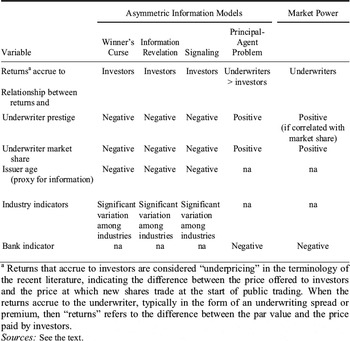
If any of these theoretical models is accurate, empirical tests should reveal positive average underpricing as well as significant effects of firm quality and information asymmetry. Information proxies might include issuer age, under the assumption that more information becomes available as firms create a track record. If information availability varies more between than within industries, then underpricing may as well, and industry dummies may enter the equation. Prestige of the lead underwriter is seen as a proxy for an issuer's quality, so underwriter reputation should relate negatively with the extent of underpricing, unless the underpricing is a signal of issuer quality (Tables 1 and 2).Footnote 14
EXPECTED EMPIRICAL RESULTS UNDER DIFFERENT THEORIES OF UNDERPRICING

a Returns that accrue to investors are considered “underpricing” in the terminology of the recent literature, indicating the difference between the price offered to investors and the price at which new shares trade at the start of public trading. When the returns accrue to the underwriter, typically in the form of an underwriting spread or premium, then “returns” refers to the difference between the par value and the price paid by investors.
Sources:
See the text.
Additional predictions may help differentiate among the theories. Most importantly for this article, the principal-agent problem raises a key institutional difference between 1880s Germany and more recent U.S. experience. While modern underwriters cannot profit directly from underpricing, German underwriters could, via the difference (“spread”) between the price they paid to issuers and the price at which they sold off the shares to other investors. In the current state of affairs, underwriters can only reap a benefit from the principal-agent problem by underpricing to investors and then shirking or earning kickbacks through excessive commissions and promises of future business. This institutional difference underscores the need to differentiate between the underpricing paid to investors in the form of initial market returns and the underpricing paid to underwriters in the form of their underwriting spread. A principal-agent problem under 1880s German institutions would suggest high returns directly to the underwriter but not high initial market returns to investors.
The principal-agent model also predicts that underpricing is decreased when the underwriter issues its own equity or owns a stake in the issuing company.Footnote 15 In general, we cannot observe ownership stakes due to the widespread use of bearer shares and insufficient archival evidence on stake holding by banks, but we do know from secondary sources that banks did not intentionally hold substantial long-term stakes in industrial firms; indeed, the banks’ shareholders viewed such stakes as evidence of a poor issuance business.Footnote 16 Since banks normally would retain some portion of their own issues, a finding that investment banks systematically underprice less on their own issues suggests that the underpricing on nonfinancial issues stemmed from the principal agent problem.
Some hypotheses prove difficult to test in practice. For example, to test the “winner's curse” model, one could in principle compare underpricing for high-information versus low-information sectors. But this requires a definition and measure of relative information levels. One might assume that old technology sectors such as textiles or brewing would have more readily available information about company valuation, whereas heavy industries—mining, smelting, machinery, or electrical—would have more diverse companies with less certain valuations. Testing for differences in underpricing between the two sets of industries would provide suggestive but surely not definitive evidence of the winner's curse. Thus, we can only use the sector test to reject the winner's curse theory (insignificant differences would imply an absence of a winner's curse), and then only if we are willing to assume that significant and relevant information differences do exist among industries.
One final test would be useful but is also poorly suited to the current data. The “quality signal” model predicts that underpricing relates positively with the probability of undertaking a secondary offering, and that such offers will be larger and less underpriced relative to offerings of issuers with less underpriced IPOs. Given data constraints, the test could only cover a small sample of issuers—those whose IPOs took place early enough in the period that sufficient time would have passed for a secondary offer to take place. Moreover, the environment for new issues deteriorated at the end of the period of study due to the Baring Crisis. Thus, some firms that originally planned a secondary offering would have delayed their offerings until the recovery that started around 1894/95.
Several other theories motivate underpricing without the use of information asymmetry.Footnote 17 According to one leading hypothesis, underwriters support prices in the aftermarket, effectively eliminating the negative tail in the returns distribution, so new issues earn positive initial returns on average.Footnote 18 Given the supposed activist involvement of the German universal banks in the capital markets, banks may have helped prop up prices, most likely by withholding shares from the market. If they withheld mostly poorly performing shares, then we should observe marked skewness toward positive initial market returns. In the extreme, if banks prevented all shares from falling below their offer price, then we would observe no negative initial market returns at all. The distribution would be completely truncated at zero. A more normal distribution of initial returns, with plenty of negative values, would suggest that the banks did not heavily support prices of their poorly performing new issues, or at least that the banks were not guaranteeing a positive return to initial investors. Such a finding in itself constitutes a significant revision of the standard historical narrative of interventionist banks.
Also, if the underwriting business is imperfectly competitive— due to network externalities, returns to scale, or product differentiation (say, in the quality of advice)—then the largest banks may exercise market power. Underwriters do sometimes obscure charges in opaque pricing.Footnote 19 Lack of competition suggests a positive relationship between underwriter market share and underpricing “charged” on new issues. This argument applies particularly well to late-nineteenth-century Germany, where underwriters profited directly from underpricing issues, and where markets internal to the underwriting banks benefited from network externalities.Footnote 20
To sum up, the theoretical and institutional considerations together yield a set of empirical predictions to test (Tables 1 and 2). Of key interest are the two types of underpricing (initial market returns and the underwriter premium or spread) and their relationship with the two measures of underwriter quality (reputation ranking and market share). Zero or very low initial market returns would undermine the validity of a large range of theoretical models of IPO pricing—signaling, winner's curse, information revelation, and price supports, for example. Such a finding would not invalidate the principal- agent or market power models. If those conditions prevail, then we should observe significant gains from “underpricing” flowing to the underwriters in the form of a large underwriting spread. Moreover, in the presence of market power, those spreads should increase with banks’ market share.
The empirical results can inform further studies on the connection between institutional design and new issues pricing, highlighting how the institutional setup makes a significant difference to the usefulness of the theories. For example, when underwriters are well informed and are allowed to profit directly from underpricing, other investors may earn neglible initial market returns. The bottom line is that different models might apply in different cases, and one needs to carefully assess the institutional arrangements in place and align them with the assumptions made in the theoretical models. Thus it may well prove fruitless to seek a theory of new issues pricing that applies in all cases, independent of institutional arrangements.
DATA SOURCES AND EMPIRICAL METHODS
Three types of analysis can help disentangle the theories summarized in Table 2: first, measuring the extent of underpricing for the sample of issues; second, testing for truncation in the distribution of these returns; and third, analyzing the impact of issuer characteristics in the cross section of underpricing.
Underpricing in 1880s Germany could accrue to initial investors via sales in the secondary market or to underwriters directly. The first type, the percentage change in share values between the official issue price and the first official day of trading on the exchange, parallels the modern notion of underpricing. I refine this measure by dividing the return by the number of days between the issue and the first day of market trading.Footnote 21 The first day return does not fully capture the opportunity cost of new issues, the “money left on the table,” since the issuing firm does not necessarily receive the value of its shares at the issue price. Nor does it account for the potentially greater risk shouldered by the underwriters in this system. The second measure therefore takes the percentage change between the issue price and its par value, thereby including the premium paid to the underwriter. This return is not precisely the underwriter spread, since underwriters may not have paid par value to issuers.Footnote 22 Company founders could have earned part of this return as well, but in any case, it represents a significant part of the opportunity cost to issuers. The ability to identify the main beneficiary of underpricing allows us to split the principal-agent model from the other three information models, as seen in the first row of Table 2. If the IPO return goes to the underwriters rather than to outside investors—that is, the underwriter spread measure is substantial on average, but the initial market return is not—then the principal-agent model dominates the other three; and vice versa. Based on the information assumptions, I have already hypothesized that only the principal-agent model makes sense in the institutional setup of the German case.
In the next step, I evaluate the distribution of initial returns to new issues to test the price support theory. We cannot observe banks’ price stabilization activities. Given the historical reports of activist universal banks, we expect to see truncation of the left side of the distribution of market returns as the banks shift impending negative returns into zero or slightly positive returns. Truncation does not prove price stabilization, but lack of truncation provides good evidence that banks were not supporting prices.
In the third stage of the analysis, I model the cross section of underpricing (both underwriter spread and initial market returns) as a function of proxies for issuer quality and information availability. The most important proxy is underwriter quality: reputation or market share. If underwriter quality negatively proxies issuer risk, then asymmetric information models predict a negative relationship with initial market returns (Table 2). By contrast, if the principal-agent model applies to this case, or if the underwriting business was imperfectly competitive, then the underwriter spread should increase with underwriter market share.
If underwriter quality also proxies for issue risk, then the model should include another proxy for risk. Issue size provides the best such proxy, particularly from the standpoint of underwriters, since very large issues faced the possibility of nonplacement, or partial placement, for the underwriter. This fact also suggests that large issue size necessitated the use of a larger bank with a wider client network. Large offers could go through a consortium of smaller banks, but most likely a large bank would still have led such an issue.Footnote 23 Thus, issue size should relate to underwriter market share, and, indeed, the two variables are correlated at around 30 percent. On the other hand, offer size is not directly indicated as a useful explanatory factor in initial market returns based on the theoretical models.Footnote 24 Issue size in itself may or may not proxy for risk to initial investors. In modern studies, firm size is sometimes used to negatively proxy risk: large issuers generate less risk and tend to yield more information for investors. Some larger firms going public in nineteenth-century Germany, however, may have faced great risk, as they engaged in new technology development or employed new, large-scale methods of production and electrification. Thus, in the current analysis, issue size provides potentially mixed signals about risk and therefore initial market returns to investors.
The fact that we think certain types of firms choose to issue shares via a particular quality of underwriter raises the issue of selection bias. In fact, the selection process is exactly the reason that many studies use underwriter prestige to proxy (negatively) for issuer risk: high prestige underwriters choose lower-risk companies, or vice versa. When viewed as risk proxies, underwriter quality variables do not exert a direct, causal influence on initial returns, and selection bias is no concern. But if underwriter market share creates market power that causes higher underwriter premia, then controlling for offer size—and the issuing risk it helps measure—becomes even more important.Footnote 25
The industry indicator variables serve two purposes. First, low underwriter spreads in the banking sector relative to all others provides evidence of principal-agent problems or market power. Additionally, a finding that other sectoral variables relate insignificantly to initial market returns, or relate insignificantly differently from one another, undermines the idea that investors suffered from the winner's curse problem.
The data come from the report of the Börsen-Enquête Kommission (Stock Exchange Enquiry Commission) of 1893, which gathered information on all new issues of shares that gained listing on the Berlin Stock Exchange between 1882 and 1892. The data set contains 250 IPOs and 194 secondary offerings, out of which 335 issues have data on pricing. The reported data include issue size, number of shares issued, price at par, price at issue (expressed in relationship to par value, Kurs),date and Kurs on the first day of trading on the Berlin exchange (official listings and unofficial trading), date of founding, and date of filing the required prospectus. I calculated the number of days between filing and listing and the number of years between founding and filing.
Reputation ratings come from my qualitative assessment of the lead underwriters’ prestige and type of institution. The ratings take the values 0 through 7, respectively, for nonfinancial corporations, low-prestige private banks, low-prestige provincial banks, middling provincial or private banks, top private banks, top provincial banks, the smallest four great banks, and the top five great banks. Lead underwriter market share is the proportion of all issues performed by the given underwriter, with and without weighting by issue size.Footnote 26 Since a bank's market share relates closely to its stature, these variables correlate highly, even though they are constructed independently of one another.
Given the institutional discussion, I expect to find that the principal- agent and market power effects dominate and to find potentially little impact of underwriter reputation on initial market returns. Similarly, issuer age, another proxy for information availability, may not relate significantly with underpricing, if the first three asymmetric information models do not apply (Table 2).
RESULTS
Levels of Underpricing
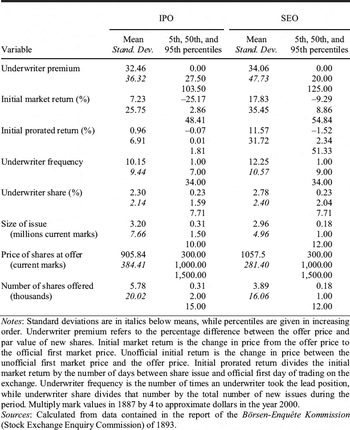
New issues typically yielded modest initial returns to investors (Table 3). The initial market return on IPOs, the percentage change between the issue price and the price at the first day of official trading, averaged 7.2 percent; rates much lower than those earned on U.S. IPOs in the past few decades. These rates fall dramatically, to an average of just under 1 percent for IPOs, when we divide by the number of days between the filing and the official listing of shares on the exchange. This listing lag commonly lasted about one year (median of 325 days) for IPOs, while for SEOs, listing took place much faster (median of 0 days). In contrast to market returns, underwriter premia on IPOs averaged 32.5 percent over the decade, while seasoned offerings averaged 34 percent.Footnote 27 Also notable, a substantial number of Berlin issues earned negative initial market returns, while very few issues earned negative underwriter premia.Footnote 28
THE BERLIN NEW ISSUES MARKET—DESCRIPTIVE STATISTICS

Notes:
Standard deviations are in italics below means, while percentiles are given in increasing order. Underwriter premium refers to the percentage difference between the offer price and par value of new shares. Initial market return is the change in price from the offer price to the official first market price. Unofficial initial return is the change in price between the unofficial first market price and the offer price. Initial prorated return divides the initial market return by the number of days between share issue and official first day of trading on the exchange. Underwriter frequency is the number of times an underwriter took the lead position, while underwriter share divides that number by the total number of new issues during the period. Multiply mark values in 1887 by 4 to approximate dollars in the year 2000.
Sources:
Calculated from data contained in the report of the Börsen-Enquête Kommission (Stock Exchange Enquiry Commission) of 1893.
The low initial market returns on their own are consistent with several hypotheses. First, investors required modest remuneration for investing in new issues during this period. Second, the new issues market was not beset by uninformed underwriters and investors. And third, most asymmetric information models of IPO pricing do not apply to this case. At the same time, the high underwriter spread measures suggest that banks reaped substantial rewards for their underwriting business and that underwriters may have profited from a principal-agent problem or market power in the underwriting business—or both.
Underwriter frequencies and market shares provide further evidence on competition in the underwriting business. For IPOs, the average lead underwriter took that position in 10 issues during the 10 years and held an unweighted market share of 2.3 percent. For SEOs, the average underwriter frequency was slightly higher (12), as was market share (2.8 percent), but still not extremely high. A few issuers held much larger shares than average, but the largest underwriter led 34 issues and held an unweighted market share of 8 percent. The largest underwriters also tended to lead larger issues, so when weighted by issue amounts, the top underwriters’ share increases.Footnote 29 Deutsche Bank led the pack, with 14 percent of issued capital. Another of the so-called great banks, Berliner Handelsgesellschaft took a close second place at 13 percent, while the elite private banker, S. Bleichröder, came in third place at a little over 12 percent. Lead market shares drop off considerably after that level. Overall, top German underwriters held somewhat lower market share than their recent American counterparts, where the top four underwriters held unweighted market shares between 44 and 64 percent in the last decade.
The Berlin market floated very small issues by modern-day standards, as small as 60,000 marks for a secondary offering and about 100,000 marks for an IPO. Yet individual shares in the 1880s were very expensive, averaging nearly 1,000 marks per share. These numbers also imply a major difference in the number of shares issued then versus now. Whereas American firms today issue several million shares on average (and sometimes into the hundreds of millions), German firms issued 4,000 shares on average and no more than 15,000 during this period. Such information supports the standard view that equity investing in Germany during the 1880s (and for many decades following) was the domain of wealthy elites, corporations, and bankers. Many issues, or large portions thereof, were placed in the hands of the issuing families or related industrial groups and were traded very little. This result also bolsters the argument that many information-based theories fit poorly with the institutional setting of late-nineteenth-century Germany.
The Distribution of Underwriter Premia and Initial Market Returns
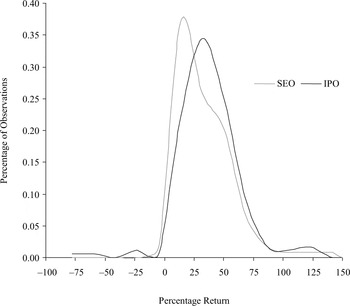
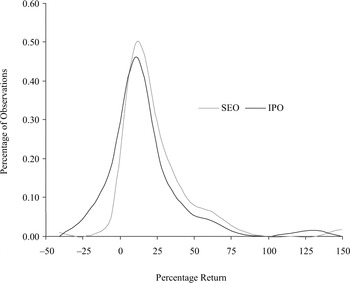
The two measures of underpricing demonstrate distinctly different patterns of left censoring (Figures 1 and 2) and also tell different parts of the story of new issues markets. First, contrary to the price support hypothesis, the initial market returns show very little censoring and plenty of negative returns. Over 40 percent of IPO shares earned negative returns between the stated offering price and the closing price on the first official listing date. Of course, this evidence in itself cannot rule out the possibility that underwriters supported prices: The underperforming shares could have been set to perform even worse than they did. If the universal banks supported shares, however, one would expect more skewness toward positive returns. The high proportion of negative initial market returns also further undermines most information-related IPO theories in explaining the German new issues market.
KERNEL DENSITY OF UNDERWRITER PREMIUM ON NEW ISSUES IN BERLIN, 1882–1892

KERNEL DENSITY OF INITIAL MARKET RETURN ON NEW ISSUES IN BERLIN, 1882–1892

Regardless of information problems, we would expect truncation in the distribution of underwriter premia, as the banks would require a positive return on their investment. Truncation is clearly apparent.Footnote 30 Close to half of new issues earned between zero and the median premium, and another 8 percent earned exactly zero premia. Only a handful of new issues earned negative underwriter premia. The truncation of this measure suggests that banks were almost always able to issues shares at a profit for themselves. While the banks may have waited to sell the shares until the market was favorable, the lack of negative returns may also indicate that the banks were adept at assessing and pricing risk. The combination of high underwriting premia and low initial market returns also implies that the banks were able to garner information from issuing firms that allowed for accurate pricing decisions. This evidence further undermines the first three information theories (Table 1) and supports the principal-agent and market power theories.
The density estimates also further illustrate the fact that IPOs and SEOs performed differently from one another. In the case of underwriter premia, the IPO curve sits to the right of the SEO curve, indicating a greater volume at higher returns for the IPOs. This result fits with the idea that underwriters generally possess less information about—and therefore require higher returns from—IPOs than corresponding SEOs. It could also indicate that underwriters held an information advantage over investors in the IPO arena, meaning that the underwriters could set issue prices so as to capture the lion's share of potential returns. In contrast, the distribution of initial market returns for secondary offerings lies to the right of that for IPOs. The density estimates graphically illustrate both the much smaller negative tail for SEOs and the greater proportion of returns in the moderately high range. This finding runs counter to the information-based IPO theories that predict less underpricing on SEOs than on IPOs. The result could still be consistent with the principal-agent explanation, as that model predicts a gain to underwriters, which in this case appears in the underwriting premium. Moreover, the gain relates at least in part to the underwriters’ advantage in knowledge of capital markets in addition to any potential information advantage regarding issue quality, so the difference between SEOs and IPOs is smaller.
Correlates of Underpricing
The results on levels and distributions of underpricing offer important insights into the role of information in the costs of new issues, but we can go further by analyzing the relationship between these costs and issuer characteristics. The theoretical and institutional discussion summarized in Tables 1 and 2 motivates the modeling of underwriter premia and initial market returns as a function of proxies for issuer risk and information availability—underwriter prestige, issuer age, offer size and price, and industrial sector—as well as underwriter market share. In order to mitigate extreme outlier biases, I use median regression models of the following form:

where UWQUALITY takes the form of either underwriter prestige or underwriter market share, as noted in the results tables.
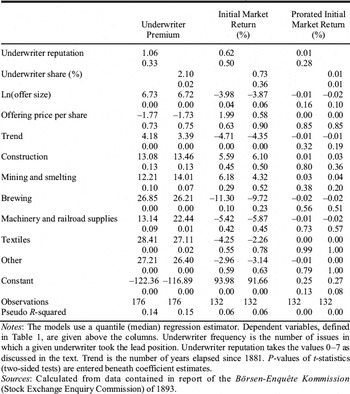
The regression results further support the principal-agent and market power hypotheses and undermine the other information- based theories. Underwriter prestige and market share both relate very strongly and positively with underwriter premia but not at all with initial market returns, time-weighted and not (Table 4).Footnote 31 In other words, large, high-prestige underwriters command more return for themselves, but their presence as lead underwriter does not signal a lower risk issue and thereby reduce the initial market return. Furthermore, as predicted (Table 1), the sector indicator variables also support the principal-agent model, as they show that financial institutions paid lower underwriter premia than issuers in other sectors.Footnote 32 Among the nonfinancial sectors, however, the initial returns in the formal market differ insignificantly from one another.Footnote 33 If information heterogeneity of investors varies systematically among sectors, then the “winner's curse” model predicts sectoral differences in underpicing. The information differences among sectors could be construed as risk proxies and therefore seen as tests of most information-based models. The lack of sectoral variation therefore undermines all such models to some degree, but especially suggests the absence of a winner's curse problem.
FACTORS ASSOCIATED WITH IPO RETURNS, 1882–1892

Notes:
The models use a quantile (median) regression estimator. Dependent variables, defined in Table 1, are given above the columns. Underwriter frequency is the number of issues in which a given underwriter took the lead position. Underwriter reputation takes the values 0–7 as discussed in the text. Trend is the number of years elapsed since 1881. P-values of t-statistics (two-sided tests) are entered beneath coefficient estimates.
Sources:
Calculated from data contained in report of the Börsen-Enquête Kommission (Stock Exchange Enquiry Commission) of 1893.
Taken together, the cross-sectional results support the principal- agent model of underpricing and undermine the other three major information-based models. At the same time, the fact that the underwriters with the greatest market share earned the widest spreads indicates that the big players exerted some level of market power.Footnote 34 It is difficult to distinguish between the two leading explanations—market power and principal-agent problems—and it is quite possible that both issues go hand in hand. In fact, in order for the underwriters to earn excess rents from the exploitation of their information advantage, competition among underwriters must have been suppressed. Likewise, the information advantage of the banks may have created their market power.
CONCLUSIONS
During the key period of German industrial development from 1882–1892, a significant number of firms issued new stock underwritten by German universal banks and private bankers. The institutional structure of the German IPO market differed markedly from modern U.S. IPO markets in important ways. Universal/investment banks played a role similar to modern-day institutional investors, often purchasing new stock issues from companies for subsequent sale to other investors. Unlike modern investment banks in the United States, German underwriters directly reaped the profits from pricing their purchases of new issues below market values. In consequence, several theoretical models that work well in modern studies of new issues markets—winner's curse, signaling, and information revelation—do not appear to fit the German setting.
This analysis of the German markets of the late nineteenth century suggests that issuers faced principal agent or market power problems when they worked with underwriters. Investors earned small initial market returns on average, with a solid proportion of negative returns. In contrast, underwriters made substantial profits in the form of spreads, and rarely earned negative returns. The pronounced skewness of underwriters’ spreads suggests that underwriters possessed a great ability to value and price their risk. An additional piece of evidence comes from the sectoral differences in underwriting costs: financial firms paid significantly lower underwriting spreads than did other issuers (supporting the principal-agent theory), but the spreads did not vary systematically among the nonfinancial sectors (undermining the winner's curse theory).
Finally, supporting the hypothesis of market power, the underwriter's gain increased with the market share and prestige of the underwriter, while initial market returns to investors did not. The Berlin great banks clearly held the largest market share in underwriting in the Berlin stock exchange, maintained the most extensive networks of clients with which to place shares, and therefore most likely exercised market power.
Beyond historical interest, the study highlights the importance of institutional differences in determining the extent and form of underpricing in new issues markets. In comparison with recent experience, underpricing flowed more directly to the underwriting banks and to company founders than to the outside investors in those shares. Investors demanded modest returns for investing in new issues, suggesting manageable levels of risk and information asymmetries from their perspective. To some extent, these differences in who receives the costs of new issues may reflect institutional and regulatory disparities: the banks in Germany in the 1880s were allowed to profit from paying issuing firms one price for shares and selling those same shares to investors in the market. As rules have prevented underwriters from profiting directly from underpricing, they have moved to indirect methods of profiting that ostensibly shift the gain to outside investors, but that do benefit underwriters through fees and repeat business with their venture capitalist and institutional investors.
The results here reveal both costs and benefits of the German system of new issues during the late nineteenth century. Most important from the historical standpoint is the fact that while issuers did bear a significant cost of issuing shares, thousands of German companies participated actively in the new issues market over the late nineteenth and early twentieth centuries, often undertaking multiple issues over several years. On net, therefore, the benefits of the system clearly outweighed the costs in the eyes of many issuers and investors. Whether the system warranted the drastic measures taken in the 1896 Börsengesetz is less clear, as are the effects of that new law. These issues await further research.