Implications
New methods enabled by technology to monitor cows calving may help minimise the costs of dystocia and reduce the time that farmers spend on this task. Profiles of dairy cow rumination duration and activity level between, and within, days peripartum were determined. These data showed a distinct decline in the duration of rumination prepartum that was used as a method to predict the day of calving for dairy cows based outdoors on pasture.
Introduction
The average Australian dairy herd size has doubled from 120 to 240 cows/farm over the last 20 years (Dairy Australia, 2012), substantially increasing the time that farmers require for individual animal attention (Raussi, Reference Raussi2003). At the same time, the prevalence of dystocia in dairy cows internationally is between 2% and 13% (Mee, Reference Mee2008), with the upper limit of the range from the United States, the country where Australia currently sources the majority of its dairy genetics. This increasing herd size and incidence of dystocia together increases the risk of cow and calf mortality without a significant investment in farm labour. Alongside the labour and lifestyle issues for dairy farmers associated with this investment are the significant costs of dystocia on cow welfare (Barrier et al., Reference Barrier, Ruelle, Haskell and Dwyer2012) and a dairy enterprise’s finances through decreased production and fertility, and increased cow and calf morbidity (Dematawewa and Berger, Reference Dematawewa and Berger1997). New methods enabled by technology to monitor cows calving may help minimise the costs of dystocia and reduce the time that farmers spend on this task.
There are various methods used to predict the timing of calving. Accurate record keeping enables calving to be predicted within a window of 10 days, given the range in the gestation period of a cow (280±5 days) (Norton, Reference Norton1956). Behavioural observations such as cows seeking isolation from the rest of the herd (Lidfors et al., Reference Lidfors, Moran, Jung, Jensen and Castren1994), increases in restlessness (Owens et al., Reference Owens, Edey, Bindon and Piper1985), transitions between standing and lying and tail raising (Miedema et al., Reference Miedema, Cockram, Dwyer and Macrae2011) and a decline in rumination and feeding levels (Schirmann et al., Reference Schirmann, Chapinal, Weary, Vickers and von Keyserlingk2013) are also indicators of calving for cows offered a total mixed ration. As the timing and duration of rumination, feeding and activity differs substantially between housed (Schirmann et al., Reference Schirmann, Chapinal, Weary, Heuwieser and von Keyserlingk2012) and pasture-based grazing (Gregorini et al., Reference Gregorini, DelaRue, McLeod, Clark, Glassey and Jago2012) animals, the potential to use these behaviours to predict calving for pasture-based dairy cows is unknown.
Varying forms of technology are currently used to measure individual animal physiology, behaviour, and production to improve management strategies and dairy farm performance (Rutten et al., Reference Rutten, Velthuis, Steeneveld and Hogeveen2013). Calving events have been successfully predicted using vaginal probes to monitor changes in temperature (Aoki et al., Reference Aoki, Kimura and Suzuki2005) and by video monitoring (Cangar et al., Reference Cangar, Leroy, Guarino, Vranken, Fallon, Lenehan, Meed and Berckmans2008). However, these methods require a skill set such as the ability to suture the sensor in the correct position, additional labour to monitor video footage and are specific to the monitoring of calving. In contrast, rumination duration and activity level can be continuously monitored using collar-based systems. As rumination duration declines around calving for housed cows offered a total mixed ration (Schirmann et al., Reference Schirmann, Chapinal, Weary, Vickers and von Keyserlingk2013), there is potential to use rumination and activity sensors to predict the timing of calving for cows based outdoors on pasture.
The objective of this study was to first determine the profiles of rumination duration and level of activity between and within days for dairy cows peripartum and second to use these data to predict the day of calving.
Material and methods
The use of animals was approved by the Animal Ethics Committee of the University of Sydney (N00/5-2013/3/5998). The study was conducted at the University of Sydney’s Corstorphine dairy research farm, Camden from 27 August to 8 October 2013. Two weeks before expected calving date, 27 cows were fitted with SCR heat and rumination long distance Tags (Hi Tag; SCR Engineers Ltd, Netanya, Israel). These collars consisted of an accelerometer to quantify activity and a microphone to monitor rumination, as validated by Schirmann et al. (Reference Schirmann, von Keyserlingk, Weary, Veira and Heuwieser2009). Both activity and rumination data were stored in 5-min intervals, which were downloaded to a farm computer and collated into mean hourly levels.
Cows were located in one 40×90 m2 paddock and offered ad libitum oaten hay and taken to the milking facility once daily where they were offered 2 kg grain-based concentrate/cow per day until calving. Cows were then introduced to the main milking herd that were offered grazed pasture as their primary feed source. Farm staff monitored the calving paddock every hour through the day from a distance so as not to impact on behaviour. Calves were collected from cows the day post-calving and at the same time the cows were transferred to the main herd. The time of calving was recorded by farm staff.
Prediction of calving
‘Prediction’ of calving was classified as the ability to determine that a cow was going to calve on the following day. The change in rumination values across time were determined by:
-
(i) Relating day of trial (t) with the previous day rumination duration (t−1) (d t /d t−1) or;
-
(ii) Relating day of trial with the average rumination duration for the previous 4 days (d t /(d t−1, d t−2, d t−3, d t−4)/4) as an exploratory analysis showed daily rumination and activity levels to be stable up to 4 days prepartum but the major change in rumination levels to occur in the 2 days prepartum.
Threshold levels of rumination change were created using 0.1 unit increments (where 0.1 is equivalent to 10%) with values ranging from 0.1 to 1.4 corresponding with the range in values obtained from the aforementioned methods. The gold standard for the prediction of calving day was day −1 (the day before calving) as calculated from the day of calving recorded by farm staff.
Change in rumination duration using the first (i) or second (ii) calculation determined above was classified as being a true positive value if the result from the calculation was less than the threshold level. The sensitivity and specificity of each threshold level was determined by relating the gold standard with rumination change. Sensitivity percentage was calculated as 100×true positive/(true positive+false negative) and specificity percentage as 100×true negative/(true negative+false positive).
Statistical analysis
Five minute activity data detailing the relative activity of each cow as an index was determined from an accelerometer and associated detailed algorithms and rumination duration determined by a built-in microphone were collated into hourly means for each cow to aid in the interpretation of the results. Hourly activity and rumination data for each cow were fitted with linear mixed models, and all parameters were estimated using restricted maximum likelihood procedure of Genstat for Windows version 14 (VSN International Ltd, Hemel Hempstead, Hertfordshire, UK).
To determine the effects of day relative to calving (t) (14 days before (days −14 to 0) to 14 days after calving (days 1 to 14)) on mean hourly activity level and rumination duration across each day, time was included in the model as a fixed effect and cow as a random effect. To examine the effects of time within a day on rumination or activity levels for the 5 days leading up to calving (days −5 to 0), a mixed linear model was fitted to hourly rumination and activity data for each cow. The standard error of the difference (s.e.d.) is reported describing the changes in rumination duration and activity level.
Results
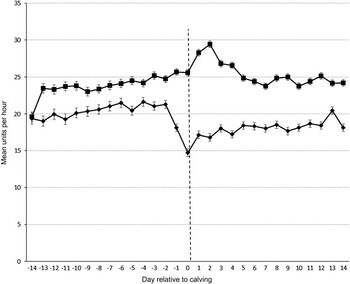
Rumination duration (min/h) and activity level (units/h) peripartum are presented in Figure 1. There was an effect of rumination (P<0.01; s.e.d. 1.5) and activity (P<0.01, s.e.d. 1.4) level with time. Rumination duration declined on average by 15% from day −2 to −1, and a further 18% from day −1 to the day of calving, representing an overall rumination duration decline of 33% as compared with rumination duration taken from days −3 to −14. There was a short-term rise in activity levels reaching ≈30 units/h by 2 days postpartum. Overall, prepartum (mean 24 units/h) and postpartum (mean 25 units/h) activity levels were similar. In contrast, rumination duration remained low in the days postpartum, reaching a stable level 5 days postpartum.
Mean (±s.e.) level of rumination (min/h) (diamond) and activity (units/h) (square) relative to the day of calving (day 0).

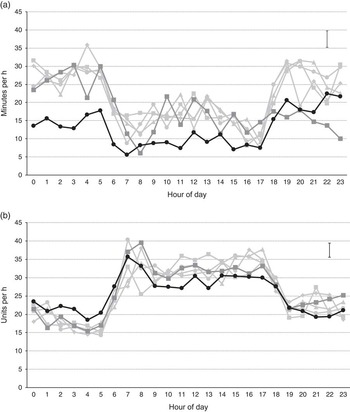
The duration of rumination and activity level within the 5 days pre-calving are shown in Figure 2a and b. Overall, with the exception of the day of calving (day 0), rumination and activity profiles were the inverse of each other with cows spending half of their time ruminating during the night (1800 to 0600 h) as compared with only a quarter of their time ruminating during the day (0600 to 1800 h). Rumination profiles of day −1 and the day of calving (day 0) differed to those on days −5 to −2 with a distinct decline in night time rumination duration on the day of calving.
Mean level of rumination (a) and activity (b) (min/h) for day −5 to −2 (light grey), −1 (dark grey) and 0 (black). The error bar indicates the average s.e.d.

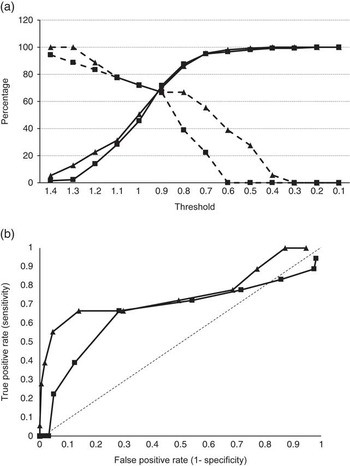
The effect of changing threshold rumination duration on sensitivity and specificity of detecting the day before calving is shown in Figure 3a. The relative trade-off between true positive and false positive rates is given as the receiver operating characteristic (ROC) curve (Figure 3b). The greatest distance of the ROC curve from the line of no discrimination occurred at a sensitivity of ~0.7.
The effect of changing threshold rumination value calculated as today/yesterday mean rumination duration (min/h) (triangle) or today/previous 4 day mean rumination duration (min/h) (square) on (a) sensitivity (dashed line) and specificity (solid line) with a true positive being the day before calving and (b) receiver operating characteristic (ROC) curve where the dashed line is the line of no discrimination.

Discussion
Rumination duration for cows in the current study decreased by 33% over the 2 days prepartum. In contrast, activity levels were maintained prepartum but increased in the days postpartum. In line with our findings, Schirmann et al. (Reference Schirmann, Chapinal, Weary, Vickers and von Keyserlingk2013), when monitoring housed cows, showed rumination duration to decrease by 31% around the time of calving relative to 2 to 4 days prepartum, with half of this decrease occurring in the 24 h postpartum in line with the decreased dry matter intake and time spent feeding at this time (Miedema et al., Reference Miedema, Cockram, Dwyer and Macrae2011). Together, these findings suggest that the decline of rumination levels in the lead up to calving is independent of system type, highlighting the opportunity to predict the timing of calving within a day and provide new insights into the behaviour of dairy cows postpartum.
Our findings are the first to show that the day of calving can be predicted for dairy cows based outdoors on pasture by the creation of threshold levels calculated by relating the day to day duration of rumination. Threshold values of 0.9 for both methods evaluated showed the greatest distance from the line of no discrimination towards perfect classification (the point 0.1), with sensitivity and specificity of ~70%. In comparison with our method, Burfeind et al. (Reference Burfeind, Suthar, Voigtsberger, Bonk and Heuwieser2011) using rectal and vaginal temperature loggers found a greater level of sensitivity (40% to 70%) but reduced specificity (80% to 85%) to predict calving within 24 h. Despite the greater specificity achieved by using temperature loggers, Burfeind et al. (Reference Burfeind, Suthar, Voigtsberger, Bonk and Heuwieser2011) acknowledge that such loggers would not be practical on commercial dairy farms. Thus, there is further work required to significantly increase the sensitivity and specificity of practical methods to predict calving events. Analysing rumination and activity sensor data taken at a more frequent interval and/or by incorporating other sources of data into a calving prediction model will be avenues to explore in future research.
Rumination duration and activity level had a distinct inverse diurnal pattern in the current study. These findings are in line with previous research (Thomson et al., Reference Thomson, Cruickshank, Poppi and Sykes1985; Taweel et al., Reference Taweel, Tas, Dijkstra and Tamminga2004; Gregorini et al., Reference Gregorini, Gunter, Beck, Soder and Tamminga2008), which reported the longest and most intensive rumination bouts to occur during the night, with rumen fill lowest at dawn. While these data provide insights into the behaviour of dairy cattle within a day prepartum, care must be taken in the interpretation of calving day profiles (Figure 2) of both rumination and activity as the timing of any calving event may have occurred at any hour. Despite this, these data highlight a clear opportunity to distinguish between calving cows and those that are not calving within a day, particularly using rumination duration in the early morning (midnight to 0500 h). Such detail may also allow the prediction of whether the dairy cow will require intervention to calve, which is the critical information that farmers require as a cow that is going to calve naturally requires less immediate attention. The opportunity to establish such a system is highlighted by Miedema (Reference Miedema2009) and Barrier et al. (Reference Barrier, Ruelle, Haskell and Dwyer2012) who showed unassisted or assisted cows without malpresentation spent significantly more time lying than those that were assisted with malpresentation. Thus, ‘normal’ profiles of behaviour leading to the final stages of parturition followed by an abnormally high duration of standing could predict the likelihood of dystocia and should be evaluated in further study.
As only 5 min are required for a dairy cow to establish a bond with its calf after birth (Hudson and Mallord, Reference Hudson and Mullord1977), and calves were removed from cows soon after this time in the current study, the increase in activity of cows in the 2 days postpartum may have been associated with the breaking of this bond. To the best of the authors’ knowledge, such findings are the first to be presented and give an insight into this behavioural aspect of dairy cows postpartum. Further work is required to define typical behaviours postpartum as abnormal profiles of activity and rumination could be useful early predictors of poor health given the prevalence of disease that occurs at this time (Dechow and Goodling, Reference Dechow and Goodling2008).
Conclusion
Profiles of rumination duration and activity level between and within days around calving were determined. These data showed a distinct decline in the duration of rumination prepartum that was used to successfully predict the day of calving for cows based outdoors on pasture. Further work is required to analyse rumination duration and levels of activity at reduced time intervals to predict the time of calving and whether assistance for calving is required.
Acknowledgements
The authors gratefully acknowledge the contribution of the staff from the University of Sydney’s Dairy Science Group, Corstorphine dairy farm and Dr Doron Bar from SCR. The authors wish to acknowledge the input and support of the Faculty of Veterinary Science, the University of Sydney throughout this project, in particular Associate Professor Peter Williamson and Professor Rosanne Taylor.