I. INTRODUCTION
In recent years, considerable research has been focused on the characterization and swelling behavior of superabsorbent responsive hydrogels designed for extensive applications including controlled drug delivery devices, sensors, biomaterials, and electrophoresis. Reference Samchenko, Ulberg and Korotych1–Reference Eeckman, Moes and Amighi5 Among them, ionic hydrogels based on acrylamide (AAm) and itaconic acid (IA) have attracted considerable interest for use as environmentally sensitive membranes and specific sorbents because of their larger swelling capacity, chemical composition, and three-dimensional network structure. Reference Kopecek, Sprincl, Bazilova and Vacik6–Reference Çaykara, Dogmus and Kantoglu8 Due to the importance of superabsorbent hydrogels in different fields, their swelling mechanism and water diffusion have been studied extensively. Reference Rodriguez and Katime9,Reference Hwang, Yuk and Huh10 Since one of the basic parameters determining the applicability of hydrogels as responsive systems is their swelling–deswelling behavior, the combination of large swelling capacity and good mechanical properties is also important in most of these applications. However, due to the random nature of crosslinking reactions, the conventional hydrogels have some limitations such as slow response rate to external stimuli, limited swelling degree at equilibrium, low mechanical strength after the swelling process, poor dimensional stability, and faulty behavior in the presence of salts.
The water-absorbing capacity and swelling kinetics of stimuli-responsive hydrogels depend on several parameters such as the presence of hydrophilic groups, the elasticity of the network structure, and the properties of swelling media. There are several techniques to impart remarkable properties to the hydrogels and find a compromise between large swelling and good mechanical response. Due to their swelling capacity, superabsorbent hydrogels with improved mechanical properties are more advantageous since they show a higher permeability and biocompatibility. Tomic et al. Reference Tomic, Mićić, Dobic, Filipovic and Suljovrujic11 showed that pH- and temperature-responsive hydrogels based on 2-hydroxyethylmethacrylate and IA copolymers have great potential for biomedical applications, especially for skin treatment and wound dressings. In addition, for swelling of hydrogels from the copolymers of N-isopropylacrylamide (NIPA) and IA in response to temperature and pH, Krušić and Filipovic Reference Krušić and Filipovic12 observed that the swelling of P(NIPA–IA) hydrogels strongly depends on the copolymer composition and also, the deswelling of hydrogels is faster than their swelling process. From the previous results obtained for hydrogels prepared by gamma radiation polymerization of AAm and various ionic comonomers such as acrylic acid (AAc), maleic acid (MA), and IA, it was observed that the reactivity of acids used in the copolymerization reaction can be arranged as AAc > MA > IA. Reference El-Neser13 In another work, anioinic hydrogels were synthesized by copolymerization of AAm and IA in the presence of poly(N-vinyl-2-pyrrolidone) in an aqueous medium and it was reported that the resulting hydrogels exhibit a number of deswelling–swelling cycles while maintaining the mechanical strength and shape stability for oral drug delivery applications. Reference Bajpai and Sonkusley14
To obtain a hydrogel system with larger swelling capacity and acceptable mechanical strength, one way is the preparation of a composite molecular structure by copolymerizing hydrophilic monomers which absorb large amounts of water with hydrophobic ones which enhance the mechanical strength. However, few studies have investigated systematically the elasticity and swelling capacity of hydrogels containing strongly dissociating electrolytes at low degrees of ionization. The purpose of the present study is to investigate the swelling behavior and elasticity of stimuli-responsive hydrogels made from acrylamide-based monomers as a function of the ionic group content. To improve the understanding of these systems, itaconic acid (IA) was selected as the ionic comonomer in the hydrogel preparation and the mole fraction of IA in the monomer mixture x i was varied between 0 and 0.10. The importance of the present work lies in the fact that these hydrogels can be used as superabsorbent responsive materials since the resulting hydrogels containing carboxylic groups can swell in neutral and alkaline pH range. The equilibrium swelling of P(AAm–IA) and P(DMA–IA) hydrogels in water, in buffer solutions, and in aqueous salt solutions was studied as a function of the IA content. The variation of the hydrogel volumes in response to changes in the ionic comonomer IA content, pH of the swelling medium, and the salt concentration was measured. To analyze the mechanical properties of the resulting hydrogels, the uniaxial compression testing was performed on the equilibrium-swollen samples and on hydrogels after their preparation.
II. EXPERIMENTAL
A. Materials
Acrylamide (AAm, Merck, Darmstadt, Germany), N,N-dimethylacrylamide (DMA, Fluka, Buchs, Switzerland), itaconic acid (IA, Aldrich, Steinheim, Germany), N,N′-methylenebisacrylamide (BAAm, Merck), ammonium persulfate (APS, Merck), and N,N,N′,N′-tetramethylethylenediamine (TEMED, Merck) were used as received. Hydrochloric acid (Merck), potassium dihydrogen phosphate (Riedel-de Haen, Seelze, Germany), potassium phosphate (J.T. Baker, Deventer, Netherlands), disodium hydrogen phosphate (Merck), and sodium chloride (Merck) were used for the swelling experiments in buffer solutions. All monomers and reagents were used as received, and double-distilled water was used for the preparation of hydrogels and for the swelling experiments.
B. Preparation of ionic hydrogels
Ionic hydrogels were prepared by free radical copolymerization in aqueous solutions of AAm or DMA as main monomers in the presence of IA as ionic comonomer and BAAm as the crosslinking agent. The preparation procedure of P(AAm–IA) and P(DMA–IA) hydrogels was schematically illustrated in Scheme 1. Free-radical crosslinking copolymerization reactions of AAm, DMA, IA, and BAAm were carried out in aqueous solutions at 24 °C in the presence of 2.63 mM APS and 24.9 mM (0.375 vol/vol%) TEMED as a redox initiator system. The initial concentration of the total monomers C 0 was held constant at 6.0 wt/vol%. The mole fraction of the ionic comonomer IA in the monomer mixture x i was varied between 0 and 0.10. The crosslinker ratio X (mole ratio of the crosslinker BAAm to the monomers AAm or DMA + IA) was fixed at 1/80. The stock solutions of the monomers and the initiator system were prepared in water using the following concentrations: AAm (3.0 g/20 mL), IA (0.92 g/20 mL), BAAm (0.211 g/10 mL), APS (0.08 g/10 mL), and TEMED (0.375 mL/10 mL). Table I summarizes the composition and characteristic parameters of P(AAm–IA) and P(DMA–IA) hydrogels. To illustrate the synthetic procedure in the polypropylene syringes, the details for the preparation of P(AAm–IA) hydrogel containing IA with x i = 0.01: AAm (0.573 g), IA (0.0106 g), BAAm (0.0158 g), APS stock solution (1.00 mL), and water (4.61 mL) were mixed in a 10-mL graduated flask. After cooling in an ice-water bath and bubbling nitrogen for 15 min, TEMED stock solution (1.0 mL) was added to the mixture and then mixed together for 5 min. Afterward, the solution was poured into the several syringes of 4.5–5.0 mm internal diameters and about 100-mm long. The syringes were sealed and kept at room temperature for at least 24 h during which time the polymerization took place. The resulting hydrogel samples thus obtained were subjected to the swelling and mechanical tests, as will be described below.
The feed composition and characteristic data of hydrogels. x
i = the mole fraction of ionic comonomer IA,
 ${\rm{\nu }}_{2,\exp }^0$
= the volume fraction of crosslinked polymer after preparation calculated using Eq. (1),
 ${{\rm{\nu }}_2}$
= the volume fraction of crosslinked polymer in the equilibrium swollen hydrogel, f = calculated effective charge density of hydrogels.

C. Equilibrium swelling studies
The equilibrium swelling studies of ionic P(AAm–IA) and P(DMA–IA) hydrogels were carried out in distilled water, in buffer solutions, and in aqueous salt solutions. All the swelling measurements were conducted at room temperature. pH-dependent swelling of hydrogels was performed in buffer solutions with pH ranging from 2.1 to 11.2, whereas the salt-sensitive swelling measurements were performed in aqueous NaCl solutions with concentrations ranging from 10−5 to 1.0 M. The hydrogels obtained in long cylindrical shapes were cut into 4–5 mm in length, and then, each sample was immersed in an excess of distilled water for one week to remove the uncrosslinked polymer and/or residual monomer. After that, the hydrogel samples were dried in vacuum at 40 °C to constant weight and then stored in a vacuum desiccator. The volume fraction of the crosslinked polymer network after preparation was denoted by
 ${\rm{\nu }}_2^0$
; the degree of dilution of network after preparation was experimentally determined according to the following expression:
 $${\rm{\nu }}_{2,\exp }^0 = {\left[ {1 + {{\left( {{q_{\rm{F}}} - 1} \right){\rm{\rho }}} \over {{d_1}}}} \right]^{ - 1}}\quad ,$$
where q
F is the dilution degree after the gel preparation (mass of gel after preparation/mass of dried gel), ρ and d
1 are the densities of the polymer and water, respectively. The values ρ and d
1 used in this study were 1.35 g/mL for P(AAm–IA) hydrogels, 1.213 g/mL for P(DMA–IA) hydrogels, and 1.00 g/mL for water, respectively. The experimental values of
 ${\rm{\nu }}_2^0$
of both hydrogels were also given in Table I. It was observed that
 ${\rm{\nu }}_2^0$
values increase slightly with increasing charge density from 0 to 0.10. By assuming that the monomer conversion is complete after the crosslinking, it is possible to calculate the theoretical value of
 ${\rm{\nu }}_2^0$
from the initial molar concentration of the monomers C
0 using the equation,
 ${\rm{\nu }}_2^0 = {10^{ - 3}}{C_{\rm{0}}}{\overline V _{\rm{r}}}$
, where
 ${\overline V _{\rm{r}}}$
is the average molar volume of the polymer repeat units (in mL/mol) and for P(AAm–IA) and P(DMA–IA) hydrogels can be given as:
 $${\bar V_{\rm{r}}} = \left[ {130.1{x_{\rm{i}}} + 71\left( {1 - {x_{\rm{i}}}} \right)} \right]/{\rm{\rho }}\quad {\rm{P(AAm {\hbox-} IA)}}\quad {\rm{,}}$$
 $${\bar V_{\rm{r}}} = \left[ {130.1{x_{\rm{i}}} + 99\left( {1 - {x_{\rm{i}}}} \right)} \right]/{\rm{\rho }}\quad {\rm{P(DMA {\hbox-} IA)}}\quad {\rm{.}}$$
For swelling experiments, the hydrogel samples from the same gel were immersed in vials (100 mL) filled with water for at least 2 weeks to reach the equilibrium swelling at room temperature. The swollen hydrogels were taken out at regular time intervals, wiped with filter paper, and the diameter of hydrogel samples both after equilibrium swelling D and after preparation D 0 was measured by a calibrated digital compass (Mitutoyo Digimatic Caliper, Kawasaki, Japan, Series 500, resolution: 0.01 mm). Four measurements were carried out on each hydrogel sample to achieve good precision and the equilibrium-swelling ratio of hydrogels V eq (volume of equilibrium-swollen hydrogel/volume of the hydrogel just after preparation) was calculated from:
 $${V_{{\rm{eq}}}} = {(D/{D_0})^3}\quad .$$
Then, the volume fraction of the crosslinked polymer in the equilibrium swollen hydrogel ν2 was calculated using the following equation;
 ${{\rm{\nu }}_2} = {\rm{\nu }}_2^0/{V_{{\rm{eq}}}}$
. The relationship between the volume-swelling ratio of gels q
v
(volume of equilibrium-swollen hydrogel/volume of dry hydrogel), ν2, and the polymer network concentration after the gel preparation
 ${\rm{\nu }}_2^0$
can be given as:
 $${q_v} = {1 \over {{{\rm{\nu }}_2}}} = {{{V_{{\rm{eq}}}}} \over {{\rm{\nu }}_2^0}}\quad .$$
The Flory–Rehner theory including the ideal Donnan equilibria gives the following well-known equation between the equilibrium-swelling ratio of hydrogels and the gel synthesis parameters Reference Flory and Rehner15 :
 $$\ln \left( {1 - {{\rm{\nu }}_2}} \right) + {{\rm{\nu }}_2} + {\rm{\chi }}{{\rm{\nu }}_2}^2 + {N^{ - 1}}\left( {{{\rm{\nu }}_2}^{1/3}{\rm{\nu }}{{_2^0}^{^{2/3}}} - {{\rm{\nu }}_2}/2} \right) - f{{\rm{\nu }}_2} = 0\quad ,$$
where f is the effective charge density of ionic hydrogels, χ is the interaction parameter between the polymer and water, and N is the average network chain length, i.e., the number of segments between two successive crosslinks. Since only a certain fraction of the mobile counterions inside the network structure is effective for the creation of osmotic pressure which expands the hydrogel, Eq. (6) was solved for the determination of the effective charge density of hydrogels. Both ν2 and N values were known from the swelling and elasticity measurements, respectively. For the calculation of χ parameter between polymer and water, for nonionic PAAm hydrogels; the values used were f = 0, ν2 = 1/52.3, and N = 620.5 ± 22. The value of χ parameter for nonionic PAAm hydrogels was found as χ = 0.468 ± 0.016 and for nonionic PDMA hydrogels as χ = 0.479 ± 0.026.
D. Compressive mechanical testing
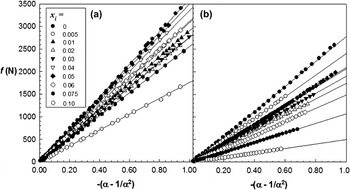
For the investigation of the effect of charge density on mechanical properties of P(AAm–IA) and P(DMA–IA) hydrogels, the uniaxial compression tests were performed on cylindrical gel samples after their preparation as well as after their equilibrium swelling by using a compression measurement apparatus as described before. Reference Orakdogen16 The hydrogel sample was placed between flat plate and analytical balance and then the force acting on the gel sample was calculated from the reading of the balance m as F = mg, where g is gravitational acceleration. Since the resulting deformation is Δl = l − l 0, where l 0 and l are the initial undeformed and deformed lengths, respectively, the deformation ratio α (deformed length/initial length) was calculated using the equation, α = 1 − Δl/l 0. The force and the resulting deformation were recorded after 20 s of relaxation, and the measurements were conducted up to about 20% compression. The results of the stress–strain experiments were used to calculate the elastic modulus of hydrogels after preparation and after their equilibrium swelling and also the effective crosslinking density in terms of the average chain length between two successive crosslink points N. The typical stress–strain curves of P(AAm–IA) hydrogels both after preparation and after their equilibrium swelling in water were collected in Fig. 1. As can be seen from the figure, the slope of the stress–strain isotherms varies depending on the mole fraction of the ionic comonomer IA used in the preparation, and the magnitude of %strain at deformation decreases with increasing IA content.
Typical stress–strain isotherms of P(AAm–IA) hydrogels after their preparation (a) and after equilibrium swelling in water (b). The mole fraction of ionic comonomer IA x i is indicated in the figure. The solid curves only show the trend of the data.

III. RESULTS AND DISCUSSION
In the present work, responsive hydrogels based on AAm and DMA with charge densities ranging from 0 to 10 mol% of IA were prepared by free radical crosslinking polymerization in aqueous solution using APS and TEMED as a redox initiator system. The ionic hydrogels were prepared at a fixed crosslinker ratio and obtained in clear transparent cylindrical forms. The uniaxial compression results indicated that there is a close relationship between the mechanical properties and the swelling of P(AAm–IA) and P(DMA–IA) hydrogels.
A. Elasticity of P(AAm–IA) and P(DMA–IA) hydrogels
The elastic modulus of ionic hydrogels after preparation and after equilibrium swelling in water was calculated by using the elastic deformation theory. Reference Flory and Rehner15,Reference Treloar17,Reference James and Guth18 The stress-deformation function is given as f = G (α − α−2), where f is the compressive stress applied and G is the elastic modulus of the gel sample. At low strains, the plot of the stress f versus (α − α−2) would yield a straight line whose slope gives G. For a homogeneous network structure, the elastic modulus of swollen gel G is given by the following equation Reference Flory and Rehner15,Reference Treloar17,Reference James and Guth18 :
 $$G = A{{RT} \over {N{V_1}}}{{\rm{\nu }}_2}^{{1 \mathord{\left/ {\vphantom {1 3}} \right. \kern-\nulldelimiterspace} 3}}{({\rm{\nu }}_2^0)^{{2 \mathord{\left/3{\vphantom {2 3}} \quad,$$
where V
1 is the molar volume of the solvent, the front factor A equals to 1 for an affine network and 1–2/
 $\phi$
for a phantom network, in which
 $\phi$
is the functionality of the crosslinks, R and T are in their usual meanings. For the hydrogels after their preparation,
 ${{\rm{\nu }}_2} = {\rm{\nu }}_2^0$
and then the modulus after preparation G
0 is given by:
 $${G_{\rm{0}}} = A{{RT} \over {N{V_1}}}{\rm{\nu }}_2^0\quad .$$
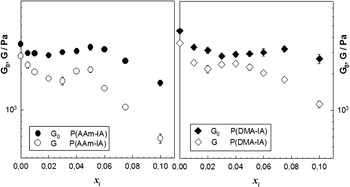
In Fig. 2, the elastic moduli of ionic P(AAm–IA) and P(DMA–IA) hydrogels after preparation G 0 (filled symbols) and after their equilibrium swelling in water G (open symbols) are shown as a function of the mole fraction of IA x i in the comonomer feed. Each elastic modulus data reported in this study are an average of four separate measurements performed in parallel. The elastic moduli of both P(AAm–IA) and P(DMA–IA) hydrogels change depending on the charge density of their network structures. As is seen that the elastic moduli of both hydrogels first decrease due to the presence of ionic IA units in the hydrogel structure. Between x i = 0.02 and 0.05, the elastic moduli of both hydrogel systems slightly increase with the ionic group content. This slight variation of the elastic moduli is connected with the high stretching of the network chains. For x i > 0.05, the moduli of hydrogels rapidly decrease with further increasing the charge density of the network due to the effect of electrostatic interaction of charged groups on the elastic free energy.
The elastic moduli of P(AAm–IA) and P(DMA–IA) hydrogels both after their preparation (filled symbols) and after equilibrium swelling in water (open symbols) plotted as a function of the mole fraction of IA in the comonomer feed x i.

Another point shown from Fig. 2 is that, as expected, the elastic modulus of both hydrogels decreases upon the swelling process. The elastic moduli of hydrogels after their preparation G
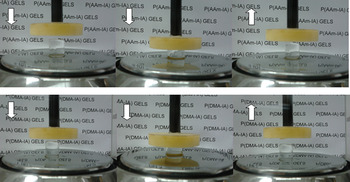
0 are larger than the equilibrium-swollen moduli G over the whole range of ionic comonomer IA content. Since the network chains in these swollen hydrogels are in their expanded configuration with respect to their dry state, destruction of chains may occur during the mechanical measurements. From the uniaxial compression testing of both hydrogel systems, it was also observed that P(DMA–IA) hydrogels are very tough while those formed with AAm are fragile under large deformation. Indeed, the elastic moduli data of P(AAm–IA) and P(DMA–IA) hydrogels in Fig. 2 showed that P(DMA–IA) hydrogels exhibit a high modulus of elasticity when compared with those of P(AAm–IA) hydrogels. The photographs of P(AAm–IA) hydrogels (upper panel) and P(DMA–IA) hydrogels (bottom panel) taken during compression test can be seen in Fig. 3. The mole fraction of ionic comonomer IA in P(DMA–IA) and P(AAm–IA) hydrogel samples x
i is 0.04. For P(AAm–IA) and P(DMA–IA) hydrogels, using G
0 and
 ${\rm{\nu }}_2^0$
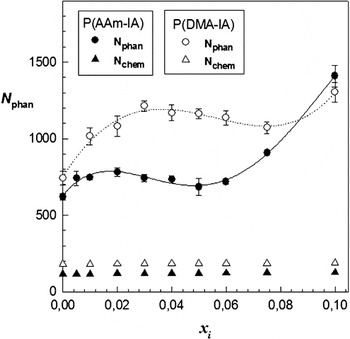
values together with Eq. (8), the network chain length N related to the effective crosslink density of hydrogels was calculated, and the results were collected in Fig. 4 as a function of x
i. The filled and open circles show the calculation results for P(AAm–IA) and P(DMA–IA) hydrogels, respectively. Since the hydrogels prepared in this study were highly swollen, the phantom network model (
 $\phi$
= 4) was used to calculate the network chain length and the other characteristic parameters of hydrogels (Table I). The triangles in the figure represent the chemical crosslink density, N
chem, which would result if all the crosslinker (BAAm) molecules formed effective crosslinks in the network structure. N
chem was calculated from the crosslinker ratio X used in the gel preparation by the following equation:
 $${N_{{\rm{chem}}}} = {{{X^{ - 1}}} \over 2}{{{{\overline V }_{\rm{r}}}} \over {{V_1}}}\quad .$$
Photographs of P(AAm–IA) hydrogels (upper panel) and P(DMA–IA) hydrogels (bottom panel) during the compression tests in their equilibrium swollen state. The mole fraction of ionic comonomer IA in the swollen hydrogel samples x i is 0.04.

The network chain length N of P(AAm–IA) hydrogels (filled symbols) and P(DMA–IA) hydrogels (open symbols) shown as a function of the mole fraction of IA in the monomer mixture x i. The solid curves only show the trend of the data.

For nonionic PAAm and PDMA hydrogels (x i = 0), N equals 620 and 741, respectively, compared to its chemical value of 116 and 181 calculated from the molar ratio of monomers to crosslinkers used in the gel synthesis (80). It is seen that the effective value of N is much larger than its chemical value N chem and the difference between N and N chem further increases at high charge densities. This difference in the effective and the chemical crosslink density values of both P(AAm–IA) and P(DMA–IA) hydrogels indicates that a significant fraction of the crosslinker BAAm is wasted during the crosslinking copolymerization probably due to the cyclization and multiple crosslinking reactions. The fraction of wasted BAAm units in PAAm gels was previously reported to be as 90% using the determination of the pendant vinyl group conversions. Reference Naghash, Massah and Erfan19,Reference Orakdogen and Okay20 Another point shown from Fig. 4 is that the effective crosslink density of P(DMA–IA) hydrogels is higher than that of P(AAm–IA) hydrogels over the entire range of ionic comonomer IA concentration. The elastic modulus of P(DMA–IA) hydrogels both after preparation and after equilibrium swelling is also higher than the corresponding P(AAm–IA) hydrogels as can be seen in Fig. 2, and this point can be explained with the presence of the methyl groups in the network structure of P(DMA–IA) hydrogels.
B. Effect of ionic comonomer concentration
1. pH-dependent swelling of ionic P(AAm–IA) and P(DMA–IA) hydrogels
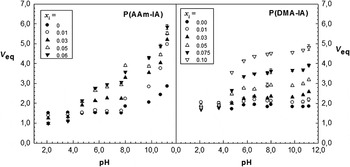
The effect of pH of external solution on equilibrium water uptake of ionic P(AAm–IA) and P(DMA–IA) hydrogels was studied in external solutions of varying pH between 2.1 and 11.2. In Fig. 5, the equilibrium volume swelling ratio of ionic P(AAm–IA) and P(DMA–IA) hydrogels was shown as a function of the mole fraction of IA in the comonomer feed. The amount of ionic comonomer IA present in the network structure affects the equilibrium water uptake of P(AAm–IA) and P(DMA–IA) hydrogels in a rather interesting way. Both hydrogels are observed to swell upon a change from acidic to alkaline pH conditions. The equilibrium water uptake increased with pH of the external solution, thus attaining a maximum value at pH between 9.8 and 11.2. As the ionic comonomer IA concentration increases, the swelling of both hydrogels considerably increases upon a change in pH. This swelling behavior may have a key role in pH-induced controlled release of drugs. Further studies such as in situ observation of drug release from pH-responsive acrylamide-based hydrogels will lead to the development of high-performance drug delivery systems.
The equilibrium volume swelling ratio of ionic P(AAm–IA) and P(DMA–IA) hydrogels V eq shown as a function of the pH value. The mole fraction of the ionic comonomer IA in the comonomer feed x i is already indicated in the figure.

Figure 5 also shows that the swelling of both P(AAm–IA) and P(DMA–IA) hydrogels display double-step rise in the S-shaped curve at pH around 4.0 and 8.0. The reason for the observed increase in the swelling can be explained by the dissociation of two carboxylic groups of IA in the pH range of 4.0–8.0, within which their pK a values of 3.85 and 5.44. Similar results obtained in Fig. 5 were previously reported by Sen and Guven. Reference Sen and Guven21 Their investigation on the swelling of itaconic acid-containing poly(vinyl pyrrolidone) hydrogels showed that the swelling exhibits a sudden increase at pH values around corresponding pK a values of IA. Bajpai and Sonkusley Reference Bajpai and Sonkusley14 also examined a single-step swelling during pH-dependent swelling of hydrogels synthesized by the copolymerization of AAm and itaconic acid in the presence of poly(N-vinyl-2-pyrrolidone). Figure 5 shows that both PAAm and PDMA hydrogels with no IA content exhibit swelling behavior which is almost independent of pH. Since these hydrogels are nonionic and do not contain any ionizable groups, the variation in pH of the external solution does not make any change in their equilibrium swelling. However, it was observed that nonionic PAAm hydrogels undergo hydrolysis in the range of pH 9.8–11.2. It is well known that a PAAm gel prepared by free radical polymerization behaves like a partially charged gel due to hydrolysis of its amide groups. Previous studies showed that the amide groups on the PAAm chains gradually convert into carboxylate anions at a pH value between 8 and 9 due to the presence of TEMED as a reducing agent in the polymerization. Reference Kurenkov, Hartan and Lobanov22,Reference Kudryavtsev, Litmanovich and Plate23 More recently, the effect of hydrolysis on spatial inhomogeneity in PAAm gels prepared at various crosslink densities was reported to show the hydrolysis of amide groups into carboxylate anions, which facilitates the homogenization of the gel samples. Reference Kizilay and Okay24
2. Equilibrium water uptake of ionic P(AAm–IA) and P(DMA–IA) hydrogels
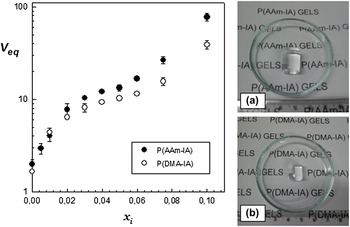
Since the resulting network structure and crosslink density distribution throughout the hydrogel affect the swelling properties, the equilibrium swelling of ionic P(AAm–IA) and P(DMA–IA) hydrogels was also investigated in water. In Fig. 6, the equilibrium volume swelling ratio of P(AAm–IA) hydrogels (solid symbols) and P(DMA–IA) hydrogels (open symbols) is shown as a function of x i. The photograph of P(AAm–IA) hydrogel-containing ionic comonomer IA, x i = 0.04 is shown in Fig. 6(a) and that of P(DMA–IA) is also shown in Fig. 6(b). The equilibrium swelling of both P(AAm–IA) and P(DMA–IA) hydrogels increases with the ionic comonomer IA content. The observed swelling can be explained by the presence of an appropriate balance of the hydrophilicity and hydrophobicity in the molecular structure imparted by undissociated IA and ionized carboxylate groups, respectively. First, the swelling of both hydrogels increases sharply with increasing ionic comonomer IA content until about x i = 0.03 which may be attributed to the ionization of carboxylic groups inside the network structure. As a consequence of the osmotic pressure exerted by the counterions of IA units in the network chains, for both hydrogels, V eq increase as IA content x i increases. Between x i = 0.03 and 0.06, the hydrogel volumes do not change much with the ionic group content. This is mainly due to the hydrophilicity imparted by ionized carboxylate groups, which is almost counterbalanced by the hydrophobic character of unionized IA in the network, thus causing slight change in the swelling capacity of hydrogels. In this region, for P(AAm–IA) hydrogels, the equilibrium volume swelling ratio V eq remains constant at about V eq = 12.6 ± 1.2, whereas for P(DMA–IA) hydrogels, it is found as V eq = 10.1 ± 1.5. In the same region, the elastic modulus of the hydrogels also increases with increasing x i at a fixed crosslinker ratio, and this observation is connected with the high stretching of the network chains.
The equilibrium volume swelling ratio V eq of P(AAm–IA) hydrogels (solid symbols) and P(DMA–IA) hydrogels (open symbols) shown as a function of the mole fraction of ionic comonomer IA x i. The photographs of hydrogels containing ionic comonomer IA at x i = 0.04 for P(AAm–IA) (a) and that for P(DMA–IA) (b) are shown in the figure.

Further increase in the ionic comonomer IA concentration above x i = 0.06 led to a rapid increase in the swelling capacity of hydrogels. It was found that the introduction of 10 mol% IA in the hydrogel systems increases markedly the swelling capacity which can be explained by the increase in the number of carboxylic groups and the hydrophilic tendency of ionized carboxylate groups in the network structure, thus causing an increase in the osmotic swelling pressure, as well as the extent of chain relaxation. The increase in the concentration of IA above 15 mol% led to a drastic inhibition of polymerization of AAm, and no crosslinked hydrogel was obtained. In the case of DMA and IA system, the crosslinked hydrogels containing 15 mol% IA were successfully prepared; however, the resulting hydrogels were too weak for the measurements since they were highly swollen in water. Figure 6 also showed that the swelling capacity of P(AAm–IA) hydrogels over the entire range of the ionic comonomer IA is much higher than those obtained for P(DMA–IA) hydrogels at the same comonomer composition. This difference in swelling can presumably be related to the different chemistry of the monomeric side chains and the formation of hydrophobic complexes between IA and methyl groups in the network structure through hydrogen bonds which suppress the swelling of P(DMA–IA) hydrogels.
3. Effective charge density of hydrogels
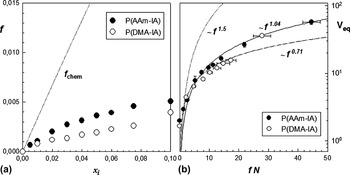
By using the experimental swelling and elasticity data and also χ parameters for both hydrogel systems, the effective charge density of hydrogels was calculated from Eq. (6), and the results were collected in Fig. 7(a) as a function of the mole fraction of ionic comonomer IA. The chemical charge density f
chem which gives the value if all IA units are effective in the hydrogel swelling was calculated from IA content present in the network as
 ${f_{{\rm{chem}}}} = {x_i}{\bar V_1}/{\bar V_{\rm{r}}}$
. In Fig. 7(a), the dotted line represents the relationship f = f
chem. It is seen that the effective charge density f of P(AAm–IA) and P(DMA–IA) hydrogels increases by increasing the mole fraction of ionic comonomer IA. The effective charge density of both hydrogels is also less than the chemical charge density over the entire range of the mole fraction of IA. This result indicates that a large amount of counterions in the network structure is ineffective during swelling. This can be explained by the hydrophobic interactions between the alkyl groups of polymer chains, which led to the formation of aggregates. By condensation of counterions in these aggregates, the osmotic pressure and hence the swelling ratio of hydrogels decrease. The observed results for both hydrogel systems are in accord with previous works indicating the existence of osmotically passive counterions.
Reference Okay and Durmaz25
The effective charge density of P(AAm–IA) and P(DMA–IA) hydrogels as a function of the mole fraction of IA in the comonomer feed x i (a). The equilibrium volume swelling ratio of hydrogels V eq shown as a function of the number of charges per network chain fN (b).

Figure 7(b) shows a double-logarithmic plot of the equilibrium volume swelling ratio V eq of P(AAm–IA) and P(DMA–IA) hydrogels against the number of charges per network chains fN. Experimental data are shown by solid symbols for P(AAm–IA) hydrogels and by open symbols for P(DMA–IA) hydrogels. The values of N were calculated from Eq. (7) using the phantom network model. From the swelling experiments in water, it was found that for ionic P(AAm–IA) hydrogels, ν2 values vary between 0.01913 and 0.00059 depending on the charge density, which indicates that the polymer network chains in the equilibrium swollen hydrogels are in their extended conformation according to the dry state (Table I). According to Flory–Huggins (FH) theory, Reference Flory and Rehner15,Reference Flory26,Reference Huggins27 the polymer network is a collection of Gaussian chains, which can be extended to infinity. At such high swelling ratios, deviation from the Gaussian statistics may appear due to the finite extensibility of the network chains. Reference Gundogan, Melekaslan and Okay28,Reference Gundogan, Melekaslan and Okay29 The equilibrium swelling of an ionic gel is determined by a balance of three primary forces: the free energy of mixing of polymer network chains with the external solution ΔG mix, the elastic force of polymer network chains ΔG el, and the ionic osmotic pressure resulting from the mobile counterions surrounding the fixed charged groups of the network ΔG ionic. Reference Orakdogen16–Reference Orakdogen and Okay20 According to the theory of rubber elasticity of Gaussian chains, the free energy of elastic deformation ΔG el scales with the deformation ratio as follows Reference Flory26 :
 $$\Delta {G_{{\rm{el}}}}{\rm{ }} = {\rm{ }}{{\rm{3}} \over {\rm{2}}}{{RT} \over {N{V_1}}}\left( {{{\rm{\alpha }}^{\rm{2}}} - 1 - \ln {\rm{\alpha }}} \right)\quad ,$$
where α is the linear deformation ratio, (α = D/D
0 =
 $V_{{\rm{eq}}}^{{1 \mathord{\left/ {\vphantom {1 3}} \right. \kern-\nulldelimiterspace} 3}}$
). Moreover, there is an additional contribution to the total change in Gibbs free energy due to the ionic nature of the polymer network, and the ionic contribution to the free energy ΔG
ionic may be written as
Reference Flory26
:
 $$\Delta {G_{{\rm{ionic}}}}{\rm{ }} = {\rm{ }}RT\,\,{\rm{ }}f{\rm{ }}{{{{\rm{\nu }}_{\rm{2}}}} \over {{{\rm{\nu }}_{\rm{1}}}}}{n_1}\ln \left( \,{f{{\rm{\nu }}_2}} \right)\quad ,$$
where n 1 and ν1 are the mole and the volume fraction of the solvent. For Gaussian chains, balancing these two free energy contributions represented by ΔG el and ΔG ionic gives the following relationship:
 $${V_{{\rm{eq}}}} \approx {\left( \,{fN} \right)^{1.5}}\quad ,$$
which indicates a scaling parameter of 1.5 between the equilibrium-swollen volume V eq of hydrogels and the number of charges per network chain fN. The scaling parameter predicted by Eq. (12) decreases below 1.5 as the number of flexible units between crosslinks N decreases (i.e., as the network chains deviate from the Gaussian behavior). In Fig. 7(b), the dotted curve with a scaling parameter of 1.5 represents the prediction of Eq. (12). The solid curves in the figure are the best fitting curve to the experimental data of hydrogels, which give scaling parameters; 1.04 ± 0.02 for ionic P(AAm–IA) hydrogels and 0.71 ± 0.03 for P(DMA–IA) hydrogels. It is seen that the scaling parameters 1.04 and 0.71 found for P(AAm–IA) and P(DMA–IA) hydrogels deviate from the prediction of the FH theory [Eq. (12)] and indicate nonGaussian behavior of the network chains.
4. Swelling of ionic hydrogels in aqueous salt solutions
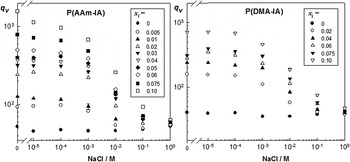
Since the swelling of ionic hydrogels is strongly influenced by salt concentration, the swelling behavior of P(AAm–IA) and P(DMA–IA) hydrogels was also performed in aqueous NaCl solutions. The hydrogels at equilibrium swollen in water were transferred to the vials containing aqueous NaCl solutions and the swelling measurements were carried out by weighing the samples. The volume swelling ratio of gels q v was calculated using Eq. (5), and the results were collected in Fig. 8. The volume swelling ratio of ionic P(AAm–IA) and P(DMA–IA) hydrogels is shown as a function of the NaCl concentration in the external solution. It was observed that the swelling ratio of hydrogels decreases with increasing salt concentration in the external solution; this is mainly due to a decrease in the concentration difference of counterions inside and outside of the hydrogel. Since the mobile counterion concentration in the external solution is higher than that in the gel phase, which results in an osmotic pressure, water molecules flow from the hydrogel to the solution phase so that the hydrogel deswells. Both hydrogel systems exhibit strong salt sensitive swelling behavior over the entire range of the ionic comonomer IA concentration.
The volume swelling ratio q v of ionic P(AAm–IA) and P(DMA–IA) hydrogels shown as a function of the NaCl concentration in the external solution.

The structures of the monomers and crosslinker and the preparation procedure of P(AAm–IA) and P(DMA–IA) hydrogels.

IV. CONCLUSIONS
In this study, the effect of charge density on the equilibrium swelling properties and elasticity of stimuli-responsive P(AAm–IA) and P(DMA–IA) hydrogels have been investigated. The ionic hydrogels were prepared by free radical polymerization in aqueous solution using BAAm as the crosslinking agent. It was found that the free radical crosslinking mechanism of both hydrogel systems depends on the comonomer composition and the mole fraction of ionic comonomer IA used in the synthesis. AAm–IA cannot be easily polymerized and crosslinked when ionic comonomer IA concentration is higher than 10 mol%, even in the presence of a crosslinking agent. The swelling studies showed that the ionic comonomer IA concentration, pH of the swelling solution, and the presence of salt in the swelling medium are basic parameters affecting the swelling degree of P(AAm–IA) and P(DMA–IA) hydrogels. The addition of only a few percent of ionic comonomer drastically changes the swelling capacity and elasticity of ionic P(AAm–IA) and P(DMA–IA) hydrogels and the resulting hydrogels become completely superabsorbent and responsive systems by this modification. Considering the effect of IA content on the swelling of hydrogels in water, it was observed that the swelling first increases with the amount of IA, remains almost constant for a small range of concentrations of IA, and then it starts increasing rapidly with a further rise in the content of ionic comonomer. The swelling of the AAm–IA system is much higher than that obtained for DMA–IA at the same comonomer composition.
ACKNOWLEDGMENT
The author gratefully acknowledges support from the Istanbul Technical University Research Fund (ITU, 34313).