Background: Kartvelian Languages
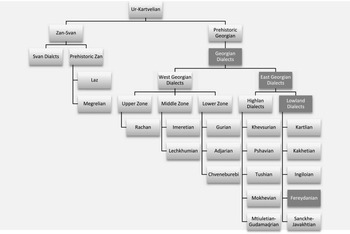
The Georgian language belongs to the Kartvelian group of languages, which as a genetically closed language family (Georgian, Zan and Svan) shows structural and typological similarities with other Caucasian languages. The general linguistic characteristics of the Kartvelian languages mainly concern the nominal and verbal morphology. Georgian, for example, distinguishes between declination types of final-vowel-stem and final-consonant-stem. A special feature is the syntactic function of the case. In the Kartvelian languages nominative, ergative and dative are regarded as subject cases. Ergative is the subject case in the transitive verbs and yet there are cases within the transitive verbs where the agent is not in the ergative but in the nominative. This typological peculiarity is called split ergativity. Besides the complex nominal morphology, Georgian has a very rich verbal morphology. Up to fifteen verb categories are listed. An important characteristic is the polypersonality. In the verb body, morphological markers mark not only the subject but also the direct and/or indirect object. An important role is played by the preverbs, whose function is not only the marking of the direction but also the formation of aspects and derivation. The grammatical tempus of the verb in Georgian is a complex system of tesne-aspect-mood (TAM) categories and constructs three series. The sixteen dialects of Georgian can initially be classified geographically into West Georgian and East Georgian dialects. The East Georgian dialects can be divided into two groups, which can also be traced back to geographical circumstances: the highland dialects and the lowland dialects. The lowland dialects of the East Georgian group are Kartlian (kartluri, ქართლური), Kakhetian (ḳaxuri, კახური), Ingiloian (ingilouri, ინგილოური) (in Azerbaijan), Fereydanian (pereidnuli, ფერეიდნული) (in Iran) and Samtskhe-Javakhetian (samcxur-ǯavaxetian, სამცხურ-ჯავახური). The highland dialects are Khevsurian (xevsuruli, ხევსურული), Pshavian (pšauri, ფშაური), Tushetian (tušuri, თუშური), Mokhevian (moxeuri, მოხეური) and Mtiulian-Gudama rian (mtiulur-gudamaq˙ruli, მთიულურ-გუდამაყრული). When classifying West Georgian dialects, it is possible to subdivide them into three zones: upper zone, middle zone and lower zone. The Rachan (ra
 uli, რაჭული) dialect belongs to the upper zone. Imeretian (imeruli, იმერული) and Letshkhumian (lečxumuri, ლეჩხუმური) are located in the middle zone. The lower zone of the West Georgian dialects includes the Gurian (guruli, გურული), Adjarian (aaruli, აჭარული) and Chveneburebi (/Klarjian) (čveneburebi (ḳlarǯuli), ჩვენებურები (კლარჯული)) (in Turkey) dialects (Figure 1).
The Classification of Kartvelian Languages and Georgian Dialects.
Source: Based on Kurdiani (1996). In Tuit (1997, 6).

The highland dialects of the Georgian language are characterized by a special linguistic proximity to Old Georgian. The archaic grammatical and lexical elements are preserved and productive. There is a long list of linguistic characteristics that the West and East Georgian dialects represent as one unit, and the internal differentiation of the dialects is even deeper geographically and linguistically.
The East Georgian highland dialects developed in relative isolation from the standard language and have most strongly preserved the historical stage of Georgian from the ninth and thirteenth centuries. In the Tushian dialect a non-Georgian stratum can be observed. This is the influence of the Nakh language, which is geographically adjacent. The Kartlian and Kakhian dialects are considered the core Georgian dialects. The reason for this is the close affinity to the standard language. The Sanckhe-Javakhtian dialect is very close to the Kartlian and is often described as a variant of Kartlian.Footnote 1 The dialectal characteristics by their very nature rarely correspond to the assumed geographical or ethnic boundaries. Rather, it is the concentration of linguistic characteristics in one area and the decrease in the intensity of these characteristics the farther one is from this place. This decrease is compensated by the increase in other linguistic properties. This produces a picture of the soft transitions between the dialects that exist geographically side by side and maintain active contact with each other. In Imeretian, you can find some linguistic features of Kartlian and in Gurian you can see the influence of the Megrelian language. In Lechkhumian, the properties of the Svan language are not rare and Rachan is very close to Imeretian. Three Georgian dialects are not located on Georgian territory: Ingiloian (Azerbaijan), Chveneburebi (Turkey) and Fereydanian (Iran). Two subgroups can be identified in this group due to their geographical proximity to Georgian. On the one hand, Ingiloian and Chveneburebi share a common geographical border with Georgian, while on the other hand, Fereydan is about 1,500 kilometres away from the motherland.
The Fereydani Georgian Case
A general bird’s-eye view confirms a strong historical interweaving between Kartvel languages and the dialects of the Georgian language. A peculiar dialect stands out from this picture first geographically, then historically, and finally linguistically. The Fereydani Georgian dialect represents an extremely rare and remarkable language development that can be described as a language island. This article describes relevant linguistic and historical aspects of the genesis, study, and structure of the Fereydanian dialect. What are the internal and external dynamics involved in preserving a dialect variant with an extremely small number of speakers in a typologically highly diverse linguistic environment? Which linguistic features define the boundaries of a language island and how do these boundaries interact with geographical boundaries? The factors of preservation of the Fereydani Georgian, with over 400 years of linguistic isolation, are still only vaguely clarified. The clarification of this question depends on the related empirical data and scientific perspectives based on them. The descriptions in this article place empiricism above all other criteria and are all based on the original historical sources or, to a large degree, self-directed field research in Fereydan. In different historical phases the isolation of the Fereydanian did not only have traffic-technical and economic-ecological, but also, and above all, global political reasons relating to the Soviet Union and Iran. For a long time, access to the materials documenting this epoch was closed. In recent years, however, such documents have been made accessible by the opening of archives. A new leitmotif in the complex interweaving of the history of Fereydanian has emerged. Therefore, the facts presented in this article are partly an empirical novelty.
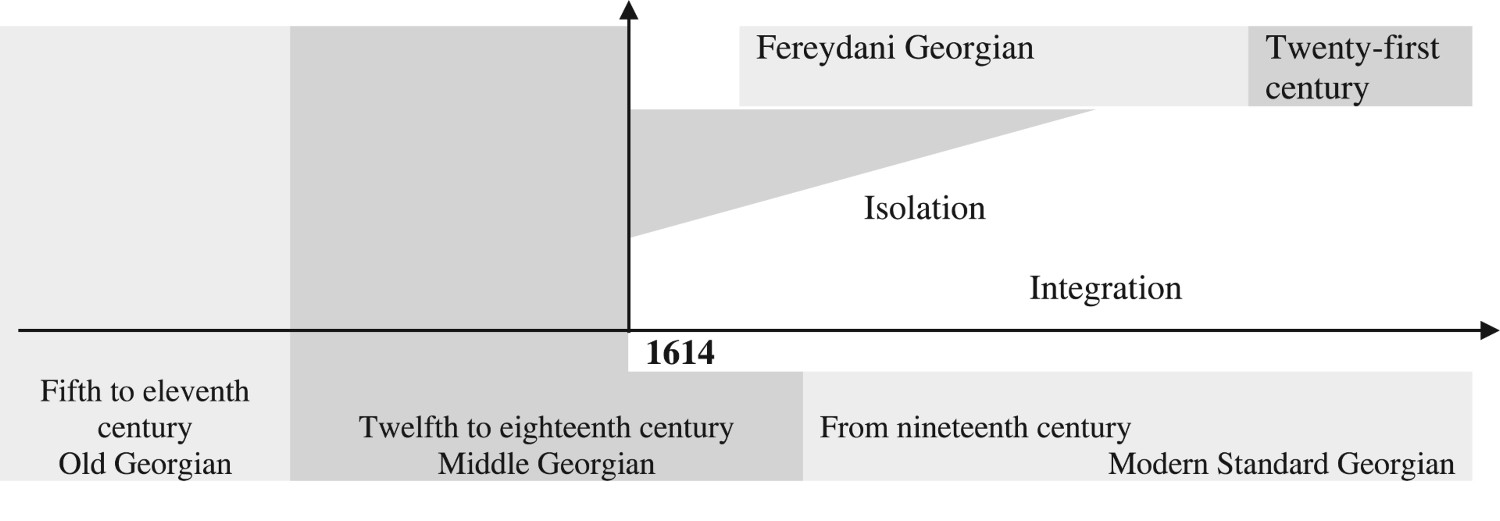
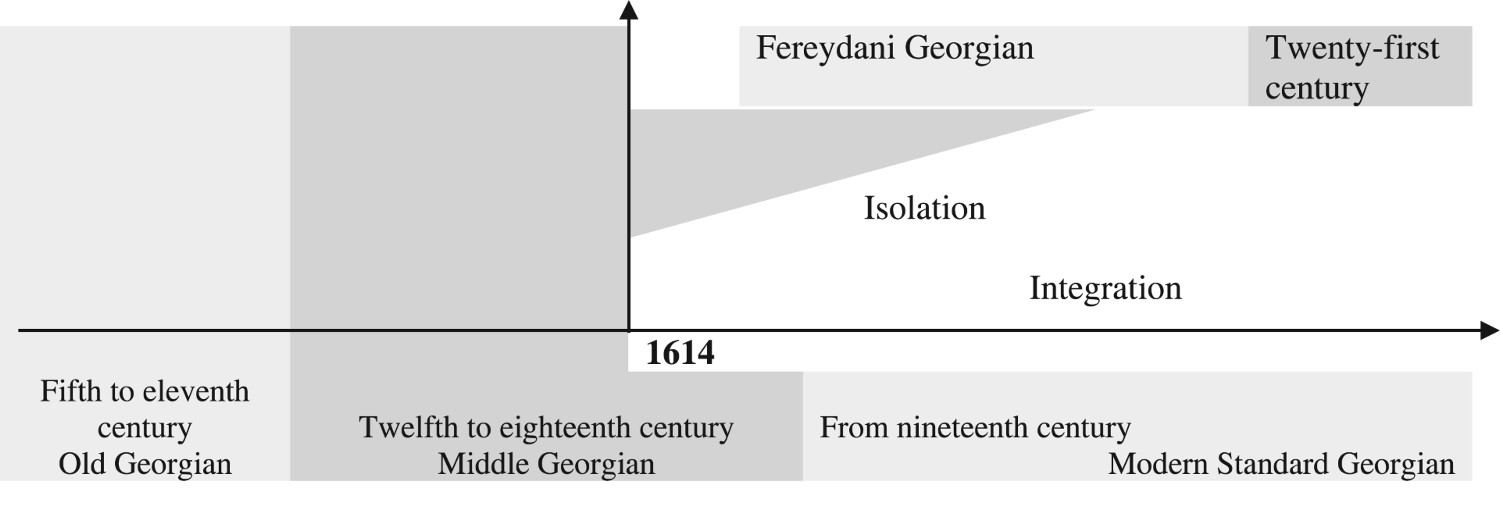
At the beginning of the seventeenth century, linguistic isolation arose, in which Fereydani Georgian began to exist. This stage of the development of the Georgian language is considered to be Middle Georgian. Middle Georgian begins in the late twelfth century and ends in the eighteenth century. One hundred years after the East Georgians were forced to resettle in Isfahan, the Georgian language in Georgia developed one step further—New Georgian standardized the language through newly published newspapers, books and writings in Georgian, as well as through the foundation of the National Theatre, state schools and the literacy of society. This happened after more than a hundred years of exodus and in Iranian Georgia there were none of the epochal cultural developments of the motherland. The Europeanization of the nineteenth century in Georgia set the course in a different direction and the “new” Georgian language represented all of this. Fereydani Georgian distinguishes itself from the Georgian of Georgia by at least one level of language development. A part of the speakers was separated from the main nation by Shah Abbas I and the development of the language of the forced deportees took another path. The paths separated for the next 400 years and only recently approached each other again.
Based on Fereydani Georgian, a language island represents a geographically restricted use of a language that differs from the language or dialect of the motherland in at least one historical stage of language development (Figure 2).
Fereydani Georgian within Historical Development Stages of the Georgian Language.
Fereydani Georgian and Its Integration in the Dialects of Georgian: The Story of Its Origin
The name Fereydan covers a geographical area some 160 kilometres from Isfahan in the southwestern direction along the Bakhtiary mountains (central part of the Zagros mountain range). Living there are the descendants of the Georgians who were forcibly deported from Georgia in 1614 and the following years in at least four phases. Some of the descendants preserved the Georgian language in a form made possible by the development of the island-type environment. The designations Fereydan and Fereydanians have become collective terms. The first refers to the geographical spread of the descendants of the Georgians, while the second refers to the language variant of the Georgian language in Iran. The self-identification of the Fereydani Georgians includes the self-designation “Fereydanian” (pereidneli, ფერეიდნელი), although not all who identify themselves as such, strictly speaking, come from the place with the name Fereidun-Shahre. Thus, we must distinguish the meaning of the term “Fereydan” according to the language in which it is used. In Georgian use (and thus also for Fereydani Georgian) the historical aspects have a determining effect. “Fereydan” thus means more than today’s administrative marking. The terms Fereydan and Fereydanian were introduced by popular usage into journalism and scientific language and became independent. The terms do not appear in Georgia until the 1870s. The sources that are older call the area “peria.”Footnote 2 At present, the Fereydanians themselves refer to them as Kartveli (Georgians) and the Iranians refer to them as Gorji. At the end of the nineteenth century in Georgia the term “Persian Georgians” was created to describe descendants of the original Georgian settlers living in Iran. At the beginning of the twentieth century the name “Fereydani Georgians” spread and a little later the term Fereydanian was used to describe the language or dialect.
The Settlement Area
According to the first sources from the nineteenth century,Footnote 3 which deal with the topic of the Georgian settlement area and structure, there must have originally been many more Georgian villages and settlers in Fereydan. The Fereydan territory was reportedly divided into four parts (nahaya). One part was called Gorji Nahaya.Footnote 4 The term ნაჰაია /nahaia/ is a Persian loan and means region, district (Pers.) ﻧﺎﺤﻴﻪ /nāḥye/. The source translates it into Georgian as უბანი /ubani/, which is not to be understood in today’s sense of neighbourhood or street corner, but a much larger urban area. Agniashvili also provided a map of Gorji Nahaya. On this map an area is delimited covering a third of the whole Fereydan region and including non-Georgian villages. This indicates that the name Gorji Nahaya preserves the former state of spread of the Fereydanians.Footnote 5
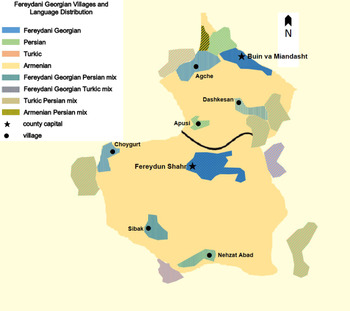
The language map in Figure 3 shows the geographical distribution of the Fereydani Georgian villages in two counties of this province of Isfahan: Fereydunshahr county and Buin and Buin va Miandasht county. The polygons with the blue tones represent the Georgian villages of Fereydani. The intensity of the colour corresponds to the estimated degree of preservation of the language averaged during the field research in Fereydan region. The Fereydani Georgians are at least bilingual (Persian/Fereydani Georgian) and in the villages that are in language contact with Southern Luri, they even speak three languages. In the outlying villages are many mixed families who teach their children the languages of both parents. In some children under the age of five we observed strict monolingualism represented by Fereydani Georgian. The language map gives an idea that a language island is not a composition of a minority and a majority language. It is rather a complex structure of several minority languages, which on one level stand in relation to each other and on the other level face the majority language together.
Fereydani Georgian Villages in Fereydunshahr and Buin and Buin va Miandasht Counties.
Note: Colour online.

Historical Sources
According to oral accounts of the Fereydanians, their ancestors 400 years ago were relocated as spoils of war from Georgia to Isfahan by Shah Abbas I. The collective memory of the Fereydani Georgians contained no information about the original historical situation in Georgia and about their alleged home, Kakhetia. The narratives were created in the nineteenth century in the course of intensifying contacts with the motherland. It is not clear why only the Georgian region—Kakhetia—was declared the place of origin of the Fereydani Georgians. This idea, however, was first presented in Georgian society as being indisputable and then it also spread in Fereydan. A logical question about another possible place or places of origin in Georgia that could be considered the original home of the Fereydani Georgians was rarely raised. It would be worth investigating at least whether people from other parts of East Georgia were enslaved by Shah Abbas. Which original migration routes are conceivable? Depending on the source, the following places of origin can be identified: Kakhetia and Kiziq˙i (100,000 war slaves)Footnote 6; or Djavakhetia and Kartli (30,000 war slaves who were transferred to the villages north of Isfahan near Armenian villages).Footnote 7 According to Davrizhetsi, the merchants from Tbilisi were also resettled in a suburb of Isfahan. From Tianetia (30,000 war slaves) and from Heretia (Saingilo) the Georgians were resettled to Mazandaran in Farahabad. After the conquest of the castle of Erevan, the shah’s soldiers also reached Meskhetia and, according to Iskander Munsh, brought countless war slaves to Iran. According to Pierre Oberling,Footnote 8 the Armenians and Georgians were resettled west of Isfahan almost simultaneously in the years 1603–5.
According to Davrizhetsi, all Georgian deportees were first brought to Isfahan and distributed to different places. In the reconstruction of the migration route, Fereydan seems to be the second or even the third phase of the resettlement. Based on an unknown source, the Fereydani Georgians themselves believe that they first went from Isfahan to Najafabad and only then to Fereydan. If this version is correct, then the deportees from Georgia could not have been in Fereydan before 1611, because Najafabad was founded in 1611. The choice of the Fereydan region is underpinned by two arguments: military protection of the western borders and assistance in collecting taxes.
The Georgians must have been the first to settle the areaFootnote 9 and at the same time Armenians also came into question as settlers. According to Maeda, there is not a single document that proves why the Georgians were transferred to Fereydan (“probably because they [Fereydani Georgians] were farmers and it did not directly affect the state budget and courtier life”).Footnote 10 In his opinion, the reason may lie in the traditional agriculture of Georgians and not in the global strategies of the Persian empire. Razvani, which is one of the most important sources for the ethnogenesis of the Fereydani Georgians, offers the following description of the deportation and settlement policy in Fereydan based on Oberling and Sharashenidze:Footnote 11
The Kakhetians were to be wiped out or deported and their country settled by qezelbâš and other Turkmen tribes, while the nobles of Kartli were to be resettled in Persia … Abbas undertook another campaign in 1614 against Kartli and Kakheti, replacing their kings with Muslims. When nobles of Kakheti rose in revolt in 1615, his troops ravaged the country … Perhaps as many as 70,000 people were killed and over 100,000 deported to Persia … [T]he majority of the Georgians were settled in widely scattered parts of Persia and became cultivators of the soil. The most important of these Georgian colonies was in Farıˆdan (q.v.) in Isfahan province, where their descendants still speak Georgian and retain their Christian faith.Footnote 12
Shah Abbas I attacked Georgia more than once (1614, 1615, 1616, 1617, 1623, 1625)Footnote 13 and always returned to Iran with deportees. The descendants of the forced resettlers have no memory of the historical dates of this history. Today’s Fereydani Georgians cannot be used as a source for the verification of these historical events, because the only thing they handed down is the name Shah Abbas and his role. However, these are historical events whose oral narratives are still alive today. The fight against the Afghan army and the victory in 1722 as well as the fight against Kerimkhan strengthened the historical memory of the Fereydani Georgians and extended the identity factors. Most memories and oral traditions do not have the function of reconstructing history, but represent an important identity-forming aspect. Therefore, the numerous recorded narratives of Fereydani Georgians are of no use from the historical point of view.
After Isfahan had been named the capital of the empire, the majority of Georgians, together with Shah Abbas, moved there. At the Armenian cemetery in Isfahan there are the gravestones of the Georgians, whose birthplace is Gori—a town in Kartli. On the periphery of Isfahan a dense settlement of Georgian merchants is reported.Footnote 14 There are many indications that those Georgians spread out in Iran during a certain period of time came together in Isfahan and it was only after this phase that Fereydan was probably settled. Thus Fereydan seems to be the second or even third place of resettlement within Iran.
Migration, Current Situation and Number of Speakers
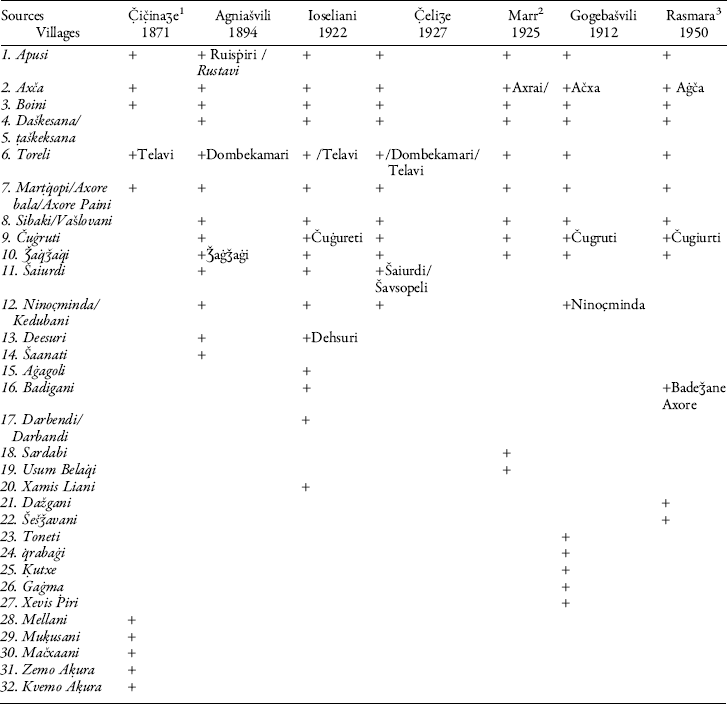
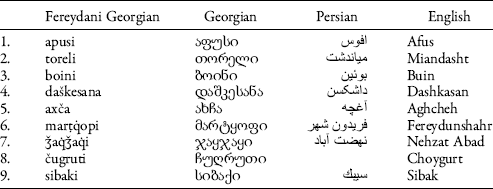
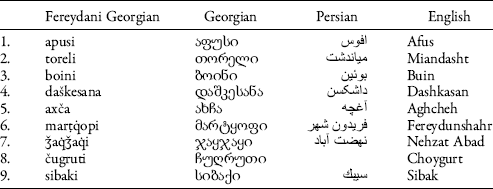
According to Fereydani Georgian hearsay, all deported Georgians originally lived in one and the same village. Only later did they break up and found different villages. The inhabitants of Afus consider their village to be the place of origin of all settlements. The same position is held by the inhabitants of the villages Boini, Axča, Daškesan and Toreli. The Fereydani Georgians from Marṭq˙opi also think that all other villages were founded from there. They declare the settlers in villages like čuġruti, sibaki and ǯaq˙ǯaq˙i their descendants. Many farmers from Martkhopi owned the farmland in the areas where the villages are now located. Due to farming activity, the farmers were going there often, and in time they settled permanently.Footnote 15
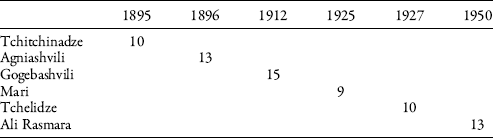
However, there were also mixed villages such as Darband, where Fereydani Georgians made up only half of the population. They also resettled in the villages that were completely Georgian (Tables 2 and 3;Footnote 16 for a detailed overview of the villages and denominations see Table 3). The Fereydani Georgian villages reported and the corresponding sources (Appendix 3). At present there are nine settlements of the Fereydani Georgians: Fereydun shahr, which is called Marṭq˙opi by the Fereydani Georgians, is regarded as a town-like settlement. Buyn-Miandasht, formed by the merger of two settlements, is counted among the urban settlements. It is almost impossible to establish with any degree of certainty the number of speakers of Fereydani Georgian. These are hardly credible sources. All sources rely on oral traditions. The number of Fereydani Georgians in Table 3 is taken from a Georgian-language dissertation of the 1990s.Footnote 17

A much earlier source counts 12,000 to 14,000 Fereydani Georgians,Footnote 18 whereas a total of about 61,000 Georgians are counted outside the Fereydan region.Footnote 19
Many Georgian-speaking people moved to Tehran, Isfahan or other big cities in Iran. Most of them recognize themselves as Georgians from the Fereydan province. Fereydani Georgians also contain a group of non-Georgians. There are Jews and Lorians, who share the main characteristics of Fereydani Georgians: they speak the Georgian language and identify themselves as a part of the Georgian community. The group identity of Fereydani Georgians focuses on their language: those who speak Georgian are Georgian, they say.
Among the population, other terms for the Georgian language circulate:
a. čoneburi
our minner (like “unser-deutsch”—“our German” ∼ Rabaul creole German)
b. čveni ʒvelebis ena
our ancestors language
The Beginnings and Progression of Fereydani Georgia Reintegration
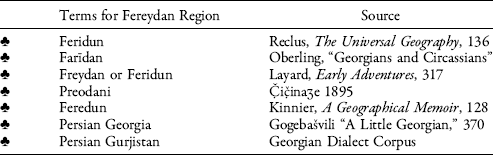
When contact between Georgia and Fereydan was revived, the Fereydani Georgians were strongly motivated to learn the language and especially the alphabet. From a Fereydani Georgian’s point of view, the best way of reintegration with the home country was linguistic reintegration. The inhabitants of the village of Afus, where Georgian is only a language of commemoration, founded a language school and also integrated the learners from other villages. At present, the Fereydani Georgians are trying to orient themselves to the standard language, to write and to speak, as is spoken on Georgian radio for example. As a result, many linguistic characteristics and many old lexemes are lost. In the last decades, many Fereydani Georgian families have moved from Iran to Georgia. The mutual perception in Georgia is growing. The fact that the language and the alphabet are the identity-forming aspects is also seen in the Fereydani Georgians’ use of Georgian lettering wherever they consider it appropriate: house facades, car windows, tablecloths, carpets, etc. In the Georgian sources from the seventeenth and eighteenth centuries, there is only very little information about the forced resettlement from Georgia to Iran. Papuna Orbeliani and Beri Egnatashvili mention Peria regarding the settlement of the deportees.Footnote 20 The nineteenth century Georgian historian Zhordania also mentions Peria.Footnote 21 The place named as Peria is also mentioned in another historical context. According to Papuna Orbeliani, in the middle of the eighteenth century, the Georgian nobles brought the granddaughter of King Iese, Mariam Begum, to Peria to marry her to the Azat Khan.Footnote 22 There are terms referring to Fereydan found in various Georgian and non-Georgian sources (Table 4).
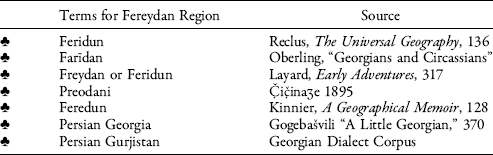
The Georgian-speaking population uses the term Fereydan for the whole region:

The first planned and permanent contacts between Fereydani Georgians and Georgian society began with travelers from Fereydan. In the 1870s news about Iranian Georgians visiting the country appeared in Georgian newspapers from time to time. The first most famous visitor from Fereydan was Atam Onikashvili, who published information about the life of the Fereydani Georgians in the newspapers. There was a real need for information about the Georgians in Iran. Evsevi Tsabadze and Raphael Nebieridze, who lived in Persia, collected the news.
Atam Onikashvili visited Georgia for the first time in 1871. He came from Fereidun Shahre and spoke the Georgian that he had learned from his parents. His route from Tehran to Tbilisi was via Baku. He was warmly welcomed by important figures of Georgian literature, theatre and academic circles such as Grigol Orbeliani, Dimitri Qipiani, Dimitri Bakradze, Petre Umikashvili, Iakob Gogebashvili and Giorgi Tsereteli. Atam Onikashvili also attended a seminar during this time to improve his language. His great concern was to bring the Fereydani Georgians back to Georgia. With this request he took over the important officials of the tsar’s empire in Tbilisi. He received no positive feedback and thus gave up. Atam Onikashvili settled in Sagarejo (Kakhetia) and founded a family. In 1880, he committed suicide for unclear reasons. The first traveler was followed by other Fereydani Georgians: Narsula Khatiashvili (1901), Mahmud Makhashvili and his brother-in-law Narsula (1907), Qolam-Reza Khutsishvili and Husein Onikashvili (1907). Most of them stayed in Georgia for more than a year and deepened their language skills. They traveled through the country and introduced themselves as Iranian Georgians.Footnote 23 In 1922, Seipola Ioseliani visited Georgia. He was the first language assistant who helped to describe Fereydani Georgian linguistically. The linguistic study of Fereydani Georgian in Georgia began thanks to his visit. The first scientific article about Fereydani Georgian was published by Topuria in 1922 in the newspaper Lomisi with the title “An Example of the Georgian Language from Fereydan.” Chikobava started the systematic analysis of Fereydani Georgian. In 1923 he published the articles “Main Characteristics of the Fereydani Georgian,” “Particle -q˙e in Fereydani Georgian and Its Meaning from the Point of View of the Relation between Grammar and Logic” and “Reflexes of ‘vin’ in Fereidani Georgian (Chikobava).” He considered Fereydani Georgian to be a variant of the Kakhatic dialect.
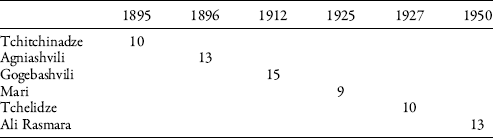
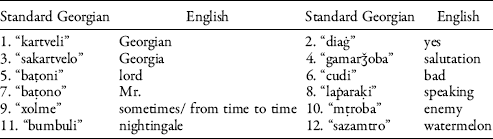
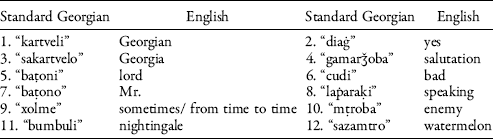
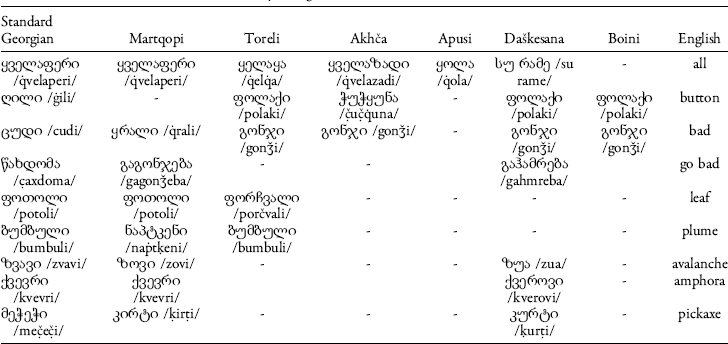
Visits also came from another direction: from Georgia to Fereydan. The first person from Georgia who visited Fereydan in 1894 and reported about it was Lado Agniashvili (Lado Aġniašvili ლადო აღნიაშვილი). His travel reports were the most read articles of the journal Moambe (lit. Reporter). He also published the book The Georgian Community in Persia. The genre of reports also allowed linguistic observations to be included. Thus, we can find out about the suffix -q˙e (-ყე), archaic words, etc.Footnote 24 Agniashvili also reports that despite a manageable geographical area, the subdialectal diversity is relatively high. He suspects that the Fereydani Georgians could originate not only from Kakhetia, but also from the mountains (Pshavetia and Khevsuretia).Footnote 25 Aġniašvili observes that the Fereydanians do not understand the meaning of the words shown in Table 5.
In 1925 Georgian orientalist Yuri Marr met a Fereydani Georgian in Isfahan and recorded his language. Besides the linguistic observations, in his article “From a Talk with a Fereydani Georgian” Marr describes Fereydanian as an islet (კუნძულაკი /ḳunʒulaḳi/ Small island). Ambako Tchlidze also wrote down long linguistic passages. He was an employee of the Soviet Bank in Tehran and was interested in the Fereydani Georgians. He visited the Fereydani villages in 1927 and wrote a book about his journey. The relevant scientific source for the research of Fereydani Georgian is Magali Todua. His texts from 1969 to 1972 in Tehran and Fereydan were published in 1975. Together with Maia Matchavariani, the recorded language examples were analyzed linguistically. In 1973, under the supervision of G. Chitaia, a long-term study of the language of the Fereydani Georgians was launched, examining who had moved back to Georgia. The representatives of various disciplines documented the language, customs and everyday life of repatriates.Footnote 26 The steps for cultural reintegration of Fereydani Georgians in Georgia coincide with the scientific research of Fereydani. From today’s point of view, we count on a research tradition of more than a hundred years with different reasons and from different perspectives. A research initiative at the Chikobava Institute of Linguistics in Tbilisi has been investigating Fereydanese since 2004 with the aim of creating an electronic database. After the field research and collections focused on textual materials, the “digital data source” was established (GDC), and is freely accessible.Footnote 27 The online dictionary for Fereydani Georgian (http://corpora.co/#/dictionaries) was generated based on the digital data that was provided.
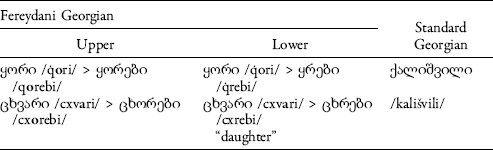
The linguistic heterogeneity of Fereydani Georgian has been recognized in many analyses, but it has never been the main point of research. Hence, Fereydani Georgian had always been treated as linguistically uniform with insignificant internal variations. At least since the field documentation of the Fereydani Georgian dialect of 2004, the internal heterogeneity and multi-layered linguistic character of the language island has been impossible to ignore. When describing the linguistic features of Fereydani Georgian, it should be noted that there are internal differences in dialect. For example, in Upper and Lower Fereydani Georgian different word formation affixes dominate. In the speech of the villages Toreli, Daškesana and Boini, the plural of the word ყორი /q˙ori/ “daughter” is used with its syncopated variant: q˙r-eb-i, but in Marṭq˙opi the same word is used as un-syncopated: q˙or-eb-i.Footnote 28 The internal dialectal differences are based not only on the phonetic elements, but also on the different use of functional grammatical units.
The speech data documented by language assistants Abolq˙osem Ahmadi (44) and Muxṭar Darčiašvili (80) from Marṭq˙opi shows clear distinctions between the villages Toreli and Marṭq˙opi (Table 6). The speakers are aware of these differences. During the recording of both languages, our assistants underlined the distinctions and tried to justify the correctness of their own versions. Their argumentation was usually something like: “in our village we say it like this.”

The digitized data recorded in the Georgian Dialect Corpus represents the entire language material collected within the aforementioned research tradition in Georgia. On the basis of these data, a linguistic description of the main linguistic features of Fereydani Georgian follows.
Phonetics
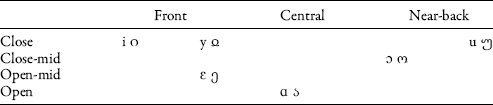
The sound system of Fereydani Georgian is clearly different from standard Georgian, but has no phonetic characteristics that would distinguish it from dialects of the Georgian or Kartvel languages. The vowels of Fereydani Georgian are: ა /ɑ/, ე /ϵ/, ი /i/, ო /ɔ/, უ /u/, ჲ /y/, /û/ and the schwa ჷ /ə/. Fereydanian has no short or long vowels and no umlauts (Table 7).
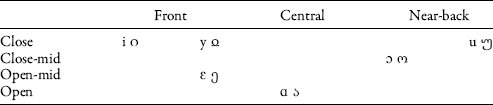
Apart from ჲ /y/, /û/ and ჷ /ə/, all vowels of the standard language are present in Fereydani Georgian. The existence of ჲ /y/ was already noted at the beginning of the study of Fereydani Georgian.Footnote 29 Chikobava associates the vowel with the similar vowel from other dialects of Georgian in Kartlian and Kakhetian.
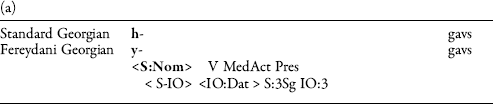
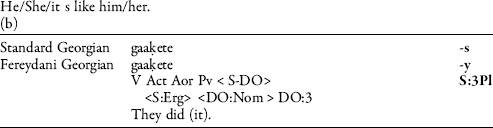
The vowel ჲ /y/ occurs in the function of an allophone of a personal and number marker: /h-/, /-s/ → /y/ (ჰ / ს > ჲ). (a) shows the function of marking the grammatical person while: ჰ-გავს → ჲ-გავს, /h-gavs/ → /y-gavs/, while (b) shows marking the grammatical person and category number: გააკეთე-ს → გაკეთე-ჲ, /gaaḳete-y/→/gaaḳete-s/.
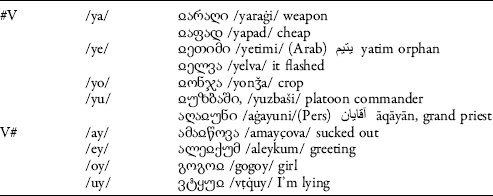
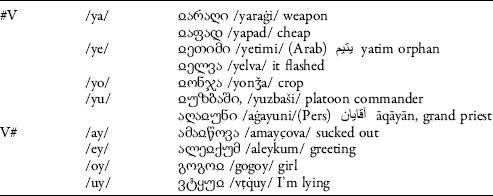
The vowel ჲ /y/ can both occur in immediate positions to another vowel and correspond to the rising diphthong to the left of the vowel, whereas a falling diphthong is formed to the right of the vowel (Table 8).
The Fereydani Georgian Schwa ჷ /ə/ is a rare phenomenon. In the unstressed syllables, the vowel is realized as schwa (a, b, c): (a) თჷრთიალებს /tərtialebs/ to twitch, (b) ღჷრღიალებს /gərgrialebs/ to yell around, n (b) ბჷზრიალებს /bəzrialebs/ to spin around. This sound is short, weak and formless. It may be very difficult to hear. This is probably the reason why the linguistic descriptions of Fereydani Georgian seldom include the Shwa. Marr is the only one to describe the schwa when speaking from Dashkesana and Boini. It is remarkable that the speakers from these villages realize the Epenthesis like ქმარი /kmari/ > ქუმარი /kumari/. With these phonetic characteristics, Fereydani Georgian is in the same category as the southern dialects of Georgian, for example Samckhe-Javakhetian.
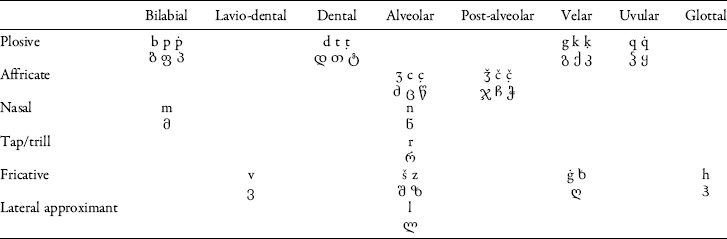
The consonant system of Fereydani Georgian contains all the consonants of the Georgian standard language and additionally adds the following: voiceless bilabial fricative /ჶ/ and uvular stop ჴ /q/. A voiced pharyngeal (epiglottal) stop ჸ /ʔ/ also occurs rarely.Footnote 30 The fricative /ჶ/ usually appears in the borrowed words. For example, the toponym Fereydan is used as /pereidan/ as /ჶeidan/ or /isfahan/ and/or /isჶahan/ (Table 9).

Consonant lengthening (gemination) like მაგგრა /mag¯ra/, “strongly,” ყოტტი /q˙ot¯i/, “frog” rarely takes place in Fereydani Georgian. The Fereydani Georgians perceive the phonetic features of Fereydani Georgian as an aspect of identity formation. They realize the high degree of differentiation with the surrounding languages. Uvular and velar plosives, as well as glottal consonants, are pronounced particularly expressively. The uvular ჴ /q/ has a special role to play.
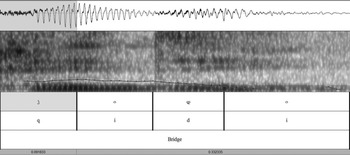
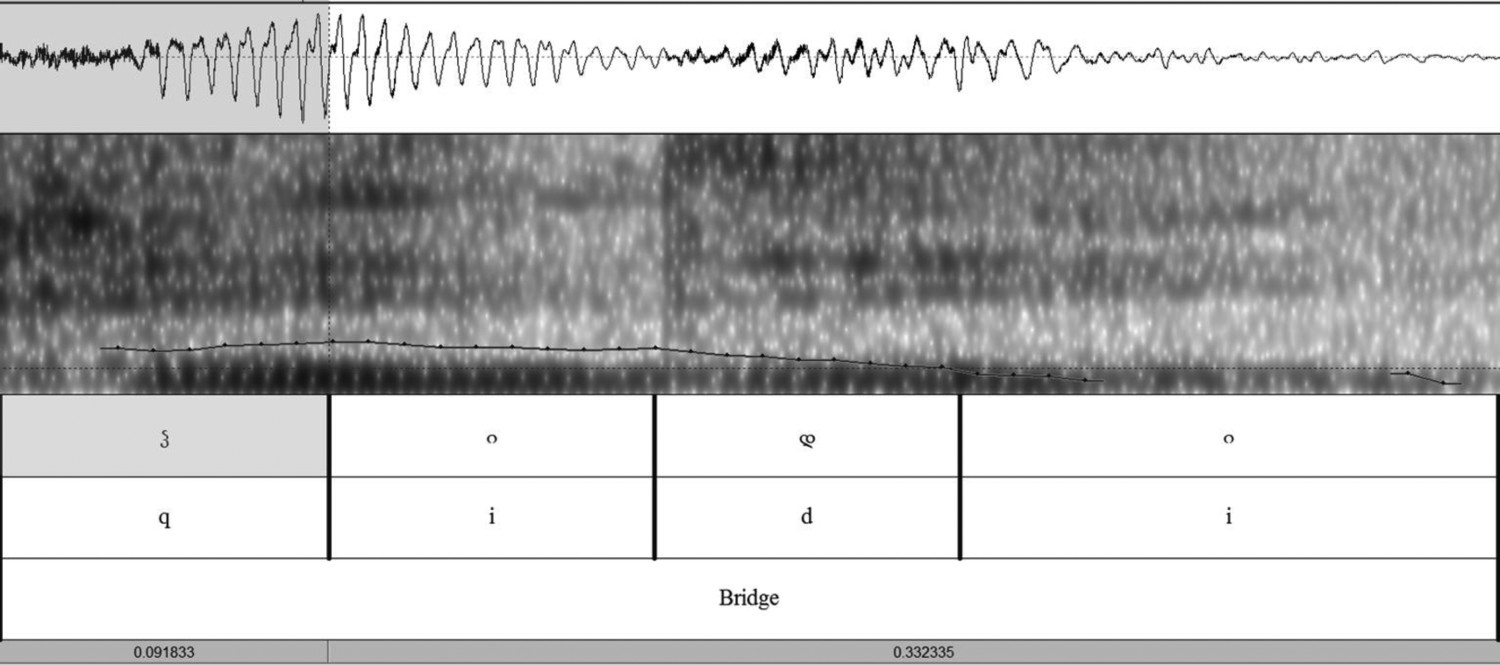
In Fereydani Georgian, the consonant of the ancient Georgian uvular consonant ჴ /q/ (ჴიდი /qidi/ “Bridge”; Figure 4) is very much alive. In dialogues, Fereydani speakers often underline the question: “You don’t have any ჴ /q/ in Georgian, do you?” They clearly distinguish ხ /x/ (velar fricative) and ჴ /q/ from each other and never confuse the words with these two consonants. According to Jorbenadze,Footnote 31 ჴ /q/ and others the phonemes of Fereydani Georgian are very close to Ingiloian and Kakhetian. In Fereydani Georgian, the consonant usually appears in the initial sound: ჴორცი /qorci/ meat, ჴელი /qeli/ hand, ჴერჴი /qerqi/ saw, ჴარი /qari/ bull. ჴ /q/ in the Fereydani Georgian was also described by Agniashvili, Marr and Chikobava. This statement served to classify the Fereydani Georgian as one of the East Georgian mountain dialects, because this consonant is also present in the linguistic usage in that area.
ჴ /q/ Analyse with Praat.
Origo in Fereydani Georgian.
In the first phonetic descriptions of the Fereydani Georgian by Chikobava, a /ŭ/ is noted that is not capable of forming a syllable and which is therefore called a semi-vowel.Footnote 32 His examples are დაŭძახით /daŭʒaxit/, (We) call, გოŭხარდაყე /goŭxardaq˙e/, be pleased about something, აŭდუღი /aŭduġi/ (Pers.) آب دوغ ābduq, Kefir fungus, გოŭჯა /goŭǯa/ (Pers.) گ وج ه gouje, “Tomato.”
In Old Georgian, the /v/ and /ŭ/ phonemes were related to each other in the elementary distribution.Footnote 33 In the later stage of language development a free distribution is observed.Footnote 34 In Fereydani Georgian, the situation of Middle Georgian is presently preserved, in which /ŭ/ freely exchanges its positions with /v/: აკŭანი /aḳŭani/</>აკვანი /aḳvani/ “cradle”, აიყŭანს /aiq˙ŭans/</>აიყვანს /aiq˙vans/, “uplift something.”
The labial consonant /ჶ/ occurs in two cases in Fereydani Georgian. In the position in front of the voiceless consonants the expected consonant /v/ becomes /ჶ/: ჶკითხე /ჶḳitxe/ ask somebody something, ჶქენ /ჶqen/ do something, დაჶკლავთ /daჶḳlavt/ butcher something. In the extended Persian words, the /ჶ/ is also in the anlaut: ჶამილი /ჶamili, (Pers.) فامیل fāmil Last name.
The most important phonetic processes. The formation of diphthongs has already been mentioned. An obvious phonetic process in Fereydani Georgian is the deletion or phonetic transformation from /v/ to /u/ or /o/.
-
1. /v/ deletion: გვერდი /gverdi/ → გერდი /gerdi/ page; კვერცხი /ḳvercxi/ → კერცხი /kercxi/ Egg;
-
2. /v/ vocalization or lowering: [/v/+/i/]→ /u/ and [/v/+/e/] → /o/. For example გვინდა /gvina/ → გუნდა /gunda/ want something, გვიამბე /gviambe/ → გუამბე /guambe/ tell something, გვებარებიან /gvebarebian/ → გობარებიან /gobarebian/ (entrust with something) to look after.
Similar phonetic processes also take place in the other dialects of Georgian, such as Ingiloian and Mokhevian.Footnote 35 The phonetic process of epenthesis with /u/ differentiates the Fereydani Georgian internally. By analyzing audio data, observing the phonetic context with sonorant speech sounds can be responsible for this: ქმარი /kmari/ → ქუმარი /kumari/, ძმა /ʒma/ → ძუმა /ʒuma/.
The cases of proclitics are remarkable (Table 10). Similar processes can be found in the West Georgian dialects, as in Imeretian ხვ'არ /xvar/ < ხომ არ /xom ar/ in Gurian კა'რ /kar/ <კი არ /ki ar/ but not.

Generally speaking, the sound system of the Fereydani Georgian and related phonetic processes differs insignificantly from the standard Georgian and is very similar to the East Georgian dialects.
Morphology
In the following exposition only the essential features of the Fereydani Georgian morphology are picked up. The references to the standard Georgian and the dialects of Georgian are displayed. A relevant grammatical reference point of Fereydani Georgian is Old Georgian. Almost all dominant tendencies in morphology show an intriguing resemblance to Old Georgian. A few phenomena lie at the boundary between morphology and syntax and give the idea of the morphosyntax of Fereydani Georgian.
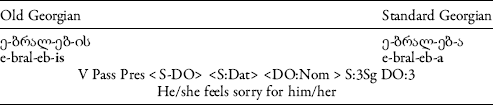
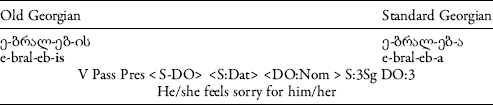
The derivation of verb forms in Fereydani Georgian is characterized by an archaic nature. The derivation of the passive verb forms for the third person in the present and past tenses was implemented in alto Georgian with the suffix -is, which was switched to suffix -a in Standard Georgian (Table 11). The formation of verb forms with the suffix -is has been preserved in a few dialects, such as Khevsurian, Pshavien, Mokhevian, Ingiloian and Rachan.Footnote 36 Fereydani Georgian is also a member of this line.
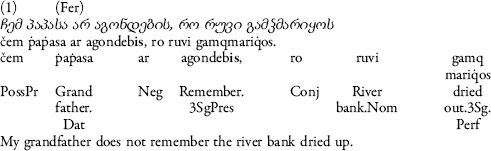
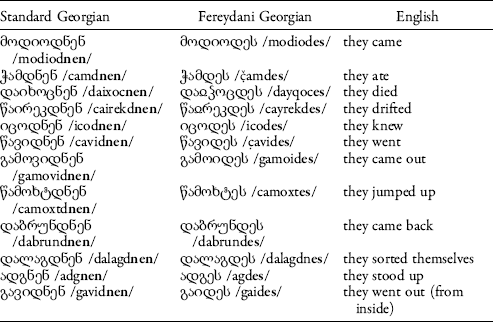
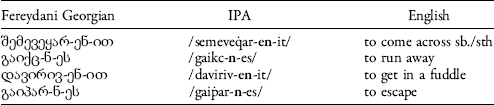
For transitive and intransitive verbs in the Imperfect series and for intransitive verbs in the aorist, the third person in Fereydani Georgian is marked with the suffix /-es/. The same marking is used in Old Georgian. At the same place in Standard Georgian, the suffix /-(n)en/ appears as (Old Georgian and Fereydani Georgian) აკეთებდ-ეს /aḳetebd-es/ vs. (Standard Georgian) აკეთებდ-ნენ /aḳetebd-nen/ do something (Table 12).

The person marker is one of the points at which the internal differentiation of Fereydani Georgian is described. The data shows that this only affects the villages with Lower Fereydanian. Because in the villages of the Upper Fereydanian the suffix /-(n)en/ dominates: გაიდ-ენ /gaid-en/ have gone out, ადგ-ენ /adg-en/ have got up, დალაგდ-ენ /dalagd-en/ have ordered themselves.Footnote 37
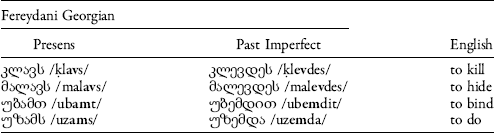
The verbal suffixes in the present tense -ავ /-av/ and -ამ /-am/ become -ევ /-ev/ and -ემ /-em/ in the past (imperfectives) in Old Georgian.
(Standard Georgian) ვხატ-ავ-დი /vxat-av-di/ > (Old Georgian) ვხატ-ევ-დი /vxat-ev-di/ I painted.
Also at this point Fereydani Georgian has preserved the essence of Old Georgian. The language data shows a dominant use of suffixes -ევ /-ev/ and -ემ /-em/ in past tense (Table 13).
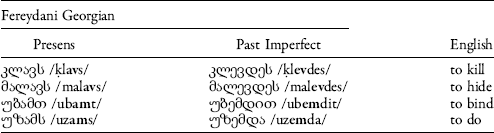
An exception is Fereydani Georgian in the village Dashkesana, where -ავ /-av/ and -ამ /-am/ is found both in the present and in the past. Verbs with the /-av/ sign in Fereydani Georgian lose the vowel part of the marker by adding the plural marker (V-av-enPL > V-v-enPL): მალავს /malavs/ > მალვენ /malven/ to hide, მოზელავს /mezelavs/ > მოზელვენ /mozelven/ to knead. This phenomenon is typical for Old Georgian: დაჰკვლენ /dahkvlen/ to slaughter, გაიკითხვენ /gaiḳitxven/ convict sb.
The iterative aktionsart or lexical aspect of the verb is included in Standard Georgian in the Conditional subseries (ხოლმეობითი, /xolmeobiti/). In contrast to Old Georgian, iterativity is not a morphological category in Standard Georgian. This type of action is expressed by lexical particle ხოლმე /xolme/ time and again, over and over.
Conditional (Standard Georgian)

In Old Georgian the iterative actionsart was represented in all three verbal series with morphological markers. In the development of language, this function was lexicalized by shifting from synthetic formation to analytical formation. Chikobava uses the term “permansive,”Footnote 38 which is relatively close to the iterative. Besides, in Fereydani Georgian the morphological form of the iterative has also remained the same as in other dialects of Georgian: Khevsurian, Tushian, Pshavian, Mokhevian, Mtian-Gudamaqrian and Ingiloian. All three subseries as in Old Georgian are preserved only in the Khevsurian dialect.
Fereydani Georgian kept the style of Old Georgian. When an iterative is formed, the verb stem is taken from the imperfective (Present subseries) and tagged with the permansive marker -ი /-i-/.
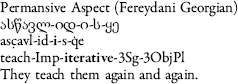
The subject’s number markers vary depending on the context as -ს /-s/ or -ან /-an/ (Table 14). The data set (2) shows the frequency of the use of iterative structures. The endings of the iterative aspect are strongly emphasized and thus extremely perceptible for a standard Georgian speaker.


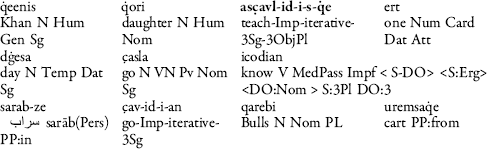



The daughter of the Khan taught them (again and again). One day they went to the city sarāb. They freed the bulls from the cart and sold them. They collected the money and gave it away, leased the land, they acted stupidly.
In Standard Georgian it is atypical to mark the passive verbs in the Perfective series with -ენ /-en/ suffix. Some of the Georgian dialects, including Fereydani Georgian, have retained this characteristic of Old Georgian. In Old Georgian there is in this case the mark of the third person plural with -ეს /-es/ suffix. In Fereydani Georgian it is partially preserved (Table 15).

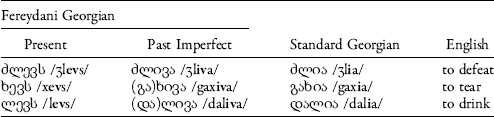
Similar to the Old Georgian, the Fereydani Georgian suffix -ევ /-ev/ changes during the stem inflexion to -ივ /-iv/ (Table 16)

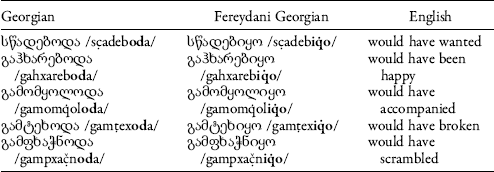
Similar to the East Georgian dialects, intransitive verbs in Fereydani Georgian in the Perfective series (Conditional) get the enclitics, which are past forms of the verb to be: იყო /iq˙o/ be. In the standard language, this function is fulfilled by the suffix -ოდ /-od/.
Regarding the marking of the second person (subject) and third person (object) in the verb, Fereydani Georgian follows the East Georgian dialects, mostly Kakhetian. Fereydani Georgian has three markers for this function ჲ- /y-/, ჰ- /h-/, ს- /s/. Only the presence of the marker ჲ- /y-/ distinguishes Fereydani Georgian from Standard Georgian.


The distribution of person markers -ჰ /h-/ and -ს /s-/ has occurred irregularly and inconsistently in Georgian. Therefore, in the 1930s a rule was established: the marker /s-/ is used before the consonants b, p, ṗ, g, k, ḳ and q˙, whereas the marker /-h/ is used before the consonants d, t, ṭ, ʒ, c,  , ǯ, č, . This rule was based on the East Georgian dialects and Fereydani Georgian follows this rule with one exception: the marker /h-/ also appears in front of the consonant /x/.

All those who have come into contact with Fereydani Georgian underline the frequent use of particles -ყე /-q˙e/ and -ღა /-ġa/. Despite a strong linguistic reintegration of Fereydani Georgian with Standard Georgian, the use of both particles remains a strong dialectal self-identification feature.
The particle -ყე /-q˙e/ has two functions that are shifted on different grammatical levels. One function is morphosyntactic and the second function is that of a particle. The particle -ყე /-q˙e/ in Fereydani Georgian marks in the verb the dative subject in the plural. A similar function of the particles -ყე /-q˙e/ can be found in Rachan, Imeretian, Kiziq˙ian and Ingiloian dialects. According to Melikishvili, the existence of this function can already be assumed in Old Georgian.Footnote 39


The second function of the particle -ყე /-q˙e/ is described as permansive in the Georgian grammatical tradition. The permansive constituting an aspect of the verb denotes that the action is a continuous procedure.


A further marginal function of the particle is the expression of the direction
ისპნისაყე /isṗnisaq˙e/ from Isfahan
საქართველოსაყე /sakartvelosaq˙e/ from Georgia.
The contexts with the indication of the opposite direction are also documented.
სოფელსაყე /soplisaq˙e/ to village.
According to Chkhubianishvili, the particle -ყე /-q˙e/ can also be replaced by the postal positions of the Standard Georgian like -გან /-gan/ “fromHum,” -ზე /-ze/ “on,” -თვის /-tvis/ “for” can replace.Footnote 40
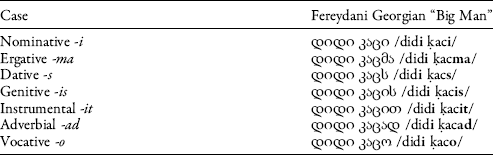
The case markers in Standard Georgian that start with a vowel cause a morphonological process known as syncope: the inner vowel of the stem is dropped. The stem’s last vowel can also be cut off. This process is called apocope. Syncope takes place in the genitive, instrumental and adverbial, whereas apocopes occur only in the genitive and adverbial. These morphophonological processes characterize the declension of the Georgian noun in a peculiar way.
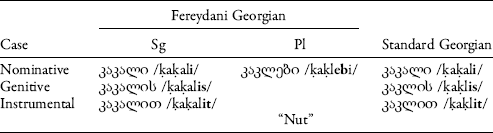
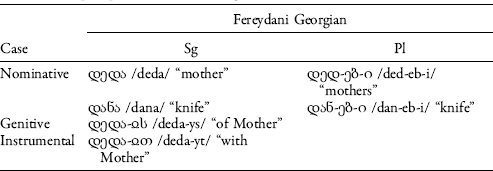
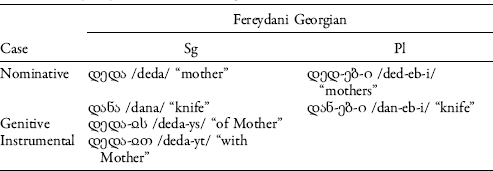
The dialects of Georgian carry this property further in their use and create a diverse picture of possible variations. Fereydani Georgian places itself apart from this uniform picture. Both syncope and apocope are extremely rare. Chkhubianishvili explains this fact by the linguistic isolation of Fereydani Georgian.Footnote 41 The syncopable nouns in Fereydani Georgian are syncopated only in the plural and not in the singular (Table 18).

It is not justified to claim that no syncope or apocope takes place in Fereydani Georgian. However, they are not so frequent as in Standard Georgian or other Georgian dialects. It is remarkable that some words syncopated in Lower Fereydani Georgian are realized in Upper Fereydani Georgian without syncope (Table 19). Most nouns in Fereydani Georgian with the vowel at the end of the stem are apocopized (Table 20). At the expected apocope a multistep phonological process can be observed in some villages, as shown in Table 21.


Due to the phonetic variations there is a wide variety of preverbs in Fereydani Georgian. The simple preverbs are the following: მო- /mo-/, მუ- /mu-/, მა- /ma-/, გო- /go-/, გუ- /gi-/, დო- /do-/, დუ- /du-/, წო- /o-/. წუ- /u-/. The complex preverbs are გოდმო- /godmo-/, გუდმუ- /gudmu-/, გომო- /gomo-/, გუმო- /gumo-/.
An overview of the major aspects of Fereydani Georgian morphology shows a clear similarity with Old Georgian and the morphology of East Georgian dialects. This image is also maintained in the syntax of Fereydani Georgian.
Syntax
In his 1927 description Chikobava writes a chapter with the German title “Wortzusammensetzung” (word composition).Footnote 42 Here he examines the prominent syntactic properties of Fereydani Georgian.
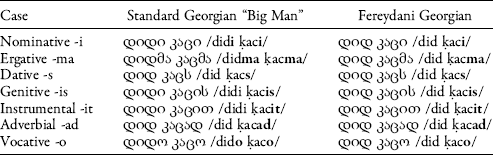
Fereydani Georgian differs from Standard Georgian in terms of congruence between the determiner with the consonant in stem final position and the head noun. In the other dialects there is a tendency to slow loss of the case mark in some cases. In Fereydani Georgian this tendency is a general rule: the subordinate element of the noun is not marked in all case forms as a stem resp. without casus sign (Table 22). There are rare cases in Fereydani Georgian where the determinist disagrees with head nouns (Table 23). This leads to an addition to Table 23, resulting in Table 24.
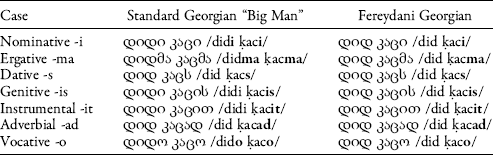

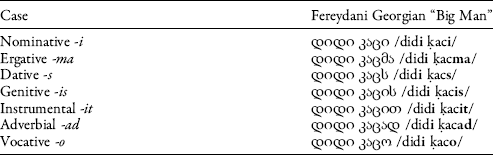
Such declensions cannot be found in other dialects. But this type of declension is very natural for the Kartvel language, Megrelian, in which the determiner always stands in the nominative and only the head noun is declined. Chikobava explains this unique feature of the Fereydani Georgian nominal morphology by evolution in total isolation from the Georgian standard language.Footnote 43 The fieldwork data shows that the two types of declension can be found within a language assistant. In the second series of verb conjugation, only the transitive verbs get the ergative construction. In a few southern and western dialects of Georgian there are cases in which the subject of an intransitive verb appears in ergative. Among the eastern dialects, this phenomenon (ergonomic subject of an intransitive verb) can only be found in Fereydani Georgian.Footnote 44 In Fereydani Georgian the ergative subject appears in the medial and passive verbs.





To explain the ergative subjects of intransitive verbs in Fereydani Georgian by the fact that Fereydani Georgian had several hundred years without contact with Standard Georgian is strengthened by another fact from the Megrelian: it also developed for several centuries independently of the standard variant of the sister language, Georgian, and marks the subject of the intransitive verb with the ergative. Similar to a few East Georgian dialects, Fereydani Georgian also tends to mark question sentences with a suffix at the end of the sentence. In Standard Georgian, an interrogative sentence can be recognized by the corresponding intonation. The Fereydanese uses the question intonation for the question and adds a final quasi question suffix -a.
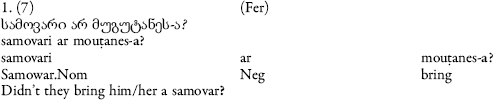
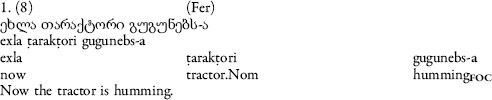
Chkhubianishvili gives examples in which the suffix -a appears in the declarative sentences and is interpreted as a focus marker.Footnote 45
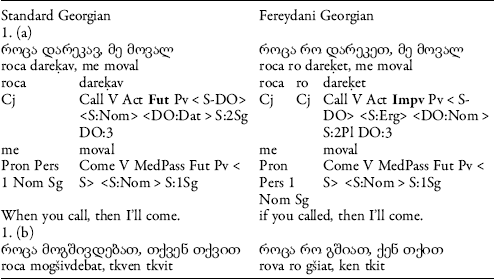
In the conditional movements in Fereydan the verbs are in the main and subordinate clauses in different tense forms. In Standard Georgian, both verbs are future, whereas in Fereydan, the verb in the subordinate clause is always present or past.


The partial reduplication of conjunction is not uncommon in Georgian dialects and it often takes place in Fereydani Georgian as well: როცა რო /roca ro/ “whenever,” როგორც რო /rogotc ro/ “however,” სადაც რო /sadac ro/ “wherever,” ვინც რო /vinc ro/ “whoever.”
The conjunctions that mark hypotaxes in Fereydani Georgian differ between Upper and Lower Fereydanian. In Lower Fereydanian (the villages around Marṭq˙opi) the conjunction ro/rom dominates, whereas in Upper Fereydanian the ke/ki is preferred. It is noteworthy that of the other Georgian dialects, only those in language contact with Turkish also prefer ke/ki (Ingiloian and Chveneburebi, Adjarian) ( که، کی بلند شد که در را باز کند. /bolænd ʃod ke dær rɒ bɒz konæd/). The Persian conjunction /tɒ/ تا (from the preposition تا) also occurs in hypotaxis in Fereydani Georgian.




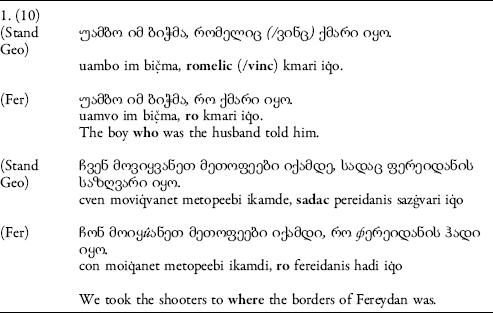
The 1922 records of Seipola Ioseliani document two interesting cases of hypotaxy which differ significantly from the standard Georgian language. They are the conjunction რო /ro/ “that,” which replaces the standard language conjunctions ვინც /vinc/ “who” and სადაც /sadac/ “where.”Footnote 46
An atypical Georgian phenomenon in Fereydani Georgian syntax is the forming of complex verbs. Typically, the verb in Georgian is morphologically complex and syntetic. The analytical formations are exceptional and are usually due to analogies or calque.

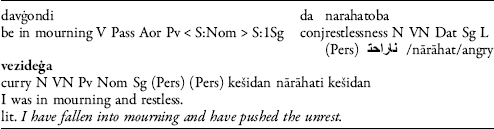
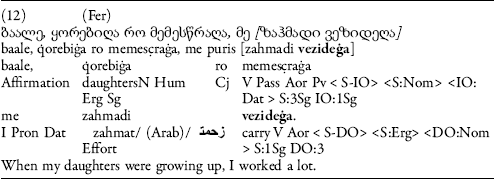








However, the cases in which both parts of the complex verb are translated into Georgian as in (11) are rarely documented.



The analytical formation of the passive was characteristic of Old Georgian. Deverbal nomina receive the corresponding form of the do verb:
ცხოველ-ჰყოფს /cxovel-hq˙ops/ vitalize make
Only in the later historical language did it convert the analytical formation of the passive to the synthetic form:
მეფე-ჰყო /mepe hq˙o/ > გაამეფა /gaamepa/ making king
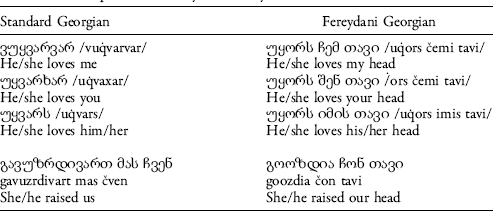
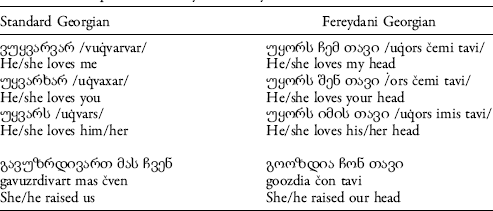
The person marking the emotional verbs in Georgian are inverted. The phenomenon is described as inversion. In Fereydani Georgian such a verb is analytically dissolved: the object standing in the nominative is expressed with the help of a grammaticalized lexeme “head” (as a reflexive). In addition, there is the possesive pronoun, which congruates the person of the object (Table 25).
In Fereydani Georgian, the verb “love” has a modal use of the particles /minda/ “would like.”


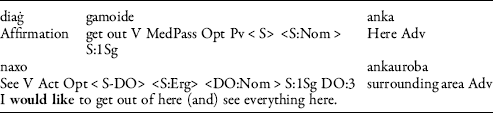
The modality is expressed in Georgian by special modal particles. There are two models of modality: (1) the combination of modal verb and main verb as optative (Aorist series) (მინდა გავაკეთო /minda gavaḳeto/) and modal verb and masdar (მინდა გაკეთება /minda gaḳeteba/ “wants to do something”); (2) A combination of modal verb, particle and the main verb.
In Fereydani Georgian there is no construction at all with a masdar. The only example is documented in the records of Seipola Ioseliani in 1922 (13).




The main difference to Georgian is that in Fereydani Georgian the main verb (Optative, Aorist series) remains unchanged and the modal verb varies according to the tense.
მინდა გავაკეთო /minda gavaḳeto/ wants to do something
მინდოდა გავაკეთო /mindoda gavaḳeto/ wanted to do something.
In summary it can be stated that Fereydani Georgian prefers analytical formation to synthetic formation. The frequency of complex verbs, most of which are borrowed from Iranian, is remarkably high. Loans are also found in the area of hypotaxis in the form of complementers. In Fereydani Georgian the ergative subject appears in the media and passive verbs, which is not possible for the syntax of Standard Georgian. It is also noteworthy that in the noun phrase (NP) the determiner is not congruent with the head nomen regarding the case.
Deixis
In the linguistic analysis of Fereydani Georgian, all phenomena can be analyzed in the context of the other Georgian dialects or with a retrospective view of Old Georgian. Deixis is one of the rare linguistic phenomena in which Fereydani Georgian lacks any even kartvelian background.
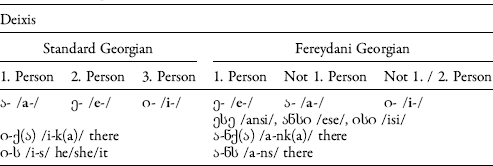
In Standard Georgian the special vowels perform the expression of deictic distances in the first and second person.Footnote 47
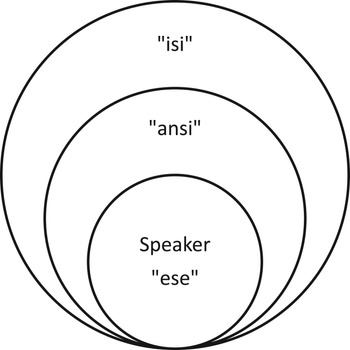
The prefix ა- /-a/ expresses the proximity to the first person (speaker’s space), whereas the prefix ე- /e-/ refers to the space around the second person. The prefix ი- /i-/ indicates the distance from both (first and second person) spaces. In the dialects of Georgian, the opposition between the first and second persons is established by the prefix მ- /m-/: ასე /ase/ “in this way” > მ-ასე /m-ase/ “in that way,” აქ /ak/ “here” > მ-აქ /m-ak/ “there.”Footnote 48
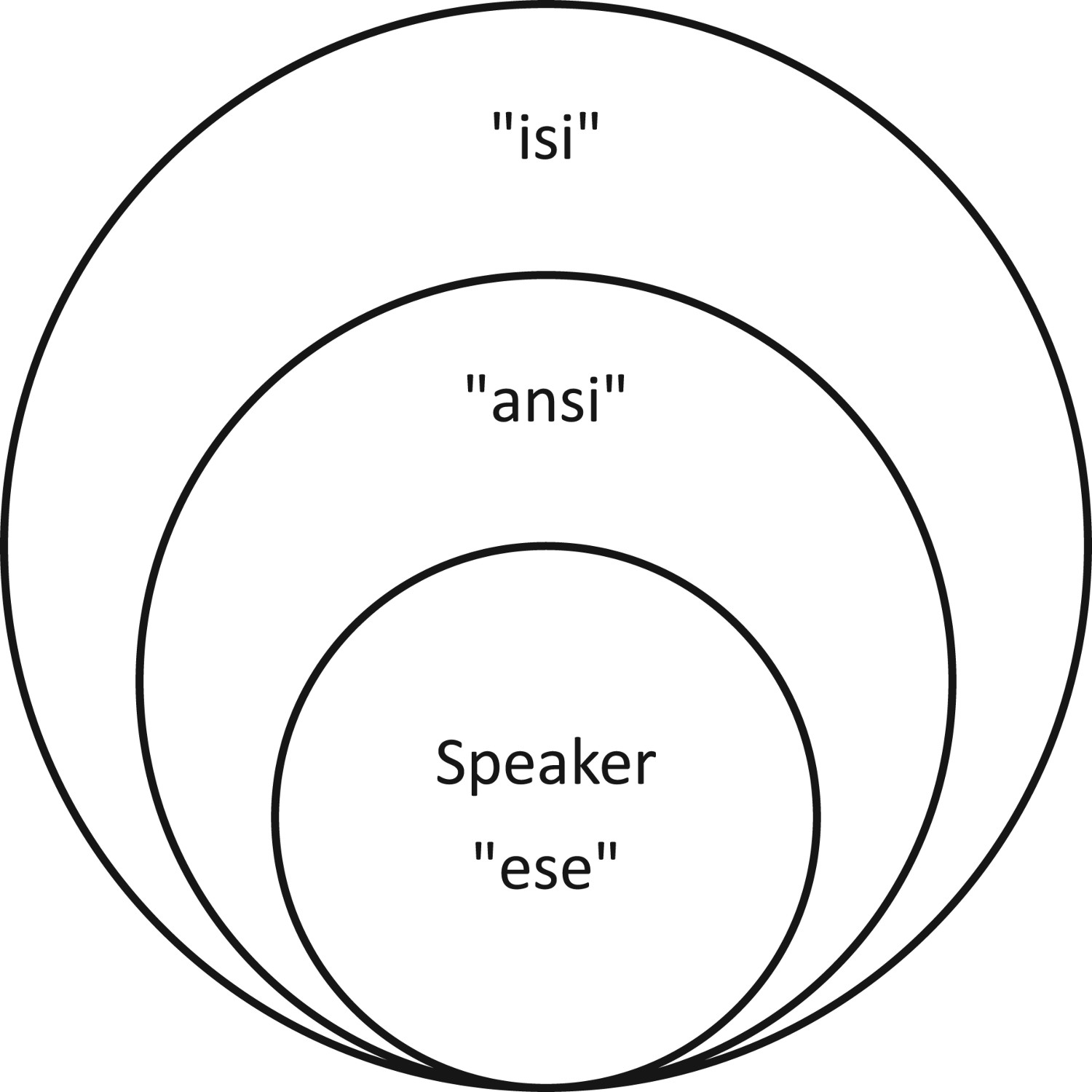
The spatial deixis in Fereydani Georgian stands apart from the well-known systems of deiktic refereeing in the Kartvelian languages.Footnote 49 The speaker himself and the speaker’s space in the Georgian deixis system as well as in all dialects are expressed with the prefixes ა- /a-/ (აქ /ak/ “here”) and ე- /-e/, whereas the non-speaker and non-speaker space is marked with the prefix ი- /i-/ (იქ /ik/ “there”) (see Figure 5).
In Fereydani Georgian, the marking is the other way around. Pronomina and adverbs with the prefix e- refer to the speaker and speaker’s room, whereas non-speaker and non-speaker’s room are expressed with the prefixes ა- /a-/ (ანს კაცი /ans ḳaci/ “that man,” ანქ იყო /ank iq˙o/ “He/she was there”) and ი/ /i-/ (Table 26).
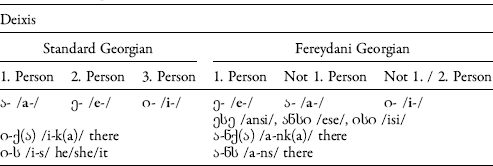
The differences from Georgian are attributed to the influences of Persian. In the Persian person deixis system the third person (neuter) appears with /an/ آن . The Fereydani Georgian ა-ნს /a-ns/ “there” (not speaker’s space) is connected with the /an/ آن of the Persian.
Lexical Properties
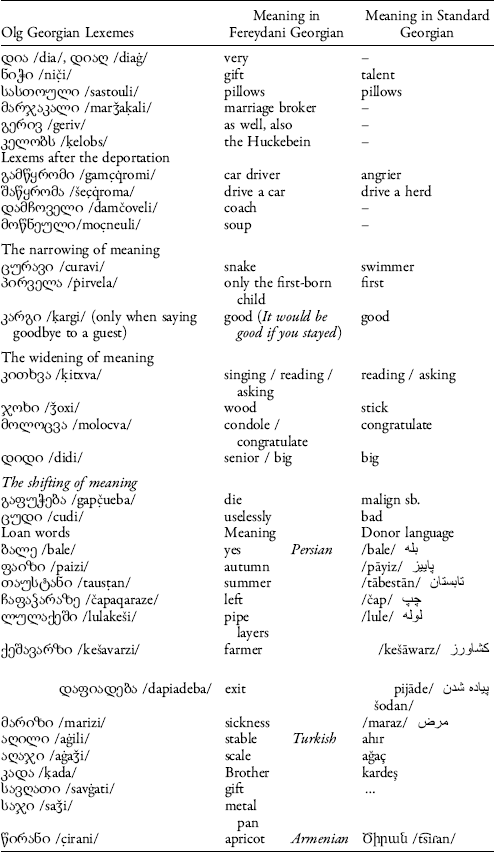
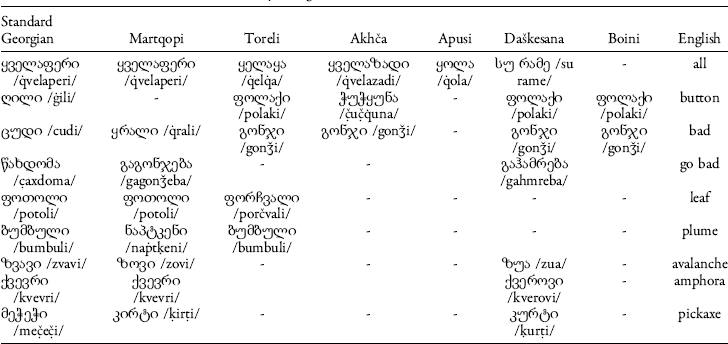
Fereydani Georgian has maintained the ancient lexemes of the Georgian language with the original meaning. Much of this vocabulary is lost in Standard Georgian. Archaic examples are listed in Table 27.
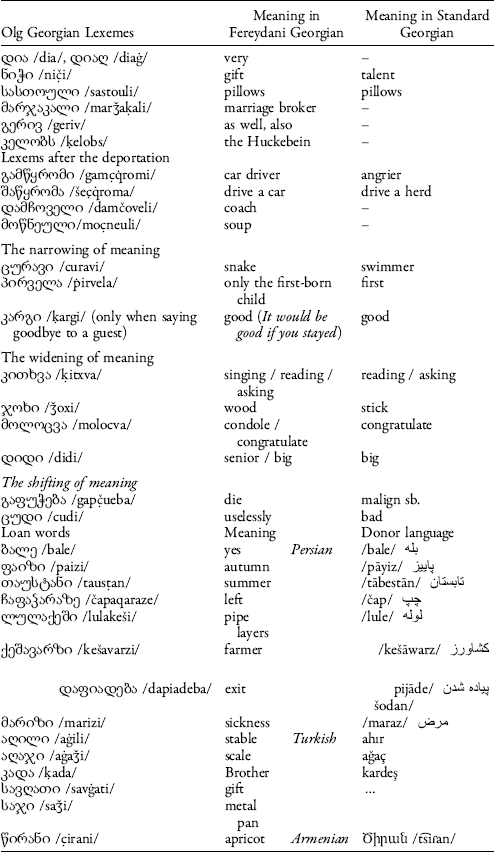
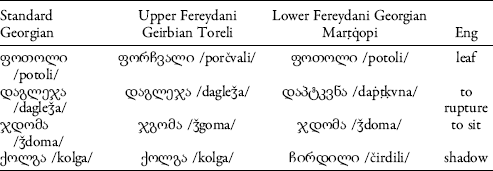
The internal differentiation of Fereydani Georgian shows itself on different levels. The Upper and Lower areas also differ in the use of different lexemes. These differences also contribute to local self-identification and are consciously perceived. Iuri Marr classified the internal language areas of Fereydani Georgian on the basis of the meaning of the word ჩირდილი /čirdili/ “shadow.”Footnote 50 In villages like Daškesana, Boini, Toreli and Akhča the word is interpreted as “shadow,” whereas in the villages Marṭq˙opi, čuġruti, ǯaq˙ǯaq˙i and Sibaki it means “umbrella” (Table 8). The uses of sayings in Fereydani Georgian the meanings of which are vague or completely unknown to users have been documented. For example, a language assistant reminds us of the saying: მარგალიტებს ხომ არ აცვამო აცვამო? /margaliṭebs xom ar acvamo/ “Are you making a pearl necklace?” Through the interaction it was to be interpreted that the saying referred to people working slowly. After several years, the language assistant found the meaning of the word “pearl” or “pearl chain” in a Georgian–English dictionary and could understand exactly what was meant by the saying at that time (Table 28).
Fereydani Georgian Toponymy
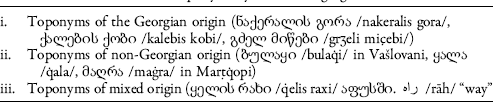
It is a remarkable fact that when settling a new geographical area, the settlers invent and assign new place names, although place names already exist. In these new place names the settlers try to reconstruct their original homeland (at least in the language). They create a type of “fake ecology” around them and build the whole reality of life on it (see Appendix 2). The place names in Fereydan can be classified according to the language of origin (Table 29).
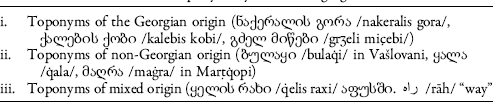
In the toponyms historical events are expressed. They play a strong identity-forming role. For example, ავღანის გორა /გორა gora/ (or აჶღანის გორა /avġanis gora/ or აღუნის გორა /aġunis gora/) “The Mountain of the Afghani” is considered sacred. The fight against the Afghan invasion took place there. According to legends, many brave Fereydanian warriors fell. This story also plays a role in the present: when the Fereydani Georgian found out that a non-Fereydani Georgian wanted to settle near the “Mountain of the Afghani,” they collected the necessary money and bought the area. The high number of microtoponyms is striking (see Appendix 2). Parallel to these names exist the official administrative names, whereby they are almost never used.
Resume
The formation and sustainability of language islands depends on historical, geographical, political and cultural factors. The interweaving of complex levels creates deep traces in the language, which at the same time serve as a demarcation between environment and bridge to surrounding cultures.
For 400 years Fereydani Georgian has been forming a language island that can be described as dynamic isolation. The dynamism lies in the constantly activating factors of identity and the isolation is manifested in the constant perception of the foreign environment. When Fereydani Georgians hear an unknown Georgian word on Georgian radio, it is surprisingly quickly integrated into the language usage. The newly learned word becomes part of the sacred heritage of the ancestors. The word loses the status of lexical innovation and is considered part of the old vocabulary. Isolation is as much a matter of survival for the Fereydani language island as integration. In the 1970s there were some attempts to settle a few Fereydani families back to East Georgia in their original home area. They returned to Fereydan after a few years. Fereydani Georgian is an island culture and it has developed as it could only develop, as a language island.
From the descriptions in this article it can be seen that the Fereydani language island is a peculiar case and its scientific exploration requires the attention of linguists and all associated disciplines. What does Fereydani Georgian represent today? A dialect? A language? If this is a variant of the Georgian language, how can it be classified linguistically?
We find that Fereydani Georgian did not originate from a single Georgian dialect (for example Kakhetian) and there were speakers of various East Georgian dialects, including Highland dialects, among the deportees. We find many linguistic similarities with Old Georgian on all levels of grammar. Thus, Fereydani Georgian can be considered as a peculiar mixture of East Georgian dialects in their archaic linguistic state. The ecology of the language island played a crucial role in the process of linguistic development. No less important was a 300-year isolation from the standard language. Through cultural reintegration, a new, linguistically exciting process of language (dialect) contact takes place in which Standard Georgian appears as the donor language and Fereydani Georgian as the recipient language. All in all, we observe a linguistic laboratory in which grammatical processes take place much faster and more strikingly than is otherwise assumed in linguistics. The answer to the question of how a linguistic minority in Fereydan could exist as an island for more than 400 years remains a subject for future research.
Appendix 1. Abbreviations
▪ 1st first person
▪ 2nd second person
▪ 3rd third person
▪ <Advb > argument in advb
▪ <AuxIntr > intransitive auxiliary
▪ <AuxTrans > transitive auxiliary
▪ <DO:Dat > dative direct object
▪ <DO:Nom > nom. direct object
▪ <Dat/Gen > argument dat or gen
▪ <Dat > argument in dat
▪ <Gen > argument in gen
▪ <IO:Dat > dative indirect object
▪ <Inst > argument in instr.
▪ <S-DO-IO > transitive relative
▪ <S-DO > transitive absolute
▪ <S-IO > intransitive relative
▪ <S:Dat > dative subject
▪ <S:Erg > ergative subject
▪ <S:Nom > nominative subject
▪ A adjective
▪ Act active
▪ Adv adverb
▪ Advb adverbialis
▪ Alpha alphabetic
▪ Anthr anthroponym
▪ Aor aorist
▪ Att attributive form
▪ Card cardinal
▪ Caus causative
▪ Cj conjunction
▪ DO:1/2/3 person direct object
▪ Dat dative
▪ Dem demonstrative
▪ Encl enclitics
▪ Encl:Aux enclitic auxiliary
▪ verb
▪ Erg ergative
▪ Foc focus
▪ Frac fraction
▪ Fut future
▪ Gen genitive
▪ Hum human
▪ IO:1/2/3 person indirect object
▪ Impf imperfect
▪ Impv imperative
▪ Indef indefinite
▪ Inst instrumental
▪ Int interrogative
▪ Med medial
▪ MedAct medioactive
▪ MedPass mediopassive
▪ Modal modal
▪ N noun
▪ Neg negative marker
▪ Nom nominative
▪ Num numeral
▪ OV objective version
▪ Opt optative
▪ PP postposition suffix
▪ PP:დან postposition -from
▪ PP:ში postposition -in
▪ Part participle
▪ Pass passive
▪ Perf perfect
▪ Pers person
▪ Pl plural
▪ Poss possessive
▪ Pot potential
▪ Pp post- or preposition
▪ Pres present
▪ PresPart present participle
▪ Pron pronoun
▪ Pv preverb
▪ S:1/2/3 person subject
▪ SV subjective version
▪ Sg singular
▪ Sub subordinating
▪ Temp temporal
▪ Top toponym
▪ V verb
▪ VN verbal noun, masdar
Appendix 2. Microtoponymics

Notes
1The data represents the statistic materials from Fereydani Georgian—Atam Oniḳašvili (1871).
2The Georgian orientalist; he collected the material during travel in Iran.
3The Iranian general; he documented Georgian villages in 1950.

Appendix 3
Table A1. The Fereydani Georgian Villages Reported and the Corresponding Sources