Introduction
In environments where multiple languages are used, bi- and multilingual speakers can combine more than one language in their conversations, a phenomenon known as code-switching. Code-switching was originally believed to be the result of a language deficiency (Weinreich, Reference Weinreich2010), a strategy used by bilinguals to compensate for a lack of proficiency in either one or both languages (Heredia & Altarriba, Reference Heredia and Altarriba2001). Others believed that code-switching threatened the “purity” of a language (Myers-Scotton, Reference Myers-Scotton2017). Scholars today, however, overwhelmingly reject these views and recognize that code-switching is a systematic and complex linguistic phenomenon that is typical of bilingual communities (Hoff & Core, Reference Hoff and Core2015; Ritchie & Bhatia, Reference Ritchie and Bhatia2012; Yow, Tan & Flynn, Reference Yow, Tan and Flynn2018). For the past several decades, researchers have investigated how often, where syntactically, and why code-switching occurs. While this body of research is vast, it has typically focused on speech between bilingual adults. What remains largely unstudied is the nature and purpose of code-switching when bilingual adults speak to young children. Here, we analyzed the speech input of 21 French–English bilingual families in Montreal via day-long, at-home audio recordings that were made when infants were both 10 and 18 months old, a critical period for language development. Our goal was to understand the nature of code-switching in parental speech to bilingual infants, focusing on a) frequency, b) syntactic location, and c) apparent reasons for code-switching.
Why caregivers’ code-switching matters for understanding language acquisition
Adults routinely modify their speech when interacting with children (Fernald, Reference Fernald1989). For example, many language communities around the world use infant-directed speech, which has characteristics that include variability in pitch (Stern, Spieker & Mackain, Reference Stern, Spieker and Mackain1982), higher pitch (Albin & Echols, Reference Albin and Echols1996), shorter utterances (Soderstrom, Blossom, Foygel & Morgan, Reference Soderstrom, Blossom, Foygel and Morgan2008), more repetition (Hills, Reference Hills2013), and lengthening of final syllables (Albin & Echols, Reference Albin and Echols1996). The exact qualities of infant-directed speech vary between parents and have been linked to variations in infants’ linguistic abilities (see Soderstrom, Reference Soderstrom2007 for a review).
For bilingual caregivers, infant-directed speech may contain code-switches, which like other aspects of infant-directed speech, could impact language acquisition either positively or negatively. On one hand, laboratory studies have suggested that code-switched speech can be more challenging for bilingual children to process than single-language speech (Byers-Heinlein, Reference Byers-Heinlein2013; Byers-Heinlein, Morin-Lessard & Lew-Williams, Reference Byers-Heinlein, Morin-Lessard and Lew-Williams2017; Morini & Newman, Reference Morini and Newman2019; Potter, Fourakis, Morin-Lessard, Byers-Heinlein & Lew-Williams, Reference Potter, Fourakis, Morin-Lessard, Byers-Heinlein and Lew-Williams2018). Difficulties in language processing could ultimately lead to delayed language acquisition. On the other hand, code-switching may be a useful strategy for bilingual caregivers to support their child's development in both of their languages. For example, long-term exposure to code-switching could prepare infants for processing dual-language input (Orena & Polka, Reference Orena and Polka2019). Further, code-switching could be used to scaffold bilingual vocabulary acquisition, by providing terms in each language. However, we still have a poor understanding of how often and what types of code-switches infants encounter in their daily life. Investigating the quality and quantity of infant-directed code-switching is a crucial first step in understanding how it might affect language acquisition.
Frequency of code-switching
Code-switching is common in bilingual and multilingual communities (Myers-Scotton, Reference Myers-Scotton2017), and it also occurs in parents’ speech to their children (Goodz, Reference Goodz1989). A questionnaire-based study in Vancouver, Canada, found that more than 90% of bilingual parents (English and another language) reported engaging in code-switching when speaking to their children (Byers-Heinlein, Reference Byers-Heinlein2013). Although code-switching was common, the frequency across parents was found to be highly individualistic. Within-sentence code-switching roughly followed a normal distribution, highlighting the variation between parents’ rates of code-switching. Similarly, an observation-based study in Maryland, USA, observed that all of their Spanish–English bilingual parents used code-switching during a play session with their child (Bail, Morini & Newman, Reference Bail, Morini and Newman2015). While code-switching occurred, on average, in 15.8% of all utterances by each parent, this ranged by parent from 0.4 to 58.5% (Bail et al., Reference Bail, Morini and Newman2015). This variation across speakers is also commonly observed in studies on adults’ code-switching behaviors (Dewaele & Li, Reference Dewaele and Li2014; Dewaele & Zeckel, Reference Dewaele and Zeckel2016).
The frequency of parental code-switching may be an important factor in a bilingual child's language development. For example, children code-switch at a similar rate as their parents, suggesting that parental code-switching serves as a model (Genesee, Nicoladis & Paradis, Reference Genesee, Nicoladis and Paradis1995). Additionally, several studies have investigated the relationship between the frequency of parents’ code-switching and their child's vocabulary size, but these studies have reported divergent findings: some indicate that code-switching may negatively impact a child's vocabulary development (Byers-Heinlein, Reference Byers-Heinlein2013) while others indicate that code-switching has no impact on a child's vocabulary development (Bail et al., Reference Bail, Morini and Newman2015; Cabarjal & Peperkamp, Reference Cabarjal and Peperkamp2020).
One possible reason for these mixed results in the literature is that different studies have used different methods to measure the frequency of parental code-switching. One method that has been used is observing parents during a play session in a laboratory environment (Bail et al., Reference Bail, Morini and Newman2015; De Houwer & Bornstein, Reference De Houwer and Bornstein2016). This allows for direct measurement of code-switching frequency but is limited, because parents may not engage in their usual code-switching behaviors due to perceived expectations in the laboratory environment. Another method is to use questionnaires asking parents to rate the frequency of their code-switching (Byers-Heinlein, Reference Byers-Heinlein2013; Place & Hoff, Reference Place and Hoff2016). However, parents’ self-reported frequency of code-switching may not reflect their actual frequency of code-switching (Bail et al., Reference Bail, Morini and Newman2015). Additionally, when comparing parents’ self-reported code-switching to their child's performance on language tasks, no relationship between the two measures has been observed (Place & Hoff, Reference Place and Hoff2016; Schott, Mastroberardino, Fourakis, Lew-Williams & Byers-Heinlein, Reference Schott, Mastroberardino, Fourakis, Lew-Williams and Byers-Heinlein2020). This indicates that while self-report is time-efficient, parents may not be consciously aware of how much they code-switch, meaning this measure could be inaccurate. Lastly, rates of parental code-switching have been measured via a diary method, where parents indicate whether they spoke to their child in one or both of their languages in a given 30-minute block (Place & Hoff, Reference Place and Hoff2011, Reference Place and Hoff2016). This measures whether the two languages co-occur temporally across large blocks of time but does not quantify in more fine-grained detail exactly how much code-switching a child hears.
To better understand how code-switching might influence children's language development, and given that the frequency of code-switching is highly variable between individuals and difficult to measure precisely, a new approach is needed to more accurately measure the frequency of parental code-switching. One solution is to obtain recordings from parents speaking to their child in their home. This provides a more accurate picture of everyday code-switching in families; the exact number of code-switches can be counted and analyzed. This method circumvents measurement issues associated with observation in an unfamiliar laboratory environment and self-report. Moreover, it provides the opportunity to assess the accuracy of self-report measures and evaluate how these measures could be incorporated into future research. Our first research goal was to observe how frequently code-switching occurs in the daily life of bilingual families and to compare this to self-report measures of code-switching.
Syntax of code-switching
Raw measures of the frequency of code-switching do not account for the diverse syntactic locations where code-switching can occur. Code-switching is a rule-governed language phenomenon, and code-switches do not occur in random syntactic locations (MacSwan, Reference MacSwan2012). Intersentential switches occur between sentences, and thus are not subject to syntactic constraints (e.g., Let's read a book. Je vais lire un livre. [I'm going to read a book.]); intrasentential switches occur within a sentence and are governed by syntactic rules (e.g., I'm going to read un livre [a book]; MacSwan, Reference MacSwan2012). This distinction is important even in early development, as some research has suggested that 20-month-old bilinguals more readily process intersentential code-switches than intrasentential code-switches (Byers-Heinlein et al., Reference Byers-Heinlein, Morin-Lessard and Lew-Williams2017). Indeed, previous research has shown that parents tend to code-switch more between sentences than within a sentence when playing with their child (Bail et al., Reference Bail, Morini and Newman2015).
Intrasentential code-switches can occur at several different locations (MacSwan, Reference MacSwan2012). For decades, scholars have proposed various theories and rules to describe the systematic nature of code-switching (e.g., Azuma, Reference Azuma1992; MacSwan, Reference MacSwan2012; Myers-Scotton, Reference Myers-Scotton1997; Poplack, Reference Poplack1980; Sankoff & Poplack, Reference Sankoff and Poplack1981; Woolford, Reference Woolford1983). While these theories vary on their exact rules, they generally converge on the idea that code-switching can occur when the grammars of the two languages overlap in some way (Poplack, Reference Poplack1978, Reference Poplack1980).
To our knowledge, only one study has examined the syntactic locations of intrasentential code-switches in parental speech, finding that over half of intrasentential code-switches occurred between a determiner and a noun (e.g., el [the] apple; Bail et al., Reference Bail, Morini and Newman2015). One important distinction may be whether intrasentential code-switches occur at a syntactic boundary (e.g., The student brought the homework para la profesora [for the teacher]; example and translation from Belazi, Rubin & Toribio, Reference Belazi, Rubin and Toribio1994), or within a syntactic phrase (e.g., una Gegend fredda [a region cold]; example and translation from Cantone & MacSwan, Reference Cantone and MacSwan2009). Bilingual infants show sensitivity to the syntactic structure of their languages by age 7 months (Gervain & Werker, Reference Gervain and Werker2013), which suggests that they might also be sensitive to the syntactic location of code-switches. Due to the potential differences in children's processing of code-switches at various syntactic boundaries, our second research goal was to investigate the prevalence of code-switches occurring at a syntactic boundary compared to ones occurring within a syntactic phrase. This is a tractable way to begin examining the effects of the syntactic properties of parental code-switching on speech processing and language development in general.
Reasons for code-switching
Speakers may engage in code-switching for different reasons depending on whether they are interacting with another adult or with a child. Certain reasons that drive code-switching in adult conversations might also apply to parent–child speech. At the same time, there may be unique motivations that parents have for code-switching that support their child's language development.
First, code-switching behaviors vary significantly between different communities of bilinguals (Heller, Reference Heller2010). For many, code-switching serves to reinforce a community's identity by following the accepted local norms and functions of code-switching (Nilep, Reference Nilep2006). For example, the communal identity can be strengthened when a speaker code-switches in order to use an idiom from one of their languages or to share a piece of cultural wisdom or history, a type of linguistic borrowing (Ritchie & Bhatia, Reference Ritchie and Bhatia2012). Parents may code-switch with their young children in the same way that they do with other community members. This could serve to teach their child their community's norms and expectations. Indeed, research on children's early productions of code-switching have found that children code-switch at a similar rate to their parents, suggesting that parental code-switching may serve as a model for developing bilinguals (Comeau, Genesee & Lapaquette, Reference Comeau, Genesee and Lapaquette2003; Yip & Matthews, Reference Yip and Matthews2016). Modeling norms might also occur through borrowings that are common in the community, which could include baby- and child-specific terms. For example, in Montreal, Canada, it is common for a child's stuffed toy to be referred to with the French word “toutou” regardless of the language that the parent is speaking. Using this term when speaking English would be an instance of code-switching.
Another important driver of code-switching in adult–adult conversations is to improve understanding of the speaker by their conversational partner (Heredia & Altarriba, Reference Heredia and Altarriba2001). Similarly, bilingual parents may use code-switching to adapt to their child's knowledge – for example, code-switching to produce a word that they know their child understands rather than its unfamiliar translation equivalent. There are also reports that parents sometimes code-switch in order to teach their child a new word, again using code-switching strategically to enhance their children's comprehension and learning (Byers-Heinlein, Reference Byers-Heinlein2013). For example, bilingual parents have been observed to code-switch in order to provide a translation from one language into the other (Bail et al., Reference Bail, Morini and Newman2015). Code-switching in these circumstances may help to support children's language learning.
Finally, adults have been observed to code-switch in conversations to create metaphorical effects in the discourse (Blom & Gumperz, Reference Blom and Gumperz1972; Gumperz, Reference Gumperz1982; Ritchie & Bhatia, Reference Ritchie and Bhatia2012) – for example, using direct quotations, such as, “they be like ‘loca, loca’” [honey, honey] (example and translation from Bailey, Reference Bailey2000). Metaphorical code-switching is difficult for analysts to classify, and even native-speakers do not consciously understand all of the motivations driving metaphorical code-switching (Gumperz, Reference Gumperz1982). Parents may also code-switch to produce metaphorical effects unique to a child's language development. This could include code-switching in order to get their child's attention, emphasize a point, or discipline their child (Bail et al., Reference Bail, Morini and Newman2015; Byers-Heinlein, Reference Byers-Heinlein2013; Goodz, Reference Goodz1989).
In sum, there are numerous reasons why adults code-switch in speech to other bilingual adults, as well as additional reasons why adults might code-switch when speaking to their children. The reason(s) motivating a parent's code-switching could potentially bolster a child's language development. Additionally, a single code-switch may be motivated by multiple reasons. However, there is little research that quantitatively investigates parents’ motivation for code-switching when speaking to their child. Our third research goal was therefore to explore and quantify parents’ apparent reasons for code-switching in speech to their young children, given the paucity of research on this topic.
Changes across development
Parents adapt their speech to their child's linguistic abilities. For example, prosodic features, such as pitch, change across an infant's first months (Kitamura & Burnham, Reference Kitamura and Burnham2003; Kitamura & Lam, Reference Kitamura and Lam2009; Stern, Spieker, Barnett & MacKain, Reference Stern, Spieker, Barnett and MacKain1983). As a second example, properties of parents’ speech, such as vowel articulation (Lam & Kitamura, Reference Lam and Kitamura2012) and syntactic complexity (Elmlinger, Schwade & Goldstein, Reference Elmlinger, Schwade and Goldstein2019), appear to change in response to their infants’ feedback. This work has focused on monolingual parents, but it is likely that bilingual parents also alter their speech based on their infant's feedback. It is currently unknown whether parents’ code-switching changes in response to an infant's developing language abilities, as previous studies have not investigated properties of parental code-switching longitudinally beyond whether or not code-switching occurs (De Houwer & Bornstein, Reference De Houwer and Bornstein2016). Thus, our fourth research goal was to examine how parental code-switching may change across their infant's development.
Current study
The current study investigated the code-switching behaviors of parents in Montreal, Canada. Montreal is a unique environment for studying bilingualism, because both French and English are widely spoken throughout the city, and both have high status in the community. This creates a favorable environment for investigating code-switching. Below, we detail the predictions associated with each of our research questions (RQ):
RQ1a: How often do parents code-switch?
We expected to observe code-switching in all families. However, we expected that the frequency of code-switching would vary across families. Such a finding would be consistent with previous research (Bail et al., Reference Bail, Morini and Newman2015; Byers-Heinlein, Reference Byers-Heinlein2013).
RQ1b: How reliable are self-report measures of code-switching?
In addition to measuring the frequency of parents’ code-switching, we had the opportunity to compare this direct observation to a self-report measure (the Language Mixing Questionnaire; Byers-Heinlein, Reference Byers-Heinlein2013), thereby evaluating the validity of such measures.
RQ2: Where do parents code-switch syntactically?
We predicted that parents would code-switch both between and within sentences. Generally, we expected to observe more intersentential than intrasentential code-switches, as previously reported by Bail and colleagues (2015). For intrasentential code-switching, we predicted that it would more often occur between syntactic phrases than within a syntactic phrase (Woolford, Reference Woolford1983). This pattern may emerge because switches at a syntactic phrase boundary are easier to produce or process.
RQ3: Why do parents code-switch?
We anticipated that code-switching would occur for a variety of apparent reasons. Previous research suggests that parents may code-switch for reasons such as boosting their child's understanding, borrowing a term from the other language, providing a translation equivalent, getting their child's attention, emphasizing a point, or disciplining their child. Because previous research has not addressed how frequently parents code-switch for each of these reasons, we did not have any predictions as to which reasons would be more frequent than others or what combination of reasons may motivate a single code-switch.
RQ4: Do patterns change across the infant's development?
Due to the great advances in children's language skills between 10 and 18 months of age, we expected parents’ code-switching frequency to increase between these two time points, as they adjust to their children's language skills (e.g., Stern, Spieker, Barnett & MacKain, Reference Stern, Spieker, Barnett and MacKain1983). This prediction also follows from an implicit assumption that parents adapt their input to their children's language processing abilities.
Method
Data were drawn from the Montreal Bilingual Corpus (Orena, Byers-Heinlein & Polka, Reference Orena, Byers-Heinlein and Polka2019), which contains daylong home recordings for French–English bilingual children recorded at age 10 months and again at age 18 months. We initially conducted pilot coding of data from 2 children at 10 months to verify and finalize our coding scheme. Prior to listening to or coding the remaining code-switches, we then pre-registered our methods via the Open Science Framework at https://osf.io/a52ku. Any deviations from the pre-registration are noted and justified. All data, including those from the 2 pilot children, were included in the final analysis. This research was approved by the Institutional Review Board at McGill University (IRB # A05-B20-16A).
Participants
Participants who contributed to the corpus were families with a young infant who heard French and English at home (n = 21). Infants were 10 months of age (M = 9m29d, Range = 9m15d – 10m14d) during their first visit to the laboratory. Most of these families returned for a second visit (n = 16) when infants were 18 months of age (M = 18m29d, Range = 18m4d – 20m26d). As reported by parents, none of the infants had an auditory or developmental neurocognitive disorder. Parents also reported being from a mid- to high- socioeconomic background, with a mean Hollingshead score of 52.2 (Range = 31–66 out of a possible 66).
Using a common cut off in the field of infant and child bilingualism (Byers-Heinlein, Reference Byers-Heinlein and Schwieter2015), initial eligibility criteria for the corpus required that infants have at least 25% of their overall exposure to both English and French, and that they have daily exposure to both languages. Infants’ language exposure was first estimated during a phone screening and then evaluated more thoroughly upon their visit to the lab with a language exposure questionnaire (LEQ; Bosch & Sebastián-Gallés, Reference Bosch and Sebastián-Gallés2001) using the Multilingual Approach to Parent Language Estimates (MAPLE; Byers-Heinlein et al., Reference Byers-Heinlein, Schott, Gonzalez-Barrero, Brouillard, Dubé, Jardak, Laoun-Rubenstein, Mastroberardino, Morin-Lessard and Iliaei2019). Based on this questionnaire, 3 infants no longer met the language exposure criteria as they had slightly lower than the 25% minimum exposure to their non-dominant language. However, these infants were still included in the corpus as well as the current analyses because they all received daily exposure to both French and English (Orena et al., Reference Orena, Byers-Heinlein and Polka2019). At 10 months, twelve infants were in a French-dominant environment (i.e., 56–79% of their language exposure was in French), and 9 were in an English-dominant environment (i.e., 55–76% of their language exposure was in English). Four infants also heard a small amount of a third language in the home (i.e., Arabic, Kannada, Portuguese, and Spanish), but this constituted less than 5% of each infant's language exposure. At 18 months, 8 infants were in a French-dominant environment (60–78% French) and 8 were in an English-dominant environment (50–78% English).
Each family in the corpus included two different-sex parents. While all parents reported knowledge of English and French, not all parents reported speaking both languages to their infant. Of the 42 parents in the corpus, 26 reported that they spoke both languages to their infant, while 16 reported speaking only one language to their infant. Each parent, except one, completed the Language Experience and Proficiency Questionnaire (LEAP-Q; Marian, Blumenfeld & Kaushanskaya, Reference Marian, Blumenfeld and Kaushanskaya2007). Parents’ age of acquisition ranged from 0–17 years old (Mean: 4.78, SD: 4.94) for English and from 0–21 years old (Mean: 3.10, SD: 5.27) for French. Parents also rated their proficiency for speaking, comprehension, and reading from 0 to 10 in both English and French and reported a mean proficiency score of 9.23 (SD: 0.86, Range: 6.33–10) in English and 9.42 (SD: 1.12, Range: 5.67–10) in French. All parents completed the Bilingual Dominance Scale (Dunn & Fox Tree, Reference Dunn and Fox Tree2009), and reported an average dominance score of 3.48 (SD:12.90, Range: −19–22), where a negative score indicates dominance in English and a positive score indicates dominance in French. Sixteen parents were dominant in English, 25 were dominant in French, and 1 was equally dominant in both languages. In sum, while parents generally reported high levels of proficiency in both languages, most also reported having a dominant language. This reflects variation that is common between bilinguals. While this variation could explain parents’ code-switching, such questions are beyond the scope of the current paper.
Procedure
Data for the corpus were collected as part of a larger research project on early bilingual development (Orena et al., Reference Orena, Byers-Heinlein and Polka2019; Orena, Byers-Heinlein & Polka, Reference Orena, Byers-Heinlein and Polka2020). The data for 10-month-olds were collected between November 8th, 2016 and September 18th, 2017, and the data for 18-month-olds were collected between July 25th, 2017 and March 28th, 2018. The audio recordings were collected using Language ENvironment Analysis (LENA) devices, which are small, portable recorders that can record up to 16 hours. When infants were 10 months old, each family completed two appointments. At the first appointment, the procedure and purpose of the study were explained, and families were interviewed about their language use (LEQ via MAPLE; Bosch & Sebastián-Gallés, Reference Bosch and Sebastián-Gallés2001; Byers-Heinlein, Schott, Gonzalez-Barrero, Brouillard, Dubé, Jardak, Laoun-Rubenstein, Mastroberardino, Morin-Lessard & Iliaei, Reference Byers-Heinlein, Schott, Gonzalez-Barrero, Brouillard, Dubé, Jardak, Laoun-Rubenstein, Mastroberardino, Morin-Lessard and Iliaei2019). Each family was given three LENA recording devices, and three infant vests to hold the devices. Families were asked to record three full days at home: two weekdays and one weekend day. Two families were unable to follow this schedule: one recorded 1 weekday and 2 weekend days, and the other recorded 3 weekdays. Three infants were enrolled in daycare at the time of their participation, but the recordings were made on days the infant was at home. Families were instructed to begin the recording when the infant woke up and have the LENA device record the entire 16 hours. When all three recordings were complete, there was another appointment where the LENA devices were collected and questionnaires about the parents’ language experience and proficiency (LEAP-Q; Marian et al., Reference Marian, Blumenfeld and Kaushanskaya2007) and language mixing (Language Mixing Questionnaire; Byers-Heinlein, Reference Byers-Heinlein2013) were administered.
When infants were 18 months old, families repeated the same procedure. To capture any changes in the infant's language environment, the Language Exposure Questionnaire and the Language Mixing Questionnaire were re-administered. At this age, for practical reasons families were only asked to record one weekend day. Most of the parents had finished their parental leaves, so most of the children were enrolled in daycare. Asking families to record their child's environment while they were in daycare during the week was not feasible, due to privacy concerns related to the presence of other children. For these reasons, families were asked to record one weekend day instead, in hopes that this would maximize participation.
Transcription
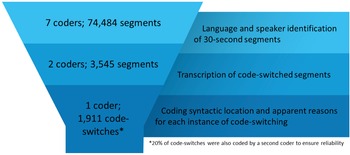
The LENA system does not differentiate between languages, and therefore cannot identify when code-switching occurs. Thus, language identification and transcriptions were conducted manually by trained, highly proficient, simultaneous French–English bilingual research assistants (for details, see Orena et al., Reference Orena, Byers-Heinlein and Polka2020). To create the corpus, the recordings were first divided into 30-second segments, following a standard practice for coding daylong recordings (e.g., Ramírez-Esparza, García-Sierra & Kuhl, Reference Ramírez-Esparza, García-Sierra and Kuhl2014), and to allow research assistants to reliably pay attention to who was speaking and in what language (Orena et al., Reference Orena, Byers-Heinlein and Polka2020). If an utterance broke off in mid-stream at the end of the segment, the research assistants listened to the following segment to transcribe the end of the utterance. Through pilot analyses of the corpus, it was determined that looking at every other segment was sufficient for evaluating infants’ language environment (Orena et al., Reference Orena, Byers-Heinlein and Polka2020). Therefore, the research assistants listened to every other segment and noted who was speaking, to whom, and in what language (See Figure 1). If any speaker used more than one language within a segment, the language of that segment was tagged as “mixed.” Each of the mixed-language segments was transcribed by research assistants. The transcriptions were reviewed by a second group of research assistants to ensure accuracy.
Transcription and coding pipeline describing the number of coders and segments at each stage.

Coding
Once all the segments that contained mixed language were identified and transcribed in the coded portion of the corpus, every instance where a parent was talking to their infant and changed the language they were speaking was tagged as a code-switch. This means that it was possible for a single segment to contain multiple code-switches if the speaker changed languages multiple times. If a single segment contained more than one code-switch, it was marked as such. The full coding protocol can be found at https://osf.io/ yz6f7 /.
Frequency
After identifying all instances of code-switching in the corpus, frequency was determined by normalizing this value by the amount of speech that children heard. This was important to ensure that observed differences in code-switching frequency would not simply reflect the overall level of interaction between infants and their caregivers. We used two related approaches to normalize our data. Our pre-registered approach was to calculate the number of code-switches per hour of speech directed at the infant, which was based on the number of 30-second segments that contained infant-directed speech. Our second approach, which was suggested by a reviewer and thus was not pre-registered, was to calculate the number of code-switches per 1,000 infant-directed words. This latter value was calculated based on LENA's automatic word count values, which have been shown to be reliable in this corpus (Orena et al., Reference Orena, Byers-Heinlein and Polka2020). We were then able to compare these measures of frequency to parent-reported rates of code-switching from the Language Mixing Questionnaire. If the average speech rate that infants encounter is reasonably consistent, these two normalization approaches will yield similar results.
Direction
First, for each code-switch, we noted the direction of the switch. That is, we noted whether the speaker's language switched from French to English, or English to French. As there were no hypotheses related to this variable, it was not analyzed.
Syntactic location
Second, we determined the syntactic location of the switch. There were three possible levels for this coding. We determined whether the switch was between sentences (intersentential) or within a sentence (intrasentential). Any switch that happened between sentences and within the same 30-second segment was coded as intersentential, regardless of any intervening silence. For the intrasentential code-switches, we further determined whether the switch occurred within a syntactic phrase (e.g., the red chien [dog]) or between syntactic phrases (e.g., le chien [the dog] runs). This was determined by applying various tests of constituency (Radford, Reference Radford2006).
Apparent reason for the code-switch
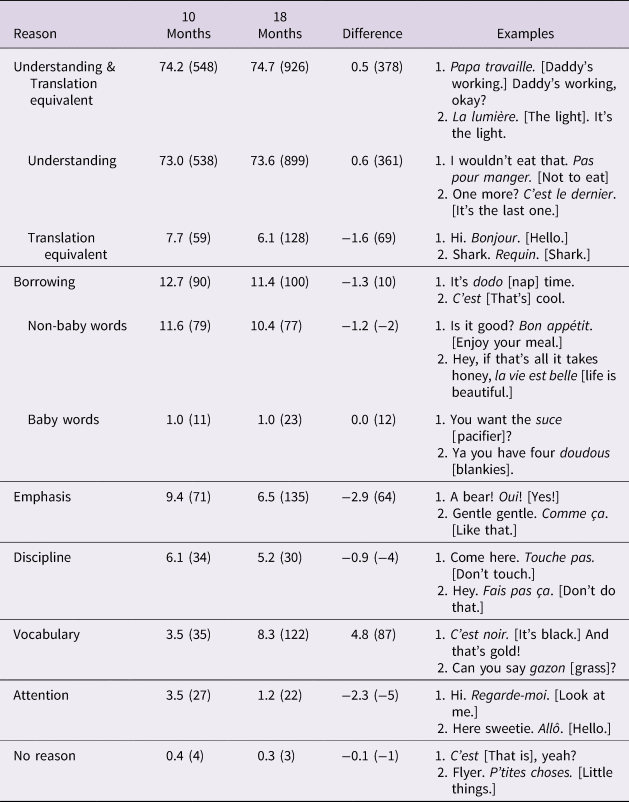
Lastly, each switch was coded for the apparent reason for the switch based on the context available in the audio segment. Apparent reasons were initially based on those previously reported in the literature on bilingual parents’ code switching (Bail et al., Reference Bail, Morini and Newman2015; Byers-Heinlein, Reference Byers-Heinlein2013; Goodz, Reference Goodz1989): attracting the child's attention, adding emphasis, disciplining the child, bolstering the infant's understanding, attempting to teach new vocabulary, providing a translation, and conventionalized borrowings and phrases, including baby-specific words and phrases. For definitions for each of these reasons, see the coding manual at https://osf.io/yz6f7/. For examples, see Table 2. Additionally, after pilot coding 2 of the 10-month-old infants but before pre-registering the study, we decided to add baby-specific words and phrases as a subset of the borrowing category in order to better understand the nature of borrowing as a type of parental code-switching. Although we coded 8 different apparent reasons for code-switching drawn both from the literature and from our pilot coding, we acknowledge that our list is not exhaustive and that parents may code-switch for reasons not included here. Therefore, if a single switch did not appear to be motivated by any of our pre-determined reasons, the coding for the switch was left blank (i.e., categorized as “no reason”). Given the complex nature of code-switching and potential overlap between our categories, we allowed a single switch to be coded as having multiple apparent reasons.
Inter-rater reliability
To evaluate the accuracy of the data coding, inter-rater reliability was calculated for the following categories: direction, syntactic location, and each of the 8 apparent reasons for the code-switch. Data were initially coded by the second author, who has training in linguistics and psychology and is highly proficient in both French and English. Subsequently, the first author coded a randomly selected 20% of utterances to each infant. Inter-rater reliability for each category is reported as the percentage of code-switches for each category that were coded the same by both raters. Interrater reliability was generally high: 100% for the direction, 94% for the constituency of the code-switch, and ranging from 78% to 97% for each of the 8 apparent reasons (see Table 1). We pre-registered a minimum inter-rater reliability of 75% for each apparent reason category to be included in our analyses, thus all the categories were included in the subsequent analyses.
Inter-rater reliability for each apparent reason

Results
All analyses were conducted as per our preregistration, except where deviations are noted. One important deviation is that we had originally planned to collapse the data across the two age groups (10 and 18 months old) for several of our analyses. However, after preliminary analyses revealed striking changes in parental code-switching across development, instead of reporting analyses that collapsed across age groups, we opted to report analyses for each age group separately followed by the planned statistical comparisons of the two ages. Coded data and analysis code are available at https://osf.io/bxkg7/.
Frequency
As a reminder, we operationalized frequency in two ways: number of code-switches per hour of infant-directed speech, and number of code-switches per 1,000 infant-directed words. To calculate the number of code-switches parents produced per hour of infant-directed speech, we divided the number of parental code-switches by the number of 30-second segments where a parent was speaking to their infant and then multiplied this number by 120, the number of segments per hour. To calculate the number of code-switches per 1,000 infant-directed words, we divided the number of parental code-switches by the number of infant-directed words (as calculated by LENA's automated word counter). At 10 months, because there were three days of recording for each child, we averaged the frequency of code-switching across the three days. The two measures of frequency were highly correlated, r = 0.91, 95% CI [0.82, 0.95], t(35) = 12.605, p < 0.001, and thus results were highly similar whether calculated by hour of infant-directed speech or per 1,000 infant-directed words.
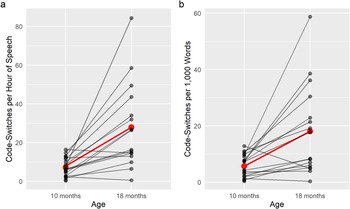
On average, 10-month-olds heard 7 (SD = 4.85, Range = 1–16) code-switches per hour of infant-directed speech, which corresponded to 6 code-switches per 1,000 infant-directed words (SD = 3.91, Range = 0–13). On average, 18-month-olds heard 28 (SD = 22.03, Range = 1–84) code-switches per hour of infant-directed speech, which corresponded to 18 code-switches per 1,000 infant-directed words (SD = 16.21, Range = 0–59). Paired t-tests of the families that contributed recordings at both ages confirmed that parents code-switched more frequently in interactions with 18-month-olds than in interactions with 10-month-olds, whether measured by code-switches per hour of infant-directed speech t(15) = −3.89, p = .001, M d = −19.99, 95% CI [−30.94, −9.03] (see Figure 2a) or code-switches per 1,000 infant-directed words t(15) = −3.26, p = .005, Md = −11.71, 95% CI [−19.36, −4.06] (see Figure 2b).
Change in the number of code-switches per hour of infant-directed speech for individual families between 10 and 18 months of age (a) per hour of infant-directed speech and (b) per 1,000 infant-directed words. The grey points and lines represent individual families, and the red points and line show the average change.

In an exploratory analysis, we examined how the frequency of code-switching may have changed in each individual family. We compared each family's code-switching at 18 months to their code-switching at 10 months. If a family's code-switching at 18 months increased or decreased from their code-switching at 10 months by more than 2 times the full sample's standard deviation at 10 months (per hour of infant-directed speech: SD = 4.85; per 1,000 words: SD = 3.91), we considered this to indicate a change in the frequency of code-switching within a family. Our rationale was that a change in frequency of less than 2 standard deviations could be attributed to normal variation within the range of what had been observed across families at 10 months, but a change greater than 2 standard deviations would indicate a meaningful difference. As measured by the number of code-switches per hour of infant-directed speech, 9 families increased the frequency of their code-switching, 7 families did not change the frequency of their code-switching, and no families decreased the frequency of their code-switching. As measured by the number of code-switches per 1,000 infant-directed words, 8 families increased the frequency of their code-switching, 8 families did not change the frequency of their code-switching, and no families decreased the frequency of their code-switching. Thus, code-switching appeared to generally remain stable or increase across these two time points.
Validity of the Language Mixing Questionnaire
To evaluate the validity of the Language Mixing Questionnaire, parents’ responses to the questionnaire were compared to their code-switching behaviors observed in the data. To do this, each parent who completed the questionnaire was assigned a Language Mixing Scale Score (following Byers-Heinlein, Reference Byers-Heinlein2013), calculated by summing the responses to 5 questions on the questionnaire with Likert scales (1 = very true, frequent language mixing; 7 = not at all true, infrequent language mixing). This sum was then subtracted from 35, the highest possible sum. This resulted in a maximum score of 30 for those who report frequently code-switching, and a minimum score of 0 for those who report never code-switching. One parent did not have a Language Mixing Scale Score and was excluded from the following analyses. Parents had a mean Language Mixing Scale Score of 11.07 (SD = 8.73; Range = 0–30) at 10 months and 12.48 (SD = 7.59; Range = 1–28) at 18 months.
In our pre-registration, we had planned to compute a correlation between parents’ Language Mixing Scale Score and a quantification of code-switching frequency where we would divide the number of code-switches each parent produced by the number of 30-second segments where they spoke to their infant and multiplying this by 100. However, we deviated slightly from this plan, to instead be consistent with the quantifications of code switching used in the previous analyses: the number of code-switches each parent produced per hour of infant-directed speech, and the number of code-switches each parent produced per 1,000 infant-directed words. We note that the metric of code-switches per hour is a linear transformation of our pre-registered metric of code switches per 30 seconds * 100, and thus this change does not impact inferential statistics.
Because the Language Mixing Questionnaire was administered at both 10 and 18 months, it was possible to compute correlations between self-reported and observed code-switches at two ages, and thus scores from each age were included as separate data points in the following analyses. The correlation between the Language Mixing Scale Scores and parents’ observed code-switching was statistically significant, with a moderate effect size, for both the number of code-switches per hour of speech, r = .37, 95% CI [.15, .56], t(69) = 3.30, p = .002 (see Figure 3a), and per 1,000 infant-directed words, r = .35, 95% CI [.13, .54], t(69) = 3.13, p = .003 (see Figure 3b).
The relationship between parents’ Language Mixing Scale Score and the number of code-switches per (a) hour of speech and (b) 1,000 infant-directed words based on data collected at 10 and 18 months combined.

One previous study found that the Language Mixing Scale Score has a higher correlation with parents’ actual intersentential code-switching than intrasentential code-switching, despite the questionnaire asking mainly about intrasentential code-switching (Bail et al., Reference Bail, Morini and Newman2015). To examine the replicability of this finding, we conducted additional analyses that considered intersentential and intrasentential code-switches separately. Parents who participated at both ages have different intersentential and intrasentential frequencies for each age. The correlation between the frequency of intersentential code-switching and the Language Mixing Scale Scores was statistically significant for both the number of code-switches per hour of speech, r = .34, 95% CI [.11, .54], t(67) = 2.98, p = .004, and per 1,000 infant-directed words, r = .33, 95% CI [.10, .52], t(67) = 2.84, p = .006. The correlation between the frequency of intrasentential code-switching and the Language Mixing Scale Scores was of a similar magnitude and direction, and was statistically significant for both the number of code-switches per hour of speech, r = .30, 95% CI [.07, .50], t(67) = 2.61, p = .011, and per 1,000 infant-directed words, r = .29, 95% CI [.05, .49], t(67) = 2.45, p = .017.
To compare the correlations between the Language Mixing Scale Scores and the intersentential and intrasentential frequencies directly for each frequency measure, we transformed them using Fisher's r to z transformation. Comparing these dependent, overlapping correlations revealed that the correlations between the intersentential and intrasentential frequencies and the Language Mixing Scale Score were not statistically significantly different for either the number of code-switches per hour of speech, z = 0.38, p = 0.70, or per 1,000 infant-directed words, z = 0.42, p = 0.68. Additionally, parents’ intersentential and intrasentential frequencies were correlated for both the number of code-switches per hour of speech, r = .60, 95% CI [.43, .73], t(68) = 6.20, p < .001, and per 1,000 infant-directed words, r = .62, 95% CI [.45, .75], t(68) = 6.53, p < .001, suggesting that parents who code-switch intersententially also code-switch intrasententially, which could explain why parents’ Language Mixing Scale Score was similarly correlated with both types of directly-observed code-switching.
Syntactic location
Frequency comparison of intersentential and intrasentential code-switching
To evaluate our prediction that parents would produce more code-switches between sentences than within a sentence, we divided the number of intersentential code-switches by the total number of code-switches at each age of recording. An intersentential percentage score of 50% would therefore indicate that intersentential and intrasentential code-switches happened at the same rate. At 10 months, on average, 77% (Range = 50% – 100%) of code-switches were intersentential. At 18 months, on average, 83% (Range = 61% – 100%) of code-switches were intersentential. We conducted a one-sample t-test with μ 0 = 50 at each age. Consistent with our predictions, parents produced more intersentential (e.g., Come on. C'est fini. [It's done.]) than intrasentential (e.g., Est-ce qu'on va aller manger [Are we going to eat] banana pancake?) code-switches at both 10 months, t(20) = 7.85, p < .001, M = 77.11, 95% CI [69.91, 84.32], and 18 months, t(15) = 11.73, p < .001, M = 82.90, 95% CI [76.92, 88.88].
Next, we examined whether the percentage of intersentential code-switches changed across development. A paired t-test for the 16 families that provided recordings at both ages revealed that parents code-switched intersententially more when their child was 18 months old (83%) than 10 months old (74%) , t(15) = −2.21, p = .043, M d = −8.47, 95% CI [−16.64, −0.29]. The change in the percentage of code-switches at each syntactic location across ages can be seen in Figure 4.
The percentage of code-switches produced at different syntactic locations across ages with all families included at each age (at 10 months, n = 21; at 18 months, n = 16).

Frequency comparison of intrasentential code-switching at and within syntactic boundaries
To evaluate our prediction that within-sentence code-switches are more likely to occur between syntactic phrases than within syntactic phrases, we divided the number of intrasentential code-switches that occurred between syntactic phrases by all code-switches that occurred within a sentence. A between-phrase percentage score of 50% would therefore indicate that intrasentential code-switches between and within syntactic phrases happen at the same rate. At 10 months, on average, 62% (Range = 0% – 100%) of intrasentential code-switches occurred at a syntactic boundary. At 18 months, on average, 54% (Range = 14% – 100%) of intrasentential code-switches occurred at a syntactic boundary. We conducted a one-sample t-test with μ 0 = 50 at each age to examine if the percentages of intrasentential code-switches produced between and within syntactic phrases were equivalent. These tests revealed that the intrasentential percentage score was not statistically significantly different from 50% at either 10 months, t(17) = 1.54, p = .143, M = 61.83, 95% CI [45.58, 78.08], or 18 months, t(14) = 0.73, p = .480, M = 54.46, 95% CI [41.28, 67.64]. Our results did not support the prediction that parents produce more intrasentential code-switches at a syntactic boundary (e.g., Now you want lait [milk].) than within a syntactic phrase (e.g., C'est un [It's a] monkey.).
Next, we examined whether the percentage of intrasentential code-switches changed across development. A paired sample t-test of the families that provided recordings and produced intrasentential code-switches at both ages revealed that there was no statistical difference in the rate of between-phrase percentage scores across time points t(13) = 0.65, p = .529, M d = 6.86, 95% CI [−16.06, 29.78]. This indicates that while the frequency of code-switching increases between 10 and 18 months, the percentage of intrasentential code-switches occurring at and within syntactic boundaries remains stable.
Apparent reason
Co-occurrence of apparent reasons
Because our coding system allowed for a single code-switch to be coded as having multiple apparent reasons, we wanted to evaluate if two reasons co-occurred frequently enough to be combined into a single reason. Thus, for each of the 8 reasons, we calculated the proportion of switches coded for that particular reason that were also coded for each of the other 7 reasons. We identified two pairs of reasons with a co-occurrence rate above 75%, a value set in our pre-registration. First, 100% of the code-switches that were attributed to the use of baby-specific words were also coded as language borrowing. This was unsurprising given that the baby word category was added as a subset of borrowing. Second, 80% of the code-switches that were attributed to the use of translation equivalents were also coded as increasing understanding. Following our pre-registration, we combined each pair of reasons that frequently co-occurred into a single category. Additionally, we kept each of the original reasons as subsets of the combined category for subsequent analyses.
Frequency of apparent reasons
To explore the frequency of each apparent reason, we calculated the proportion of code-switches motivated by that reason for each parent. The proportions for each reason were then averaged across all parents. We created a contingency table with the time points and apparent reasons as factors (see Table 2). No statistical tests were planned or conducted, as we had no specific prediction regarding the frequency of the different apparent reasons.
Percentage (raw count in parentheses) of code-switches observed for each apparent reason at 10 and 18 months, the difference in percentage (difference in raw count in parentheses) across ages, and examples of each reason. Note that a code-switch could be coded as having multiple apparent reasons.

Parents appear to code-switch most frequently in an effort to bolster their child's understanding. Moreover, while common borrowings of words and phrases were relatively frequent in our data, these borrowings did not appear to be attributable to the use of baby-specific words or phrases. The most notable change across time points was the increase in teaching vocabulary. Other apparent reasons were not frequent in our data but do seem to motivate some of the parents’ code-switching. Finally, we observed very few code switches that did not seem to fit any of the apparent reasons we coded, indicating that most parental code-switches fit into one or more of these categories.
The frequency of each of these reasons motivating a code-switch also varied across parents. Figure 5 shows the percentage of code-switches that were attributed to parents 1) bolstering their child's understanding and/or producing a translation equivalent, 2) bolstering understanding and one of the other 6 apparent reasons, and 3) only another apparent reason. These mutually exclusive categories were created to illustrate the prevalence of understanding as an apparent reason for code-switching relative to the other reasons. The numbers in each bar represent the count for each of the three categories. This figure shows not only the variability in apparent reasons behind parents’ code-switching, but also the variation in frequency of code-switching by individual parents.
Percentage and count of parents’ code-switches motivated by apparent reason.

Discussion
In this study, we investigated the properties of parents’ code-switching behaviors in everyday interactions with their infant. Specifically, we used a corpus of at-home recordings to analyze how frequently French–English bilingual parents in Montreal code-switched, as well as the syntactic location and apparent reason for each of their code-switches. First, we found that the frequency of code-switching, whether controlling for hours of infant-directed speech or number of infant-directed words, generally increased between 10 and 18 months of age. Second, we found that the majority of parents’ code-switches occurred intersententially at both ages, and that this proportion increased across their infant's development. For the code-switches that occurred intrasententially, the proportions of code-switches that happened between syntactic phrases and within a syntactic phrase were comparable at both ages. Last, while parents code-switched for a variety of apparent reasons, most parental code-switches at both time points appeared to be motivated by the desire to bolster their infant's understanding. Parents also appeared to code-switch more to teach vocabulary when their infant was 18-months old than when they were 10-months old. Combined, our results suggest that parents may be adapting their code-switching behavior to their infant's developing linguistic abilities, producing code-switching that could support successful acquisition of both languages.
The first indication that parents may be adapting their code-switching to their infant's language abilities is the increased frequency of code-switching between 10 and 18 months. Between these two ages, an infant's language abilities undergo a large transformation: at 10 months, most infants do not produce a single word, whereas at 18 months, infants may be producing as many as several dozen (Fenson, Marchman, Thal, Dale & Reznick, Reference Fenson, Marchman, Thal, Dale and Reznick2014). It is possible that at 18 months, parents are aware of which words an infant knows and which language those words are in. Parents may then code-switch more to strategically support their infant's language development in two different ways. One way that parents may code-switch strategically is by switching languages to use a word they believe their infant understands. This pattern is consistent with the current data showing that parents produced a higher total number of code-switches to bolster their infant's understanding and/or to provide a translation equivalent when their infant was 18 months old compared to when they were 10 months old.
Another way parents may code-switch strategically is by switching languages to use a word they believe their infant does not understand in order to teach them a new word. This pattern is also consistent with our data, as parents were found to code-switch to teach vocabulary more when their infant was 18 months old compared to when they were 10 months old. For example, this could explain the positive relationship between parents’ intrasentential code-switching and their child's vocabulary size found in previous research (Bail et al., Reference Bail, Morini and Newman2015). While these two reasons for code-switching are seemingly paradoxical, in conjunction, they could ultimately support the acquisition of two languages.
Parents may also adapt their code-switching to their infant's language abilities through altering the syntactic location of their code-switches. Consistent with previous research, at both time points, the majority of code-switches that the parents produced occurred intersententially (Bail et al., Reference Bail, Morini and Newman2015). Parents may use more intersentential code-switches when speaking to their infant because intersentential code-switches are easier to produce than intrasentential code-switches (Poplack, Reference Poplack1980). The relative difficulty speakers have in producing intrasentential code-switches is mirrored by processing difficulties for listeners in comprehending them. Experimental work has suggested that intrasentential, but not intersentential, code-switches elicit processing costs in bilingual infants (Byers-Heinlein et al., Reference Byers-Heinlein, Morin-Lessard and Lew-Williams2017; Potter et al., Reference Potter, Fourakis, Morin-Lessard, Byers-Heinlein and Lew-Williams2018), and thus the majority of code-switches that bilingual parents produce are those that are the least difficult for their infants to understand. The processing costs associated with intrasentential code-switches may underlie parents’ shift toward producing a higher percentage of intersentential code-switches at 18 months compared to 10 months. Parents may (likely implicitly) realize that intrasentential code-switches are difficult for their infant to understand, so they decrease the number of intrasentential code-switches they produce to reduce processing costs, thus supporting their infant's comprehension and resulting in a higher percentage of intersentential code-switches. It is unlikely that parents produced more intersentential code-switches when their child was 18 months old simply because they are easier to produce. If a parent is able to produce intrasentential code-switches when their infant is 10 months old, they likely retain that ability eight months later when their infant is 18 months old. Therefore, any changes in the production of code-switching are probably due to external influences: in this case, the development of their infant. If parents are indeed altering their code-switching behavior in an effort to reduce processing costs for their infant, this suggests that aspects of parental speech unique to bilingual contexts are sensitive to an infant's linguistic development.
One prediction that was not supported by our analyses was that parents’ intrasentential code-switches would occur more often at a syntactic boundary than within a syntactic phrase. Instead, we found that these occurred at a similar frequency. This result may be driven by single-word code-switches that occur between a determiner and a noun (e.g., the chien [dog]), which has been found to be a frequent location for parental code-switching (Bail et al., Reference Bail, Morini and Newman2015). However, our coding scheme did not record the exact syntactic location or the number of words that followed a given code-switch, which could be addressed in a subsequent study. Therefore, it is possible the frequency of single-word code-switches could explain the equivalent proportion of intrasentential code-switches at and within syntactic boundaries. Future work is needed to confirm this prediction.
In sum, our results suggest that, similar to other aspects of infant-directed speech, infant-directed code-switching can have qualities that might support infant language acquisition. Future naturalistic studies could examine links between parents’ use of supportive code-switching strategies and infants’ language outcomes. In addition, laboratory studies could directly investigate whether code-switching supports bilingual infants in learning words in each of their languages. By describing the quality and quantity of code-switching that children hear, we can ask more nuanced questions about how code-switching affects bilingual language development.
Differences in parental code-switching patterns between bilingual communities
The current study focused on parental code-switching patterns in one bilingual community: French–English bilingual families in Montreal. Given the limited research on parents’ naturally-produced code-switching, it is unknown how much these patterns generalize to other bilingual communities. Understanding the differences between bilingual communities could be important when synthesizing findings on bilingual language development. Parental code-switching in different bilingual communities may have different properties, which may impact language development in different ways, such as the potential link between frequency and a child's vocabulary size (Bail et al., Reference Bail, Morini and Newman2015; Byers-Heinlein, Reference Byers-Heinlein2013; Place & Hoff, Reference Place and Hoff2016).
To illustrate, here we compare our findings to Spanish–English bilingual parents’ code-switching during a laboratory play session with their 17- to 24-month-olds, the only other study to our knowledge to directly investigate and describe parents’ code-switching (Bail et al., Reference Bail, Morini and Newman2015). It is important to note that the majority of parents in both our study and this study reported being highly proficient in both of their languages. By comparing the results of these two studies, one major difference between French–English parents in Montreal and Spanish–English parents in the U.S. stands out: the frequency of parental code-switching. Spanish–English parents code-switched, on average, more than 30 times in a 13-minute play session – over four times more than French–English parents, who code-switched, on average, 28 times in an hour of speech when their child was 18 months old.
One highly plausible explanation for this difference is that different bilingual communities may have different baseline rates of code-switching that permeate into parents’ code-switching with their children. Code-switching may simply be more frequent in Spanish–English communities in the U.S. compared to French–English communities in Canada. While it is hard to determine the exact underlying cause(s) of the difference in code-switching frequency across communities, it is possible that communities use code-switching in different ways to create and maintain a group identity (Nilep, Reference Nilep2006). In Canada, French and English are both official languages, and in Montreal, both languages are widely used throughout the community and have high sociolinguistic status. Given the prevalence of both languages in the larger community, code-switching may not be used by French–English bilinguals to maintain a group identity (Kircher, Reference Kircher2009). However, bilingual Spanish–English communities in the U.S. may feel more of a need to cultivate a group identity through the use of frequent code-switching, due to the minority status of Spanish in the larger community (Zentella, Reference Zentella1981).
A second, complementary possibility is that observed differences between these studies are attributable to divergent methodologies, with different ages of participants, procedures, and coding approaches. First, the age of a child may be an important factor in influencing how parents code-switch. For example, the Spanish–English parents might have code-switched more than the French–English parents, because the Spanish–English sample was older (ranging from 17 to 24 months old). Given our results suggesting that the frequency of code-switching increases across a child's development, it would not be surprising that the older Spanish–English children heard more code-switching than the younger French–English children.
Second, the differences between communities may be explained by the methods used to collect the speech samples. Short, structured play sessions result in denser speech samples and different features of speech (e.g., density of noun input) compared to naturalistic at-home recordings (Belsky, Reference Belsky1980; Bergelson, Amatuni, Dailey, Koorathota & Tor, Reference Bergelson, Amatuni, Dailey, Koorathota and Tor2019; Tamis-LeMonda, Kuchirko, Luo, Escobar & Bornstein, Reference Tamis-LeMonda, Kuchirko, Luo, Escobar and Bornstein2017). If parents’ speech is denser in play sessions, this provides more opportunities for them to code-switch. However, we were able to control for the density of speech in our analysis in the number of code-switches parents produced per 1,000 words. Therefore, it is unlikely that the speech density between play sessions and at-home recordings underlie the differences in the rate of code-switching between the two communities. Additionally, parents might code-switch at a different frequency during daily life as compared to play sessions, particularly in the lab. Therefore, the frequency of code-switching in play sessions may be inflated compared to the frequency of code-switching in daily life. Other methodological differences, such as the number and gender of parents included in the sample could also contribute to the different findings. Therefore, differences between Spanish–English and French–English communities might be attenuated if parents’ code-switching was assessed using the same method.
Lastly, the way in which the recordings were made and transcribed in the current study could be underestimating how frequently French–English parents code-switch. First, our transcription was only able to capture code-switches that happened within the same 30-second segment. This method could have missed code-switches that happened between segments. However, it is unlikely that enough code-switches occurred at these precise boundaries to dramatically alter our results. Second, we only coded every other segment. While pilot analyses determined that this resulted in a sample that sufficiently represented an infant's language environment (Orena et al., Reference Orena, Byers-Heinlein and Polka2019), some of these segments may have had higher levels of code-switching. Lastly, only one weekend day was recorded at 18 months, compared to the 2 week days and 1 weekend day at 10 months. This may not have captured the child's entire linguistic environment – therefore, our estimate of code-switching frequency in Montreal may not be fully representative for older infants. Future studies applying the same methods will be needed to directly address the question of how code-switching varies across bilingual communities.
Methodological contributions
Beyond the substantive contributions toward understanding the nature of parents’ code-switching, this study provided several methodological contributions. To our knowledge, this study was the first to investigate parental code-switching at home through daylong recordings, and we were able to develop several novel approaches to do so. An important feature of our coding scheme is the ability to measure the frequency of different apparent reasons that parents code-switch throughout their daily life. Determining why code-switches occur is difficult even for the speaker producing the code-switch (Gumperz, Reference Gumperz1982), so at the outset it was unclear whether this could be reliably coded. However, the main coder carefully considered the context of each switch when assigning the apparent reason(s) for the switch and the interrater reliability for each of the individual reasons was high. Additionally, fewer than 1% of the code-switches in the dataset were not coded as being motivated by any of our predetermined reasons, suggesting that the reasons we examined are representative of why parents code-switch when speaking to their child. This suggests that our approach can reasonably determine the apparent reason behind a parent's code-switch.
Second, we were able to assess the relationship between parents’ actual code-switching frequency and their responses to the Language Mixing Questionnaire (Byers-Heinlein, Reference Byers-Heinlein2013). These two measures were found to have a statistically reliable correlation, (r = .30 – .34), suggesting that the Language Mixing Questionnaire can detect some of the variation in the frequency of parents’ code-switching. Nonetheless, the Language Mixing Scale Scores only explained 14% of the variance in parents’ code-switching frequency. There are several possible explanations for this result. First, parents may be unable to answer the questions on the questionnaire accurately, due to a lack of awareness of their use of code-switching or not understanding what the questionnaire is asking (Myers-Scotton, Reference Myers-Scotton2017). Second, the range of code-switching observed in the data was restricted, particularly at 10 months. It is a well-known statistical phenomenon that the magnitude of a correlation is reduced when a sample has a restricted range of scores. The Language Mixing Questionnaire may not be fine-grained enough to pick up on variation in the frequency of code-switching when it is relatively infrequent, as it was in our data.
Scope and future directions
While this study provides the first account of parents’ naturally-produced code-switching, we nonetheless had to limit our scope to what could be reasonably explored in one study. There are still many other questions that this and similar datasets could address in future research. There are two major directions we propose for this research: investigating predictors of parental code-switching, and investigating how parental code-switching may be linked to child language outcomes.
First, we did not explore whether demographic variables (e.g., parental language proficiency or dominance, familial language strategy) impacted parents’ code-switching behaviors. Research has been able to identify some predictors of an adult's rate of code-switching when speaking to another adult, such as personality and language history (Dewaele & Li, Reference Dewaele and Li2014). This research has not yet been extended to when adults are speaking to children.
Second, we also did not investigate impacts of parents’ code-switching on infants’ linguistic development, such as vocabulary scores. Our focus was on investigating the variation in a bilingual infant's environment, which we believe lays crucial groundwork for understanding how this variation affects infants’ language development. This is an important direction for future research, because there is little consensus in the literature on whether parents’ code-switching affects their infant's language development (Bail et al., Reference Bail, Morini and Newman2015; Byers-Heinlein, Reference Byers-Heinlein2013; Orena & Polka, Reference Orena and Polka2019; Place & Hoff, Reference Place and Hoff2016). It is possible that the inconsistent findings are due to qualitative and quantitative differences in the code-switching parents produce across different bilingual communities. Thus, more research, applying the same or similar methods as used in this study to different bilingual populations, is required to strengthen this foundational understanding of how infant-directed code-switching varies across communities. Once community differences are better understood, future research could then build upon this knowledge and examine the direct impact of parents’ code-switching on children's language development or bilingual language development in general.
Conclusion
Code-switching is a linguistic phenomenon that is pervasive in bilingual and multilingual communities; thus, it is unsurprising that bilingual parents code-switch when speaking to their infants. Our results from a sample of French–English bilingual families in Montreal show that the frequency of parents’ code-switching and the percentage of intersentential code-switches increased between 10 and 18 months of age. At both ages, parents appeared to code-switch most frequently in order to boost their child's understanding. At 18 months, parents code-switched to teach vocabulary more than they had when their infant was 10 months old. Combined, these results suggest that parents may code-switch in ways that support successful bilingual language development.
Acknowledgements
This work was supported by grants from the Natural Sciences and Humanities Research Council of Canada to KBH (402470-2011; 2018-04390), the Social Sciences and Humanities Research Council of Canada to LP (PI) and KBH (co-I) (435-2015-0385), the National Institutes of Health to KBH (1R01HD095912-01A1), and a fellowship from the Centre for Research on Brain, Language and Music and the Fonds de Recherche du Québec to LVK. We thank Julia Srouji, Katherine Xu, and Grace Zhou for transcribing the data for the original corpus.
Author contributions
The concept for this study was developed by LVK, AJO, LP, and KBH. AJO collected the original data. LVK and KBH developed the coding manual and pre-registered analyses. JA coded the data. LVK conducted the analyses and wrote the original manuscript under the supervision of KBH. All authors contributed to revising and editing the manuscript.