Introduction
Tobacco smoking is one of the principal causes of needless death and disease in Australia (Winstanley, Reference Winstanley, Scollo and Winstanley2012). There have been a number of evidence based clinical interventions to reduce harms from smoking over the last decade – including brief interventions, telephone counselling and group therapy. Whilst all these are effective, group sessions are more cost and time-effective and provide the additional advantage of peer interaction.
A Cochrane review in 2005 showed the use of group behaviour therapy programmes to be more effective than self-help, telephone or brief intervention (Stead & Lancaster, Reference Stead and Lancaster2005) and a meta-analysis in 2009 demonstrated group counselling to have similar efficacy to individual counselling and telephone counselling, all of which were more effective than minimal intervention (Mottillo et al., Reference Mottillo, Filion, Belisle, Joseph, Gervais and O'Loughlin2009). A quasi-experimental comparison of one-to-one versus group treatment within a single service provider in the UK demonstrated higher quit rates for the group treatment, which was more cost-effective (McEwen, West, & McRobbie, Reference McEwen, West and McRobbie2006). Another study on group interventions versus individual interventions had lower than expected levels of effectiveness, potentially due to the lack of available pharmacological treatment (Ramos et al., Reference Ramos, Ripoll, Estrades, Socias, Fe and Duro2010).
There has been little exploration of, or support for single-session group interventions to achieve acceptable smoking cessation rates in the literature. Systematic reviews and meta-analyses (Mottillo et al., Reference Mottillo, Filion, Belisle, Joseph, Gervais and O'Loughlin2009; Stead et al., Reference Stead and Lancaster2005) have excluded single-session group interventions from their definition. Research on single-session groups has used various outcomes measures, but mainly self-reported quit rates. An early comparison made in 1984, reporting serum thiocynate validated quit rates, showed that a single health education session was comparable in effectiveness to a multi-session behaviour modification group programme (Rabkin, Boyko, Shane & Kaufert, Reference Rabkin, Boyko, Shane and Kaufert1984). Research in regional New South Wales found self-reported quit rates of 23% for single-session groups compared with 32% for triple-session groups (Gould & McGechan, Reference Gould and McGechan2009). More recently, Mohamed (Reference Mohamad2011) discussed issues related to two studies of lengthy single-session Alan Carr workplace-based seminars which claimed high quit rates. Moshammer and Neuberger (Reference Moshammer and Neuberger2007) retrospectively contacted participants three years after they attended a six-hour seminar, and found a self-reported quit rate of 50%: however only 510 of the 1311 smokers attending the seminar agreed to be interviewed, so the study had a risk of reporting bias (intention-to-treat rate would be 23%). A workplace intervention study described a self-reported quit rate of 40% (Hutter, Moshammer & Neuberger, Reference Hutter, Moshammer and Neuberger2006).
This article reports on a pilot study, which evaluated a novel single-session group intervention for smoking cessation in 2009, with a view to assessing: the practicality of providing a single-session group approach in a rural setting, the feasibility of validating self-reported cessation with expired carbon monoxide readings, and whether a single-session group is sufficient to produce positive outcomes comparable to those already reported in the literature.
Methods
This study used a pre- and post-test repeated measures design to evaluate the single-session group intervention. Recruitment into the programme was via self-selection or referral from health professionals. Advertisements were put in the local newspaper and posters sent to local general practitioners and pharmacists. After gaining informed consent, participants were surveyed at registration and at six months following the programme. The University of New South Wales Human Research Ethics Committee approved the study (approval number 06283).
The setting for the study was in Grafton NSW, with participants from Grafton and surrounding rural areas who attended an evening two-hour smoking cessation group. Grafton and the neighbouring Clarence Valley are in the lowest two deciles of socio-economic disadvantage (PHIDU, 2007), and at the time had a higher smoking prevalence of 17.5 % compared to 16.6% in urban areas of NSW (Centre for Epidemiology and Research, 2010).
Demographic data obtained on registration included age, gender, Aboriginal or Torres Strait Islander status, cigarette consumption, previous quit attempts and cessation methods, and questions on adjective scales measuring readiness to quit (not ready, unsure, ready, already quit) (NSW Health, 2005) and confidence to quit (not confident, somewhat confident, quite confident or very confident). Participants were telephoned six months after the intervention and asked about their smoking status, cigarette consumption, and use of cessation medications. Those who had not already quit were further asked whether they had reduced their cigarette consumption, used pharmacotherapy to reduce consumption, whether they had set a quit date, and confidence and readiness to quit. As we anticipated challenges to follow up in this community setting, we decided that we would accept as measures of abstinence at the 6-month follow up either the Russell Standard (Clinical) (RS (C)) for self-reported cessation (‘not a puff’ or less than five cigarettes since cessation) (West, Reference West2005), or cessation validated by Carbon Monoxide (CO) readings using a Bedfont Picoplus Meter (<10ppm indicating abstinence), by a home visit or meeting the researcher at an agreed location. In practicality, the logistics of obtaining CO readings from all of the self-reported quitters caused some difficulties, because two of the participants lived in remote areas, one participant was about to give birth, and another was a long-distance truck driver seldom at home.
Data analysis included a series of Chi square tests for independence, measuring relationships between categorical variables and whether participants were able to quit at 6 months; and a paired sample t-test measuring reduction in cigarette consumption at 6 months.
Intervention
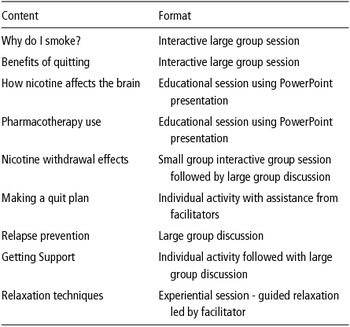
Fiore promotes the ideal group intervention as that based on the combination of advice on pharmacotherapy and the provision of cognitive behavioural strategies (Fiore et al., Reference Fiore, Bailey, Cohen, Dorfman, Goldstein and Gritz1996). This intervention was designed with that in mind. The two-hour session included a mix of educational and group interactive work covering behavioural change techniques based on cognitive behaviour therapy for smoking cessation (Ellerman, Ford & Stillman, Reference Ellerman, Ford, Stillman and Scollo2012) and in-depth information on available pharmacotherapy. Table 1 gives details of content and formats used.
Content and format of features of the single-session group intervention

Participants were assisted to plan their own quit attempt, without having a quit date enforced. Harm reduction with the use of pharmacotherapy was an alternative promoted during the course for those not able to be completely abstinent (Hughes & Carpenter, Reference Hughes and Carpenter2005). Limited samples of nicotine patches, gum or lozenges were offered to participants to try at home (for example one to two patches or a foil strip of gum/lozenges). The study pre-dated nicotine patches being subsidised on the Pharmaceutical Benefits Scheme. The session was conducted by a local General Practitioner Tobacco Treatment Specialist and a local health promotion officer and was held at the education facility of Grafton Base Hospital in 2009. A local clinical psychologist did the follow up assessments at 6 months.
Results
Participants
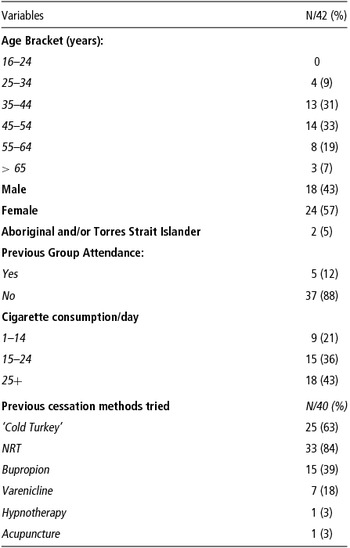
Forty-two participants attended the single-session (57% female), two participants were Aboriginal and/or Torres Strait Islanders; five participants had been to previous quit programmes and only two people had no previous quit attempts. For participant characteristics see Table 2.
Characteristics of participants

Nearly all participants had previously tried various methods to quit. Table 2 depicts how many participants had tried each method: the majority had previously tried to go ‘cold turkey’ (N = 33) and/or used Nicotine Replacement Therapy (NRT) (N = 25). On average, participants consumed 21 cigarettes each day (SD = 8.95; Range: 2–40). Eighty-three per cent (N = 35) of participants said that they were ready to quit at baseline. Eighty per cent (N = 34) expressed some degree of confidence of success (i.e. selected somewhat confident, quite confident or very confident on the adjective scale): the remainder reported ‘not confident’.
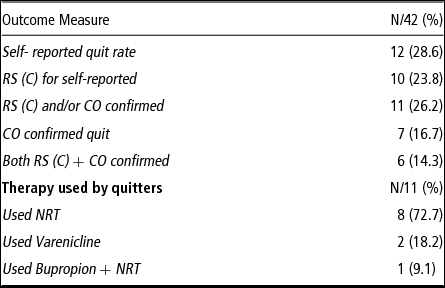
Retention was high, with all 42 participants contacted at six months. Twelve participants claimed to have quit smoking, but one was discounted as neither having met the RS (C) criteria nor provided a CO reading, leaving 11 participants (26.2% on an intention-to-treat basis) who we accepted had evidence of quitting: this included one of the two Aboriginal smokers. Of the 11 quitters, six were female and none had attended previous quit groups. As per the RS (C), nine participants had ‘not a puff’, and one had smoked 1–5 cigarettes since quitting (West, Reference West2005). The remaining quitter (who had smoked >5 cigarettes since quitting) was confirmed abstinent by a CO reading of 3ppm. The sample of seven quitters, verified by CO readings, translated into a biochemically validated quit rate of 16.7%. All of the CO readings were 5 ppm or under (median 2, range 1–5ppm). Table 3 summarises the quit rate calculations depending on the measures used.
Participant outcomes
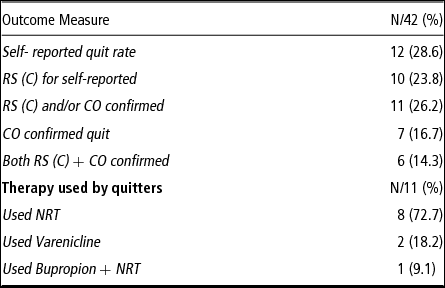
Legend: RS (C) – Russell Standard (Clinical); CO – Exhaled Carbon Monoxide
The course encouraged people to plan their own quit date. Eight participants (73%) quit within a month of the session and the other three reported quitting four to five months post intervention.
Those who quit successfully all used medications: 73% (N = 8) used NRT, 18% (N = 2) used varenicline and 9% (N = 1) used bupropion with NRT.
A series of Chi square tests were undertaken to assess the relationships between quit status and a range of variables. There were no significant relationships between whether or not the participant had quit smoking at follow up and any of the following: age group, gender, previous group attendance, previous quit attempts, previous use of cessation medication, current quit method, or readiness and confidence at baseline. A two-tailed Fisher's exact test showed a statistical significant association (p<.05) for baseline cigarette consumption and quitting, with a trend observed towards increased quit rates in those who smoked less than 15/day (55% quit), compared to 15–24/day (26% quit), and 25+/day (11% quit).
A paired samples t-test was conducted to evaluate whether as a group, those participants who were still smoking at 6 months (N = 30, excluding the abstinent smoker not meeting the quit criteria), had significantly reduced their cigarette consumption from baseline. There was a statistically significant decrease in the numbers of cigarettes smoked per day from the attendance at the course (M = 21.53, SD = 8.43) to the 6 months follow up (M = 16.57, SD = 9.29, t (29) = 3.66, p<.001). The eta-squared statistic (.32) indicated a large effect.
Harm reduction with the use of pharmacotherapy is an alternative promoted during the course for those not able to be completely abstinent. Forty-eight per cent of participants that were still smoking (N = 15) reported smoking less: 47% of those who reduced (N = 7) were using pharmacotherapy to assist them to do so and 53% (N = 8) had reduced unaided. Thirty-five per cent (N = 11) of those still smoking at follow up said they were ready to quit now and five of these had set another quit date.
Discussion
This pilot study tested the feasibility of a single-session group intervention and was successful in terms of its self-reported quit rate at six months of 26.2%, with almost a half of those still smoking having reduced their consumption of cigarettes. All of the quitters used pharmacotherapy. Additionally nearly half of the participants who reduced had opted to use pharmacotherapy for harm reduction – an alternative approach recommended during the course, for those unable to quit (Gould, Reference Gould2014; Hughes & Carpenter, Reference Hughes and Carpenter2005). The abstinent rates were more significant in those who smoked less than 15/day.
The 26% quit rate from this large single-session smoking cessation course was comparable to that expected from multi-session groups (Motillo et al., Reference Mottillo, Filion, Belisle, Joseph, Gervais and O'Loughlin2009), but slightly less than UK programmes having six to eight sessions (McEwen et al., Reference McEwen, West and McRobbie2006). The validated quit rate of 16.7% is reasonably comparable none-the-less to Motillo's validated rate of 19.38%. This finding is encouraging as the study was carried out on a sample of smokers from a low socioeconomic area, which may predict difficulty with quitting (Kotz & West, Reference Kotz and West2009). However, those with higher consumption may require more intensive on-going support (Stead & Lancaster, Reference Stead and Lancaster2012).
Clinical practice guidelines from the US have reported more than double the chance of success with multiple sessions compared to a single-session (Fiore et al., Reference Fiore, Bailey, Cohen, Dorfman, Goldstein and Gritz1996). Fiore et al. (Reference Fiore, Bailey, Cohen, Dorfman, Goldstein and Gritz1996) suggests that the dose-response relationship of quit interventions is important for cessation success, with one-off person-to-person interventions faring poorly with quit rates of 12.4%, but with provision of more than eight multi-sessions, quit rates increase to 24.7%. In comparison, the UK study showed group programmes lasting six to eight weeks have CO validated quit rates of 30% at 1 month follow up (McEwen et al., Reference McEwen, West and McRobbie2006). The 18 group interventions included in the review by Motillo et al. (Reference Mottillo, Filion, Belisle, Joseph, Gervais and O'Loughlin2009) had a mean validated quit rate of 19.38% (range 5–39%), with eight sessions in an average course, at 6–12 month follow up.
Perhaps critical in the design of single-session and multiple session programmes is not the number of sessions per se, but time spent in them. It has been suggested that as few as 90 minutes is enough to increase quit rates up to 28% (Fiore et al., Reference Fiore, Bailey, Cohen, Dorfman, Goldstein and Gritz1996). Similarly Ramos et al. (Reference Ramos, Ripoll, Estrades, Socias, Fe and Duro2010) found a significant association with overall duration of intervention and smoking cessation. These data support those findings.
Fiore et al. (Reference Fiore, Bailey, Cohen, Dorfman, Goldstein and Gritz1996) has argued that group-based quit smoking programmes should involve medical clinicians (to deliver health messages and pharmacotherapy) and non-medical clinicians (to deliver psychosocial or behavioural strategies). Hughes (2007) also suggests benefits from the use of tobacco treatment specialists. The current study includes these features, by using both medical and non-medical tobacco treatment specialists.
These results are preliminary evidence that a single, well-designed group intervention lasting 120 minutes is sufficient to support successful quitting at rates equivalent to more extensive and expensive group programmes (McEwen et al., Reference McEwen, West and McRobbie2006; Motillo et al., Reference Mottillo, Filion, Belisle, Joseph, Gervais and O'Loughlin2009): though it is problematic to compare a group such as this followed up at six months with another whose end point was one month.
Offering a single attendance group, which covers most of the important smoking cessation information through an interactive format on one occasion, avoids the inevitable drop-off in attendance at multiple sessions, of around 50% (Gould, McGechan & van der Zwan, Reference Gould, McGechan and van der Zwan2009). The Cochrane review has also reported variable drop-out rates, in the context of random allocation (Stead & Lancaster, Reference Stead and Lancaster2005), and Ramos et al. (Reference Ramos, Ripoll, Estrades, Socias, Fe and Duro2010) reported an attrition rate of more than 50% over a six-week intervention, with 75% lost to follow up at 12 months.
Although there was a 100% retention rate for the study, there were limitations in obtaining biochemical validation of self-reported quitters in this community setting. A financial incentive to provide the validation measure may have improved the feasibility of getting CO readings. The study could have been improved by the inclusion of a nicotine dependence scale such as the Fagerstrom Test for Nicotine Dependence. Another limitation could have been that some participants due to low socioeconomic status may not have been able to afford to buy NRT – this was not explored. There is an indication that some participants tried a harm reduction approach by using pharmacotherapy, even if they were not able to quit smoking. It could have been of interest to explore this aspect in more detail, and determine whether this resulted in lowered CO readings.
The implications of this study are limited by being a non-controlled pilot study, with limited power, and so the results need to be interpreted with caution; however they suggest that this multi-faceted single-session two-hour intervention can successfully support quit attempts. The intervention is worthy of further pilot research to explore what components of group interventions are more effective before consideration of a clinical trial.
The benefits of single-session group interventions include reduced costs and time-effective support for those wanting help to quit. Given the financial, time and resource pressures on health services generally, and those in regional, rural, and remote communities particularly, single group intervention strategies could be implemented broadly and effectively, with some confidence for success. This approach is especially relevant where individual smoking cessation counselling from experts may not be available.
Conclusion
This pilot study demonstrates the feasibility of a single two-hour group session, facilitated jointly by medical and non-medical health professionals, to enable successful quit attempts, using a combination of behavioural interventions and pharmacotherapy advice. The process of validating abstinence is challenging in a rural community setting.
Acknowledgements
We acknowledge the contribution of Mark Mitchell, Health Promotion Officer, North Coast Area Health Service, in helping to organise and co-facilitate this course. Thanks also to A/Prof Rick van der Zwan, Dr David Allsop and A/Prof Alan Clough for helpful comments on previous drafts.
Funding Support
The Mid North Coast (NSW) Division of General Practice and the Woodend Foundation funded this smoking cessation group and the evaluation.
Conflicts of Interest
None
Ethical Standards
The authors assert that all procedures contributing to this work comply with the ethical standards of the relevant national and institutional committees on human experimentation and with the Helsinki Declaration of 1975, as revised in 2008.