INTRODUCTION
It is well known that subject relative clauses (RCs) elicit better performance than object RCs in children speaking a variety of languages. Such a subject/object asymmetry was originally reported in English (Brown, Reference Brown1971; Sheldon, Reference Sheldon1974, Reference Sheldon1977), and has been replicated in many other languages with head-initial RCs (e.g., Adani, Reference Adani2011; Arnon, Reference Arnon, Brugos, Clark-Cotton and Ha2005, Reference Arnon2010; Correa, Reference Correa1995; Labelle, Reference Labelle1990). By contrast, previous studies on comprehension of RCs in Chinese, a language with head-final RCs, are mixed (e.g., Chiu, Reference Chiu1996; Lee, Reference Lee and Lee1992). Given some methodological limitations and weaknesses in the experimental materials used in these studies, it is difficult to interpret their contrasting results.
In the current study, we aim at establishing whether the subject/object asymmetry holds in Chinese in spite of the branching direction of RCs, and attempt to fuel a cross-linguistic discussion on the acquisition of RCs, taking into account the typological differences between languages with head-initial RCs and languages with head-final RCs.
The paper is organized as follows. We begin with a brief review of previous comprehension studies on RCs across languages, followed by a review of studies on Chinese RCs. Then, we present the predictions of the Dependency Locality Theory (Gibson, Reference Gibson1998, Reference Gibson, Marantz, Miyashita and O'Neil2000) and the Relativized Minimality approach (Friedmann, Belletti & Rizzi, Reference Friedmann, Belletti and Rizzi2009). Next, we report our experiment, and finally we discuss the implications of our results.
A review of previous comprehension studies on RCs across languages
Early studies on children's comprehension of RCs, mainly using act-out tasks, suggested that children at five years of age still have considerable difficulty comprehending RCs, whereas they begin to produce them at three years of age (e.g., Limber, Reference Limber and Moore1973; Sheldon, Reference Sheldon1974). More recently, picture–sentence matching tasks were used in a number of experiments (Arosio, Adani & Guasti, Reference Arosio, Adani, Guasti, Brucart, Gavarró and Solà2009; Friedmann et al., Reference Friedmann, Belletti and Rizzi2009; Friedmann & Novogrodsky, Reference Friedmann and Novogrodsky2004; Gutiérrez-Mangado, Reference Gutiérrez-Mangado2011; Hu, Reference Hu2014; Suzuki, Reference Suzuki2011). In these experiments, children were asked to choose one out of two pictures matching the sentence that they heard. Friedmann and Novogrodsky (Reference Friedmann and Novogrodsky2004) initially used this task to test comprehension of subject RCs, as in (1a), and object RCs, as in (1b), with a group of ten Hebrew-speaking children with Specific Language Impairment (aged 7;3–11;2), a young group of ten normally developing children (aged 4;0–5;0), and an old group of ten normally developing children (aged 5;11–6;5).
- (l)
a. Zot ha-safta she-menasheket et ha-yalda.
this the-grandmother that-kisses acc the-girl
‘This is the grandmother that is kissing the girl.’
b. Zot ha-safta she-ha-yalda menasheket.
this the-grandmother that-the-girl kisses
‘This is the grandmother that the girl is kissing.’
A subject/object asymmetry was observed in every group (98·5% vs. 62%; 85·5% vs. 58%; 95% vs. 86%, respectively). However, the picture–sentence matching methodology used in that study had some limitations, as pointed out by Arnon (Reference Arnon, Brugos, Clark-Cotton and Ha2005), Adani (Reference Adani2011), and Hu (Reference Hu2014). Note indeed that the function of the RC is to single out a character whose relevant properties are described by the RC, whereas the picture–sentence matching task requires children to choose a picture, rather than a character. Although children may choose the correct picture, it is unclear whether they do so because they recognize the correct referent of the RC in that picture or they use some other strategies. For example, in order to choose the correct picture matching the sentence this is the grandmother that the girl is kissing, it is enough to rely on the embedded clause the girl is kissing and choose a picture that depicts a girl kissing.
Arnon (Reference Arnon, Brugos, Clark-Cotton and Ha2005) modified Friedmann and Novogrodsky's task by asking fourteen Hebrew-speaking children aged from 4;5 to 5;2 to choose a character. As in Friedmann and Novogrodsky (Reference Friedmann and Novogrodsky2004), she used two pictures, one displaying A kissing B and the other showing B kissing A, but instructed children to choose A or B in the relevant picture. In line with Friedmann and Novogrodsky, children comprehended subject RCs significantly better than object RCs (95% vs. 51%). However, in contrast to Friedmann and Novogrodsky, a more fine-grained class of errors was detected. While in Friedmann and Novogrodsky only the reversal error could be observed, in Arnon other errors were observed. In comprehending object RCs, children not only pointed to the head of the RC in the wrong picture in 27% of the cases (Reversal Error, as in Friedmann & Novogrodsky), but also to the NP of the embedded clause in the right picture in 22% of the cases (Embedded NP Error). Crucially, the Embedded NP Error cannot be detected in the picture–sentence matching task. Since the right picture is chosen, these responses fall among correct responses. Results similar to Arnon were obtained by Adani (Reference Adani2011) with Italian-speaking children aged from 3;4 to 7;9, using a slightly different version of the character–sentence matching task. Although Reversal Errors were the most common, Embedded NP Errors (coded as Middle Errors in Adani, Reference Adani2011) were also found, especially in object RCs. These findings were corroborated in Catalan by Gavarró, Adani, Ramon, Rusiñol, and Sànchez (Reference Gavarró, Adani, Ramon, Rusiñol and Sànchez2012).
Although the above-mentioned studies, involving both the picture–sentence matching and the character–sentence matching methodology, showed a similar pattern of results, i.e., a subject/object asymmetry in head-initial RCs, the information gathered with the two tasks was slightly different and provides different clues on the course of development of RC comprehension. In the current study, we will focus on the results of an experiment that used the character–sentence matching task.
A review of previous studies on Chinese RCs
Although several studies have been carried out on the acquisition of Chinese RCs, the results are mixed. A subject RC preference, an object RC preference, and no preference have all been reported, in experiments using the act-out task. Chang (Reference Chang1984) tested forty-eight school-aged children in Grade 1, Grade 2, Grade 4, and Grade 6 (which corresponds roughly to six-, seven-, nine-, and eleven-year-olds, respectively) and found no asymmetry between subject RCs and object RCs. Lee (Reference Lee and Lee1992) tested sixty-one children from four to eight years of age and observed a subject preference in most age groups (e.g., at age seven, 48·1% vs. 17·3%; but at age five, 8·3% vs. 6·3%). Chiu (Reference Chiu1996) (cited in Su, Reference Su2006) tested sixty-five children aged from 3;2 to 6;1 and found that the younger children comprehended subject RCs worse than object RCs (41% vs. 64%), but the older children comprehended subject RCs better than object RCs (83% vs. 65%). Cao, Goodluck, and Shan (Reference Cao, Goodluck, Shan and Otsu2005) tested thrty-four children aged from 4;1 to 6;1 and reported no subject/object asymmetry (e.g., 83% vs. 78% for children aged 5;2 and under).
These results are difficult to interpret due to the different ages of the groups tested and to some limitations in the materials and experimental designs. First, a sentence like (2), involving the passive morpheme bei, is a passive subject RC, but was treated as an object RC in Chang (Reference Chang1984).
(2) Laoshu zhui [bei gou yao de] mao.
mouse chase bei dog bite de cat
‘The mouse is chasing the cat that is bitten by the dog.’
Second, the experimental items were few in some studies, especially Chiu (Reference Chiu1996), in which there was only one trial per sentence type (Crain & Thornton, Reference Crain and Thornton1998; Goodluck Reference Goodluck, McDaniel, McKee and Cairns1996, for discussion of the act-out task). Although, to our knowledge, there is as yet no general consensus in the literature about the minimum number of trials in a (comprehension) experiment, it would be advisable to collect a higher number of trials.
The results from adult sentence processing studies are also controversial. Hsiao and Gibson (Reference Hsiao and Gibson2003), Chen, Ning, Bi, and Dunlap (Reference Chen, Ning, Bi and Dunlap2008), Qiao, Shen, and Forster (Reference Qiao, Shen and Forster2012), and Gibson and Wu (Reference Gibson and Wu2013) found an object preference for Chinese RCs. This preference was also confirmed in an event-related potentials study by Packard, Ye, and Zhou (Reference Packard, Ye, Zhou, Yamashita, Hirose and Packard2011). In contrast, Lin and Bever (Reference Lin, Bever, Baumer, Montero and Scanlon2006, Reference Lin, Bever, Yamashita, Hirose and Packard2011) reported that subject RCs were processed faster than object RCs, as did Wu (Reference Wu2009) and Vasishth, Chen, Li, and Guo (Reference Vasishth, Chen, Li and Guo2013).
In summary, data from children's and adults' comprehension display conflicting results in Chinese. As for children, we pointed out some methodological concerns, including some problems with the experimental materials used.
Accounts of the acquisition of RCs
A number of hypotheses have been proposed to account for the difficulty in the acquisition of RCs by children and their processing by adults. Some authors attribute the difficulty to the processing of long-distance dependencies (e.g., Gibson, Reference Gibson1998, Reference Gibson, Marantz, Miyashita and O'Neil2000; Morrill, Reference Morrill2010), others to structural intervention (e.g., Belletti & Rizzi, 2013; Friedmann et al., Reference Friedmann, Belletti and Rizzi2009). Interestingly, these accounts make the same predictions for languages with head-initial RCs such as English, but make different predictions for languages like Chinese with head-final RCs. In this section, we compare the predictions of the two accounts.
The first account, namely the Dependency Locality Theory (DLT; Gibson, Reference Gibson1998, Reference Gibson, Marantz, Miyashita and O'Neil2000), belongs to the adult sentence processing literature, but it can be extended to acquisition data as well. According to this account, sentence comprehension requires two computational resources: storage of the structure built, and integration of the current word into the existing structure. One key aspect of this account is that sentence complexity is related to the locality of integration between dependent syntactic elements (e.g., a dependent with a head). The locality is measured by the distance between these relevant elements, i.e., the number of new discourse referents (nouns and verbs) intervening between them. This provides the motivation for stating that the longer an element has to be kept in working memory, the more the cost of the processing should be. Within this framework, object RCs (in languages like English or Italian) should be more difficult than subject RCs, because the relation between the relative head and its trace in object RCs is resolved at a later stage. In particular, in (3a), the integration between the relative head the dog and its trace is local. By contrast, in (3b), the integration between the relative head and its trace has to cross the embedded subject the cat and the embedded verb hits, and is thus hypothesized to consume more computational resources.
- (3)
a. English subject RCs:
the dogi that __i hits the cat
b. English object RCs:
the dogi that the cat hits __i
The DLT predicts that, in contrast to English, Chinese subject RCs should be harder to process than object RCs. More specifically, consider (4a–b). When processing the embedded clause da xiaomao ‘hit the cat’ in (4a), and xiaomao da ‘the cat hits' in (4b), the cost is the same because the integrations are local. When the relative marker de is processed, the cost between (4a) and (4b) is still not different. Next, the relative head xiaogou ‘dog’ is processed, and the head is required to connect to its trace. In (4a), the integration between the relative head and its trace is not local, because the embedded verb da ‘hit’ and the embedded object xiaomao ‘cat’ intervene. By contrast, in (4b), the integration is local, because no discourse referent intervenes. In total, the distance between the relative head and its trace in subject RCs is longer than that in object RCs, and processing subject RCs is thus hypothesized to require more computational resources.
- (4)
a. Chinese subject RCs:
[_ida xiaomao de] xiaogoui
hit cat de dog
‘the dog that hits the cat’
b. Chinese object RCs:
[xiaomao da _i de] xiaogoui
cat hit de dog
‘the dog that the cat hits'
In summary, according to the DLT theory, object RCs are expected to be more complex than subject RCs in English, and the reverse holds in Chinese (Gibson & Wu, Reference Gibson and Wu2013, Hsiao & Gibson, Reference Hsiao and Gibson2003, see also Gavarró, Cunill, Muntané & Reguant, Reference Gavarró, Cunill, Muntané and Reguant2012, for an implementation of this theory along the lines of Morrill, Reference Morrill2010).
According to the second account, the subject/object asymmetry is explained in terms of structural intervention, and results from the failure to compute relations relevant to assess Relativized Minimality violations (RM; Rizzi, Reference Rizzi1990). The leading idea of RM is that a local relation between X and Y in the configuration (5) is blocked when Z intervenes and is a potential candidate for the same local relation.
(5) X … Z … Y
Intervention is computed in a hierarchical manner and is based on the notion of c-command (Z c-commands Y and Z does not c-command X). In its original formulation, the concept of RM was devised to account for the impossibility of extracting some wh-elements from islands. For instance, in (6), the wh-element how cannot be linked to its copy due to the intervention of another wh-element who, which qualifies as a closer candidate for the same relation.
(6) How do you wonder who behaved <how>?
Building on Starke (Reference Starke2001), Friedmann et al. (2009) adopted a featural interpretation of the RM approach to account for the subject/object asymmetry in RCs (see also Adani, van der Lely, Forgiarini & Guasti, Reference Adani, van der Lely, Forgiarini and Guasti2010; Belletti, Friedmann, Brunato & Rizzi, Reference Belletti, Friedmann, Brunato and Rizzi2012; Belletti & Rizzi, Reference Belletti, Rizzi, Piattelli-Palmarini and Berwick2013, for further development within this approach). They assumed that in the adult system the target can attract the goal if the potential intervener has a distinct featural specification from the goal. Thus, an intervener which has either a different feature or a subset of the features of the goal does not cause a minimality violation. When X and Z do not share any features, it is easy to establish that they are distinct. However, when they share features, one needs to compute a superset/subset relation in order to conclude that they are distinct. Children may fail in the computation of this relation and thus may regard X and Z as identical. In this way, they incur in a RM violation. In a raising analysis of RCs, the relative head is attracted by an attractor endowed with the features [+R, +NP], where +R stands for the relative feature and +NP stands for the lexically restrictive feature. More specifically, in subject RCs like English in (7a), there is no structural intervener between the relative head (the dog) and its copy, whereas in object RCs (7b), the embedded subject (the cat) [+NP] shares a subset of the featural specification of the relative head (the dog) [+R, +NP], causing comprehension problems.
- (7)
a.

b.
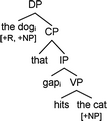
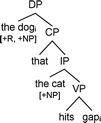
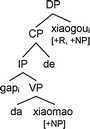
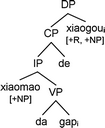
Let us now turn to Chinese RCs. As illustrated in (8a), there is no structural intervener between the relative head and its copy in subject RCs, whereas in object RCs (8b), the embedded subject (xiaomao ‘cat’) intervenes between the relative head (xiaogou ‘dog’) and its copy in object position, and qualifies as a candidate for the same local relation as the object copy. Thus, this account predicts that object RCs should be harder not only in English, but in Chinese as well.
- (8)
a.
b.
In the current study, we administered a character–sentence matching task to different age groups of Chinese children. The aims of the study are the following. First, we aim at disentangling whether the subject vs. object RC asymmetry holds for Chinese, and in so doing we contrast the predictions of the DLT and of the RM approach. Second, we attempt to investigate if and how it is manifested in different age groups of children.
METHOD
Participants
One hundred and twenty children participated in the study. They were divided into six groups: the three-year-old group (N = 20, aged 3;0–3;11, M = 3;7, SD = ·28, 10 males); the four-year-old group (N = 20, aged 4;1–4;10, M = 4;6, SD = ·22, 10 males); the five-year-old group (N = 20, aged 5;0–5;11, M = 5;5, SD = ·30, 10 males); the six-year-old group (N = 20, aged 6;1–6;11, M = 6;5, SD = ·26, 10 males); the seven-year-old group (N = 20, aged 7;0–7;11, M = 7;5, SD = ·29, 10 males); and the eight-year-old group (N = 20, aged 8;0–8;11, M = 8;5, SD = ·23, 10 males). They were all native speakers of Mandarin Chinese, living in Zhejiang, China. An additional adult group (N = 20, aged 22;0–30;0, M = 26·8, SD = 2·26, 10 males) served as controls.
Materials
The stimuli consisted of sixteen sentences, eight subject RCs like (9a) and eight object RCs like (9b).
- (9)
a. Na yi-ge shi da xiaogou de xiaomao?
which one-cl is hit dog de cat
‘Which one is the cat that hits the dog?’
a. Na yi-ge shi waipo hua de xiaohai?
which one-cl is grandma paint de child
‘Which one is the child that the grandma paints?’
All the matrix sentences started with na yi-ge ‘which one’. Ge is a general classifier in Chinese, which is typically used to single out a character and is one of the first classifiers used by children at an early age (Erbaugh, Reference Erbaugh and Craig1986).
To build up our stimuli, we employed eight transitive verbs: bang ‘help’, da ‘hit’, gai ‘cover’, hua ‘paint’, kan ‘look at’, tui ‘push’, yao ‘bite’, and zhui ‘chase’. All the sentences in the experiment were semantically reversible and unambiguous.
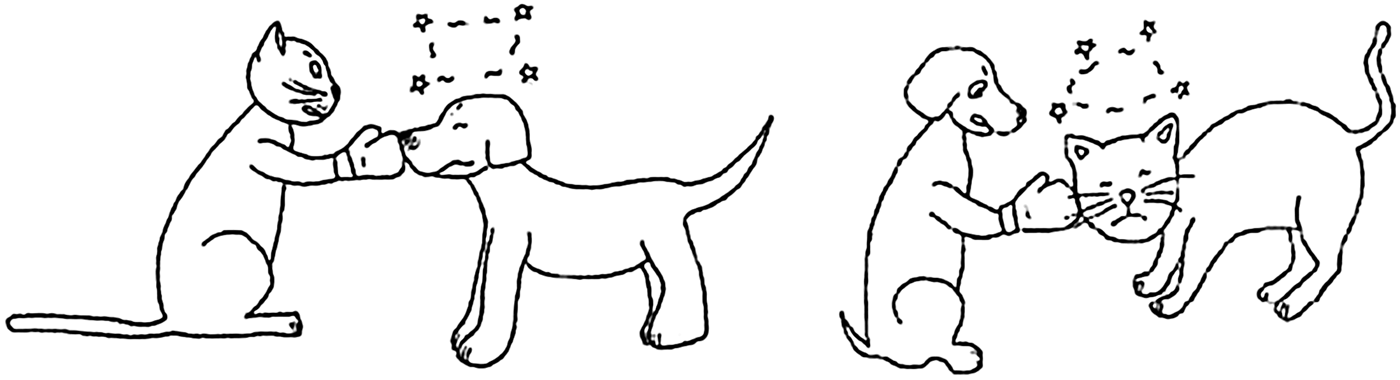
The experimental sentences were matched with sixteen sets of experimental pictures. Each set of experimental pictures consisted of two black-and-white drawings. On each set of pictures there were four characters. In Figure 1 we provide an example of a set of experimental pictures. In each of the pictures there were a cat and a dog partaking in a transitive event (to hit), but with opposite thematic roles (i.e., in one the cat occurred as the Agent, in the other as the Patient). We believe that the question asking the subjects to indicate one character was felicitous as the child was exposed to two pictures (e.g. two cats and two dogs).
A set of pictures used in the experiment.

Additionally, there were eight filler sentences involving an actional irreversible verb (e.g., wear, in which one is the girl that wears a skirt) or an intransitive verb (e.g., sit, in which one is the girl that is sitting).
As discussed earlier, the information gathered with a picture–sentence matching task and a character–sentence matching task is different. Given that Chinese has head-final RCs and has topic drop, the choice of a character–matching task turned out to matter. In fact, the Chinese RC, which comes before the relative head, can be misanalyzed as a declarative sentence with canonical word order. Consequently, to find a matching picture, Chinese-speaking children could simply depend on the linear order of the embedded RC. This is not possible in the character–sentence matching task, as children have to choose the relevant character that is described by means of the RC. For a more detailed discussion about the use of a picture–sentence matching task to test the comprehension of Chinese RCs, see Hu (Reference Hu2014).
Design
The independent variable, i.e., sentence type (subject RC vs. object RC), was manipulated between items. That is, each set of pictures (i.e., Figure 1) was associated with an experimental sentence that could only occur as a subject RC or an object RC. For instance, Figure 1 was associated exclusively with the Chinese equivalent of the subject RC (9a), namely which one is the cat that hits the dog. The dependent variable was the accuracy in the character–sentence matching task, namely, the accuracy in identifying the correct character (out of four). The experimental sentences and the fillers were presented to each participant in pseudo-random order.
Procedure
Participants were tested individually. The pictures were presented on an iPad to participants. At the beginning of the task, each participant was told to look at the experimental pictures on the iPad screen and to point to the character (out of four) that the experimenter described. Then, three practice items were presented to make sure that participants understood the task.
Before each experimental sentence was presented, the experimenter asked children (only to three- and four-year-olds) Tamen zai ganshenme ‘What are they doing?’, and children had to tell the experimenter Xiaogou da xiaomao ‘The dog is hitting the cat’ or Xiaomao da xiaogou ‘The cat is hitting the dog’. Through this procedure we made sure that children comprehended the actions depicted.
Scoring and error coding
We coded a response as correct when the participant accurately identified the correct character (out of four). When participants did not choose the correct one, we coded the response as Error. Errors were labelled as Embedded NP Error, Reversal Error, and Other Error.
An Embedded NP Error was coded when participants pointed to the character corresponding to the embedded NP in the correct picture, namely, they chose the dog in the correct picture for the sentence which one is the cat that hits the dog. A Reversal Error was coded when participants pointed to the character corresponding to the relative head in the wrong picture, namely, they chose the cat in the wrong picture for the sentence which one is the cat that hits the dog. Here, the theta-roles are reversed, i.e., the relative head the cat is the Agent in the testing sentence, but the child interprets it as a Patient. An Other Error was coded when participants pointed to the character corresponding to the embedded NP in the wrong picture, namely, they chose the dog in the wrong picture for the sentence which one is the cat that hits the dog.
RESULTS
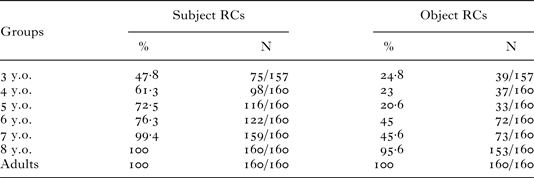
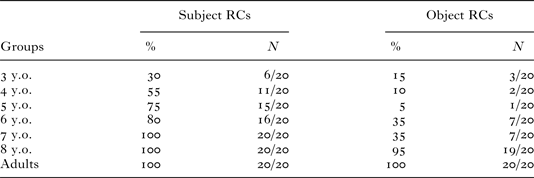
The descriptive results in Table 1 indicate that children comprehended subject RCs more accurately than object RCs in each age group and that accuracy rates increased with age.
Percentages (%) and raw scores (N) of correct responses in each age group
The statistical analysis confirmed our descriptive results. We fitted the combined responses of subject and object RCs to a mixed-effects model with sentence type and age as fixed factors and subjects and items as random factors. We found a significant effect of sentence type (χ 2(1) = 50·41, p = ·001; Wald Z = 16·88, p = ·001) and a significant effect of age. There was a significant increase in accuracy between age three and age six (χ 2(5) = 145·78, p = ·001; Wald Z = 4·08, p = ·001) and between age four and age six (Wald Z = 3·08, p = ·01). Accuracy also increased from age five to age six (Wald Z = 2·37, p = ·02), from age six to age seven (Wald Z = 2·22, p = ·03), and from age seven to age eight (Wald Z = 6·01, p = ·001). In contrast, accurate responses did not significantly increase either from age three to age four (Wald Z = 1·03, p = ·30) or from age four to age five (Wald Z = 0·72, p = ·47).
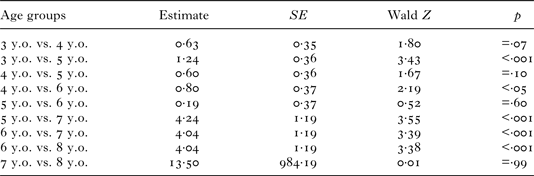
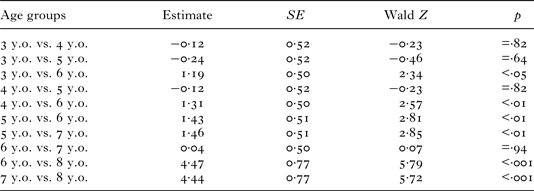
Then, we analyzed whether age predicted comprehension accuracy separately for subject and object RCs. Table 2 reports a summary of the results of the statistical analysis for subject RCs, whilst Table 3 reports the results for object RCs. In both datasets age provided significant fit to the models (subject RCs: χ 2(5) = 121·81, p = ·001; object RCs: χ 2(5) = 100·76, p = ·001).
Summary of the fixed effects in the mixed-effects model (N = 957, log-likelihood = –393.29) for subject RC comprehension
Summary of the fixed effects in the mixed-effects model (N = 957, log-likelihood = –460.73) for object RC comprehension
When we considered only accurate responses in subject RCs, there was a significant development in accuracy between age three and age five, between age four and age six, between age five and age seven, between age six to age seven, and between age six and age eight.
When we considered only object RCs, we observed a robust increase in accuracy at age six and then at age eight. Six-year-olds differed with respect to three-, four-, and five-year-olds. In contrast, at three, four, and five years of age children did not show any difference in accuracy. At eight years of age, there was an increase in accuracy such that the performance of children was almost adultlike and significantly diverged from that of six- and seven-year-olds.
We further performed an individual analysis by counting the number of participants performing above chance in each condition. Recall that in the character–sentence matching task, participants have to choose one character out of four characters and have to answer eight items in each condition. Therefore, following the binomial distribution, performance was considered as above chance when there were five correct responses (out of eight) in each condition. Table 4 shows that the percentages and number of children performing above chance in the comprehension of subject RCs vs. object RCs differed. At age three, there were descriptively more children performing above chance in the comprehension of subject RCs as compared to object RCs, but the difference was not significant (χ 2(1) = 1·29, p = ·25). In contrast, we observed a significant difference at age four (χ 2(1) = 9·23, p = ·005), at age five (χ 2(1) = 20·42, p = ·001), at age six (χ 2(1) = 8·29, p = ·005), and at age seven (χ 2(1) = 19·26, p = ·001). There was no difference at age eight (χ 2(1) = 1·03, p = ·25). Note that all of the children at age seven comprehended subject RCs above chance, whereas many children were still below chance in the comprehension of object RCs. As expected, adults performed at ceiling, with 100% correct responses in both sentence type conditions.
Percentages (%) and number (N) of participants who performed above chance in each age group
To sum up, we observed that, at least up to seven years of age, Chinese children showed a subject RC preference when asked to select a character. This subject preference is in line with studies conducted in other languages (see references cited in the ‘Introduction’). We also noted that subject RCs were still not yet well comprehended at six years of age.
Error analysis
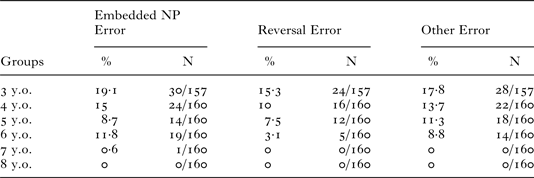
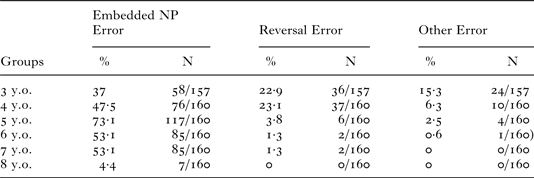
To investigate what children do when they fail to understand a sentence, we examined the distribution of errors. Tables 5 and 6 summarize percentages of error types (i.e., Embedded NP Error, Reversal Error, and Other Error) for each group in subject RCs and object RCs, respectively. Error types were equally distributed in the comprehension of subject RCs, whereas Embedded NP Error was more common than Reversal Error and Other Error in the comprehension of object RCs.
Percentages (%) and raw scores (N) of errors as a function of Error Type in the subject RC comprehension
Percentages (%) and raw scores (N) of errors as a function of Error Type in the object RC comprehension
As we were dealing with a count variable (e.g., number of errors), we ran a Poisson regression model. We limited the factor age from three to six years of age, since Other Error was not observed at seven and eight years of age.
For children from three to five years, there was no difference among the three types of errors in the subject RC comprehension (all ps > ·21). At six years of age, Reversal Error was significantly less frequent than Embedded NP Error (Wald Z = –2·66, p = ·01) and Other Error (Wald Z = 1·98, p = ·05), while Embedded NP Error did not differ from Other Error (Wald Z = 0·87, p = ·39). Therefore, children did not show a tendency to make a specific error when they failed to understand subject RCs, and this was true at least from three to five years of age.
In object RCs, Embedded NP Error was significantly more common than Reversal Error at age three (Wald Z = –2·25, p = ·03), at age four (Wald Z = –3·59, p = ·001), at age five (Wald Z = –7·10, p = ·001), and at age six (Wald Z = –5·24, p = ·001). Embedded NP Error was also more frequent as compared to Other Error at age three (Wald Z = –3·64, p = ·001), at age four (Wald Z = –6·03, p = ·001), at age five (Wald Z = –6·64, p = ·001), and at age six (Wald Z = –4·42, p = ·001). Proportions of Reversal Error and Other Error did not differ from each other at age three, five, and six (all ps > ·13), and differed only at age four (Wald Z = 3·67, p = ·001), with Reversal Error being more common. Our analysis confirmed that children were more likely to make an Embedded NP Error as compared to any other type of error when they were not able to accurately comprehend an object RC.
In order to examine how the tendency to make a specific error evolved along with age, we ran an additional analysis involving the three types of errors as dependent variables (i.e., Embedded NP Error, Reversal Error, and Other Error), using a series of mixed-effects models with age as fixed factor, and subjects and items as random factors. In subject RCs no significant effect was found, i.e., in none of the error types was there a difference across ages (all ps > ·11). In object RCs, children were more likely to make an Embedded NP Error (χ 2(5) = 80·61, p = ·001) from age four to age five (Wald Z = 2·91, p = ·01) and from age five to age six (Wald Z = –2·29, p = ·05), and were less likely to make such an error from age seven to age eight (Wald Z = –5·87, p = ·001).
A comparison across different experiments has to be made with caution, because the design was not the same and the chance performance was established differently. However, we tentatively would like to discuss the error pattern found in the current study and those in head-initial RC studies. Our results appear to be novel in two ways. First, our Chinese children made three different errors in subject RCs and all of them were common, in contrast to what was found in the comprehension of head-initial subject RCs, where errors were rare (e.g. Adani, Reference Adani2011; Arnon, Reference Arnon, Brugos, Clark-Cotton and Ha2005, Reference Arnon2010; Gavarró et al., Reference Gavarró, Adani, Ramon, Rusiñol and Sànchez2012a). Second, the most common error that Chinese children made in comprehending object RCs was the Embedded NP Error, whereas the most common one that Italian and Catalan children made was the Reversal Error. For instance, Italian children (aged 3;4–3;11) were more likely to make a Reversal Error as compared to a Middle Error (Adani, Reference Adani2011; 34% vs. 13% in object RCs with a preverbal subject; 60% vs. 3% in object RCs with a postverbal subject), and Catalan children (aged 3;5–6;2) displayed the same asymmetry (Gavarró et al., Reference Gavarró, Adani, Ramon, Rusiñol and Sànchez2012a; 22% vs. 7·5% in object RCs with a preverbal subject; 83% vs. 2·5% in object RCs with a postverbal subject). Also, Hebrew children (aged 4;5–5;2) showed that the Reversal Error and the Embedded NP Error were equally likely to occur (Arnon, Reference Arnon, Brugos, Clark-Cotton and Ha2005; 27% vs. 22%). To summarize, our error pattern differs from what has been reported in the literature on head-initial RCs.
GENERAL DISCUSSION
In this study, we used a character–sentence matching task to examine children's comprehension of Chinese RCs. Children were more accurate in comprehending subject RCs as compared to object RCs, in line with the findings from other studies in languages with head-initial RCs. This result cannot be taken for granted, as Chinese has head-final RCs. Our developmental data showed that at least from four years of age on, children comprehended subject RCs more accurately than object RCs. Note that at six years of age, 80% of children performed above chance in the comprehension of subject RCs, whereas only 35% of them performed above chance in the comprehension of object RCs. Again, at seven years of age, all of the children performed above chance in subject RCs, but only 35% of them performed above chance in object RCs.
To account for our results, we review the predictions of the DLT and RM approaches. According to the DLT approach, an object preference should have been found for Chinese RCs. To recall, the comprehension difficulty is related to the locality of assembling two dependent syntactic heads: the earlier the dependency is resolved, the fewer computational resources are required. As we have discussed in Chinese RCs (see 4a–b), the dependency is resolved earlier in object RCs than in subject RCs, and is therefore assumed to require less computational resources. In other words, object RCs are less costly than subject RCs, and should be less difficult to process and to acquire. However, our result showed that object RCs were harder to acquire by Chinese-speaking children. This result is better explained by the RM approach. According to this approach, in an object RC (see (8b)), the embedded subject (xiaomao ‘cat’), which is hierarchically higher than the embedded object, intervenes in the chain connecting the relative head (xiaogou ‘dog’) and its copy, and it is assumed to affect children's ability to build the dependency. By contrast, in the hierarchical structure of subject RCs (see (8a)), there is no structural intervener between the relative head (xiaogou ‘dog’) and its copy, and the dependency can be built without problems by children. Thus, following Friedmann et al. (Reference Friedmann, Belletti and Rizzi2009), Adani et al. (Reference Adani, van der Lely, Forgiarini and Guasti2010), Belletti et al. (Reference Belletti, Friedmann, Brunato and Rizzi2012), and Belletti and Rizzi (Reference Belletti, Rizzi, Piattelli-Palmarini and Berwick2013), we propose that structural intervention of the embedded subject is at the source of the difficulty in comprehending object RCs. More specifically, a dependency can be built when the intervening element has distinct features from the head and the copy of the dependency. Two elements are distinct when they do not have any feature in common or when they have only a subset of the features in common. Children have no problem in the first case; however, they appear to have problems in the second case, when they have to compute a subset relation in order to establish that the relevant elements are distinct. Computing a subset relation is costly, and children may fail and be unable to understand object RCs. This is what is argued to happen in object head-initial RCs and, as we have established, in object head-final RCs, where the intervening element is the embedded subject that has a subset of the features of the relative head.
From a comparative perspective, we note that subject RCs were also difficult up to six years of age, while this has not been reported for head-initial RC in Hebrew, Italian, and Catalan. In addition, the comprehension of subject RCs in Chinese elicited a variety of errors. As stated in the literature (Arnon, Reference Arnon, Brugos, Clark-Cotton and Ha2005), the errors reflect different sources of difficulty. We found three types of errors, which were equally distributed in subject RCs at least for children from three to five years age, and, crucially, none of them showed significant differences across ages. The Embedded NP Error and the Other Error may reflect children's confusion about the syntactic role of the relative head. They indicate that children are not sensitive to the fact that the RC adds information to the relative head and they only use the information in the embedded clause to select the referent of the head NP, that is, children do not integrate the two set of information, from the relative head and from the embedded RC. In contrast, the Reversal Error seems to reflect a misunderstanding of the thematic assignment. The findings on subject RCs lead us to conjecture that also linear intervention is taxing for Chinese children, although to a lesser extent than structural intervention (operating in object RCs). Consider (4a), repeated in (10) below. In a subject RC, the embedded object (xiaomao ‘cat’) linearly intervenes between the relative head (xiaogou ‘dog’) and its copy.
(10) [ _i da xiaomao de] xiaogoui
hit cat de dog
‘the dog that hits the cat’
Our proposal that linear intervention may also affect children's comprehension is in line with findings from Franck, Lassi, Frauenfelder, and Rizzi (Reference Franck, Lassi, Frauenfelder and Rizzi2006). In a study on the production of structures involving subject–verb agreement by adults, these authors found that linear intervention led to the production of agreement errors, but to a lesser extent than structural intervention.
Additional evidence for the role played by linear order in the early stages of development comes from the error analysis of object RCs, when this is considered from a cross-linguistic perspective. In contrast to subject RCs, there was one error that was most common in object RCs, namely, the Embedded NP Error. In Italian and Catalan, in contrast, the most common error was the Reversal Error. This difference between the error patterns indicates that Chinese-speaking children are really misinterpreting the RC as the main clause, because it comes before the relative head. When children have not mastered the modifying nature of the RC, they would tend to misconstrue the embedded subject as the relative head. Based on these observations, we tentatively suggest that the linear order, beyond hierarchical order, plays some role in acquisition/processing depending on the shape of the RC. However, the impact of linear and hierarchical order is different.
The RM approach which we have endorsed here was criticized by Goodluck (Reference Goodluck2010), based on results from experiments on the comprehension of which-N-questions. Goodluck levelled at the RM approach different points, of which we are able to address only one in the interest of space. Consider (11) and its schematic featural representation given below.
- (11)
a. the lion that the zebra kissed <the lion>
+R +NP +NP
b. Which lion did the zebra kiss <which lion>?
+Q +NP +NP
In the spirit of Friedmann et al. (Reference Friedmann, Belletti and Rizzi2009), children's failure to understand object which-questions like (11b) should have the same source as children's failure to understand object RCs (11a), i.e., intervention of an element with a subset of the features of the target. Goodluck acknowledged that, as in Friedmann et al.'s study, object questions are challenging for children, but she pointed out that when which lion was changed into which animal, as in (12), children's performance improved dramatically.
(12) Which animal did the zebra kiss <which animal>?
The author further pointed out that animal and zebra in (12) are in a superset/subset relation, and if children fail to understand certain extraction structures because they have trouble computing superset/subset relations, they should perform as poorly with (12) as they do with (11), contrary to fact. As Goodluck recognized, the superset/subset relations in (12) and (11) are different in nature. In the former case, it is a semantic relation between a general term and a more specific one, and in the latter it is a relation between sets of grammatical features. This difference may be responsible for the different outcomes between (12) and (11b). Be that as it may, the only way to account for the improvement obtained with (12) within the RM framework is to attribute it to linear precedence and not to any structural factor, that is, to the fact that the general term precedes the more specific term and thus establishes the referent context. As we have seen earlier, linear factors play a role in Chinese children's acquisition of RCs. Thus, it would not be surprising that these same factors affect other aspects of children's acquisition of object extraction structures. To investigate this possibility, we need to know more about the facilitatory nature of the effect, and to this end Chinese may provide crucial evidence. Specifically, we could test, in Chinese, if the facilitatory effect in (13) (if one is found) follows from structural constraints or from linear order. In the former case, if improvement is due to the more general term c-commanding the more specific, (13a) should elicit more correct answers than (13b), and this would be challenging for the RM approach. In the latter case, in contrast, if improvement is due to the more general term preceding the more specific one, we do not expect any increase in accuracy in (13a).
- (13)
a. banma qin de dongwu
zebra kiss de animal
‘the animal that the zebra kisses’
b. dongwu qin de banma
animal kiss de zebra
‘the zebra that the animal kisses’
Thus, we think that the point raised by Goodluck is not necessarily incompatible with the RM approach and has the potential to initiate a line of research where different facilitatory effects can be distinguished. We leave these issues for future research.
To conclude, our study has provided an insight into the processing of RCs in Chinese children: we observed a subject/object asymmetry as predicted by the RM approach, contrary to the DLT approach, but we demonstrated a peculiar pattern of errors in comparison with that of children speaking languages with head-initial RCs. Such a pattern suggests that the linear order also affects the comprehension of RCs, even if it does not account for the overall great difficulty of RCs.