


Preterm birth is one of the leading causes of neonatal and child mortality, affecting 15 million infants annually worldwide (Walani, Reference Walani2020), with approximately 75–80% of preterm births being spontaneous (Goldenberg, Reference Goldenberg2002). Twin pregnancies are at higher risk of preterm birth than singleton pregnancies, and the global rate of twin births has increased by a third in only three decades (Monden et al., Reference Monden, Pison and Smits2021). Therefore, it is essential to prevent preterm birth of twins to prevent infant morbidity and mortality.
Gestational weight gain (GWG), directly or indirectly related to pregnancy outcomes, is an important modifiable risk factor for spontaneous preterm birth (SPTB; Voerman et al., Reference Voerman, Santos, Inskip, Amiano, Barros, Charles, Chatzi, Chrousos, Corpeleijn, Crozier, Doyon, Eggesbø, Fantini, Farchi, Forastiere, Georgiu, Gori, Hanke, Hertz-Picciotto, Heude, Hivert, Hryhorczuk, Iñiguez, Karvonen, Küpers and Gaillard2019, Ukah et al., Reference Ukah, Bayrampour, Sabr, Razaz, Chan, Lim and Lisonkova2019). Excess gestational weight gain (EGWG) indirectly contributes to SPTB by maternal and neonatal complications, such as hypertensive disorders of pregnancy and macrosomia (McDowell et al., Reference McDowell, Cain and Brumley2019). On the contrary, inadequate gestational weight gain (IGWG) directly results in preterm birth and fetal growth restriction (Goldstein et al., Reference Goldstein, Abell, Ranasinha, Misso, Boyle, Black, Li, Hu, Corrado, Rode, Kim, Haugen, Song, Kim, Bogaerts, Devlieger, Chung and Teede2017). Few studies have discussed the relationship between GWG and SPTB in women with twin pregnancies (Algeri et al., Reference Algeri, Pelizzoni, Bernasconi, Russo, Incerti, Cozzolino, Mastrolia and Vergani2018; González-Quintero et al., Reference González-Quintero, Kathiresan, Tudela, Rhea, Desch and Istwan2012; Kosinska-Kaczynska et al., Reference Kosińska-Kaczyńska, Szymusik, Kaczyński and Wielgos2017; Lin et al., Reference Lin, Fan, Wu, Chen, Li, Ma, Ye, Rao, Zhang, Zeng, Liu, Guo and Liu2019; Liu et al., Reference Liu, Zafman and Fox2021). The results of these studies are inconsistent and inconclusive. In addition, there is no uniform standard guideline for the appropriate weight gain for women with twin pregnancies in China.
Based on the given background, our study aimed to evaluate the association between GWG and SPTB in Chinese women with twin pregnancies.
Materials and Methods
Study Design
We used a retrospective cohort study design, in which GWG was identified as the independent variable, while SPTB was considered as the dependent variable. From January 1, 2015 to December 31, 2019, clinical information of women who delivered live twins was collected from medical records by study staff and reviewed by medical doctors using a standard data form. This study was approved by our Human Ethics Committee and followed relevant guidelines and regulations (Ethical approval number: IRB-20200189-R).
Inclusion and Exclusion Criteria
Criteria 1. In order to study the association between maternal GWG and SPTB in twin pregnancies the study included: (1) all women who delivered live twin newborns after more than 28 weeks of gestation; (2) women with complete medical data; (3) monochorionic monoamniotic twins, twin-to-twin transfusion syndrome, selective intrauterine growth restriction and preterm birth due to congenital malformation were excluded; (4) preterm birth for maternal or fetal indications were excluded (Figure 1).
Flow chart of study population.

Criteria 2. In order to obtain a suitable range of GWG in Chinese twin pregnancies with different prepregnancy body mass index (BMI) the study included: (1) all women who delivered live twin newborns after more than 28 weeks of gestation; (2) women with complete medical data; (3) monochorionic monoamniotic twins, twin-to-twin transfusion syndrome, selective intrauterine growth restriction, and congenital malformation were excluded; (4) pregestational diseases and gestational complications: chronic hypertensive disorder, diabetes mellitus, cervical insufficiency, history of uterine malformation, gestational hypertension/pre-eclampsia, gestational diabetes mellitus and intrahepatic cholestasis of pregnancy were excluded; (5) Full-term twin pregnancies (Figure 1).
Clinical Data
The clinical variables included: (1) general variables: maternal age, education level, occupation, prepregnancy weight and height, delivery weight of pregnant women; (2) prepregnancy-related clinical variables: chronic hypertensive disorder, diabetes mellitus, history of preterm birth, history of artificial miscarriage, history of inevitable miscarriage, history of uterine surgery (cesarean section/myomectomy/hysteroscopic surgery), history of uterine malformation, gravidity, parity; (3) pregnancy-related variables: chorionic properties of twins, cervical insufficiency, gestational hypertension/pre-eclampsia, gestational diabetes mellitus, mode of conception, mode of delivery; (4) neonatal variables: sex, gestational age, birth weight, neonatal intensive care unit admission, intracranial hemorrhage, sepsis, respiratory distress syndrome, intubation, neonatal death, necrotizing enterocolitis, neonatal hypoglycemia.
Diagnostic Criteria
-
(1) Gestational age was determined by the dates of the last menstrual period and the evaluation of obstetric ultrasound examination.
-
(2) Chorionicity was determined on the basis of the ultrasound examination during the first trimester of pregnancy and confirmed by postpartum examination. Women were also classified into two subgroups according to chorionicity: monochorionic diamniotic twins (MCDA) and dichorionic diamniotic twins (DCDA).
-
(3) Prepregnancy BMI was calculated as prepregnancy weight (in kilograms) divided by square height (in meters). The prepregnancy weight was recorded during the first maternity care registration. According to the Chinese adult standards: underweight (BMI < 18.5 kg/m2), normal weight (18.5 ≤ BMI < 24.0 kg/m2), overweight (25.0 ≤ BMI < 28.0 kg/m2), and obesity (BMI ≥ 28.0 kg/m2). The overweight and obesity groups were combined for analysis due to the low prevalence of obesity in our study sample.
-
(4) SPTB was defined as the delivery that occurs spontaneously without intervention less than 37 weeks of gestation, excluding preterm birth for maternal or fetal indications (cesarean section or induction of labor due to maternal or fetal factors). SPTB was further subdivided into three subgroups in our study: very preterm spontaneous birth (28–31+6 weeks of gestation), moderate spontaneous preterm birth (32–33+6 weeks of gestation), and late spontaneous preterm birth (34-36+6 weeks of gestation).
-
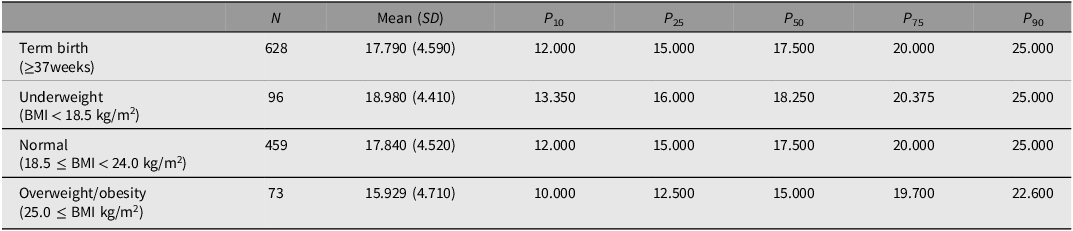
(5) The total maternal GWG was calculated by subtracting the delivery weight from the prepregnancy weight. First, we obtained the interquartile range and median of gestational weight gain of term birth in twin pregnancies with different prepregnancy BMI through criteria 2 (Table 1). As suggested by many prior studies (Lin et al., Reference Lin, Fan, Wu, Chen, Li, Ma, Ye, Rao, Zhang, Zeng, Liu, Guo and Liu2019; Ozcan et al., Reference Ozcan, Bacak, Zozzaro-Smith, Li, Sagcan, Seligman and Glantz2017), we divided the recommended total GWG by 37 weeks to obtain the recommended weekly GWG. The results were concluded as follows: 0.432–0.551 kg/week for women with underweight, 0.405–0.541 kg/week for women with normal weight, and 0.338–0.532 kg/week for women with overweight and obesity. Through criteria 1, we obtained 1510 women who delivered living twins. We divided the total GWG by the gestational weeks to calculate the weekly GWG in order to control the impact of gestational age at delivery, then classified the weekly GWG into IGWG, adequate gestational weight gain (AGWG) and EGWG subgroups by means of comparing with the standard weekly GWG.
Table 1.Gestational weight gain of term birth in twin pregnancies with different prepregnancy BMI (kg)

-
(6) Birth weight discordance in twins = (birth weight of larger twin – birth weight of smaller twin)/birth weight of larger twin * 100%.

Statistical Analysis
The sample size was justified by both the Events Per Variable criterion and an a priori power calculation. Covariate selection was guided by a predefined directed acyclic graph (Supplementary Figure 1) and clinical knowledge. We defined three adjustment sets: a full set (all collected potential confounders), a core set (prepregnancy BMI, maternal age, chorionicity, mode of conception, cervical insufficiency, history of preterm birth, education level, history of inevitable miscarriage, history of uterine surgery, history of uterine malformation, and pregestational diabetes), and a minimal set (prepregnancy BMI, maternal age, chorionicity, mode of conception, cervical insufficiency, and history of preterm birth). In the primary analysis of the whole cohort, the association between GWG and SPTB was assessed using multivariable logistic regression, adjusting for both the full and core sets. For subgroup analyses, the minimal set was uniformly applied to ensure model stability and comparability. A sensitivity analysis comparing the core and minimal sets confirmed the robustness of the primary findings (Supplementary Table 2). The analysis of GWG and SPTB severity was exploratory and adjusted for a parsimonious set of covariates (prepregnancy BMI, maternal age, chorionicity, and mode of conception) due to limited sample size in severity subgroups.
The basic demographics and outcomes of mothers and neonates were listed as mean (standard deviation), median (upper quartile, lower quartile), or frequency (%). The Kruskal-Wallis test was used to compare measurements with aberrant distributions. We calculated the odds ratios (ORs) and 95% confidence intervals (CIs) for SPTB in the overall population and different subgroups. Two-sided p values less than .05 were considered significant. All statistical analyses were performed with SPSS Statistical software (Version 22; IBM Corp, Armonk, NY).
Results
Association Between GWG and Mothers and Neonates’ Basic Demographics and Outcomes
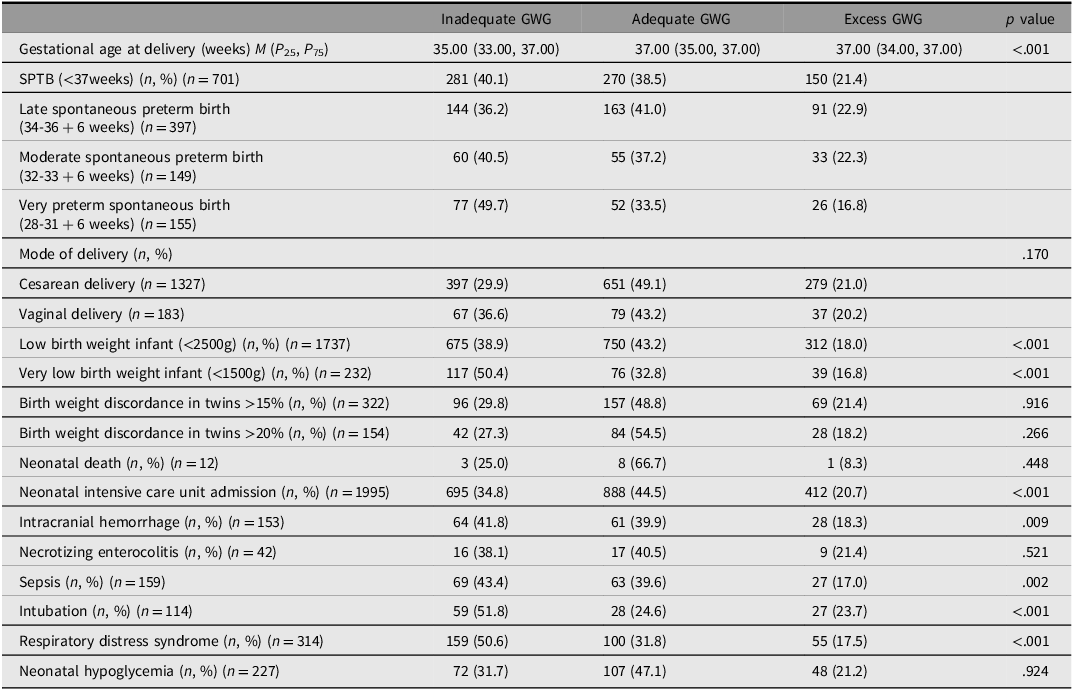
This study included 1510 women who delivered live twin newborns, of whom 464 (30.7%) women had inadequate GWG and 316 (20.9%) women had excess GWG (Supplementary Table 1).
The median gestational age at delivery of IGWG, AGWG, and EGWG were 35 weeks (interquartile ranges: 33–37), 37 weeks (interquartile ranges: 35–37), and 37 weeks (interquartile rages: 34–37). GWG is associated with SPTB (p < .001), low birth weight infant (p < .001), very low birth weight infant (p < .001), neonatal intensive care unit admission (p < .001), intubation (p < .001), respiratory distress syndrome (p < .001), sepsis (p < .002), and intracranial hemorrhage (p = .009) in maternal and neonatal outcomes (Table 2).
Maternal and neonatal outcomes associated with gestational weight gain

Note: Data reported as n (%), describe the distribution of gestational weight gain in each subgroup.
GWG, gestational weight gain; SPTB, Spontaneous preterm birth; Spontaneous preterm birth was defined as delivery occurs spontaneously without intervention before 37 weeks of gestation.
p < .05, indicating that there is a statistical difference in the maternal and neonatal outcomes rate of the gestational weight gain.
Prevalence of SPTB
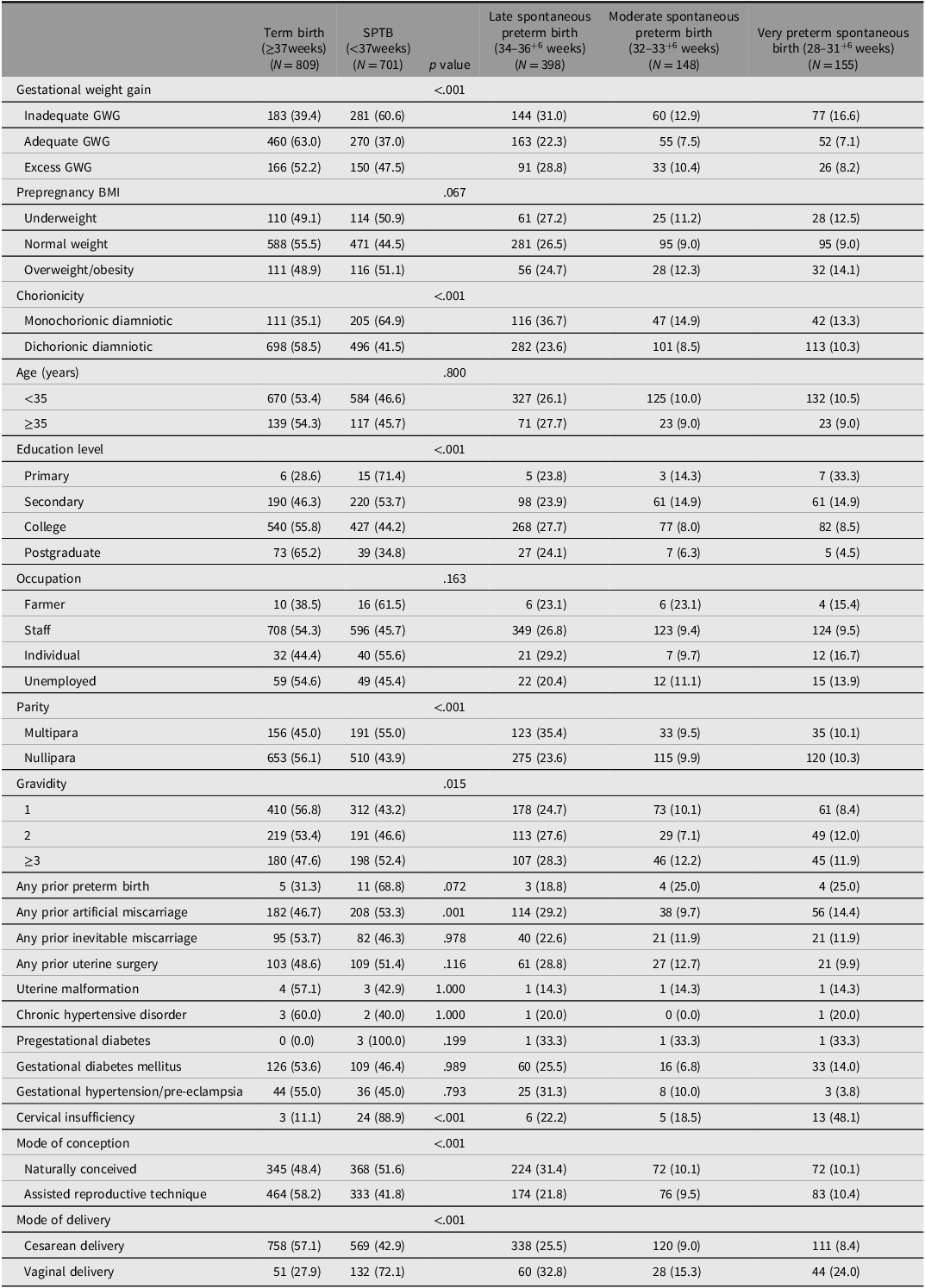
This study included 809 (53.6%) women who had a term birth and 701 (46.4%) women with SPTB. GWG (p < .001), education level (p < .001), mode of conception (p < .001), mode of delivery (p < .001), history of artificial miscarriage (p = .001), parity (p < .001), gravidity (p = .015), cervical insufficiency (p < .001), and chorionicity (p < .001) are associated with SPTB. The prevalence of SPTB was higher among women with EGWG than AGWG, while women with IGWG also had a higher prevalence compared with women with AGWG. The education level (primary), naturally conceived, vaginal delivery, multipara, gravidity (≥3 times), and MCDA subgroups had a higher prevalence of SPTB (Table 3).
Prevalence of the spontaneous preterm birth

Note: Data reported as n (%), describe the prevalence of the spontaneous preterm birth and term birth in the basic demographics subgroups.
GWG, gestational weight gain; BMI, body mass index; SPTB, Spontaneous preterm birth.
Spontaneous preterm birth was defined as delivery occurs spontaneously without intervention before 37 weeks of gestation.
p < .05, indicating that there is a statistical difference in the spontaneous preterm birth rate of the variable.
Association Between GWG and SPTB
Compared to women with AGWG, women with EGWG showed an increased risk of SPTB (adjusted odds ratio (aOR): 1.48, 95% CI [1.12, 1.95]), while women with IGWG had a significantly higher risk of SPTB (aOR: 2.46, 95% CI [1.92, 3.15]). Both IGWG and EGWG had a significantly higher risk of SPTB in women with DCDA (EGWG aOR: 1.53, 95% CI [1.12, 2.09]; IGWG aOR: 2.38, 95% CI [1.81, 3.13]), women with normal weight (EGWG aOR: 1.79, 95% CI [1.29, 2.48]; IGWG aOR: 2.77, 95% CI [2.06, 3.74]), women with assisted reproductive technique (EGWG aOR: 1.51, 95% CI [1.02, 2.23]; IGWG aOR: 2.72, 95% CI [1.94, 3.80]), women with cesarean delivery (EGWG aOR: 1.59, 95% CI [1.19, 2.14]; IGWG aOR: 2.35, 95% CI [1.80, 3.06]), nullipara (EGWG aOR: 1.66, 95% CI [1.21, 2.29]; IGWG aOR: 2.57, 95% CI [1.94, 3.41]), and women under 35 years old (EGWG aOR: 1.44, 95% CI [1.07, 1.94]; IGWG aOR: 2.44, 95% CI [1.86, 3.21]) (Supplementary Table 2, Figure 2).
Odds ratios (ORs) for the association between gestational weight gain (GWG) and spontaneous preterm birth: IGWG (a), EGWG (b). Reference: adequate GWG.
Note: Error bars present 95% CI; *p < .05. IGWG, inadequate gestational weight gain; EGWG, excess gestational weight gain; MCDA, monochorionic diamniotic twins; DCDA, dichorionic diamniotic twins. Adjusted for prepregnancy BMI, maternal age, chorionicity, mode of conception, cervical insufficiency, and history of preterm birth.

We found that IGWG was significantly associated with SPTB in the underweight subgroup (aOR: 2.74, 95% CI [1.40, 5.33]). This association persisted across both MCDA (aOR: 2.93, 95% CI [1.65, 5.22]) and DCDA (aOR: 2.38, 95% CI [1.81, 3.13]) subgroups, naturally conceived (aOR: 2.23, 95% CI [1.54, 3.22]) and assisted reproductive technique (aOR: 2.72, 95% CI [1.94, 3.80]) subgroups, vaginal delivery (aOR: 3.48, 95% CI [1.45, 8.34]) and cesarean delivery (aOR: 2.35, 95% CI [1.80, 3.06]) subgroups, women under 35 years old (aOR: 2.44, 95% CI [1.86, 3.21]) and women aged 35 or older (aOR: 2.62, 95% CI [1.41, 4.87]) subgroups (Figure 2a).
Association Between GWG and the Severity of SPTB
This study included 398 (26.4%) women with late spontaneous preterm birth (34–36+6 weeks), 148 (9.8%) women with moderate spontaneous preterm birth (32–33+6 weeks), and 155 (10.3%) women with very preterm spontaneous birth (28–31+6 weeks).
Women with IGWG or EGWG showed a significant positive association with late spontaneous preterm birth when compared to women with AGWG (IGWG aOR: 2.18, 95% CI [1.63, 2.90]; EGWG aOR: 1.47, 95% CI [1.07, 2.02]). This trend was also observed in the normal weight subgroup (IGWG aOR: 2.16, 95% CI [1.53, 3.05]; EGWG aOR: 1.81, 95% CI [1.26, 2.61]), nullipara subgroup (IGWG aOR: 2.44, 95% CI [1.74, 3.41]; EGWG aOR: 1.77, 95% CI [1.22, 2.57]), cesarean delivery subgroup (IGWG aOR: 2.14, 95% CI [1.58, 2.91]; EGWG aOR: 1.64, 95% CI [1.17, 2.29]), and assisted reproductive technique subgroup (IGWG aOR: 2.38, 95% CI [1.58, 3.59]; EGWG aOR: 1.79, 95% CI [1.13, 2.83]). In the DCDA (aOR: 1.85, 95% CI [1.34, 2.57]) and MCDA (aOR: 3.58, 95% CI [1.87, 6.84]) subgroups, women under 35 years old (aOR: 2.19, 95% CI [1.60, 3.01]) and women aged 35 or older (aOR: 2.04, 95% CI [1.01, 4.11]) subgroups, and naturally conceived (aOR: 2.00, 95% CI [1.33, 3.00]) subgroup, only IGWG was significantly associated with late spontaneous preterm birth (Supplementary Table 3, Figure 3a).
Odds ratios (ORs) for the association between gestational weight gain (GWG) and the severity of spontaneous preterm birth (SPTB): Late spontaneous preterm birth (a), Moderate spontaneous preterm birth (b), Very preterm spontaneous birth (c). Reference: adequate GWG.
Note: Error bars present 95% CI. *p < .05. MCDA, monochorionic diamniotic twins; DCDA, dichorionic diamniotic twins. Adjusted for prepregnancy BMI, maternal age, chorionicity, and mode of conception.

The association between IGWG and moderate spontaneous preterm birth was positive (aOR: 2.59, 95% CI [1.72, 3.90]). Positive association between IGWG and moderate spontaneous preterm birth was also found in the DCDA subgroup (aOR: 2.73, 95% CI [1.68, 4.42]), normal weight subgroup (aOR: 3.37, 95% CI [2.02, 5.62]), nullipara subgroup (aOR: 2.43, 95% CI [1.53, 3.86]), cesarean delivery subgroup (aOR: 2.38, 95% CI [1.52, 3.73]), assisted reproductive technique subgroup (aOR: 2.51, 95% CI [1.45, 4.34]), and women under 35 years old subgroup (aOR: 2.39, 95% CI [1.52, 3.76]). Positive association between EGWG and moderate spontaneous preterm birth was only found in the DCDA subgroup (aOR: 1.80, 95% CI [1.03, 3.14]) and normal weight subgroup (aOR: 1.91, 95% CI [1.06, 3.44]) (Supplementary Table 3, Figure 3b).
IGWG demonstrated a strong positive association with very preterm spontaneous birth (aOR: 3.53, 95% CI [2.38, 5.24]). In addition, we found a significant association between IGWG and very preterm spontaneous birth in the DCDA subgroup (aOR: 4.23, 95% CI [2.68, 6.68]), normal weight subgroup (aOR: 4.55, 95% CI [2.76, 7.52]), nullipara subgroup (aOR: 3.80, 95% CI [2.42, 5.96]), cesarean delivery subgroup (aOR: 3.63, 95% CI [2.29, 5.73]), assisted reproductive technique subgroup (aOR: 4.23, 95% CI [2.50, 7.16]), and women under 35 years old subgroup (aOR: 3.69, 95% CI [2.39, 5.68]). (Supplementary Table 3, Figure 3c).
Discussion
In this twin pregnancy retrospective study, we found that GWG is associated with SPTB, low birth weight infant, very low birth weight infant, neonatal intensive care unit admission, intubation, respiratory distress syndrome, sepsis, and intracranial hemorrhage. IGWG and EGWG were substantially associated with a higher risk of SPTB compared to AGWG. This trend was also observed in women with DCDA, women with normal weight, women with assisted reproductive technique, women with cesarean delivery, nullipara, and women under 35 years old. IGWG was shown to have a higher risk of all severities of SPTB. EGWG had increased odds of late SPTB compared with women with AGWG.
There is minimal and conflicting evidence on the relationship between GWG and SPTB in twin pregnancies (Algeri et al., Reference Algeri, Pelizzoni, Bernasconi, Russo, Incerti, Cozzolino, Mastrolia and Vergani2018; Fox et al., Reference Fox, Stern, Saltzman, Klauser, Gupta and Rebarber2014; González-Quintero et al.; Reference González-Quintero, Kathiresan, Tudela, Rhea, Desch and Istwan2012, Kosinska-Kaczynska et al., Reference Kosińska-Kaczyńska, Szymusik, Kaczyński and Wielgos2017; Lin et al., Reference Lin, Fan, Wu, Chen, Li, Ma, Ye, Rao, Zhang, Zeng, Liu, Guo and Liu2019; Liu et al., Reference Liu, Zafman and Fox2021). A recent study in China showed that in comparison to weight gain within recommendations, IGWG was related to higher risks in SPTB (<37 weeks), but no equivalent findings were observed in the EGWG group (Lin et al., Reference Lin, Fan, Wu, Chen, Li, Ma, Ye, Rao, Zhang, Zeng, Liu, Guo and Liu2019), while Kosinska Kaczynska et al. (Reference Kosińska-Kaczyńska, Szymusik, Kaczyński and Wielgos2017) reported that a high GWG ratio (GWG ratio > 0.66 kg/week) was associated with increased odds of SPTB (<32 weeks) in dichorionic twin pregnancies, but no difference in SPTB (<37 weeks) was founded in groups with IGWG, AGWG, and EGWG. In terms of the relationship between IGWG and SPTB, a prospective cohort study reported that reduced total GWG is associated with a higher risk of SPTB (<37 weeks; Algeri et al., Reference Algeri, Pelizzoni, Bernasconi, Russo, Incerti, Cozzolino, Mastrolia and Vergani2018). Fox et al. (Reference Fox, Stern, Saltzman, Klauser, Gupta and Rebarber2014) reported that compared to women who delivered after 32 weeks, women with SPTB before 32 weeks had considerably poorer weight gain as early as 16 gestational weeks. González-Quintero et al. (Reference González-Quintero, Kathiresan, Tudela, Rhea, Desch and Istwan2012) found that women with IGWG were more likely to deliver spontaneously (<35 weeks) irrespective of the BMI category, while another study that included a total of 609 women with normal BMI and twin pregnancies discovered that IGWG was associated with different degrees of SPTB (<37 weeks’ gestation, <34 weeks’ gestation and <32 weeks’ gestation; Liu et al., Reference Liu, Zafman and Fox2021). The conflicting results of previous research might be attributed to a variety of factors, including study population, sample size, GWG classifications, and different analytical methodologies.
Consistent with most studies, our study found that IGWG is associated with an increased risk of SPTB. We also found that EGWG was significantly associated with a higher risk of SPTB. For the first time, we examined the relationship between GWG and SPTB in twin pregnancies in China from the perspective of prepregnancy BMI and chorionicity. Our study, which included both MCDA and DCDA, is the first to evaluate the association between GWG and SPTB in twin pregnancies in China according to chorionicity. It is more significant than prior studies that solely included dichorionic twins (Kosinska-Kaczynska et al., Reference Kosińska-Kaczyńska, Szymusik, Kaczyński and Wielgos2017; Wang et al., Reference Wang, Wen, Zheng, Zhou, Mei, Li, Tong, Qi and Baker2018) or did not include chorionicity information (Chen et al., Reference Chen, Liu, Zhang, Hu, Qian, Xian, Vaughn, Liu, Cao, Gan and Zhang2018; Ozcan et al., Reference Ozcan, Bacak, Zozzaro-Smith, Li, Sagcan, Seligman and Glantz2017). Furthermore, we covered the underweight subgroup, which was not covered by the Institute of Medicine guidelines, and utilized weekly adequate weight gain as the reference instead of grouping women who gain weight at or beyond the recommended levels.
For an extended period, China has lacked nationally endorsed guidelines for GWG in twin pregnancy. The direct application of the Institute of Medicine (IOM) recommendations to the Chinese population is problematic. Significant differences exist between Chinese and Western populations in genetic characteristics, dietary patterns, and the prevalence of pregnancy complications, all of which can influence gestational weight management and outcomes. Furthermore, the IOM recommendations are based on the World Health Organization’s BMI classification, which differs from the weight status categories established for Chinese adults. Our study, therefore, utilized the Chinese BMI criteria to establish GWG references specifically for twin pregnancies. The resulting recommended GWG ranges in our study were lower than those proposed by the IOM across all BMI categories, with values of 0.432–0.551 kg/week for women with underweight, 0.405–0.541 kg/week for women with normal weight, and 0.338–0.532 kg/week for women with overweight and obesity. This discrepancy may reflect the rising prevalence of overweight and obesity among Chinese women of reproductive age, suggesting a need for more conservative weight-gain targets to optimize pregnancy outcomes in this evolving demographic context. Our study provided a basis for the weight gain guideline for women with twin pregnancies in China in the future.
We discovered that GWG is associated with a number of neonatal outcomes in addition to SPTB, including low and very low birth weight, neonatal intensive care unit admission, intubation, respiratory distress syndrome, sepsis, and intracranial hemorrhage. This is consistent with previous studies that found a link between GWG and low birth weight and preterm birth (Li et al., Reference Li, Gao, Liu, Hu, Chen, He, Tang, Liu and Cao2021). Preterm birth raises the risk of neonatal sepsis, intracranial hemorrhage, and respiratory distress syndrome which raise the need for intubation (Menon, Reference Menon2008), and these complications lead to an increase in neonatal intensive care unit admissions.
Various pathogenic factors trigger premature labor through the activation of the hypothalamic-pituitary-adrenal axis, inflammation, uteroplacental ischemia or hemorrhage, and pathological expansion of the myometrium (Menon, Reference Menon2008). The uterus is stretched more in twins than in singletons, which may account for the higher likelihood of SPTB (Romero et al., Reference Romero, Espinoza, Kusanovic, Gotsch, Hassan, Erez, Chaiworapongsa and Mazor2006). Weight changes throughout pregnancy indicate the nutritional status of the mother, and twin pregnancy requires more nutrition to fulfill fetal development and maternal demands. IGWG which has been associated with nutritional shortages during pregnancy and may have an effect on fetal hypothalamic-pituitary-adrenal axis development and oxidative stress might increase the risk of SPTB (Kumarasamy et al., Reference Kumarasamy, Mitchell, Bloomfield, Oliver, Campbell, Challis and Harding2005, Luo et al., Reference Luo, Fraser, Julien, Deal, Audibert, Smith, Xiong and Walker2006). In addition, EGWG might increase maternal nutritional status and raise the risk of pregnancy complications and adverse outcomes, such as pre-eclampsia and postpartum weight retention (Neggers & Goldenberg, Reference Neggers and Goldenberg2003; Lipworth et al., Reference Lipworth, Barrett, Murphy, Redelmeier and Melamed2022; Woolfolk et al., Reference Woolfolk, Harper, Flick, Mathews and Chang2016). Further research is needed to explore the relationship between EGWG and SPTB.
We found that underweight and normal-weight women had a higher risk of SPTB if they had IGWG. IGWG might be the main reason for this finding, while abnormal prepregnancy BMI might also be a contributing factor among underweight women. Underweight women with poor nutritional status, which has been associated with low blood flow, high maternal infections, iron deficiency anemia, and a reduction in placental weight and surface area, are more prone to suffer SPTB (Goldenberg, Reference Goldenberg2003; Neggers & Goldenberg, Reference Neggers and Goldenberg2003; Ram et al., Reference Ram, Berger, Lipworth, Geary, McDonald, Murray-Davis, Riddell, Hasan, Barrett and Melamed2020). Due to the association between obesity and inflammation, it has been hypothesized that people who are obese are more prone to experience SPTB (Catalano & Shankar, Reference Catalano and Shankar2017).
Due to several limitations, the results of this study should also be interpreted with care. First, this study only involved one center. The sample size, particularly for pregnant individuals with obesity, was limited. Even if our research center is one of the biggest in China, it is crucial to collaborate with other research centers to increase the generalizability of our findings across all demographics. Second, although we adjusted for major confounders, data on factors such as the history of late inevitable miscarriage were not available for inclusion. Our results may still have been affected by unmeasured factors. Third, our analysis was restricted to SPTB from 28 to <37 weeks, consistent with the Chinese clinical definition. Future studies that include SPTB (<28 weeks) would hold significant clinical value. Finally, it is important to note that the true trajectory of GWG in twin pregnancies is dynamic and nonlinear, which could influence the association between GWG and pregnancy outcomes (Bodnar et al., Reference Bodnar, Pugh, Abrams, Himes and Hutcheon2014; Li et al., Reference Li, Dawuti, Wu, Tian, Zhang, Gao, Huang and Li2025). A more detailed analysis of trimester-specific weight gain patterns represents an important direction for future research.
Conclusion
Twin pregnancies with IGWG and EGWG had a significantly higher risk of SPTB. In order to reduce the likelihood of SPTB, it is recommended to return to normal weight before pregnancy and carefully control weight gain during pregnancy. Nevertheless, future research needs to go deeper into the underlying mechanisms of the association between GWG and SPTB in twin pregnancies.
Supplementary material
To view supplementary material for this article, please visit https://doi.org/10.1017/thg.2025.10038
Data availability statement
The datasets generated and/or analyzed during the current study are not publicly available due to privacy and ethical restrictions but are available from the corresponding author on reasonable request.
Acknowledgements
We are truly grateful to all mothers who participated in this research.
Authors’ contributions
Lesha Wang and Zhaoxia Liang conceived and designed this study. Yibo Tang made important contributions in the revision process. Ying Hu helped to collect data. Lesha Wang did the analysis and wrote the manuscript. Marie Parfaite Uwimana Muhuza and Menglin Zhou assisted review and editing. Danqing Chen supervised this project. All authors contributed to the article and approved the submitted version.
Funding
This work was supported by grants from National Natural Science Foundation of China, grant number 82571935, and 4+X Clinical Research Project of Women’s Hospital, School of Medicine, Zhejiang University (ZDFY2022-4XB101).
Competing interests
The authors report no conflict of interest.