INTRODUCTION
Good management of fertilization practices is a critical issue for the development of sustainable agricultural activities (Tilman et al., Reference Tilman, Cassman, Matson, Naylor and Polasky2002). However, the world consumption of fertilizers is forecast to grow continuously. East and Southeast Asian countries are estimated to account for half the growth in consumption of nitrogen (N), phosphate (P) and potassium (K) fertilizers (FAO, 2015). Fertilization is a very common practice in Thai agricultural holdings; in 2013, it occurred on 92.3% of farms. Between 2003 and 2013, the percentage of holdings using only chemical fertilizers decreased (from 56.8 to 51.5%) but the average quantity of chemical fertilizers used per land unit increased by 43% (NSO, 2013).
Rubber (Hevea brasiliensis) is a major crop in the country providing about one-third of the world's natural rubber. With 3.5 million ha planted as at 2013, rubber plantations cover 17% of the nation's farmland (OAE, 2015), and 90% of the rubber plantation areas belong to smallholders. Rubber yields are one of the best in the world. This good performance is the result of the general adoption of a technological model based on high-yielding planting material combined with the use of large amount of inputs –notably fertilizers – during the immature period of the plantations. Indeed, the need for fertilization during this period is generally acknowledged (Karthikakuttyamma et al., Reference Karthikakuttyamma, Mercykutty, Sasidharan Nair, George and Jacob2000). Regarding the mature period, there is not yet scientific consensus on the impact of fertilization on latex yield (Gohet et al., Reference Gohet, Saaban, Soumahoro, Uche, Soumahoro and Cauchy2013). However, in Thailand, fertilization recommendations for mature rubber plantations are very high compared to other countries (Kangpichadan, Reference Kangpichadan2009; Watson, Reference Watson, Webster and Baulkwill1989), and other similar tree plantations. To our knowledge, there has been no study on the actual fertilization practices of rubber farmers showing whether or not they have adopted these recommendations and analysing the factors driving their choice of a fertilization strategy.
Knowing and understanding farmers’ practices are generally the first step in improving cropping systems towards a given set of objectives. The adoption of cultural practices by farmers is driven by factors external or internal to the farms. In the case of fertilization, the main external factor is the price of fertilizers as fertilization decreases when the fertilizer price increases (Akpan et al., Reference Akpan, Nkanta and Essien2012; Ariga and Jayne, Reference Ariga, Jayne, Chuhan-Pole and Angwafo2011; Fufa and Hassan, Reference Fufa and Hassan2006; Zhou et al., Reference Zhou, Yang, Mosler and Abbaspour2010). The selling price of crops can also influence the farmers’ decision (Akpan et al., Reference Akpan, Nkanta and Essien2012; Ariga and Jayne, Reference Ariga, Jayne, Chuhan-Pole and Angwafo2011; Wanyama et al., Reference Wanyama, Mose, Rono, Masinde and Kariuki2010). Other external factors are linked to fertilizer supply and the technical information farmers can get through extension officers or farmers associations (Akpan et al., Reference Akpan, Nkanta and Essien2012; Ariga and Jayne, Reference Ariga, Jayne, Chuhan-Pole and Angwafo2011; Martey et al., Reference Martey, Wiredu, Etwire, Fosu, Buah, Bidzakin, Ahiabor and Kusi2014; Minot et al., Reference Minot, Kherallah and Berry2000; Wanyama et al., Reference Wanyama, Mose, Rono, Masinde and Kariuki2010; Zhou et al., Reference Zhou, Yang, Mosler and Abbaspour2010). There are three main categories of factors internal to the farms driving fertilization practices: household characteristics, personal characteristics of the household head and farm characteristics. Household characteristics determine the investment capacity in fertilizers and others inputs needed for crop management. Several characteristics are often highlighted in the literature: family size, household income or assets, landholding size or sometimes the land under crops used as a proxy of landholding size, the presence of non-farm or off-farm income and the access to credit (Akpan et al., Reference Akpan, Nkanta and Essien2012; Ariga and Jayne, Reference Ariga, Jayne, Chuhan-Pole and Angwafo2011; Martey et al., Reference Martey, Wiredu, Etwire, Fosu, Buah, Bidzakin, Ahiabor and Kusi2014; Minot et al., Reference Minot, Kherallah and Berry2000; Olayide et al., Reference Olayide, Alene and Ikpi2009; Wanyama et al., Reference Wanyama, Mose, Rono, Masinde and Kariuki2010; Wimalagunasekara et al., Reference Wimalagunasekara, Edirisinghe and Wijesuriya2012; Wiredu et al., Reference Wiredu, Zeller and Diagne2015; Zhou et al., Reference Zhou, Yang, Mosler and Abbaspour2010). The impact of these factors depends on the strategy of the households to use their income and so no clear trend could be established. Similarly, the impact of the personal characteristics of the household head depends on the situation. The age, gender, level of education and experience in farming activities of the household head are the main factors reported in the literature (Akpan et al., 2012; Ariga and Jayne, Reference Ariga, Jayne, Chuhan-Pole and Angwafo2011; Fufa and Hassan, Reference Fufa and Hassan2006; Martey et al., Reference Martey, Wiredu, Etwire, Fosu, Buah, Bidzakin, Ahiabor and Kusi2014; Minot et al., Reference Minot, Kherallah and Berry2000; Nkamleu and Adesina, Reference Nkamleu and Adesina2000; Wanyama et al., Reference Wanyama, Mose, Rono, Masinde and Kariuki2010; Wimalagunasekara et al., Reference Wimalagunasekara, Edirisinghe and Wijesuriya2012; Zhou et al., Reference Zhou, Yang, Mosler and Abbaspour2010). Farm characteristics are linked to the farming and cropping systems, such as crop diversification (Minot et al., Reference Minot, Kherallah and Berry2000) or livestock rearing (Akpan et al., Reference Akpan, Nkanta and Essien2012; Zhou et al., Reference Zhou, Yang, Mosler and Abbaspour2010), but also to more specific features of the plots, such as the size, the distance from the house or the land tenure (Ariga and Jayne, Reference Ariga, Jayne, Chuhan-Pole and Angwafo2011; Minot et al., Reference Minot, Kherallah and Berry2000; Nkamleu and Adesina, Reference Nkamleu and Adesina2000; Olayide et al., Reference Olayide, Alene and Ikpi2009; Wimalagunasekara et al., Reference Wimalagunasekara, Edirisinghe and Wijesuriya2012). It is noteworthy that most of the published papers on the determinants of fertilization practices deal with annual crops, whether under temperate or tropical conditions. Papers on tropical perennial crops, such as rubber are scarce. We assume that two specific characteristics of perennial crops can influence fertilization practices: the age and the stage of development of the crop. The lifespan of rubber, like most perennial crops, can be divided in two phases of unequal length; after 6–7 years of an immature growth phase, rubber trees then enter their mature phase and are tapped for latex, commonly for at least the next 20 years before the trees themselves are finally harvested for wood products.
The study presented in this paper was a part of a project aiming to develop sustainable fertilization practices for rubber smallholdings in Thailand. This project focused mainly on fertilization practices at the mature stage because of the discrepancy between the unclear effect of the application of fertilizers on latex yield and the national recommendations. In this respect, the general objective of this study was to understand the fertilization practices adopted by rubber farmers in different rubber-producing areas of Thailand. The first specific objective was to build a typology of these fertilization practices. The second objective was to identify the determinants of the use of fertilizers in mature rubber plantations. The third objective was to assess the difference in fertilization practices between historical and new rubber-producing areas in Thailand. We expect the results of this study to be useful for agronomists, extension officers and policy makers in Thailand in designing sustainable fertilization practices that take into account the farmers’ constraints and capacity to implement them. From a more generic point of view, this study should contribute to building up knowledge on the management of fertilization of tropical perennial crops.
MATERIALS AND METHODS
Selection of study areas and farm sampling
Based on the history of rubber cultivation development, rubber-producing areas in Thailand can be divided roughly into two regions (Supplementary Figure S1, available online at https://doi.org/10.1017/S0014479717000400). The South and East are the historical areas, where rubber plantations started at the turn of the 20th century. The Northeast and North are new areas, where plantations have expanded during the 1990’s and the 2000’s, respectively. The North remains marginal for rubber cultivation. Therefore, this region was not included in the study. These rubber-producing areas are also different in terms of climatic conditions. The South and East regions present favourable conditions for rubber cultivation with an annual rainfall between 1500 and 2000 mm, and a dry season that does not exceed two months. In contrast, the dry season in the Northeast spans four to six months with the annual rainfall limited to 1500 mm or less in most provinces except those along the Mekong River. Hence, the Northeast of Thailand is considered as a marginal area for rubber cultivation.
To allow for analysis of the impact of different biophysical and socio-economic contexts of rubber farms on fertilization practices, we selected four provinces: Phatthalung in the South, Rayong in the East, and Buriram and Bueng Kan in the Northeast.
In each province, we identified three or four districts to cover the diversity of local conditions for rubber cultivation. In addition, we selected at least three different, non-adjacent sub-districts in order to have a better representation of the diversity of the rubber farmers in the province. It is indeed well known that farmers are influenced by their neighbours and tend to adopt similar practices within a production zone (Martey et al., Reference Martey, Wiredu, Etwire, Fosu, Buah, Bidzakin, Ahiabor and Kusi2014; Wimalagunasekara et al., Reference Wimalagunasekara, Edirisinghe and Wijesuriya2012).
In total, 414 farmers were interviewed with a minimum of 100 in each province. The first criterion used to select farmers was ownership of at least one mature rubber plantation. In addition, in each province, the objective was to balance the sample with farmers who had and who had not received support from the Office of Rubber Replanting Aid Fund (ORRAF) scheme. We assumed that the financial support and the recommendations provided through ORRAF's project could lead to different fertilization practices. Due to field constraints, it was not always possible to reach this target. Nonetheless in all the provinces, both farmers with and without support were well represented.
The strategy to meet the farmers was to make contact with a key informant through ORRAF (village leader or farming group representative), who could provide a list of farmers. In addition, sampling was completed using a door-to-door survey.
Data collection
We used primary data from individual interviews with the head of each farm conducted between January and April 2014. Data were collected using a semi-structured questionnaire with different categories of questions. The first sets of questions were aimed to provide a detailed description of all the cultural practices during the mature period for each rubber plot owned by the farmer with a focus on fertilization. Another set of questions aimed to characterize the factors likely to explain the choice of farmers’ fertilization practices. Finally, the questionnaire included open questions on each farmer's rationale for choosing fertilization management. Questions were included to estimate the rubber yield. However, it was not possible to get reliable data, since rubber production varies throughout the year with the season and farmers do not record their production. Under these conditions, a single interview did not allow for an adequate assessment of the yield per rubber plot. All data were entered into an Excel file and analysed using the XLStat 2015 statistical software.
Establishment of a typology of fertilization practices in mature plantations
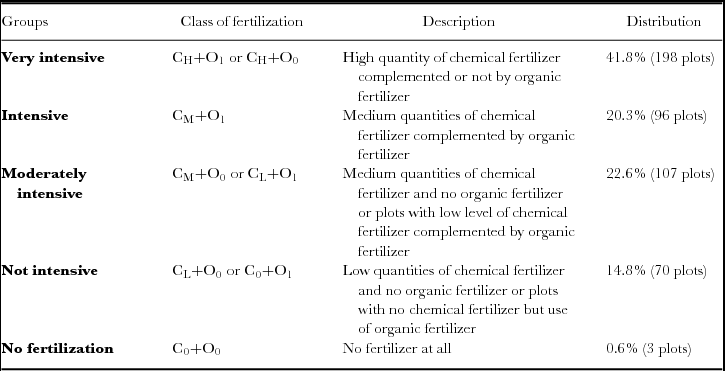
Univariate descriptive statistics were used to summarize variables related to farmers’ practices on fertilizer application during the mature phase of the rubber plantations in view of showing the diversity in their responses. In order to build a typology of the fertilization practices, we defined four possible classes of chemical fertilization and two classes of organic fertilization. The four classes of chemical fertilization were based on the dose of nitrogen (N) applied to the plantation: the first class was for plantations without an application of chemical fertilizer (code C0), the second class was for a low level of fertilization with the N application below or equal to 53 kg ha−1yr−1 dose that corresponds to 35% of the recommendation in Thailand (code CL), the third class was for a medium level of fertilization with the N application between 53 and 94 kg ha−1yr−1 (code CM), the fourth class was for a high level of fertilization with the N application above 94 kg ha−1yr−1 that corresponds to 63% of the recommendation in Thailand (code CH). For organic fertilizer, we could not assign a nutrient value because farmers did not know the composition of the organic product they used and this could be diverse (for example, manure, homemade organic fertilizer and commercial organic fertilizer). Therefore, we considered only two classes: use (code O1) or no use (code O0). From the eight possible combinations of chemical and organic fertilization classes, we determined five groups of fertilization intensity giving more importance to the amount of nitrogen (N) in chemical fertilization than the organic fertilization. Indeed, nitrogen is a key nutriment for rubber tree growth and nitrogen content in organic fertilizer is generally low.
Possible factors driving farmers fertilization practices
Based on a non-exhaustive literature review, we identified some factors likely to affect the fertilization practices of rubber smallholders. Table S1 summarizes the external and internal factors analysed in this study. We did not consider family size because only two or three members of the family were usually involved in farming activities suggesting that this variable was probably non-discriminating, and fertilizer application for mature rubber is often done at no charge by the person in charge of latex harvesting as part of the share tapping contract. Family labour is, therefore, certainly not a constraint for fertilizer application. However, we created an indicator of the level of household expenses based on the family size (three groups identified: small family includes less than three persons, average family includes three to five persons and large family more than five persons) and education expenses (divided into the number of children going to school and going to university, where we assumed that university costs were higher than for school, and so we gave a coefficient of two for the children going to university and a coefficient of one for the others; from that three groups were identified: no education expenses when no child goes at school, low education expenses when the score was one or two meaning one child going to school, two children going to school or one child going to the university and high education expenses when the score was 3–5). The combination of family size and education expenses gave four groups characterizing the level of family expenses: (i) high expenses for large family with high education expenses, (ii) medium expenses for large family with no education expenses or with low education expenses, or average family with high education expenses or with low education expenses, (iii) low expenses for average family with no education expenses or small family with low education expenses and (iv) very low expenses for small family with no education expenses. Access to a loan was not included in this paper as the data collected were not precise enough. We included the number of tapping days per year as a proxy of the intensification of the production with the hypothesis that the higher the number of tapping days per year, the more intensive the fertilization. Accessibility to the plantation was addressed by the distance from the house to the rubber plot, and also by the possibility of using a four-wheeled vehicle to reach the plot. Plot accessibility could be a constraint or a factor facilitating fertilizer transportation and so fertilizer's use. Animal husbandry was not considered because only 28% of the households raised animals and very few of them used this manure for their own plantations; most farmers bought organic fertilizers, either manure or commercial ones. Finally, according to the objectives of the study and the particularities of perennial crops, we included the age of the plantations and the province location.
Identification of the drivers of fertilization practices
To test the relationship between the fertilization groups and the explanatory variables, we did not consider one group (‘no fertilization’) as there were only three plots that could be considered as marginal practices. Consequently, only four groups were included in the analysis.
First, univariate descriptive statistical analysis was performed on all the factors likely to determine fertilization (also called explanatory variables) in order to obtain an overview of the sample characteristics and to convert the quantitative variables into qualitative ones by using quartiles. Then, a χ² test was performed between the variable of the typology of fertilization practices and each of the 23 explanatory variables to detect some possible dependencies. For some variables, the number of observations per modality was insufficient to run a χ² test. So, modalities were gathered (when relevant) to meet the requirement of this test. Last, multi-correspondence analysis (MCA) was performed using the variable of typology of fertilization practices and all the explanatory variables that appeared to be non-independent with fertilization practices from the χ² tests. MCA is a statistical tool used to analyse the pattern of relationships among a set of qualitative variables. Therefore, it was useful to analyse our full data set and extend the statistical analysis between only two variables that is possible with χ² tests. In total, 12 variables were included in the MCA. This allowed the identification of qualitative relationships among explanatory variables and between explanatory variables and the typology of fertilization practices.
RESULTS
Characterization of farmers’ fertilization practices and typology
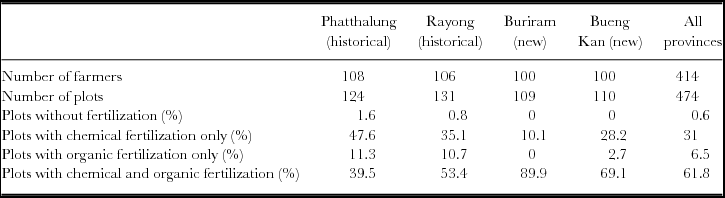
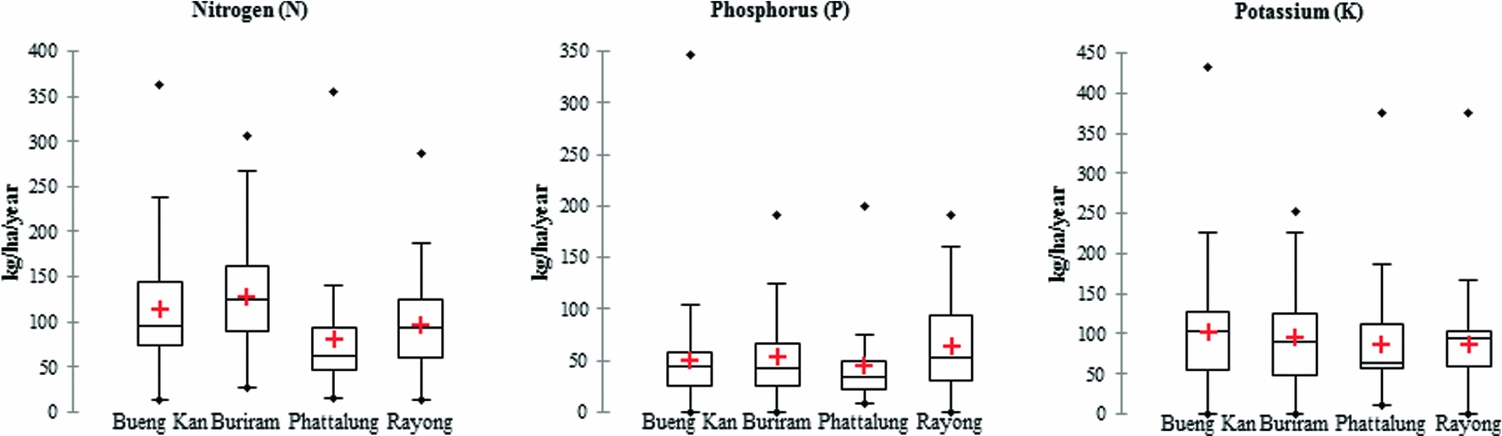
The interviews with 414 farmers provided detailed information on the cultural practices applied on 474 mature rubber plantations for which full data were obtained. Almost all the plots were fertilized during the mature period. Most plots received chemical fertilizer (93%). Organic fertilization was less systematic (69% of the plots). Many farmers combined chemical and organic fertilizers, especially in the two Northeastern provinces (Table 1). Most plots received two chemical fertilizer applications per year and/or one or two organic fertilizer applications per year. The first fertilization was usually applied in May and the second in October, but sometimes in September. Fertilization was mainly applied in the inter-row (77% of plots). Chemical fertilization usually involved the application of NPK ready-to-use with many different formulas. Generally, farmers used a large quantity of chemical fertilizer even though there was great variability among the farmers (Figure 1).
Synthesis of the data on fertilization practices in mature rubber plantations collected in each province (historical and new areas) based on 414 face-to-face interviews with rubber smallholders.

Doses of nitrogen, phosphorus and potassium used for each province showing means and distributions.

Almost two-thirds (62%) of the 474 plantations from our survey had intensive or very intensive fertilization practices, 177 plots had moderate to not intensive fertilization practices, and three plots received no fertilizer (Table 2).
Typology of fertilization practices based on the combination on the four possible classes of chemical fertilization and two classes of organic fertilization.

Meaning of the codes: C0 = no application of chemical fertilizer; CL = low level of fertilization (N application below or equal to 53 kg ha−1yr−1); CM = medium level of fertilization (N application between 53 and 94 kg ha−1yr−1); CH = high level of fertilization (N application above 94 kg ha−1yr−1); O0 = no organic fertilizer; O1 = use of organic fertilizer.
Characteristics of the sample for the explanatory variables
Descriptive statistics for the quantitative and categorical explanatory variables for fertilization practices are given in Tables S2 and S3, respectively. Rubber farmers were rather old with an average age of 53 years. Female farmers represented almost half of the sample. Almost all the farmers had received an education (only two farmers had no education at all) but most of them had attended primary school only. The four different levels of farmers’ experience in rubber cultivation identified were well represented in the sample. Farmers were equally distributed in the four provinces.
The average size of the total landholding was 5.6 ha with great variability between farms. Crop diversification was practiced on half of the farms. For one-third of the sample, rubber was the only source of income. For the other households, income diversification came from other farming income, non-farm income or sometimes both. Total household income was not easy to estimate, and so the reported results must be considered only approximate. Nonetheless, trends could be identified showing great variability among the farms regarding annual household income, with an average of around US$12,000. The indicator combining the number of persons in the household and the education expenses showed that most farms had medium or low family expenses.
The average size of the mature rubber plots was 2.7 ha with great variability. The average age of the plantation was 14 years, with most aged between 6 and 17 years. More than two-thirds of the mature plots were the first cycle of rubber on the plot. Most of the rubber plots were close to the farmer's house and almost all could be reached by four-wheeled vehicle, so generally, there was easy access to the plots. Very few farmers had no land property document for the plot where they planted rubber trees (12 plots out of 474). Many plots had a real land title; the others had some official documents that secured the right to use the land but limited its transfer.
With an average of 137 tapping days per year, latex harvesting was not really intensive. Most farmers considered that the fertility of their plot was good. This was based on their own assessment using their own criteria. Indeed, only one-third of the farmers had a soil analysis for some of their plots but not all farmers received the results.
Almost one-quarter of the respondents reported a lack of availability of fertilizer when it was needed. The fertilizer price varied among farmers depending on the formula selected and the brand, among others things, but for most fertilizer, the price ranged between US$27 and 33 per 50 kg bag in 2013–14.
Two-thirds of the farmers were members of a rubber group. The main source of recommendation for fertilization practices was public institutions: the Rubber Research Institute of Thailand, the ORRAF and agricultural extension services, but farmers had different sources of recommendation. Furthermore, 17% had not received any fertilization recommendations.
Factors determining fertilization practices
We could not obtain reliable rubber yield data from the survey. Therefore, the role of the level of production as a determinant of fertilization practices could not be analysed.
The χ² tests showed that for 12 out of the 23 variables tested, the independent hypothesis was rejected (Table S4). For six explanatory variables, the risk of wrongfully rejecting independence between variables was very low (below 0.0001%). They included the four external factors considered in this study (Table S1), which characterized the socio-economic environment of the farm (supply of fertilizers, availability of fertilization recommendations and geographical location) and two internal factors, being experience in rubber cultivation (the only factor related to household head characteristics with significant dependence) and membership of a rubber group. It is noteworthy that the highest χ² value was found for the province factor. Other variables with significant non-independence were related to farm characteristics (total landholding size, crop diversification and household income diversification), rubber plot characteristics (number of rubber cycles on the plot, access to the plot by four-wheeled vehicle) and farmers’ practices (number of tapping days per year).
Relationships between fertilization practices and non-independent variables
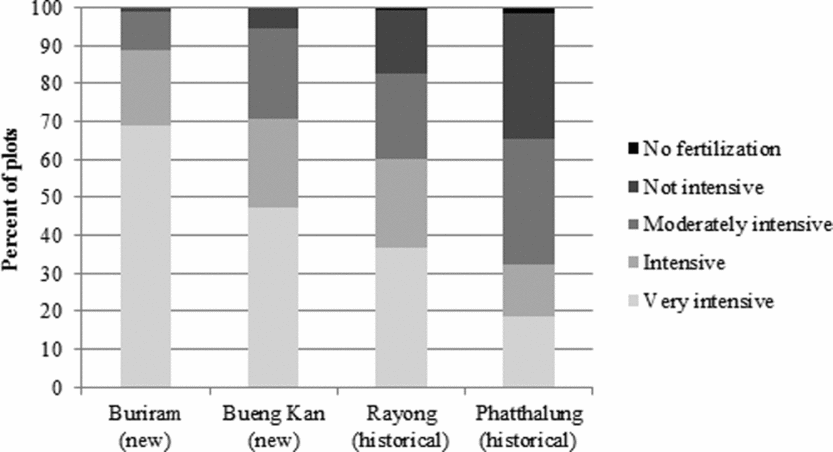
The 13 variables used to implement the MCA (12 non-independent explanatory variables and the variable for the typology of fertilization practices) corresponded to 44 modalities. The first three axes represented 71% of the information. The typology of fertilization practices contributed significantly to axis F1 only with the modality ‘not intensive’ as the positive coordinate and the modality ‘very intensive’ as the negative coordinate. These modalities, respectively, are close to Phatthalung province on the one hand and Buriram and Bueng Kan provinces on the other. Our data showed a clear trend between provinces and the intensity of fertilization practices – the provinces from the historical rubber-producing areas had the least intensive practices, while in the new provinces, 70–90% of farmers reported intensive to very intensive practices (Figure 2).
Increasing intensity of fertilization practices in the four provinces. Distribution of rubber plots based on the intensity of fertilization practices for the four provinces.

A detailed analysis of the modalities of the explanatory variables that contribute the most to the three axes of the MCA (modalities with a contribution higher than 1/44 or 0.022) confirmed the importance of the province factor (Table S5). The province modalities had the strongest contributions on axes F1 and F2. Phatthalung on one side and Buriram and Bueng Kan on the other were opposed on F1, similarly with Rayong and Bueng Kan on F2. Rayong also had a low contribution to axis F3. The information provided by axis F1 showed several modalities linked to Phatthalung province and explained most of the positive coordinate. Phatthalung province (and not intensive practices) was linked with farmers having very long experience in rubber cultivation and not belonging to any rubber group, plots in the second cycle of rubber plantation, farms with small landholding size, specialized in rubber cultivation (no other crops in the farm) but diversifying income with non-farm activities and located close to fertilizer sellers. Conversely, the modalities linked to Buriram and Bueng Kan provinces (linked with very intensive practices) and explaining most of the negative coordinate were farmers with medium experience in rubber cultivation, plots in the first cycle of rubber plantation, farms with large landholding size, diversified farming systems (other crops) and diversification of income through farming activities. Buriram and Bueng Kan provinces were also linked to modalities suggesting problems with fertilizer supply (high distance between the household and the fertilizer depot and unavailability of fertilizers when needed). They were also linked with the source of fertilization recommendations mainly from institutions (ORRAF, RRIT).
Fertilization typology did not contribute significantly to axes F2 and F3. However, axis F2 provided some additional information on rubber smallholdings in Rayong and Bueng Kan provinces. Rubber smallholdings in Rayong presented some characteristics similar to those of Phatthalung (very long experience of farmers with rubber cultivation, two cycles of rubber plantations on the same land and short distance to fertilizer retailer) that could be considered as specific of historical rubber-producing areas. However, smallholdings in Rayong differed from those in Phatthalung with regard to landholding size (large in Rayong), tapping intensity (low number of tapping days in Rayong) and membership of rubber farmers’ groups (more frequent in Rayong). Other differences shown by axis F3 were: smallholdings in Rayong had diversified farming systems and diversified sources of income (farming alone or completed by non-farm activities).
Similarly, rubber smallholdings in Bueng Khan could be compared to those in Buriram in terms of experience with rubber cultivation (small) and first cycle of rubber plantation on the same land that could be considered as specific to new rubber-producing areas; but they presented some specificities: relatively high tapping intensity (more tapping days in Bueng Kan than in Buriram), farmers were not members of a rubber group and they received fertilization recommendations from other farmers (and not from institutions).
DISCUSSION
Are rubber smallholders in Thailand applying too much fertilizer?
The recommended rates of fertilizer application for mature rubber plantations in Thailand are equivalent to 75–150 kg ha−1 yr−1 of N, 25–50 kg ha−1 yr−1 of P and 90–120 kg ha−1 yr−1 of K (Kangpichadan, Reference Kangpichadan2009). These recommendations are high compared to those in other major rubber-producing countries like Malaysia (Watson, Reference Watson, Webster and Baulkwill1989) and India (Karthikakuttyamma et al., Reference Karthikakuttyamma, Mercykutty, Sasidharan Nair, George and Jacob2000), especially for N that ranges from 8 to 40 kg ha−1 yr−1, and, to a lesser extent, for which K is recommended at a rate between 25 and 90 kg ha−1 yr−1. Therefore, the first objective of this study was to assess whether rubber smallholders in Thailand followed these recommendations. Almost all the farmers (more than 90%) in our survey were using chemical fertilizers, often (more than 60%) in combination with organic fertilizers. The average application rate of chemical fertilizers was 105/53/92 kg ha−1 yr−1 of N/P/K, which was close to the national recommendations, but with wide variation (Figure 1). In particular, 40% of the rubber plantations in our survey received doses of N above 94 kg ha−1 yr−1 with a maximum of 363 kg ha−1 yr−1, which was well above the recommendations. The two periods of fertilizer application and the significant use of organic fertilizers in the Northeast also matched with RRIT recommendations. These results were consistent with and complemented the study conducted in 2005–2006 by Viswanathan (Reference Viswanathan2008) and more recently by Nualkaew et al. (Reference Nualkaew, Poonpakdee, Kaewmano and Onthong2013) who showed that farmers in Southern Thailand were regularly applying fertilizers.
However, these findings are surprising considering the knowledge on the effect of fertilization on latex yield of rubber trees. Indeed, to date, there has not been an unambiguous response in rubber yield to fertilizer. Several recent studies conducted in different countries with different clones did not observe any effect of fertilization on latex yield (for instance, Sherin and Phebe, Reference Sherin and Phebe2011 in India), while other studies showed a significant effect (for instance, Gohet et al., Reference Gohet, Saaban, Soumahoro, Uche, Soumahoro and Cauchy2013 in Africa and Indonesia). In the best cases, chemical fertilization at high rates (more than 100 kg ha−1 yr−1 of N) increased the latex yield by 10% on average. It is noteworthy that we did not find any data in the literature on fertilizer trials conducted in Thailand. However, the majority of farmers in our survey believed that fertilization does increase the production of latex, as was also reported previously by Besson (Reference Besson2002), even if they could not assess the profitability of the application of fertilizers. The cost of fertilization calculated from data collected in our survey ranged from US$ 192 ha−1 yr−1 for the not intensive practices, US$ 284 ha−1 yr−1 for the moderately intensive practices, US$ 455 ha−1 yr−1 for the intensive practices and US$ 554 ha−1 yr−1 for the very intensive practices. With a potential 10% increase in the average rubber yield in Thailand (1700 kg ha−1 yr−1 according to national statistics), fertilization practices would be profitable for farmers with intensive and very intensive practices only, if the price of rubber was at least US$ 3–4 kg−1. This has happened only for a very short period of time during the last 10 years. Nowadays, the price of rubber varies around US$ 2 kg−1. Under these conditions, fertilization practices are only profitable for farmers of the not intensive and moderately intensive groups, providing that they have an effect on yield. Therefore, if rubber farmers were applying fertilizers in excess because they expected over-application to be more profitable than under-application, as shown by Rajsic and Weersink (Reference Rajsic and Weersink2008) on corn farms in Canada, they would be wrong. In other words, this finding raises the question of whether or not rubber smallholders are wasting money when they apply chemical fertilizers at high rates. This question deserves deeper investigation and, in particular, field surveys and field trials to assess the impact of fertilizer application on latex yield under the specific conditions of the rubber-producing areas in Thailand.
Why common factors do not drive fertilization practices in rubber plantations?
Many factors found in previous research did not appear as major determinants of fertilization practices in mature rubber plantations in Thailand (Tables S4 and S5). An initial explanation for this could be that these studies were mainly conducted with short-term crops, such as rice or maize for which the management rationale could be different from a perennial crop. They were also conducted in contexts where the issue was mainly to explain low fertilization practices; we found that the situation in Thailand was very different with mainly intensive practices.
Unlike Ariga and Jayne (Reference Ariga, Jayne, Chuhan-Pole and Angwafo2011) or Martey et al. (Reference Martey, Wiredu, Etwire, Fosu, Buah, Bidzakin, Ahiabor and Kusi2014), who analysed the adoption of fertilization when it was generally low, we found that the level of income of the household did not impact fertilization practices. But our results are consistent with Zhou et al. (Reference Zhou, Yang, Mosler and Abbaspour2010), who investigated the drivers of over fertilization, thus being in a context seemingly closer to our case study. Funding fertilization was not a major constraint. If the adoption of fertilization and its intensity depend on the household cash flow (Besson, Reference Besson2002), the context of the rather high rubber price when the study was conducted probably contributed to explaining our findings. Another explanation for our result is that in our sample, households with the lowest income were also the households with the lowest family expenses (statistical non-independence). This could have limited the impact of the low level of household income on the capacity to fund fertilizers.
The gender of the head of the farm was identified as a determinant of fertilization practices in many studies (Akpan et al., Reference Akpan, Nkanta and Essien2012; Ariga and Jayne, Reference Ariga, Jayne, Chuhan-Pole and Angwafo2011; Martey et al., Reference Martey, Wiredu, Etwire, Fosu, Buah, Bidzakin, Ahiabor and Kusi2014; Wimalagunasekara et al., Reference Wimalagunasekara, Edirisinghe and Wijesuriya2012) but had no significant impact on the fertilization of mature rubber plantations in Thailand in the current study. A hypothesis to explain our result is that whatever the gender of the head of the farm, a technical decision could be taken by the couple, since farms often combine plantations inherited by both husband and wife.
The low variability in our sample for some parameters probably also explains why several factors did not determine fertilization practices. This was the case for the age and the level of education of the owner, the land title for the plot, the distance to reach the plot and the fertilizer price, which have been identified as important drivers in previous works (Akpan et al., Reference Akpan, Nkanta and Essien2012; Ariga and Jayne, Reference Ariga, Jayne, Chuhan-Pole and Angwafo2011; Fufa and Hassan, Reference Fufa and Hassan2006; Martey et al., Reference Martey, Wiredu, Etwire, Fosu, Buah, Bidzakin, Ahiabor and Kusi2014; Nkamleu and Adesina, Reference Nkamleu and Adesina2000; Olayide et al., Reference Olayide, Alene and Ikpi2009; Wanyama et al., Reference Wanyama, Mose, Rono, Masinde and Kariuki2010; Wimalagunasekara et al., Reference Wimalagunasekara, Edirisinghe and Wijesuriya2012; Zhou et al., Reference Zhou, Yang, Mosler and Abbaspour2010). In our study, the variability of these factors among farmers was not sufficient to be a driver of fertilization practices: other drivers were more important.
Contrast between new and historical rubber-producing areas with specificities for the provinces within one region
The results of the MCA were consistent with the results of the χ² test; both identified the province factor as the main explanatory variable in our study (Tables S4 and S5). The results showed that there was a clear contrast between the historical rubber-producing areas, particularly Phatthalung province, where fertilization was at a low intensity and the new areas where fertilization was very intensive. In historical areas, farmers had long or very long rubber experience and plots were in the second cycle of rubber plantations or more. The lower intensification for farmers with longer rubber experience contradicts previous work (Akpan et al., Reference Akpan, Nkanta and Essien2012). Our results could indicate that even if they never made any economic return analysis, experienced rubber farmers could have noticed that a very high level of fertilization did not induce a significant increase in rubber production. This difference between our work and previous studies may come from the fact that rubber is perennial crop. However, this hypothesis needs to be checked. The more intensive practices for the plots in the first cycle of rubber plantation than the plots with two cycles or more could be related to the fact that the farmers in only the first cycle of rubber plantation were farmers from the new rubber-producing areas with small or medium experience encouraging them to follow the high recommendations given by extension institutions.
Farms in Phatthalung province tended to be small and specialized in rubber cultivation unlike in Rayong and the two provinces from the new areas where farms were large landholdings with crop diversification. The difference in farm structures between Phatthalung and Rayong could explain some differences in the fertilization practices in these provinces that are both located in the historical rubber-producing area. From the literature, the role of the landholding size as a driver of fertilization practices is not clear. Some authors (Wanyama et al., Reference Wanyama, Mose, Rono, Masinde and Kariuki2010; Wimalagunasekara et al., Reference Wimalagunasekara, Edirisinghe and Wijesuriya2012) found that fertilization was more intensive in large landholdings that have a higher capacity to invest in fertilizers. Contrarily, others found that the probability of fertilization adoption and the application rate decreased when landholding size increased either to improve economic efficiency (Zhou et al., Reference Zhou, Yang, Mosler and Abbaspour2010), because the increase in farm size induced more difficulties to fund fertilizing (Martey et al., Reference Martey, Wiredu, Etwire, Fosu, Buah, Bidzakin, Ahiabor and Kusi2014) or because a small landholding encouraged intensification (Olayide et al., Reference Olayide, Alene and Ikpi2009). In our study, small landholdings were associated with non-farm incomes suggesting that the landholding size was probably not a relevant indicator of the household wealth. However, lower intensive fertilization in the smaller rubber farms rather suggested that experienced farmers with non-farm activities did not strive for maximization of production by increasing fertilization. In our sample, households with diversified farming systems adopted more intensive fertilization than those who specialized in rubber. There might be influence from the fertilization management of the other crops; indeed, 95% of the plots with other crops received fertilization. Diversification of crops was also associated with large landholdings. Our result of low intensive practices for households with a non-farm income contradicts Wiredu et al. (Reference Wiredu, Zeller and Diagne2015), who reported that having an off-farm income was associated with a higher rate of fertilizer used and with Zhou et al. (Reference Zhou, Yang, Mosler and Abbaspour2010), who found no impact of off-farm employment on fertilization intensity. Again, this could indicate that at the time when our survey was conducted, funding fertilizers was not a driver of fertilization management.
Our results showing that practices were more intensive for farmers facing fertilization supply difficulties were surprising. They contradict previous work that either found that a greater distance from the house to the fertilizer seller could lead to lower fertilization (Akpan et al., Reference Akpan, Nkanta and Essien2012; Ariga and Jayne, Reference Ariga, Jayne, Chuhan-Pole and Angwafo2011; Zhou et al., Reference Zhou, Yang, Mosler and Abbaspour2010) or that the distance to the fertilizer seller did not affect fertilization practices (Martey et al., Reference Martey, Wiredu, Etwire, Fosu, Buah, Bidzakin, Ahiabor and Kusi2014; Minot et al., Reference Minot, Kherallah and Berry2000). Previous studies also found that low availability of fertilizers at the time when farmers needed them could have limited the level of fertilization (Minot et al., Reference Minot, Kherallah and Berry2000) or conversely the availability of fertilizer could have encouraged fertilization (Olayide et al., Reference Olayide, Alene and Ikpi2009). However, our results suggest that for rubber smallholders, the distance to fertilizer depots and the availability of fertilizer were not constraints for fertilization intensification (new areas) and contrarily, that easy access to fertilizers (distance and availability) did not necessarily induce intensification of fertilization (in the South). Other drivers were more important.
The members of a rubber farmers group tended to adopt intensive fertilization practices that was in line with previous study (Martey et al., Reference Martey, Wiredu, Etwire, Fosu, Buah, Bidzakin, Ahiabor and Kusi2014); although other authors found no impact (Minot et al., Reference Minot, Kherallah and Berry2000). Through the groups, farmers may have more access to the official fertilization recommendations that are rather intensive. Besides that, farmers who received fertilization recommendations from research and extension institutions adopted intensive practices that appear logical because of the high official recommendation. It is worth remembering that many farmers in the historical rubber-producing areas, particularly in Phatthalung province, were not members of rubber groups.
Finally, the geographical location was a main driver, if not the main one, of fertilization practices in mature rubber plantations. This could explain some surprising results such as the low fertilization intensity for farmers located close to fertilizer sellers, without any problem of fertilizer supply (and vice versa). Regional variations of fertilizer use were observed in relation to different agro-ecological conditions (Ariga and Jayne, Reference Ariga, Jayne, Chuhan-Pole and Angwafo2011) or due to socio-economic specificities (Minot et al., Reference Minot, Kherallah and Berry2000; Zhou et al., Reference Zhou, Yang, Mosler and Abbaspour2010). In our study, it was certainly a combination of both: less favourable biophysical conditions in the new rubber-producing areas than in the historical zones and farmers with different levels of experience of rubber cultivation and different farm structures. The more intensive fertilization practices in the new rubber-producing areas were consistent with Wimalagunasekara et al. (Reference Wimalagunasekara, Edirisinghe and Wijesuriya2012), who found that against common belief, farmers were not reluctant to use fertilizers in mature rubber plantations. They proposed two explanations: their study was conducted in a non-historical rubber-producing area where farmers’ practices could have been be different from the historical areas; and the study was conducted in a context of a high rubber price encouraging farmers to invest in rubber plantations. This was also the case in our study, although rubber prices had started to decrease compared with the top price reached in 2011.
Study limitations
In this study, based on data collected through interviews with the farmers, it was not possible to quantify the rubber yield. This was an important factor that could have contributed to determining the intensity of fertilization in the mature plantations. The relationship between the intensity of fertilization and the rubber yield needs to be addressed with appropriate methodology. Concerning the methodology used, we decided to implement first a bivariate analysis (χ² tests) to identify the dependent variables followed by multi-component analysis that provided a qualitative analysis of the proximity of the variables. It should be kept in mind that due to the different distribution of the explicative variables according to the provinces and other variables, some χ² tests may have appeared significant by chance because everything else was not equal. However, the results that we have presented appear to be consistent and allowed the identification of the characteristics of farmers and plots with very intensive and low intensive practices. In addition, these results were from a static study, based on one-time interviews with the rubber farmers. Furthermore, it was conducted during a period of high rubber prices. Last, in this study, we focused on the socio-economic determinants of farmers’ practices. It would be of interest to include biophysical factors to provide a complete understanding of the drivers of fertilization practices in mature rubber plantations.
CONCLUSION
This study showed that the fertilization of mature rubber plantations was quasi-systematic and intensive. Unfortunately, we were not able to analyse the link between fertilization practices, biophysical conditions and production. Thus, because of the economic consequences for the rubber farmers and because of the environmental impacts, there is an urgent need to revise fertilization recommendations to optimize fertilization in mature rubber plantations. Optimizing the production cost is an important issue for smallholders during periods of low rubber prices. This study also clearly showed that there is a regional difference (historical rubber-producing areas with low intensive practices versus new rubber-producing areas with intensive or very intensive practices) that could be linked to biophysical and/or socio-economic specificities. This highlights the need to develop local fertilization recommendations adapted to different biophysical and socio-economic situations. Fertilization trials need to be conducted and the results of the impact of fertilization on mature rubber trees disseminated to the farmers. The high intensity of fertilization application in the new rubber-producing areas that has already been observed elsewhere (Wimalagunasekara et al., Reference Wimalagunasekara, Edirisinghe and Wijesuriya2012) is a concern that goes beyond Thailand. Indeed, there has been a recent and widespread expansion of rubber plantations in Southeast Asia into new and marginal areas (Fox and Castella, Reference Fox and Castella2013). Studies on environmental risk associated with high dose of fertilizer appear therefore important. This provides substantial justification for government intervention to ensure that the fertilization recommendations to the farmers are appropriate and that farmers are aware of the impact of fertilization practices in mature plantations.
Acknowledgements
This study was funded by Yara International ASA and the Thai International Cooperation Agency (TICA). We thank the farmers for their patience and kindness during the interviews, the translators for collecting and pre-processing the data, the people from ORRAF and Taksin University for their essential support in contacting and granting access to the farmers, Mr. Albert Flori (CIRAD) for statistical analysis advice and the two anonymous reviewers who provided useful comments to improve an earlier version of the paper.
SUPPLEMENTARY MATERIAL
For supplementary material for this article, please visit https://doi.org/10.1017/S0014479717000400