Introduction
Retinoblastoma is the most common intraocular malignant tumour in childhood with reported cases of approximately 1 in 18,000 live births worldwide. Reference Houston, Murray, Wolfe and Fernandes1,Reference Kivelä2 About 40% of the cases of retinoblastoma are hereditary due to germline mutations in the RB1 tumour-suppressor gene and 60% are sporadic. Reference Agarwal, Thaker and Tawk3,Reference Ayari-Jeridi, Moran and Chebbi4
Management of retinoblastoma has notably changed over years as a result of the availability of different local treatments like cryotherapy, photocoagulation, plaque therapy and various newer chemotherapeutic agents. Reference Hamel, Heon, Gallie and Budning5–Reference Friedman, Himelstein and Shields9 Although a radiosensitive tumour, the role of external beam radiotherapy (EBRT) in the treatment of retinoblastoma has decreased over time. This is because of the increased risk of late toxicities caused by radiation especially second malignancies. As per the National Cancer Institute’s Surveillance, Epidemiology and End Results database of the nine original tumour registries (SEER-9), the use of EBRT for retinoblastoma has decreased from 30% of treatments in the period from 1973 to 76 to 2% in the period from 2005 to 2008. Reference Reddy10–Reference Jairam, Roberts and Yu12
Currently, EBRT is used in the treatment of retinoblastoma in situations of residual disease or recurrences after chemotherapy or local therapy, diffuse vitreous seeding and post enucleated retinoblastoma with sclera involvement, extraocular extension and optic nerve involvement. Reference Reddy10 Radiotherapy treatment delivery to the orbit is technically challenging due to presence of critical structures nearby. Traditionally anterior and lateral wedged portals were used to deliver the treatment. However, this results in dose heterogenicity within the target volume.
The modern radiotherapy delivery techniques such as intensity modulated radiotherapy (IMRT), volumetric modulated arc therapy (VMAT) and proton therapy achieve more conformal dose to the target volume and less doses to the surrounding normal structures. Reference Munier, Verwey and Pica13 However, IMRT increases the total integral dose by delivering a low dose to the surrounding structures, hence increasing the risk of second malignancies. Reference Kim and Park14 VMAT technique gives more dose homogenicity in the target volume while sparing normal structures than IMRT in various tumour sites. Reference Jin, Yi, Zhou, Yan, Han and Xie15–Reference Palma, Vollans and James17 In VMAT technique, there is a continuous change of multileaf collimator (MLC) movement with gantry rotation and dose rate takes place with less monitor units (MU) and treatment delivery time. Reference Palma, Vollans and James17,Reference Otto18
The study focussed on evaluation of four different EBRT techniques used for treatment of retinoblastoma when the target volume is the whole globe. Dosimetric comparison was carried out among the four EBRT techniques to find the optimum one.
Materials and Methods
Patient selection and simulation
This is a hospital-based dosimetric study conducted on the computed tomography (CT) sets of already treated patients. CT data sets of five children of post enucleated retinoblastoma who required radiotherapy to one globe were included in the study. The simulation was done in supine position using three clamped thermoplastic head mould. CT images were acquired in the Philips Brilliance big bore CT (Phillips Medical Systems Nederland B.V. Veenpluis, The Netherlands) machine according to standard procedures with 3-mm slice spacing.
Radiotherapy planning: techniques and objectives
The clinical target volume (CTV) was comprised of the eye globe and proximal 0·5 cm of the optic nerve. The planning target volume (PTV) was created by using uniform three dimensional 3-mm margin to the CTV. Four different plans for each patient were generated for comparison using three dimensional conformal radiotherapy (3DCRT) with two coplanar beams, IMRT with 7 dynamic delivery fields, single arc VMAT and VMAT using flattening filter free beams (VMAT-FFF). For uniform dosimetric comparison, dose prescription was 5,400 cGy in 30 fractions to the PTV for all the patients and plans.
The goal of treatment planning was to achieve clinically acceptable PTV coverage and organ at risk (OAR) sparing. 3DCRT plans were developed using two coplanar portals. Fields were shaped by using MLC blocking and an enhanced dynamic wedge was manually optimised to obtain uniform dose distributions in the PTV. The IMRT was planned with seven dynamic delivery fields. For the VMAT and VMAT-FFF plans, single full arc beams were used ranging from 181 to 179° in clockwise direction.
For all plans, the dose calculations and optimizations were performed using the Eclipse V 15.6 treatment planning system (Varian Medical Systems, Inc. Palo Alto, CA USA). The plans were generated by using 6-MV photons in Varian trilogy (Varian Medical Systems, Inc. Palo Alto, CA USA), equipped with Millennium 120 MLC. The central 20 cm leaf width projected at isocentre is 5 mm and outer 20 cm leaf width projected at isocentre is 10 mm with leaf transmission factor is 0.0145 for 6 MV photons.
A fixed dose rate of 600 MU/min was applied for 3DCRT and IMRT cases. Maximum dose rate for VMAT was 600 MU/min and for VMAT-FFF was 1,400 MU/min. Dose calculation was performed using the Anisotropic Analytical Algorithm (AAA) and grid spacing of 2·5 mm.
Planning objectives for PTV was, at least 95% of the PTV volume must be covered by 95% of the prescription dose and a maximum 107% of prescribed dose should be limited to less than 1% of volume. For the OARs the objectives were, the Brainstem D1% < 5,400 cGy, the Optic Chiasm D1% < 5,400 cGy, for contralateral lens D1% < 800 cGy, for contralateral eyeball Dmean < 4,000 cGy, for contralateral optic nerve D1% < 5,400 cGy.
Plan evaluation and comparison
Cumulative dose–volume histograms (DVH) calculated for each plan were used for quantitative evaluation of plans. For PTV, the values of D99 and D1% (dose received by the 99 and 1% of the volume respectively) were defined as metrics for minimum and maximum doses and consequently reported. V95 is the target volume expressed in percentage (%), which is covered by the 95% of the prescription dose.
Homogeneity Index (HI) is an objective tool to analyse the uniformity of dose distribution in the target volume. It was calculated by difference between D1 and D99% of PTV and divided by the prescription dose (Dp). Reference Iori, Cattaneo and Cagni19,Reference Deng, Shen and Zheng20
 $${\rm{HI}} = ({\rm{D}}1\% - {\rm{D}}99\% )/{\rm{Dp}}$$
Conformity index was calculated by using the formula as suggested by International Commission on Radiation Units and Measurements (ICRU) Report 62 that was originally reported in Radiation Therapy Oncology Group (RTOG) 90-05 protocol. Reference Shaw, Kline and Gillin21,Reference Atiq, Atiq, Iqbal, Shamsi, Andleeb and Buzdar22
 $${\rm{CI}} = {\rm{TV/}}{{\rm{V}}_{{\rm{PTV}}}}, $$
where TV is the volume for target enclosed by 95% of isodose lines, that is V95 and VPTV is the geometric target volume calculated from DVH.
Statistical analysis
Results are described as mean ± standard deviation (SD). Comparison of different dosimetric parameters among the plans with different treatment techniques are analysed with t-test. Statistical analysis was conducted with Microsoft Office Excel 2007 and GraphPad Prism 8·3 1. Difference is considered statistically significant when p < 0·05
Results
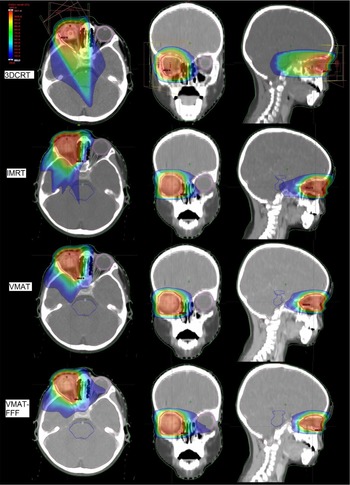
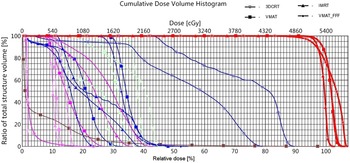
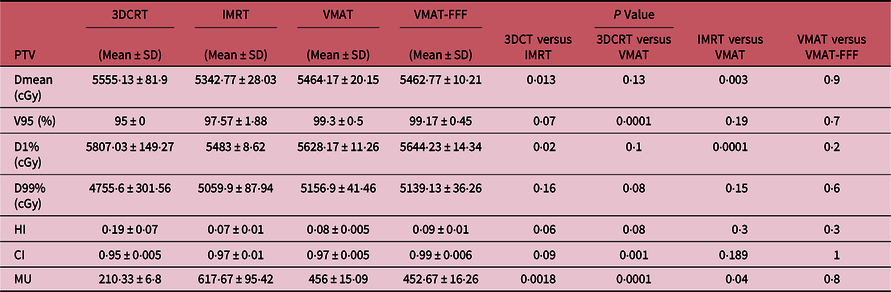
CT data sets of five patients were enrolled in the study and in total 20 plans were generated for these patients. Figures 1 and 2 depict typical dose distribution and DVH comparison among the four treatment techniques of one patient. Detailed dosimetric comparisons on target coverage are presented in Table 1. The target coverage of PTV for all the four modalities was clinically acceptable with a V95 of 95 ± 0%, 97·6 ± 1·87%, 99·3 ± 0·5% and 99·17 ± 0·45% for 3DCRT, IMRT, VMAT and VMAT-FFF respectively. VMAT technique showed statistically significant improved coverage of PTV in terms of V95 when compared with 3DCRT (p = 0·0001). D1% (cGy), which is the matrix for maximum dose, was lowest for the PTV in IMRT technique (5483 ± 8·6) and highest for 3DCRT technique (5807·03 ± 149·3). Significant difference observed between 3DCRT versus IMRT (p = 0·02) and IMRT versus VMAT (p = 0·001), but not with VMAT versus VMAT-FFF (p = 0·2). The HI of the 3DCRT, IMRT, VMAT and VMAT-FFF were 0·19 ± 0·08, 0·07 ± 0·01, 0·08 ± 0·005 and 0·09 ± 0·01 respectively.
Dose distribution comparison among 3DCRT, IMRT, VMAT and VMAT-FFF for one patient.

DVH comparison among 3DCRT, IMRT, VMAT and VMAT-FFF for one patient.

Comparison of target coverage for different techniques

SD, standard deviation.
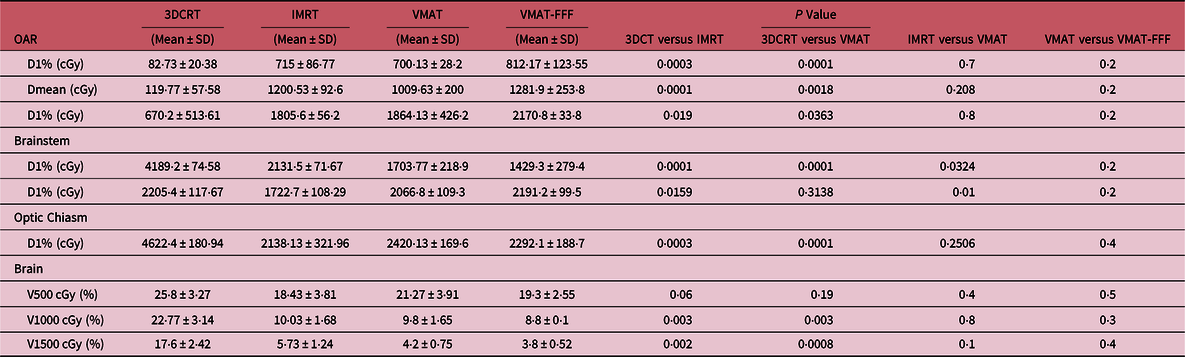
Table 2 lists the OARs protection comparison among four planning modalities. For the contralateral optic nerve, lens and eyeball, the received doses were well below their respective tolerance limits.
Comparison of OAR sparing for different techniques

OAR, organ at risk; SD, standard deviation.
The D1% (cGy) of the contralateral eyeballs were 670·2 ± 513·6, 1805·6 ± 56·2, 1864·1 ± 426·2 and 2170·8 ± 33·8 for 3DCRT, IMRT, VMAT and VMAT-FFF respectively. In this regard, 3DCRT showed significant reduction of dose when compared with IMRT (p = 0·02) and VMAT (p = 0·04). But no differences were observed between IMRT versus VMAT (p = 0·8) and VMAT versus VMAT-FFF (p = 0·2).
The doses of optic chiasm for all the plans were within tolerance limit. The D1% (cGy) were 4622·4 ± 180·9, 2138·1 ± 322, 2420·1 ± 169·6 and 2292·1 ± 188·7 for 3DCRT, IMRT, VMAT and VMAT-FFF respectively. Similarly doses to the brainstem for all the plans were within tolerance limit. The D1% of the brainstem was lowest for the VMAT-FFF technique (1429·37 ± 279·35) and highest for the 3DCRT technique (4189·2 ± 74·58). Significant difference was observed between 3DCRT versus IMRT (p = 0·0001), 3DCRT versus VMAT (p = 0·0001) and IMRT versus VMAT (p = 0·03) but not with VMAT versus VMAT-FFF (p = 0·25). The brain volumes receiving 500, 1,000 and 1,500 cGy were the greatest with the 3DCRT technique and maximum brain sparing achieved with VMAT technique. The average MUs of 3DCRT, IMRT, VMAT and VMAT-FFF plans were 210·3 ± 6·8, 617·67 ± 95·4, 456 ± 15·1 and 452·67 ± 16·2 respectively. VMAT plans have a significantly lower MU delivery as compared to the IMRT plans (p = 0·04); however, no significant difference was observed between VMAT and VMAT-FFF plans (p = 0·8).
The IMRT and VMAT plans achieved better brain sparing than 3DCRT plans. The brain volumes receiving 500, 1,000 and 1,500 cGy (V500, V1000 and V1500) are shown in the Table 2. Statistically significant brain sparing of IMRT and VMAT plans were observed in terms of V10 and V15 when compared with 3DCRT plans (p < 0·05).
Discussion
Dosimetric parameters of four different EBRT techniques used for treatment of retinoblastoma were compared in this study. The 3DCRT plans resulted a higher HI indicating poor homogenicity. The IMRT and the VMAT plans were more homogeneous than the 3DCRT plans but the statistical difference only reached borderline significance (3DCRT versus IMRT, p = 0·06 and 3DCRT versus VMAT, p = 0·08). The VMAT and IMRT plans had better target coverage (V95) than the 3DCRT plans (p = 0·001 and p = 0·07 respectively). There was no significant difference on target coverage observed between IMRT versus VMAT and VMAT versus VMAT-FFF. 3DCRT plans showed highest value of maximum dose (D1) within the target volume.
Deng Z et al. evaluated the dosimetric advantages of VMAT in the treatment of primary and secondary intraocular cancer comparing directly with 3DCRT and IMRT. Although no clear distinction on PTV coverage among 3DCRT, IMRT and VMAT plans was observed in the treatment of intraocular cancer, VMAT and IMRT achieved better homogeneity and conformity for target volume. Reference Deng, Shen and Zheng20
Due to the vicinity of critical organs, such as the lens, optic nerve, brainstem etc, optimising the dose coverage on target volumes while sparing critical organs has been a challenge in Radiotherapy of ocular malignancies. In this study, VMAT (p = 0·0001) and IMRT (p = 0·0001) plans significantly decreased the maximum dose (D1%) to the brainstem in comparison to the 3DCRT plans. In this regard, VMAT was found superior to IMRT plans (p = 0·03) but there was no significant difference between VMAT and VMAT-FFF.
In this study, the IMRT and the VMAT plans showed a significant increase of Dose (D1%) to the controlateral lens and the eyeball as compared to 3DCRT plans. Similar results were obtained by Deng Z et al. where they have recorded increased dose to the controlateral eyeball and lens with IMRT and VMAT technique as compared to 3DCRT plans. Reference Deng, Shen and Zheng20 However, in our study, the dose to the contralateral optic nerve (D1%) is lower with IMRT and VMAT plans as compared to the 3DCRT plans.
As for the dose delivery to the optic chiasm (D1%), the IMRT and the VMAT plans delivered significantly lower dose when compared with the 3DCRT plans (p = 0·0003 and p = 0·0001 respectively). However, there is no significant difference between IMRT versus VMAT and VMAT versus VMAT-FFF in this regard.
IMRT and VMAT plans were superior with respect to brain sparing than the 3DCRT plans. The brain volumes receiving 500, 1,000 and 1,500 cGy were greatest with 3DCRT plans. Eldebawy et al. compared ten different treatment techniques for radiotherapy in three retinoblastoma patients and found that VMAT, staeriotactic radiotherapy and electron beam plans provided greatest sparing of brain. Reference Eldebawy, Parker, Abdel Rahman and Freeman23
In this study, the VMAT and the IMRT plans had better conformity index as compared to the 3DCRT plans (3DCRT versus VMAT, p = 0·001); however, no significant difference in CI was found between IMRT versus VMAT and VMAT versus VMAT-FFF plans. In a study by Vanetti et al., IMRT and VMAT plans were equivalent in terms of CI while in another study by Bertelsen et al., VMAT improved the CI compared with IMRT in treatment of head and neck cancers. Reference Vanetti, Clivio and Nicolini24,Reference Bertelsen, Hansen, Johansen and Brink25
In our study, the VMAT plans significantly reduced the MU delivery in comparison to the IMRT plans (p = 0·04). This is consistent with previous studies. Reference Deng, Shen and Zheng20,Reference Wu, Xie and Hu16 Because of the delivery of more MUs and leakage of radiation in IMRT, there is increased potential of developing second malignancies in long-term survivors. Reference Hall26
The main limitation of our study is the small sample size. This is because there are few patients presents to us for radiotherapy.
Conclusion
The traditionally used anterior and lateral wedged portals negatively affect the dose distribution and OAR sparing. In our study, the VMAT and IMRT plans achieved statistically significant better target coverage than the 3DCRT plans and delivered less dose to the brainstem, optic chiasm and the brain. The use of VMAT-FFF beams did not show any benefit over VMAT in target coverage and OAR sparing. Although VMAT and IMRT showed mixed results on target coverage and OAR sparing, the VMAT plans were superior to the IMRT plans in respect to MU delivery. Moreover, VMAT delivered significantly lower dose to the brainstem and contralateral optic nerve. Therefore, VMAT should be used as the preferred external beam radiotherapy technique in the treatment of retinoblastoma. However, IMRT and VMAT should be used with caution because of increased low dose volumes to the contralateral lens and eyeball.
Acknowledgements
None.
Financial Disclosure
None.
Conflicts of Interest
None.
Ethical Approval
The sudy was approved by Institutional Ethics Commitee.