1. Introduction
In thinking about the social structures of science, philosophers of science and metascientists have for some time now predominantly adopted an ‘economic approach’, where scientists are modeled as credit-maximizing agents responding to incentives such as promotion, funding, or publication criteria (Kitcher Reference Kitcher1990; Strevens Reference Strevens2006; Smaldino and McElreath Reference Smaldino and McElreath2016; Heesen Reference Heesen2018; O’Connor Reference O’Connor2019).
Yet in applied ethics, sociology of science, and to some extent also science policy, an ‘ethical approach’ informs research on the social structures of science: individual scientists are represented as agents capable of acting contrary to incentive structures and concerned with the virtues and ideals of research integrity, such as honesty, respect, or reliability (ALLEA 2017; Carvalho Reference Carvalho, Huisman and Tight2017; Forsberg et al. Reference Forsberg2018; Pennock Reference Pennock2019; Desmond Reference Desmond2020).
Philosophers of science and metascientists do not openly dismiss the value of research integrity as such. In economic approaches, the capacity for ethical decision-making is implicitly assigned to policy makers (or the “philosopher-monarchs” in Kitcher [Reference Kitcher1990]): these agents take the long view and decide on how incentives should be designed. However, the question arises whether the ethical approach to the decision-making of individual scientists brings anything to the explanatory table that cannot be covered by the economic approach. For instance, individual concern with honesty could be reduced to minimizing the expected penalties (negative credit) following a strategy of dishonesty; concern for reliability could be explained as maximizing replicable studies, which can be modeled as having a higher payoff than nonreplicable studies (as in Heesen Reference Heesen2018).
Moreover, what is it, if anything, that prevents one from taking a cynical stance on the ideals of individual scientists, that is, that these ideals are mere window dressing, ineffectual against the brutal reality of credit maximization? Indeed, the view that individual scientists should be credit maximizers, in the interests of scientific progress, seems viable (Kitcher Reference Kitcher1990).
The importance of this question extends to economic approaches to science policy. Consider, for instance, how, in order to increase individual scientists’ honesty, some have called for increased penalties for fraud, even to the extent of making criminal prosecutions of scientific misconduct more widespread (see, e.g., Collier Reference Collier2015). Similarly, it is proposed that individuals’ concern for reliability can be improved by incentivizing replication research, for instance, by giving funding and “badges” to scientists doing replication studies (Munafò et al. Reference Munafò, Nosek, Bishop, Button, Chambers, Sert, Simonsohn, Wagenmakers, Ware and Ioannidis2017) or by introducing “Replication Awards” (Gorgolewski et al. Reference Gorgolewski, Nichols, Kennedy, Poline and Poldrack2018).
This article will focus on default trust between scientists as something that cannot be engineered by incentive reform. This will be defined in detail later on (in sec. 2), but the core idea is that scientists tend to believe that their colleagues are telling the truth—or are at least attempting to do so. This default trust in each others’ assertions underlies many core scientific behaviors—peer review and collaboration are considered as illustrative examples—and thus may be considered integral to scientific research.
Given widespread problems with reproducibility and replicability (Baker Reference Baker2016)—or at least, the perception that such problems are widespread (Fanelli Reference Fanelli2018)—default trust can be said to be under pressure.Footnote 1 I then consider one of the most important proposed policy reforms to the credit-based incentive structure of science: incentivizing replication research. Replication research basically acts to disincentivize low-credence assertions. The question then becomes: Can incentivizing replication safeguard default trust? Using an expanded version of Heesen’s model of when replicable (or trustworthy) assertions maximize credit (sec. 3), I show that, no matter how much replication research is incentivized, default trust cannot be justified in a culture of credit maximization (sec. 4).
One upshot is that the economic model cannot account for an important explanandum concerning scientific practice (i.e., default trust). Another, more normative upshot is that a culture of extreme credit maximization ultimately erodes default trust between scientists and even gives rise to a ‘default lack of trust’. This shows why it would be misguided for policy efforts to focus on incentive reform alone.
2. Default Trust in Scientific Research
In the literature on trust (for a summary, see Hawley Reference Hawley2012), trust in an assertion φ is typically understood to depend on the asserting agent’s intention to tell the truth and competence to know that φ. If the agent either lacks knowledge or is dishonest, trust would be misplaced. For example, if a climate scientist tells me that humans are responsible for global warming, I will trust that assertion when I believe that the climate scientist has the right type of competence (understanding of climatological processes, familiarity with the data, understanding of statistical methods) and the intention to tell the truth (and thus, e.g., to carefully consider alternative hypotheses).
With this in mind, I posit the following thesis:
Default Trust (DT). If scientist A with competence in field F makes an assertion φ, then scientist B believes φ, unless B has an honest disagreement with φ due to an incompatible prior belief φ′.
The trust is ‘default’ in the sense that the trustworthiness of A is not called into question: if A possesses the right type of competence, then A can be trusted because A’s intention to tell the truth is not doubted. Note that DT does not imply agreement: B can withhold high credence in φ if φ is incompatible with a prior belief φ′ of B.
DT can be read both normatively and descriptively. In a normative reading, DT is an ideal for the scientific ethos, even though actual behavior may fall short. For instance, a sensational but questionable assertion φ that enhances A’s career could be distrusted by colleagues. Thus in reality, the stances scientists adopt toward each other may not necessarily correspond to ‘default trust’.
This article, unless otherwise specified, will primarily be concerned with the descriptive reading: DT between scientific colleagues characterizes a number of core scientific practices. This descriptive reading does not imply that the scientific ethos is only defined by DT—there is room for lack of trust and for distrust, under certain circumstances. It just holds that the activity of scientific research is characterized by considerable DT and, moreover, that core scientific practices would not be possible without DT.
Take, for instance, peer review. As is often acknowledged, the peer review system is not designed to detect intentional fraud (Crocker and Cooper Reference Crocker and Cooper2011; Horbach and Halffman Reference Horbach and Halffman2018). When peer reviewer B evaluates an assertion φ by author A, B does not necessarily have a way of detecting falsification or fabrication by analysis of the manuscript alone. Image that manipulation (of, e.g., Western blots) or statistically unlikely patterns in the raw data can be detected; nonetheless, high-profile cases of repeated fabrication have gone undetected by peer review (e.g., Diederik Stapel; cf. discussion in Crocker and Cooper Reference Crocker and Cooper2011). The peer reviewer can only primarily check the soundness of the manuscript, by looking for possible errors in the methodology or reasoning or ascertaining whether the manuscript’s assertions cohere with the reviewer’s background beliefs. In other words, the reviewer primarily checks for honest errors.
Collaboration is another core scientific practice that would be impossible without DT. Consider a collaboration between two scientists A and B, where A and B have different specializations (i.e., competences) and where B uses A’s analysis and conclusion φ to support further analysis. Then B must ultimately trust A’s assertion φ unless B would want to redo A’s work. Depending on the degree to which φ was unexpected for B, B may of course check in with A for honest errors and whether A’s implicit subassertions φ1, φ2, … actually imply φ. Nonetheless, at some point B must trust A’s work and will not be able to check everything—unless B starts redoing A’s work, but then one can no longer speak of a “collaboration” between A and B. In this sense, DT is a necessary precondition for collaboration.
These core practices illustrate how communication between scientists is permeated by DT and that were such DT not justified in most cases, then many core scientific practices including peer review and collaboration would need to be abandoned. Since it is not obvious how a competitive, credit-maximizing model of scientific endeavor can explain such justified DT, the justified DT among scientists can be posited as an explanandum that should be accounted for.
In what follows, we will be focusing attention on the question (in connection with credit maximization): When is DT justified? Here it is important to distinguish between two ways in which B’s trust in scientist A’s assertion can be undermined. The first is by reasons to believe that A made an (honest) error in the experimental design, data collection, or data analysis. Thus, the assertion φ may not be compatible with the other agent’s existing (high credence) beliefs, prompting skepticism toward φ. Note that such reasons can undermine trust in whole fields F, for instance, if it becomes known that a whole field is suffering from widespread methodological problems (see, e.g., Sorkin et al. Reference Sorkin, Kuszak, Williamson, Hopp and Betz2016). However, such undermining reasons do not undermine DT: A’s intention to tell the truth is not doubted.
The second way, and more relevant for purposes here, that trust can be undermined is by learning about the intentions of the scientist for asserting φ. For instance, if scientist A claims that “smoking does not cause lung cancer” and scientist B finds out that A is being funded by a tobacco company, this not only undermines any trust B might have had in φ but also undermines B’s DT in A.
3. Credit-Maximizing Norms of Assertion
What is particularly pernicious or disturbing about the problems of sloppy science—the cutting of corners—is that it suggests a widespread culture of scientists putting career over the truth and, hence, presents a ubiquitous defeater for the DT in any scientist. In fact, scientists have long reported that trust is undermined by metric-based incentive structures that actively promote competition (Anderson et al. Reference Anderson, Ronning, Vries and Martinson2007). The question I will consider is: Can the credit-maximizing incentive structure be reformed in such a way that DT is safeguarded? Or is this a false expectation?
I will approach this question in the following way: How can the norm of assertion of a credit-maximizing scientist be manipulated by incentivizing replication, such that DT in that scientist’s assertions is justified? The norm of assertion can be stated as follows:
Credit-Maximizing Norm of Assertion. Scientist A must choose to assert φ out of an associated set of possible assertions Φ when φ maximizes the expected credit function C.
Here φ’s associated set of possible assertions is defined as
 , where the various φ(i) are variations, sometimes minute, of the same basic idea but with a different (sometimes radically different) expected payoff or credit C(φ(i)).
Note that this norm of assertion is very unlike the norms of assertion traditionally defended by epistemologists (e.g., Williamson Reference Williamson2000), which for instance, state that an agent can only assert φ when the agent knows φ or has a high credence in φ. Within a credit-maximizing model, it may be ‘rational’ for a scientist A to assert φ even though A does not know φ and may even have a low credence in φ.
Stating that such a norm of assertion is rational (relative to a credit-maximizing framework) does not mean that it is necessarily desirable. An unchecked growth in assertions with low credence would mean the death of science, since discourse would be flooded with low-credence (and likely false) statements. Hence in a credit maximization model, there needs to be a correction mechanism that disincentivizes low-credence assertions. The main mechanism that is considered today is replication research.
To further operationalize this norm of assertion, I will expand on Heesen’s (Reference Heesen2018) model of how credit-maximizing scientists should balance speed of output with replicability. In this model, articles or assertions that cannot be replicated have lower expected credit (e.g., through reputation loss), but high-credence (and likely replicable) assertions require more investment and thus are made at a lower frequency. In particular, Heesen uses the following expected credit function:

where p = scientist’s credence that assertion is accurate (and also the credence that the assertion is replicable), λ(p) = expected speed for constructing an article of replicability p, α = probability of acceptance of erroneous article, β = probability of acceptance of accurate article, and ce (ca) = average credit accrual with erroneous (accurate) publication. Note that, in Heesen’s model, the “replicability” of an assertion is scientist A’s credence in an assertion and not the actual replicability: the assumption is thus that this expected replicability closely adheres to actual replicability.Footnote 2 (This is a reasonable assumption, because, if it were false, and if the scientist’s own estimate of replicability was not in any way a reliable indicator of actual replicability, then aiming at credit maximization would not be a good strategy to maximize credit.)
The credit-maximizing norm of assertion based on Heesen’s expected credit function can be described as follows. A scientist must decide between a set of possible assertions
 , where φ has the lowest replicability (but requires the least research work in order to assert) and φ(n) has the highest replicability (and requires the most research work in order to assert). The norm of assertion is not to choose to assert the φ(i) in which the scientist has highest credence but, rather, to assert the φ(j) that has the best trade-off between replicability and speed of publication (and thus highest expected credit).
This credit-maximizing norm does not necessarily undermine DT. In fact, it could be reinterpreted as a form of practical wisdom: attempting to do the best research one can without succumbing to perfectionism. When a researcher gives in to perfectionism, marginal improvements in accuracy are eked out at great cost, thus sabotaging future research and overall credit. From an ethical perspective, there is nothing necessarily nonintegrous about avoiding perfectionism. It is still about doing the best research one can but considered over a longer timescale instead of one publication at a time.
To map the issues concerning DT, we need a more complex and realistic model of credit maximization. First of all, not all original assertions are subjected to replication research: by and large, only significant assertions are. This is inevitable: by some estimates (Ware and Mabe Reference Ware and Mabe2015), 2.5 million articles were published in 2014, and with a historical growth rate of 3%, this would imply over 3 million articles will be published in 2021. Some selection is needed.Footnote 3 Normative guidelines on replication also reflect this reality: a recent guideline explicitly recommends that replication researchers prioritize those assertions when the results from replication will have a “major impact on scientific knowledge” (KNAW 2018). Or to put it more crudely: do not bother with replicating insignificant assertions. Hence, the credit-maximizing scientist must take the significance of the assertion into consideration:
Significance of an assertion φ. Novel, important, or surprising assertions gain more attention than trivial or wholly expected assertions and are more likely to be the target of replication research.
The second element that should be present in a more realistic model of credit maximization reflects the fact that replication studies do not always give clear answers (Gilbert et al. Reference Gilbert, King, Pettigrew and Wilson2016). Thus, one can submit an assertion φ to replication research and subsequently not be able to decide whether φ has been confirmed or falsified. This is especially the case when direct replications (in which all the necessary elements of a procedure are replicated but with different data) are not possible, leaving only conceptual replications (in which the procedure is varied). While it is a complex and ongoing question how replications should be conducted (for extensive discussion, see Zwaan et al. Reference Zwaan, Etz, Lucas and Donnellan2018), it is safe to say that some assertions are more falsifiable by replication studies than others and that this falsifiability is relatively independent of the significance of the assertion. Hence, one can posit a second additional factor influencing the credit-maximizing norm:
Falsifiability of an assertion φ. Some assertions can be easily confirmed or falsified by replication studies, whereas for other assertions, especially those relying on complex data, replication studies do not either confirm or falsify the original assertion.
In sum, the set of possible assertions Φ can be mapped out on a three-dimensional space where the axes are significance, falsifiability, and accuracy. These three dimensions determine whether an assertion will be subjected to replication research at all (significance) and the probability the replication research will yield a clear confirmation, or a clear falsification, or neither (falsifiability and accuracy).
This means that four scenarios must be distinguished with regard to the fate of an assertion with regard to replicability. First, the assertion is conclusively and successfully replicated, with probability P(↑) and credit accrual C ↑. Second, the assertion conclusively fails to replicate, with probability P(↓) and credit accrual of C ↓. Third, the assertion does not conclusively replicate, nor is it conclusively falsified (not replicated), with probability P(↔) and credit accrual C ↔. And finally, the assertion is not subjected to a replication study, with probability P (0) and credit accrual C 0.
As in Heesen (Reference Heesen2018), I assume that C ↑ is the largest value, and C ↓ the smallest. In addition, I assume that C ↔ is larger than C 0, because an assertion that is not deemed significant to replicate will typically only be published in lower-ranking journals, whereas some results that cannot be conclusively reproduced may still find their way into a high-ranking journal (as documented by Brembs Reference Brembs2018).
With these four scenarios, the expected credit function of an assertion φ made by scientist A becomes

Here the exogenous structural incentive for replication research (e.g., funding, badges, or awards) is inversely correlated with the probability that an assertion of average significance is not subjected to a replication study. (If an assertion is very significant [or insignificant], the probability of being subjected to replication may be 1 [or 0] regardless of the strength of the structural incentive.)
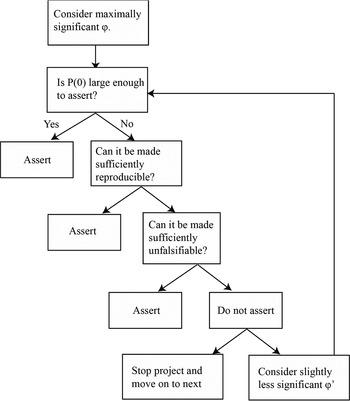
The function C A depends on three independent variables,Footnote 4 and thus the topology of extrema of C A is likely to be such that there may not be any single way to maximize credit. In other words, there may be different credit-maximizing strategies. Nonetheless, instead of viewing credit maximization as an analytic calculation (as is possible in Heesen’s model), one can also think of credit maximization as an iterative search process. This search thus consists of a decision tree an agent will follow in a quest to maximize credit.
Consider the following example of a rather simple search strategy: the scientist first starts with the most significant assertion, which maximizes the largest credit accrual type C
↑, and from there goes down the ladder of payoffs guided by
 . In more detail:
a) Look for a maximally significant φ (minimizing P(0)).
b) If, with some effort, it can be made sufficiently reproducible (maximizing P(↑) while minimizing P(↔) and P(↓)), then assert. This is the ideal, maximum payoff scenario.
c) If, with another additional effort, φ unfalsifiability can be maximized, then assert.
d) If not, consider a next assertion φ′ in Φ with slightly lower significance, and either (when potential payoff is high enough) go through the same process again or else consider the project to be a failure and move on.
e) If stopping without assertion is not an option (e.g., due to large investment in starting up the project), then in the worst case scenario the search process is stopped on arriving at a maximally significant assertion φ(n), which is just about insignificant enough that it will not attract any attention. Such a norm can be asserted.
Note that this decision-making process makes two, reasonably plausible, assumptions. The first is that a scientist must also decide whether it is worth continuing the search, or in other words, whether the additional investment needed for continuing the search is less than the expected payoff. The second is that peer review does not present an obstacle for the assertion of φ, so that if φ is unfalsifiable, the scientist is sufficiently experienced to hide its unfalsifiability. If φ is not highly significant, then the assertion will be published in a lower-ranked journal.
4. Credit Maximization and Trust
The illustrative credit-maximizing reasoning sketched in figure 1 is linear and highly simplified and does not reflect, for instance, how researchers may simultaneously consider multiple possible assertions. The main lesson to be drawn is that, in a research culture characterized by credit maximization, another scientist B can know that A has followed some credit-maximizing decision-making tree prior to assertion. In other words, the function C A is common knowledge, and the associated norm of assertion is a social norm (cf. Bicchieri Reference Bicchieri2016): A asserts φ only when A believes C A(φ) is maximal, B knows that A only asserts φ when C A(φ) is believed to be maximal, A knows that B knows, and so on. Given such a credit-maximizing culture, B may not know which precise search strategy A employs, but B can know that A is swayed by credence (or accuracy), significance, and falsifiability and hence that A could assert φ without knowing φ or even having a high credence in φ.
Example decision tree a credit-maximizing scientist could use to search Φ for an assertion with maximal expected credit.

This may sound like a defeater for trust, but that is why replication research is so important: it makes it difficult for A to get away with low-credence assertions. Hence, if replication research is incentivized (lowering P(0)), B knows that A is less likely to assert φ without A’s credence in φ, P(↑), being high. Thus, incentivizing replication research can help maintain B’s trust in A’s assertions.
So while incentivizing replication may increase trust, the question becomes whether it is sufficient to maintain (justified) DT in a culture defined by a norm of credit maximization as described by C A. Recall that DT is a type of trust in which the truth-telling intentions of A are not questioned: A’s assertion φ is evidence of A’s high credence in φ. However, DT can be undermined by beliefs about the intentions of A. For instance, B knows that if A’s assertion φ is relatively insignificant, then φ is unlikely to be submitted to replication research (P(0) is high). Similarly, B knows that, if φ seems difficult to falsify, then a replication study of φ may not be conclusive (P(↔) is high). In both these cases, B knows that A can conceivably assert without high credence. In other words, B can only safely infer A’s high credence when A makes a significant and falsifiable assertion. Given these considerations, a credit-maximizing norm of assertion only gives support for the following sense of qualified trust:
Justified Qualified Trust. If scientist A specialized in field F makes an assertion Φ, then scientist B is only justified in believing φ when φ is highly significant and clearly falsifiable.
How can significance and falsifiability be estimated by scientist B? The former is relatively straightforward: since B is an expert in the field, B can often directly infer, from his or her background knowledge, whether an assertion φ is significant. Hence, B can assume that if A is making a highly significant assertion, A will know that it will attract replication research and will want to minimize the probability of falsification.
Falsifiability is more difficult to assess by B. Failure to replicate surprisingly often does not imply that the assertion φ is false (see again Zwaan et al. Reference Zwaan, Etz, Lucas and Donnellan2018). Nonetheless, the falsifiability of an assertion can be explicitly signaled by an author. For instance, the author can provide minute procedural detail, thereby giving explicit instructions on how to replicate the findings. Or, the author can share the raw data on which the assertion was based. These, not coincidentally, are some of the core measures proposed to increase reproducibility of research (Munafò et al. Reference Munafò, Nosek, Bishop, Button, Chambers, Sert, Simonsohn, Wagenmakers, Ware and Ioannidis2017): perhaps more importantly, such measures also increase qualified trust in a credit-maximizing world.
5. Conclusion
In a world where assertions can be not only be true or false but also significant or insignificant or easily falsifiable or not, it becomes impossible to assume that scientists can be sufficiently incentivized to only make assertions that can be maximally replicated. Not all strategies for success align with truth telling. This means that DT, in a sufficiently sophisticated credit-maximizing culture, cannot be justified.
There is nothing inherently wrong about the scientific enterprise having some elements of the jungle, with scientists jostling to make assertions of significance, even though this can occasionally lead to untrustworthy science. Nonetheless, given how crucial DT is for basic scientific practices like peer review or collaboration, it would seem important to place limits on what one can expect from efforts to engineer incentive structures.