As anyone who has visited Taos, Tuba City, or Tucson knows, turquoise and its many hues are inextricably linked to concepts of the US Southwest. This connection is hardly new; archaeologists have long recognized that turquoise was valued among many of the region's prehispanic societies. Many consider the valuation and distribution of turquoise within an economic framework (e.g., Di Peso Reference Di Peso1968; Frisbie Reference Frisbie1980; Lummis Reference Lummis1920:219; Riley Reference Riley1980:15), and focus on questions of procurement and exchange (e.g., Harbottle and Weigand Reference Harbottle and Weigand1992; Hull et al., Reference Hull, Fayek, Mathien, Shelley and Durand2008; Judge et al. Reference Judge, Gillespie, Lekson, Toll and Schroeder1981; Mathien Reference Mathien1981, Reference Mathien, McGuire and Mathien1986, Reference Mathien, Ericson and Baugh1993; Reyman Reference Reyman and Reyman1995; Snow Reference Snow1973; Weigand Reference Weigand and Doyel1992, Reference Weigand, Craig and West1994; Weigand and Harbottle Reference Weigand, Harbottle, Ericson and Baugh1993; Weigand et al. Reference Weigand, Harbottle, Sayre, Earle and Ericson1977; Windes Reference Windes1987, Reference Windes and Doyel1992; Young et al. Reference Young, Phillips, Mathien, Demirci, Ozer and Summers1994).
Noneconomic explanations for the widespread, prehispanic use of turquoise are gaining traction, drawing from indigenous insight and expanding discussion to include the mineral's subtler symbolic associations (Hedquist Reference Hedquist2016, Reference Hedquist2017; Mathien Reference Mathien2001; Mills Reference Mills, Mills and Walker2008; Plog Reference Plog2003; Shepard et al. Reference Shepard, Schwartz, Russell, Weiner and Nelson2017; Weiner Reference Weiner2015; Whiteley Reference Whiteley, King, Carocci, Cartwright, McEwan and Stacey2012). Turquoise, it seems, was but one of several components within a blue-green complex, referencing and petitioning the cyclic movement of life-sustaining moisture. The multifaceted use of blue-green is, we suggest, interwoven with the Uto-Aztecan Flower World, as described by Hays-Gilpin and Hill (Reference Hays-Gilpin, Hill and Hegmon2000; see also Hill Reference Hill1992; Stephen Reference Stephen and Parsons1936:165).
Others have argued that, within the prehispanic blue-green complex, turquoise was valued as a vector of meaning and power, rather than because of its specific mineralogy (Hedquist Reference Hedquist2016, Reference Hedquist2017; Shepard et al. Reference Shepard, Schwartz, Russell, Weiner and Nelson2017; Weiner Reference Weiner2015), a conclusion based on both archaeological and ethnographic evidence (e.g., Parsons Reference Parsons1939:555; Plog and Heitman Reference Plog and Heitman2010; Stephen Reference Stephen and Parsons1936:165). Turquoise was not the only blue-green mineral to have garnered such veneration. Others include azurite, malachite, serpentine, and chrysocolla,Footnote 1 suggesting that the manifestation of the blue-green color (and perhaps other shared properties) was more important than mineralogical particulars.
Given the longstanding importance of the blue-green complex, one would expect to encounter overlapping and redundant means of preserving and sharing it. Our fundamental research objective, then, is to explore the more subtle and nuanced ways in which the blue-green complex was embedded and reified in everyday life and practice.
Archaeological and ethnographic data indicate that the use of blue-green was one of many strategies to reference the blue-green complex. Others involved the depiction of flowers, clouds, rainbows, and riverine insects (see Hays-Gilpin and Hill Reference Hays-Gilpin, Hill and Hegmon2000), lyrical description (e.g., Hill Reference Hill1992), and metaphor in dress (e.g., Roediger Reference Roediger1941:132). J. J. Brody suspected that hachure on Chacoan pottery—shu'k’ish-pa-tsí-nan in Zuni (Cushing Reference Cushing1886:488)—might have represented the color blue-green (Plog Reference Plog2003:670). To test Brody's hypothesis, Plog (Reference Plog2003:673) first identified instances where Pueblo potters suggested that hachure was, in fact, conceptualized as a color (Bunzel Reference Bunzel1929:35, 42). He then examined nonceramic Chacoan artifacts that include blue-green, focusing on the color's incorporation into overall designs. He documented a pattern of similarly rendered, similarly incorporated motifs on Gallup-Dogoszhi pottery, albeit rendered in hachure. Thus, Plog argued that Chacoan hachure served as a proxy for blue-green at a time when blue-green paint could not survive the firing process (see Rice Reference Rice1987:333; Shepard Reference Shepard1961:32).
Over a decade has passed since Plog's (Reference Plog2003) analysis, yet there has been little effort to see whether the use of hachure as a substitute for blue-green extended beyond the Chacoan horizon. One place to look is within Mimbres society. In this paper, we test the hypothesis that Mimbres hachure, like Chacoan hachure, served as a visual proxy for the color blue-green.
Although the Chaco and Mimbres phenomena were largely contemporaneous and relatively close (but not adjacent or overlapping; see Figure 1), they developed in remarkably different ways. Whereas Bonito phase (AD 920–1130) Chacoan culture emphasized expansion, ostentation, and nonlocal interaction (e.g., Judge Reference Judge, Cordell and Gummerman1989; Kantner Reference Kantner1999; Lekson Reference Lekson1999, Reference Lekson2007; Reed Reference Reed2004; Swentzell Reference Swentzell and Noble2004:50), Classic period (AD 1000–1130) Mimbres society developed as a small-scale, insular network with little evident connection to what was going on in the north. Given these differences, the few things held in common stand out, including the early introduction of large masonry pueblos, interest in Mesoamerican materials, noteworthy turquoise consumption, and the early use of black hachure on white-slipped pottery (see Anyon and LeBlanc Reference Anyon and LeBlanc1984:306–307; Brody Reference Brody2004; Crown and Hurst Reference Crown and Jeffrey2009; Lekson Reference Lekson, Duran and Kirkpatrick1992:116, Reference Lekson1999:52–53; Plog Reference Plog2003).
Map of New Mexico, showing locations of Chaco Canyon and Mimbres River Valley.

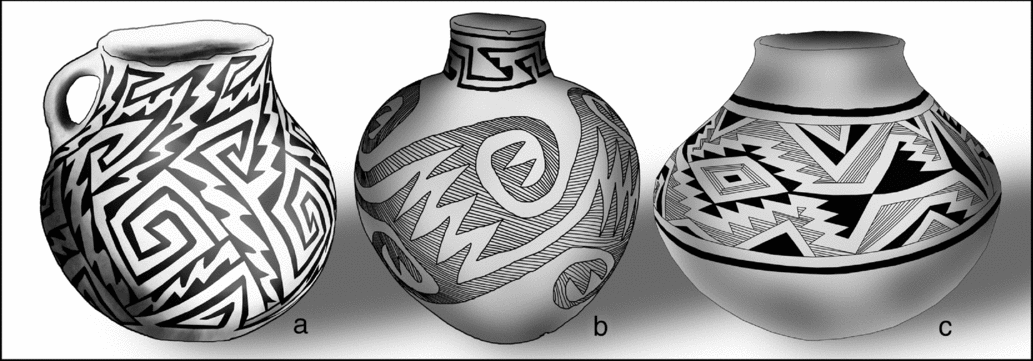
In comparing the meaning(s) of Chacoan and Mimbres hachure, we acknowledge some significant differences, such as the relationship between hachured and solid elements. Some of the best-known examples of Chacoan hachure involve the Gallup-Dogoszhi style, with geometric designs not unlike those of contemporaneous local types (Plog Reference Plog2003:667). The primary difference is that, while Gallup-Dogoszhi patterns are constructed almost exclusively from hachured elements (Hays-Gilpin and van Hartesveldt Reference Hays-Gilpin and van Hartesveldt1998:118), patterns on other Northern San Juan pottery are executed almost entirely in solid black (Colton and Hargrave Reference Colton and Hargrave1937; see Figures 2a and 2b). On rare occasions, Chacoan vessels combine the two styles with interlocking elements of solid and hachure (Plog Reference Plog2003:678). While this combination was infrequent in San Juan pottery during the 1000s and early 1100s, it was increasingly common first in the Mimbres region (Mimbres black-on-white; Figure 2c) and then in the Mogollon Highlands (Reserve Black-on-white) (Brody Reference Brody2004; Rinaldo and Bluhm Reference Rinaldo and Bluhm1956; Shafer and Brewington Reference Shafer and Brewington1995). In fact, the use of interlocking solid and hachure appeared during the Three Circle phase (AD 750–1000) and became increasingly popular throughout the Mimbres Classic period (Russell Reference Russell2009).
Three jars from the (2a, 2b) Chaco and (2c) Mimbres regions. (2a) Sosi Black-on-white pitcher, after image by American Southwest Virtual Museum; (2b) Gallup-Dogoszhi Black-on-white jar, after image by American Southwest Virtual Museum; (2c) Middle Style III Mimbres black-on-white jar, after MimPIDD 8729. Not to scale.

Stylistic relationships between hachure and solid black may have conveyed additional meaning. Chacoan vessels rarely incorporate both elements, but, when they do, the two are generally separated (Plog Reference Plog2003:678). A notable example is a double-cylinder jar from LA59497 (see Figure 3a). The only other known double-cylinder jar (see Figure 3b), from Pueblo Bonito, is decorated entirely with hachure. In contrast, only half of the LA59497 specimen received this treatment, the other half being painted with a solid black design. Post wrote that the
separation of the solid and hatchured layouts suggests a duality that cannot be fully appreciated by studying individual sherds or even individual vessels that have a single style represented. I doubt that the solid and hatchure design styles are indicative of cultural identity; instead, they are suggestive or symbolic of belief systems. (Post Reference Post1993:49)
The only known Chacoan double-cylinder vessels, both decorated in the Gallup-Dogoszhi style. (3a) Extramural burial, LA59497, after Post (Reference Post1993:Figure 7); (3b) kiva, Pueblo Bonito, after image by Peabody Museum of Archaeology and Ethnology. Not to scale.

We agree with Post's inference of dualism but suggest, based on Puebloan ethnographies, that the two design styles are more likely to represent opposing or complementary components within a single belief system rather than distinct systems. The question of how far this belief system extended coincides with our paper's primary objective. That is, Plog's symbolic findings and Post's hypothesized duality may have operated both within and beyond Chacoan society. At this scale, differences in the presentation of hachure may be “indicative of cultural identity” (Post Reference Post1993:49) after all.
We offer three analyses to test the hypothesis that Mimbres hachure, like Chacoan hachure, served as a proxy for blue-green. First, like Plog, we compare the use of hachured elements (in Mimbres pottery) to the use of blue-green elements (in nonceramic artifacts). Stylistic correlation would suggest conceptual interchangeability. Second, we compare the use of hachure (in Mimbres black-on-white vessels) to the use of color (in Mimbres Polychrome). If hachure was a substitute for blue-green, we would expect the two decorative techniques to be incorporated in similar ways. That is, hachured panels and colored panels should be incorporated similarly despite occurring in different pottery types. Third, we examine differences in hachure use across a series of Mimbres motifs, some being more likely than others to have conceptual associations with blue-green. If hachure served as a proxy for blue-green, we would expect motifs with pan-Puebloan, blue-green associations to be preferentially decorated with hachure.
Because there is no universally accepted Mimbres typology, we need to define some of the Mimbres-specific terms we use. At the broadest scale, our concern is with what we call the Mimbres ceramic series. As a categorical scale, this is largely analogous to a pottery ware. Some authors refer to “Mimbres White Ware,” but we avoid the term because, with few exceptions, Mimbres potters used brown paste. Using “Mimbres Brown Ware” is no less problematic, in that the term is often used to describe unpainted pottery from the region.
The Mimbres ceramic series includes at least five distinct, decorated types: Three Circle Red-on-white, Style I Black-on-white, Style II Black-on-white, Style III Black-on-white, and Mimbres Polychrome (see Supplemental Table 1). Using pottery from well-dated contexts at the large, multicomponent site of NAN Ranch, Shafer and Brewington (Reference Shafer and Brewington1995) subdivided Styles I, II, and III into several refined micro-styles (see also Shafer and Taylor Reference Shafer and Taylor1986).
One might add Mogollon Red-on-brown and/or San Francisco Red to the front end of the series, but their distributions are larger than the eventual extent of the Mimbres region, suggesting that they are best thought of as generally Mogollon, rather than specifically Mimbres. Livesay (Reference Livesay2013) has argued for distinguishing, in select cases, between (reduced) black-on-white and (oxidized) red-on-white decoration during the Classic period. Her position has yet to be widely accepted, and we have decided not to make the distinction here. We also note that Mimbres Polychrome is not universally recognized as a distinct type. Some researchers see polychromatic vessels, which are quite rare, as a Style III Black-on-white variant. A portion of this paper involves the comparison of designs on Mimbres Polychrome vessels to those on vessels with only black-on-white color schemes. We refer to the latter as Mimbres black-on-white, a colloquial term encompassing Styles I, II, and III, as well as Shafer and Brewington's (Reference Shafer and Brewington1995) Style II/III Black-on-white and all micro-styles.
Cross-Media Comparisons
Here, we mirror Plog's (Reference Plog2003) analysis by comparing the use of color on nonceramic artifacts to the placement of hachure in Mimbres pottery designs. If Mimbres hachure, like Chacoan hachure, represents blue-green, we would expect stylistic similarities in how the two decorative approaches were incorporated into larger designs. We examine images of nonceramic artifacts in museums and private collections, along with photographs of vessels in the Mimbres Pottery Images Digital Database (MimPIDD).
Unlike at Chaco, there are few multicolored Mimbres artifacts. Many of those in our sample are also from poorly dated Mogollon cave deposits that may or may not correspond directly with Mimbres society. Turquoise mosaics at Mimbres sites are frequently encountered as concentrations of detached tesserae. Thus, while some comparisons are possible, they are largely anecdotal and produce mixed results. Supplemental Figure 1a, for example, shows one of two shell pendants from Swarts, each depicting a bird and snake, the latter's tail encircling turquoise. One Mimbres vessel has a similar motif (Supplemental Figure 1b), repeated three times. In the bowl, however, the snakes are hachured, their tails do not form complete circles, and there is no hachure enclosed by the tail. Thus, there is no parallel use of turquoise and hachure in this cross-media example. There are several Mimbres bowls with quadrupeds whose tails encircle hachured elements (Supplemental Figure 1c), but this similarity is hardly compelling.
Elsewhere, correspondence between blue-green and hachure is entirely absent. In Supplemental Figure 2a, for example, turquoise was used to represent flower petals within a mosaic. Similar motifs, carved from wood and painted, are known from prehispanic caches (Supplemental Figure 2b) and some historic Pueblo altars (Fox Reference Fox1988; Geertz Reference Geertz1987; Stevenson Reference Stevenson1904:Plate 103; Wright Reference Wright1973). Several Mimbres bowls depict similar flowers (Supplemental Figure 2c), some with hachured centers, but none with hachured petals. Supplemental Figure 2d shows a wooden bird, from a Mogollon cave, that incorporates blue-green paint. A very similar bird is depicted in one Mimbres vessel (Supplemental Figure 2e), along with a series of somewhat-similar birds in other bowls (Supplemental Figure 2f). None incorporate hachure.
A potential parallel involves Hough's (Reference Hough1914:122) “basket pahos” from Bear Creek Cave (Supplemental Figure 2g), located in the Blue Range of east-central Arizona. Although the cave is on the periphery of what is generally considered to be the greater Mimbres region, it has been associated with the Mimbres cultural tradition (e.g., Webster Reference Webster, Gregory and Wilcox2007, Reference Webster2008). The basket pahos’ alternating rays of red and blue-green resemble those of solid black and hachure on some Mimbres vessels (Supplemental Figure 2h). The pottery motifs may reference or relate to basket pahos, but, if so, the hachure (on bowls) could represent either blue-green or red (as on baskets).
Perhaps Mimbres hachure represented colors other than blue-green. Supplemental Figure 3a, for example, shows a carved and painted fish from a cave in the Mimbres region (Shepard Reference Shepard2015; cf. Stevenson Reference Stevenson1883:Figure 493). Decoration includes a yellow-brown, stepped-fret design. This may be the original color, or the faded remnants of a brighter yellow. The fish is likely part of a ceremonial mobile, like those depicted in six Mimbres bowls. Mobiles in two of the six bowls include pendant fish (e.g., Supplemental Figure 3c), one decorated with hachure (Townsend Reference Townsend2005:Plate 18).Footnote 2 Fish in Mimbres vessels generally do incorporate hachure (Supplemental Figure 3b). Does hachure in Mimbres painted fish represent blue-green (as it would at Chaco), yellow (like the wooden mobile), several colors, no colors, or a generalized notion of color?
An inference that Mimbres hachure could represent a particular color, a palette of colors, or color in general is supported by the absence of hachure on nonceramic Mimbres artifacts. That is, Mimbres artisans seem to have used hachure only when technological barriers prevented the direct application of color.Footnote 3 Thus far, however, we find no convincing evidence of a specific association between Mimbres hachure and blue-green. In fact, what little evidence we find of an association with a particular color points toward shades ranging from yellow to red.
Mimbres Hachure and Polychrome
Here, we compare the stylistic use of hachure in Mimbres black-on-white types (Styles I, II, II/III, and III) to that of color in Mimbres Polychrome. Interchangeability would suggest conceptual parallels, which could involve a particular color (uniform interchangeability) or the general concept of color (interchangeability with multiple colors).
Color identification is highly subjective. Munsell standardization helps, but colors can vary considerably within a single artifact. Use, deposition, and exposure are also likely to introduce change (especially fading) over time. Parlance adds another dimension of ambiguity, especially in cross-media comparisons. Similarly colored artifacts can be described as “tan,” “buff,” “beige,” or “brown,” depending on the medium. Lastly, the ways in which colors are conceptualized are contextually and culturally specific. We may differentiate between “blue” and “green,” for instance, but this distinction is not universal (see Plog Reference Plog2003:Note 3).
Of the over 10,000 Mimbres vessels documented in MimPIDD, 146 have been identified as Mimbres Polychrome. To avoid the inclusion of forged pottery, we restrict our polychrome sample to a group of 44 vessels with known provenance (Supplemental Table 2; see also Hegmon et al. Reference Hegmon, McGrath and Munson2017). Various portions of this sample are used in the analyses to follow, depending on the attributes in question.
The Interchangeability of Hachure and Color
First, we identify and assess associations between hachure (on Mimbres black-on-white) and color (on Mimbres Polychrome) by comparing the stylistic placement of both decorative techniques within geometric schemes. Our sample consists of a subset of 32 provenienced polychrome vessels wherein color is used as a geometric component. We exclude the other 12 polychrome vessels because color is used in their designs only in the decoration of figurative motifs. Our concern is that the use of color in such cases could relate to the physical characteristics of the motif's referent, rather than to any abstract meaning associated with the color. Some of the 32 included vessels incorporate color in both figurative and geometric schemes, but our analysis is limited to geometric incorporation.
In 23 of the 32 polychrome bowls (71.9%), colored elements are incorporated in ways that approximate the placement of hachure in Mimbres black-on-white vessels (Supplemental Figure 4). Seven cases are ambiguous, involving the use of color in ways that could be analogous to either hachure or solid black. Only twice was color used in ways that clearly parallel the use of solid black.
Thus, within our sample, hachure and color were stylistically interchangeable—in geometric designs—far more often than not. This suggests that hachure and color may likewise have been conceptually interchangeable. However, the stylistic interchangeability was not universal, indicating some degree of artistic and/or social flexibility in the use of color and/or hachure.
Choice(s) of Color(s)
If Mimbres hachure acted as a proxy for color (or a color), and if this hachure was conceptually linked to the colors of Mimbres Polychrome, the next logical step is to examine which colors occur in Mimbres Polychrome. For this exercise, we rely on another subset of vessels (n = 38) for which we have color photographs. To reduce subjectivity in the identification of color, and to account for differences in lighting and preservation, we use Photoshop to select the highest color value per vessel. Selected colors, shown in Supplemental Figure 5, are translated into Munsell classifications (see Supplemental Table 2). Overall, they are decidedly brownish. To us, at least, this is an unexpected find, given that Mimbres Polychrome is often described by observers as including yellow (see Supplemental Figure 6).
The perception of yellow, generated through the juxtaposition of brown and black, was perhaps unintended. On the other hand, the technique may have been developed, as hachure may have been, to produce or convey colors that were otherwise nonreplicable in ceramic form.
Our observations do not support the hypothesis that Mimbres hachure acted as a proxy for blue-green. If such an association did exist, it would make little sense for potters to use hachure interchangeably with any color other than blue-green. That is, if hachure did represent blue-green, it follows that it would either stand alone, or be stylistically interchangeable with blue-green. Although blue-green pigment would not have stayed blue-green after firing, it could have been added as fugitive paint (see Moulard Reference Moulard1984:121). Thus, if our comparison suggests any correlation between Mimbres hachure and a particular color, that color is either brown (objective) or yellow (subjective).
Polychrome, Sex, and Gender
Because blue-green is conceptually linked to maleness in Puebloan societies (Parsons Reference Parsons1919:452; Stephen Reference Stephen and Parsons1936:1191), we explore potential associations between Mimbres Polychrome and maleness. If the brown/yellow in these vessels is interchangeable with hachure, and if Mimbres hachure represents blue-green, we would expect the brown/yellow to be preferentially associated with male motifs. Sex or gender is determinable for seven polychromatic human motifs: five women and two men. Thus, color in Mimbres pottery is associated with depictions of women more than twice as often as with men, although the sample size prevents robust statistical assessment. In contrast, sex was determinable for only two polychromatic pronghorn motifs, both of which were male. Our observations are ambiguous and demonstrate no clear connection between Mimbres Polychrome colors, sex, or gender.
Mimbres Hachure and Figurative Motifs
Here we consider a selection of figurative motifs in Mimbres pottery. Drawing from ethnographic information, we identify motifs that are likely or unlikely to have been associated, in prehispanic societies, with blue-green. If Mimbres hachure served as a proxy for blue-green, we would expect hachure to be preferentially associated with these motifs.
Animals and Hachure
Among the ethnographically documented Pueblos, blue-green and blue-green objects are closely associated with water and the sky. At Hopi, for example, the clinking together of turquoise nuggets approximates the sound of running water (Charles Loloma, in Hays-Gilpin et al. Reference Hays-Gilpin, Sekaquaptewa, Newsome, Hays-Gilpin and Schaafsma2010:5). At Zuni, light reflects from the upper world's Mountain of Turquoises, turning the sky blue (Cushing Reference Cushing1901:39–40; Parsons Reference Parsons1930:50).
We assume that some animals were understood, in Mimbres society, to have a stronger connection than others with water or the sky. These, in turn, are more likely to have been conceptually associated with blue-green. We cannot know with certainty which animals were conceptualized in this way, but we do know that, historically, Puebloan societies consistently associated fish with water and with blue-green. Likewise, many birds were routinely associated with the sky and with blue-green. Thus, we compiled two samples from MimPIDD. The first includes all provenienced vessels depicting fish (203 fish motifs, in 135 vessels, all bowls). The second includes all provenienced vessels depicting birds (86 bird motifs, in 51 vessels, all bowls).Footnote 4 We also assembled a control group consisting of all provenienced vessels depicting canids and lagomorphs (118 motifs, in 94 vessels, all bowls), neither of which have ethnographically documented Puebloan associations with water or sky (Supplemental Table 3). All date to the Classic period, save six fish bowls and one lagomorph bowl, which date to the late Three Circle phase. The paucity of pre-Classic vessels disallows diachronic analysis but is not surprising; hachure became more prevalent through time, and the MimPIDD universe is skewed heavily toward Classic period vessels.
If Mimbres hachure represents blue-green, we would expect higher relative frequencies of hachure in the fish and/or bird samples than in the control sample. Each of the 411 animal depictions are classified as either including or lacking hachure.Footnote 5
We focus on standard hachure, but recognize that similar elements—what we call pseudo-hachure—may have been conceptualized similarly. We identify five pseudo-hachure elements: zigzag hachure, stacked lines, nested shapes, cross-hachure, and the captive bar motif. We define standard hachure as straight, closely spaced, parallel lines used to fill a polygon (Figure 4a). While the lines used in pseudo-hachure are also closely spaced and equidistant, they are generally not straight (see Figures 4b-f). The exception to this criterion involves stacked lines, which resemble standard hachure in being straight, closely spaced, and parallel, but are differentiated from standard hachure for at least one of three reasons. First, stacked line panels (always rectangular) are in every case much longer than they are wide, often having a length-to-width ratio of at least 4:1 (Figure 4c1). Second, stacked lines may not be entirely framed (Figure 4c2). Third, stacked lines are at times embedded within fields of solid black, producing the illusion of white lines (Figure 4c3). Because some forms of pseudo-hachure more closely resemble standard hachure than others, analyses can include various combinations to examine results along a continuum of confidence (Supplemental Table 4).
Examples of fish decorated with hachure and pseudo-hachure. (4a) standard hachure (after MimPIDD 1149); (4b) zigzag hachure (after MimPIDD 2100); (4c) stacked lines (after MimPIDD 2838); (4d) nested shapes (after MimPIDD 2272); (4e) cross-hachure (after MimPIDD 2069); (4f) captive bar motif (after MimPIDD 1595). Not to scale.

We do not include “basket-weave” patterns (e.g., Figure 4g) in our pseudo-hachure category, given the possibility that they are literal representations of basketry (see Brew Reference Brew1946:247; Brody Reference Brody1991:61; Carlson Reference Carlson and Schroeder1982:208; Hays Reference Hays1992:261–264; Hays-Gilpin Reference Hays-Gilpin1995; Holmes Reference Holmes1886:247; Larralde Reference Larralde1977; Morris Reference Morris1927:197; Nordenskiöld Reference Nordenskiöld and Morgan1990:86; Ortman Reference Ortman2000).
We compare the relative frequencies of hachure, pseudo-hachure, and various permutations across motif classes (fish, bird, and control) and, given small sample sizes, assess differences using two-tailed Fisher's exact tests (Supplemental Tables 5 and 6), with Yule's Q as a measure of the strength of association. The most conservative of our comparisons, limited to standard hachure, indicates that hachure is associated with fish more than twice as often as lagomorphs (p = 0.03; Q = 0.48). However, the difference in relative hachure frequency between fish and land-animals in general is less than compelling (p = 0.11), as were all other differences (p > 0.11).
Because standard hachure and pseudo-hachure may have been stylistically analogous, we perform two additional sub-analyses. The first involves the combined consideration of standard hachure, zigzag hachure, and stacked lines (Supplemental Tables 7 and 8). Results indicate that fish have a far higher relative frequency than land-animals in general (p < 0.01; Q = 0.43), lagomorphs in particular (p < 0.01; Q = 0.72), and birds (p < 0.01; Q = 0.47). The second recombination involves standard hachure and all forms of pseudo-hachure (Supplemental Tables 9 and 10). In this instance, fish have a relative frequency that is substantially greater than that of birds (p < 0.01; Q = 0.52), lagomorphs (p < 0.01; Q = 0.77), canids (p = 0.01; Q = 0.37), and the combined land-animal category (p < 0.01; Q = 0.56). Both birds and canids included hachure far more often than lagomorphs (p < 0.01; Q = 0.56 and p < 0.01; Q = -0.55, respectively).
To summarize, cross-motif comparisons indicate that hachure was used preferentially in Mimbres fish motifs. While compelling, this can be explained in several ways. Hachure could indeed be linked conceptually to water and/or blue-green. Then again, it may depict scales, refraction, currents, or the color of the fish themselves.
Pahos and Hachure
Next, we consider depictions of pahos (prayer sticks), which have ethnographic and archaeological connections to blue-green. Historically, pahos were used to make and convey prayers (e.g., Boas Reference Boas1928:241; Parsons Reference Parsons1939). Often dedicated to the procuring of moisture, efflorescence of crops (e.g., Parsons Reference Parsons1939:206), or rebirth in a watery underworld (e.g., Parsons Reference Parsons1939:72–73), pahos are frequently associated with blue-green. As quoted by Plog (Reference Plog2003:675), Stephen (Reference Stephen and Parsons1936:165) wrote that “All ordinary pá-ho [at Zuni] are painted . . . a blue-green, because, they say, that is the color of vegetation” and “prayer sticks are painted green because it is vegetation that is asked for, prayed for.” Plog (Reference Plog2003:675) notes that at Hawikku, the only color reported for excavated pahos was blue (Smith et al. Reference Smith, Woodbury and Woodbury1966:272–273). This monochromatic tendency is less pronounced to the south. Hough (Reference Hough1914:62), for instance, described a paho-like staff from a cave near Silver City as “painted in lively colors of red, yellow, green, and black.”
Archaeological and ethnographic pahos vary in size, form, style, and function. Archaeologically, one of the most widespread and stylistically heterogeneous types is the roundel paho, found in Mogollon caves (Hough Reference Hough1914), Chaco Canyon (Pepper Reference Pepper1920), and elsewhere (e.g., Anderson et al. Reference Anderson, Fenner, Morris, Teague and McKusick1986; Cosgrove Reference Cosgrove1947; Gifford Reference Gifford1980; Haury Reference Haury1945; Lambert and Ambler Reference Lambert and Ambler1961; Martin et al. Reference Martin, Rinaldo, Bluhm, Cutler and Grange1952; see also McGregor Reference McGregor1943). They are relatively long, staff-like, and grooved at one end. Roundel pahos were often, perhaps always, painted. Those recovered by Hough (Reference Hough1914) were decorated with combinations of blue, green, red, yellow, and black. Most of those excavated by Fewkes (Reference Fewkes1898, Reference Fewkes1904) in northern Arizona were green or blue, although red and black are also encountered (Plog Reference Plog2003:675).
Similar objects are depicted in a small number of Mimbres bowls (LeBlanc Reference LeBlanc2004:33). These are often called “swords” because of their shape (see Supplemental Figure 7) and how they are held (see MimPIDD 2794). They have been interpreted as swallowing sticks (Brody Reference Brody2004:48), staffs of office (Fewkes Reference Fewkes1916:544), and weapons (Kabotie Reference Kabotie1982:29), but are most frequently thought of as roundel pahos (Cosgrove and Cosgrove Reference Cosgrove and Cosgrove1932:Plate 228; Riggs Reference Riggs and Sklar2005; Webster Reference Webster, Gregory and Wilcox2009:285, 310).
If Mimbres “swords” depict pahos, it is reasonable to suspect that their execution on black and white pottery may have conveyed concepts of vivid color that were otherwise not replicable in a literal sense. While archaeologists have recovered many brightly painted artifacts resembling “swords,” we are unaware of any decorated with hachure.Footnote 6
We identify 25 sword motifs in MimPIDD, 12 of which are provenienced (in 11 bowls; Supplemental Table 11). Within the provenienced subset, five sword motifs are rendered in solid black (often as a simple black line). Each of the seven remaining motifs is decorated with zigzag hachure. We note also that all 13 non-provenienced swords are likewise decorated with zigzag hachure. These observations suggest a meaningful link between Mimbres swords (arguably pahos) and zigzag hachure, the latter likely representing an indeterminate color or the concept of color in general. While northern pahos were often blue-green, those to the south were more varied in color, preventing us from inferring a link between zigzag hachure and any one color in particular.
In the context of Mimbres pottery, zigzag hachure may have been polysemous, representing more than just color (or a color). Zigzag motifs, among the Pueblos, are associated with lightning and rain (Old Elk and Stoklas Reference Old Elk and Stoklas2001; Parsons Reference Parsons1939; Wardle Reference Wardle1990). Thus, the zigzag hachure on Mimbres swords could represent both color and iconographic reference to moisture.
Mimbres Hachure and Sex- or Gender-Specific Motifs
Puebloan color symbolism includes references to gender. As noted above, blue-green and blue-green minerals are often associated with maleness (Parsons Reference Parsons1919:452; Stephen Reference Stephen and Parsons1936:1191). Were this the case in Mimbres society, and if hachure was used by potters to convey the color and concepts of blue-green, we would expect hachure to be preferentially associated with male motifs. To investigate, we examined images of all provenienced Mimbres vessels with human motifs. Using hairstyle, clothing, and anatomy (see Hegmon et al. Reference Hegmon, McGrath and Munson2017; Munson Reference Munson2000), we identified 43 male motifs (in 32 vessels) and 23 female motifs (in 17 vessels), listed in Supplemental Table 12.Footnote 7 Within each class we determined the number of individuals that do and do not incorporate hachure or pseudo-hachure (see Supplemental Table 13). Differences in relative frequency were assessed with two-tailed Fisher's exact tests (Supplemental Table 14 and 15). All differences have a high probability of resulting from chance, whether considering standard hachure (p = 0.35), a combination of standard hachure, zigzag hachure, or stacked lines (p = 0.12), or both standard hachure and all forms of pseudo-hachure together (p = 0.23). Thus, neither male nor female human motifs incorporate hachure more than the other.
Because hachure was so rarely encountered in human motifs, we extended our analysis to include pronghorn. Pronghorn motifs can be consistently sexed by way of conspicuous anatomical characteristics (Figure 5). Considering only provenienced vessels, eight female and 18 male pronghorn are identified in MimPIDD (in 16 vessels; Supplemental Table 16). Every female includes hachure or pseudo-hachure, compared to only 55.6% of males (Supplemental Table 17). Differences in relative frequency are assessed using a series of two-tailed Fisher's exact tests (Supplemental Tables 18 and 19). Differences involving standard hachure alone, as well as those concerned with standard hachure, zigzag hachure, and stacked lines are unlikely to be meaningful (p = 0.33 and 0.15, respectively). When hachure and all forms of pseudo-hachure are considered, the difference is found to have a low probability of attribution to chance (p = 0.03; r = 0.56).Footnote 8
Examples of (a) male and (b) female pronghorn as depicted in Mimbres pottery. (a) After MimPIDD 3829; (b) after MimPIDD 7669. Not to scale.

Once again, our results are ambiguous and potentially conflicting. Among human motifs, males and females were seldom hachured, but equally so. Among pronghorn motifs, all females were decorated with hachure or pseudo-hachure, significantly more often than males. Each finding fails to suggest that Mimbres hachure was preferentially associated with maleness or, by extension, blue-green.
Conclusion
In the analyses above, we asked whether Mimbres hachure, like Chacoan hachure, represented the color blue-green when used to decorate black-on-white pottery. In some ways, our results are ambiguous. On one hand, hachure is preferentially associated with fish and paho motifs, both having ethnographic connections to moisture and blue-green. On the other hand, Mimbres hachure rarely (if ever) corresponds stylistically with the use of blue-green on nonceramic artifacts. The most convincing, cross-media similarities, in fact, involve shades of yellow.
Ethnographically, blue-green is often associated with maleness, yet Mimbres hachure is not preferentially associated with male motifs. Rather, depictions of men and women are decorated with hachure in equal proportions. Among pronghorn motifs, females are decorated with hachure or pseudo-hachure significantly more often than males.
The use of colored elements in Mimbres Polychrome often parallels that of hachure in Mimbres black-on-white types, suggesting conceptual interchangeability. Polychrome colors, however, are not blue-green, instead appearing yellow. We find it unlikely that Mimbres potters would use hachure, if it indeed represented blue-green, and brown paint (appearing yellow) interchangeably. Although depictions of women were colored more often than those of men, colored pronghorn motifs are exclusively male.
Some of our associative patterns are compelling, but none are absolute. While fish, sword, and female pronghorn motifs are preferentially associated with hachure, there are plenty of exceptions. Hachure is significantly underrepresented among canid, lagomorph, and male pronghorn motifs, but it is not absent. Rather than detracting from our inferences, however, this statistical imperfection is entirely consistent with what we would expect, based on Puebloan ethnographies. While turquoise is conceptually linked to maleness, for example, Puebloan women are not precluded from wearing turquoise jewelry. Maize is conceptually associated with femaleness, but Puebloan men are traditionally responsible for its planting, care, and harvesting.
In sum, our results fail to support the hypothesis that Mimbres hachure, like Chacoan hachure, represents the color blue-green. In fact, we can say with some confidence that Mimbres hachure was not representative of blue-green. Nevertheless, we do suggest that Mimbres hachure was representative of color in general, or of a particular color (see Bunzel Reference Bunzel1929:35, 42). If the latter, the most convincing candidate is yellow. This stands as another way in which the two contemporaneous phenomena—Chaco and Mimbres—were at once similar and different. Both regions built large pueblos, kivas, and roads (e.g., Anyon and LeBlanc Reference Anyon and LeBlanc1980; Creel Reference Creel2006:233–242; Creel and Anyon Reference Creel and Anyon2003; Hegmon et al. Reference Hegmon, Brady, Nelson, Powell-Marti and Gilman2006; Kincaid Reference Kincaid1983; Lekson et al. Reference Lekson, Windes, Stein and Judge1994; Roney Reference Roney and Doyel1992; Shafer Reference Shafer1982; Vivian and Reiter Reference Vivian and Reiter1960; Wills Reference Wills and Mills2000). Both were consumers of turquoise, shell, and scarlet macaws (e.g., Creel and McKusick Reference Creel and McKusick1994; Gilman et al. Reference Gilman, Thompson and Wyckoff2014; Heacock Reference Heacock and Bassaraba2015; Mathien Reference Mathien, Judge and Schelbert1984; Parks-Barrett Reference Parks-Barrett2001; Watson et al. Reference Watson, Plog, Culleton, Gilman, LeBlanc, Whiteley, Claramunt and Kennett2015; Windes Reference Windes and Doyel1992). Both slipped their pottery white and used patterns of solid black and hachure, and, in both cases, hachure apparently represented color. These parallels, however, were manifest in differing ways, such as the shape of kivas, the juxtaposition of black and hachure, and the specific meaning attached to the latter. Specifically, Plog (Reference Plog2003) showed that Chacoan hachure represented blue-green, while our results suggest that Mimbres hachure represented, if any particular color, yellow.
Blue and Yellow
Ethnographically, Puebloan societies often recognized and celebrated a dyadic relationship between blue (including blue-green) and yellow. Within this pairing, blue represents maleness, water, sun, and sky, whereas yellow is associated with femaleness, maize, earth, and moon (Bunzel Reference Bunzel1932a:717, Reference Bunzel1932b:500; Colton Reference Colton1965:50–51; Parsons Reference Parsons1917a:193, Reference Parsons1919:452; Stephen Reference Stephen and Parsons1936:1191). The Oraibi Flute Society altar includes a
maize mosaic . . . representing a cloud with parallel lines symbolic of falling rain. Although outlined with a narrow band of black . . . the design was filled in with grains of maize of two colors, yellow on the right, blue on the left. (Fewkes Reference Fewkes1895:267)
The Zuni Corn Maidens are led by Yellow Corn Maiden and Blue Corn Maiden (Parsons Reference Parsons1917b:498 n. 1). An O'odham story describes how “Yellow Finch Shaman” and “Blue Jay Shaman” flew above the world, pulling out feathers and letting them fall to the ground, where they turned into yellow and blue flowers (Donald Bahr, in Skinner Reference Skinner2009:837). At Walpi, and prior to a Lé-len-ti ceremony, part of the Moñ’kiva’s floor is separated into two parts, one covered with blue-green corn pollen, and the other with yellow corn pollen (Fewkes Reference Fewkes1894:277). In Keresen cosmology, the two worlds below this one are associated with blue and yellow (White Reference White1942:80–81). During his ceremonial retreat, the Zuni Pekwin priest visits outlying shrines, leaving offerings of blue-green turquoise and yellow cornmeal as supplication for rain and fertility, respectively (Bunzel Reference Bunzel1932c:663).
The Nature of Differences
At their respective heights, the Chaco and Mimbres phenomena were temporally coincident, spatially proximate, and likely aware of one another, yet remarkably (and probably intentionally) different. Their differences have yet to be systematically explored, and one way to approach the task would be to consider an element of interregional complementarity. That is, Chaco may have emphasized one-half of a whole (sky, sun, day, north, round, winter, blue-green, male) while Mimbres emphasized the other (earth, moon, night, south, square, summer, yellow, female).
Although recent studies mark growing interest in Southwestern dualism and complementarity (e.g., Bernardini and Fowles Reference Bernardini, Fowles, Nelson and Strawhacker2011; Bernhart and Ortman Reference Bernhart, Ortman, Munson, Bostwick and Hull2014; Fowles Reference Fowles2005; Heitman and Plog Reference Heitman, Plog and Scarborough2005; Ware Reference Ware2014), salient evidence has been collected by archaeologists and ethnographers for over a century, and at many socio-spatial scales. As discussed above, Post (Reference Post1993:49) recognized such evidence within a single artifact. Lowell (Reference Lowell1996:80, 81) noted that, historically, architectural distinctions within a single structure have corresponded with social dualism (see also Ellis Reference Ellis and Ortiz1979:358). At Nambe, for example, the Winter People and Summer People use different features within a single kiva (Parsons Reference Parsons1929:101). The “D” shape of some large, ancestral Zuni pueblos is essentially the combination of a square and a circle (Kintigh Reference Kintigh1985), which Potter and Perry (Reference Potter, Perry and Mills2000:72) have interpreted as evidence of site-scale duality. Similarly, but at the intrasite scale, the presence of both square and round kivas at Atsinna Pueblo suggests complementarity. Historically, Eastern Keresan villages generally had a dual kiva system (Dozier Reference Dozier1970:155; Eggan Reference Eggan and Ortiz1983:727; Fox Reference Fox1967:14; Goldfrank Reference Goldfrank1974 [1927]:10; Hawley Reference Hawley1950:291–292; Hoebel Reference Hoebel, Ortiz and Sturtevant1979:411; Lange Reference Lange and Ortiz1979a:32; Reference Lange and Ortiz1979b:384; Strong Reference Strong and Ortiz1979:401; Strong Reference Strong1927:14; White Reference White1932:13, Reference White1935:26, Reference White1942:112, Reference White1962:52), which Snead and Preucel (Reference Snead, Preucel, Ashmore and Knapp1999) were able to identify archaeologically. The two halves of this system are referred to as the Turquoise Kiva (often located in the northern part of the settlement), and the Squash Kiva (often located in the southern part). Of course, turquoise and squash are associated with blue-green and yellow, respectively. Similar two-kiva systems are known from several Tewa communities as well (Dozier Reference Dozier1966:73; Parsons Reference Parsons1929:99). Potter (Reference Potter1997:224–226; Potter and Perry Reference Potter, Perry and Mills2000:72–74) suggested that the juxtaposition of oval pueblos and rectangular pueblos in the El Morro Valley suggests an element of dualistic complementarity at an intersite scale. And, finally, several authors have discussed duality and complementarity at the societal scale, such as the incorporation of moiety systems (e.g., Ortiz Reference Ortiz1969; Ware Reference Ware2014).
The possibility of dualism and complementarity having cross-cut contemporaneous-yet-distinct cultural traditions has received little archaeological attention in the Southwest. Although beyond the scope of our present paper, we recognize that our findings may contribute to a broader and more multiscalar understanding of such phenomena.
Acknowledgments
We credit J. J. Brody and Stephen Plog for our inspiration. Our analyses began with an invitation by Carlos Rodríguez Rellán, Ramón Fábregas Valcarce, and Ben Nelson to take part in a Society for American Archaeology symposium, and we are thankful for the honor of participating and the wonderful feedback received. Margaret Nelson and Marit Munson were kind enough to review earlier drafts and provide insightful comments. We thank Matthew Peeples for statistical advice and Stephen Lekson for access to artifact images. We greatly benefited from comments by Robert Kelly and two anonymous reviewers, and from the encouragement of Michelle Hegmon. We are grateful to Erin Bouchard and the Weisman Art Museum for Supplemental Figure 6 and permission to publish. Research was funded by Arizona State University's Mogollon Prehistoric Landscapes Project, Connections and Impacts of Northern and West Mexican Cultures project, and Center for Archaeology and Society. Access to MimPIDD was critical to our research, and for this we thank Michelle Hegmon, Steven LeBlanc, the Mimbres Foundation, and the Digital Archaeological Record. Yucelyn Turek provided the Spanish translation.
Data Availability Statement
Mimbres vessel data are available through the Mimbres Pottery Images Digital Database, which is maintained in perpetuity by the Digital Archaeological Record. Access is available online at http://core.tdar.org/collection/22070.
Supplemental Materials
For supplementary material accompanying this paper, visit https://core.tdar.org/document/433658/supplemental-tables-russell-klassen-and-salazar-2017 and http://core.tdar.org/document/427303/supplemental-figures-russell-klassen-and-salazar-2017.
Supplemental Table 1. Mimbres Ceramic Typology
Supplemental Table 2. Mimbres Polychrome Vessels (Provenienced)
Supplemental Table 3. Select Animal Motifs (Provenienced)
Supplemental Table 4. Hachure Proportions: Animal Motifs
Supplemental Table 5. Contingency Tables: Animal Motifs (Standard)
Supplemental Table 6. Probability Matrix: Animal Motifs (Standard)
Supplemental Table 7. Contingency Tables: Animal Motifs (Standard/Zigzag/Stacked)
Supplemental Table 8. Probability Matrix: Animal Motifs (Standard/Zigzag/Stacked)
Supplemental Table 9. Contingency Tables: Animal Motifs (All Forms)
Supplemental Table 10. Probability Matrix: Animal Motifs (All Forms)
Supplemental Table 11. Sword Motifs (Provenienced)
Supplemental Table 12. Human Motifs with Determinable Sex or Gender (Provenienced)
Supplemental Table 13. Hachure Proportions: Sexed/Gendered Human Motifs
Supplemental Table 14. Contingency Tables: Sexed/Gendered Human Motifs
Supplemental Table 15. Probability Matrices: Sexed/Gendered Human Motifs
Supplemental Table 16. Pronghorn Motifs with Determinable Sex (Provenienced)
Supplemental Table 17. Proportions: Sexed Pronghorn Motifs
Supplemental Table 18. Contingency Tables: Sexed Pronghorn Motifs
Supplemental Table 19. Probability Matrices: Sexed Pronghorn Motifs
Supplemental Figure 1. Cross-Media Comparison of Mimbres Motifs with Curled Tails
Supplemental Figure 2. Cross-Media Comparison of Mogollon Flower, Bird, and Basket Motifs
Supplemental Figure 3. Cross-Media Comparison of Mogollon Fish Motifs
Supplemental Figure 4. Comparison of Black-on-white and Polychrome Designs
Supplemental Figure 5. Colors in Mimbres Polychrome Vessels
Supplemental Figure 6. Mimbres Polychrome Bowl
Supplemental Figure 7. Mimbres “Sword” Motif