INTRODUCTION
The Ponto-Caspian invasive species Cordylophora caspia (Pallas, 1771) is a colonial euryhaline athecate hydroid that is mainly distributed throughout the northern hemisphere (Arndt, Reference Arndt1984; Folino-Rorem et al., Reference Folino-Rorem, Darling and D'Ausilio2009). Invasions by Ponto-Caspian macroinvertebrate species have been facilitated by the construction of man-made canals in Europe. These canals have created three inland migratory corridors in central Europe that connect European river basins (Bij de Vaate et al., Reference Bij de Vaate, Jazdzewski, Ketelaars, Gollasch and van der Velde2002). Cordylophora caspia has made use of these corridors to extend its distribution, thus reaching the Baltic and the River Rhine basin (Bij de Vaate et al., Reference Bij de Vaate, Jazdzewski, Ketelaars, Gollasch and van der Velde2002) and has spread from these areas throughout the world via ballast water and ship fouling (Rees & Gershwin, Reference Rees and Gershwin2000; Pienimäki & Leppäkoski, Reference Pienimäki and Leppäkoski2004; Streftaris et al., Reference Streftaris, Zenetos and Papathanassiou2005).
Detailed descriptions of Cordylophora caspia are provided by Morri (Reference Morri1981: 45, figure 13, Pl. I figure 3 & Pl. II figure 3) and Schuchert (Reference Schuchert2004: 346, figure 10). Cordylophora caspia can tolerate a wide range of salinities (Morri & Boero, Reference Morri and Boero1986; Bij de Vaate et al., Reference Bij de Vaate, Jazdzewski, Ketelaars, Gollasch and van der Velde2002; Janssen et al., Reference Janssen, Berg, Lozano, Edsall and Munawar2005) and can even inhabit freshwater environments (Roos, Reference Roos1979; Smith et al., Reference Smith, Werle and Klekowski2002), although it grows optimally in mesohaline waters, especially in the salinity range 15–17 (Kinne, Reference Kinne1966; Arndt, Reference Arndt1984). Arndt (Reference Arndt1984) stated that C. caspia can occur in inland waters when its appearance coincides with ionic anomalies in freshwater (chloride concentrations). Although this may favour the occurrence of C. caspia in freshwater environments, the species is able to make physiological and ecological adjustments that enable it to live in soft water of low alkalinity (Smith et al., Reference Smith, Werle and Klekowski2002), in agreement with the alternative proposal of Hutchinson (Reference Hutchinson1993) and against Arndt's (Reference Arndt1984) prediction. This colonial hydroid has specialized polyps for feeding and reproduction, although asexual reproduction is also possible via production of buds (Roos, Reference Roos1979; Folino-Rorem & Indelicato, Reference Folino-Rorem and Indelicato2005). Cordylophora caspia overcomes adverse environmental conditions by producing resistant forms called menonts, which are spherical structures within coenosarc tissue in the stolon of the colony (Roos, Reference Roos1979; Morri, Reference Morri, Morri and Torelli1980). Menonts are formed under adverse environmental conditions and as part of a remarkable survival strategy; they remain dormant to regenerate under favourable conditions (Folino-Rorem & Indelicato, Reference Folino-Rorem and Indelicato2005). Using settlement panels and aquarium rearing, Morri & Bianchi (Reference Morri and Bianchi1983, see pp. 190–192) described the life cycle of the species in the Po River Delta, where reproduction occurs especially during spring and menonts were found during summer.
The aim of this study is to report the occurrence of C. caspia in the Tagus estuary and also to characterize the habitat in which C. caspia has been found. Additionally, we intend to bring attention to the occurrence of C. caspia in this industrialized estuary, because this hydroid can clog man-made infrastructures (such as industrial pipes and screens, e.g. Folino-Rorem & Indelicato, Reference Folino-Rorem and Indelicato2005).
MATERIALS AND METHODS
Study site
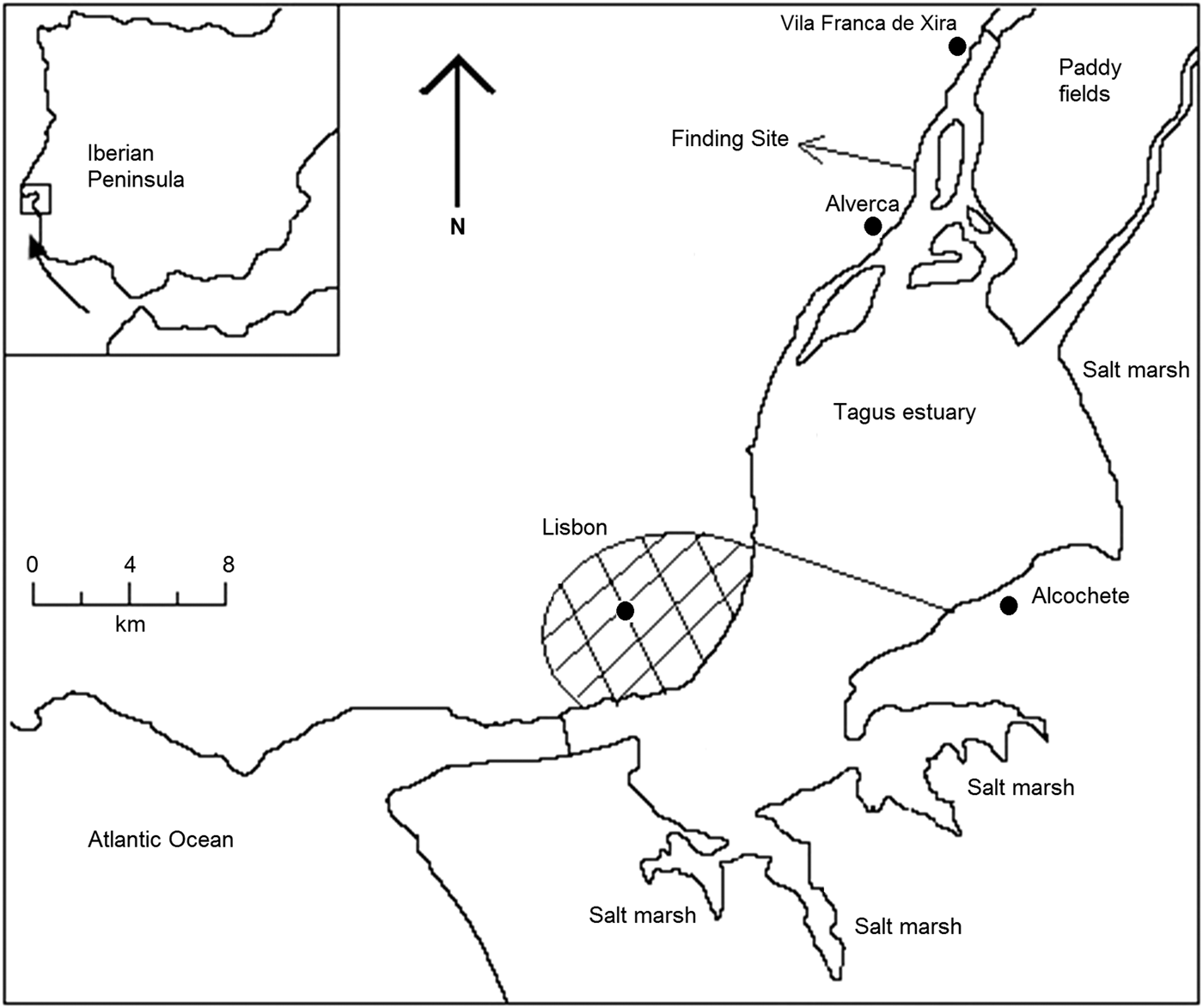
The Tagus estuary is one of the largest estuarine systems in Europe and covers an area of approximately 325 km2. It is a mesotidal estuary with a tidal range of between 1 m (neap tides) and 4 m (spring tides). The study site is located in an intertidal area of the northern bank of the estuary, in Alverca, 4 km seawards from the head of the estuary at Vila Franca de Xira (Figure 1). The intertidal zone is approximately 30 m wide during spring tides. The surrounding vegetation in the supratidal zone is mainly dominated by Phragmites spp. and Juncus spp.
Site where the colony of Cordylophora caspia was discovered at Alverca, the Tagus estuary. Transverse lines over the estuary are bridges.

A layer of fluid mud was deposited in the intertidal area at the beginning of August 2011 until about the 20 August 2011. Sediment sampling was conducted while the fluid mud was still present in the study site.
Field and laboratory procedures
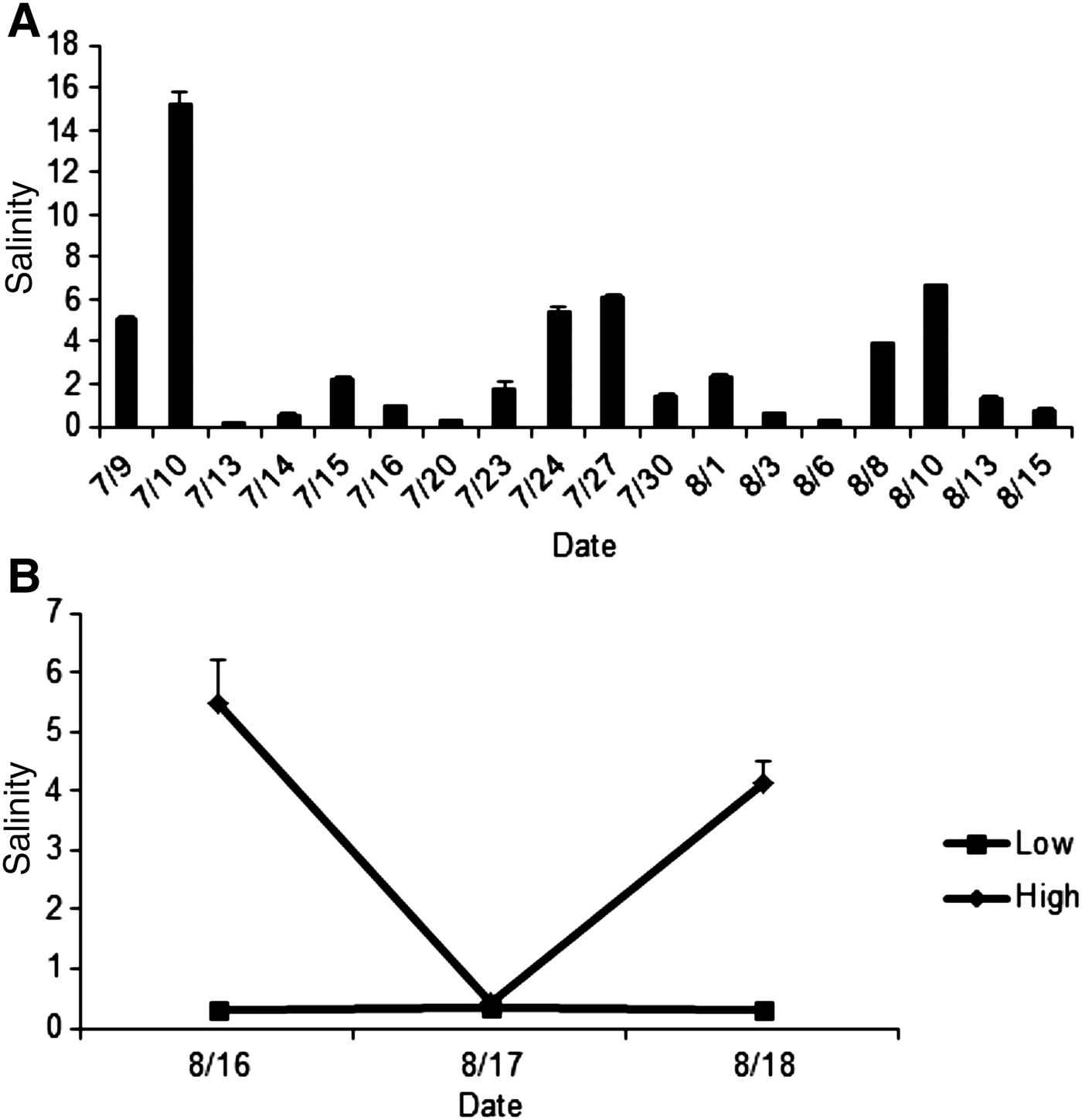
Field observations were made between 23 June and 18 August 2011. Salinity was measured in the water column (3 replicate samples) with a standard field probe (WTW 340i), between 9 July and 15 August and during consecutive tidal cycles between 16 and 18 August. Four sediment samples were collected from the study area on 15 August 2011, to assess the degree of hydration and the organic matter content. The water content of the sediment was estimated from the weight loss after drying the wet sediment to a constant weight at 100°C. Organic matter was determined by loss of weight on ignition at 500°C for 24 h in a muffle furnace. The salinity, organic matter and sediment water content values are reported as mean ± standard deviation. Salinity is considered a dimensionless parameter (e.g. Stickney, Reference Stickney2009).
Biological samples were collected on 29 August 2011. The biological material was preserved in 70% ethanol and transported to the laboratory to confirm the taxonomic identity of the species. Photographs were taken with a Motic digital camera attached to a stereoscopic microscope.
RESULTS
Species record
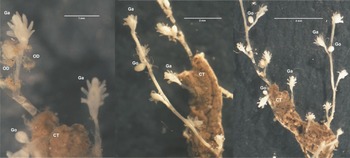
Samples of Cordylophora caspia were collected from a hard calcareous substrate (limestone) that was only exposed during spring tides, at Alverca in the Tagus estuary (Figure 1). This substrate was heavily colonized by Balanus spp. and the tube-building amphipod Corophium multisetosum. Tubes of Corophium multisetosum were also observed attached to the hydroid colony (see also organic matter debris, Figure 2). Cordylophora caspia was restricted to a small area on the top surface of the substrate. Samples of C. caspia displayed erect, branching white hydroid colonies, with the stems reaching a height of approximately 2 cm from the stolon (Figure 2). The colonies had gastrozooids with scattered filiform tentacles and gonophores borne on hydranthophores (Figure 2).
Details of Cordylophora caspia collected in Alverca in decreasing order of magnification (from left to right). CT, Corophium multisetosum tube; Ga, gastrozooid; Go, gonophore; OD, organic debris.

Environmental features of the site
The study site is located in a saline transition zone (Figure 1) within which the salinity varies over time from freshwater values to mesohaline values, with a maximum salinity value of 15.3 and a minimum of 0.2 (Figure 3). Sharp saline fluctuations were also recorded daily between low and high tide (Figure 3B). The water column is very turbid in the area, and it was impossible to see the bottom at any depth during the survey, even near the water's edge.
Salinity fluctuations (mean ± standard deviation) in the study site: (A) over time; (B) during consecutive tidal cycles.

DISCUSSION
Species record, substrate preferences and interaction with other species
Cordylophora caspia was found on limestone at the site (Figure 1), but it can colonize a wide variety of hard substrates (Roos, Reference Roos1979; Morri & Boero, Reference Morri and Boero1986; Folino-Rorem & Indelicato, Reference Folino-Rorem and Indelicato2005; Wintzer et al., Reference Wintzer, Meek, Moyle and May2011). The presence of the species in the fouling on ship hulls and in ballast water aids its worldwide spread (Pienimäki & Leppäkoski, Reference Pienimäki and Leppäkoski2004; Folino-Rorem et al., Reference Folino-Rorem, Darling and D'Ausilio2009). Bivalves are often reported as a suitable substrate for the settlement of C. caspia and the species has been found on, e.g. shells of the zebra mussel Dreissena polymorpha (Olenin & Leppäkoski, Reference Olenin and Leppäkoski1999) or Dreissena spp. beds (Ricciardi, Reference Ricciardi2001), the invasive bivalves Mytilopsis leucophaeta (Escot et al., Reference Escot, Basanta, Cobo and González2003) and Corbicula fluminea (Escot et al., Reference Escot, Basanta, Cobo and González2003; Servia et al., Reference Servia, Vieira-Lanero, Cobo, González, Sánchez and Barca2006). The invasive bivalve Corbicula fluminea inhabits the tidal region of the freshwater sector of the Tagus estuary (Chainho, Reference Chainho2008), potentially facilitating the spread of Cordylophora caspia riverwards. Further, Leloup (Reference Leloup1952) also suggested that the species might attach to the feathers and legs of aquatic birds, thereby enhancing dispersal.
In turn, other fauna may use species of hydroids as a substrate for settlement (Bradshaw et al., Reference Bradshaw, Collins and Brand2003). In this study, tubes of Corophium multisetosum were observed attached to the hydroid colony (see also organic matter debris, Figure 2). Roos (Reference Roos1979) described colonies of Cordylophora on water-lily stalks crowded by the amphipod Gammarus tigrinus in The Netherlands, especially during August. In the latter case, Gammarus tigrinus preys on the hydrants of C. caspia, whereas Corophium multisetosum, a deposit-feeder (see e.g. Cunha et al., Reference Cunha, Sorbe and Moreira2000), does not. It has been suggested that Cordylophora caspia is an attractive substrate for barnacles, amphipods and polychaetes (Von Holle & Ruiz, 1997, cited by Folino, Reference Folino2000).
Environmental features of the site and species tolerance
The finding site was characterized by high fluctuations in salinity and high concentration of suspended solids. The maximum concentration of suspended sediment in the Tagus estuary (up to 250 mg l−1) was measured in an area located about 5 km downstream of the study site (Portela & Neves, Reference Portela and Neves1994). The dissolved oxygen concentration is usually higher than 5 mg l−1, but lower levels sometimes occur in the mixing zone close to the finding site (Ferreira et al., Reference Ferreira, Bricker and Simas2007). This type of environmental feature is commonly described near the estuarine turbidity maximum (ETM) (Eisma, Reference Eisma1993). High concentrations of suspended particulate matter associated with the ETM may lead to the formation of fluid mud (e.g. Kirby & Parker, Reference Kirby and Parker1983), as observed in the study area. Since C. caspia tolerates low values of salinity, transparency, depth and intermediate levels of dissolved oxygen (Wintzer et al., Reference Wintzer, Meek, Moyle and May2011), it is able to proliferate in these harsh conditions. However, the species is unable to survive low oxygen concentrations (Fulton, Reference Fulton1962). Saline conditions outside the optimum value slow the growth of the colony, reduce the number of branches and shorten the size of the gonophores (Kinne, Reference Kinne1964, Reference Kinne1966; Arndt, Reference Arndt1984), probably because of physiological adaptations to stress (Kinne, Reference Kinne1964). Cordylophora caspia can inhabit waters of varying salinity and can even live in freshwater (e.g. Kinne, Reference Kinne1964, Reference Kinne1966; Arndt, Reference Arndt1984; Smith et al., Reference Smith, Werle and Klekowski2002; Folino-Rorem & Indelicato, Reference Folino-Rorem and Indelicato2005), which enables the species to extend its distribution riverwards. The regeneration of C. caspia from menonts and the ability of this species to quickly proliferate in varying salinities make it difficult to control its populations (Folino-Rorem & Indelicato, Reference Folino-Rorem and Indelicato2005) in newly invaded habitats.
Some industries take water for cooling and agricultural purposes from the freshwater tidal reaches of the Tagus estuary, some kilometres upstream from the finding site. A biofouling control plan for this estuarine section could be justified by the ecological and physiological plasticity of C. caspia as well as by its ability to colonize and compromise industrial infrastructures (Folino-Rorem & Indelicato, Reference Folino-Rorem and Indelicato2005).
Biodistribution
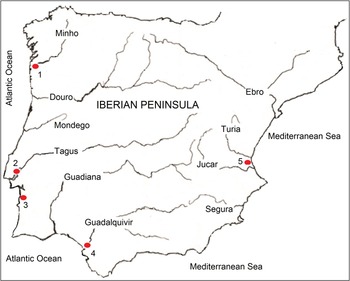
Records of C. caspia are scarce in the Iberian Peninsula (Altuna, Reference Altuna2010). The first record of the species on the Portuguese coast was in an oligohaline environment, the Santo André lagoon, in south-western Portugal (Correia et al., Reference Correia, Costa, Chainho, Félix, Chaves, Medeiros, Silva, Azeda, Tavares, Costa, Costa, Bernardo, Cabral, Costa and Cancela da Fonseca2012; Figure 4). This discovery was made during sampling surveys conducted during the 1980s; however, the species was not observed during a survey conducted in 2010 (Correia et al., Reference Correia, Costa, Chainho, Félix, Chaves, Medeiros, Silva, Azeda, Tavares, Costa, Costa, Bernardo, Cabral, Costa and Cancela da Fonseca2012). Cordylophora caspia was also described in freshwater environments such as streams, rivers, lakes and reservoirs, and also in brackish Iberian waters (García-Berthou et al., Reference García-Berthou, Boix, Clavero and Gherardi2007; Cobo et al., Reference Cobo, Vieira-Lanero, Rego and Servia2010). As such, the species has been reported from the Guadalquivir River (southern Iberian Peninsula; Escot et al., Reference Escot, Basanta, Cobo and González2003), the Minho River and from Albufera de Valencia (north-west and east of the Iberian Peninsula respectively; Servia et al., Reference Servia, Vieira-Lanero, Cobo, González, Sánchez and Barca2006). All these locations are shown in Figure 4.
Distribution of Cordylophora caspia in the Iberian Peninsula: (1) Minho River; (2) Tagus estuary; (3) Santo André lagoon; (4) Guadalquivir River; (5) Albufera de Valencia. See text for references. The main Iberian rivers are shown and named.

In accordance with Schuchert (Reference Schuchert2004), C. caspia distribution is ‘circumglobal in temperate and subtropical regions, usually in brackish waters as in estuaries, river deltas and lagoons’. Arndt (Reference Arndt1984) described the worldwide distribution of the species showing that it spread mainly in Europe and North America. Folino (Reference Folino2000) and Folino-Rorem et al. (Reference Folino-Rorem, Darling and D'Ausilio2009) studied the world distribution of the invasive genus Cordylophora; these studies were focused on genus rather than species taxonomic level because it is not yet clear if among the current eight species of Cordylophora some could be synonyms or actual distinct species.
Concluding remarks
The invasive hydroid Cordylophora caspia is reported for the first time in the Tagus estuary, on the central Portuguese continental coast. The species was found in a harsh environment within the Tagus estuary (with acute fluctuation of salinity and high turbidity), which has probably prevented optimal growth of colonies. The worldwide distribution of C. caspia attributable to anthropogenic transport vectors, the ecological resilience of the species and its ability to colonize brackish or freshwater environments, the absence of population control and the consequent spread of this invasive species in the Iberian Peninsula suggest that new records of C. caspia will be reported in Iberian waters and beyond.
ACKNOWLEDGEMENTS
We are grateful to Mr Narciso Argibay for granting access to the sampling site through the Adarse industrial zone in Alverca. We also thank Manú Moreira and Renata Ferreira for help in taking photographs with Motic software. Special thanks are given to Drs Luísa and Jonathan Davies for comments, language improvements and revision. We are also indebted to the comments and suggestions of two anonymous referees that led us to the last version of this paper.