Introduction
Mortuary rituals create, reproduce, and transform community (Renfrew Reference Renfrew, Renfrew, Boyd and Morley2016). Mortuary rituals are conservative and enduring, their invariability closely linked to the emotional turmoil and rupture of social relations that ensue at the death of a person. Broad changes in mortuary ritual are therefore considered indicative of profound ideological, ontological, or societal shifts (Brandt et al. Reference Brandt, Prusac and Hakon2015; Carr Reference Carr1995). Mortuary variability has been intensively studied for over half a century with archaeologists seeking to identify and extrapolate the meaning and relationships of the dead and the living, funerary objects and spaces, taphonomy and ontology. Before we can attempt to untangle the meaning and significance of big changes and small differences in burial practices, we must first come to understand how skills and knowledge of death-related rituals are transmitted at the individual and community level. Ultimately, this becomes a necessary first step toward assessing patterns of synchronic and diachronic variability in mortuary ritual which form a central tenet of structural and processual interpretations in mortuary archaeology (see Nilsson-Stutz Reference Nilsson-Stutz2003).
Mortuary practices do not reproduce themselves but through actions and interactions. Like other skills and concepts, they are learned through knowledge transmission. Communities of practice (Lave & Wenger Reference Lave and Wenger1991; Roddick & Stahl Reference Roddick and Stahl2016a; Wenger Reference Wenger1998) offer a compelling framework for examining the dynamic, emergent and heterogeneous relationships between people, objects, places and knowledge that constitute ritual practice. At the same time, a growing awareness of emotions and sensation in the past (Baitzel Reference Baitzel2018; Baxter Reference Baxter, Supernant, Baxter, Lyons and Atalay2020; Fleisher & Norman Reference Fleisher and Norman2016; Nilsson-Stutz Reference Nilsson-Stutz, Skeates and Day2020; Tarlow Reference Tarlow2012) and studies in the psychology of memory and learning (Conway Reference Conway2005; Holland & Kensinger Reference Holland, Kensinger, Armony and Vuilleumier2013) offer important insights into learning through mortuary practice.
In this paper, I explore how learning about death and burial occurred among the inhabitants of the provincial Tiwanaku site of Omo M10, Peru, in the south-central Andes (eighth–twelfth centuries ce). Based on the mortuary records of 183 excavated burials, I reconstruct the sequential phases of body preparation, interment and post-interment activities. Drawing on ethnographic and ethnohistorical description, I explore Tiwanaku mortuary ritual as a community of practice to examine how emotions, locality, materiality and identity shaped the experiences, skills and knowledge of diverse ritual participants. I consider how episodic memory formation and the bundling of a corpse, offerings and funerary spaces aided or challenged learning about Tiwanaku death and burial. In conclusion, I consider how this reconstruction of knowledge transmission among communities of mortuary practice at Omo M10 may inform current interpretations of Tiwanaku mortuary variability.
Archaeologies of ritual and communities of practice
In recent decades, archaeologists have explored learning at the individual and communal level. The archaeology of childhood has played a major role in conceptualizing actors and conditions of learning informed by historical and modern observations of children and their environments (Baxter Reference Baxter2005; Crawford et al. Reference Crawford, Hadley and Shepherd2018; Thomas Reference Thomas and Baxter2005), leading us to understand learning as embedded in places, interactions and material culture, from homes to burials, domestic and craft production to ritual, miniatures to preciosities (e.g. Ardren Reference Ardren2006; Reference Ardren2011; Minar Reference Minar2001; Park Reference Park and Baxter2005; Smith Reference Smith and Baxter2005).
But learning continues long after childhood. Humans acquire, adjust and expand their skills and knowledge throughout the life course, sometimes as a conscious effort to acquire skills and other times through mutual engagements in joint enterprises. Archaeological approaches to learning use communities of practice, coined by sociologists Lave and Wenger (Reference Lave and Wenger1991), to explore adolescent and adult learning in the context of ‘making’ and craft production (e.g. Abbott Reference Abbott, Supernant, Baxter, Lyons and Atalay2020; Crown Reference Crown, Roddick and Stahl2016; M. Harris Reference Harris, Roddick and Stahl2016; Sassaman & Rudolphi Reference Sassaman and Rudolphi2001). Material assemblages represent shared activity, skill and knowledge (e.g. craft production, monumentalism, cuisine) (O. Harris Reference Harris2014). By studying spatial and temporal patterns, archaeologists can reconstruct how human and non-human participants engaged in situated practice and approximate how learning was mediated through material culture, bodies and environment (Roddick & Stahl Reference Roddick and Stahl2016a; Wendrich Reference Wendrich and Wendrich2012a). Similarly, Ingold (Reference Ingold2015, 135–6) has proposed learning to be the ‘education of attention’, in which the more experienced guide the younger by drawing them out into the world. Rather than transferring a corpus of knowledge, Ingold argues, education renders the learner ‘attentive’ towards specific understandings and skills.
Such an approach invites us to educate our own attention on the totality of relationships between people, objects, space and knowledge that contribute to practice. Most importantly, communities of practice do not have finite and bounded membership; rather membership is emergent as newcomers join, learn and become skilled members. People can belong to multiple communities of practice at once and over time (Roddick & Stahl Reference Roddick, Stahl, Roddick and Stahl2016b, 9). Members may come from diverse localities but end up creating a new locality (Wenger Reference Wenger1998, 130). Communities of practice reproduce themselves in larger constellations of interconnected practices whose component communities of practice may share members, artifacts (boundary objects), histories, enterprises, or conditions (Wenger Reference Wenger1998, 127; Roddick & Stahl Reference Roddick, Stahl, Roddick and Stahl2016b, 9). As a result, situated learning articulates the participants of a community of practice with enduring, widespread fields of knowledge beyond their own experience (Gosselain Reference Gosselain, Roddick and Stahl2016).
Some archaeologists have explored ritual in knowledge transmission of craft production (Crown Reference Crown, Roddick and Stahl2016; M. Harris Reference Harris, Roddick and Stahl2016) or specialized ritual knowledge (Holdaway & Allen Reference Holdaway, Allen and Wendrich2012). Yet ritual and communities of practice share attributes that can transform our thinking about ritual knowledge transmission, and that elucidate under-explored aspects of situated learning, such as the role of emotions in memory formation. Ritual practices and performances give rise to communities of practice. They constitute an extraordinary type of marked practice characterized by mutual participation, reification (what Swenson Reference Swenson2015 calls ‘amplified materialization’), a shared focus, knowledge heterogeneity and emergent yet differentiated constituent identities.
Ritual practice as community of practice
Participation in ritual and communities of practice is exclusive and must be legitimate; even inclusion does not guarantee full access. Legitimate peripheral participation parallels Bell's (Reference Bell1992) concept of ritualization. The process by which newcomers learn skills and knowledge, engage in practice and move from peripheral involvement to full integration in the community of practice (Lave & Wenger Reference Lave and Wenger1991, 29; Roddick & Stahl Reference Roddick, Stahl, Roddick and Stahl2016b, 7; Wendrich Reference Wendrich and Wendrich2012b) is similar to the sense of ritual that is acquired through bodily interactions in a structured and structuring environment by way of formal, fixed, and repetitive actions (Bell Reference Bell1992, 92, 99). This gradual progression toward full understanding and membership elucidates the dynamic variability of knowledge of practice at the individual and community level, and the potential for knowledge and power differentiation.
Ritual and community of practice participants engage in reification, materializing shared experiences into processes and products, such as objects, tools, stories and symbols, that are the subject of engagement (Wenger Reference Wenger1998, 58–9). Ritualization similarly produces extraordinary objects or contexts (Bell Reference Bell1992, 124) through amplified materialization of practice, multi-sensory experiences and emotions (Swenson Reference Swenson2015, 334). Amplified materiality occurs through bundling—the association of concepts with material qualities (Keane Reference Keane, Kuechler and Were2005)—or structured depositions when artifacts are assembled, juxtaposed and dispersed to demand attention (Swenson Reference Swenson2015, 334). Deposition, including burial, comprises ‘differential knowledgeability, and the ways that knowledge is bound up in relations to persons and things’ (Joyce Reference Joyce, Mills and Walker2008, 27). Participation and proximity in deposition condition bodies and memories in different ways according to the actors’ status and goals while reproducing shared knowledge (Roddick & Stahl Reference Roddick, Stahl, Roddick and Stahl2016b, 17). One example of this is the ritual specialist whose knowledge and power mediates relations between humans and non-humans (Bell Reference Bell1992, 134). Reification is thus simultaneously the joint venture through which learners acquire knowledge as well as full member identity and status, while also materializing differences within the community of practice.
Rituals, in particular mortuary rituals, lend a ‘special flavour’ to the temporality and locality of communities of practice. The temporality of death and burial differs from that of traditional communities of practice, such as craft workshops. Death often comes unannounced and at irregular intervals, and it requires immediate attention. As a result, communities of mortuary practice are often short-lived, sporadic and stochastic, emerging and ending with temporally bounded burial or commemorative rituals. Individuals will participate in different mortuary rituals throughout their lives, and funerals rarely have the same participants. This illustrates the emergent, unique and heterogenous participation in communities of practice. I would even go so far as to argue that participation extends into death, as the bodies of former newcomers and old-timers eventually become the subject of the joint enterprise of burial.
Cemeteries as sites where communities of mortuary practice periodically emerge to bury and remember their dead form peculiar localities that are more than a community of practice, yet less than a constellation of protracted dispersed funerary traditions. They form curious spatial-temporal aggregates where the echoes and memories of previous events shape the experiences of present and future communities of practice (Lucas Reference Lucas2005, 26). The juxtaposition of bounded yet open-ended burial events with the persistence of mortuary traditions as constellations of practice illustrates how shared practice and situated learning operate at various temporal and spatial scales.
Learning through emotions and episodic memories
Emotions moderate the interactions and experiences of community members as they engage in shared practices. Hope and joy following a good learning outcome may positively re-enforce the acquired skill, whereas anxiety, anger, or sadness may negatively impact knowledge formation, relationships between newcomer and old-timer, and thus the reproduction of the community of practice. Emotions mediate cognition by providing bottom-up somatic markers for the retention and recall of episodic memories (Allen et al. Reference Allen, Kaut, Lord, Dere, Easton, Nadel and Huston2008). Episodic memories shape autobiographical memory (sense-of-self) and conceptual knowledge. A summary record of sensory-perceptual-conceptual-affective processing, episodic memories comprise short sequences of experiences that are recalled as visual images and that can be intentionally or incidentally activated over long periods (Conway Reference Conway2009; Tulving Reference Tulving, Tulving and Donaldson1972). When accessed, episodic memories cause a person to relive prior experiences, which form our memories of self. Episodic memories that remain accessible in long-term memory may also instill a sense of temporal order (Conway Reference Conway2009). Episodic memories also facilitate concept acquisition. Semantic knowledge of concepts such as death and afterlife is rooted in episodic memories as people are exposed to situations involving death even before they are aware of the corresponding concept (Boyer Reference Boyer1990, 43). If episodic memory, i.e. the event-specific visual representations of prior experiences from which knowledge is gradually abstracted, informs a general frame of contextual knowledge including knowledge of self (Conway Reference Conway2005; Reference Conway2009), then the archaeological study of memorable events that would have produced episodic memories, such as communal events and rites of passage, becomes essential to approximating identity formation and memory making.
Being in an emotional state that matches that of the memory itself improves memory performance; greater emotional intensity—especially in the case of negative emotions—enhances memory retrieval (Allen et al. Reference Allen, Kaut, Lord, Dere, Easton, Nadel and Huston2008; Holland & Kensinger Reference Holland, Kensinger, Armony and Vuilleumier2013). Emotions can also distort memories, especially background or peripheral details, but the feeling of re-experience that is characteristic of episodic memories is generated by the correct recall of a small set of details (Holland & Kensinger Reference Holland, Kensinger, Armony and Vuilleumier2013, 481). It follows that we must hypothesize different types of emotions, especially negative emotions such as grief, as affecting episodic memory formation and conceptual knowledge formation. A discussion of communities of mortuary practice, then, must consider the role of grief in a person's recall, contextualization and learning of death.
The above introduction of communities of practice, ritual practice, learning and emotions provides a point of departure from which to reconsider the unchanging a priori nature of mortuary ritual. Like other practices, mortuary rituals are learned; this includes the practical skillset needed to prepare and bury the corpse with the necessary accoutrements, as well as the conceptual knowledge surrounding death and the afterlife. Yet the circumstances of death—timing, locality, heterogeneous participation and emotions—present obstacles to the faithful transmission of knowledge and skills. I propose that mortuary ritual framed as community of practice, rather than just practice, focuses our attention on how situated learning reproduces the relationships between people, objects, place, and knowledge that emerge during mortuary ritual.
Learning about death in the ancient Andes
Corpses and community in the ancient Andes
The dead were a vital and tangible presence in ancient Andean society. Individually and collectively, communal ancestors and founders (mallkus) anchored expansive familial networks (ayllus) (Salomon [1995] Reference Salomon and Dillehay2011). Burials and above-ground tombs within or beyond settlements occupied key spaces in the social landscape (e.g. Mantha Reference Mantha2009; Velasco Reference Velasco2018). Continued interaction with the dead included the manipulation of human remains, re-opening and accessing tombs and depositing offerings even long after death (e.g. Dillehay [1995] Reference Dillehay2011; Hastorf Reference Hastorf2003; Isbell & Korpisaari Reference Isbell, Korpisaari, Eeckhout and Owens2015; Lau Reference Lau2002; Shimada & Fitzsimmons Reference Shimada and Fitzsimmons2015). The productive and reciprocal relationship between communities and their dead contrasts with the negligent or violent treatment of outsiders and enemies (Tung & Knudson Reference Tung and Knudson2010). Increasingly, mortuary rituals are also reimagined as performances that contributed to the production of power, identity, social memory, and ontology (Klaus & Toyne Reference Klaus and Toyne2016; Muro Ynoñán Reference Muro Ynoñán2018; Tung Reference Tung2014). Despite the richness of the Prehispanic Andean mortuary record, detailed reconstructions of funerary processes are rare, leaving us to speculate about how death-related skills and knowledge were enacted, experienced and transmitted among members of the community. Without written or iconographic records, descriptions of modern and historical cultural traditions offer a possible but cautiously applied insight into the participants, places, practices and emotions of ancient mortuary ritual.
Ethnographic insights on learning and death in the Andes
Modern highland Aymara and Quechua-speaking communities offer pertinent insights regarding emotions, funerary rituals and activities, and learning in childhood. Although 500 years of religious syncretism in the Andes require a cautious reading of this information, parallels between modern and early colonial life-cycle rituals indicate persistence of deep-rooted cultural customs. Ethnographic accounts of death and funeral in Andean indigenous communities today reveal an ‘emotional community’ (Rosenwein Reference Rosenwein2006, 2) in which grief generates sadness, anger and fear (susto) (e.g. Allen Reference Allen2002; Onofre Mamani Reference Onofre Mamani2001). Commemorative events consisting of commensal feasting and family reunions days or even years after death also evoke positive feelings. Descriptions of sixteenth-century indigenous chiefly funerary processions portray mourners as crying and shaving their head (Cieza de León [1553] Reference Cieza de León1922, 317), yet no mention of intense emotions during continued interactions with ancestral remains is made (Guaman Poma de Ayala [1615] 1987). This suggests that grief and sadness were socially acceptable and perhaps even expected emotional responses to death, but that the intensity and nature of emotions may have varied over space and time.
Thick descriptions of twentieth- and sixteenth-century Andean funerals and post-interment activities provide a tentative scaffold for the identities and actions of ritual participants, the timing and location of mortuary activities and the culturally constructed meanings of death on to which the limited archaeological record can be draped to explore the possibilities of ancient communities of practice. In the hours following death, washing and dressing of the corpse and preparations for the wake are confined to the home and the immediate family, with non-kin only assisting in manipulating the corpse (Canales Reference Canales1925; Fernandez J. Reference Fernandez2001; Onofre Mamani Reference Onofre Mamani2001; van Kessel Reference van Kessel2001). During the wake, which may last several days, the bereaved receive extended family and community members. Women visitors contribute to the preparation of food and drink, while men are tasked with transporting the coffin to the cemetery and excavating the tomb. Children are not always permitted at the wake and interment, where alcohol and food fuel an emotionally charged atmosphere. After the interment, commemorative activities continue periodically at home and at the cemetery. During these, the bereaved will dispose of the deceased's personal items and present food and libations on the altar to ensure the soul's goodwill and safe passage to the afterlife.
The writings of Bartolome Álvarez on sixteenth-century highland indigenous funerals confirm the antiquity of some of the ethnographically documented practices, such as gendered tasks and participation, prolonged visitation and feasting, washing and burning of the deceased's clothing. More importantly, they reveal an expansive death-related ritual repertoire prior to Catholic reforms, that included animal sacrifices, divinations, feeding of the dead and rites of purification under the direction of ritual specialists (Álvarez et al. [1588] Reference Álvarez, Martín Rubio, Villarías Robles and Díaz1998). Removal of bundles from the tomb was also widespread (Álvarez et al. [1588] Reference Álvarez, Martín Rubio, Villarías Robles and Díaz1998; Canales Reference Canales1925; Cieza de León [1553] Reference Cieza de León1922), but no longer occurs today. The contrast of sixteenth- and twentieth-century funerary rites from the highlands of Bolivia and southern Peru reveals the potential shortcomings of ethnographic analogies, but also the shared ‘determining structures’ (sensu Wylie Reference Wylie1989) that prevail in times of death and mourning. Even so, this abridged description of south-central Andean mortuary activities still fails to acknowledge the complexities of individual experiences, relationships and traditions that shape each funeral; a myriad of factors, such as the circumstances of death and the economic standing and social identity of the deceased and bereaved, influence the extent, complexity and mood of funerary ritual.
Ethnographic descriptions of children's participation in domestic life and craft production align closely with Lave and Wenger's model of legitimate peripheral participation and situated learning. Acquiring subsistence, housekeeping and craft production skills is part of coming of age and personhood; relationships between old and young, novice and master, are characterized by respect, permissiveness and autonomy (e.g. Bolin Reference Bolin2006; Franquemont & Franquemont Reference Franquemont and Franquemont1987; Leinaweaver Reference Leinaweaver2008). By virtue of being around older family members, children observe the actions of others within the web of activities and social relations that define practice. Through playful experimentation, imitation and completion of age-appropriate tasks at the periphery of practice fields, children gradually acquire a repertoire of bodily motions and conceptual knowledge. Learning occurs as much through peer-interactions as through guidance from experienced elders. Only certain fields (craft production, advanced ritual and medicinal knowledge) require learners to enter into formal mentorship (Schlegelberger Reference Schlegelberger and Baumann1996).
Koen De Munter (Reference De Munter2016) proposes family is one of the most elemental communities of practice in which Aymara children learn to participate. Rituals, specifically funerals and commemorative rituals, ‘braid the lines of Aymara sociality [between the living, the dead, objects, other-than-human entities, and the landscape]’ (De Munter Reference De Munter2016, 635). These celebrations provide children with the opportunity to educate their attention (sensu Ingold Reference Ingold2015) towards engaging with vital relational ontologies. Visitation and food sharing, libation and commemoration of and with the dead are practices to be learned and mastered via legitimate peripheral participation to ‘make’ family. By extension, because similar activities are also performed in co-participation with the living, the landscape and other-than-human entities during non-funerary occasions, learning about death and, therefore, family becomes anchored outside the context of death, as well. This occurs voluntarily and consciously through storytelling, while sensory experiences and bodily movements in everyday activities may also invoke involuntary or subconscious associations with death.
Modern indigenous ritual practices and ontologies are undeniably shaped by the currents of history. Nevertheless, practices and beliefs that are spatially, temporally and materially consistent with the archaeological record may provide important evidence for re-imagining death in the past as communities of practice. Ethnographic and ethnohistorical descriptions of funerals, burials and commemoration reveal participation to be emotionally dynamic, variable in attendance and shaped by age, gender and status. Funerary ceremonies afford children and other newcomers opportunities for situated peripheral learning about death, emotions and family. In what follows, I examine the materiality of Tiwanaku burials to reconstruct what the processes and products of Tiwanaku mortuary ritual reveal about community of practice and knowledge transmission.
Reconstructing Tiwanaku mortuary ritual at Omo M10
The Omo M10 site (eighth–twelfth centuries ce) was a provincial Tiwanaku settlement in the Moquegua valley. Its mortuary contexts forms part of a large corpus of excavated burials from highland and lowland settlements associated with the Tiwanaku state, the earliest state society in the south-central Andes. Studies of Tiwanaku mortuary variability have explored social organization, social identity, ancestor veneration and interregional interaction (Baitzel Reference Baitzel2016; Reference Baitzel2019; Baitzel & Goldstein Reference Baitzel and Goldstein2014; Blom & Janusek Reference Blom and Janusek2004; Buikstra Reference Buikstra and Dillehay1995; Couture Reference Couture and Kolata2003; Goldstein Reference Goldstein2005; Reference Goldstein, Vranich and Stanish2013; Isbell & Korpisaari Reference Isbell, Korpisaari, Eeckhout and Owens2015; Korpisaari Reference Korpisaari2006; Sharratt Reference Sharratt2016). In these studies, archaeologists have relied on traditional variables such as body position, tomb architecture and associated objects. Tiwanaku burials are characterized as funerary bundles of seated-flexed individuals wrapped in camelid-fibre textiles and plant-fibre netting placed in below-ground pits or cists; they were accompanied by serving assemblages, personal tools, or accessories. Burials clustered in discrete cemeteries along the edges of settlements. Only recently has the rich materiality of well-preserved provincial Tiwanaku burials been used to investigate intimate processes of body preparation and post-depositional processes (Baitzel Reference Baitzel2019; Baitzel & Goldstein Reference Baitzel and Goldstein2014) serving as a point of departure for re-imagining Tiwanaku mortuary ritual as community of practice.
A detailed reconstruction of funerary activities at Omo M10 is made possible by the large number of excavated burials and the hyperarid conditions of the region in which organic materials preserve naturally. This study draws on the analysis of 183 intact (25 per cent) and disturbed Tiwanaku-style burials from 11 communal cemeteries (Fig. 1). Natural and anthropogenic taphonomic processes have variably affected mortuary assemblages across the site (Baitzel Reference Baitzel2019). Most tombs contained skeletonized human remains and fragmentary textiles and organic artifacts. The spatial association of bundle materials, offerings and tomb architecture made it possible to reconstruct the temporal sequence of funerary activities. In addition, the micro-analysis of two funerary bundles (P-18A and S-16) allows for a detailed reconstruction of bundling practices.
Map of the Omo M10 archaeological site and surrounding landscape.

Tiwanaku activities and beliefs surrounding death formed part of a broader ritual repertoire around the veneration of ancestral bodies, other-than-human entities and sacred landscapes through sacrifices and offerings (Janusek Reference Janusek2008). Monumental spaces, ceramic forms, musical instruments and psychotropic substances suggest Tiwanaku was a ceremonial state whose populace incorporated social order and multi-ethnic communality though commensal activities in which keros, tazones and incensarios mediated the flow of drink, food and smoke between natural, social and supernatural realms (Janusek Reference Janusek2008). Death, as a transformative counterpoint to social life, was realized through residential burial of important individuals, sacrifice and caching of keros, preciosities, humans and camelids, and anthropomorphic megaliths that punctuated the landscape. At the site of Omo M10, a Tiwanaku-style temple, springs and geoglyphs animated the landscape, so that the cemeteries surrounding the settlement formed a porous boundary between life and death, human and other-than-human entities.
Phase 1: Learning bundling
Within one to two days after death, the corpse was prepared for burial (Baitzel Reference Baitzel2019). This included flexing the legs toward the chest and crossing the arms over the shins or chest. Sometimes, the corpse retained a personal adornment such as a necklace, bracelet, ring or earspools. The face and head were covered with raw camelid fibre, a small square camelid-fibre cloth, or a tattered piece of fabric. The corpse was then dressed in a loosely draped tunic or mantle. Such was the dress of the living who would wear a belt that cinched the garment at the waist, although we might speculate that the belt was removed during sleeping. A second (and sometimes a third) cloth shrouded the corpse, which had to be lifted up to fold the bottom edges of the cloth under the feet and buttocks. Folds and seams were stitched together to prevent the textiles from unravelling.
Only cloth made from camelid fibre was used to wrap the dead, conferring Tiwanaku's highland cultural heritage on dead bodies. The plain-coloured brown and polychrome-dyed tunics, mantles and blankets enveloping the corpse often had tattered and repaired sections, indicating that garments had long life-histories, growing old alongside the bodies they covered. When larger pieces of cloth for shrouding were not to hand, smaller fragments were haphazardly stitched together, a common occurrence in children's burials whose fast-growing bodies required more expedient clothing in life and death. There is no evidence at Omo M10 that bundling included newly woven garments; in fact, some garments were extensively curated before their interment (Baitzel & Goldstein Reference Baitzel and Goldstein2014).
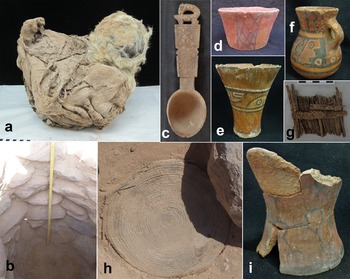
Once the body was wrapped, the bundle was adorned and prepared for transportation to the grave site. An informal feather crown, usually found on child bundles, included a simple thread wrapped around the head, holding in place white and red feathers inserted into small cane pieces. The bundle was held together by rope made from twisted or braided plant fibre that was looped and knotted to make a tight net (Fig. 2a). The netting also allowed for occasional tuck-ins such as leather sandals, and it possibly served to carry the bundle to the grave (Buechler & Buechler Reference Buechler and Buechler1971).
(a) Child funerary bundle with textile wrapping and plant-fibre netting (Burial M10P-18A); (b) stone-dressed tomb interior; (c–g) burial offerings: wooden spoon, ceramic tazon, kero and pitcher, comb; (h–i) surface offerings: basket platter and incense burner. (Images: S. Baitzel.)

Consistency of corpse posture and bundling objects across all but two of the 183 burials from the Omo M10 communal cemeteries, regardless of age at death, sex, burial location, or grave goods, indicates that the principles of bundling were familiar to many in the community. Nevertheless, the reconstruction of Tiwanaku enfardelamiento processes and the description of current-day Aymara and Quechua funerals suggest that this first phase of activities after death carried an intimacy and emotionality that shaped participation, memory-making and knowledge transmission.
According to ethnographic evidence, the preparation of the dead would have taken place in the home of the deceased attended by immediate family, although washing and dressing the corpse usually fell to a person outside the household. The use of quotidian items in Tiwanaku bundles—tattered garments, the needle and thread used to stitch the shroud, and the rope tied around the bundle—supports a similarly domestic setting with access to such items. While we can only speculate who attended the shrouding, the confined spaces of Tiwanaku residences and patios limited the number of participants.
As the attendant shrouded the body, family members caught final glances of the deceased. In the background, others set in motion the preparation of food and drink for the communal funerary ceremonies. Whether these moments included a hushed silence, laments, songs, recitations, or other sounds, the atmosphere would have matched and heightened the emotional state of the bereaved. Young family members would notice the changed mood without fully grasping the reasons. Older children and adolescents may already have attended funerals or witnessed death, and thus grew their understanding of death and grieving. As legitimate peripheral participants of bundling, these learners gradually assumed more responsibilities, perhaps fetching supplies or lending a helping hand to the corpse attendant.
To the young and the old, the actions of the corpse attendant were familiar ones: washing, caring for and dressing bodies, using rope to tie cloth bundles containing food items and playfully crowning heads with feathers. The mundaneness of these activities would have made it easy to remember these steps and materials. Anthropologist Pascal Boyer (Reference Boyer1990, 17–18) proposes that the ability of ritual participants to retain ritual ‘surface’ actions—enabling the faithful repetition that ultimately legitimizes ritual—is driven by the ‘memorable-ness’ of these activities, in this case their mundaneness. Furthermore, memory acquisition of ritual requires that the actions be represented in their entirety and correct order (Bell Reference Bell1992; Boyer Reference Boyer1990, 19), so that the learner has access to the whole sequence of ritual activities. This corresponds to the formation of episodic memories as part of a spatio-temporal trajectory of prior experiences that can be revisited and activated in sequence (Hasselmo Reference Hasselmo2011, 2). Sadness, anger and grief added bodily sensation to the bereaved's memories of bundling, facilitating recall during similar emotional experiences in the future. Moreover, Tiwanaku funerary bundles probably only represented part of the ritual activities that occurred while wrapping the corpse. Colonial and modern Aymara funerals include the erection of altars, elaborate and costly sacrifices and divination and prolonged wakes to commemorate the dead. We must therefore consider that the corpse may have received visitors at home before burial. During such visitation, consumption of food and drink, smoke offerings and other ritual or sacrificial acts enhanced the formation of multi-sensorial episodic memories.
Phase 2: Learning burying
After concluding the preparations in the home, the mourners transported the bundle to the nearby cemetery located beyond the edge of town. The procession had to pass by neighbouring houses and through the plazas of residential communities. The walk to the cemetery led over narrow paths on the desert surface towards the edge of the bluff on which the Omo M10 townsite is situated. Sometimes, mourners and litter carriers had to descend along the bluff slopes and through small ravines to reach the cemetery, recognizable by protruding capstones and rockpiles of tombs and the scattered debris of previous funerals.
Excavating the tomb was an arduous task. Using stone hoes, several persons had to dig into the compact clastic sediments that underlie the site; they had to carve out a pit that measured between 60 and 100 cm in diameter to a depth of at least 60 cm. Often, the excavated pit was enlarged so that its walls could be lined with field stones, river cobbles and broken ground stone (Fig. 2b). Reminiscent of the stone walls of highland dwellings, tomb architecture at Omo M10 was designed to outlast the cane-and-adobe homes of the living. The tools, materials and bodily movements used to make the tomb were familiar from farming and house construction. If modern Aymara funerals are any indication, digging Tiwanaku tombs under the hot sun was a solemn, sweaty, alcohol-fuelled, male enterprise. Today older, more experienced family and community members guide the actions of younger, stronger men who come to understand the task at hand through observation and storytelling.
With the excavation finished, the bundle was lowered into the tomb so that the deceased faced eastward toward the rising sun, the highlands, the Tiwanaku heartland. Sitting at the bottom of the tomb, the deceased received their last meal in serving wares such as cups, bowls, pitchers, cooking pots made from pottery, wood, or basketry, along with gourd ladles, wooden spoons or maize cobs (Fig. 2c–g); personal items were placed around and on top of the bundle. The most popular items to accompany the dead were decorated keros and tazones used to consume the maize beer, gruel and stews emblematic of Tiwanaku cuisine (Fig. 2d–e). Like the cloth used to wrap the corpse, the serving vessels and utensils were moderately or heavily worn, having served the living for some time before their interment. On rare occasions, weaving tools and ritual paraphernalia were placed with the bundles of adults, perhaps in recognition of their skills (Fig. 2g). For example, weaving tools were ubiquitous household items, yet were not common grave goods. The decision to remove these items permanently from the home and place them in the burial must have been sanctioned by the bereaved household.
Lastly, large rocks had to be gathered to cap and seal the tomb. Placing the rocks around the opening and carefully piling on the final stones suspended over the tomb cavity required many hands and much care. A misplaced stone could cause the dome-like structure to collapse inward, damaging the bundle. To prevent sand and silt from infilling the burial, handfuls of wet sand and silt were pressed into the spaces between the rocks. The feasting, offering and communing that accompanied the interment may have continued for some time, but the deceased no longer attended the funerary party. Instead, the living were now surrounded by stony reminders of past lives and loved ones, as they navigated their steps homeward around tomb markers.
The first phase of the funerary processes had comprised the transitory transformation of the corpse into a bundle within the home. The second stage of Tiwanaku funeral was concerned with place-making and deposition of bundle and offerings. The archaeological record reveals more heterogeneity of tomb architecture and burial assemblages, and thus more variability in participatory actions. It is thus important to identify what choices members of the communities faced, how these decisions were made and what this may have meant for transmitting knowledge of funeral ritual and death.
The Omo M10 site features 11 communal Tiwanaku-style cemeteries. The absence of isolated burials at the site suggests that burial outside a communal cemetery was neither desirable nor acceptable. Tiwanaku cemeteries are considered representative of kin groups (Buikstra Reference Buikstra and Dillehay1995; Goldstein Reference Goldstein2005). Given the diverse meanings and practices of Andean kinship, the decision where to inter the deceased may have been contentious. Tiwanaku individuals habitually relocated between highlands and lowlands (Knudson et al. Reference Knudson, Goldstein, Dahlstedt, Somerville and Schoeninger2014). Locally, Andean practices such as post-marital mobility and labour obligations may have caused persons to move between households, communities and towns. Tiwanaku kinship affinities as defined by biological ties and co-residence probably changed over the life course. Whether a person was buried in the cemetery of their natal family, of the household that raised them, or the community they married into or co-resided with later in life, may have been decided prior to death, perhaps even by the deceased themselves. However, it may also have become a negotiation among those who laid claim to the corpse.
Once the funerary procession reached the cemetery, the attendees faced the decision of where to dig. Capstones do not bear recognizable markers of the identity of the entombed, so that choices about proximity to other tombs had to be made based on social and personal memories. In Aymara cemeteries today, burials of nuclear family members are placed near one another, facilitating the visitation and commemoration of the family unit. Pending future analyses, we do not know this for Omo M10, but we can assume that tomb placement was deliberate. A density of c. 5–7 burials per 16 sq. m would suggest that there were social prescription or practical consideration for spacing burials.
The rules and deliberations that determined cemetery and burial location did not entail learning a tangible skill. Rather, they provided insight into community relationships. Such decisions ultimately determined future visitations and rights of access. Thus, witnessing and partaking in these discussions was critical for negotiating kinship and group membership with implications for newcomers and old-timers. The rupture in the social fabric that death created afforded an opportunity to assert affinities. The alliances and compromises made to afford the dead a proper resting place are likely to have had repercussions beyond the interment.
In the same way that corpse preparation invoked everyday gestures and bodily movements, the interment—digging into the ground, lining the tomb and bending over and crouching to arrange the funerary bundle and its offerings at the bottom of the tomb—carried associations with non-funerary acts of planting, storing, building and caching offerings. Close engagement with the ground is deeply symbolic in Andean cosmology, where the earth is considered a female and fertile other-than-human being (de la Cadena Reference de la Cadena2015; di Salvia 2016). Breaking ground during sowing or construction requires reciprocal offerings to pachamama (e.g. Abercrombie 1999; Allen Reference Allen2002; Guaman Poma de Ayala [1615] Reference Guaman Poma de Ayala, Murra, Adorno and Urioste1987). The Aymara term for mummy bundle—mallku—means both ‘ancestor’ and ‘seed’; they share a desiccated appearance and life-giving potency (Doyle Reference Doyle1988). The interment of bundle and offerings recreated productive activities that facilitated communication with supernatural beings. This act of structured or embodied deposition, in which repetitive movements in relation to space, people and objects shape the disposition of the agent (Joyce Reference Joyce, Mills and Walker2008), are synonymous with what Bell (Reference Bell1992) terms the ritualization of the body. Joyce (Reference Joyce, Mills and Walker2008, 37) proposed that ‘embodied dispositions [are created by] early experiences [that] are in profound ways mediated by their engagement with nonhumans, as much as with other humans’. This suggests that the peripheral participation of children and adolescents in interment activities would have provided critical moments for the incorporation of episodic memory formation (Connerton Reference Connerton1989; Conway Reference Conway2009).
The procession and interment would have included a bigger group, including persons who came from farther away and whom the news of death had reached later. Reunion with community and family members at the grave site afforded opportunities to exchange news and share memories of the departed. Among the bustle of activities at the grave site—away from the place and sight of the corpse tinged by the raw emotions of recent death—the emotional atmosphere shifted toward the living. Attendees participated in preparing the tomb and offerings, served and consumed food and drink and engaged in music, storytelling, prayer and communion. Ritual specialists experienced in funerals and feasting coordinated specific activities, relying on the help of those less skilled. In turn, by fetching supplies and conveying messages, learners could observe how different activities related to each other. Feelings of sadness and anger gave way to emotions that arose from congregation, affection for participating family and friends, irritation and jealousy among persons who felt slighted by the acts of others, and contentment and relief over a successful ceremony.
Phase 3: Learning visiting
At Omo M10, evidence for post-interment ritual activities is rare but versatile. Only five of the 183 analysed burials show clear evidence of revisitation and modification. Remains of intact and broken objects on cemetery surfaces—large basket and ceramic platters, incense burners (Fig. 2h–i), and personal serving wares—may indicate periodic visitations of the grave accompanied by food and smoke offerings. However, there is not sufficient stratigraphic evidence on the wind-deflated desert surface to reconstruct the temporal relationship between burial and surrounding debris. In two burials (T-12 and R-16), burial offerings were found on top of the capstones. The only secondary interment (P-23) consisted of a bundled selection of long bones and a cranium. Two other burials had been opened to remove the skeletonized crania, leaving a grinding stone in their place and the opening unsealed; it is uncertain whether this occurred during the occupation of the site, or during looting. Although these variations in mortuary practice during the final phase stand out, burials at Omo 10 mostly conform to the two phases described above. The post-interment deposition of offerings attempts to rectify an oversight or omission, whereas the removal of crania could relate to a very different treatment and meaning of human remains. Only the secondary burial indicates a stark difference in body preparation, implying the long-term curation of remains. These exceptional activities occurred either before or after bundling and burial, and they may have required specialized knowledge.
Because of the proximity of cemeteries to town and temple at Omo M10, it is likely that cemeteries were not (usually) considered taboo or ‘off-limits’ and, in fact, were the subject of regular, repeated visitation. Many of the cemeteries are located along paths that connected different activity spaces in the landscape of the living, such as residences, agricultural fields and canals, springs and caravan routes. Residents and visitors would have to pass by or through cemeteries daily, so that ‘visitation’ included punctuated brief interactions as well as more sustained and focused engagements. It is probably during these visitations that those without personal memories of death and burial first experienced and learned about death. Returning to De Munter's (2017) study of Aymara family-making, it is through visitation and remembering that the young learn to educate their attention towards the vital ontologies that connect humans and other-than-human entities with the landscape.
Tiwanaku burials and communities of practice
Using a community-of-practice approach and ethnographic description to interpret Tiwanaku mortuary materiality and variability at Omo M10 reveals overlapping physical, social and emotional spheres where knowledge about death and burial was transferred. The compact temporality of interment and the expansion of participants, space and activities defines these communities of mortuary practice as situational, variable and heterogenous. Each burial at Omo M10 represents the convergence of a community of practice whose joint enterprise was to dispatch the deceased. At the same time, the overlap of participants, ritual activities and space between burials illustrates communities of practice as periodically activated within a broader constellation of mortuary practice and knowledge.
My reconstruction of Tiwanaku burial draws on textual descriptions of modern and historical indigenous Andean funerary rituals to help imagine the experiences of ritual participants without claiming centuries of cultural continuities. It is not possible to know who was excluded from different phases of funeral based on their age, gender, or affinity. It is safe to assume that participants came from different localities and walks of life, with different skills and memories of death. Although studies of knowledge acquisition often discuss children, we must assume that adults, too, were learners who expanded and revisited their understanding of death and burial with each funeral and commemorative event they attended. This would have included community members who moved to Moquegua later in life (Knudson Reference Knudson2008; Knudson et al. Reference Knudson, Goldstein, Dahlstedt, Somerville and Schoeninger2014) and who would have shared with other mourners their experiences of death in faraway lands. Shared engagement in burial, mourning and commemoration was the future-creating foundation for community and shared knowledge. Similarly important to the heterogeneity of participants was access to knowledge. Old-timers or ritual specialists who were intimately involved with wrapping the corpse or depositing the bundle and offerings created distinctive, personalized and emotionally charged memories that differed from those who arrived late to the interment, or who suffered loss for the first time. This differential knowledgeability manifested in distinct episodic memories that shaped personal experiences and determined modes of participation in future communities of mortuary practice.
Lastly, material attributes and associations of corpse, shrouding garments, personal belongings, serving offerings, tomb architecture and burial space provide concrete evidence for the activities and movements of ritual participants. It is thus possible to hypothesize how such movements and activities could be peripherally observed, inferred via non-mortuary contexts and applied as learners gained access to and expertise of funerary knowledge. Attendance at cemetery visitations and funerals from an early age provided episodic memories that scaffolded the formation of conceptual knowledge about death. Here, conceptual knowledge was transmitted through consecutive phases of bundling (sensu Keane Reference Keane, Kuechler and Were2005). Mummy bundles, tombs and cemeteries bestowed contingent qualities on mundane materials and activities to materialize death (Keane Reference Keane, Kuechler and Were2005, 194). This included objects from all realms of daily life: old clothing, needle and thread and rope used for dressing, sewing and packaging; grinding stones for food processing; hoes for farming; and dishes from shared meals. As boundary objects, these items transferred some of their everyday meaning and valence on to their funerary use. The assemblage and juxtaposition of corpses with the stuff of everyday life also shifted salience, value, utility and relevance across other contexts (Keane Reference Keane, Kuechler and Were2005, 193; Swenson Reference Swenson2015, 334). Garments, nets, serving wares and grinding stones used in non-mortuary contexts acquired an association with death as they invoked memories of past funerals or anticipated future ones. Furthermore, a comparison of mortuary and non-mortuary Tiwanaku material culture reveals activities that were not bundled with the dead. Tools or personal adornments (with few exceptions), cooking, hunting and herding had no place in death-related practices. By observing these choices and behaviours, learners created a memory matrix that would gradually become populated with conceptual knowledge of death.
At the beginning of this paper, I argued (following Nilsson-Stutz Reference Nilsson-Stutz2003) that reconstructing knowledge transmission is important for interpretating mortuary variability as the materialization of social processes. Like all behaviour and knowledge, mortuary ritual is subject to learning, errors and manipulation. At Omo M10, not all mortuary variability correlates with age, sex and cemetery location (see Baitzel Reference Baitzel2016). The most heterogeneous practices and materials occur during interment and later visitations of the grave. One reason for this may have been that learners educated their attention differently during phases 1, and 2 and 3. Wrapping the corpse provided a singular focus of learning, while peripheral preparations for the funeral blended into mundane household activities. The intimacy of the setting and materials involved, small number of participants, and heightened emotional state created vivid episodic memories for future recall. In contrast, the growing numbers of participants, activities and multi-sensory experiences that occurred during later phases of burial diluted the focus of newcomers. Learners would have to educate their attention towards the process of interment and deposition, while also trying to comprehend the totality of social dynamics and meanings of death and burial. The specific circumstances of situated learning must therefore be taken into consideration when interpreting mortuary variability.
Concluding thoughts
Reimagining Tiwanaku mortuary ritual as community of practice is both a point of arrival and of departure. On the one hand, it affords a dynamic perspective of mortuary ritual as product of and subject to the circumstances of learning and situated practice. Burial attendees did not just represent diverse social identities and roles: they also contributed distinct knowledge and skill sets, and were differentially affected by their participation. On the other hand, examining community of practice through the lens of funeral shows that emotionality was an important factor in experiencing learning and forming memories of practice and self. Going forward, this approach offers new directions for research into mortuary variability at Omo M10, Tiwanaku ritual ‘at large’ and reconstructing ancient Andean life histories through learning and emotional experiences. By thinking through mortuary practice as ‘making’ community and knowledge, archaeologists are better situated to approach death and burial in the past.
Data availability statement
The archaeological collections of the PIA Omo M10 2010–2011 are housed at the Museo Contisuyo Moquegua and can be accessed with permission of the Ministerio de Cultura Peru. Fieldnotes, photos, and other digital records of analyses are curated by the author and can be made available upon request.
Acknowledgements
The author would like to thank Lic. Patricia Palacios; Paul Goldstein; the PIA Omo M10 2010–2011 field and lab team; Cathy Costin; Andy Roddick; Jane Baxter. This research was conducted with permission from the Ministerio de Cultura Peru Resolución Directoral No. 1618/INC-2010. Funding and support were provided by US NSF Grant No. SBE-1240079; Fulbright-Hays DDRA; F.G. Bailey Dissertation Research Fund (Anthropology, UC San Diego); Museo Contisuyo Moquegua.