1. Introduction
Natural numbers are the familiar positive whole numbers: 1, 2, 3, … (or, on some treatments, the non-negative whole numbers: 0, 1, 2, 3, …); and they clearly play an essential part in many mathematical activities, for example, counting and arithmetic. In addition to their practical role, natural numbers also have a central place in mathematical theory. Texts on set theory use the natural numbers to construct more complicated number systems: the integers, rationals, reals, and complex numbers (e.g., Enderton Reference Enderton1977; Hamilton Reference Hamilton1982), and even the surreal numbers (Knuth Reference Knuth1974). For example, we can represent the integers (positive, negative, and zero) as the difference between pairs of natural numbers (e.g., −7=2−9). Similarly, we can represent the rationals as the ratio of two integers (–7/9) and, thus, as the ratio of the differences between two natural numbers (e.g., [2−9]/[10−1]). Children may not necessarily learn the integers, rationals, or (especially) reals in terms of natural numbers, but the availability of these constructions is an important unifying idea in mathematical theory, testifying to natural numbers' central foundational role.
Given the central position of the natural numbers in practice and theory, how do children learn them? We argue here that although research on number learning is an extremely active and exciting area within cognitive developmental psychology, there is a gap between the numerical concepts studied in children and the natural-number concepts they use in later life. There is a lack of conceptual fit between the properties of the natural numbers and the properties of what psychologists have identified as precursor representations of quantity. These representations may be useful to nonhuman animals, infants, children, and even adults for certain purposes, such as estimating amounts or keeping track of objects, but they are not extendible by ordinary inductive learning to concepts of natural numbers. Moreover, the tasks psychologists have used to determine whether children have natural-number concepts do not necessarily tap these concepts. We argue that psychologists should look elsewhere for a basis for number concepts, and we suggest a possible starting point.
After some preliminaries in the first section, we start building a case for this point of view in section 2 by sketching what we think is the most complete current model of infants' early quantitative abilities. We then try to show in the third section what the obstacles are for using this model to capture the concept of natural number. Deficiencies in this respect have become increasingly evident in recent work, and the proposals for bridging between these early representations and more mature ones have grown correspondingly more complex. We argue that the difficulty of constructing such a bridge is a principled one and that the “precursor” representations are not precursors. In the fourth section, we consider another popular way of thinking about how children acquire number concepts, by mapping them from groupings of physical objects. We argue that this mapping view is also up against difficult problems. The fifth section speculates about the route to a more adequate theory.
Although we think there is no way to get from current proposals about early quantitative representations to mature number concepts, this claim should not be confused with more sweeping or dismissive ones. In particular, we will not be claiming that early quantitative representations are unimportant or irrelevant to adult performance. There is evidence, for example, that magnitude representations, which many psychologists believe underlie infants' quantitative abilities, also play a role in adults' mathematics. Our concern here is solely with whether psychological research is on the right track in its search for the cognitive origins of natural number, as we think there's a good chance that it is not.
1.1. Words and numbers
In exploring this terrain, we stick to a few terminological restrictions, since the uses of key terms such as “number” and “counting” are far from uniform in everyday language. First, we refer to the number of elements in a set as the set's cardinality, which can be finite or infinite. (Other authors use the terms “numerosity” or “set size” for what we take to be the same concept.) Second, we follow the trend in psychology of using natural numbers for the positive integers (1, 2, 3, …). In most formal treatments, the natural numbers start with 0, rather than 1, but for psychological purposes it is useful to think of 1 as the first natural number, since it is unclear whether children initially view 0 as part of this sequence (see sect. 5.3.1 for further discussion). In any case, we eliminate from consideration as the natural numbers any sequence that fails to have: (a) a unique first element (e.g., 1); (b) a unique immediate successor for each element in the sequence (e.g., 905 is the one and only immediate successor of 904), (c) a unique immediate predecessor for each element except the first (e.g., 904 is the one and only immediate predecessor of 905), and (d) the property of (second-order) mathematical induction. The latter property essentially prohibits any element from being a natural number unless it is the initial number or the successor (… of the successor) of the initial number. We discuss these requirements in section 5. It might be reasonable to place further restrictions on the natural numbers, but systems that fail to observe the four (a) to (d) requirements just mentioned are simply too remote from standard usage in mathematics to be on topic.
Finally, counting. The term “counting” has an intransitive use (“Calvin counted to ten”) and a transitive one (“Martha counted the cats”). In this article, we reserve the term for the intransitive meaning, and we distinguish two forms of counting in this sense. One form, which we call simple counting, consists of just reciting the number sequence to some fixed numeral, for example, “ten” or “one hundred.” The second form, which we call advanced counting, is the ability to get from any numeral “n” to its successor “n+1” in some system of numerals for the natural numbers. Thus, an advanced counter who is given the English term “nine hundred four” could supply the successor “nine hundred five,” and an advanced counter with Arabic numerals who is given “904” could supply “905.” Advanced counting, but not simple counting, implies knowledge of the full system of numerals for the natural numbers. (For studies of numerical notation, such as the Arabic or Roman numerals, see Chrisomalis [Reference Chrisomalis2004] and Zhang & Norman [Reference Zhang and Norman1995]; for studies of number terms in natural language, see Hurford [Reference Hurford1975] and the contributions to Gvozdanović [Reference Gvozdanović1992].)
For clarity, we use the term “enumerating” for the transitive meaning of counting – determining the cardinality of a collection – and it is enumerating which is the focus of much developmental research on the origins of mathematics, notably Gelman and Gallistel's (1978) landmark book. Enumerating typically involves pairing verbal numerals with objects to reach a determinable total, but research has also considered various forms of nonverbal enumeration. In some theories, for example, some internal continuous quantity (e.g., activation strength) is adjusted, either serially or in parallel, to achieve a measure of a set's cardinality. We use the term “mental magnitude” (or magnitude for short) in this article to denote such a continuous mental representation, and we contrast this with countable representations, such as the numerals in standard systems (e.g., Arabic numerals or natural-language terms for natural numbers). Mental magnitudes could, of course, represent many different properties, such as duration, length, or volume, but unless we indicate otherwise, the mental magnitudes at issue will be representations of cardinality.
2. Possible precursors of natural numbers
Nearly all cognitive research on the development of number concepts rests on the idea that such concepts depend on enumerating objects. To be sure, there is plenty of debate about how infants assess the cardinality of object collections and about how these early abilities give place to more sophisticated ones. However, there seems to be no serious disagreement that enumerating is the conceptual basis for number concepts.
There may be theoretical reasons, however, to question a necessary link between enumerating and number. Recent structuralist theories in the philosophy of mathematics take numbers to be, not cardinalities, but positions in an overall structure – a structure that obeys the axioms of the system in question (Parsons Reference Parsons2008; Resnik Reference Resnik1997; Shapiro Reference Shapiro1997). The number five, for example, is what occupies the fifth position in a system that obeys the characteristics (a) to (d) that we listed in section 1.1. Psychologists seem to have been influenced instead by the conception of natural numbers as sets of all equinumerous sets of objects (see Frege Reference Frege1884/1974; Russell Reference Russell1920). According to one version of this conception, for example, five is the set of all five-membered sets of objects. As a theoretical account of natural numbers, however, this one runs into difficulty because it presupposes an infinite number of objects (since there are an infinite number of natural numbers). To circumvent the problem that there might not be enough objects to go around, Frege had to posit the idea that numbers were themselves objects (see Dummett Reference Dummett1991, pp. 131–33), and Russell had to posit an Axiom of Infinity, guaranteeing that there are infinite sets of a certain sort. In either case, numbers are not simply sets of sets of physical objects, such as tables or trees. It virtually goes without saying that not all philosophers of mathematics agree on the merits of the structuralist approach over earlier ones.Footnote 1 Nevertheless, the structuralist view suggests that the concept of natural number is not necessarily defined by cardinality or enumeration, and we develop this suggestion in section 5.
But, although we think that the structuralist approach is the most plausible current theory about the meaning of number terms, we do not presuppose it in examining psychological accounts. Instead, we argue that even if natural numbers are cardinalities (and cardinalities sets of sets of physical objects), most current accounts fail to provide a satisfactory explanation of how children move from their initial quantitative abilities to a mature concept of natural number. For these purposes, then, let us temporarily assume (in sects. 2–4) that “one,” “two,” “three,” and so on denote the appropriate cardinalities, and consider proposals for learning the natural number concept in these terms. Of course, one psychological theory that would be theoretically adequate has NATURAL NUMBER as an innate concept. We briefly consider this possibility in section 2.1, but most psychologists believe that NATURAL NUMBER is constructed from other innate starting points. Section 2.2 sketches the view of infants' quantitative abilities that seems to us in best accord with current theory and research in this area. Sections 3 and 4 then consider the prospects that children could use these abilities to construct the natural number concept.
2.1. Innate natural number concepts
Infants might start off with pre-specified number concepts that represent cardinalities, one concept representing all sets with one element, a second representing all sets with two elements, and so on. A simple mental system of this sort might be diagrammatic, with a symbol such as “■” standing for all one-item sets, “■■” standing for all two-item sets, and continuing with a new item added to the previous one to form the next number symbol.Footnote 2 Of course, such a system could never represent each of the infinitely many cardinalities by storing separate concepts for each. Nevertheless, a simple generative rule might be available for deriving new symbols from old ones (by adding a “■” to form the successor) that would allow the infant to represent in a potential way all cardinalities (see the grammar in sect. 3.2 for an explicit formulation). A system of this kind is consistent with Chomsky's (1988, p. 169) suggestion that “we might think of the human number faculty as essentially an ‘abstraction’ from human language, preserving the mechanism of discrete infinity and eliminating the other special features of language.” It is easy to see how an infant could use such a system for enumerating things and for simple arithmetic operations (e.g., concatenating two such symbols to obtain the symbol for their sum); and it is possible that older children's reflections on the system could lead them to an understanding of other mathematical domains (e.g., the positive and negative integers or the rational numbers). A less artificial example comes from a recent proposal by Leslie et al. (Reference Leslie, Gallistel, Gelman, Carruthers, Laurence and Stich2007) that there is an innately given internal symbol for the integer value 1 and an innate successor function that generates the remaining positive integers (subject to some further psychological constraints).
However, although there is evidence that infants have an early appreciation of cardinality (as we will see in the next subsection), several investigators have argued against innate number concepts based on “discrete” (i.e., countable) representations. For example, Wynn (Reference Wynn1992a) concludes on the basis of a longitudinal study of 2- and 3-year-olds that there is a phase in which children interpret “two,” “three,” and higher terms in their own counting sequence to stand for some cardinality or other without knowing which specific cardinality is correct. They may know, for instance, that “three” represents the cardinality of a set containing either two elements or a set containing three elements, and so on; however, they may not be able to carry out the command to point to the picture with two dogs when confronted by a pair of pictures, one with two dogs and the other with three. These children can, of course, perceptually discriminate the pictures; their difficulty lies in understanding the meaning of “two” in this context.
Wynn's (1992a) evidence is that children in this dilemma can already perform simple counting (e.g., can recite the number terms “one” through “nine”), and they already understand that “one” can refer to sets containing just one object. They also know that “one” contrasts in meaning with “two” and other elements in their list of count terms. The argument is that if children already had a countable internal representation of the natural numbers, there should not be a delay between the time they understand “one” and the time they understand “two” (and between the time they understand “two” and “three”) in such tasks. But since there is, in fact, such a lag, younger children's understanding of cardinality must occur by means of a system that differs from that of the natural numbers. Wynn opts for a representation in which mental magnitudes (degrees of a continuous or analog medium) represent cardinality.
One point worth noting is that Wynn's argument was not directed against innate numbers in general, but, rather, against a more specific proposal attributed to Gelman and Gallistel (Reference Gelman and Gallistel1978). This proposal included not only a countable representation but also a set of principles for using the representation to enumerate sets of objects. If children have (a) an innate representation for natural numbers, (b) an algorithm for applying them to enumerate sets, (c) knowledge of the initial portion of the integer sequence in their native language (e.g., “one,” “two,”… ,“nine”), and (d) knowledge that the first term of the natural-language sequence (“one”) maps onto the first term of their innate representation, then it is difficult to see why they do not immediately know which cardinality “two” (“three,”…, “nine”) denotes. The evidence tells against (a) to (d), considered jointly, but leaves it open whether children's delay between understanding “one dog” and “two dogs” is due to incomplete knowledge of the principles for enumerating sets (Le Corre et al. Reference Le Corre, Van de Walle, Brannon and Carey2006) or due to processing difficulties in applying the principles to larger sets (Cordes & Gelman Reference Cordes, Gelman and Campbell2005), rather than the result of a lack of a countable representation of natural numbers.
We think the possibility of an innate system for the natural numbers should not be dismissed too quickly. Such a theory, however, is clearly out of favor among psychologists (though see Leslie et al. [2007] for a reappraisal). According to many current views, children build the natural-number concept from preliminary representations with very different properties, and it is accounting for the transition between these preliminary representations and the mature ones that creates the theoretical gap with which we are concerned.
2.2. Magnitudes and object individuation
Many current theories in cognitive development see children's understanding of number as proceeding from concepts that do not conform to the structure of the natural numbers. On the one hand, there is the claim that numerical ability in infants rests on internal magnitudes – perhaps some type of continuous strength or activation – that nonhuman vertebrates also use for similar purposes (Dehaene Reference Dehaene1997; Gallistel & Gelman Reference Gallistel and Gelman1992; Gallistel et al. Reference Gallistel, Gelman, Cordes, Levinson and Jaisson2006; Wynn Reference Wynn1992b). On the other hand, infants' math-like skills may also draw on discrete representations for integer values less than four (Carey Reference Carey2001; Spelke Reference Spelke2000). Either approach requires some account of how children arrive at natural numbers from these beginnings.
There seems little doubt that infants are sensitive to quantitative information in their surroundings. For example, 10- to 12-month-old infants demonstrate their awareness of quantities in an addition-subtraction task: If the infants see an experimenter hide two toys in a box and then remove one, they will search longer in the box (presumably to find the remaining hidden toy) than if the experimenter hides only one toy in the box and then removes it (Van de Walle et al. Reference Van de Walle, Carey and Prevor2000). Similarly, in habituation experiments, infants see a sequence of displays, with each display containing a fixed number of dots (e.g., 8 dots) in varying configurations. After the infants habituate, they see new arrays containing either the same number of dots (8) or a new number (e.g., 16). Under these conditions (and with overall surface area controlled), infants as young as 6 months look longer at the novel number of items, as long as the ratio of dots in the two kinds of display exceeds some critical value (e.g., Xu Reference Xu2003; Xu & Spelke Reference Xu and Spelke2000; Xu et al. Reference Xu, Spelke and Goddard2005).
Controversy surrounds the reason for the infants' success. Wynn (Reference Wynn1992b) argued that infants keep track of the number of objects in the addition-subtraction task by means of internal continuous magnitudes, using the magnitudes to predict what they will find. A magnitude representation of this sort has also the advantage of accounting for the results from animal studies of cardinality detection (see Gallistel et al. Reference Gallistel, Gelman, Cordes, Levinson and Jaisson2006, for a review) and for experiments on number comparison by adults (e.g., Banks et al. 1976; Buckley & Gillman Reference Buckley and Gillman1974; Moyer & Landauer Reference Moyer and Landauer1967; Parkman Reference Parkman1971). In the latter studies, participants see a pair of single-digit numerals (e.g., 8 and 2) on each trial and must choose under reaction-time conditions which numeral represents the larger number. Mean response times in these experiments are faster, the larger the absolute difference between the digits; for example, participants take less time to compare 8 and 2 than 4 and 2. This symbolic distance effect is what we should expect if participants make their judgment by comparing two internal magnitudes, one for each digit. If the magnitudes include some amount of noise, then the larger the absolute difference between the digits, the more clear-cut the comparison and the faster the response times. The mental-magnitude idea also accords with people's ability to provide rough estimates of cardinality in situations in which an exact count is difficult or impossible (e.g., Conrad et al. Reference Conrad, Brown and Cashman1998). People may produce these magnitude representations in an iterative way by successively incrementing the magnitude for each item to be enumerated (an accumulator mechanism), but they could also produce a magnitude representation in parallel as a global impression of a total (for details of this issue, see Barth et al. Reference Barth, Kanwisher and Spelke2003; Cordes et al. Reference Cordes, Gelman, Gallistel and Whalen2001; Whalen et al. Reference Whalen, Gallistel and Gelman1999; Wood & Spelke Reference Wood and Spelke2005). We use the term single-mechanism theories for all such models in which magnitudes are infants' sole means of keeping track of quantity.
Carey (Reference Carey2001; 2004), Spelke (Reference Spelke2000; Reference Spelke, Gentner and Goldin-Meadow2003), and their colleagues, however, have argued that infants' ability to predict the total number of objects in small sets (less than 4) depends, not on internal magnitudes, but on attentional or short-term memory mechanisms that represent individual objects as distinct entities (see, also, Scholl & Leslie Reference Scholl, Leslie, Lepore and Pylyshyn1999). One such representation is maintained for each object within the four-object capacity limit. Infants seem unable to anticipate the correct number of objects in addition-subtraction tasks for cardinalities of four or more (Feigenson & Carey Reference Feigenson and Carey2003; Feigenson et al. Reference Feigenson, Carey and Hauser2002a), even though they can discriminate much larger arrays of items (e.g., 8 vs. 16 dots) in habituation tasks (Xu Reference Xu2003; Xu & Spelke Reference Xu and Spelke2000; Xu et al. Reference Xu, Spelke and Goddard2005). Carey and Spelke therefore argue that infants' failure in the former tasks is due to the infants' tendency to engage object representations (rather than magnitudes) for small numbers of objects. In the original formulation, these were pre-conceptual object-tracking devices – called object files or visual indexes – that record objects' spatial position and perhaps other properties (Kahneman et al. Reference Kahneman, Treisman and Gibbs1992; Pylyshyn Reference Pylyshyn2001). In more recent formulations (Le Corre & Carey Reference Le Corre and Carey2007), these are working memory representations of sets of individual objects. Success with larger arrays depends instead on a magnitude mechanism that correctly distinguishes sets only if the sets' ratio is large enough (e.g., greater than 3:2 for older infants; Lipton & Spelke Reference Lipton and Spelke2003; Xu & Arriaga Reference Xu and Arriaga2007). We call this account the dual mechanism view (see Feigenson et al. Reference Feigenson, Dehaene and Spelke2004).
Should we conclude, then, that infants' knowledge of number is built on magnitude information alone, on magnitude information in combination with discrete object-based representations, or on some other basis? One issue concerns small numbers of objects. Recent addition-subtraction and habituation experiments with two or three visually presented objects have also controlled for surface area, contour length (i.e., sum of object perimeters), and other continuous variables. Some of these studies, however, have found that infants respond to the continuous variables rather than to cardinality (Clearfield & Mix Reference Clearfield and Mix1999; Feigenson et al. Reference Feigenson, Carey and Spelke2002b; Xu et al. Reference Xu, Spelke and Goddard2005). According to the dual-mechanism explanation, small numbers of objects selectively engage infants' discrete object-representing process, and this process operates correctly in this range. So why don't the infants attend to cardinality? Feigenson et al. (Reference Feigenson, Carey and Spelke2002b; Reference Feigenson, Dehaene and Spelke2004) suggest that infants do employ discrete object representations in this situation but attend to the continuous properties of the tracked objects when these objects are not distinctive. When the objects do have distinctive properties (Feigenson Reference Feigenson2005) or when the infants have to reach for particular toys (Feigenson & Carey Reference Feigenson and Carey2003), the individuality of the items becomes important, and the infants respond to cardinality. This suggests a three-way distinction among infants' quantitative abilities: (a) With small sets of distinctive objects, infants use discrete representations to discriminate the objects and to maintain a trace of each. (b) With small sets of nondistinctive items, however, infants feed some continuous property from the representation (e.g., surface area) into a mental magnitude and remember the total magnitude. (c) With large sets of objects, infants form a magnitude for the total number. According to (b), infants should fail in discriminating small numbers of nondistinctive objects (e.g., 1 vs. 2 dots) under conditions that control for continuous variables, as they are relying on an irrelevant magnitude, such as total area. But by (c), they should succeed with larger numbers (e.g., 4 vs. 8 dots) under controlled conditions, as they are using a relevant magnitude (total number of items). In fact, there is evidence that this prediction is correct (Xu Reference Xu2003).
A second issue has to do with large numbers of objects. People's ability to respond to the cardinality of large sets, as well as small sets, depends on individuating the items in the set, barring the kinds of confounds just discussed. This follows from the very concept of cardinality (as Schwartz [Reference Schwartz1995] has argued). Even a magnitude representation for the total number of objects in a collection must be sensitive to individual objects; else it is not measuring cardinality but some other variable. Individuating objects, in the sense we use here, means determining, for the elements of an array, which elements belong to the same object. Thus, individuation is the basis for deciding when we are dealing with a single object and when we are dealing with more.
Investigators in this area have concluded that object files or working-memory representations cannot be the only means infants have to individuate objects. If they were, then the limitations of these mechanisms would appear in experiments with sets of larger cardinalities containing nondistinctive objects (Barth et al. Reference Barth, Kanwisher and Spelke2003; Reference Barth, La Mont, Lipton, Dehaene, Kanwisher and Spelke2006; Wood & Spelke Reference Wood and Spelke2005; Xu Reference Xu2003; Xu & Arriaga Reference Xu and Arriaga2007; Xu & Spelke Reference Xu and Spelke2000; Xu et al. Reference Xu, Spelke and Goddard2005). If these object representations simply output information about some continuous variable such as surface area (as they do for small numbers of nondistinctive items), then infants should also fail to distinguish the number of items in large sets in studies that implement appropriate controls (see Mix et al. [Reference Mix, Huttenlocher and Levine2002a] and Xu et al. [2005] for debate about the controls' appropriateness). Moreover, current experiments with both infants (Wood & Spelke Reference Wood and Spelke2005) and adults (Barth et al. Reference Barth, Kanwisher and Spelke2003) find that increasing the cardinality of large arrays does not necessarily increase the time required for discriminating the arrays, provided that the sets to be compared maintain the same ratio (e.g., 2:1).
In order to handle the problem of dealing with large sets, we apparently need a mechanism for individuating items, but one that is not subject to the capacity limits of working memory or object files. One possibility is that some perceptual mechanism is able to individuate relatively large numbers of items in parallel, with the output of this analysis fed to a magnitude indicator. Dehaene and Changeux (Reference Dehaene and Changeux1993) propose a parallel analysis of this sort, and parallel individuation is also consistent with estimates that adults can attentionally discriminate at least 60 nondistinctive items in the visual field (Intriligator & Cavanagh Reference Intriligator and Cavanagh2001).Footnote 3
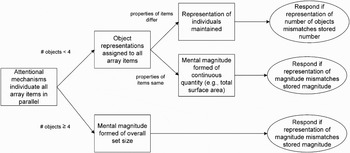
The model in Figure 1 provides a summary of infants' quantitative abilities based on this account. According to this model, infants first segregate items in the visual field by means of a parallel attentive mechanism, similar to that discussed by Intriligator and Cavanagh (Reference Intriligator and Cavanagh2001) or Dehaene and Changeux (Reference Dehaene and Changeux1993). Infants will quickly forget the results of this analysis once the physical display is no longer in view. But while the display is visible, infants assign a more permanent object representation if the total number of items is less than four. The Figure 1 model therefore predicts the results for small numbers of objects in the same way as the simpler theory considered earlier (though the use of both parallel segregation and object representations suggests that individuating objects may be a more complex process than might first appear). If the number of items is four or more, however, infants cannot employ object representations but may, instead, use the output from the initial parallel analysis to produce a single measure of approximate cardinality. Thus, the lower track accords with Barth et al.'s (2003) and Wood and Spelke's (2005) findings of constant time to discriminate large displays when the ratios between them are equal. The model assumes ad hoc that object representations take precedence over the global cardinality measure for small arrays. However, perhaps an explanation for this co-opting behavior could be framed in terms of the functional importance of keeping track of individual objects compared to treating them as a lump sum.Footnote 4
A model for infants’ quantitative abilities. Response rules in ovals indicate conditions under which infants look longer in addition-subtraction or habituation tasks. They are not meant to exhaust possible uses of these representations.

We do not mean to suggest that the tracks in Figure 1 are the only quantitative processes that people (especially adults) can apply to an array of items. While the display is visible, adults can obviously enumerate the elements verbally. Similarly, children and adults may also use a nonverbal enumeration mechanism similar to that described by Cordes et al. (Reference Cordes, Gelman, Gallistel and Whalen2001), Gallistel et al. (Reference Gallistel, Gelman, Cordes, Levinson and Jaisson2006), and Whalen et al. (Reference Whalen, Gallistel and Gelman1999) in some conditions. Which strategies people employ may depend on properties of the display, task demands, and other factors, and we have not tried to capture this interaction in the figure. (We should add that the model in Fig. 1 is our attempt to understand current empirical results within the dual-mechanism framework, and it may not be an accurate depiction of the views of specific dual-mechanism theorists. Our aim is to clarify the implications of such theories rather than to provide an exact account of a particular version of the model.)
We have tried in this section to understand what mechanisms underlie infants' performance in tasks that aim to assess their numerical concepts. Although there are many uncertainties about the Figure 1 model, it appears to account for much of the available data. Our goal, however, is not to defend the model but to examine its implications for later learning. The model is useful because it presents a provisional survey of the components that, according to developmental research, children bring to learning more sophisticated mathematical notions. The issue for us is this: Many psychologists believe that people's mathematical thinking originates from the components in Figure 1. But, if the picture in Figure 1 is even approximately correct, it presents some extremely difficult problems for how children acquire the concept of natural number. These problems are next on our agenda.
3. The route to concepts of number
Let us suppose the Figure 1 model or some close relative correctly captures infants' sensitivity to cardinality. Should we then say that they have the concept of natural number? Dual-mechanism theorists tend to answer “no” (Carey [2004] and Carey & Sarnecka [2006] are explicit on this point). Neither magnitudes nor short-term representations of individual objects have the properties of the natural numbers; hence, according to these theories, children's quantitative concepts have to undergo conceptual change in order to qualify as true number representations. The task for these theorists is then to specify the nature of this change. Some single-mechanism accounts claim that although magnitudes do not represent natural numbers, they do represent continuous quantity, perhaps even real numbers (Gallistel et al. Reference Gallistel, Gelman, Cordes, Levinson and Jaisson2006). The route to natural numbers in this case involves transforming a continuous representation into a countable one. In this section, we extend dual theorists' skepticism about the relation between the natural number concept, on the one hand, and object files, magnitudes, and similar representations, on the other. Not only do the latter fail to qualify as representations of numbers in their own right, but also there is no straightforward way to get from them to natural numbers.
In examining proposals about the acquisition of natural number (and related arithmetic principles in sect. 4), we repeatedly make use of a simple methodological rule that it might be worth describing in advance. In explaining how a person acquires some idea Q, cognitive scientists often claim that people make an inductive inference to Q from some body of information P, which these people already possess. If people already know P and if the inference from P to Q is plausible to them, then the inference is a potential explanation of how they acquire Q. However, rival inferences can undercut such an explanation. Suppose there is also a body of information P′ (possibly equal to P) and an inference from P′ to a contrary idea non-Q. Then if P′ is as believable and as salient as P and if the inference from P′ to non-Q is as plausible as the one from P to Q, then the inference from P to Q fails to explain Q adequately. We call this rule the no-competing-inference test for psychological explanations. To take a nonmathematical example, suppose we want to explain people's belief that their deity is omnipotent. We might hypothesize that this idea comes from previous knowledge of a powerful parent, plus a conscious or unconscious inference from the parent to the deity. But, although this may be the right account, we should also consider possible competing inferences. In everyday experience, we encounter only individuals (even parents) with limited power. So why don't people draw the inference from a person with limited power to a deity who is non-omnipotent? There could, of course, be considerations that favor the first inference over the second (e.g., Freud [Reference Freud1927/1961] believed that people's fear and need for protection motivates the inference to an omnipotent deity). However, unless we can supply such a reason – a reason why the selected inference is more convincing than potential competing ones – the initial explanation is incomplete.
It is understandable why theories sometimes violate the no-competing-inference test. Because we ordinarily know the final knowledge state Q that we want to explain, it is natural to look for antecedents P that would lead people to Q. Because we are not trying to explain non-Q, we do not seek out antecedents for these rivals. It is also clear that cognitive scientists who work on mathematical thinking are no more prone than others to violate the no-competing-inference principle. Still, we find this principle helpful in evaluating the strengths and weaknesses of existing theories in this domain.
3.1. Numerical concepts versus concepts of numbers
As dual-mechanism theorists have pointed out, analog magnitudes are too coarse to provide the precision associated with specific natural numbers (Carey Reference Carey2004; Carey & Sarnecka Reference Carey, Sarnecka, Munakata and Johnson2006; Spelke Reference Spelke2000; Reference Spelke, Gentner and Goldin-Meadow2003). The magnitude representation of 157 would barely differ from that of 158 (if a magnitude device could represent them at all), so they would not have the specificity of a unique natural number and its successor. Short-term object representations do have the discreteness of natural numbers, but they are not unitary representations. Without further apparatus, having one, two, or three such active representations does not amount to a representation of oneness, twoness, or threeness. If a child is tracking three objects, he or she has one object representation per object but nothing that represents the (cardinality of the) set of three. Unless such representations build in the concept of a unified set of individuated elements, there is nothing to represent number. According to the dual-mechanism story, then, it is only after children learn to count and to combine the precursor representations that they have true concepts of natural numbers.
Some single-mechanism theorists credit infants (and nonhuman animals) with more mathematical sophistication. For example, Gallistel et al. (Reference Gallistel, Gelman, Cordes, Levinson and Jaisson2006, p. 247) assert that “when we refer to ‘mental magnitudes’ we are referring to a real number system in the brain.” Although we tend to think of real numbers as more advanced concepts than natural numbers, this may reverse the true developmental progression. The reals may be the innate system, with natural numbers emerging later as the result of counting or through other means.
However, some of the criticisms that dual-mechanism theorists level against magnitudes as representations of natural numbers also apply to magnitudes as representations of the reals. Because the mental magnitudes become increasingly noisy and imprecise as the size of the number increases, larger numbers are less discriminable than smaller ones. For example, if we consider 157 and 158 as real numbers (i.e., as 157.000… and 158.000…), they will be much less discriminable than two smaller but equally spaced numbers, such as 3 and 4 (3.000… and 4.000…). In Gallistel et al.'s view, this imprecision is the result of the way a mental magnitude is retrieved rather than a property of the magnitude itself. This is of no comfort, however, to the idea that infants can represent real numbers. If cognitive access to this representation is always noisy or approximate, it is unclear how the system could attribute the correct real-number properties to the representation without some independent concept of the reals. People cannot skirt the retrieval step because, as Gallistel et al. consistently emphasize, the representation of a number cannot be inert but has to play a role in arithmetic reasoning. An analogy may be helpful on this point. Suppose you have access to some continuously varying quantity, such as the level of water in a tub, and suppose, too, that the viewing conditions are such that the higher the level of water, the greater the perceived level randomly deviates from the true level. Could you use such a device to represent the real numbers – in order to perform arithmetic? Although you could combine two quantities of water to get a larger quantity, the representation of the sum would be even fuzzier than that of the original quantities (Barth et al. Reference Barth, La Mont, Lipton, Dehaene, Kanwisher and Spelke2006) and has few of the properties of real-number arithmetic. For example, real-number addition is a function that takes two reals as inputs and yields a unique real as output. But addition with noisy magnitudes is not a function at all; for any two real input values, it can yield any value within a distribution as a possible output.Footnote 5 Of course, if you already knew some statistics, you might be able to use this tool to compensate for the deviations, but this depends on a pre-existing grasp of real-number properties.
These considerations suggest that if prelinguistic infants start from the components in Figure 1, then there is no reason to think that they have concepts of either the natural or the real numbers. Many theorists believe, however, that once children have learned language or, at least, language-based counting, they are in a position to attain true concepts of natural numbers and that they have acquired these concepts when they are able to perform tasks such as enumerating the items in an array or carrying out simple commands (e.g., “Give me six balloons”). In what follows, we suggest that neither of these ideas stands up to scrutiny. Language is unable to transform magnitudes or object representations to true number concepts, and tests involving small numbers of objects do not necessarily tap concepts of natural number.
3.2. The role of language and verbal counting
We have mentioned Chomsky's (1988) hypothesis that mathematics piggybacks on language, making use of the ability of syntax to generate countably infinite sequences. In more recent work, Chomsky and colleagues (see Hauser et al. Reference Hauser, Chomsky and Fitch2002) take what seems a different view of the relation between language and mathematics – one in which both systems spring from an underlying ability to perform recursive computations; we consider this idea in section 5. However, many theorists continue to see language as necessary in shaping a true understanding of the natural numbers. Considering this issue draws us back into an arena of active controversy.
3.2.1. Language as sufficient for number concepts
There are several reasons why the language-to-math hypothesis is attractive. First, natural languages possess properties that are also crucial in mathematics and that are difficult to obtain from experience with everyday objects and actions. The grammatical resources of language can easily generate the type of countably infinite sequence that can represent the natural numbers. For example, the nearly trivial grammar in (1) produces the “square language” we introduced earlier:

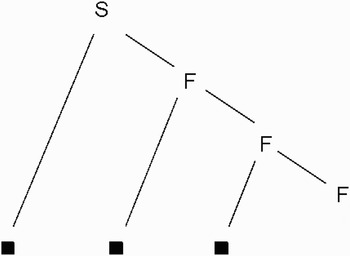
We originally used this language in section 2.1 to represent cardinality, but it could also serve more generally as a system of numerals. As an example, these phrase-structure rules generate the tree structure in Figure 2 as the representation of three.
A representation of the number three, according to the grammar rules in (1).

The role of the F symbol in this grammar illustrates the way recursion is useful in generating the natural numbers. The symbol F can be embedded as many times as necessary in order to produce the correct number of squares. What makes Figure 2 represent three is in part that it occupies the third position in the sequence of such strings that the grammar of (1) generates. (Of course, we are not proposing the square language as a cognitively plausible representation but only as a simple illustration of the generative capacity that such representations would require; we consider other ways to formulate the natural numbers in sect. 5.) This tie to language would clearly be helpful in accounting for math properties that depend essentially on the infinite size of the natural numbers (see sect. 4). Along similar lines, Pollmann (Reference Pollmann2003) and Wiese (Reference Wiese2003) have pointed out that the natural numbers, like certain parts of language, are an inherently relational system in which the meaning of any numeral depends on its position in the system as a whole. Language furnishes a type of relationally determined meaning in which a sentence, for example, depends on the grammatical relations among its constituents (e.g., “The financier dazzled the actress” differs in meaning from “The actress dazzled the financier”). Thus, language can set the stage for understanding mathematics.
It is possible to imagine a strong version of the language-to-mathematics hypothesis in which possessing a natural language is not only necessary but also sufficient for the development of concepts of natural numbers. According to this type of theory, language is the sole source of number concepts. Psychologists who see a role for language in acquiring number concepts have more often taken the “catalyst” view that we describe shortly (in the next subsection), but the stronger position may be implicit in the idea that “the human number faculty [is] essentially an ‘abstraction’ from human language”(Chomsky Reference Chomsky1988, p. 169). Evidence against this possibility comes from recent studies of native Brazilian peoples who appear to lack concepts for exact numbers greater than four (Gordon Reference Gordon2004; Pica et al. Reference Pica, Lemer, Izard and Dehaene2004). These people have no number terms that distinguish between, for example, six and seven; instead, they use words such as “many” for larger numbers of items. In tasks that require knowledge of approximate quantity, members of these cultures perform in a way that is comparable to Americans or Europeans. For example, Pica et al. (Reference Pica, Lemer, Izard and Dehaene2004) report that the Mundurukú are able to point to the larger of two sets of 20 to 80 dots with accuracy that is nearly the same as French controls. However, in tasks that require exact enumeration, accuracy is relatively low. If participants see a number of objects placed in a container and then see a subset of the objects withdrawn, they have difficulty predicting how many (Pica et al. Reference Pica, Lemer, Izard and Dehaene2004) – or whether any (Gordon Reference Gordon2004) – objects remain. These experiments suggest that the Mundurukú and Pirahã peoples use a system for dealing with cardinality roughly similar to that of Figure 1. They treat large cardinalities (and, perhaps, small cardinalities as well) as approximate quantities. As in the case of findings with Western infants, it is possible to question whether difficulties in assessing the cardinality of a set imply lack of a concept of natural numbers (see sects. 2 and 3.3). But in this case, it is difficult to argue for knowledge of natural numbers in the absence of evidence for more than four discrete representations for numerical properties. Gelman and Butterworth (Reference Gelman and Butterworth2005) suggest that such counterevidence might be obtainable. However, taking the Brazilian results at face value, we need to explain why natural language shows up in such cultures but natural numbers do not, if there is an innate linguistic basis for a countable number system.Footnote 6, Footnote 7
3.2.2. Language as a catalyst for number concepts
A weaker, and more plausible, hypothesis is that children need, not language in general, but some type of language-based enumeration technique in order to form number concepts. Initially, children verbally enumerate items by means of simple counting (see sect. 1.1 for our distinction between simple and advanced counting). They match a small fixed list of numerals to the elements of a collection.
Adults, of course, can enumerate by advanced counting, and there is no doubt that advanced counting could be helpful in conveying the concept of natural numbers. Once children have mastered advanced counting, they have a model of the natural numbers that is much closer than anything in the world of (finite) physical experience. This is because the elements of advanced counting (the numerals of the counting system) are in a one-to-one correspondence with the natural numbers – a correspondence that preserves the successor relation (i.e., the successor relation on the numerals corresponds to that on the natural numbers). We are not claiming that children attain the concept of natural number by learning advanced counting: We think it more likely that children learn an underlying set of principles that facilitates both advanced counting and the concept of natural number (see sect. 5). However, advanced counting, not simple counting, provides the numerals that are the obvious counterpart of the natural numbers.
Most psychologists believe, however, that children acquire the natural number concepts long before they master advanced counting either in natural language or in explicit mathematical notation. Thus, if language-based counting plays a role in forming these concepts, it must be simple counting and associated enumerating that are responsible. How are they able to produce this effect? Some recent dual theories of a counting-to-number link suggest that enumerating items with natural-language count terms provides a conceptual bridge between magnitudes and object representations, giving rise to a new sort of mental representation (Spelke Reference Spelke2000; Reference Spelke, Gentner and Goldin-Meadow2003; Spelke & Tsivkin Reference Spelke and Tsivkin2001). Magnitudes bring to this marriage the concept of a set, object representations bring the concept of an individual, and the result is the concept of cardinality as a measure of a set of distinct individuals:
To learn the full meaning of two, however, children must combine their representations of individuals and sets: they must learn that two applies just in case the array contains a set composed of an individual, of another, numerically distinct individual, and of no further individuals…. The lexical item two is learned slowly, on this view, because it must be mapped simultaneously to representations from two distinct core domains. (Spelke Reference Spelke, Gentner and Goldin-Meadow2003, p. 301)
But it is difficult to understand how conjoining these systems could transform number representations in the desired way (see Gelman & Butterworth [2005] and Laurence & Margolis [Reference Laurence, Margolis, Carruthers, Laurence and Stich2005] for related comments). Suppose the meaning of a number word like “two” connects to both a fuzzy magnitude and two object files. According to this theory, magnitude information must transform the representation of two separate objects into an adult-like representation of a single set of two. But why doesn't the fuzziness of the magnitudes lead the children to believe that “two” means approximately two individuals (or a few)? Why do magnitudes lead to sets rather than to some other form of composite, such as a part-whole grouping? Why is language necessary if even infants can treat individual items as parts of chunks (Feigenson & Halberda Reference Feigenson and Halberda2004; Wynn et al. Reference Wynn, Bloom and Chiang2002)? Unless we can somehow answer these questions, the explanation trips over what we called the no-competing-inference rule, since there are many competing conclusions about the meaning of number words that children could draw from the same data. We might do better to discard magnitudes and to think of the resulting representations as drawing on some more direct form of set-like grouping. Along these lines, Carey (Reference Carey2004; Carey & Sarnecka Reference Carey, Sarnecka, Munakata and Johnson2006; Le Corre & Carey Reference Le Corre and Carey2007) has proposed that children use the resources of natural-language quantifiers to combine object representations into sets, so that children come to represent one as {a}, two as {a, b}, and so on – representations which we will refer to as “internal sets.”
It is language that spurs the creation of an internal symbol whose meaning is that which is common to all situations where a pair of individuals are being tracked at the same time. Associating linguistic markers with unique states of the parallel individuation system is only possible for up to three objects, because the parallel individuation system can only keep track of up to three individuals at once. (Carey & Sarnecka Reference Carey, Sarnecka, Munakata and Johnson2006, p. 490, emphasis in original)
Some single-mechanism theories describe infants as already having true natural number concepts for smaller numbers; so the role of language is more plausibly confined to extending these concepts to the rest of the integers (Bloom Reference Bloom2000; see also Hurford Reference Hurford1987 for a related account). According to Bloom (Reference Bloom2000, p. 215), for example, “Long before language learning, … [babies] have the main prerequisite for learning the smaller number words: they have the concepts of oneness, twoness, and threeness. Their problem is simply figuring out the names that go with these concepts.”
The crucial question for both single-mechanism and dual-mechanism theories is then whether simple counting and enumerating allow children to extend their knowledge of number beyond these first three to a full concept of natural number. Suppose, in other words, that at a critical stage, children have worked out facts like those in (2):
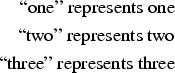
According to the assumptions we have temporarily adopted, words occupy the left-hand side of these relations, and cardinalities occupy the right-hand sides (e.g., one is the size of singleton sets, two is the size of two-member sets, etc.). The concepts that mediate the relations in (2) depend on the theory in question. For single-mechanism theories, internal magnitudes underlie these associations; for example, “two” denotes two because children learn that “two” represents what the corresponding internal magnitude does. For dual-mechanism theories, the associations depend on preliminary combinations of object representations and magnitudes (Spelke Reference Spelke, Gentner and Goldin-Meadow2003) or object representations and set-like groupings (Carey Reference Carey2004; Carey & Sarnecka Reference Carey, Sarnecka, Munakata and Johnson2006; Le Corre & Carey Reference Le Corre and Carey2007).
In all cases, though, the outcome of these linkages is that children acquire the denotations in (2). Then, by correlating the sequence of words in the count series with the regular increase in cardinality, the children arrive at something like the generalization in Principle (3):
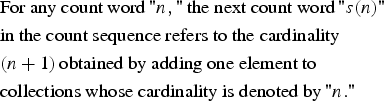
Carey (Reference Carey2004) and Hurford (Reference Hurford1987) have detailed formulations along these lines. Similar suggestions appear in Bloom (Reference Bloom1994) and Schaeffer et al. (Reference Schaeffer, Eggleston and Scott1974). According to Carey and Sarnecka (Reference Carey, Sarnecka, Munakata and Johnson2006, p. 490), “This idea (one word forward [in the count list] equals one more individual) captures the successor principle.” Notice, though, that Principle (3) depends on the concept of the next count word, which we have referred to as “s(n),” for any count term “n” (if “n” is “five,” “s(n)” is “six”; if “n” is “ninety,” “s(n)” is “ninety-one”; etc.). For these purposes, simple counting won't do as a guide to “s(n),” as simple counting uses a finite list of elements. For example, if a child's count list stops at “nine,” then Principle (3) can extend the numeral-cardinality connection through nine. In order to capture all the natural numbers, however, Principle (3) requires advanced counting: an appreciation of the full numeral system. But at this point the trouble with the counting hypothesis comes clearly into view, for at the point at which children are supposed to infer Principle (3) – at a little over 4 years of age – they have not yet mastered advanced counting. There is nothing that determines for such a number learner which function or sequence specifies the natural number words (i.e., the function that appears as “s(n)” in Principle [3]).
In learning ordinary correlations or functions, children induce a relation between two pre-existing concepts, for example, degree of hunger and time since lunch. By contrast, what lies behind the proposal that children induce Principle (3) from (2) is the bootstrapping hypothesis that they are simultaneously learning advanced counting along with (and because of) the correlation with cardinality. But it is unclear how this is possible in the case of natural numbers (see Rips et al. Reference Rips, Asmuth and Bloomfield2006; Reference Rips, Asmuth and Bloomfield2008). Suppose, for example, that the count system that the child is learning is not one for the natural numbers but, instead, for arithmetic modulo 10, so that adding 1 to 0 produces 1, … , and adding 1 to 8 produces 9, but adding 1 to 9 produces 0, and so on in a cyclical pattern. In this case, Principle (3) is still a valid generalization of (2) if we interpret “s(n)” as the next numeral in the modular cycle, but then what has been learned is not the natural numbers.
The generalization in (3) can seduce you if you think of the child as interpreting it (after a year of struggle) as “Aha, I finally get it! The next number in the count sequence denotes the size of sets that have one more thing.” But “next number in the count sequence” isn't an innocent expression since the issue is, in part, how children figure out from (2) that the next number is given by the successor function for the numerals corresponding to the natural numbers and not to a different sequence (e.g., the numbers mod 10 or mod 38 or mod 983). You might be tempted to reply that this problem is no different from any other case of (empirical) induction, where there is normally an infinite choice of extrapolations. There have to be some constraints on induction to make learning humanly possible. But although this is true, it is unclear what general constraints could steer Principle (3) toward the natural numbers, especially because the function successor-mod-10 and many others seem less complicated than the successor function for natural numbers, with its infinite domain. (See Rips et al. [2006] for a discussion of the relation between the bootstrapping problem and more general problems of induction and meaning.)Footnote 8
We have been concentrating on the relation between numerals and cardinalities, as the issues are clearest in this context, but the same difficulties appear if we look at acquisition of number meanings from the perspective of the mental representations that support them. The theories we are examining suppose that the mental representations are latched to external cardinalities, so that larger internal magnitudes or larger internal sets always correlate with larger external set sizes. On this assumption, if we are learning the standard system for natural numbers, “nine” will come to be associated with a single magnitude or internal set, whereas if we are learning the mod10 system, “nine” will be associated with a collection of internal magnitudes or sets. Principle (3) does not tell us which of these connections is correct.
Some theorists may understand Principle (3) as a way of transcending, rather than extending, the initial representations. On this understanding, mental magnitudes or internal sets are no longer needed once children arrive at this principle. To the extent that properties of the initial representations carry over to later ones, however, they bring additional difficulties to number concepts. If we start with a magnitude representation for (2) and extend it by (3), we get increasingly noisy representations as we go to higher numbers. There is nothing about the representation that gives us the ingredients we need to formulate the correct hypothesis of a countable sequence (as Leslie et al. [2007] point out). If we start with a set-like representation for (2) and try to extend it by (3), we run into the problem that we can't possibly represent in this way more than a small initial segment of the natural numbers. Our ability to represent individual sets (e.g., {a}, {a, b}) must come to an end because of memory limits, but the natural numbers keep on going. To take up the slack, the concepts have to go generative, as in (1). But since the right generative principle is not supposed to be available beforehand, it is unclear what guarantees a structure that will continue infinitely. To represent the natural numbers, though, we need a representation for a sequence that is both countable and infinite.
This is not to say that the generalization in (3) is false or that it is unhelpful to number learners. The generalization is true, but it does not serve to fix the meaning of the numerals for children, because at this point they do not know what function “s(n)” is. For this reason, Principle (3) cannot tell them what the natural numbers are; Principle (3) is indeterminate for them. For practical purposes of enumerating objects, of course, it is important for children to realize that there is some systematic relation or other that holds between the numeral sequence and the cardinalities, and (3) could mark this recognition. However, realizing that there is such a link does not fully specify it. Theories of number acquisition rely on Principle (3) both because they take the meaning of a numeral to be a cardinality and because they suppose (3) specifies this meaning for the natural numbers. But (3) is incapable of performing this function, since it presupposes knowledge of the very structure that it is supposed to create. This suggests that enumerating might be less crucial to the development of natural number than might first appear. Enumerating – pairing numerals to cardinalities – cannot create the natural numbers, as many forms of enumerating that are consistent with Principle (3) lead to nonstandard systems (see sect. 5.3.4).
3.3 Do tests of “how many objects?” require concepts of natural number?
Suppose, though, that the child finally succeeds in the standard tests of number comprehension, performing correctly when asked to “Point to the picture with six dogs” or to “Give me six balloons.” Should we now say that he or she has the concept of natural number? The answer seems to be “no” when we are dealing with the small collections that these experiments employ. A textbook exercise in first-order logic asks students to paraphrase sentences such as “There are (exactly) two dogs” or “There are (exactly) three hats.”Footnote 9 An answer to the first of these exercises appears in Proposition (4):

Sentences like this one do not contain references to numbers or any other mathematical objects but get along with concrete objects, such as dogs. The quantifiers and variables in (4) make clear its commitments about the existence of objects – (4) is committed to dogs but not to numbers (see Hodes Reference Hodes1984; Parsons Reference Parsons2008; Quine Reference Quine1973) – but the representation for two dogs as an internal set (e.g., {a, b}) or as a magnitude presumably carry the same commitments.
We should be careful to acknowledge that children's quantitative abilities extend beyond concrete physical objects like dogs. Even infants are sensitive to the number of tones in a sequence (e.g., Lipton & Spelke Reference Lipton and Spelke2003) and to the number of jumps of a puppet (Wynn Reference Wynn1996). They also keep track of sums of entities appearing in different modalities – for example, visual objects plus tones, at least if they have previously witnessed the tones paired with the objects (Kobayashi et al. Reference Kobayashi, Hiraki, Mugitani and Hasegawa2004). In this sense, the infants' numerical skills are more abstract than what is required to enumerate visually presented items. However, this type of abstractness does not affect the present argument, since the infants can accomplish all these tasks by representing objects, tones, or jumps, rather than number.
Our goal in this article is to find out how people attain the concept of natural number. To summarize our interim conclusions about this, let us consider hypothetical children who have made the inference to Principle (3) and can correctly understand requests, such as “Give me n balloons,” for “n” up to “nine” (or the last of the children's current set of count terms).
Do such children have the concept NATURAL NUMBER?
No, since many definitional properties of the natural numbers are unknown to them (e.g., that the numbers don't loop around).
Could the children have partial knowledge of NATURAL NUMBER?
Yes, in the sense that they could know some properties of this concept. There is no reason to think that knowledge of natural numbers is all or none. Although children must have a certain body of information to be said to have the natural number concept (see sect. 1.1), they may assemble the components of this information over an extended period of time.
Do such children have the concept of ONE (or TWO or… or NINE)?
Not that we can discern from the results of tests such as “Give me n.” Although children may have such concepts, the range of tasks that we have reviewed does not reveal their presence. To put this in a slightly different way, the developmental studies may have revealed numerical concepts but not concepts of numbers. It may be only when children make mathematical judgments about numbers (rather than about objects) that we can study the nature of these concepts. For example, whereas it is easy to express the idea that there are two dogs by means of proposition (4) without using concepts of numbers, it is more difficult to express the ideas that one is the first number, that one is less than two, that for any number there is a larger one, and so on.Footnote 10
Our distinction between numerical concepts and concepts of number partially resembles others that have appeared in the literature on number development. Gelman (Reference Gelman1972; Gelman & Gallistel Reference Gelman and Gallistel1978, Ch. 10), for example, separates children's ability to determine the number of elements in a collection from their ability to reason about the resulting cardinality. For instance, deciding that there are three books in one pile and five in another requires enumerating the books, but deciding that the two piles have different numbers of books is a matter of numerical reasoning, in Gelman's terminology. The distinction we are driving at here, however, differs in that even numerical reasoning (in Gelman's sense) does not necessarily involve concepts of number. It would be possible to determine that two piles have different numbers of books by employing concrete representations of books rather than representations of number. Compare this judgment with the idea that five is greater than three, which does seem to require concepts of numbers. Closer to our own distinction is Gelman and Gallistel's account of numerical versus algebraic reasoning: “Numerical reasoning deals with representations of specific numerosities. Algebraic reasoning deals with relations between unspecified numerosities” (Gelman & Gallistel Reference Gelman and Gallistel1978, p. 230). However, even algebraic reasoning on this account is about the cardinalities of physical objects rather than about numbers themselves. Gelman and Gallistel (Reference Gelman and Gallistel1978, p. 236) do note, however, “the conceivable existence of another stage of development… In this stage arithmetic is no longer limited to dealing with representations of numerosity. It now deals with that ethereal abstraction called number.”
To forestall a possible misunderstanding, we are not asking whether children have conscious access to the principles governing the natural number system or other mathematical domains, and we are not asking when (or if) children are able to behave like “little mathematicians” in explicitly wielding such principles in reasoning or computation. Of course, a child's explicit formulation of such principles would be excellent evidence that he or she had concepts of natural numbers, and it would place an upper bound on when he or she had acquired these concepts. But there is no reason why the child couldn't display evidence of such concepts indirectly – for example, evidence of a correct understanding of the sentence, “Three is less than four.” Gelman and Greeno (Reference Gelman, Greeno and Resnick1989) have clarified this point concerning mathematical principles, and the analogous case with respect to knowledge of linguistic rules is too well known to need replaying here. What we are interested in probing is whether children have any concept whatsoever of numbers, implicit or explicit, and our review of research on infants and preschool children has turned up no evidence that allows us to decide this issue. This is due to limitations in the nature of the experimental tasks. To find such evidence, then, we need to look at how children make mathematical judgments that have a more complex structure, as we do in the following section.
One objection to this line of reasoning can be summarized thus:
It is impossible that early quantitative abilities are disconnected from true concepts of number, since evidence for these precursors appears even in adults' mathematics. For example, adults' judgments of which of two digits is larger yield distance effects on reaction times (see the studies cited in sect. 2.2). Assuming that some magnitude-like representation is responsible for this effect, magnitude must be part of adults' natural-number concept. For this reason, some proposals about number representation in adults have included these magnitudes, along with other ingredients (e.g., Anderson Reference Anderson, Scarborough and Sternberg1998; McCloskey & Lindemann Reference McCloskey, Lindemann and Campbell1992).
Adults might well find magnitude representations useful, for example, in carrying out tasks that call for estimation of quantity or amounts; but we do not find it convincing that because number terms are associated with magnitudes, magnitudes are responsible for number concepts. There may be a sense of “concept” in psychology in which anything can be part of a concept, as long as a corresponding expression reminds us of it. But what proponents of magnitudes-as-precursors-of-natural-numbers have to claim is not just that magnitude is associated with natural number (in the way, e.g., that BREAD is associated with JAM), but also that it plays a causal role in children's acquisition of this concept – that NATURAL NUMBER is built on a foundation of magnitude – and we see no reason for believing this is true. For example, natural number includes the notion that each such number has a unique successor, but there is nothing about magnitudes that enforces this idea (since magnitudes don't have successors), and there is no easy way for magnitudes to be conjoined with this idea to produce the adult concept of natural number.
Here is a related objection:
Some of the components of Figure 1 seem likely to be part of adults' ability to enumerate objects using advanced counting. For example, they must use object individuation to discriminate the to-be-enumerated items, and they may need object representations or magnitudes as well. Granted: these resources are not sufficient for adults' (or even children's) object enumeration, since this requires further knowledge, such as Gelman and Gallistel's cardinal principle (the last element of the count sequence represents the cardinality of a collection). Nevertheless, some of the Figure 1 processes are surely part of the story of adult enumeration and, hence, must be part of adults' concept of natural number.
This objection is initially tempting because of the assumptions that we have temporarily adopted: that numbers are cardinalities and that cardinalities are sets of sets of physical objects. The components of Figure 1 that determine object representations no doubt carry over to adult performance in enumerating objects (i.e., determining the cardinality of groups of objects). But this only makes the difficulties we have just seen more acute. The lack of a plausible story about how children graduate from the representations and processes of Figure 1 to an adult concept of natural number suggests that the assumptions themselves are incorrect. As in the case of the previous objection, this one works only if you assume that adults' enumerating figures into the concept NATURAL NUMBER. What we suggest in section 5 is that the natural number concept, and even concepts of particular numbers such as TEN, may not necessarily depend on enumeration, either definitionally or empirically. Before exploring this idea, however, we first examine a different route from objects to number.
4. Knowledge of mathematical principles
The ability to perform simple counting and enumerating probably will not suffice as evidence of concepts of numbers for the reasons we have just seen. Even early arithmetic may be too restricted a skill to demand number concepts: A child's first taste of arithmetic may involve object tracking, mental manipulation of images of objects, counting strategies, or mental look up of sums that do not require the numerals to refer to numbers. This may seem to raise the issue of whether even adults have or use the concept of natural number outside very special contexts, such as mathematics classes. Certainly, older children and adults continue to use number words in phrases such as “three stooges” for which no concepts of number may be in play. However, older children and adults also appear to have a range of knowledge about numbers, which they can use in nontrivial arithmetic, numerical problem solving, and other tasks, and a look at this knowledge may give us some ideas about how the natural number concept first appears.
One place to search for evidence of concepts of numbers is knowledge of general statements that hold for infinitely many numbers. Understanding generalizations of the form “for any number x, F(x)” forces people to deal with concepts that carry a commitment to numbers rather than to physical objects, as these generalizations are overtly about numbers. Statements of this sort include those that define the numbers (e.g., every natural number has just one immediate successor) and those that state arithmetic principles that adults can express with algebraic variables (e.g., additive commutativity: a+b= b+a; additive inverse principle: a+b−b=a). Statements of the first sort have an especially important role here, as they bear on the issue of when people can be said to have the concept NATURAL NUMBER, and we return to them in section 5. General arithmetic principles, though, are also of interest because the infinite scope of such principles makes it difficult to paraphrase them purely in terms of statement about physical objects (at least not without additional mathematical apparatus). Children's knowledge of these principles can provide evidence that they have a concept of number, whether or not this exactly coincides with the natural numbers. In this section, we consider as an example the additive commutativity principle because there is a substantial body of research devoted to how children acquire it. (We also consider briefly the additive inverse principle in Note 11.) Bear in mind, however, that many other principles could serve the same purpose.
We are not requiring that children be able to compute the answers to specific arithmetic problems in order to demonstrate understanding of math principles: It is enough that they recognize the necessity of the rule itself. Although children would, of course, have to possess the notion of addition in order for them to recognize that a+b=b+a, there is no need for them to be able to compute correctly that, say, 946+285=1,231 and 285+946=1,231. What's crucial is that they understand that, for all natural numbers, reversing the order of the addends does not change their sum.
4.1. Acquisition of the commutativity principle
Commutativity appears to be one of the few general relations to attract researchers' attention, probably because of its close ties to children's early addition strategies. It may also be one of the first general properties of addition that children acquire (Canobi et al. Reference Canobi, Reeve and Pattison2002; see Baroody et al. [2003] for an extensive review of children's concept of commutativity.)
Evidence on commutativity suggests that most 5-year-olds know that the left-to-right order of two groups of objects is irrelevant to their total. Three ducks on the right and two ducks on the left have the same sum as two on the right and three on the left. Children recognize the truth of this relation even when they can't count the number of items in one or both groups – for example, because the experimenter has concealed them (Canobi et al. Reference Canobi, Reeve and Pattison2002; Cowan & Renton Reference Cowan and Renton1996; Ioakimidou 1998, as cited in Cowan Reference Cowan, Baroody and Dowker2003; Sophian et al. Reference Sophian, Harley and Manos Martin1995). Of course, children do not read any mathematical notation in these studies; they simply make same/different judgments about the total number of objects. Hence, any potential difficulties in coping with explicit mathematical variables do not come into play in the way they might for beginning algebra students (MacGregor & Stacey Reference MacGregor and Stacey1997; Matz Reference Matz, Sleeman and Brown1982). However, the lack of explicit mathematical connections raises the issue of whether children's judgments about the spatial or temporal order of the combination reflect the same notion of commutativity as their later understanding that a+b=b+a. Children who succeed in these grouping tasks have apparently understood the idea that for two disjoint collections of concrete objects, A and B, certain spatial or temporal rearrangements do not change the cardinality of their union. But the commutativity of addition is the statement that for any two numbers, a and b, the number produced by adding a to b is the same as that produced by adding b to a.
This difference between generalizing over objects and over numbers does not imply that knowledge of the spatial or temporal commutativity of objects is irrelevant in learning the commutativity of addition. In working out the relation between them, however, it is good to keep in mind that not all binary mathematical operations are commutative. For example, subtraction, division, and matrix multiplication are not; even addition of ordinal numbers is not commutative (Hamilton Reference Hamilton1982, p. 216). Similarly, not all physical grouping operations are commutative in the sense of preserving cardinalities. The total number of objects in a pile may depend on whether fragile objects are put on before or after heavy ones. This suggests that any transfer of commutativity from physical to mathematical operations must be selective rather than automatic. There seems to be little possibility that children could first discover that physical grouping of objects is commutative with respect to totals and then immediately generalize commutativity to addition of numbers. Children would have to hedge the initial “discovery” in ways that might be difficult to anticipate before they had some knowledge of addition itself, and they would have to transfer the properties to some mathematical operations but not to others.
This difference between commutativity in the physical and mathematical domains helps account for some of the empirical findings. Many children are able to pass a commutativity test involving sums of hidden objects, as in the experiments cited earlier, before they are able to solve simple addition problems (Ioakimidou 1998, as cited in Cowan Reference Cowan, Baroody and Dowker2003). Once they have learned addition, however, they do not automatically recognize the commutativity of specific totals (e.g., that 2+5=5+2). This is true even when the addition strategies they use presuppose commutativity. For example, some children solve addition problems by finding the larger of the two addends and then counting upwards by the smaller addend; that is, these children solve both 2+5 and 5+2 by starting with 5 and counting up two more units to 7. However, children who use this strategy of counting on from the larger addend do not always see that addition is commutative when directly faced with this problem. For example, although they may use counting from the larger addend to solve both 2+5 and 5+2, they may not be able to affirm that 2+5=5+2 without performing the two addition operations separately and then comparing them (Baroody & Gannon Reference Baroody and Gannon1984). In fact, some children seem to discover the commutativity of addition only after noticing that these paired sums turn out to be the same over a range of problems (Baroody et al. Reference Baroody, Wilkins, Tiilikainen, Baroody and Dowker2003).
We argued in section 3 that there is no evidence from studies of infants that they possess concepts of numbers. Even tasks with older children that require them to determine the cardinality associated with specific number words do not necessarily reveal their presence. Of course, it is still quite possible that preschool children have such concepts. The available experimental techniques may simply not be the right ones to detect them. The studies on commutativity are of interest in this respect because tasks involving this principle do seem to require concepts of numbers in order for children to appreciate the principle's generality. The results of these studies suggest, however, that children do not automatically recognize the validity of the principle when they first confront it.Footnote 11
We are about to explore the issue of where such principles come from. But the findings about additive commutativity already suggest that people's understanding of mathematical properties cannot be completely explained by their nonmathematical experience. This partial independence is in line with the relative certainty we attach to mathematical versus nonmathematical versions of these properties. We conceive of the commutativity of addition for natural numbers as true in all possible worlds but not the commutativity of physical grouping operations.
4.2. Mapping of mathematical principles from physical experience
Most psychological theories of math principles (e.g., commutativity) portray them as based on knowledge of physical objects or actions. In this respect, these theories follow Mill's assertion that:
the fundamental truths of [the science of Number] all rest on the evidence of sense; they are proved by showing to our eyes and fingers that any given number of objects – ten balls, for example – may by separation and re-arrangement exhibit to the senses all the different sets of numbers the sum of which is equal to ten. (Mill Reference Mill1874, p. 190)
Of course, nearly all contemporary theories in this area credit children with some innate knowledge of numerical concepts (e.g., via magnitudes), as we have seen in section 2. Unlike Mill's proposal, these theories do not try to reduce all mathematical knowledge to perceptual knowledge. Nevertheless, all theories of how children acquire arithmetic principles, such as the commutativity or the additive inverse principle, view these principles as based, at least in part, on physical object grouping. In the case of the commutativity of addition, these theories typically see spatial-temporal commutativity for sums of objects as a precursor, though they may also acknowledge the role of other psychological components, such as experience with computation (e.g., Gelman & Gallistel Reference Gelman and Gallistel1978, p. 191; Lakoff & Núñez Reference Lakoff and Núñez2000, p. 58; Piaget Reference Piaget1970, pp. 16–17; Resnick Reference Resnick, Leinhardt, Putnam and Hattrup1992, pp. 407–408). Theories of this sort must then explain the transition from knowledge of the object domain to the mathematical domain. An account of the empirical-to-mathematical transition is pressing in view of the evidence that this transition is not automatic. How does this transformation take place?
According to Lakoff and Núñez (Reference Lakoff and Núñez2000), general properties of arithmetic depend on mappings from everyday experience. These mappings begin with simple correlations between a child's perceptual-motor activities and a set of innate, but limited, arithmetic operations (roughly the ones covered by the Fig. 1 model). The child experiences the grouping of physical objects simultaneously with the addition or subtraction of small numbers. This correlation is supposed to produce neural connections between cortical sensory-motor areas and areas specialized for arithmetic, and these connections then support mapping of properties from object grouping to arithmetic. Lakoff and Núñez call such a mapping a “conceptual metaphor” – in this case, the “Arithmetic is Object Collection” metaphor. This metaphor transfers inferences from the domain of object collections to that of arithmetic, including some inferences that do not hold for the innate part of arithmetic. For example, closure of addition – the principle that adding any two natural numbers produces a natural number – does not hold in innate arithmetic, according to Lakoff and Núñez, because innate arithmetic is limited to numbers less than four. The metaphor Arithmetic is Object Collection, however, allows closure to be transferred from the object to the number domain, expanding the nature of arithmetic:
[T]he metaphor [Arithmetic is Object Collection] will also extend innate arithmetic, adding properties that the innate arithmetic of numbers 1 through 4 does not have, because of its limited range – namely, closure (e.g., under addition) and what follows from closure…The metaphor will map these properties from the domain of object collections to the expanded domain of number. The result is the elementary arithmetic of addition and subtraction for natural numbers, which goes beyond innate arithmetic. (Lakoff & Núñez Reference Lakoff and Núñez2000, p. 60, emphasis in original.)
A key issue for the theory, though, is that everyday experience with physical objects, which provides the source domain for the metaphors, does not always exhibit the properties that these metaphors are supposed to supply. Closure under addition, for example, does not always hold for physical objects, as there are obvious restrictions on our ability to collect objects together. The mappings in question are unconscious ones: They do not require deliberative reasoning about object collections or mathematics; and they are not posited specifically for arithmetic. Still, given everyday limits on the disposition of objects, why don't people acquire the opposite “nonclosure” property – that collections of objects cannot always be collected together – and project it to numbers? Acquiring the closure property cannot rest on a child's experience that it is always possible “in principle” to add another object, since it is exactly this principle that the theory must explain. The theory seems to run up against the no-competing-inference test that we outlined at the beginning of section 3.
The Lakoff-Núñez theory also contains a metaphor that produces the concept of infinity from experience with physical processes: “The Basic Metaphor of Infinity.” This metaphor projects the notion of an infinite entity (e.g., an infinite set) from experience with repeated physical processes, such as jumping. The repeated process is conceived in the metaphor as unending and yet as having, not only intermediate states, but also a final resultant state. Mapping this conception to a mathematical operation yields the idea of an infinitely repeated process (e.g., adding items to a set) and an infinite resulting entity (e.g., an infinite set). Lakoff and Núñez do not invoke the Basic Metaphor of Infinity in their initial explanation of closure under addition (Lakoff & Núñez Reference Lakoff and Núñez2000, pp. 56–60), perhaps because closure does not necessarily require an infinite set (e.g., modular arithmetic is closed under addition, even though only a finite set of elements is involved). But they do use this metaphor later in dealing with what they call “generative closure,” which would include additive closure as a special case (pp. 176–78). Closure of addition over the natural numbers does involve an infinite set; so perhaps the Basic Metaphor of Infinity is needed in this context. However, this additional apparatus encounters the same difficulty from the no-competing-inference test as does their earlier explanation. Although there may be a potential metaphorical mapping from iterated physical processes to infinite sets of numbers, it is at least as easy to imagine other mappings from iterated processes to finite sets. Why would people follow the first type of inference rather than the second? The Lakoff-Núñez theory is part of a more encompassing framework of cognitive semantics and embodied cognition (see Lakoff & Núñez Reference Lakoff and Núñez2000 for references to this literature), and it includes many more conceptual metaphors. As far as we can see, however, there is nothing about this background that would allow us to resolve this question. This does not mean that such mappings are worthless. Math teachers can exploit them to motivate complex ideas by emphasizing certain metaphors over their rivals (“Don't think about limits that way, think about them this way…”). But without some method for making rival inferences less plausible than the chosen one, the mappings do not explain acquisition.
The principles that make trouble for mapping theories are precisely the ones that are of central interest for our purposes: They are generalizations over all numbers within some math domain. To see that these principles are true, people cannot simply enumerate instances but must grasp, at least implicitly, general properties of the number system. Because the domain of ordinary physical objects and actions contains no counterpart to these principles, people cannot automatically transfer them from that domain. It is possible, of course, that cognitive theories could get around these difficulties by envisioning a different kind of relation between the physical and mathematical realms. In particular, ideas about mathematical objects may be the result of idealizing or theorizing about concrete experience – a view that goes along with certain strains in the philosophy of mathematics (e.g., Putnam Reference Putnam1971; Quine Reference Quine1960). But it is not easy to get a clear picture of how the psychological theory-building process works. It is unclear, for example, how a mental math theory compensates for the messiness of object grouping to obtain the crisp properties of addition, such as commutativity, additive closure, and so on, that allow mathematical reasoning to proceed. Some versions of the theory idea in psychology depend on postulating a metacognitive process that allows people to reflect on lower-level mental representations and to create a new higher-level representation that generalizes their properties (e.g., Beth & Piaget Reference Beth and Piaget1966; Resnick Reference Resnick, Leinhardt, Putnam and Hattrup1992). However, once the abstracting begins, how does this system know which features to preserve, which to regularize or idealize, and which to discard?
In this section, we have been exploring possible ways for children to arrive at math generalizations. This is because these generalizations provide evidence that children have concepts of number. If our present considerations are correct, however, children cannot reach such generalizations by induction over physical objects, and we should therefore consider more direct ways of reaching them. It is also worth noting that many of these same concerns apply to theories in which abstracting over physical objects yields, not mathematical principles like commutativity, but the numbers themselves. Suppose that children initially notice that two similar sets of objects – for example, two sets of three toy cars – can be matched one-to-one. At a later stage, they may extend this matching to successively less similar objects – three toy cars matched to three toy drivers – and eventually to one-to-one matching for any two sets of three items. This could yield the general concept of sets that can be matched one-to-one to a target set of three objects – a possible representation for three itself. In this way, learning the number three could be seen as a concept forming process similar to, but more abstract than, the formation of other natural language concepts (see Mix et al. Reference Mix, Huttenlocher and Levine2002b). But, as we have already mentioned in section 2, the theoretical view that a number is a set of equinumerous sets of physical objects is on shaky grounds, and even if it is possible to learn the concepts of small natural numbers (e.g., THREE) in this way, there is no possibility that the abstraction process is sufficient psychologically for learning all natural numbers one by one.
5. Math schemas
We suggested that early quantitative skills may reveal more about object concepts than about math concepts, and we also suggested that children cannot bootstrap their way from these beginnings to true math concepts by means of empirical induction. For this reason, we looked at beliefs that are more directly about numbers and other mathematical entities. Principles such as the commutativity of addition are cases in point, as are others that generalize over all numbers. Most psychological theories of math suppose that people acquire such generalizations from their experience with physical objects (with the aid of innate numerical concepts, such as magnitudes), but an inspection of these theories revealed gaps in their explanations. These theoretical problems go hand in hand with psychological evidence that questions the possibility of abstracting math from everyday experience. What's left as an account of concepts of number?
5.1. An alternative view of number knowledge
We believe a better explanation of how people understand math takes a top-down approach. Instead of attempting to project the natural numbers from knowledge of physical objects or from partial knowledge of the numerals and cardinality, children form a schema for the numbers that specifies their structure as a countably infinite sequence. Once the schema is in place, they can use it to reorganize and to extend their fragmentary knowledge. The schema furnishes them with a representation for the natural numbers, because the elements of the structure play just such a role.
This view contrasts with the bottom-up approaches that we have canvassed in sections 3 and 4. These approaches suggest that children achieve knowledge of the natural number concept by extrapolating from their early skills in enumerating objects (or manipulating them in other ways). Some form of inductive inference transforms these skills into a full-fledged grasp of the natural numbers. Our review turned up no plausible proposals about the crucial inference, and our suspicion is that this gap is a principled one. Children's simple counting and enumerating does not provide rich enough constraints to formulate the right hypothesis about the natural numbers (Rips et al. Reference Rips, Asmuth and Bloomfield2006; Reference Rips, Asmuth and Bloomfield2008). Investigators could, of course, agree that a pure bottom-up approach cannot be the whole story and that early numerical concepts have to be supplemented with further constraints in order for children to converge on the right hypothesis. But, although this hybrid idea might be correct, the constraints that are needed (which we discuss in the following section) are themselves sufficient to determine the correct structure. Why not suppose, then, that children build a schema for the natural numbers on the basis of these constraints and then instantiate the schema to their preliminary number knowledge?
What is distinctive to the approach we are exploring is that the natural number schema is understood directly as generalizations about numbers rather than in terms of operations on physical objects, such as enumerating or grouping. According to our view, it is no use trying to reduce number talk to object talk, or number thought to object thought. Of course, early numerical concepts could help motivate children to search for math schemas as a way of dealing with their experience. On the present view, however, although these concepts may play a motivational role, they do not provide direct input to schema construction; they do not play a role in framing hypotheses about the concept NATURAL NUMBER. A kind of caricaturized version of our hypothesis is that children learn axioms for math domains, having come equipped with enough logical concepts to be able to express these axioms and with enough deductive machinery to draw out some of their consequences. It is impossible to give a full theory at this point, as not enough evidence is available about the key principles, but in what follows, we consider in a tentative and speculative way what some of the components of such a theory might be, attempting to fill in enough gaps to make it seem less like a caricature. In section 4, we looked at principles that refer to numbers in general, exploring proposals about where these concepts come from. In this section, we narrow our focus to principles that define the concept NATURAL NUMBER.
5.2. Starting points
A first approximation is to think of a knowledge schema for a mathematical domain as knowledge of the definitions or axioms for that field, plus inference rules for applying them. But, of course, in the case of knowledge of the natural numbers, we obviously don't introduce children to the topic by giving them axioms, definitions, and inference rules. They therefore do not start out with a schema for natural numbers in the sense in which an undergraduate who has just learned the axioms of set theory has a schema for set theory. Instead, children gradually acquire the information they need to understand the meanings of numbers. What are the starting points for learning this information if, as we believe, they are not the quantitative abilities discussed in sections 2 to 4? We will assume that children have an innate grasp of concepts that allow them to express the notions of uniqueness (there is one and only one P such that…) and mapping (for every P there is a Q such that…). These resources would allow children to formulate the idea of a function (for every P, there is one and only one Q such that…) and a function that is one-to-one. It is important for our purposes that these representations contain variables for individuals and predicates, since it is in this sense that the representations are schematic.
We also assume that children have innate processing abilities for combining and applying these representations. The crucial built-in operation for math is recursion. A particular token operation may need to carry out other tokens of the same operation in the course of its execution. The system must maintain procedures that keep track of potential levels of embedding, so that execution of the highest-level operation can resume when the second-level finishes after the third level finishes… after the lowest-level finishes. The same operations can also be used to perform simple iterative tasks. The importance of recursion for understanding natural numbers comes from its close relation to the successor function, as we noticed in connection with the grammar for the square language for natural numbers in (1) (see sect. 3.2.1). Our reading of the proposal by Hauser et al. (Reference Hauser, Chomsky and Fitch2002) is that natural language, mathematics, and navigation all draw on a more basic recursive capacity, and if so, this proposal seems consistent with the present suggestions. Of course, recursion alone is not sufficient for producing the natural numbers, but it may well be a necessary part of people's ability to use these structures.
Like many theories that include an innate component, this one has to deal with the fact that children tend to develop mathematics relatively late and in a relatively variable way, compared to skills like comprehending their native language. In addition to the built-in aspects, however, children must still assemble the schematic or structural information that is specific to a domain of mathematics (see the following subsection). We typically expect children to acquire abilities such as these in a measured way that depends in part on their exposure to the key information. Moreover, by taking the ultimate source of countable infinity to be a math schema rather than language, we gain some flexibility in accounting for the psychological facts. For one thing, we needn't worry why mathematics is not distributed in the same universal way as natural language. We take no position on the exact relationship between language learning and mathematics learning; but from the point of view of Hauser et al. (Reference Hauser, Chomsky and Fitch2002), in which language and mathematics both draw on the same recursive resources, the issue is not why mathematics is slow and effortful but why language is fast and easy.
5.3. Math principles
What information must children include in their math schema in order to possess the concept of natural number? As we mentioned earlier, it is hard to escape the conclusion that they need to understand that there is a unique initial number (0 or 1); that each number has a unique successor; that each number (but the first) has a unique predecessor; and that nothing else (nothing other than the initial number and its successors) can be a natural number. These are the ideas that the Dedekind-Peano axioms for the natural numbers codify (Dedekind Reference Dedekind1888/1963), and our top-down approach suggests that these principles (or logically equivalent ones) are acquired as such – that is, as generalizations – rather than being induced from facts about physical objects. However, to repeat our earlier warning, there is no reason to think that children have to be consciously aware of these ideas, to have them in a formalized language, to cite them explicitly in reasoning, or to come upon them all at once. People also supplement these basic ideas with many elaborations rather than deriving all their number knowledge from basic principles. Without something like a tacit grasp of these central ideas, however, it is simply unclear what it would mean to claim that children had a concept of natural number. For this reason, it is striking how little research has been devoted to these principles. Here we summarize the state of knowledge of such principles, partly to identify where gaps exist in research.
5.3.1. The first number
Children may appreciate quite early in their mathematical career that the unique starting number is one. By the time they are 3 years old, they can recite short counting sequences beginning with “one,” and they are able to understand phrases such as “one dog” (Fuson Reference Fuson1988; Wynn Reference Wynn1992a). As we have emphasized, however, these abilities do not necessarily indicate that children think of “one” as a number. The functions “one” performs in sentences such as “Give me one balloon” are similar to those of determiners such as “a” (“Give me a balloon”), which are not numbers (e.g., Carey Reference Carey2004; Carey & Sarnecka Reference Carey, Sarnecka, Munakata and Johnson2006). Evidence seems to be lacking about when children use number terms in expressions such as “One is the first number” or “One is less than two,” that are prima facie about numbers rather than about (physical) objects. Even when children are able to affirm that one is a number, it is unclear at what point they have distinguished numbers from the numerals they see in picture books, puzzles, and games. In ordinary talk, number terms are ambiguous in this respect (“The number one is to the left of the number two” refers to numerals, but “The number one is less than the number two” refers to numbers).
Although most psychological theories consider “one” to be the first number term because of its position in the standard sequence of count terms and because of its role in enumerating, it is not completely clear that this should rule out zero as a possible initial number for children. On the one hand, there is evidence that zero presents some conceptual difficulties (Wellman & Miller Reference Wellman and Miller1986). On the other, children seem to have an early understanding of quantifiers such as “none” or “no” (as in “There are no cookies”) that express a cardinality of zero items (Hanlon Reference Hanlon and Kessel1988). On the assumptions that numbers are cardinalities and that numbers derive from natural language quantifiers, it is mysterious why zero should be so difficult.
5.3.2. The successor function is one-to-one
It is the one-to-one nature of the successor function that makes the natural numbers unending. Children must learn that each natural number has just one successor (so the successor relation is a function) and that each natural number except one has just a single predecessor (so the successor function is one-to-one). Because of these constraints, the sequence of natural numbers cannot stop or double back. Evidence concerning children's appreciation of these facts suggests that they appear rather late (Hartnett Reference Hartnett1991). Although children in kindergarten are often able to affirm that you can keep on counting or adding 1 to numbers, it takes them a while – perhaps as long as another year or two – to work out the fact that this implies that there cannot be a largest number. Counting skill is not a good predictor of the ability to understand the successor function, although knowledge of numbers larger than 100 does seem predictive. It may be, as Hartnett suggests, that children who can grapple with larger numbers have learned enough about the generative rules of the numeral sequence (i.e., advanced counting) to understand their implications about the infinity of the numbers. As we would expect, there is a relation between knowledge of advanced counting and knowledge of constraints on the successor function, but the exact form of this interaction cannot be determined from present evidence.
5.3.3. Math induction
In its usual formal presentations, this closure principle takes the form: “For all properties P: if P(0) and if P(k) implies P(k+1) for an arbitrary natural number k, then for all natural numbers n, P(n).” In view of the importance of mathematical induction for an understanding of natural numbers, it is odd that psychologists have given this principle so little attention. We know of only one recent study that purports to investigate children's understanding of mathematical induction (Smith Reference Smith2002), but unfortunately, it actually examines a quite different logical principle – universal generalization – as we have argued elsewhere (Rips & Asmuth Reference Rips, Asmuth, Feeney and Heit2007). It may seem strange even to suppose that children just learning the natural numbers could cope with a principle as complex as math induction, which they typically encounter only much later as a proof rule in high school. But math induction is equivalent to the following idea (the Least Number Principle), given other facts about the natural numbers (Kaye Reference Kaye1991): For all properties P: If P(n), then there is a smallest number m such that P(m). The Least Number Principle does not seem out of reach of children.
5.3.4. Other principles?
Mention of the Least Number Principle should make it clear that we are not claiming that the Dedekind-Peano axioms are the only ones that are sufficient for producing the natural numbers or that they are the most cognitively plausible for the job. However, we do not know of systematic attempts to find substitutes in the psychological literature. One might suggest that Gelman and Gallistel's (1978) counting principles (the one-one, stable-order, and cardinal principles) define a successor relation and that research in this area has concentrated on these principles for just this reason. The counting principles, of course, are crucial in understanding children's ability to enumerate objects and are a worthy subject of investigation in their own right, but, as a definition of the successor relation for natural numbers, their status is similar to Principle (3) and is subject to the same argument that appears in section 3.2.2. The principles map the terms in a count list onto the numerosities they denote, so the next term in the count list comes to be connected with a cardinality that has one more element than the last. This induces a function on the cardinalities. Moreover, Gelman and Gallistel's one-one principle (one and only one numeral is used for each element in an array) would prohibit sequences that violate the successor function by looping around. For example, the one-one principle would prevent counting sequences such as “one, two, three, one, two, three, …” instead of “one, two, three, four, five, six, …” (though Gelman & Gallistel [1978, p. 132] do report children's occasional use of such sequences). Does this yield the structure of the natural numbers? Not necessarily, as there is no guarantee that the sequence will continue indefinitely. Gelman and Gallistel's (1978) original treatment may have assumed an innate sequence of mental count terms (“numerons”) that do have the structure of the natural numbers and will therefore produce the correct successor function. But, in that case, it is the structure of the numerons (along with the counting principles) that are responsible, not the count principles alone.Footnote 12 This goes along with our hunch that advanced counting, but not enumerating, is closely linked with knowledge of the natural numbers.
5.4. Competition among schemas
The natural numbers are, of course, not the only structures that children are learning at this age. They must also cope with linear but finite sequences (e.g., the letters of the alphabet), circular structures (e.g., the days of the week or the hours of the day), partial orders (e.g., object taxonomies or part-whole relations), and many others. In top-down learning of the structure of the natural numbers, children must decide which of these schemas is the right one. Their preliminary numerical concepts cannot decide this, as simple counting and enumerating small, finite sets are compatible with several distinct structures. Finite linear lists and circular structures are both compatible with their experience, provided the number of elements in these structures is greater than the number they have so far encountered. For this reason, we suspect that external clues are probably necessary to determine the right alternative. We can expect children to be undecided about whether there is a last number or whether numbers circle back and to experiment with different schemas, as they sometimes do (Harnett 1991). What decides them in favor of a countably infinite sequence may be hints from parents or teachers (e.g., that there is no end to the numbers) or more implicit clues about the numerals or arithmetic. Children are able to absorb this information because they already have access to schemas that are potentially relevant.
Once children know the right schema, they are in a position to make inferences about the natural numbers that would have seemed unwarranted earlier. These include the kinds of generalizations that we encountered in section 4: closure under addition, the property that any two numbers can be ordered under ≤, and many others. Likewise, they can infer new facts about the numerals, such as the existence of numerals beyond those in their current count list. There should be a burst of such inferences following children's discovery of the natural number schema, but current data about such properties are too thin to trace this time course.
6. Concluding comments
Thanks to analytic work by Dedekind (1888/1963), Frege (1884/1974), and others, we have a firm idea about the constituents of the natural number concept. Psychological research on number, however, has not always taken advantage of these leads. We hope to refocus effort in this area by outlining a framework that can accommodate research on such issues. The math schema idea obviously does not amount to a full-fledged theory of people's knowledge of natural numbers, much less a theory for all mathematics, but we hope it points to the kind of information that we need to fill in.
If our picture is approximately correct, though, it may have some fairly radical consequences for current cognitive theory.Footnote 13 How does the natural number concept depend on object files, internal magnitudes, experience with concrete objects, and mental models or internal sets of such objects? A potential answer that we believe is consistent with the evidence is that there is no dependency whatsoever. The early representations may simply not be conceptually responsible for, or part of the meaning of, the concept of natural number.
You might view as a paradoxical consequence of this position that it cuts off some everyday numerical activities – both in adults and children – from the concept of number. Activities such as estimating the number of objects in a collection or even exactly enumerating these objects may proceed without drawing on natural number concepts. Number concepts may come into play only at a more abstract level – for example, in arithmetic – where the focus is on the numbers themselves rather than on physical objects. However, people can bring to bear different analyses in numerical contexts. Moreover, we need not view such a consequence as belittling investigations of either sort of activity or the research that targets them. Estimating and enumerating objects are well worth studying, even if they do not directly support number concepts. Number concepts are worth studying because of their role in mathematical reasoning, even if mathematical reasoning is not the whole of numerical cognition. Separating these forms of thinking is meant to clarify their origins and interrelations. In particular, understanding the natural number concept may allow us to avoid trying to derive it from unwieldy raw material from which no such derivation is possible.
ACKNOWLEDGMENTS
We thank Kaitlin Ainsworth, Susan Carey, Stella Christie, Lisa Feigenson, Randy Gallistel, Dedre Gentner, Rochel Gelman, Susan Hespos, Rumen Iliev, George Lakoff, Jeffrey Lidz, Douglas Medin, and a number of anonymous reviewers for comments on earlier versions of this article. We also thank the undergraduate and graduate students in Northwestern courses on this topic who have helped us think through some of these issues. The first author is grateful to the Fulbright Program for providing the time during which this article was written and to the Psychology Department, Katholieke Universiteit Leuven, and its chairman, Paul De Boeck, for providing the space.