Population aging has been experienced in the majority of developed countries and is a subject that is being increasingly discussed in current, modern day Brazil (Boehs, Medina, Bardagi, Luna, & Silva, Reference Boehs, Medina, Bardagi, Luna and Silva2017). According to the Brazilian Institute of Geography and Statistics (Instituto Brasileiro de Geografia e Estatística - IBGE, 2017), between 1960 and 2016, life expectancy in Brazil increased from 54 to 75 years. The prospect of rising life expectancy coincided with a high number of retirees being expected for the coming years. If, on one hand, an increase in the number of this population is to be celebrated, on the other, it requires that efforts be made to promote the well-being of these individuals once their working life comes to and end (França & Hershey, Reference França and Hershey2018).
The drastic changes to people’s lifestyles caused by retirement make this a stressing event, and analysing it has gained increasing academic importance (Boehs et al., Reference Boehs, Medina, Bardagi, Luna and Silva2017; Dingemans & Henkens, Reference Dingemans and Henkens2014). As a psychological construct, retirement has been the object of study with regards to three aspects: (i) The decision-making process, where emphasis is placed on making a decision, followed by a decrease in work activities and an increase in leisure activities; (ii) the adjustment process, based on the characteristics of the transition process; and (iii) career transition, which prioritizes the ways career goals can be aligned with life as a retiree (Vogelsang, Shultz, & Oslon, Reference Vogelsang, Shultz and Oslon2018).
França and Vaughan (Reference França and Vaughan2008) argue that the retirement process is based on people’s attitudes towards retirement, or how they perceive this event, either from a positive perspective (benefits or advantages) or from a negative perspective (losses or disadvantages). For these authors, the attitudes precede the decision to retire.
Szinovacz (Reference Szinovacz and Wang2013) argues that the process can be understood by looking at the macro, meso and micro levels of context. The macro context takes into account aspects of culture, population structure and economic context. The meso context relates to the environment, including infrastructure and the labour market, among others. And finally, the micro context consists of individual structure and experience.
For Hobfoll (Reference Hobfoll1989, Reference Hobfoll2002), individual characteristics, be they material or social, and the conditions valued by individuals used to achieve their goals, can be defined as resources. Hobfoll (Reference Hobfoll1989) proposed the conservation of resources theory be used together with other theories of psychosocial resources that distanced themselves from psychopathological models and took well-being and resilience into consideration (Baltes, Reference Baltes1987; Diener & Fujita, Reference Diener and Fujita1995). The theory suggests that people are motivated to acquire, protect and maintain what they have acquired and value, and stress is the result of any situation that reduces or threatens these resources, interfering with well-being (Hobfoll, Reference Hobfoll2002; Holmgrenn, Tirone, Gerhart, & Hobfoll, Reference Holmgrenn, Tirone, Gerhart, Hobfoll, Cooper and Quick2017).
From the point of view of Holmgrenn et al. (Reference Holmgrenn, Tirone, Gerhart, Hobfoll, Cooper and Quick2017), the value of a resource is related to its level of requirement for survival. For example, primary resources such as food, health, and housing are values that are considered to be universal. Resources such as social support and employment are secondary, but increase in value when associated with the primary resources. On the other hand, values related with fulfilment and social status are tertiary seeing they are of cultural construction.
The conservation of resources theory is based on an integrated and long-term model that assumes resources are essential conditions for well-being (Heaven et al., Reference Heaven, O’Brien, Evans, White, Meyer, Mathers and Moffatt2015; Hobfoll, Reference Hobfoll1989). Such a posit supports results that confirm that changes to the standard of well-being of retirees were foreseen by individual variables, resulting in the continuation of studies on retirement that are not necessarily related with the decision-making process, but rather with adjustment or career transition (Henkens et al., Reference Henkens, van Dalen, Ekerdt, Hershey, Hyde and Radl, Zacher2017).
Based on the theory proposed by Hobfoll (Reference Hobfoll1989, Reference Hobfoll2002), Wang and Shultz (Reference Wang and Shultz2010) proposed a theory of resources specific to retirement. The authors stated that the capacity to totally attain essential needs includes physical, cognitive, motivational, financial, social and emotional resources (Wang & Shultz, Reference Wang and Shultz2010). These resources influence decision-making, preparation and the adaptation process for retirement, and other consequences resulting from retirement (Shultz & Wang, Reference Shultz and Wang2011; Yeung, Reference Yeung2018).
By developing this model, Wang and Shultz (Reference Wang and Shultz2010) considered previous theories and results, seeing that most of the resources have been object of isolated research or included in decision-making, adjustment or well-being models during retirement. Among the various types of health evaluations, physical resources are the most used constructs with regards to their relevance to retirement (Amorim, França, & Valentini, Reference Amorim, França and Valentini2017), together with financial condition and preparation (Hershey, van Dalen, Conen, & Henkens, Reference Hershey, van Dalen, Conen and Henkens2017), with extensive literature published on the subject.
Bearing in mind that, subjacent to the concept of the theory that the loss of resources can be compensated, replaced directly or indirectly with other resources, or even accumulated (Hobfoll, Reference Hobfoll2002), well-being would vary during retirement according to the alteration of resources, resulting in a natural adjustment process inherent to the post-retirement trajectory (Wang & Shults, Reference Wang and Shultz2010). Heaven et al. (Reference Heaven, O’Brien, Evans, White, Meyer, Mathers and Moffatt2015) add that, during the transition to retirement, well-being is a result of the capacity to mobilize resources to reach goals that are appropriate with the context and effectively respond to circumstantial changes.
Understanding the resources available to a given population means mapping out the needs and values of a culture (Hobfoll, Reference Hobfoll1989). Looking at retirement from the resources point of view may help to understand the various types of transitions, by analysing the relationship between resources and antecedents at a macro, organizational, work and individual level (Wang & Shultz, Reference Wang and Shultz2010).
In Brazil, although the issue of retirement is emerging and is cause for concern among researchers (Boehs et al., Reference Boehs, Medina, Bardagi, Luna and Silva2017), few studies apply the resources approach. Recent empirical studies, such as the one undertaken by Amorim et al. (Reference Amorim, França and Valentini2017), have highlighted primary resources and health as predictors of happiness for retirees. In a study undertaken by Bressan, Mafra, França, Melo and de Loretto (Reference Bressan, Mafra, França, Melo and de Loretto2013), health and the financial situation, which are related to the risk and survival dimensions, were considered to be essential for retirement well-being. Resources from other levels also seem to be valued by Brazilian retirees, as demonstrated by Nalin and França (Reference Nalin and França2015) in a study where not only were relationships between social economic satisfaction and retirement well-being found, but also between resilience and well-being in this stage.
In national and international studies, sociodemographic variables have frequently been considered to be relevant for the analysis of individual resources. Zhang, Tao, Ueda, Wei, and Fang (Reference Zhang, Tao, Ueda, Wei and Fang2013) found differences between the financial resources between men and women, which are associated with their roles in society. The decrease of social relations at work, seen as a loss during retirement (França & Vaughan, Reference França and Vaughan2008) and the level of social support during retirement may depend on conjugal status (Amorim et al., Reference Amorim, França and Valentini2017; Cho & Lee, Reference Cho and Lee2014) and socioeconomic level (Cho & Lee, Reference Cho and Lee2014; Dingemans & Henkens, Reference Dingemans and Henkens2014; Vogelsang et al., Reference Vogelsang, Shultz and Oslon2018). Cognitive decline is to be expected at advanced ages (Bandura, Reference Bandura1997) as well as the search for information and access to knowledge is greater among those with higher levels of education (Gutierrez & Hershey, Reference Gutierrez and Hershey2014). Finally, the place of residence can offer different types of opportunities, needs and lifestyles, resulting in a different retirement experience according to the location of residence (Amorim et al., Reference Amorim, França and Valentini2017, Cho & Lee, Reference Cho and Lee2014; Henkens et al., Reference Henkens, van Dalen, Ekerdt, Hershey, Hyde and Radl, Zacher2017). In an attempt to identify which resources were necessary for retirement well-being, Leung and Earl (Reference Leung and Earl2012) developed the instrument Retirement Resources Inventory (RRI).
The instrument provides a comprehensive measurement, with good psychometric properties and empirically explores retirement resources. The RRI consists of 35 items and six domains (physical, financial, social, emotional, cognitive and motivational resources), as suggested by Wang and Shultz (Reference Wang and Shultz2010).
The analyses performed by Leung and Earl (Reference Leung and Earl2012) suggested a three-domain instrument that took into account the predetermined content (emotional, cognitive or motivational resources, social resources and physical and financial resources) in which the resources measured by RRI represented an additional variance to retirement satisfaction and retirement adjustment, in addition to what was accounted for by the demographic variables gender, age, marital status, education, years retired, years working, income and number of dependants.
Considering the relevance of resources in retirement, the lack of instruments that measure them, the validity attributed to RRI and, at the same time, the characteristics of Brazilians at a micro, meso and macro level, the general objective of this study was to translate and analyse RRI psychometric qualities in a Brazilian Portuguese context, seeking evidence of validity of the instrument when applied to retirees by analysing their resources with regards to the existing sociodemographic differences. The specific objectives were: (i) To verify the internal validity of RRI in Brazil and maintain the theoretical six factor structure as proposed by Leung and Earl (Reference Leung and Earl2012) and Wang, and Shultz (Reference Wang and Shultz2010); (ii) to verify if RRI is a homogeneous instrument with regards to gender, education, income and the Brazilian region, seeing that one of the important statistical assumptions is that the instruments should apply equally to the sample subjects (Franco, Valentini, & Iglesias, Reference Franco, Valentini, Iglesias, Damásio and Borsa2018); and (iii) to conduct an analysis of available resources based on the demographic characteristics of the sample.
Considering the third specific objective, it is essential to consider the results of the studies that highlight the influence of demographic variables on retirement satisfaction models, as observed in the research conducted by Cho and Lee, (2014); Dingemans and Henkens (Reference Dingemans and Henkens2014); Gutierrez and Hershey (Reference Gutierrez and Hershey2014); and Price and Balaswamy (Reference Price and Balaswamy2009). Therefore, it was deemed appropriate to consider individual and demographic differences as a part of the individual resources to outline the following hypotheses:
H 1: Does gender difference exist between financial resources.
H 2: Would retirees who have a stable affective relationship benefit from greater social resources as opposed to single, divorced or widowed retirees.
H 3: Would younger retirees have greater cognitive resources available as opposed to older retirees.
H 4: The greater the individual’s education, the greater their accumulated resources for retirement.
H 5: The better the financial situation of the retiree, the lower the retirement income loss during retirement and the fewer the dependants, the greater the accumulated resources during retirement would be.
H 6: Generally, would resources between retirees vary according to their place of residence.
Method
Procedures
Translation and adaptation
The RRI was translated using a translation and back-translation procedure, which consists of the translation of the items into Brazilian Portuguese, followed by their translation back into English and the comparison of these two versions, in order to verify the conceptual equivalence between the two English versions. As such, the scale was first translated by two Brazilian psychologists, fluent in English, both holding at least a master’s degree in this field. The back-translation of these versions was carried out by a psychologist, Brazilian, residing in Europe and fluent in Portuguese and English. The comparison between the original version, the translation and back-translation, as well as the adaptation stage into the Brazilian context was carried out by a group of four Brazilian psychologists, holding at least a master’s degree, and who conduct research either in the field of aging or in the field of retirement. During the adaptation stage, all items remained the same as in the original version, except Items 5, 8, 15 and 16, which were subjected to semantic adaptation to exemplify item content in order to cover the context of Brazilian retirees.
Data collection
The research was submitted to the Research Ethics Committee of the Salgado de Oliveira University. All participants were treated in accordance with the ethical procedures specified by the American Psychological Association (APA). After its approval, collection was conducted online by means of a GoogleDocs platform form. Retirees were invited to participate by means of invitations sent by message and e-mail, which were obtained after publishing the form on social networks, and with the support of companies and associations, and by relying on the snowball effect, where participants forwarded the form to other retirees. Those who replied and agreed to participate in the survey were provided with a Free and Informed Consent Form containing all the necessary information relating to the procedure being conducted and ensuring the confidentiality and anonymity of the information. The only condition for acceptance in the research was to be retired.
Participants
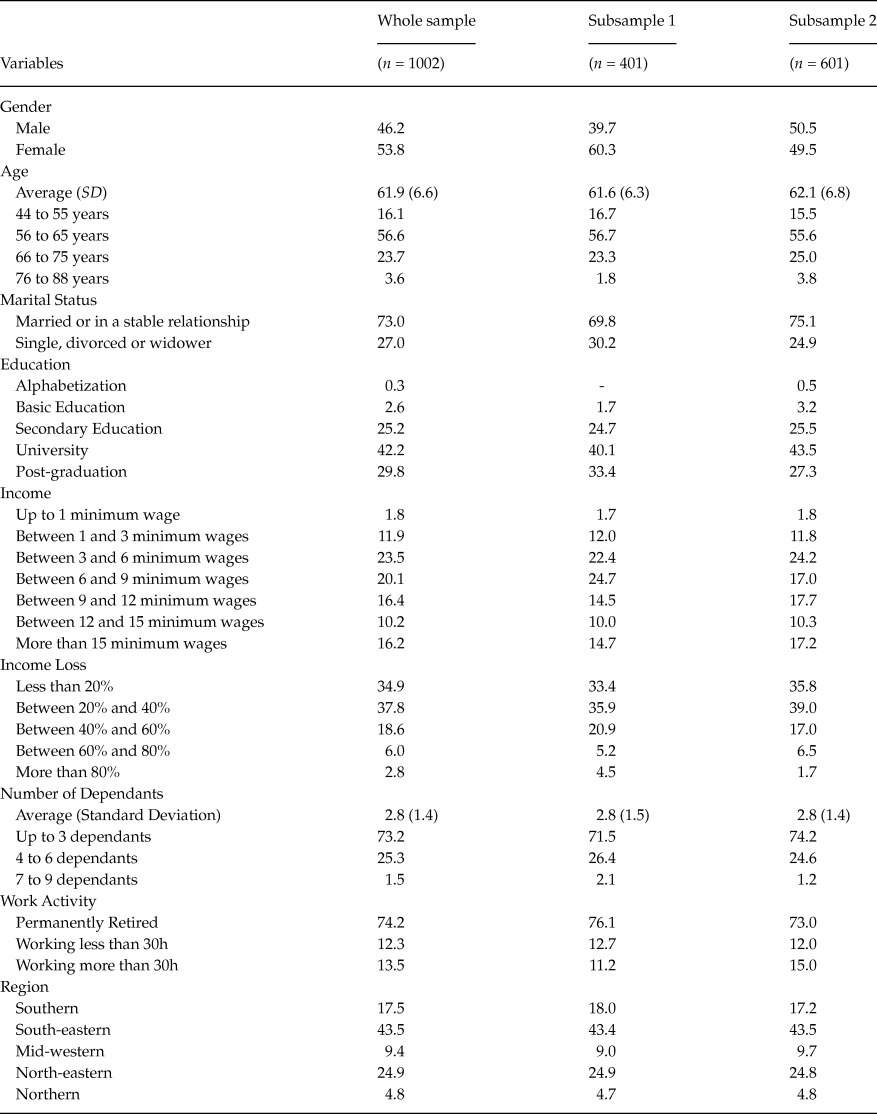
One-thousand and two (1,002) retirees residing throughout Brazil took part in the research. As can be seen in Table 1 below, the sample consisted of more women than men (46%). Participants were between 44 and 88 years old and the average age was 62 years (DP = 6.59), with the majority being retirees between the ages of 56 and 65. With regards to education, the largest group had attended university and approximately one third (29.8%) had postgraduate degrees. One quarter had attended secondary school and only 3% had primary education. Regarding marital status, the greater part of participants reported being in a stable partnership, while the lesser part declared being single, divorced or widowed.
Characteristics of the Whole Sample and Subsamples

With respect to monthly family income, a considerable part of the participants earned between three to nine minimum wages, while the other, also a considerable part, earned more than 9 minimum wages. Just over one tenth of the participants (13.7%) earned less than three minimum wages.
At the time of data collection, the majority (74%) of the participants were permanently retired and one quarter still worked at the same job or at a different job, despite receiving a pension. Of those who worked, more than half worked less than 30 hours, and just less than half worked 30 hours or more per week. With regards to post-retirement loss of income, the majority of participants reported a loss of income of up to 40% upon retirement, and less than one tenth reported a loss of income greater than 60%. As for the number of dependants, the majority had up to three dependants.
Consistent with the distribution of the retired Brazilian population (IBGE, 2017), most of the participants lived in the south-eastern region (43.5%) of the country, followed by one quarter in the north-eastern region, 17.5% in the southern region, almost one tenth in the mid-western region and 5% in the northern region. To confirm the results of two different samples, the full sample was divided into two sub-samples during analysis, which were created by stratified randomization according to region of residence, in which the first consisted of 401 retirees and the other of 601 retirees. Information relating to the general sample and subsamples can be seen in Table 1.
Instruments
Personal Resources
RRI (Leung & Earl, Reference Leung and Earl2012) was used, a Likert-type scale (with a variance between 1–5 in scales based on satisfaction, quantity, frequency or concordance) consisting of six domains. The domains were: (i) Physical resources (relating to perceived health, inexistence of deficiencies and high levels of energy), (ii) financial resources (relating to various income sources, such as personal savings, investments and government pensions), (iii) social resources (relating to the existence of sources of social support, such as marriage, family, friendship networks and associations, and the quality of those interactions), (iv) emotional resources (relating to the experience of positive emotions and emotional intelligence), (v) cognitive resources (relating to both, normal cognitive functions and adaptative cognition, such as self-esteem and optimism), and (vi) motivational resources (relating to the pursuit of objectives and establishing goals).
When it was created, the instrument was applied to a sample of 267 Australian retirees above 50 years of age, resulting in a three-factor structure consisting of the six predetermined factors, in which the first factor included items relating to emotional, cognitive or motivational resources, the second included social resources and the third, physical and financial resources. In general, the three factors showed good internal consistency (α = .81 and .89) and test-retest reliability (α = .83 – .88) within a period of one month.
Sociodemographic characteristics
In this study, the sociodemographic characteristics of participants were measured using eight items: gender (categorized between 0 and 1, in which 0 were women and 1 were men), age, education (according to the stages of the Brazilian education system), marital status (categorized between 1 and 2, in which 1 represented being married or in a stable relationship, and 2 represented being single, divorced or widowed), family income, number of dependants, post-retirement loss of income, working status (categorized between 1 and 3, in which 1 represents definitive retirement, 2 is a transition job and 3 is continued work) and the region of residence (categorized between 1 and 5, in which 1 represents the southern region, 2 is the south-eastern region, 3 the north-eastern region and 5 is the northern region).
Data analysis
With regards to data analysis procedures, the data base was first cleaned and any omissions or extreme situations were checked for, adding that no omissions were detected. Seeing this was the first time the RRI was applied in the Brazilian context, exploratory factor analysis (EFA) was conducted using a subsample of 401 participants, using the software Factor, version 10. Next, confirmatory factor analysis (CFA) was performed with a subsample of 601 participants with the objective of identifying the model with better fit, using the software MPlus, version 6. For both EFA and CFA, the fit indices CFI, GFI, TLI, RMSEA and chi-squared were considered and evaluated as recommended by Byrne (Reference Byrne2001) for well-adjusted models. Satisfactory fit cut-off criteria were based on CFI values close to 0.90, GFI values close to 0.90, TLI values close to 0.90 and RMSEA values close to, or less than 0.08.
With regards to internal validity and hypothesis testing, and aside from the average variance extracted, correlations between RRI factors and some of the sociodemographic variables were checked. As suggested by Miles and Shevlin (Reference Miles and Shevlin2001), low (between 0.10 and 0.29), moderate (0.30 and 0.49) and high (greater than 0.50) correlations were considered. Finally, in order to test the differences between averages and variance between groups, multiple group factorial analysis was conducted using the software R, version 3.1.2, RStudio package, version 0.99.892.
Results
Exploratory Factor Analysis
In order to confirm or refute the factor structure of the instrument previously tested on Australian retirees, exploratory factor analysis (Leung & Earl, Reference Leung and Earl2012) was performed using the 401 retiree subsample. Parallel analysis, which compares the values of the real data eigenvalues with the random data eigenvalues (Monte Carlo method, 500 replications), and the Hull method, which includes all the existing data in the least possible number of points (Hauck, Reference Hauck2016), pointed towards the three- and four-factor solutions. Additional testing of the five- and six-factor models was then performed to check if they supported, totally or partially, the results produced by Leung and Earl (Reference Leung and Earl2012) and Wang and Shultz’s (Reference Wang and Shultz2010) theory. The weighted oblimin rotation, which is more adequate for the psychological measurement of complex factor loads (Hauck, Reference Hauck2016), was used.
During the exploratory process, six items showed factorial loads below 0.30 in one or more factors. Items 17, 22, 23, 31, 34 and 35 were removed from the original instrument (Leung & Earl, Reference Leung and Earl2012) and referred to tangible support received, perceived control, self-esteem, effort, stagnation and unrealistic goals.
Among the four models tested, the three-factor model, χ2(gl) = 1,378.183(375); CFI = 0.73; GFI = 0.96; RMSEA = 0.08; variance = 43%, and four-factor model, χ2(gl) = 1,146.144(347); CFI = 0,83; GFI = 0,96; RMSEA = 0,05; variance = 48%, fell short of expectations. The five-factor model, χ2(gl) = 816.644(271); CFI = 0.88; GFI = 0.98; RMSEA = 0.07; variance = 55%, and the six-factor model, χ2(gl) = 1,028.291(400); CFI = 0.88; GFI = 0.98; RMSEA = 0.03; variance = 53%, showed the best adjustment indices, and were very similar. In the five-factor model, the variance percentages obtained were 29.8%, 10.7%, 9.6%, 5.8% and 4.7%, respectively. In the six-factor model, the variance percentages obtained were 28.3%, 10.4%, 9.8%, 5.9%, 4.5% and 4.2%, respectively.
Confirmatory Factor Analysis
In order to assess model, fit of the factorial models obtained in the analysis, confirmatory factor analysis was conducted on the subsample consisting of 601 retirees. The five- and six-factor models were tested using a Weighted Least Squares Mean and Variance Adjusted (WLSMV) estimator, which is considered to be an improvement over the Weighted Least Squares (WLS) estimator seeing it takes into account that the ordinal variables obtained result from a set of underlying continuous variables with lower skewing (Beauducel & Herzberg, Reference Beauducel and Herzberg2006). The five-factor model showed better fit indices, χ2(gl) = 1,274(364); CFI = 0.87; TLI = 0.86; RMSEA = 0.06, than the six-factor model, χ2(gl) = 1,597(3390); CFI = 0.83; TLI = 0.81; RMSEA = 0.07.
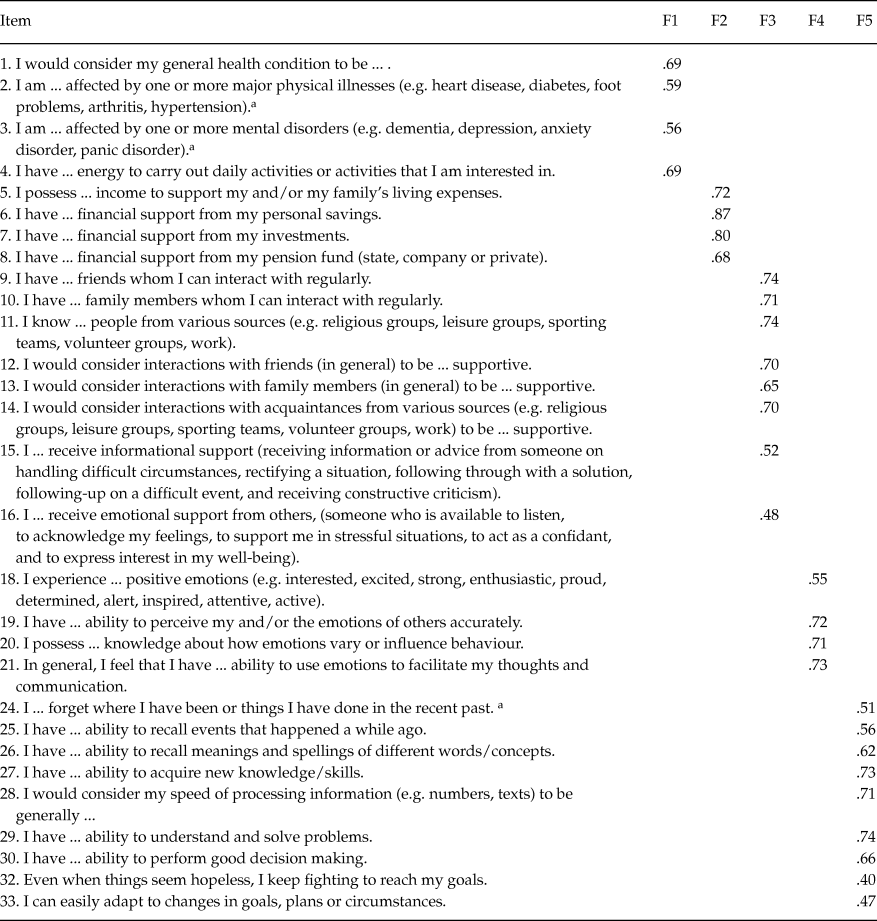
The final structure of the instrument, as seen in Table 2, consisted of five factors and 29 items. All items produced factorial loads greater than 0.50, except one item in factor three and two items in factor five, providing factorial loads ≥ 0.40. The structure found seems to support the results obtained by Leung and Earl (Reference Leung and Earl2012), the first factor relating to physical or health resources, the second relating to financial resources, followed by social resources, emotional resources, and the fifth and final factor relating to cognitive and emotional resources.
RRI Factor Structure consisting of Five Factors and 29 Items (n = 601)

Note: a Items with inverted factorial loads. F1 = Physical resources; F2 = Financial resources; F3 = Social resources; F4 = Emotional resources; F5 = Cognitive and motivational resources.
Model Validity and Hypothesis Testing
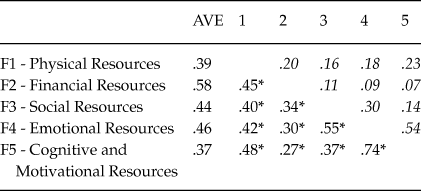
Once the model with the best fit was identified using structural equation modelling, the average variance extracted (AVE) and the correlations between latent variables (Table 3) were shown. Average variance extracted (AVE) showed that the factors accounted, on average, for more than 30% of item variance. With regards to the relationship between variables, on can see that AVE values were, for the most part, greater than the coefficients of determination (r 2) between latent variables (e.g. AVE > r 2). These results suggest the absence of multicollinearity, except for the multicollinearity found between factor four and five. The RRI factors are latent variables that suggest internal structure validity.
Average Variance Extracted (AVE), Correlations between RRI Factors (Below Diagonal) and the Coefficient of Determination (Above Diagonal) (n = 601)

Note: *p < .05.
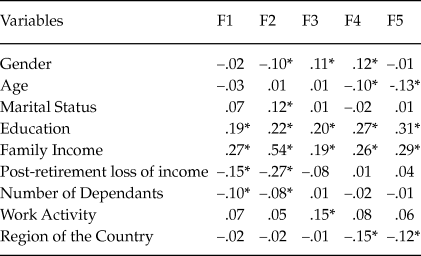
To check for evidence of validity of the construct (Pasquali, Reference Pasquali2007) and perform hypothesis testing, correlations between the five factors and the variables: Gender, education, family income, number of dependants and post-retirement income loss, were performed. As can be seen in Table 4, all included variables showed correlation with at least one factor, which confirms the evidence of validity of the instrument’s internal structure. These results partially confirmed Hypotheses 1 and 6, fully confirmed Hypotheses 2, 4 and 5 and refuted Hypothesis 3.
Correlations between the Five RRI Factors and Sociodemographic Variables (n = 601)

Note: F1 = Physical resources; F2 = Financial resources; F3 = Social resources; F4 = Emotional resources; F5 = Cognitive and motivational resources.
* p < .05.
Invariance Analysis
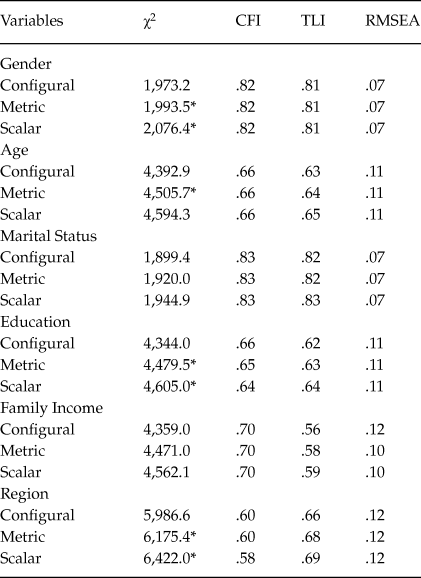
Invariance Analysis was conducted to test average and invariance differences between the groups of the following variables: Gender, education, family income and region of the country. According to Franco et al. (Reference Franco, Valentini, Iglesias, Damásio and Borsa2018), configural invariance consists of a model with a fixed number of factors and items, metric invariance consists of fixed factorial loads and scalar invariance consists of fixed intercepts.
The chi-squared test results relating to metric and scalar invariance were significant with regards to the gender, age, marital status, education and region of the country variables, indicating the heterogeneity of these variables. Nevertheless, the fit indices of the models did not fit the data, supporting the invariance model. These results can be seen in Table 5.
Configural, Metric and Scalar Invariance for Gender, Education, Family Income and Region of the Country (n = 601)

Note: *p < .005.
Discussion
In order to translate and analyse the psychometric qualities of the Retirement Resources Inventory - RRI into Brazilian Portuguese, determine evidence of validity of the instrument with regards to Brazilian retirees and perform an analysis of the sample’s available resources, this study counted on the participation of 1,002 retirees representing all regions of the country. To test the hypotheses, exploratory and confirmatory factor analysis were conducted as well as Pearson’s correlation coefficient and invariance analysis.
The structure found in the Brazilian sample, consisting of 29 items and five factors (physical resources, financial resources, social resources, emotional resources and cognitive and motivational resources), does not fully corroborate the structure suggested by Leung and Earl (Reference Leung and Earl2012), in which the instrument consisted of three factors (emotional, cognitive and motivational resources, social resources and physical and financial resources) and 35 items. This result seems to demonstrate a greater alignment with the initial theory suggested by Wang and Shultz (Reference Wang and Shultz2010), expected when tested on larger samples.
Considering the results, Brazilians seem to distinguish social and emotional resources from the other resources, perhaps due to the importance attributed to them in our society, including retirees (Amorim et al., Reference Amorim, França and Valentini2017; França & Vaughan, Reference França and Vaughan2008). Despite this, the difference is not substantial, since both structures encompass the six factors (physical, financial, social, emotional, cognitive and motivational resources) suggested by Wang and Shultz’s (Reference Wang and Shultz2010) theory. It was possible to assess both the internal and external validity of the instrument by means of AVE and correlations respectively, thus meeting the first specific objective.
On the subject of the instrument’s structure, this study highlights the multidimensionality and complexity of the construct by indicating five resource factors that are important to retirement, as already suggested in previous studies (Leung & Earl, Reference Leung and Earl2012; Wang & Shultz, Reference Wang and Shultz2010). The development of practices, policies and research should encompass resources of different natures, giving priority to primary resources (health and finance), which have a greater impact on well-being (Amorim et al., Reference Amorim, França and Valentini2017; Bressan et al., Reference Bressan, Mafra, França, Melo and de Loretto2013; Nalin & França, Reference Nalin and França2015). This reality is particularly true in Brazilian culture, where citizens are permanently faced with the urgency of solving problems that should have been solved in the past (França & Hershey, Reference França and Hershey2018). Precisely because of this, it is necessary to encourage that primary resources be planned for over the long-term, not just a few years before retirement. Nevertheless, even if they are successful in planning for primary resources, other resources become relevant with regards to retirement well-being.
Invariance analysis allowed us to argue that the instrument is equally valid for the full sample, considering the second specific objective that called for the adaptation and validation of the instrument in Brazil. As such, it can be concluded that the instrument has been successfully adapted into Brazilian Portuguese and shows evidence of validity for use with the retired Brazilian population.
The instrument can be used, for example, to identify the resources of groups preparing for retirement, in which the focus of the meetings could fall on the resources in which the pre-retirees scored the lowest (França & Vaughan, Reference França and Vaughan2008; Heaven et al., Reference Heaven, O’Brien, Evans, White, Meyer, Mathers and Moffatt2015). For those who are already retired and did not have the opportunity to think about the moment they would stop working, as is the case of involuntary retirement, it is equally important to identify the resources that need to be developed, in a group or individually (Dingemans & Henkens, Reference Dingemans and Henkens2014; Vogelsang et al., Reference Vogelsang, Shultz and Oslon2018). At a macro level, the current demographic context urges for actions that can achieve economic and practical strength when properly planned (Wang & Shultz, Reference Wang and Shultz2010).
The correlations conducted partially support the first hypothesis, seeing that the gender variable correlated negatively with the second factor and positively with the third and fourth factors, which shows a tendency for men to have greater financial resources and women greater social and emotional resources. This tendency makes sense among the Brazilian retirees, where even today men have more jobs and are, for the most part, the family income earners (IBGE, 2017), while family activities are the responsibility of women (França, Stepansky, & Amorim, Reference França, Stepansky, Amorim, Neiva, Torres and Mendonça2017). Furthermore, Price and Balaswamy (Reference Price and Balaswamy2009) point out the importance given by retired women to social and psychological aspects, such as voluntary work and self-esteem. It is possible that this situation will change in the coming years and be reflected in education, family income and responsibilities due to the gender equality movement (França et al., Reference França, Stepansky, Amorim, Neiva, Torres and Mendonça2017).
The age variable showed a negative correlation with the fourth and fifth factors, emphasizing that the older the individual answering, the lower the levels of emotional and cognitive or motivational resources, which supports the second hypothesis. In addition to the normal decline in cognitive abilities due to aging (World Health Organization - WHO, 2005), Bandura (Reference Bandura1997) stated that the decline of the individual’s motivational sense can cause cognitive and behavioural losses, especially in the absence of stimulation, which may justify the results found. This refers to the need for the constant updating of knowledge in older individuals and the opportunities for intergenerational contact and exchange, where the young and old benefit from each other (França & Hershey, Reference França and Hershey2018).
The marital status variable showed a positive correlation only with the second factor, showing that financial resources increase in a stable relationship situation, thus not supporting the third hypothesis. Despite this, the results show higher income concerns when a spouse exists, supporting Hershey et al. (Reference Hershey, van Dalen, Conen and Henkens2017) in that the loss of a partner, either by divorce or death, can lead to a decline in both primary and secondary resources.
All RRI factors presented positive and significant correlations with regards to education and income, confirming the importance of these variables that had already been highlighted in international studies (Cho & Lee, Reference Cho and Lee2014; Gutierrez & Hershey, Reference Gutierrez and Hershey2014; Hershey et al., Reference Hershey, van Dalen, Conen and Henkens2017). Education directly influences qualification and can determine retirement-related decisions (Cho & Lee, Reference Cho and Lee2014), and financial independence in retirement directly contributes to the quality of life and the achievement of retirees’ goals (Gutierrez & Hershey, Reference Gutierrez and Hershey2014; Vogelsang et al., Reference Vogelsang, Shultz and Oslon2018). In Brazil, IBGE confirms that there is a positive relationship between the level of education and the income of Brazilian workers (IBGE, 2017). These results, together with the correlations found between the number of dependants and retiree income loss and social and financial resources, confirm the fourth and fifth hypotheses.
The retirement work activity variable also seems to have some influence on the social dimension, i.e. those who are still working have greater social resources. The return to work after retirement can be found in the recent study conducted by Guerson, França and Amorim (Reference Guerson, França and Amorim2018).
Finally, the region variable showed a negative correlation with factors four and five of the RRI, suggesting that, the further north a retiree lives, the lower the levels of emotional, cognitive and motivational resources. As suggested by the IBGE (2017), part of the residents in the northern and north-eastern states have low income households, which could result in lower levels of secondary resources considering the influence of the financial situation on the acquisition and maintenance of resources related to well-being at this stage of life (Gutierrez & Hershey, Reference Gutierrez and Hershey2014; Hershey et al., Reference Hershey, van Dalen, Conen and Henkens2017; Henkens et al., Reference Henkens, van Dalen, Ekerdt, Hershey, Hyde and Radl, Zacher2017).
Despite the referred contributions, this study has some limitations. The first limitation is that the digital data collection method used allows for duplicate responses by the participants or for accidental duplication, and may compromise the results. The second limitation is that the sample, although it contains participants from all regions of the country, is not fully representative seeing that the collection was made through the internet. Although there were 1,002 participants, the education of this sample was higher than the Brazilian norm (IBGE, 2017), and future interinstitutional studies will be required to improve on this aspect and obtain more general conclusions. Finally, using a more representative sample could avoid the complete mismatch of the data matrix model, according to the margin recommended by Byrne (Reference Byrne2001) for fit indicators (CFI > 0.90 and TLI > 0.90).
It is suggested that longitudinal studies be conducted with workers who are 5 or 10 years away from retirement and workers who have been retired for 5 or 10 years in order to compare the progress of resources and well-being after entering this stage. New validations of this instrument in Brazil are also recommended, using methods such as convergent validity and temporal stability, as well as in other countries, to infer what the required global resources are to plan for retirement and what the specific resources are with regards to the socio-cultural context where the participants are inserted.
The general and specific objectives of this study were met. The RRI was translated into Brazilian Portuguese with evidence of validity and homogeneity between the sample subjects. Analysis of the resources available allowed for the conclusion that actions focusing on the development of retirement resources should take into account gender, age, education, income and the region of the country where the retiree lives and if he plans on retiring definitively or plans to keep working. Therefore, retirement planning should take into account gender differences and the need to develop resources, giving priority to older individuals with lower education and income. The northern and north-eastern regions of Brazil are in need of actions related with emotional, cognitive and motivational resources.
In their drive for the theoretical advancement of this field, any future studies should investigate the impact of these resources on retirement well-being, as suggested by Hobfoll (Reference Hobfoll2002), deepening our understanding of regional and gender specificities by considering their implications with regards to both, resources and well-being, during this stage. In this study, recommendations and suggestions were made with regards to retirement resource planning, in which the wish to stimulate workers to create primary resources well before their transition into retirement is highlighted. The development of secondary resources, on the other hand, should be higher in regions of lower income, where access to information is scarce and post-retirement opportunities are limited. Furthermore, emphasis is placed on the continuation of work activities with reduced working hours in light of the social resources they provide.
Hopefully, this study will promote the development of the Retirement Resources construct and inspire more research. In methodological and practical terms, this RRI validation may be used by work organisations to measure the resources required for retirement, seeing that the instrument can provide basic information that can be included in retirement preparation programmes.