Implications
Methane (CH4) is second to carbon dioxide in terms of its contribution to climate change (Lassey, Reference Lassey2007). More than 70% of CH4 is generated by anthropogenic activities including animal husbandry (27%; enteric fermentation in livestock, manure management), paddy rice cultivation (26%), petroleum sources (26%), waste management (13%) and 9% from biomass burning (Kvenvolden and Rogers, Reference Kvenvolden and Rogers2005; Sejian et al., Reference Sejian, Shekhawat, Ujor, Ezeji, Lakritz and Lal2012). Enteric fermentation is the largest source of CH4 from ruminant livestock with cattle being the major contributor. Cattle emit CH4 as a result of intestinal fermentation and identification of those geographical regions where this source is significant is required for targeted mitigation. There is a paucity of information on enteric CH4 emissions in regions of Africa. Use of Tier 2 methodology of the Intergovernmental Panel on Climate Change (IPCC) (Reference Eggleston, Buendia, Miwa, Ngara and Tanabe2006) improves estimates and reduces uncertainties around enteric CH4 emissions from cattle. The present paper compiled country-specific data to develop emission factors to more accurately estimate enteric CH4 emissions from cattle in Benin, Africa.
Introduction
Scientific evidence established by the Intergovernmental Panel on Climate Change (IPCC) reveals that increasing greenhouse gas (GHG) concentrations in the atmosphere attributable to human activities are responsible for global climate change (IPCC, Reference Pachauri and Reisinger2007). The contribution of GHGs namely, carbon dioxide (CO2), methane (CH4), nitrous oxide (N2O) and halocarbons to global anthropogenic emissions in 2010 expressed as CO2 equivalents (CO2eq) were estimated at 76%, 16%, 6% and 2%, respectively (Olivier and Janssens-Maenhout, Reference Olivier and Janssens-Maenhout2012). In 2000, the main GHG in Benin was N2O, accounting for 40% of CO2eq emissions, followed by CH4 (37%) and CO2 (23%) (Ministry of Environment, Urban Settlement and Town Planning (MEHU), 2011). Agriculture was the main source of GHG in Benin, accounting for ~68% of total CO2eq emissions in 2000 with enteric CH4 mainly from cattle (84%), accounting for 29% of emissions from this sector (MEHU, 2011).
The effectiveness of any global measure to combat the threat of climate change will depend significantly on the accuracy of country-specific national GHG inventories. These inventories support the prediction of GHG emission trends and in assessing the potential value of mitigation options. However, a previous review of national GHG inventories from West African countries including Benin revealed high uncertainties largely caused by gaps in activity data and the use of IPCC default emission factors (EFs) that did not reflect West African conditions (United Nations Development Programme (UNDP), 2002). Indeed, national GHG inventories are performed in West Africa mainly using Tier 1 methodology as outlined in IPCC guidelines. The GHG inventory methods given in the IPCC guidelines estimate emissions based on the extent to which a human activity takes place (activity data) along with an EF which quantify emissions or removals per unit of activity using the following equation:
 $${\rm Emissions}={\rm AD}{\times}{\rm EF}$$
For estimating CH4 from enteric fermentation, methodologies in IPCC guidelines vary from the simpler Tier 1 approach towards the increasingly more complex Tier 2 and Tier 3 methods (IPCC (Reference Eggleston, Buendia, Miwa, Ngara and Tanabe2006)). Tier 1 methods involve using the default enteric CH4 EFs, which provide fixed values for each species of animal in different regions of the World, irrespective of variations in animal physiological state or production level. Tier 2 methods substitute default EFs with those that are country specific, to more accurately reflect country-specific information on livestock populations and feed and feed intake characteristics. Tier 3 methods are also country specific and involve modeling and or detailed measurements that are expected to provide the most accurate estimate of emissions (IPCC (Reference Eggleston, Buendia, Miwa, Ngara and Tanabe2006)), requirements that are difficult in nations where financial and specialized human resources are limited and novel types of equipment whose cost and maintenance may not be within the scope of many laboratories. At present, national inventories of enteric CH4 emissions are estimated in Benin using IPCC Tier 1 methods. Among EFs contributing to uncertainty in the estimation of West African GHG emissions, enteric fermentation from domestic livestock was second only to forest and grassland conversion (UNDP, 2002). The lack of a country-specific enteric CH4 EF that reflect Benin production practices impedes accurate estimation of agricultural emissions (MEHU, 2011). One of the main future improvements identified in Benin national GHG inventory system is the need of enteric CH4 from cattle to be estimated using IPCC Tier 2 methodology.
This study aimed to develop enteric CH4 EFs for cattle native to Benin using Tier 2 methodology following the 2006 IPCC Guidelines for National GHG Inventories.
Material and methods
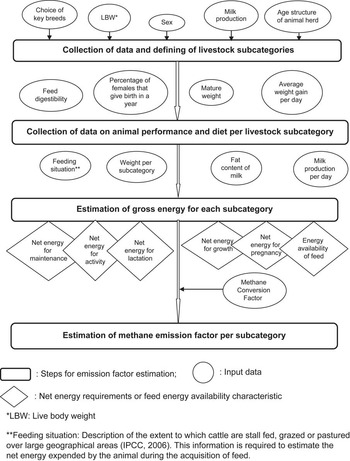
Enteric CH4 EFs (annual CH4 emissions per animal) for cattle that are used for multi-purpose within Benin were estimated using the Tier 2 method of IPCC (Reference Eggleston, Buendia, Miwa, Ngara and Tanabe2006) which is based on National Research Council (NRC) (1996) energy model. The steps as outlined in Figure 1 were used to estimate EFs.
Flow chart of methodology used for enteric methane EF estimate: IPCC (Reference Eggleston, Buendia, Miwa, Ngara and Tanabe2006).

Collection of input data
Data related to the characterization of cattle populations and the description of performance and diet by cattle subcategory were collected from sources of country-specific data as suggested by IPCC protocols through a literature search of national libraries (University of Abomey-Calavi of Benin, Livestock Department of Benin, Ministry in charge of Environment in Benin), publications in scientific journals and data compiled by the IPCC (Reference Eggleston, Buendia, Miwa, Ngara and Tanabe2006), the Food and Agriculture Organization (FAO), the International Livestock Research Institute (ILRI) and the International Livestock Centre for Africa (ILCA). Thus, scientific and technical articles (17), dissertations (7), project reports (2), national inventory reports of agriculture sector from Benin (1), consultative groups on international agricultural research (ILRI, ILCA) or international organizations (FAO, IPCC) were consulted. Collected data included that generated by studies carried out on cattle bred in traditional production systems (see ‘Feeding situation’ section) and studies designed to improve cattle productivity.
Data related to some of the Benin cattle breeds were sparse (reproduction trait for all cattle, live BW for Borgou cattle) or not available (average weight gain per day for Borgou and Lagune cattle, live BW for Lagune cattle) as censuses on livestock population and characteristics are not carried out on a regular basis. Under these conditions, additional data were derived from expert opinion and compiled from Togo (West African country) as suggested by IPCC protocols (IPCC, Reference Eggleston, Buendia, Miwa, Ngara and Tanabe2006). Traditional cattle production systems (see ‘Feeding situation’ section) are the dominant production systems in Benin (Ministère de l’Agriculture et de l’Elevage (MAEP), 2003) and consequently this production system constituted the majority of the data in deriving EF estimates. In the absence of such data, estimated average weight gain per day for Borgou and Lagune cattle, live BW data of Lagune cattle bred under similar production and climate conditions in Togo (tropical soudanian climate in the North and subequatorial climate in the South) and average weight gain of Borgou cattle of 6 to 12 months from improved systems in Benin were used.
Characterization of cattle population and performance data of cattle subcategories.
Compiled data were summarized by the three principal Benin breeds, Somba (Supplementary Tables S1 and S4), Borgou (Supplementary Tables S2 and S4) and Lagune (Supplementary Tables S3 and S4). Where available and appropriate, recorded variables included live BW, average daily gain, % of population, mature weight, daily milk production, milk fat content, calving rate and the % of castrated males.
Breed description
Cattle bred in Benin are composed of Bos taurus and Bos indicus subgroups. Bos taurus are often referred to as ‘European’ or ‘taurine’ cattle including similar types from Africa and Asia whereas B. indicus have a prominent hump forward of the shoulder and are known as zebu cattle and are of south Asian origin. Locally adapted, B. taurus breeds include Lagune (Dwarf West African Shorthorn), Somba (Savanna Shorthorn), Borgou and N’Dama cattle. According to Dehoux and Hounsou-Ve (Reference Dehoux and Hounsou-Ve1993), Borgou cattle arose from a cross between West African Shorthorn (Lagune and Somba cattle in particular) and West African B. indicus (mainly White Fulani). With the exception of N’Dama cattle which were imported from the Republic of Guinea, B. taurus breeds are native to Benin. Outside of Benin, Borgou cattle also exist in the neighboring countries of Togo, Burkina Faso (Méré) and Nigeria (Kétéku), while Somba cattle are mainly resident to Togo. In West Africa, Lagune cattle are principally located in Togo, Ghana and Nigeria. The B. indicus’ subgroup is exotic from West Africa and includes N’Bororo, White Fulani, Gudali and Djilli (MAEP, 2003). The distribution by breed type of cattle reared in Benin is as follows: Borgou (88%), Lagune (3.7%), Somba (0.3%) and B. indicus cattle (7.7%) (Senou et al., Reference Senou, Toléba, Adandédjan, Poivey, Ahissou, Touré and Monsia2008; Gbangboche et al., Reference Gbangboche, Alkoiret, Toukourou, Kagbo and Mensah2011). This distribution illustrates that Borgou cattle are the dominant breed and B. taurus are the dominant subgroup accounting for 92% of cattle in Benin.
Main categories of cattle
In Benin, cattle are primarily low productivity multi-purpose being used for production of meat; milk and hides as well as for draft power (MAEP, 2003). Meat is by far the most important product derived from cattle, whereas relatively few cattle (4%) are used for draft power with only 80 000 head used for this activity (MAEP, 2003). Milking cows represent 15% of the cattle population with an average milk production of 0.5 to 2 l/lactating cow per day (Faculté des Sciences Agronomiques (FSA), 2006). Around 60% of the milk produced by milking cows is consumed by the calf, 20% to 25% is consumed by the farm family in the home and the remaining is sold for human consumption and processing (cheese) (Dehoux and Hounsou-Ve, Reference Dehoux and Hounsou-Ve1993; FSA, 2006). According to FSA (2006), farm family consumption can reach 75% to 80% during the dry season and during transhumance when the milk production is extremely low. Following IPCC (Reference Eggleston, Buendia, Miwa, Ngara and Tanabe2006) and taking into account that cows from Benin are multi-purpose and of low productivity, the category ‘Dairy Cow’ as defined in the 2006 IPCC guidelines is not applicable to Benin. Therefore, Benin cattle are categorized as ‘other cattle’ according to IPCC protocols (IPCC, Reference Eggleston, Buendia, Miwa, Ngara and Tanabe2006). Each cattle breed was divided into two broad sub-categories namely ‘Growing livestock’ for that part of the population that had yet to reach mature BW and ‘Other Mature livestock’ for those that have achieved mature BW (Supplementary Tables S1 to S3). This approach accounted for the mature age and weight and the reproductive traits of the animal (Supplementary Tables S4 and S5).
Identification of livestock population subcategories
On the whole, subcategories defined were based on estimation of live BW. They included sex, live BW and age structure of the herds (Supplementary Tables S1 to S3).The subcategories of Borgou cattle were obtained by combining the age groups identified by Dehoux and Hounsou-Ve (Reference Dehoux and Hounsou-Ve1993) and Chabi Macco (Reference Chabi Macco1992) that categorized the age of different breeds of cattle on the basis of available records and dentition. Data on suckling calves are not presented in Supplementary Tables S1, S2 and S3 as it was assumed that CH4 emissions were negligible up to weaning, as calves were mainly fed milk until at least 4 months of age (Dehoux and Verhulst, 1994). Indeed, rumen function in calves <3 months and Ym for young cattle consuming only milk are minimal with negligible emission of enteric CH4 (IPCC, Reference Eggleston, Buendia, Miwa, Ngara and Tanabe2006).
Live BW and average weight gain per day
Information on the live BW of Lagune cattle in Benin was not available and as result values were adapted from weights recorded for this breed raised in Togo under similar conditions. The live BW and weight gain of 6 to 12-month-old Somba cattle were used as a default for 6 to 12-month-old Lagune cattle as the breeds are very similar. The live BW of 2 to 4-year-old Borgou cattle was obtained from Symoens and Hounsou-Ve (Reference Symoens and Hounsou-Ve1991) and Chabi Macco (Reference Chabi Macco1992). This subcategory corresponds to the subgroup of Borgou cattle aged on the basis of having two to six teeth (Symoens and Hounsou-Ve, Reference Symoens and Hounsou-Ve1991). Average live BWs were estimated for all Benin cattle and subcategories of yearlings, mature cows and mature bulls as weighted means of live BWs over Borgou, Somba and Lagune subcategories at 156, 115, 240 and 275 kg, respectively, and compared with the data of the IPCC (Reference Eggleston, Buendia, Miwa, Ngara and Tanabe2006) and FAO (2000). Data on growth rates for Somba cattle were obtained from Adanléhoussi et al. (Reference Adanléhoussi, Bassowa, Défly, Djabakou, Adoméfa and Kouagou2003). However, growth rates of other cattle subcategories (Bull Somba 5 to 6 years, Borgou cattle over 1 year, Lagune cattle) were estimated on the basis of live BW and predicted age as reported in Supplementary Tables S1 to S3. Consecutive subcategories in Supplementary Tables S1, S2 and S3, were used to estimate average daily gain as the difference between their weights divided by the difference in ages.
Milk production and fat content
The average daily production of milk for lactating cows (Supplementary Table S4) was calculated by dividing their total annual production by 365 days. The annual milk production in a year was assumed to be equal to the quantity of milk produced per lactation. The milk production from Togo was used as a default data for Lagune cattle. Fat content of milk was estimated as a percentage of milk weight for lactating Borgou and Lagune cows using data from Kora (Reference Kora2005), who estimated the quantity of lipids in milk relative to milk dry matter.
Percentage of females that give birth in a year
Cow fertility or calving rate was estimated as the ratio of calves born during the year to the number of females of breeding age (Supplementary Table S4).
Average amount of work performed per day
Among the breeds raised in Benin, Borgou cattle are most commonly used for draft power. However, this activity is marginal in Benin and little information is available about it. Therefore, draft power was not taken into account in EF estimates.
Feeding situation
An animal’s feeding situation is required to estimate the net energy expended by the animal during the acquisition of feed (IPCC, Reference Eggleston, Buendia, Miwa, Ngara and Tanabe2006). It describes the extent to which cattle are stall fed, grazed or pastured over large geographical areas. In the present study, the feeding situations of other cattle were defined by analyzing farming methods and feeding practices. In Benin, the farming method is generally traditional, which corresponds to minimal-input, low-production extensive systems using natural pastures in open rangeland or crop residues within fields (Goutondji, Reference Goutondji2007; Babatounde et al., Reference Babatounde, Sidi, Houinato and Mensah2009; Youssao et al., Reference Youssao, Dahouda, Attakpa, Koutinhouin, Ahounou, Toleba and Balogoun2013). Approximately 99% of cattle are produced using a traditional farm management system with <1% being produced on ranches or research stations (Hoste et al., Reference Hoste, Chalon, d’Ieteren and Trail1992). The traditional method is dominated by two village-based systems of utilizing natural pastures namely transhumance and sedentary systems. The transhumance system predominates (80%) and is characterized by continuously herding cattle across pasture land (Dehoux and Hounsou-Ve, Reference Dehoux and Hounsou-Ve1993; MAEP, 2003). Under the sedentary system, livestock are raised in areas of crop cultivation and subsist on crop residues near villages (Dehoux and Verhulst, 1994). The average grazing time of cattle on pasture is estimated at about 8 h per day and distributed as follows: 75% for grazing, 20% for walking, 5% for rest/rumination and water consumption (Dehoux and Hounsou-Ve, Reference Dehoux and Hounsou-Ve1993). During the dry season, the grazing time averages 10 h, but can range from 8 to 19 h depending on the availability of forage. During the rainy season, it averages 6 h, but ranges from 10 to 17 h depending on terrain and sward density. Cattle on ranches or research stations are raised on small grazing areas using improved management practices. Improved management systems in Benin include supplementation of cattle on natural pastures or those receiving crop residues as well as health and disease management. When not on pasture, herds may be tied in barns or fenced night parks, with shelter for calves. Borgou and Somba cattle are mainly located in the northern part of Benin and are bred under transhumance and sedentary systems while grazing large land areas. Following Aho (Faculty of Agronomic Science of the University Abomey-Calavi (Benin), personal communication) and IPCC guidelines (IPCC, Reference Eggleston, Buendia, Miwa, Ngara and Tanabe2006, table 10.5), Borgou and Somba cattle were assumed to be raised on large grazing areas that required considerable energy expenditure for feed acquisition. Lagune cattle are abundant in the southern part of Benin, bred under sedentary conditions and maintained under grazing systems on small natural pastures or fed crop residues, under palm and coconut trees or on fallow land. Following IPCC (Reference Eggleston, Buendia, Miwa, Ngara and Tanabe2006), Lagune cattle were considered to be maintained mainly in small paddocks and thus only expended modest amounts of energy to acquire feed.
Forages and their digestibility
In Benin, forages mainly include natural pastures and crop residues. Natural pastures include tropical grasses and legumes (Supplementary Table S6) with a dominance of the former and a scarcity of non-woody legumes (Achard et al., Reference Achard, Hiernaux and Banoin2001). The main crop residues are maize, sorghum, millet, rice, cotton, cowpea and groundnut. During the rainy season, grasses are the principal forages utilized by grazing cattle (Babatounde et al., Reference Babatounde, Sidi, Houinato and Mensah2009), but during the dry season fodder, multi-purpose trees and crop residues are the main feeds. Crop residues account for 70% of the feed available to cattle in the African Sudano-Sahel region (Djenontin et al., Reference Gerber, Steinfeld, Henderson, Mottet, Opio, Dijkman, Falcucci and Tempio2004). An average value of 54% was used for forage digestibility based on Benin-specific data on grasses and crop residues digestibility from 2013 version of FAO’s Global Livestock Environmental Accounting Model (Gerber et al., 2013).This digestibility value is consistent with that of 55% and 45% to 55% suggested by IPCC (Reference Eggleston, Buendia, Miwa, Ngara and Tanabe2006) for mature females and bulls grazing African forages and ruminants fed low-quality forage (crop by-products and range lands).
Estimation of feed intake per animal subcategory
After assessment, performance and diet data were used to calculate the feed intake for each animal subcategory in terms of gross energy using the equations from IPCC (Reference Eggleston, Buendia, Miwa, Ngara and Tanabe2006) as presented in Supplementary Table S7. The metabolic function relevant for each livestock category was identified (Figure 1) and the net energy requirements associated with these functions were estimated using relevant performance data. The net energy requirements were summed and combined with the energy availability in feed to estimate the gross energy requirements for each subcategory. The energy availability of the feed was estimated from the feed digestibility and the energy required for growth and maintenance. The reproductive traits of cattle in Supplementary Table S5 were taken into account in the estimation of net energy requirements for metabolic function (maintenance, growth, pregnancy, lactation). The net energy for pregnancy was estimated for heifers that had reached puberty and for cows whereas the net energy for lactation was estimated only for cows with consideration for the yearly calving rate. Data on the gestation length and age at first calving were used to identify cattle age groups from which net energy for pregnancy and lactation were estimated. Mature cattle were considered to be at maintenance and as a consequence the net energy for growth was considered to be zero.
Estimation of enteric CH4 EFs
The enteric CH4 EF was estimated for each subcategory of cattle, and for each breed within B. taurus and all Benin cattle. Considering cattle subcategories, EFs were calculated using the IPCC (Reference Eggleston, Buendia, Miwa, Ngara and Tanabe2006) equation:
 $${\rm EF}=({\rm GE}{\times}{\rm (Y}_{{\rm m}} /{\rm 1}00){\times}{\rm 365}\,{\rm days)}/{\rm 55}.{\rm 65}$$
In this equation, EF is the emission factor (kg CH4/head per year), GE the gross energy intake (MJ/head per day), Ym the methane conversion factor (%), with 55.65 (MJ/kg CH4) being the energy content of CH4, it was assumed that the EF was developed for each category of cattle over a year (365 days). The emission of CH4 was quantified by its conversion rate which was the percentage gross energy in feed converted to CH4. A Ym of 7% was selected for grazing cattle in tropical Africa where forages are of poor quality as previously reported by Sejian et al. (Reference Sejian, Shekhawat, Ujor, Ezeji, Lakritz and Lal2012). This Ym value is within the range 6.5%±1.0% suggested by IPCC (Reference Eggleston, Buendia, Miwa, Ngara and Tanabe2006) for other cattle grazing or primarily fed low-quality crop residues and by-products.
For each breed, an average EF was estimated as a weighted mean of EFs of its subcategories across its demographic profile. The individual EF estimated for each subcategory of cattle was then multiplied by the associated demographic profiles and summed. The national average EF for B. taurus was calculated by weighting average EFs for breeds on the basis of their national demographic distribution and was assumed representative for all Benin cattle owing to their predominance. EFs were not included for B. indicus cattle types as similar information was not available and they accounted for <8% of the total cattle population. Cattle demographic profiles are presented in Supplementary Tables S1, S2 and S3 and were derived mainly from Dehoux and Hounsou-Ve (Reference Dehoux and Hounsou-Ve1993) and Akadiri (Reference Akadiri1979). The day weighted population mix for cattle aged 0 to 8 months (11.9% for male and 11.9% for female) from Akadiri (Reference Akadiri1979) was used as default value for cattle aged 0 to 6 months. The day weighted population mix of Borgou cattle estimated by Dehoux and Hounsou-Ve (Reference Dehoux and Hounsou-Ve1993) was used as default value for Somba and Lagune cattle 0 to 12 months.
Results and discussion
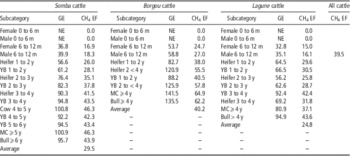
Enteric CH4 EFs estimated for cattle from Benin are presented in Table 1. They varied with breed and subcategory ranging from 15.0 to 43.6, 16.9 to 46.3 and 24.7 to 64.9 kg CH4/head per year for subcategories of Lagune, Somba and Borgou cattle, respectively. National average EFs of 24.8, 29.5 and 40.2 kg CH4/head per year were estimated for Lagune, Somba and Borgou cattle, respectively.
Estimated gross energy intake (mj/head per day) and enteric CH4 EF (kg/head per year) for cattle breeds and subcategories

y=year; m=month; NE=not estimated; GE=gross energy; EF=emission factor; YB=young bull; MC=mature cow.
The IPCC (Reference Eggleston, Buendia, Miwa, Ngara and Tanabe2006) Tier 2 methodology is a function of a number of attributes including live BW, growth rate, feeding practices, gender and productivity (e.g. pregnancy, milk production, work). These parameters are known to influence cattle energy demand and hence enteric CH4 production, with the level of animal productivity being the most important factor (Yan et al., Reference Yan, Porter and Mayne2009). Differences in live BW and grazing systems among breeds of cattle contributed to the variation in estimated EFs among cattle breeds and subcategories. This was expected since the productivity of cattle from Benin is low and a large proportion of gross energy intake is used for maintenance which is related to metabolic BW0.75 (FAO (2000)). The highest EF was observed for Borgou cattle owing to their greater live BW relative to both Somba and Lagune cattle and the fact that they are primarily raised in extensive pasture systems unlike Lagune cattle which are raised under more intensive conditions. The EF for Lagune cattle was lower than that of Somba cattle, which is a reflection of the need for Somba cattle to expend more energy to acquire feed. The national average EF of all Benin cattle was estimated to be 39.5 kg CH4/head per year, slightly lower (2.0%) than national average EF for Borgou cattle. This observation reflects the fact that Borgou are the prominent cattle breed in Benin and thus are more heavily weighted in the estimation of the average EF for Benin cattle.
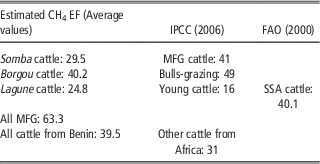
The present study reveals the national average EF for cattle from Benin was 27.4% higher than the default EF suggested by IPCC (Reference Eggleston, Buendia, Miwa, Ngara and Tanabe2006) for other African cattle (Table 2).
Comparison between estimated enteric CH4 EFs and those from other sources (kg/head per year)

EF=emission factor; IPCC=Intergovernmental Panel on Climate Change; FAO=Food and Agriculture Organization; MFG=mature females grazing; SSA=Sub-Saharan Africa.
The default EFs suggested by IPCC (Reference Eggleston, Buendia, Miwa, Ngara and Tanabe2006) for other cattle (other cattle default EF) from Africa were estimated using Tier 2 methodology and average performance data and feed characteristics reflecting African regional-specific circumstances (IPCC, Reference Eggleston, Buendia, Miwa, Ngara and Tanabe2006; annex 10A.1, table 10A.2; Lassey, Reference Lassey2007). Therefore, discrepancies between results from this study and other cattle default EF for Africa may reflect deviations in cattle management practices within Benin as compared with other African regional-specific circumstances. Among subcategories provided by IPCC (Reference Eggleston, Buendia, Miwa, Ngara and Tanabe2006) for Africa, only young cattle, mature cows and mature bulls were defined for Benin. On the whole, EFs generated by this study for these subcategories were higher than those from IPCC (Reference Eggleston, Buendia, Miwa, Ngara and Tanabe2006) except for subcategories of young cattle, mature Lagune and mature Somba bulls. National average EFs estimated for Lagune and Somba cattle were 19.9% and 4.8% lower, respectively than for the EF for other cattle from Africa. In contrast, the national average EF for Borgou cattle was 29.6% higher than the African EF default for other cattle. In general, the differences observed between EFs generated by the present study and default EFs may be attributed to discrepancies in Ym, demographic profile and growth performance data, in particular live BW and feeding practices (IPCC, Reference Eggleston, Buendia, Miwa, Ngara and Tanabe2006, annex 10A.1, table 10A.2). Indeed, the Ym value of 7.0% for grazing cattle from tropical Africa (Sejian et al., Reference Sejian, Shekhawat, Ujor, Ezeji, Lakritz and Lal2012) used in the present study was higher than the default Ym of 6.5% provided by IPCC (Reference Eggleston, Buendia, Miwa, Ngara and Tanabe2006) for Africa. It is well known that Ym is inversely related to forage quality (IPCC, Reference Eggleston, Buendia, Miwa, Ngara and Tanabe2006). Lower Ym value suggested by IPCC (Reference Eggleston, Buendia, Miwa, Ngara and Tanabe2006) for Africa may reflect the assumptions associated with temperate forages which are of higher quality and of lower Ym. Apart from mature Lagune and mature Somba cattle, the live BWs of cattle subcategories from Benin were higher than the default data reported for cattle from Africa by IPCC (Reference Eggleston, Buendia, Miwa, Ngara and Tanabe2006). The levels of production of cattle subcategories from Benin were also slightly higher than those suggested by IPCC (Reference Eggleston, Buendia, Miwa, Ngara and Tanabe2006) for cattle subcategories in Africa. The national average live BWs of young cattle and grazing mature cows from Benin were 1.6 and 1.2 times higher, respectively than those reported for these cattle subcategories in greater Africa (IPCC, Reference Eggleston, Buendia, Miwa, Ngara and Tanabe2006). National average EF estimated for mature females grazing in this study was 54.3% higher than that suggested by IPCC (Reference Eggleston, Buendia, Miwa, Ngara and Tanabe2006) for this cattle category in Africa, mainly due to differences in estimated live BW, milk production and Ym values. The study reveals the national average EF for cattle from Benin was consistent with EF reported by FAO (2000) for other cattle from Sub-Saharan Africa, being 1.5% lower than this author finding. This observation may be due to differences in the data rather than the approach used in the two studies as the FAO (2000) used Tier 1 methodology based on an emissions algorithm derived in IPCC/Organization for Economic Cooperation and Development (1994) and United States Environmental Protection Agency (1994). This method is similar to the methodology of 2006 IPCC guidelines where energy calculations are based on NRC (1996). The average live BW for cattle and energy digestibility used in the present study were 6.9% and 11.2% higher, respectively, than those reported by FAO (2000) for Sub-Saharan Africa. In contrast, the value reported by FAO (2000) for Ym in Sub-Saharan Africa circumstances was 1.1 times higher than Ym used in our study.
The application of IPCC Tier 2 methodology may be limited by the availability and quality of data in a given country (Storm et al., Reference Storm, Hellwing, Nielsen and Madsen2012). The present study was subject to limitations such as gaps in data on live BW and average weight gain per day per subcategory of Borgou and Lagune cattle. These gaps undoubtedly contribute to uncertainty in estimated EF. Execution of an uncertainty assessment was beyond the scope of the present project owing to a lack of information of the variability around select parameters. As IPCC (Reference Eggleston, Buendia, Miwa, Ngara and Tanabe2006) proposes that the uncertainty of the Tier 2 method may be similar to that of Tier 1 method (±30% to 50%), uncertainty associated with EFs in the present study could be as high as ±40%. It would be useful to undertake a detailed uncertainty assessment to know which parameters contribute most significantly to variability in EFs.
Conclusion
This study has revealed that enteric CH4 EF estimated for cattle from Benin using the Tier 2 method of IPCC (Reference Eggleston, Buendia, Miwa, Ngara and Tanabe2006) offer additional insight into emissions over the IPCC (Reference Eggleston, Buendia, Miwa, Ngara and Tanabe2006) default EF suggested for cattle categorized as ‘other’ in Africa. The national average EF calculated for Borgou cattle is representative of the EF for bovine species in Benin. The application of the Tier 2 method contained in IPCC (Reference Eggleston, Buendia, Miwa, Ngara and Tanabe2006) to Benin conditions also illustrates the challenges in developing Benin country-specific EFs stemming from lack of data within defined subcategories of cattle for animal live BW and growth rate. Further research should also focus on the estimation of uncertainties in Tier 2 inputs. The compiled country-specific data and the estimated EF should be beneficial to Benin in the estimation of national GHG inventories and provide FAO with additional information to improve estimates of enteric CH4 emissions from African cattle.
Acknowledgments
This research work was carried out at IPCC-TFI Technical Support Unit (TSU). The ‘TSU Inventory Internship’ programme has been launched by the Institute for Global Environmental Strategies and funded by the Japanese Government. The authors have benefited from the support of all kind from Mr Taka Hiraishi (TFI Co-chair) and all TSU staff. They have also benefited from the advice from or collaboration with Dr Keith R. Lassey (NIWA, New Zealand), Mr Epiphane D. Ahlonsou (ASECNA, Benin), Prof. Nestor Aho (UAC, Benin), Dr Sabin Guendehou (CBRST, Benin), and Ms Eunice DOSSA (Benin).
Supplementary material
To view supplementary material for this article, please visit http://dx.doi.org/10.1017/S1751731114002626