Introduction
Detailed knowledge of moult patterns at the species and population level is needed for a better understanding of life history traits, energy budget strategies and consequences of human activities on bird populations. Knowledge on the timing, duration and sequence of feather replacement is also essential to effectively design sampling and to interpret results of studies using feathers as biogeochemical markers. Analysis of stable isotopes, trace elements and contaminants in feathers can identify trophic relationships and ecological processes in breeding, migration and wintering areas (Gómez-Díaz & González-Solís Reference Gómez-Díaz and González-Solís2007, Leat et al. Reference Leat, Bourgeon, Magnusdottir, Gabrielsen, Grecian, Hanssen, Olafsdottir, Petersen, Phillips, Strøm, Ellis, Fisk, Bustnes, Furness and Borgå2013).
In general, birds tend not to overlap demanding activities such as breeding, migration and moult (Payne Reference Payne1972, Langston & Rohwer Reference Langston and Rohwer1996, Rohwer et al. Reference Rohwer, Viggiano and Marzluff2011). The total moult cost has various components: i) metabolic and nutritional costs of growing new feathers (Lindström et al. Reference Lindström, Visser and Daan1993), ii) impaired flight performance caused by loss of wing and tail area (Bridge Reference Bridge2009), iii) increased predation risk (Slagsvold & Dale Reference Slagsvold and Dale1996), and iv) impaired thermoregulation (Payne Reference Payne1972). Feather growth rate seems physiologically constrained, which causes moult to extend over long periods, especially for large birds because large feathers take longer to grow (Rohwer et al. Reference Rohwer, Ricklefs, Rohwer and Copple2009). Consequently, large birds either simultaneously shed all flight feathers becoming temporarily flightless or have complex moult strategies, i.e. do not renew all feathers each year, probably due to life history trade-offs involving breeding, migration, moult and ecological factors (Bridge Reference Bridge2006, Rohwer et al. Reference Rohwer, Ricklefs, Rohwer and Copple2009). The relative importance of moult cost elements and their interactions with limited feather growth rate are poorly understood. Moult studies have focused on primary replacement, precluding a better understanding of how costs of replacing other feather tracts affect moult strategies.
Procellariiformes are extremely pelagic and usually moult during the non-breeding period. Capture of seabirds at sea allows sampling moult in pelagic species away from breeding grounds (Bugoni et al. Reference Bugoni, Neves, Peppes and Furness2008). However, because of difficulties in sampling pelagic birds at sea, most moult studies have been conducted on breeding grounds, when wing moult is usually inactive in breeding birds (Furness Reference Furness1988, Prince et al. Reference Prince, Rodwell, Jones and Rothery1993, Allard et al. Reference Allard, Mallory, Wilcox and Forbes2008). Moult data have been opportunistically collected in birds washed ashore (Bugoni et al. Reference Bugoni, Sander and Costa2007), fisheries bycatch (Edwards & Rohwer Reference Edwards and Rohwer2005), museum collections and observation of live birds at distance (Watson Reference Watson1971, Brown Reference Brown1988). Despite much progress in the last 20 years, moult ecology in pelagic seabirds is poorly known. A review of seabird moult data could not find any information for around 25% of all species, most of these occurring in South America and Asia (Bridge Reference Bridge2006). Furthermore, a large diversity of moult strategies (timing, duration and sequence of feather replacement) makes it difficult to generalize patterns across species and to develop a consistent moult terminology (Bridge Reference Bridge2011).
Albatrosses have a general divergent primary moult pattern: p8–p10 moult outward sequentially (p1 is the innermost and p10 the outermost primary) and the inner primaries moult inward, maybe in stepwise waves (two or more non-adjacent feathers grow simultaneously and yet create only small gaps in the wing surface). Albatrosses usually do not moult primaries while breeding (Furness Reference Furness1988, Prince et al. Reference Prince, Rodwell, Jones and Rothery1993, Langston & Rohwer Reference Langston and Rohwer1996, Edwards Reference Edwards2008), but the black-browed albatross (Thalassarche melanophris Temminck) may start moult late in the chick-rearing period (Catry et al. Reference Catry, Poisbleau, Lecoq and Phillips2013). Non-breeding albatrosses may replace all primaries in a moult season, but breeding albatrosses may take two or more years to replace all primaries with moult suspension during breeding. Adults with accumulated moult deficit may skip a breeding season to catch up with moult in a sabbatical year (Langston & Rohwer Reference Langston and Rohwer1996) and birds with worn feathers have an increased likelihood of failing their breeding attempt (Rohwer et al. Reference Rohwer, Viggiano and Marzluff2011).
Petrels and shearwaters usually complete an annual, sequential primary moult outward from p1 to p10 (Marchant & Higgins Reference Marchant and Higgins1990). Petrels frequently start primary moult during breeding, making it possible to study primary moult at breeding grounds (Hunter Reference Hunter1984, Barbraud & Chastel Reference Barbraud and Chastel1998). The shorter inner primaries usually shed almost simultaneously and the longer outer primaries shed one or two at a time.
Within general moult patterns, the timing and frequency of feather replacement at the species, population and individual level may vary depending on migratory strategies, colony location, ecological conditions and individual status (Alonso et al. Reference Alonso, Matias, Granadeiro and Catry2009, Catry et al. Reference Catry, Poisbleau, Lecoq and Phillips2013). Tropical and subtropical shearwaters may start primary moult during breeding, such as Cory’s shearwaters (Calonectris borealis del Hoyo & Collar) breeding in the Azores and Berlengas (Alonso et al. Reference Alonso, Matias, Granadeiro and Catry2009). However, breeding great shearwaters (Puffinus gravis O’Reilly) in Tristan da Cunha are thought to delay moult until arrival in wintering grounds in the north-west Atlantic, although these are high-latitude, trans-equatorial migrants (Brown Reference Brown1988). Moult timing can also markedly differ in closely-related species: breeding southern fulmars (Fulmarus glacialoides (Smith)) start primary moult during egg incubation while breeding northern fulmars (Fulmarus glacialis (L.)) start primary moult after chick fledging (Barbraud & Chastel Reference Barbraud and Chastel1998, Allard et al. Reference Allard, Mallory, Wilcox and Forbes2008).
Previous studies have not identified different moult patterns in males and females (Furness Reference Furness1988, Prince et al. Reference Prince, Rodwell, Jones and Rothery1993, Allard et al. Reference Allard, Mallory, Wilcox and Forbes2008), except in the wandering albatross (Diomedea exulans L.) which shows pronounced sexual dimorphism (Weimerskirch Reference Weimerskirch1991).
This study provides information on moult of multiple feather tracts (primaries, rectrices and body feathers of head, back and belly) for Atlantic yellow-nosed albatrosses (Thalassarche chlororhynchos Gmelin), spectacled petrels (Procellaria conspicillata (Gould)) and great shearwaters captured at sea, largely during the non-breeding period, offshore Brazil (south-west Atlantic Ocean). The main objective of this study was to provide a comparative assessment of timing of moult among species and sex, discussed in relation to annual life cycle, including breeding and migration. This study is relevant because little (Atlantic yellow-nosed albatross and great shearwater) or no (spectacled petrel) moult information is available for these species during the austral spring and summer. The three species are endemic to Tristan da Cunha and Gough Island (central southern Atlantic Ocean), although great shearwaters also have a small population (50–100 pairs) on the Falkland (Malvinas) Islands (Woods & Woods Reference Woods and Woods1997). These species breed during the austral spring and summer. Adults arrive in Tristan da Cunha and Gough Island in late August/September and egg laying occurs from mid-September to November (Rowan Reference Rowan1951). Hatching occurs in late November to mid-December for Atlantic yellow-nosed albatrosses and spectacled petrels, and in January for great shearwaters. Chicks of spectacled petrels fledge by March (Ryan & Moloney Reference Ryan and Moloney2000), chicks of Atlantic yellow-nosed albatrosses in April (Cuthbert et al. Reference Cuthbert, Ryan, Cooper and Hilton2003) and of great shearwaters in mid-May while adults depart in April (Cuthbert Reference Cuthbert2005).
Material and methods
Study area and bird capture at sea
Birds were captured and sampled for moult on the Brazilian continental shelf and shelf break, within 25°–35°S and 41°–52°W. This region is under the influence of the Subtropical Convergence, where the warm Brazilian Current running southward meets the cold Falkland/Malvinas Current running northward. This highly productive region is a feeding ground for an abundant and diverse bird fauna (Neves et al. Reference Neves, Vooren, Bugoni, Olmos and Nascimento2006). Bird captures were carried out from two fishing boats targeting tuna (Thunnus spp.), sharks (mainly blue shark Prionace glauca (L.)) and swordfish (Xiphias gladius L.) using hook-and-line and pelagic longline. Birds were attracted to the boat by chumming, using fishing discards, and birds on the water were captured by a castnet thrown from the boat (Bugoni et al. Reference Bugoni, Neves, Peppes and Furness2008). Bird captures were conducted in cruises in February (two cruises), April (one cruise), May–June (one cruise) 2006, and late July–August 2007 (two cruises). The sample also included a few birds incidentally caught by fishing gear in February–June 2006.
Moult scores
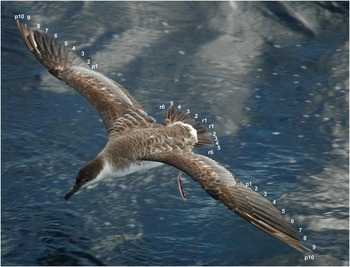
Petrels and albatrosses moult primaries in a symmetrical manner; therefore moult scores for p1–p10 were recorded for the right wing only (Harris Reference Harris1973, Hunter Reference Hunter1984, Furness Reference Furness1988, Prince et al. Reference Prince, Rodwell, Jones and Rothery1993, Allard et al. Reference Allard, Mallory, Wilcox and Forbes2008, Rohwer et al. Reference Rohwer, Viggiano and Marzluff2011). All rectrices from the left (L) and right (R) halves of the tail were scored (r1 is the central pair and r6 the outermost pair). Scores were based on feather appearance (old or new, Fig. 1) and stage of development: 0=old feather, 1=feather missing or new feather in pin, 2=new feather emerging from sheath up to one-third grown, 3=new feather one- to two-thirds grown, 4=new feather more than two-thirds grown with waxy sheath remains at its base, or 5=new feather fully grown without waxy sheath remains at its base (Ginn & Melville Reference Ginn and Melville1983). Old feathers were distinguished from new fully grown ones by having faded colour, duller brightness and abraded tips (Fig. 1). However, it was sometimes difficult to distinguish old and new feathers, especially in birds not in active moult showing only one apparent feather generation. Additionally, in birds captured by castnetting the plumage may be wet and in disarray. This scoring method documents only one category of old feathers. Therefore, the occurrence of more than two generations of primaries in albatrosses is not discussed. Despite careful consideration of scores during data collection, this scoring limitation may also have caused scoring error when outer primaries, which are more subject to decay, looked older than inner primaries although they could belong to the same generation. Body moult on head, back and belly was defined as active if at least five growing feathers were located in these areas; otherwise body moult was defined as inactive.
Moulting great shearwater (Puffinus gravis) photographed at sea in southern Brazil. The image shows differences between new (p1–p8) and old (p9–p10) primaries and new (r1) and old (r2–r6) rectrices.

Data analysis
Moult data were tabulated as the number of cases of each score (0–5) per feather (p1–p10, r6 R and L). The frequency of occurrence (FO) of each score was calculated as FO=total number of cases ÷ (number of feathers in tract × number of birds sampled). A subscript 0–5 is used to indicate the moult score. The mean number of new, old and growing feathers was also analysed. Body moult was analysed as the proportion of birds with active moult in the head, back and belly.
The sequence of replacement of rectrices was analysed for birds with active tail moult or a combination of old and new rectrices. Birds with only new or old rectrices were not included in this analysis because these birds do not provide information on moult sequence. Birds were sorted in approximate ascending order of tail moult scores (from 1–5) to depict tail moult progression. Based on the sample for Atlantic yellow-nosed albatrosses and spectacled petrels, tail moult progress was defined as early (only one or two fully grown new rectrices) or late (three or more fully grown new rectrices).
A difficulty of sampling moult away from breeding colonies is that age and breeding status are usually unknown, as opposed to moult data collected at breeding colonies in the context of banding and monitoring programmes. Hatch-year and immature Atlantic yellow-nosed albatrosses (up to 6 years old) were aged based on bill colour (Bugoni & Furness Reference Bugoni and Furness2009), and the specific age of adults (older than 6 years) was not defined. Spectacled petrels and great shearwaters cannot be easily aged based on characteristics of plumage and bare parts. Petrels and shearwaters sampled in February–June with no active moult were defined as ‘first-year juveniles’; however, this may have included some successful breeding adults in February. No such assumption was made for birds sampled in July–August because they could have been adults which had completed moult.
Sex was determined by PCR amplification of CHD genes and sex-related differences were tested for the timing of moult and synchronization between primary and tail moult.
Pearson’s correlation coefficient for relationships between total moult scores for primaries and rectrices were calculated to assess synchronization in moult of these feather tracts. Correlation coefficient for relationships between Julian day and moult scores for primaries and rectrices were also calculated to assess overlap between moult and breeding activities. Only birds in active primary and/or tail moult were included in these analyses (i.e. birds with at least one feather scored 1–4). Hatch-year birds were not included because they are unlikely to have active primary and tail moult. Analyses were carried out combining males and females for each of the three studied species and for females and males separately (sample size for albatrosses was insufficient to analyse sexes separately). There was an indication of synchronization between primary and tail moult for spectacled petrels in the non-breeding period, therefore correlation coefficients between these tracts were calculated for this category of birds. Statistical significance was determined after Bonferroni correction for multiple comparisons, derived from the α level (0.05) divided by the number of comparisons. In the moult synchronization analysis, the number of comparisons was eight, thus correlations were statistically significant if P<0.006. In the analysis of overlap between moult and breeding activities, moult scores and Julian days were log+1 transformed and the number of comparisons was 18, thus correlations were statistically significant if P<0.003.
Results
Atlantic yellow-nosed albatross
Adult and immature Atlantic yellow-nosed albatrosses were sampled in February (chick-rearing), late April (late fledging) and May–August (non-breeding). Due to small sample sizes, data for late fledging and non-breeding were combined.
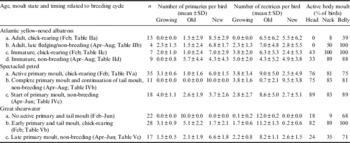
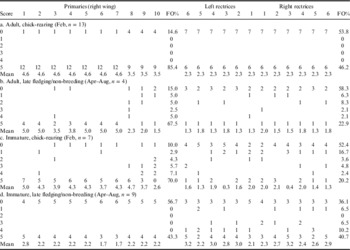
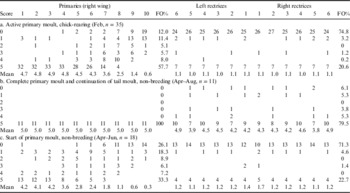
Adults sampled during chick-rearing (n=13) had a lower frequency of body moult than adults sampled during late fledging/non-breeding and immatures, and no active primary and tail moult (Tables I & IIa). Nine of these adults had all primaries scored as new, three had new p1–p7 and old p8–p10, and one had all primaries scored as old (FO5=85%). Six of these adults had all rectrices scored as new and seven had all rectrices scored as old (FO5=46%).
Primary, tail and body moult of Atlantic yellow-nosed albatross (Thalassarche chlororhynchos), spectacled petrel (Procellaria conspicillata) and great shearwater (Puffinus gravis) sampled offshore south Brazil.

Moult scores of primaries and rectrices (number of cases of each score) of the Atlantic yellow-nosed albatross. Relative frequency of occurrence (FO%)=total number of cases divided by (number of feathers in tract × number of birds sampled).

Adults sampled in late fledging/non-breeding (n=4) had most inner primaries new (FO5=68%), had old or growing outer primaries p8–p10 (FO1–4=18%), and were in active tail moult (FO1–4=19%, Tables I & IIb).
Immatures sampled during chick-rearing (n=7) were moulting one or two of the three outer primaries p8–p10; two birds were also moulting p2 and/or p3 (mean number of growing primaries=2.0, max=4, FO1–4=20%; Tables I & IIc). Six of these immatures had active tail moult (FO1–4=28%) and a high proportion of old rectrices (FO0=52%, mean number of growing rectrices=3.8, max=6).
Immatures sampled during late fledging/non-breeding (n=9) had no active primary moult and similar proportions of primaries scored as old and new (FO0=57%, FO5=43%; Tables I & IId). Three of these birds had all rectrices scored as old, one had all rectrices new, and the other five birds were in advanced tail moult.
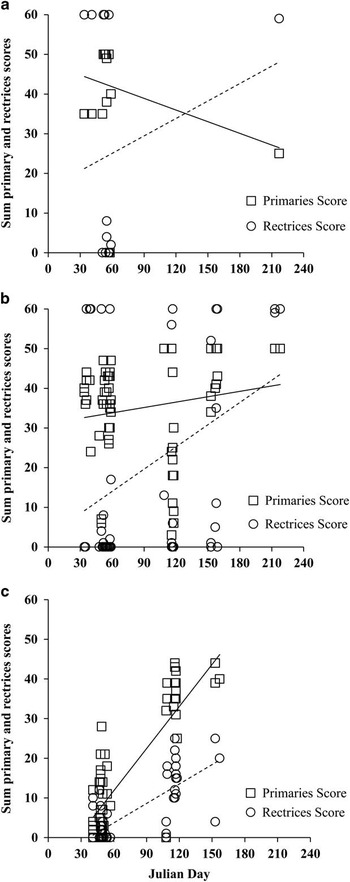
The total moult scores for primaries and rectrices were negatively correlated, but this correlation was not significant (r=-0.48, n=16, P=0.06, critical P<0.006). Correlations between moult scores and Julian day were non-significant for primaries and rectrices when considering males and females combined, or when considering males separately (sample size insufficient to assess females separately; Fig. 2a, Table III).
Relationships between Julian day and total moult scores of primaries (up to 50, continuous line) and rectrices (up to 60, dashed line). a. Atlantic yellow-nosed albatross, b. spectacled petrel, and c. great shearwaters.

Relationships between Julian day and moult scores of primaries and rectrices of the Atlantic yellow-nosed albatross, spectacled petrel and great shearwater. Data were log+1 transformed and Bonferroni correction for multiple comparisons applied; correlations are statistically significant if P<0.003.

a All birds with active moult pooled, i.e. immatures and adults.
b Small sample size for adult females precluded analysis.
c Adults (4+ years) only. Sample size for immatures (2–4 years old) precluded analysis of the group.
Spectacled petrel
All spectacled petrels sampled in February (late chick-rearing) had active primary moult, most had old rectrices (although seven birds had all rectrices scored as new), and a few were starting tail moult (defined as moult state ‘a’, n=35; Tables I & IVa). Birds sampled in April–August (non-breeding) were divided in two moult states. Birds in moult state ‘b’ (April–August) had new primaries and no active moult, advanced tail moult or all rectrices new (n=11, Tables I & IVb). Birds in moult state ‘c’ (April–June) had active primary moult and tail old or starting moult (n=18, Tables I & IVc). The moult state ‘b’ probably represented a later stage (progression over time) of state ‘a’, and these moult states may represent birds in similar age and/or breeding status. On the other hand, it seems that moult state ‘c’ involved a later start of primary and tail moult, probably after fledging, and may refer to birds of age and/or breeding status differing from birds represented in moult status ‘a’ and ‘b’. A correlation between total primary and tail scores was not found in birds sampled in the non-breeding period (r=0.21, P=0.33, n=23; moult states ‘a’, ‘b’ and ‘c’ combined).
Moult scores of primaries and rectrices (number of cases of each score) of the spectacled petrel sampled offshore south Brazil. Relative frequency of occurrence (FO%)=total number of cases divided by (number of feathers in tract × number of birds sampled).

In general, primary moult was sequential and progressed outward from p1 to p10. Seven birds had one of the four inner primaries scored higher than its adjacent inner feather (e.g. 4552110000) and two other birds in early primary moult had p1–p6 scored 1 or 2, suggesting simultaneous shedding of inner primaries. Active head, belly and back moult were observed in all three moult states, and most birds had moult in at least two body areas, suggesting that body moult largely overlaps primary and tail moult (Table I).
Total moult scores for primaries and rectrices were not correlated when considering sexes combined (r=0.00, P=0.98, n=57), or when considering females (r=-0.25, P=0.35, n=16) and males (r=0.09, P=0.50, n=41) separately. There was a tendency for a positive correlation between moult scores versus Julian day in some categories of birds, but correlations were not statistically significant (Fig. 2b, Table III).
Great shearwater
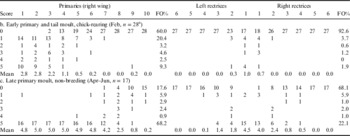
Great shearwaters were sampled in February (chick-rearing), late April (late chick-rearing/fledging) and early June (non-breeding). In the sample, 67% of birds were in active primary moult and 43% were also in active tail moult (Tables I and V). Only a few great shearwaters were seen in July–August (none captured) and all birds closely seen had new primaries, rectrices and body coverts. Three moult states were identified: a) no active primary and tail moult (except by one bird with r1L scored 1), old primaries and rectrices (FO0=100%, moult score table not presented; February n=9, April n=12, June n=1) and active body moult mostly at belly (68%, Table I), b) early primary and tail moult (February n=28) (mean growing primaries=3.1, max=5; mean growing rectrices=1.7, max=3) and active moult in at least two body areas (Table I), and c) late primary moult (April n=14, June n=3) (mean growing primaries=1.5, max=2; mean growing rectrices=2.2, max=4) and active body moult less prevalent than in state ‘b’ (Table I).
Moult scores of primaries and rectrices (number of cases of each score) of the great shearwater sampled offshore south Brazil. Relative frequency of occurrence (FO%)=total number of cases divided by (number of feathers in tract × number of birds sampled).

a Tail moult scores are available for 27 out of 28 birds in moult state ‘b’.
There were strong, positive correlations between total moult scores of primaries and rectrices when considering both sexes combined (r=0.78, P<0.0001, n=44) and when considering females (r=0.79, P<0.0001, n=27) and males (r=0.78, P=0.0003, n=17) separately. Primary and tail moult progressed from February to June, indicated by significant positive correlations between feather moult scores and Julian day (Fig. 2c, Table III).
Primary moult was sequential and proceeded outward from p1 to p10. Five out of 28 birds in early primary moult had one of the four inner primaries scored higher than its adjacent inner feather and eight other birds had at least p1–p3 scored 1 or 2, suggesting simultaneous shedding of inner primaries. The scores of p7–p10 in active moult frequently varied by two or more units, suggesting that the outermost primaries shed more discretely than inner primaries.
Tail moult
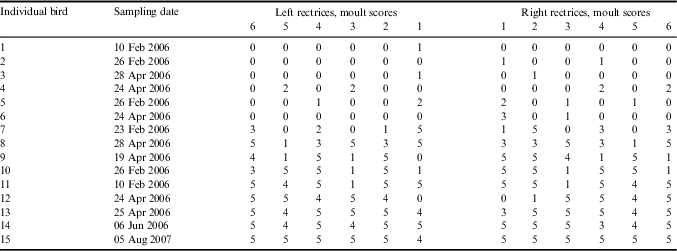
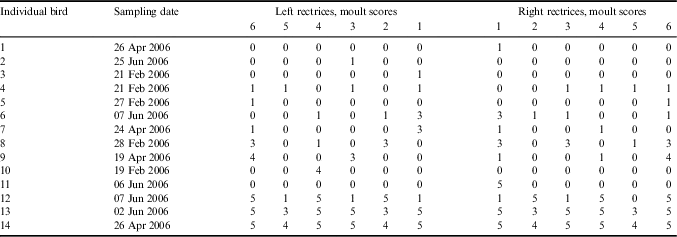
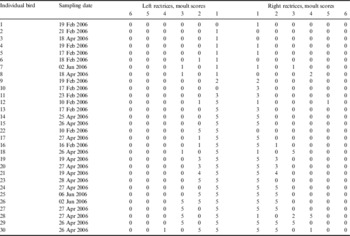
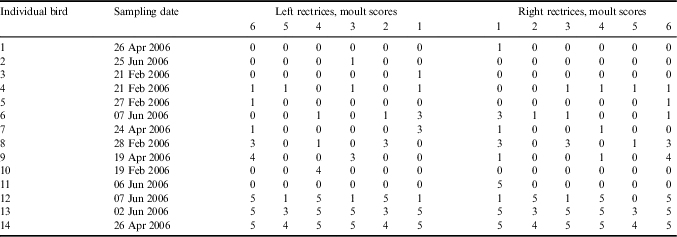
Atlantic yellow-nosed albatrosses (Table II) and spectacled petrels (Table IV) started tail moult at the end of primary moult, while tail moult in great shearwaters started while inner primaries were moulting (Table V). In albatrosses and petrels, the mean number of growing rectrices was 3.5–3.8 in both the early (one or two fully grown new feathers) and late (three or more fully grown new feathers) moult stages. Growing rectrices were interspaced with fully grown ones (scores 0 or 5), and small rectrices (scores 1 and 2) were next to large ones (scores 3, 4, 5, 0) (exceptions were observed in only one albatross and two spectacled petrels; Tables VI and VII). During the period represented in the sample, tail moult in albatrosses (7.0 months) and spectacled petrels (3.5 months) included the whole tail and reached a mean of 6.5 and 7.5 fully grown rectrices. For albatrosses and petrels, it was not possible to clearly identify moult sequence(s) based on the number of cases each rectrix was among the first ones to shed.
Tail moult sequence in the Atlantic yellow-nosed albatross. Each line corresponds to an individual bird. Dataset includes birds in active tail moult or a combination of old and new rectrices (no birds with identical scores were originally present in the sample). Birds were sorted from top to bottom based on the prevalence of low to high moult scores (0–5).
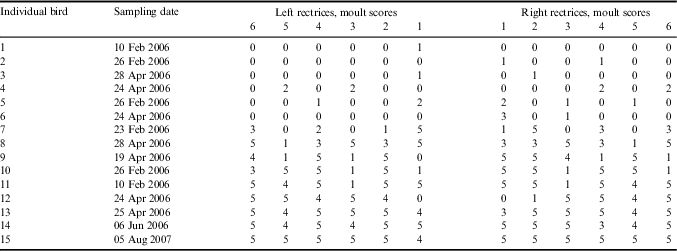
Tail moult sequence in the spectacled petrel. Each line corresponds to an individual bird. Dataset includes birds in active tail moult or a combination of old and new rectrices (no birds with identical scores were originally present in the sample). Birds were sorted from top to bottom based on the prevalence of low to high moult scores (0–5).
The definition of ‘early’ and ‘late’ tail moult based on the sample of Atlantic yellow-nosed albatross and spectacled petrel seemed to not apply to the moult pattern of great shearwaters, at least for the period represented in this sample (February–June, chick-rearing and non-breeding). However, these moult progress categories were still useful to compare tail moult patterns among the studied species. In the great shearwater, the mean number of growing rectrices was 1.9 in the early moult and 2.0 in the late moult, progressing from summer to early winter. In all great shearwaters (n=30, Table VIII), the moult started in the central pairs of rectrices. In the 3.5 months represented in the sample, the moult progressed outwards from r1 to r3 in most birds, reaching a mean of 3.9 new fully grown rectrices. Because the sample included mostly shearwaters in early tail moult (22 birds had moult only in the first or first and second pairs of rectrices), it is not clear whether the moult progresses sequentially towards outer rectrices or tends to alternate feather pairs, as observed in the spectacled petrel and Atlantic yellow-nosed albatross samples.
Tail moult sequence in the great shearwater. Each line corresponds to an individual bird. Dataset includes birds in active tail moult or a combination of old and new rectrices (birds with identical scores originally present in the sample are presented side by side, e.g. birds #2 and #3, #4 and #5). Birds were sorted from top to bottom based on the prevalence of low to high moult scores (0–5).

Discussion
The data presented here for Atlantic yellow-nosed albatrosses supports previous knowledge on moult patterns in albatrosses: i) primary moult does not overlap breeding (Furness Reference Furness1988, Prince et al. Reference Prince, Rodwell, Jones and Rothery1993, Weimerskirch Reference Weimerskirch1991, Edwards Reference Edwards2008), ii) p8–p10 constitutes a moult series (Harris Reference Harris1973, Prince et al. Reference Prince, Rodwell, Jones and Rothery1993), iii) replacement of p8–p10 proceeds outward, and iv) several patterns of moult are possible according to age (immatures, adults) and breeding status (breeders, failed breeders, sabbaticals).
This study provided new information on the timing of tail and body moult. Tail moult did not overlap breeding in the Atlantic yellow-nosed albatross and birds supposed to be breeding adults had a lower occurrence of body moult than birds supposed to be immatures and non-breeding adults. Timing of tail and body moult in Atlantic yellow-nosed albatrosses may be related to a long breeding season, which may require a higher degree of overlap of activities at times of abundant food resources. Costs of tail moult may be smaller than primary moult, at least in terms of loss of flight efficiency.
Scoring of primaries and rectrices of the Atlantic yellow-nosed albatross presented some potential difficulties. Around 50% of adults sampled during chick-rearing had all rectrices scored as new and the other half had all rectrices scored as old. Furthermore, most adults had primaries scored as new (Table II). However, during chick-rearing, breeding birds would be expected to have a relatively high proportion of old primaries. This reported occurrence of old and new primaries and rectrices may reflect: i) non-differentiation of more than one generation of old feathers, or ii) scoring error resulting from difficulty in differentiating old and new feathers. These difficulties may also have affected scoring in immatures sampled in the non-breeding period that had all primaries (n=4) and rectrices (n=3) scored as old. Difficulties in differentiating old and new feathers may explain birds with all rectrices scored as new in moult states ‘a’ (n=7) and ‘c’ (n=4) (Table II).
The great shearwater winters in the north-west Atlantic Ocean, mostly north of 45°N. Brown (Reference Brown1988) suggested that adult breeders start primary moult when they reach wintering grounds in May–June, and primary moult lasts around 40 days, with up to six inner primaries replaced simultaneously. A few documented cases of birds moulting in the south Atlantic Ocean have been interpreted as immatures because most long-distance migrant Procellariiformes breeding in high latitudes do not overlap breeding and moult, and postpone moult until arrival in wintering grounds. Great shearwaters moulting inner primaries and primary coverts were recorded in Tierra del Fuego in January (Watson Reference Watson1971). One moulting bird was seen offshore west Africa in December (Bourne Reference Bourne1963). Three birds collected in North Carolina, USA, in June were completing moult of the outermost primaries and tail (Watson Reference Watson1970). These results suggest that the south-west Atlantic Ocean holds important numbers of great shearwaters moulting primaries and tail, which may include immatures and failed breeders, as well as breeding birds starting moult at the end of the breeding period, as occurs in Cory’s shearwaters (Alonso et al. Reference Alonso, Matias, Granadeiro and Catry2009). In our sample, birds without active primary moult in February (n=9) may have included breeding birds on long foraging trips as well as non-breeding birds that had not yet started primary moult. If so, birds without active primary moult sampled in April and June (n=13) probably included mostly breeding birds, which may start primary moult in the north Atlantic wintering grounds. Similarly, the short-tailed shearwater (Puffinus tenuirostris Temminck), also a high-latitude, trans-equatorial migrant, moults head and body feathers in breeding grounds after breeding and delays primary and tail moult until June–July when they reach north Pacific wintering grounds (Marshall & Serventy Reference Marshall and Serventy1956). On the other hand, Cory’s shearwater, which migrates shorter distances within the north Atlantic Ocean, can start wing moult during breeding and probably completes moult in wintering grounds (Alonso et al. Reference Alonso, Matias, Granadeiro and Catry2009). Our data suggest that great shearwaters could start moult in the Southern Hemisphere, halting moult for migration, and finishing moult in the north Atlantic, a situation distinct from that proposed by Brown (Reference Brown1988).
Moult patterns across species
The onset of primary moult in the spectacled petrel and great shearwater was during chick-rearing, similar to that observed in the sooty shearwater (Puffinus griseus Gmelin) and the northern fulmar (Allard et al. Reference Allard, Mallory, Wilcox and Forbes2008), with nearly simultaneous shedding of the inner primaries (although information on age and breeding status is not available). While great shearwaters synchronize primary and tail moult, spectacled petrels and Atlantic yellow-nosed albatrosses had no moult synchronization in these feather tracts.
Prince et al. (Reference Prince, Rodwell, Jones and Rothery1993) reported that black-browed albatross and grey-headed albatross (Thalassarche chrysostoma (Forster)) replaced rectrices from the outermost to the innermost pair so that the central pair was the last one to moult. Our data suggest that Atlantic yellow-nosed albatross, along with the spectacled petrel, replace rectrices alternately and apparently without a fixed sequence. Great shearwaters moulted rectrices outward, starting at the central pair.
Tail moult started well after the onset of primary moult in the spectacled petrel and the great shearwater (unknown age and breeding status). Breeding and non-breeding birds may have different timing of onset of primary and tail moult. Delay of the onset of tail moult in these species until completion of inner primary moult may prevent simultaneous growing of a relatively large number of inner primaries and rectrices or simultaneous gaps in wings and tail. The lack of progress in moult scores of primaries and rectrices of spectacled petrel with Julian day (despite a trend shown in Fig. 2) suggests that our sample included birds of different age and breeding status.
The synchronization in moult differed among species. Male and female great shearwaters synchronized primary and tail moult, while spectacled petrels and Atlantic yellow-nosed albatross did not. This difference could be explained by the long-distance migration of great shearwaters constraining the time available for moult, a situation not faced by the other two species. Some moult states with active tail moult and inactive primary moult seemed to represent advanced moult where primary moult was already complete and tail and body moult either started later or extended for a longer period of time, as found in immature Atlantic yellow-nosed albatross during non-breeding. Primary moult may represent a substantial proportion of the cost of the moult in some species. However, extensive overlap of moult in different feather tracts suggests that metabolic costs of primary moult may not be overly restrictive. For example, body feathers account for 75–80% of total feather weight in cape petrels (Daption capense (L.)) (Beck Reference Beck1969) and may contribute to a significant part of the cost of replacing all feathers.
Around 50% of the Procellariiformes species overlap moult of different feather tracts (tail and body, sometimes primaries) with breeding (Bridge Reference Bridge2006). The metabolic and nutritional ability to afford simultaneous moult of different feather tracts supports the idea that impaired flight performance caused by wing moult is a strong factor driving no overlap of primary moult and breeding (Edwards Reference Edwards2008). Impaired flight performance caused by primary moult could explain why albatrosses undertaking long foraging trips do not moult primaries during breeding, while similarly-sized giant petrels (Macronectes spp.), which feed on carrion near breeding colonies, start primary moult during egg laying or early chick provisioning (Hunter Reference Hunter1984). When the requirement for extremely high flight efficiency is loosened (for example by abundant food resources close to breeding colonies), a variable degree of overlap between primary moult and breeding may be observed.
A broad understanding of moult ecology requires information on all components of the population, age and breeding status, multiple feather tracts, breeding performance and other biological data in successive years. Moult sampling at sea may yield samples that represent the population in an incomplete manner depending on the spatial and temporal distribution of age classes, breeding and non-breeding birds, males and females. However, strategic spatial and temporal allocation of offshore sampling effort when birds are in active moult has great potential to complement moult studies conducted at breeding colonies.
Acknowledgements
We thank Captain Celso Oliveira and crews of the fishing vessels Ana Amaral I and Akira V for their offshore logistical support. LB had a scholarship from the Brazilian Agency for the Support and Evaluation of Graduate Education (Coordenação de Aperfeiçoamento de Pessoal de Nível Superior, CAPES) and currently has a fellowship from the Brazilian Council for Scientific and Technological Development (Conselho Nacional de Desenvolvimento Científico e Tecnológico, CNPq; Proc. #308697/2012-0). Bird capture and banding were conducted under permit no. 023/2006 from the Brazilian Center for Bird Research and Conservation (Centro Nacional de Pesquisa e Conservação de Aves Silvestres, CEMAVE). Authors are grateful to two anonymous reviewers, who provided insights in data analysis and discussion.
Author contribution
L. Bugoni: contributed with study delineation, field sampling, data analysis, writing and revision. L.C. Naves: contributed with data analysis, writing and revision. R.W. Furness: contributed with study delineation, writing and revision.