Introduction
In recent years, the use of foreign loanwords in Chinese has increased significantly. It has been estimated that there are currently about 3,000 foreign words in Chinese, most of which are related to English (Zhang, Reference Zhang2006). Of these, more than 500 words are frequently used, together with their abbreviations and translations. In response to this situation, the Chinese government established the Inter-ministerial Joint Meeting on Chinese Language Translation and Writing Specifications (IJM-CLTWS) in 2012, consisting of ten state-level ministries and institutions such as the State Language Commission, the Central Compilation & Translation Bureau, the Ministry of Foreign Affairs and the Ministry of Education. Thus far, the expert committee of the IJM-CLTWS has identified four groups of foreign words and their standard Chinese translations.
The publication of the 6th edition of the authoritative Modern Chinese Dictionary by the Chinese Academy of Social Sciences in 2012 resulted in a heated discussion on the use of English words in Chinese because it devoted a special section to words consisting of letters in the Latin alphabet. China's leading newspapers and scholarly journals such as the People's Daily and Studies of the Chinese Language published dozens of articles which focused on the issue of whether acronyms and initialisms (henceforth ‘lettered words’) such as ‘NBA’ (‘National Basketball Association’), ‘GDP’ (‘gross domestic product’) and ‘CPI’ (‘consumer price index’) are Chinese or foreign words (Pan, Reference Pan2012; Liu, Reference Liu2013; Dong et al., Reference Dong2014). The present study aims to investigate the current situation regarding English lettered words in Chinese, and to assess the extent to which these words are now becoming acknowledged as an integral part of modern Chinese in China's academic circles.
Research methodology
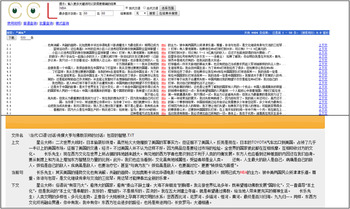
The data for this project is taken from two sources: (1) A Practical Dictionary of Lettered Words (Hou, Reference Hou2014) (henceforth ‘PDLW’); and (2) the CCL Modern Chinese Corpus (henceforth ‘CCL-MCC’) developed by the Center for Chinese Linguistics at Beijing University. The PDLW is the latest and largest dictionary of its kind, containing about 5,000 lettered words, and its editor, Professor Hou Min, is the Director of the National Broadcast Media Language Resources Monitoring & Research Center. The PDLW is based on the National Language Resources Monitoring Corpus, thus guaranteeing the comprehensiveness, authoritativeness and reliability of the data of the dictionary. The CCL–MCC created by Beijing University is characterized by big data, authentic material, free access and convenient retrieval. It contains 581,794,456 characters, covering many fields of spoken and written Chinese such as conversations, interviews, lectures, practical writings, newspaper and journal articles, biographies, novels, plays, translations and network language data. The CCL–MCC provides a search function not only for Chinese characters but also for English words, and the text in which the searched word appears (see Figure 1).
CCL–MCC's search results of ‘NBA’ and the context of the first result

In the discussion that follows, the PDLW will be used to analyse the type, structural form and meaning of English words in Chinese, while the CCL–MCC will be used to examine their semantic domains, grammatical forms and pragmatic functions. As for the research data, this study will be supplemented by the Modern Chinese Dictionary, which contains 239 foreign words, as well as 72 further foreign words identified by the IJM–CLTWS. The article will conclude with a brief discussion of public attitudes toward English lettered words in Chinese, the reasons for the presence of these words, and their future prospects.
Forms, features and functions of English words in Chinese
Since China's implementation of various reform and opening-up policies and its entry into the WTO, English words have been entering Chinese in ever larger numbers. Almost all of these words are lettered words (Hou & Teng, Reference Hou and Teng2016). A lettered word may be defined as a word consisting of letters in Latin script, Chinese pinyin letters or Greek letters, or which is created by combining these letters with symbols, numerals or Chinese characters (Duan & Liu, Reference Duan and Liu2014). Lettered words can be seen in many fields, including politics (e.g. ‘G20’ for ‘Group of Twenty’), economics (e.g. ‘GDP’ for ‘gross domestic product’), science and technology (e.g. ‘pH 值’ for ‘pH value’), information technology (e.g. ‘IT’ for ‘information technology’), health and medicine (e.g. ‘AIDS’ for ‘acquired immunodeficiency syndrome’ and ‘CT 扫描’ for ‘computerized tomography scan’), education (e.g. ‘MBA’ for ‘Master of Business Administration’), sports (e.g. ‘NBA’ for ‘National Basketball Association’), business (e.g. ‘CEO’ for ‘chief executive officer’), entertainment (e.g. ‘DVD’ for ‘digital videodisk’) and various other aspects of modern life (e.g. ‘VIP’ for ‘very important person’, ‘ATM 机’ for ‘automated teller machine’ and the now-ubiquitous ‘Wi-Fi’).
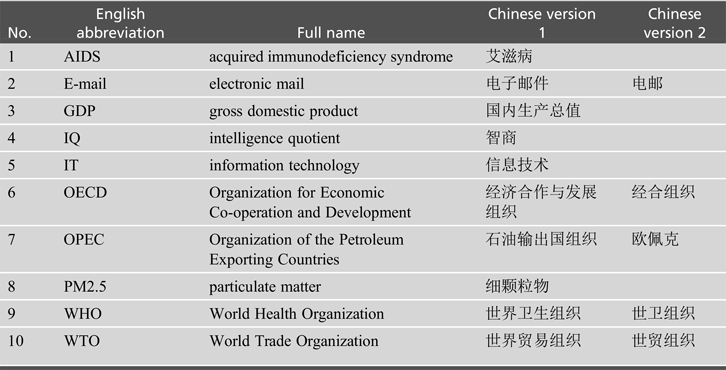
As far as their constituents are concerned, lettered words can be divided into five types: (1) words consisting of Latin letters; (2) words consisting of Latin letters and Chinese characters; (3) words consisting of Latin letters and Arabic numerals; (4) words consisting of Latin letters, Chinese characters and Arabic numerals; and (5) words consisting of Latin letters and symbols. The first type may be called ‘pure lettered words’, embracing all English abbreviations and words, and the rest ‘hybrid lettered words’. As for pure lettered words, let us take the first group of foreign words announced by the IJM–CLTWS on October 23, 2013 (Table 1).
The first group of foreign words announced by IJM–CLTWS and their full name and Chinese versions

Except for ‘E-mail’ and ‘PM2.5’, all words in Table 1 are composed of Latin letters, and are all abbreviations, directly borrowed from English and formed via acronymy and initialism. They are used independently or together with their translations in Chinese.
The second type may be divided into three sub-types: (1) words beginning with Latin letters such as ‘X光’ (‘X rays’); (2) words beginning with Chinese characters such as ‘卡拉 OK’ (‘karaoke’); and (3) words with Latin letters between Chinese characters such as ‘三 K 党’ (‘Ku Klux Klan’). These types of words are built through the fusion of English and Chinese, and thus may be viewed as hybrid or mixed forms (Meakins, Reference Meakins, Bakker and Matras2013).
The third type can be subdivided into two categories: (1) words beginning with Latin letters such as ‘PM10’ (‘particulate matter 10’); and (2) words beginning with Arabic numerals such as ‘4G’ (‘fourth generation [mobile communication]’). The fourth type is structurally complex in that Latin letters can appear in any place of a word such as ‘4S 店’ (‘automobile sales serviceshop 4S’), ‘MP3 技术’ (‘moving picture experts group audio layer III’) and ‘甲型 H1N1 流感’ (‘influenza A’). In fact, this type of words is produced by combining three languages, and can be described as a kind of language mosaic (Baskaran, Reference Baskeran1994/2008).
Compared with the above types, the fifth type is not common in Chinese. A case in point is ‘C&D’ which means ‘construction and development’. It can be observed that Latin letters in lettered words are generally capitalized, with ‘E-mail’ and ‘pH 值’ as exceptions. Besides individual Latin letters, full English words are occasionally used independently as lettered words such as ‘Internet’, ‘cool’ and ‘hip-hop’, or joined together with Chinese characters such as ‘call 台’ (‘call counter’), ‘ball 王’ (‘ball king’) and ‘hold 住’ (‘hold successfully’) (Wu, Reference Wu2001). As for lettered words consisting of Chinese pinyin letters such as ‘GB’ (guo biao, 国标, ‘national standard’) and ‘HSK’ (Hanyu Shuiping Kaoshi, 汉语水平考试, ‘Chinese Proficiency Test’), it seems that these are neither English words nor English-related words because they are created within the Chinese language system and not borrowed from English.
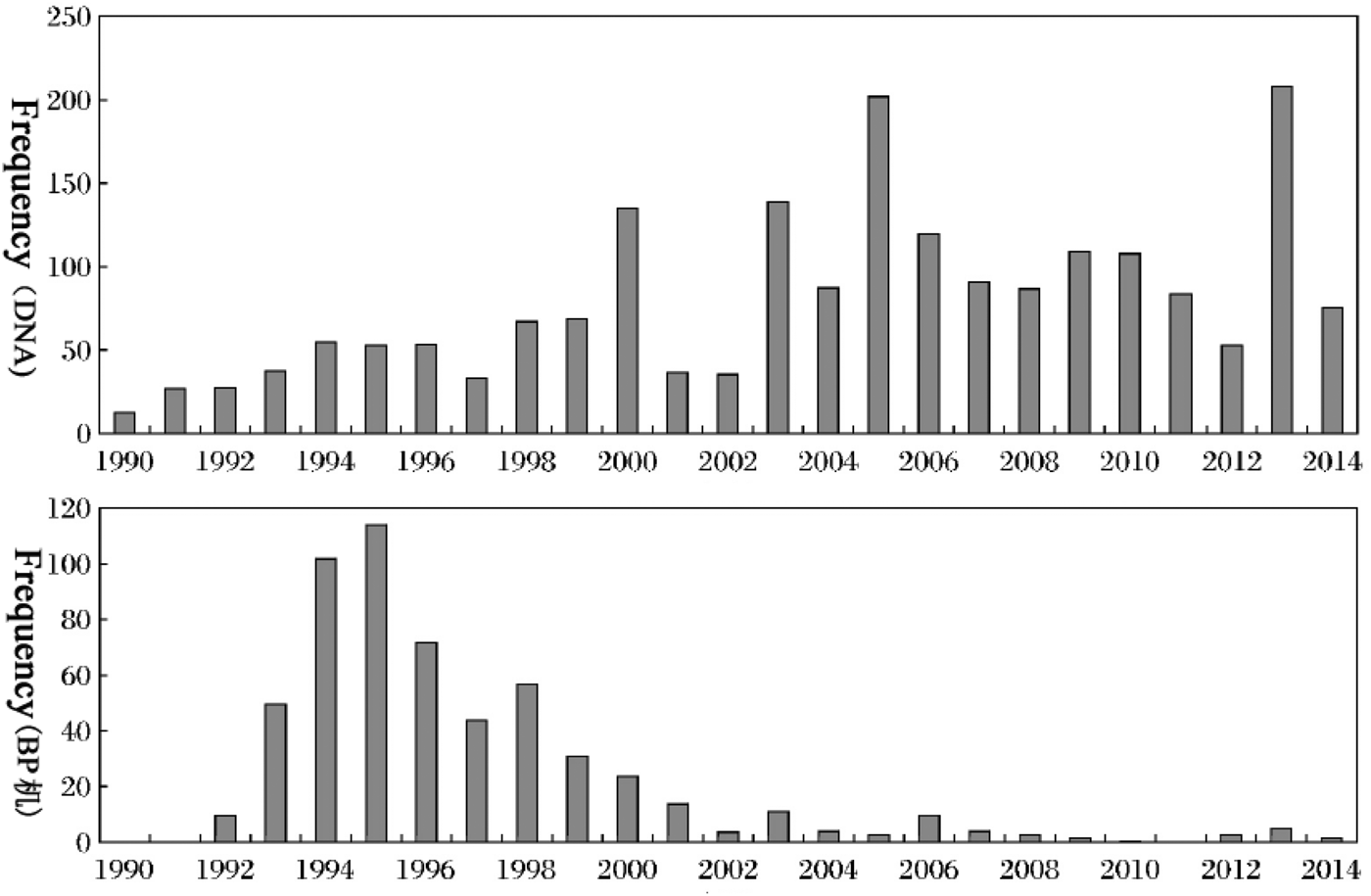
Chinese lettered words are intimately associated with modernity, representing new concepts, hot topics and emerging technologies of the day. For example, the beeper was a small piece of electronic equipment that made short high sounds as a signal for one to telephone someone else. It was introduced into China in the mid-1980s and became very popular in the first half of the 1990s, thus giving rise to the word ‘BP 机’. But it gradually disappeared in the second half of the 1990s due to the appearance of the mobile phone. Another example is ‘DNA’, namely ‘deoxyribonucleic acid’, which was first formulated as a technical term in the 1940s. Although it is not a new concept, ‘DNA’ has stayed at the center of science and technology in the past decades due to the rapid development and continuing prosperity of biological and genetic research.
Lettered words have different patterns with respect to their frequency of use after their coinage. Wang Qiuping's (Reference Wang2016a) case study of lettered words used in the People's Daily between 1990 and 2014 indicates that some of them remain stable with a relatively high frequency such as ‘DNA’, ‘IT’ and ‘IC 卡’ (‘integrated circuit card’), while others attain a high frequency within a relatively short period of time after their initial appearance before gradually decreasing and almost disappearing in Chinese, such as ‘BP 机’ (‘beeper’), ‘LD’ (‘laser diode’) and ‘SARS’ (‘severe acute respiratory syndrome’) (Figure 2). The former may be called ‘typical lettered words’, and the latter ‘non-typical lettered words’ (Duan & Liu, Reference Duan and Liu2014).
Use frequencies of ‘DNA’ and ‘BP 机’ in the People's Daily between 1990 and 2014 (Wang, Reference Wang2016a)

In some cases, the form and sound of English words may be localised via sinicisation to produce Chinese lettered words. For example, ‘BP’ in ‘BP机’ is not an abbreviation directly borrowed from English, but it is the abbreviated form of ‘beeper’ created by Chinese users. Moreover, some English letters in lettered words are not read according to their original English pronunciation but pronounced with Chinese tonal or phonetic characteristics. For example, ‘E’ is pronounced /yī/; ‘J’, /jiè/; ‘C’, /xī/ or /sèi/; ‘U’, /yóu/; ‘E-mail’, /yī mèir/ (Yu & Zhu, Reference Yu and Zhu2003). As far as parts of speech are concerned, most lettered words are nouns or noun phrases, and include names of institutions and organizations such as ‘WTO’ (‘World Trade Organization’), ‘APEC’ (‘Asia-Pacific Economic Cooperation’) and ‘BBC’ (‘British Broadcasting Corporation’), technical terms such as ‘GPS’ (‘global positioning system’), ‘LED’ (‘light emitting diode’) and ‘IPO’ (‘initial public offering’) and common nouns such as ‘VCD’ (‘versatile compact disk’), ‘MTV’ (‘music television’) and ‘BBS’ (‘bulletin board system’) (Wang, Reference Wang2016b).
A few pure lettered words, namely those consisting of English letters, have a certain degree of word-building productivity that is in agreement with the laws of Chinese word formation. For example, as a pre-modifier, ‘CBD’ (‘central business district’) can be put together with some nouns to produce some other nouns such as ‘CBD 后花园’ (‘CBD back garden’), ‘CBD 后院’ (‘CBD backyard’) and ‘CBD 卧室’ (‘CBD bedroom’). Syntactically, lettered words can behave in a variety of roles. Some words are used independently, such as ‘WTO’ and ‘DOS’ (‘disk operating system’); some are put in round brackets after their Chinese translation, such as ‘国内生产总值 (GDP)’; and some are followed by their translation in round brackets such as ‘APEC (亚太经合组织)’; some are put side by side with their translation, such as ‘ABS 防抱死系统’ (‘antilock brake system’). Sometimes, the part of speech and meaning of lettered words may be different from their original in English. For example, ‘OK’ as the abbreviated form of ‘okay’ can be used as a verb in Chinese to mean ‘produce’ or ‘succeed’, as in ‘我国人工繁殖大熊猫六年 “OK” 二十四胎’ (‘China's artificial reproduction endeavors produced 24 baby pandas in the last six years’) and ‘这单生意 OK 了’ (‘the business succeeded’) (Wu, Reference Wu2001). As for pragmatic functions, lettered words are generally used to achieve an informative function, referring to an entity, a concept or a phenomenon in society. Occasionally, however, they can also have an emotive function. For example, the English letters ‘N’ and ‘X’ can be used independently in Chinese to mean ‘a great many’ and ‘fuck’ respectively, as in ‘打了N个电话’ (‘made millions of telephone calls’) and ‘X你’ (‘fuck you’).
Chinese lettered words are generated with a variety of methods. The first and most common is via borrowing. Many abbreviations as well as a few full words in English are directly transplanted into Chinese, such as ‘CNN’ (‘Cable News Network’), ‘UFO’ (‘unidentified flying object’) and ‘spa’. Second, lettered words may be produced via modification of the form of the original English words, such as ‘Win2000’ for a computer operating system, which is derived by deleting the letters ‘dows’ in ‘Windows2000’. Third, addition of Chinese characters and modification of the original form may be simultaneously used to create lettered words such as ‘BP 机’ in which ‘BP’ can be viewed as a special kind of abbreviation and ‘机’ (‘machine’) is added to clarify the category of the product. Fourth, modification of the original form may be used together with transliteration to produce lettered words such as ‘卡拉 OK’ (‘karaoke’), in which ‘卡拉’ is a transliteration or sound feature imitation of the original ‘kara’, and ‘OK’ is a formal modification of the original ‘oke’. Fifth, abbreviation and semantic translation are used to form lettered words such as ‘IC 卡’ in which ‘IC’ is the abbreviation of ‘integrated circuit’ and ‘卡’ is semantically the Chinese equivalent of ‘card’. Sixth, borrowing of the original form may occur together with addition of Chinese characters to produce lettered words such as ‘ATM 机’ in which ‘ATM’ as the abbreviation of ‘automated teller machine’ is available in English and ‘机’ is added to clarify the category of the named entity. Finally, individual English letters can be borrowed to express referential or affective meanings. For example, ‘A’ and ‘B’ can be used to mean either the first and second grades of a thing or different kinds of things, as in ‘甲 A’ and ‘甲 B’ which refer to China's national first-grade and second-grade football league matches respectively, or as in ‘A股’ and ‘B 股’ which refer to domestic and foreign stock markets respectively.
Attitudes toward use of English in Chinese
The use of lettered words in Chinese has attracted much attention from scholars and researchers in China. According to the data of the IJM–CLTWS, there had appeared 857 relevant publications between 2000 and 2013: 612 journal articles, 139 Master's and doctoral theses, 84 newspaper articles and 22 book chapters. Hou Min and Teng Yonglin (Reference Hou and Teng2016) point out that before 1985, lettered words were generally hybrids consisting of Chinese characters and Latin letters, and that pure lettered words only began to enter Chinese after 1985. Although not all lettered words in Chinese are a kind of mixed language, Chinese scholars' attitudes generally correspond to McArthur's (Reference McArthur1995: 2) description of mixed languages: ‘Such mixes may be enjoyed, mocked, or denounced by teachers, linguists, the media, and others, but regardless of praise or blame they steamroller on: the daily usage of tens of millions of people’. On closer inspection, however, three kinds of attitude toward the use of lettered words in Chinese can be identified: some scholars support their use because they think the words are a positive supplement to weaknesses in the Chinese language; some are opposed to it because they claim that use of English words is a manifestation of cultural colonialisation; and some hold the ‘middle ground’ view that their existence in Chinese must be acknowledged but their use should be officially guided and standardised (Yu & Zhu, Reference Yu and Zhu2003).
Some scholars think that lettered words such as ‘NBA’ are Chinese words because they have entered and established their status in the Chinese communication system (Wu, Reference Wu2012). On the other hand, some others insist that they are foreign words that can become Chinese words only if they are sinicised or translated into Chinese. It is this group of scholars who have objected most strongly to the arrangement of the 239 lettered words as the second part of the main body of the Modern Chinese Dictionary (Zhang, Reference Zhang2012).
The legitimacy of lettered words has also been discussed. Clause 11 of the Law of the People's Republic of China on the Standard Spoken and Written Chinese Language goes as follows: All publications in Chinese should be in accordance with the state specifications and standards of the standard spoken and written Chinese language; the State Council's Regulations on the Administration of Publishing provides that foreign letters should not be used in Chinese in publicity materials of the media and cultural departments. These provisions have become the legal basis for opponents to resist the use of lettered words in Chinese; they even claim that the security of the Chinese language would be threatened if the rapid increase of lettered words in Chinese is not controlled properly (Wu, Reference Wu2012). However, Clause 11 also provides that necessary explanations and annotations should be offered in standard Chinese if foreign-language words are needed in Chinese publications. This offers legal support to those who advocate the acceptance of lettered words.
Reasons for the existence of English lettered words in Chinese
Seen from a historical perspective, use of English lettered words in Chinese can be traced back to the introduction in the late Ming Dynasty and the early Qing Dynasty of Latin letters by the Jesuits in their Chinese translations of western science and technology, such as ‘养气 O’ (‘oxygen O’), ‘淡气 H’ (‘hydrogen H’) and ‘白银 Ag’ (‘argentine Ag’) (Zhang, Reference Zhang2006). Lu Xun, one of the greatest writers in modern China, used the English letter ‘Q’ in his masterpiece entitled ‘阿 Q 正传’ (‘The True Story of Ah Q’, 1921). More recently, the official establishment of the Scheme for the Chinese Phonetic Alphabet in the 1950s has familiarised Chinese people with Latin letters, and made it easier for them to accept lettered words. With the reform and opening-up of the late 1970s, new concepts, technologies and products swarmed into China together with their original language forms. For example, ‘NBA’, America's sports highlight, has been a popular word in Chinese ever since Yao Ming, China's greatest basketballer, became an NBA player in 2002.
The rapid development of the Internet, the globalisation of economies and cultures and the pervasiveness of English as the world's lingua franca have all accelerated the growth of lettered words in Chinese, and the use of English has become a fashion in Chinese in recent decades (Yu & Zhu, Reference Yu and Zhu2003). The language economy of lettered words and the difficulties inherent in translating them are further reasons for their growing use in Chinese (Liu, Reference Liu2013). For example, the word form ‘NBA’ is far simpler than its Chinese translation ‘美国职业篮球联赛’, while the word ‘spa’ has not yet even found its standard equivalent in Chinese.
Prospects for English lettered words in Chinese
The number of English lettered words in Chinese has increased from a small handful to thousands in the last two centuries, and pure lettered words have replaced hybrid lettered words as the main body of Chinese lettered words. Over time, most have died out (e.g. ‘LD’, ‘SARS’ and ‘BP 机’), some have survived (e.g. ‘阿 Q’, ‘X 射线’, and ‘DNA’) and some others have begun to appear (e.g. ‘G20’, ‘4G’ and ‘PM10’) (Hou & Teng, Reference Hou and Teng2016). Those lettered words that do not stand the test of time may be viewed as temporary loan words; those which have survived after decades or even for more than a century may be seen as a kind of transitional language. Historically speaking, all foreign words that are now an integral part of Chinese have at some point been sinicised and transformed into Chinese characters, such as those words derived from Buddhist sutras. On the other hand, lettered words tend to disappear when a standard Chinese translation is found. A good case in point is ‘Internet’. It was used extensively for a certain period of time, but has now been replaced by ‘互联网’. Nevertheless, it remains certain that lettered words will continue to exist in Chinese for the foreseeable future due to the continuing dominant position of English around the globe (Seidlhofer & Berns, Reference Seidlhofer and Berns2009). However, whether or not those relatively stable lettered words can be incorporated into the Chinese language system is a question that only time can answer.
 MINGWU XU is professor in the School of Foreign Languages, Huazhong University of Science and Technology (HUST), China. He has been teaching translation and interpreting for 25 years. He has published extensively in the forms of books, book chapters and articles in journals such as Chinese Translators Journal, Critical Arts, Across Languages and Cultures, Translation Review, Babel, Australian Journal of Linguistics, and others. His special interests are Translation Studies, interpreting teaching and foreign language education. Email: xumingwu@hust.edu.cn
 CHUANMAO TIAN (corresponding author) is professor in the School of Foreign Studies, Yangtze University, China, with a PhD degree in translation and intercultural studies. More than 70 of his papers have been published in a variety of Chinese and international scholarly journals focusing on translation, culture and media, comparative literature and intercultural studies. His special interest is translation and intercultural studies. Email: tcm_316@163.com