Introduction
Suicide rates are particularly high in later life compared with other age groups. Suicide rates in older people are around 1.5 times higher than the European average of adult suicide rates (http://www.euro.who.int/en/what-we-do/health-topics/noncommunicable-diseases/mental-health/facts-and-figures). A common model to interpret the suicidal process is to place different clinical manifestations of suicidality along a continuum, with death ideation or a wish to die on one end and suicide on the other end of the continuum (O’Connell et al., Reference O’Connell, Chin, Cunningham and Lawlor2004). This implies that a wish to die can be considered as a significant precursor of a suicide attempt and of a completed suicide (Baca-Garcia et al., Reference Baca-Garcia2011). Moreover, the presence of a wish to die in later life is associated with an increased overall mortality, with hazard ratios in the range of 1.62–1.71 (Raue et al., Reference Raue2010). Epidemiological studies revealed that a wish to die is quite common among community-dwelling elder persons: European studies have reported that 10–20% of older adults had a wish to die. To date, several risk factors have been identified: older persons with a wish to die are more likely to meet criteria for depression (Rurup et al., Reference Rurup, Deeg, Poppelaars, Kerkhof and Onwuteaka-Philipsen2011a) or for a somatic disorder (Lapierre et al., Reference Lapierre2012). They also report higher levels of pain (Lapierre et al., Reference Lapierre2012) and possess a more restricted social network (Rurup et al., Reference Rurup, Deeg, Poppelaars, Kerkhof and Onwuteaka-Philipsen2011a).
The context of death ideation and a wish to die may be different in older age groups compared with younger persons, which eventually may result in age-specific correlates. Through the process of aging, the inevitability of death and the realization of moving inexorably closer to death become prominent (Maxfield et al., Reference Maxfield2007). Time spent living and time left before death is significantly different in older persons compared with younger people. On the one hand, attitudes toward death might be different in later life. The salience of death in older life may elicit different death attitudes, either more positive attitudes toward death (i.e. a neutral attitude, accepting attitude toward death either as a possibility to escape present life or as the positive outlook of an afterlife) or negative attitudes (i.e. fear of death or an avoidant attitude toward death). On the other hand, when death becomes salient, religiousness might affect the coping with mortality in later life. These age-specific factors, i.e. attitudes toward death and religiousness, are underexplored and uncharted to date in prediction models of the wish to die in later life. This leaves us with three important limitations in the existing knowledge. First, the association between religiousness and a wish to die in older adults has only been explored to a limited degree, and different measures and conceptualizations of religiousness (religious attitudes, religious behavior, and religious activities) and suicidality have been used. Participation in religious activities reduces the odds of suicide significantly (Nisbet et al., Reference Nisbet, Duberstein, Conwell and Seidlitz2000). Religious attendance and private religious activities are associated with a reduced occurrence of suicidal ideation in depressed older adults (Rushing et al., Reference Rushing, Corsentino, Hames, Sachs-Ericsson and Steffens2012). Older adults with high intrinsic religiousness reported greater death ideation (Jahn et al., 2012). Second, the contribution of death attitudes in a wish to die in later life remains unclear. There are indications that death attitudes were associated with age itself: older people reported less death anxiety than middle-age people (Gesser et al., Reference Gesser, Wong and Reker1987) and were more concerned about the existence of an afterlife (Thorson and Powell, Reference Thorson, Powell and Neimeyer1994). Third, previous research indicates that death attitudes and religiousness in older adults are mutually related, but this relationship is complex (Neimeyer et al., Reference Neimeyer, Wittkowski and Moser2004) due to the multidimensional nature of both religiousness and death attitudes. A moderate positive correlation has been found between intrinsic religiousness on the one hand, and acceptance of death (Daaleman and Dobbs, Reference Daaleman and Dobbs2010) and belief in the afterlife (Falkenhain and Handal, Reference Falkenhain and Handal2003; Ardelt and Koenig, Reference Ardelt and Koenig2006) on the other hand. Research for a meaningful relationship between different measurements of religiousness and death anxiety has provided conflicting findings (Falkenhain and Handal, Reference Falkenhain and Handal2003; Wink and Scott, Reference Wink and Scott2005).
Against these limitations, the aim of this study is to explore the relationship between religiousness and death attitudes on the one hand, and wish to die on the other hand, adjusting for clinical factors such as the presence of depression or somatic symptoms. Specifically, the research questions are as follows: (a) Do death attitudes function as predictors of the wish to die in older people? (b) Is religiousness associated with a wish to die in older adults? (c) Do death attitudes and religiousness have additional power, over and above clinical factors, in the prediction of the presence of the wish to die in older adults?
Material and Methods
Participants
Since both somatic disorders and psychiatric symptoms have found to be robust risk factors for suicidality in later life, all patients admitted in the medical wards of Internal Medicine (May 2011–January 2012), of Old Age Psychiatry of the University Hospital Leuven (UPC KU Leuven), Psychiatrische Kliniek Broeders Alexianen Tienen, and M.C. St.-Jozef Munsterbilzen, Old Age Psychiatry, AZ Vesalius Tongeren (May 2011–May 2013) were consecutively recruited to participate in this cross-sectional study. One hundred sixty-four patients were invited to participate in the study, of these 51 individuals refused to take part. Cognitive impaired (a score of 24 or below on Mini-Mental State Examination (MMSE)) and psychotic inpatients were excluded from participating in the study. A total of 113 patients (72 psychiatric inpatients, and 41 somatic inpatients) provided their informed consent, which was approved by the University Hospital's review board, and completed all study questionnaires.
Measures
Dependent variable
The wish to die was assessed with the Beck Scale for Suicide Ideation (BSS) (Beck et al., Reference Beck, Steer and Ranieri1988)). The BSS is a 21-item measure, of which only the first 19 are scored, and where the final two items are used to record previous suicide attempts. All items comprise three response options, ranging from 0 to 2. The first five items serve as an initial screening of suicide ideation. The focus of the present study was limited to the following answers of the screening item: “I have no wish to die” (score 0), “I have a weak to moderate wish to die” (score 1), and “I have a strong wish to die” (score 2). This item was converted into a binary score, where “I have no wish to die” equaled to 0, and “I have a weak to moderate, or a strong wish to die” equaled to 1. The period in scope is the week preceding the interview.
Independent variables
-
1. Death attitudes: The Death Attitudes Profiles-R (DAP-R; Wong et al., Reference Wong, Reker, Gesser and Neimeyer1994) was used to assess the following five death attitudes: Fear of Death (e.g. “The prospects of my own death arouses anxiety in me”), Death Avoidance (e.g. “I avoid thinking about death altogether”), and three positive attitudes toward death, including Neutral Acceptance of death (e.g. “Death should be viewed as a natural, undeniable, and unavoidable event”), Approach Acceptance of death (e.g. “I believe that I will be in heaven after I die”), and Escape Acceptance of death (e.g. “Death will bring an end to all my troubles”). The scale of all these items ranges from 1 (strongly agree) through 7 (strongly disagree). A scale score is computed by dividing the total score by the number of items of the scale. The DAP-R has good psychometric qualities in terms of factor structure and reliability and shows good validity (Wong et al., Reference Wong, Reker, Gesser and Neimeyer1994).
-
2. Religiousness: The Duke University Religion Index (DUREL; Koenig et al., Reference Koenig, Parkerson and Meador1997), was administered to assess religiousness. The five-item questionnaire investigates the frequency of religious attendance (one item), the frequency of participation in private religious activities (one item), and intrinsic religiousness (three items; e.g. “My religious beliefs are really what lie behind my whole approach to life”). A higher score means a higher rate of religiousness. The instrument demonstrated good internal consistency and moderate to good convergent validity.
-
3. Major depressive episode (MDE): This variable was assessed through the Structured Clinical Interview (SCID) for the Diagnostic and Statistical Manual of Mental Disorders, 4th Edition (DSM-IV; SCID-II; First et al., Reference First, Spitzer, Gibbon and Williams1996). The SCID is a semi-structured clinical interview designed to assess Axis I diagnoses based on DSM-IV criteria. The SCID was assigned for both psychiatric and somatic inpatients.
-
4. Somatic symptoms: These were assessed with the Symptom Checklist-90 (SCL-90; Derogatis et al., Reference Derogatis, Lipman and Covi1973) – somatization subscale. Psychometric evaluations reported good internal consistency (α coefficients = 0.77 to 0.90), good test-retest reliability, and good concurrent, construct, and discriminant validity (Derogatis et al., Reference Derogatis, Rickels and Rock1976).
Other variables
The following socio-demographic factors were included: age, gender (male, female), civil status (married, widowed, divorced, single), and living condition (living alone, living together). Cognitive functioning was assessed by means of MMSE (Folstein et al., Reference Folstein, Folstein and McHugh1975), where a cut-off score of 24 is used to exclude cognitively impaired patients from participating in the study.
Statistical analyses
Since the independent variables are expected to be correlated, the possibility of multi-collinearity in the regression models was evaluated with variance inflation factor statistics. The Pearson correlation test was used to determine the strength of the relationships between the independent variables. Based on these analyses, we excluded predictors that were highly correlated because we aimed to minimize the problem of multi-collinearity and decrease the number of predictors. Univariate logistic regression analyses and the Pearson correlation analyses were conducted to describe univariate relationships between the dependent variable and death attitudes and religiousness. We ran hierarchical logistic regression analysis with “wish to die” as the dependent variable (DV). Potential demographic covariates were entered in the first block, depression and somatic symptoms in the second block, and life attitudes, death attitudes, and religiousness in the third block. The internal validity of the model was tested by the Hosmer–Lemeshow test. Cox and Snell's and Nagelkerke pseudo R2 were also calculated. As an overall indication of the quality of the regression models, we calculated the concordance statistics (or C-statistics, i.e. the area under the Receiver Operating Characteristic curve). c-statistic between 0.7 and 0.8 is generally considered as acceptable, and between 0.8 and 0.9 as excellent. Analyses were performed with SPSS version 22.0 (IBM Corp, 2012). Since the study was mainly of an explanatory nature, the level of significance was set to α = 0.05.
Results
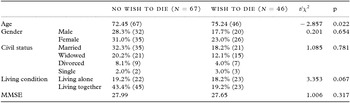
Descriptive statistics are presented in Table 1. The study included 52 males and 61 females. The mean age of the sample was 73.61 years (range 62–89 years). The mean age of the persons with a wish to die was three years higher than that of the persons without a wish to die. The overall mean score on MMSE was 27.85, without differences in mean scores between both groups. Half of the included persons (49.6%) were married.
Descriptives of the sample (n = 113)

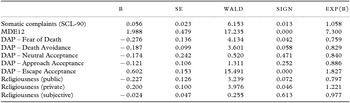
Univariate logistic regression analyses indicated that the variables somatic symptoms, MDE, religiousness (private), Escape Acceptance, and Fear of Death were significant predictors of the wish to die (Table 2). Higher scores on the religiousness and the Escape Acceptance were associated with a higher risk of the wish to die, whereas lower scores on the Fear of Death were associated with a higher probability of the wish to die.
Univariate logistic regression analyses with the wish to die as an dependent variable and religiousness and death attitudes as independent variables

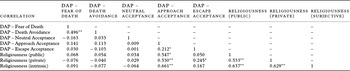
Both analysis of variance inflation factors (VIF) and inspection of the correlation matrix of independent variables (Table 3) suggested high associations between the measures of religiousness. The largest VIF was 2.705 (DUREL-subjective dimension) and the highest inter-correlation was found between the measures of religiousness (i.e. r > 0.50). Therefore, we opted to include only one measure of the DUREL-private dimension (based on the univariate regression analyses). The inter-correlation between the Fear of Death and the Death Avoidance is high (i.e. 0.496).
Correlation matrix of independent variables

Notes: *Correlation is significant at the 0.05 level.
**Correlation is significant at the 0.01 level.
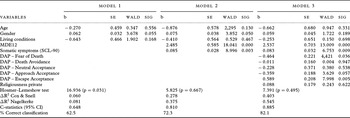
The results of the first stage of the multivariate hierarchical regression analysis are reported in Table 4 under “Model 1.” The socio-demographic variables, age, gender, and living conditions, accounted for about 9% of the observed pseudovariance. When MDE and somatic symptoms were added in Model 2, the explained pseudovariance increased to 38%. The R2 further increased to 55% when death attitudes and religiousness were entered in Model 3. The final multivariate model showed a good fit (Hosmer–Lemeshow test, p > 0.05), and an overall classification accuracy of 82.1% was obtained. The c-statistic of the multivariate model was high (c = 0.89), suggesting an excellent discriminative ability of the final model. Both religiousness and death attitudes were associated with a wish to die in univariate models. By adding them in the logistic hierarchical model, death attitudes were significant predictors but religiousness was not. MDE, somatic symptoms, the Fear of Death, and the Escape Acceptance were the most important predictors of the wish to die. Of all significant predictors in the final model, only the association between the Fear of Death and the wish to die showed an inverse relationship (b = −0464).
Hierarchical multivariate regression analysis predicting the wish to die

Discussion
The current study was the first one to examine the relationship between death attitudes, religiousness, and the wish to die in older inpatients. By adding death attitudes and religion in a predictive model, over-and-above common predictors (such as depressive episodes or somatic symptoms) explained 55% of the variance of the wish to die with an effect size of 0.89.
Death attitudes, Escape Acceptance and Fear of Death in particular predicted the wish to die in older patients, even after controlling for somatic symptoms and depression. First, a high score on the Escape Acceptance was associated with an elevated risk for a wish to die. This Escape Acceptance reflects an attitude of death as an escape from the present life: a wish to be dead can therefore be considered as a wish for an alternative to a dreadful existence. In spite of the fact that Escape Acceptance is considered as a “positive death attitude,” it might be more appropriate to interpret it in the context of death ideation and suicidality as a “negative life attitude.” Interestingly, such an interpretation is congruent with earlier reported motives by older persons who attempted complete suicide, namely the wish to escape from an intolerable situation or to gain relief from an unbearable state of mind (Dennis et al., Reference Dennis, Wakefield, Molloy, Andrews and Friedman2007). The wish to die may be interpreted as a wish to terminate the present life (Bonnewyn et al., Reference Bonnewyn2014). Older people often report their current life situation as being unacceptable, feeling they had no control over their situation and progressively “gave up” trying (Rurup et al., Reference Rurup2011b). Other components of a positive death attitude, death acceptance (similar to the perception of death as a gateway to an afterlife: Approach Acceptance or Neutral Acceptance), were not associated with a wish to die. In contrast with Escape Acceptance, these components bear less on the perceived quality of the present life and therefore might be less relevant in the development of a wish to die in later life. Second, a wish to die was negatively determined by Fear of Death: older persons with lower Fear of Death were more likely to have a wish to die, which is congruent with the results of previous studies. Fear of death and fear of killing oneself were found to be important deterrents of suicide ideation in depressed older adults (Britton et al., Reference Britton2008), and non-depressed suicidal Chinese older men reported fear of death as a reason for continuing to live (Tsai et al., Reference Tsai, Wong, Ku and Liu2012). In a study determining the acceptability of a full range of end-of-life decision options in later life, fear of death contributed significantly to the decision process, beyond the effect of demographic or health variables (Cicirelli, Reference Cicirelli1997). While fear of death in literature on death attitudes is considered as a “negative death attitude,” the disappearance of Fear of Death might be interpreted as a possible alert signal, specifically in older depressed persons with a somatic vulnerability.
We also found that “private” religiousness (participation in private religious activities) was associated with a wish to die in the univariate analysis, but not in the multivariate analyses. Lack of a unique contribution of religiousness in the multivariate analysis might be due to an overlap between the different dimensions of religiousness included in our study and Approach Acceptance (inter-correlations between 0.530 and 0.661), which is compatible with previous findings in studies with adults (Dezutter et al., Reference Dezutter, Luyckx, Bussing and Hutsebaut2009), with chronically ill older adults (Daaleman and Dobbs, Reference Daaleman and Dobbs2010), and older hospice patients (Neimeyer et al., 2011). In other words, different dimension of religiousness are closely related to death attitudes of older persons (Daaleman and Dobbs, Reference Daaleman and Dobbs2010) and seem to have an impact on the wish to die in older persons. The non-significant bivariate association between religious attendance and the wish to die might be explained by the assumption of lower public religious activities, given that the participants were inpatients. Presence of depressive symptoms was found to affect these relationships as well, but since the present study was cross-sectional in nature, longitudinal research is needed to further investigate the unique and interacting contribution of these factors on the presence of the wish to die.
In line with previous research, depressive disorder was the most important predictor of death ideation in older inpatients (Rurup et al., Reference Rurup, Deeg, Poppelaars, Kerkhof and Onwuteaka-Philipsen2011a). The report of somatic symptoms was associated with the wish to die and is congruent with a robust association between suicide and the presence of a somatic illness (Juurlink et al., Reference Juurlink, Herrmann, Szalai, Kopp and Redelmeier2004). A meta-analysis in older adults showed a positive correlation between the presence of a non-life threatening illness, physical disability on the one hand and fear of death on the other hand (Hundsdoerfer and Wink, Reference Hundsdoerfer and Wink2005). We could not confirm this pattern as we found that both higher levels of physical symptoms and depression and lower Fear of Death were predictive for a wish to die. This might be due to the multivariate character of the analysis, whereby the interaction between physical symptoms, depression, and fear of death has an effect on the wish to die. It is plausible that a wish to die as an escape from the present life occurs when the root of the distress is something other than fear of death. Moreover, high fear of death might function as a threshold to develop a wish to die in older adults exposed to risk factors such as somatic symptoms and depression. In our study sample, which was characterized by high levels of depression and somatic symptoms, a wish to die might have already been developed, explaining the lower levels of Fear of Death. Future longitudinal research is needed to further disentangle the impact of these factors on the presence of the wish to die.
The present study has several limitations. First, the sample size is limited; results must be replicated in larger samples. Second, due to the limited heterogeneity of the dependent variable and to the limited sample size, we were forced to reform the dependent variable into a binary variable, implying that information on suicidal ideation and behaviors was not incorporated in the study. It would therefore be relevant to include different levels of the suicidal spectrum as dependent variables in future research designs. Third, the choice to limit the data to older inpatients means that results might not be generalizable to home-dwelling older adults reporting lower rates of depressive symptoms.
Clinical implications
Since the wish to die in older inpatients is associated with particular death attitudes, it is relevant to explore how death is perceived because Fear of Death or death perceived as an Escape Acceptance have an additional predictive power in the presence of a wish to die in older adults. Besides religiousness (Neimeyer et al., 2011), death attitudes may be considered as relevant in the broader context of dealing with salience of death in later life. It is relevant to note that an elevated level of Escape Acceptance and a reduced level of Fear of Death in older depressed persons could be interpreted as a significant correlate of the wish to die. There may be a clinical patient-oriented benefit in asking older depressed patients about how death is perceived as this might play a role in the early detection (and prevention) of death or suicide ideation and associated behaviors in older adults.
Conflict of interest
None.
Description of authors’ roles
A. Bonnewyn, R. Bruffaerts, K. Demyttenaere, and A. Shah designed the study. A. Bonnewyn collected the data, K. Demyttenaere supervised the data collection. A. Bonnewyn and R. Bruffaerts were responsible for the statistical design and statistical analyses. A. Bonnewyn wrote the paper with the assistance of R. Bruffaerts, A. Shah, and K. Demyttenaere.
Acknowledgments
The authors wish to thank the UPC KU Leuven, Campus Kortenberg, St Goedele; Psychiatrische Kliniek Broeders Alexianen Tienen (Ter Linden), and M.C. St.-Jozef Munsterbilzen, Old Age Psychiatry, AZ Vesalius Tongeren.
This study was funded by an unrestricted educational grant by Eli Lilly Belgium. The funding source had no role in the study design, collection, analysis, and interpretation of results, in the writing of the report, or in the decision to submit the paper for publication.