SWINDON
(1) Foxbridge, Wanborough Road (SU 1982 8447): an evaluation saw 31 trial trenches located in the northern half of a proposed mixed development area.Footnote 116 Five trenches were targeted on geophysical anomalies interpreted as the continuation of Durocornovium Roman small town, a scheduled ancient monument located to the north of the site.Footnote 117 The remains comprised rectilinear enclosures, pits and post-holes but no in situ structural remains were identified. The activity was contained within a 50 m wide strip that runs parallel to the Wanborough Road, which forms the eastern site boundary, and is delimited to the west by a large enclosure ditch.
The finds assemblage comprises 396 sherds of Roman pottery, ceramic building material, glass and metal objects, worked flint, animal bone and stone. The assemblage suggests the activity within the site occurred predominantly in the middle Roman period with none of the contexts dated to earlier than the second century a.d. However, the pottery assemblage does contain sherds dating to the late Roman period, suggesting activity within the site continued into the fourth and early fifth centuries. This is supported by the metal-work assemblage which includes six late Roman coins. Although no in situ building remains were present, several fragments of roof tile and unworked limestone were recovered and suggest the presence of structures within the vicinity. Similarly, the recovery of metal-working slag suggests industrial activities occurred within the area, but no evidence was recorded within the trenches.Footnote 118
HAMPSHIRE
(1) Brockenhurst, New Copse Inclosure (SU 3200 0250): excavation continued in 2021 on the site investigated in 2019.Footnote 119 The simple rectangular building explored in 2018/2019 was found to consist of two rooms, one tessellated and the other with an earth floor, separated by a beam-slot. The outer wall was also of wood, which had partly survived as a charred timber. Another trench nearby revealed a short section of ditch filled with charcoal and other debris of first- to second-century date, including animal bone. The presence of bone was unusual for the acidic soil conditions prevailing in the New Forest, and the predominance of ovicaprid bones may indicate an aspect of the animal economy that has so far been missing from our knowledge of the Roman period in the region.Footnote 120
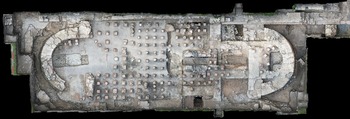
(2) Silchester (Calleva Atrebatum), Insula XXXIII (SU 6430 6240): excavation and re-excavation continued on the site of the town baths.Footnote 121 As well as continuing work on the previously unexcavated deposits in the south-east corner of the palaestra, outside the eastern wall of the baths and outside the west wall of the ‘tepidarium’ excavated in 2019, the adjacent section of the ‘caldarium’ was re-opened (fig. 44). This revealed further traces of the foundations of the first bath-house, the remains of a praefurnium at its eastern end and support for a possible hot-water bath. This, the southernmost section of the first bath-house, probably served as its caldarium. Butted against its foundations on its east side was further evidence of the brick-built structure previously reported as a stand-alone structure below the very late hypocaust re-excavated in 2018.Footnote 122 At this point it was built on piles of alder, but there were also the beams of an earlier oak frame. The brick structure was traced as a rectangular exedra around the east end of the ‘caldarium’, matched by a newly discovered western equivalent, and further, to the southernmost section of the bath-house. This structure can now be seen as part of the second bath-house, for which a coin of Trajan, dated a.d. 104–114, and a sherd of decorated Central Gaulish samian, c. a.d. 100–125, provide an early second-century terminus post quem. A major rebuild, probably of the early third century, saw the rebuilding of what had been the caldarium of the first bath-house as the tepidarium of the second with apses at each end. This work also embraced the southernmost section of the bath-house. Further alterations in the late Roman period, including the installation of a furnace inside the ‘caldarium’ to heat the eastern end and similar to the arrangement discovered in the ‘tepidarium’ in 2019, point to the breakdown of the integrity of the building.Footnote 123
Silchester: Insula XXXIII town baths. Aerial view of ‘caldarium’. (© University of Reading)

DORSET
(1) Dorset AONB, Dorset VIP (Visual Impact Provision) (SY 60454 91930 to SY 64056 84492): a programme of archaeological assessment and evaluation took place c 3.5 km to the west of Maiden Castle from Winterbourne Abbas on the A35 running south to Friar Whaddon, some 5 km north-west of Weymouth.Footnote 124 In addition to a number of prehistoric monuments and features, the investigations recorded a small Roman settlement located on the South Dorset Ridgeway. The site comprised small enclosures of late Roman date, with a corn-dryer and several millstones indicating crop processing. Eight rectangular stone-built structures were recorded terraced into the hillside; these had limited evidence of floor surfaces, and the absence of ceramic roof-tiles suggests thatched roofs. Two additional crop-drying or malting ovens were also identified, with a further large malting oven exposed on the exterior edge of one of the buildings. The recovery of 41 inhumation burials provides evidence of the inhabitants of the settlement. The burials encompass all age ranges from neonates to adults, and artefacts recovered from burials include complete pottery vessels, a bead bracelet (glass, metal and shale) and a number of hobnailed shoes. The neonates and juveniles were predominantly buried in stone-lined cists, or at least under a capping stone, while the adults were mostly within coffins. Pottery from the graves has been dated to the early Roman period and possibly of Durotrigian origin, perhaps suggesting that the settlement covered a broader period than previously thought. During the evaluation works seven inhumation burials were recorded and a further 129 inhumations and five cremations were identified during the main excavation works. One of the burials recovered during the evaluation produced a radiocarbon date of cal. a.d. 660–770. Further radiocarbon dating will be required to establish the longevity of the cemetery, but this number of individuals suggests a relatively sizeable population in the area during this period. Saxon migration into West Dorset is not thought to have occurred until the mid- to late seventh century, meaning our individuals could be some of the final post-Roman occupants of the area or some of the earliest Saxons.Footnote 125
(2) Hinton St Mary (ST 786162): an evaluation took place at the scheduled site of the Hinton St Mary Roman villa (National Heritage List entry 1002433). The villa had previously produced a number of tessellated pavements, including one of Christ with a Chi-Rho symbol now housed at the British Museum.Footnote 126 The trenches revealed that, although the room containing the Christ mosaic was probably part of a larger masonry building, there was no evidence that this was a Romano-British courtyard ‘villa’ as previously proposed.Footnote 127 Other buildings in the mosaic's immediate vicinity were confirmed as Romano-British, but these were relatively unsophisticated and were more likely to have had agricultural functions. There was very little evidence for occupation prior to a.d. 300 and the site seems to have been occupied until the end of the fourth or into the early fifth century.Footnote 128 Initial post-excavation work has been completed, the results of which are available.Footnote 129
SUPPLEMENTARY MATERIAL
For supplementary material for this article please visit https://doi.org/10.1017/S0068113X22000460