INTRODUCTION
Evidence is growing that negative consequences of cancer and antineoplastic treatment can include a reduction in or termination of physical activity (PA). For some cancer patients, the disease and treatment can result in long-term stress that complicates their acquiring or sustaining an active lifestyle and positive well-being (Courneya & Friedenreich, 1999b; Schwartz, 2004) and leaves them in a sedentary state risking lifestyle disorders such as Type 2 diabetes, high blood pressure, and long-term psychological distress.
Exercise is becoming an important component of cancer rehabilitation programs. Recent reviews summarize the findings of research conducted in this field over the past decade (Lucia et al., 2003; Drake et al., 2004; Galvão & Newton, 2005). A number of PA interventions have involved cancer patients undergoing cytostatic treatment (Winningham & MacVicar, 1988; Dimeo et al., 1999, 2003; Segal et al., 2001; Coleman et al., 2003). A consistent finding is that patients who participate in PA interventions experience improved physical fitness (Winningham & MacVicar, 1988; MacVicar et al., 1989; Durak & Lilly, 1998; Dimeo et al., 2003; Galvão & Newton, 2005) and reduced fatigue (Dimeo, 2001; Schwartz et al., 2001; Lucia et al., 2003). However, sustainability of an exercise regime will be essential in preserving the benefits of exercise over the course of cancer survivorship (Courneya et al., 2004b). So far, only one other prospective study in the field of cancer (Courneya et al., 2004b) has been conducted with the purpose of evaluating sustained PA (adherence) following an exercise program.
“Body & Cancer” is a multidisciplinary research project designed to determine the effects of a 6-week, supervised, multidimensional exercise program in a heterogeneous group of cancer patients undergoing chemotherapy. The outcomes, which include immediate effects on physical capacity, fatigue, health-related quality of life, and psychological distress, have previously been reported (Adamsen et al., 2003, 2004, 2005; Midtgaard et al., 2005, 2006). We planned at the start of the Body & Cancer Project to carry out 1- and 3-month follow-up analyses with the purpose of evaluating short-term effects in regard to the selected outcomes. The primary aim of the present study was to examine to what extent cancer patients undergoing chemotherapy adhered to PA after termination of the 6-week program. The primary outcomes were postprogram levels of and changes in self-reported PA level. A secondary aim was to examine any associations and/or determinants of postprogram exercise that could have had an impact on patients' sustained PA level.
METHODOLOGY
The methods and intervention used in the Body & Cancer Project have been described elsewhere (Adamsen et al., 2003, 2005) and are briefly summarized below.
Design
The study's design was a prospective, follow-up study using a one-group design. Assessment was carried out after 6 weeks (at completion of the program) and repeated 1 month postprogram and 3 months postprogram. For the purpose of gaining a more complete and contextualized description of sustained PA level, quantitative data were supplemented by qualitative data in the form of patients' subjective statements (i.e., data triangulation; Polit & Beck 2004, p. 431). The study was carried out with the approval of the Danish Ethics Committee (#01-273/00).
Procedure
The patients in the present study are included in the overall Body & Cancer study population (Adamsen et al., 2003, 2005). Recruitment of patients was based on self-referral. Patients were informed about the project by means of posters and pamphlets made available to them in the outpatient clinic or in the wards of the Haematology and Oncology Departments (Rigshospitalet, Copenhagen University Hospital, Copenhagen, Denmark). Patients who met the following inclusion criteria were eligible to participate: men and women between 18 and 65 years of age who were diagnosed with a malignant disease and who were undergoing cytostatic treatment and had a WHO performance status of 0 or 1. Subjects were enrolled in the program a minimum of 1 month after they had received their cancer diagnosis and after they had undergone at least one cycle of chemotherapy. Patients in terminal care or with brain or bone metastases or in anticoagulation treatment or with cardiac diseases that would preclude exercise were not entered in the study (Adamsen et al., 2003).
The exercise intervention was a 6-week, 9-h weekly, supervised, group-based, multidimensional exercise program that combined high-intensity exercise training (heavy resistance training and cardiovascular training on stationary bicycles) with three additional low-intensity training components: relaxation, body awareness training, and massage. In total, the high-intensity activities corresponded to 33 MET-hours per week. The program was carried out in the hospital, in a group setting, 9 hours weekly, over a 6-week period. (For a more detailed description of the program, see Adamsen et al., 2003.)
Measures
Leisure Time PA level
Postprogram PA level was assessed by semistructured interviews including both quantitative and qualitative data. The interviews were conducted on-site at completion of the program, whereas the follow-up interviews were conducted by telephone at 1 and 3 months postprogram (10 and 18 weeks postbaseline). Interviews, which also included questions about the patients' feeling of fatigue (data published elsewhere), lasted for an average of 15–45 min and were taped and transcribed verbatim.
To quantitatively assess the level of PA we used the assessment methodology for leisure time PA, developed by Saltin and Grimby (1968). Patients were asked to classify themselves as either (I) sedentary (completely inactive; e.g., primarily watching television, reading books, or performing other passive activities); (II) walking, cycling for pleasure or performing other forms of low to moderate exercise (unstructured, unsupervised, irregular exercise; e.g., dog walking, gardening, golf); (III) moderate- to high-intensity PA at least 3 h/week (e.g., tennis, swimming); or as (IV) “athletic” (high-intensity exercise at least 4 h/week; e.g., running, high-impact aerobic). Form, intensity, and to a certain extent duration are measured but not frequency (Aadahl & Jørgensen, 2003; Jørgensen & Rosenlund, 2005).
The quantitative assessment of PA was supplemented by qualitative, open-ended questions regarding factors that influence the subjects' current exercise habits. Interviewees were requested to substantiate their responses by providing concrete examples. These qualitative statements were categorized in relation to whether subjects had sustained, reduced, or increased their leisure time PA level. In this presentation, quotations were selected that best illustrated trends found in the statistical material and that could offer insight into factors that facilitated or hindered postprogram leisure time PA level respectively.
Psychological Distress (The Hospital Anxiety and Depression Scale—HADS)
Anxiety and depression were assessed by use of The Hospital Anxiety and Depression Scale (HADS; Zigmond & Snaith, 1983), which was found to be a useful tool as it excludes symptoms that may have both emotional and physical aetiologies, for example, loss of appetite or sleep disturbance. The HADS consists of 14 items—seven related to anxiety and seven linked to depression—and can be divided into two subscales. Subjects were asked to respond to these items by indicating how well they applied to their respective emotional states over the past week. Subjects chose between four options (0–3), with higher values indicating more distress. Item scores were summed to total scores for each of the subscales.
Medical and Demographic Characteristics
Patients' medical records provided information about disease characteristics, including diagnosis, previous and current treatment regimen, and cancer stage.
Statistical Analysis
Data were entered into Excel using Microsoft Office 2000 Professional for Windows 2000. Statistical analyses were carried out using SAS for Windows (Version 6.2). Independence between postprogram PA and age, gender, marital status, program adherence/attendance, pre-illness PA behavior, treatment, illness status (baseline), and postprogram changes in anxiety and depression were analyzed using a chi-square statistic for ordered classifications. Correlation between variables was calculated by treating the measurement scale as an interval scale (Agresti, 2002, p. 87). To analyze changes in the same factor across time, chi-square tests for marginal homogeneity were carried out. A p value of .05 was set to indicate statistical significance.
RESULTS
Study Population
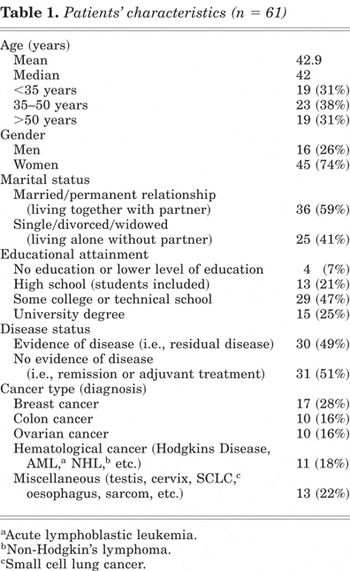
The study included a total of 85 patients enrolled in the intervention between April 2001 and December 2002. Six patients dropped out of the study due to work or transportation problems and 3 patients' data were removed from the data set because their chemotherapy treatments were discontinued prior to completion of the program. Out of the remaining population of 76 patients, 15 patients completed the program but failed to provide all necessary postprogram tests, diminishing the population size to 61 patients (response rate 80%). The demographic characteristics of the patients (n = 61) are detailed in Table 1.
Patients' characteristics (n = 61)

Postprogram Leisure Time PA Level
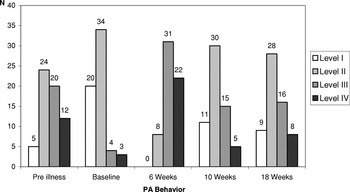
Not all patients were able to participate in the entire program due to periods of anxiety, infections, hospital admittance, and so forth, which resulted in eight patients (13%) being rated at activity level II (i.e., walk/cycling for pleasure or perform other passive activities) by the end of the intervention. The remaining patients were classified as follows: 51% at level III and 36% at level IV. At the 1-month follow-up, 11 of the patients regressed to level I (sedentary) and only 20 patients (33%) stated that they exercised for at least 3 h per week (levels III and IV). This classification process was repeated at the 3-month follow-up and showed a slight improvement in the overall picture with two patients less in level I and four patients more in level III and IV. Figure 1 shows the distribution of patients across the different PA levels.

Distribution of leisure time PA from pre-illness to 18 weeks follow-up (n = 61).
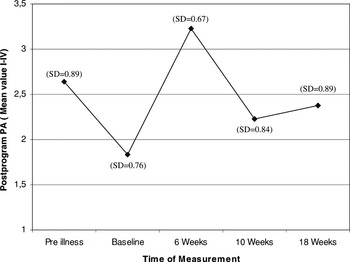
χ2 analyses indicated a significant reduction in physical activity levels during the first month following the intervention (χ2 = 64.2152, df = 3, p < .0001). The same negative trend is seen again after 3 months (χ2 = 53.0978, df = 3, p < .0001). The patients did, however, become significantly more active after 3 months compared to 1 month after the intervention (χ2 = 46.3008, df = 3, p < .0001). Patients reported being more active at weeks 10–18 versus baseline testing on entrance to the program (1-month follow-up: χ2 = 55.295, df = 3, p < .0001; 3-month follow-up: χ2 = 57.5416, df = 3, p < .0001). Figure 2 shows the change in leisure time PA level mean score from pre-illness to the 3-month follow-up.

Mean changes in postprogram leisure time PA level (n = 61).
Determinants of Postprogram Leisure Time PA Level
Treatment
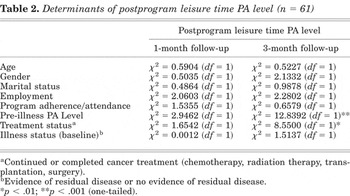
One month following the intervention (10-week test) 35 patients (57%) continued chemotherapy treatment, 8 (13%) had started radiation therapy and 18 patients (30%) had completed their treatments. In the group continuing treatment, 20% were at activity level III or IV. Nineteen percent were sedentary (level I), and 53% stated that they walked and cycled for pleasure (level II). There was no difference in physical activity level between the group of patients who were still receiving treatment (chemotherapy and radiation therapy) and the group who had finished their treatment (χ2 = 1.6542, df = 1, p = .1984). After three months (18-week test) 56% had completed their treatment, 16 (26%) continued chemotherapy, 11 (18%) were receiving radiation therapy, and 3 (5%) awaited surgery or bone marrow transplantation. The patients who continued their treatment (44%) (i.e., chemotherapy and/or radiation therapy) had a significantly lower leisure time PA level compared with those patients who had finished their treatment (χ2 = 8.5500, df = 1, p = .0035). Twenty-four percent of the patients who had completed treatment for cancer at the 3-month follow-up had intensified their leisure time PA to more than 4 hours weekly contrary to the group that continued treatment in which none of the patients progressed, that is, 72% declared their physical activity to be at level I (19%) or II (53%).
(1-month follow-up) “The radiation has steered me completely off course. I have actually regressed a little. I don't have any energy. I am tired and that seems to affect everything. And now I am told that I will not be allowed to use the swimming pool as long as I am in radiation therapy. I don't know how I will be able to motivate myself to exercise again.” (Woman, 50 years of age, breast cancer, completed chemotherapy, at start of radiation therapy; PA level: pre-illness: II, baseline: I, Week 6: IV, Week 10: II, Week 18: III)
(3-month follow-up) “I miss the project. Mostly, I miss moving around and being challenged. I also miss the others—the fun and deviation that the program created. There was a sense of security and legitimacy about it all without having to give explanations. I have not yet reached that point where I feel comfortable about being seen in a changing room without my wig. I won't be brave enough to do that until my appearance no longer draws everyone's attention.” (Woman, 41 years old, breast cancer, continuing with chemotherapy; PA level: pre-illness: II, baseline: I, Week 6: IV, Week 10: II, Week 18: II)
Pre-Illness Leisure Time PA Level
One month following the intervention, a trend became apparent that those patients claiming a low leisure time PA level pre-illness showed a corresponding lower physical activity level 1 month postprogram. Correspondingly, those patients who were active pre-illness became the most active of all of the participants 1 month postprogram (χ2 = 2.9462, df = 1, p = .0861). This trend was confirmed at the 3-month follow-up with a now clearly significant correlation (χ2 = 12.8392, df = 1, p = .0003). None of the 29 patients classified at levels I or II pre-illness increased their physical activity levels during weeks 6–10 or at 18 weeks. Among the most active patients pre-illness, there were four who increased their activity levels during weeks 6–18. Seen from the perspective of PA behavior the results show that those patients who had a sedentary status or who were moderately active pre-illness regressed more during weeks 6–18 when compared with the group that was active pre-illness (χ2 = 5.1594, df = 1, p = .0231). As illustrated in Table 2, we found no association between the adherence rate (understood as the patient's attendance and participation in the program), gender, age, civil status, employment, or disease status (evidence vs. no evidence of disease) and leisure time PA level at weeks 10 and 18.
Determinants of postprogram leisure time PA level (n = 61)

(3-month follow-up) “I have started to play handball again (3 times weekly). The project allowed me to become a whole person again and not just a ‘case’—I began to raise expectations of myself. That filled me with energy. I have made changes to the way I structure my daily life now. I accept doing more things but I have also become better in choosing what I do. I have the courage and desire to get going again. I pay close attention to ensuring that my body does not become feeble like it was before. I will not let my body or myself deteriorate any longer.” (Man, 42 years old, colon cancer, completed chemotherapy; PA level: pre-illness: IV, baseline: II, Week 6: IV, Week 10: III, Week 18: IV)
Psychological Distress
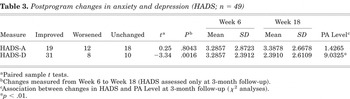
Forty-nine patients completed the HADS at the 3-month follow-up (response rate 64%). Paired sample t tests indicated an insignificant change in anxiety, t(48) = 0.25, p = .8043, and a significant decrease in depression, t(48) = −3.34, p = .0016. The mean ± SD of the change was 0.10 ± 2.87 for the HADS-A and −0.89 ± 1.87 for the HADS-D (see Table 3). We divided the sample into three groups based on whether the subjects had improved, unchanged, or worsened pre- to posttest levels of anxiety and depression scores. The results of this division show that leisure time PA level was associated with improvements in depression (χ2 = 9.0325, df = 1, p = .0027)[dk1], but not with improvements in anxiety (χ2 = 1.5761, df = 1, p = .2093). Five of the nine inactive (level I) patients claimed to feel more depressed (HADS-D) whereas 17 out of the 22 most active participants (level III + IV) stated that they felt better.
Postprogram changes in anxiety and depression (HADS; n = 49)

(3-month follow-up) “It was exciting for me to discover that I could suppress my illness while training. I miss the others a lot today. I feel much worse now that the program is over. At the moment I find myself lying down most of the time and suffering. I have continuous pain and I am not up for any socialization. I have been burnt by the radiation in the throat area and have not been able to eat now for 14 days; so I have truly regressed both physically and mentally.” (Woman, 52 years old, SCLC/lung cancer, starting radiation therapy; PA level: pre-illness: II, baseline: I, Week 6: III, Week 10: I, Week 18: I)
(3-month follow-up) “I feel incredibly happy when I exercise. I can see improvements in my body and this gives me motivation to set new goals for myself. The project forced me out of a sense of helplessness and it has been priceless for me to find out that I can do more than I ever thought possible. Exercise has become a holy ritual for me. Some days it may just amount to taking a walk, but it helps to put structure into my daily life.” (Woman, 29 years old, Hodgkin's disease, completed chemotherapy, starting radiation therapy; PA level: pre-illness: II, baseline: II, Week 6: IV, Week 10: IV, Week 18: III)
DISCUSSION
The results of this study suggest that cancer patients undergoing chemotherapy experience a significant drop in leisure time PA level after completing a supervised, multidimensional exercise program. Only 16 out of the 61 (26%) patients were able to sustain (n = 13) or increase (n = 3) their physical activity levels 1–3 months postprogram. Thirty-three (54%) patients maintained an accelerated activity level compared with when they entered the program (baseline).
We found only one other study (Courneya et al., 2004b) that investigated postprogram exercise sustainability in cancer patients. Courneya et al. measured postprogram exercise (frequency and duration) at 5 weeks after the exercise component of the intervention was completed. In contrast to this study, the Courneya et al. study showed no significant decline from program PA levels to postprogram PA in frequency or duration of exercise. Due to the differences in intensity (65%–75% vs. 85%–95% of estimated heart rate maximum), content (walking and flexing exercises vs. combined resistance and cardiovascular training), setting (home-based, unsupervised individual training vs. supervised, on-site, group-based activities), program length (10 weeks vs. 6 weeks), measures of self-reported PA (Godin Leisure-Time Exercise Questionnaire vs. Saltin & Grimby classification); and difference in the length of the follow-up period (5 weeks vs. 1–3 months), the study is not directly comparable with the present study. However the difference in findings between the two studies indicate that postprogram exercise sustainability might be easier for cancer patients if they were exposed to a single activity that can be achieved independent of time and place instead of (as is the case in the present study) being part of a supervised, highly structured, and highly intense exercise program that combines different forms of training (strength building and aerobic training). It is likely that the sudden absence of structure, familiar surroundings, and socialization following a 6-week program negatively affected the sustainability of exercise levels. Compared to most home-based exercise programs (based on self-management), the organization and content of program offered in the Body & Cancer Project is less transferable to the patients' home and community setting.
Thus, the results of this study contribute to the debate of home-based versus supervised exercise interventions (Schwartz, 2000, 2004). One argument for unsupervised, home-based programs is that these are less expensive than supervised programs and that they do not require participants to attend class, thereby overcoming transportation and scheduling barriers. Pinto et al. (2005) documented that intensive, on-site interventions are not required to increase PA among early stage breast cancer survivors who completed treatment. It seems plausible in this study that chemotherapy and/or radiation therapy could pose substantial barriers to postprogram exercise adherence and would have been best alleviated by introducing ongoing, supervised programs. In addition, altered appearances (e.g., wigs, prostheses, surgical scars)—as illustrated in one of the above-mentioned citations—was an overlooked barrier in the explanation of negative influences caused by cancer to exercise response. Another important factor is the group setting. We recently analyzed data on group cohesion and quality of life (Midtgaard et al., 2006), which showed that being a member of a training group and providing and receiving social support from other cancer patients intensifies and reinforces the individual's attendance and physical performance during the program (Midtgaard et al., 2005).
The study confirms earlier findings documenting that cancer treatment (i.e., chemotherapy, radiation, bone-marrow transplantation, and/or surgery) is an essential impacting factor on PA level. Two studies (Courneya & Friedenreich, 1997a, 1999b) found that only 37% of patients with colon cancer (Courneya & Friedenreich, 1999a) and 28% of those with breast cancer (Courneya & Friedenreich, 1999b) exercised regularly during treatment.
In a retrospective study by Young-McCaughan and Sexton (1991), the authors observed that women who previously exercised perceived fewer barriers to continuing exercise. This point was confirmed in the present study where inactivity pre-illness was associated with a drop in postprogram leisure time PA level. Thus, it appears that the individual's habitual PA level is of major importance to his/her PA level during illness and exercise habits acquired through a supervised exercise program. In contrast, there are examples in the study's data of patients who were sedentary pre-illness and who, during the program, became aware of the benefits of exercise, and the qualities of exercise as a coping strategy, and were inspired to break with their sedentary lifestyle. Out of the five patients who claimed to have had sedentary lifestyles (level I) pre-illness, one increased his physical activity level to level III, two advanced to level II, and two patients remained sedentary. As such, the results of this study are in line with existing studies on leisure time PA level in cancer patients developed on the basis of Social Cognitive Theory (Bandura, 1997) including the Theory of Planned Behaviour (Ajzen, 1985, 1991), and the Transtheoretical Model (Prochaska & DiClemente, 1983), which shows that the cancer patient's response to PA is dependent of earlier experiences with exercise, experience with self control and subjective norms, and to a lesser degree demographic (e.g., gender) and/or medical variables (e.g., illness status; Blanchard et al., 2002; Courneya et al., 2004a; Pinto et al., 2005). However a surprising finding in this study was that program exercise adherence rates did not predict postprogram exercise response. This contradicts the broadly accepted view that encouraging adherence during an exercise program is one of the best ways to ensure adherence following an exercise program (Courneya et al., 2004b).
Despite the large variations in content, intensity, duration, frequency, and organization, studies in the field of cancer show exercise adherence rates of 60%–80% achieved over periods of time ranging from 6 weeks to 6 months in both home-based and supervised exercise programs (Courneya et al., 2004a; Schwartz, 2004). In comparison, exercise adherence rates in studies of healthy individuals are consistently about 50% (Dishman, 1990). In the present study, the patients' exercise adherence rate during the program was 78%. Because the study included patients with extensive, progressive disease and who were receiving chemotherapy (57% at 1-month follow-up), their discontinuation of PA following the program is understandable.
Studies have documented an association between exercise level and quality of life (Courneya & Friedenreich, 1997b, 1999a; Pinto et al., 2002; Jones et al., 2004), and it is suggested that cancer patients exercise as much for psychological benefits as for physical health (Schwartz, 2004). In this study, we tested the hypothesis that postprogram PA level could also be characterized by postprogram changes in psychological distress. We found an association between postprogram changes in depression and leisure time PA level. It has not been possible, due to the single-group design of this study, to draw causal inferences between PA level and depression. However, the results indicate that, apart from its documented effect on fatigue and physical capacity (Galvão & Newton, 2005), motivating cancer patients and cancer survivors to exercise may reduce the risk of developing long-term psycho-morbidity. Potential mental health benefits may have prompted participation in vigorous exercise or vice versa. The results confirm findings in earlier studies that show an association between increase in aerobic capacity and a reduction in depression (Midtgaard et al., 2005).
Irrespective of the fact that cancer can be both a mentally and physically disabling illness, the period of cancer diagnosis and treatment can be seen as a resourceful time when individuals can decide to make permanent and health-promoting changes in their lives. In perspective, it can be argued that supervised exercise interventions should be offered to every patient as early as possible within the cancer care continuum to prevent physiological and psychological deterioration as well as to offer inspiration to break with pre-illness physical inactivity.
Methodological Considerations
There are several limitations that should be considered when interpreting the data of this study and when planning future research. For example, the PA level data, although taken from an objective source, were self-reported. It is debatable whether the questions asked of the study participants were representative of the accepted standard because they were not validated against an objective measure.
There are numerous ways and methods to assess and evaluate self-reported exercise behavior and physical activity in cancer populations, for example, the Godin leisure time exercise questionnaire (Godin & Shephard, 1985) employed by Courneya and collegues (e.g., Courneya et al., 2004b) and/or The Seven-Day Physical Activity Recall (Blair et al., 1985) employed by Pinto and colleagues (e.g., Pinto et al., 2005). The Saltin & Grimby (1968) method used in this study is the most frequently used in Danish health-related studies to assess leisure time PA level. It is considered an important critique that the method was able, only to a limited extent, to provide information on the intensity, type, and domains of physical activity. However the method has proven to be robust and independent of the context, and several large Danish prospective population studies have succeeded in estimating cardiovascular morbidity and mortality on the basis of its responses (Andersen et al., 2000).
We used a combined study approach (Denzin, 1989). Quantitative and qualitative data were collected concurrently, whereas the data analysis was sequential in that the analysis of quantitative data preceded and guided the analyses of the qualitative data (Malterud, 2001). The numerical and statistical representation was selected to seek explanation aimed at generalization and in-between study comparisons. The quotations were selected primarily to offer an insight into the patients' everyday life that could explain their motives for adopting/not adopting exercise in their daily routines. Thus the qualitative data can be said to have provided the context for the quantitative findings (Berman et al., 1998). The study indicates that both quantitative and qualitative research strategies are relevant and needed if future research is to capture the complexity of exercise adherence in cancer patients.
Study subjects were a convenient group/sample of highly self-motivated patients and therefore were not representative of all cancer patients undergoing chemotherapy. Participants served as their own “controls,” so efficacy data are not attainable. A randomized clinical controlled trial to evaluate both immediate and short-term effects of the program on physical capacity and quality of life in 250 cancer patients is currently being carried out. In addition, a larger questionnaire survey on leisure time PA level and attitudes toward exercise is being carried out among 500 Danish cancer patients undergoing chemotherapy (Copenhagen University Hospital). This survey aims to ascertain the extent to which the patients in the present study form a representative sample of the broader population of patients undergoing chemotherapy, and as such, to what degree the results of this study can be generalized.
CONCLUSION
Cancer patients who participated in the 6-week, 9-h weekly, structured, group-based, multidimensional exercise program while undergoing chemotherapy experienced a significant drop in exercise level at both 1-month and 3-month follow-ups. The postprogram exercise adherence was associated with the recorded pre-illness PA level, treatment status, and postprogram change in depression. Given the significant decrease in postprogram PA level, especially in subjects still undergoing cancer treatment, the study suggests that continuous supervised programs may be required in order to encourage and support exercise adherence in this population. However randomized clinical controlled trials and more follow-up studies are needed to establish the optimal program length and content for sustained exercise adherence in cancer patients.