Introduction
Infants’ ability to discriminate sound contrasts develops over the first two years of life, beginning with a fairly unrestrained ability to perceive differences in both native and non-native contrasts (Eimas, Siqueland, Jusczyk, & Vigorito, Reference Eimas, Siqueland, Jusczyk and Vigorito1971) to perceiving contrasts in their native language (Werker & Tees, Reference Werker and Tees1984). As this perceptual honing of native vowels around 6 months (Polka & Werker, Reference Polka and Werker1994) and native consonants around 10 months (Werker & Tees, Reference Werker and Tees1984) becomes more attuned, infants begin recognizing highly familiar words (Bergleson & Swingley, 2012), and by 12 months they are mapping novel labels to objects that conform to their native language phonology (Curtin, Reference Curtin2011; MacKenzie, Curtin, & Graham, Reference MacKenzie, Curtin and Graham2012). However, discrimination of speech sound contrasts is dependent not just on experience, but also on factors such as the position in the word of the contrast (Archer, Zamuner, Engel, Fais, & Curtin, Reference Archer, Zamuner, Engel, Fais and Curtin2016), and the salience of the contrast (Narayan, Werker, & Beddor, Reference Narayan, Werker and Beddor2010). Thus, while infants are increasing their knowledge of the sound system, and becoming better at discriminating native contrasts (Kuhl, Stevens, Hayashi, Deguchi, Kiritani, & Iverson, Reference Kuhl, Stevens, Hayashi, Deguchi, Kiritani and Iverson2006) in word beginnings, they still struggle with those contrasts that are not as perceptually robust, and those in less salient positions within a word. This pattern is also observed in the second year of life when infants are learning new word–object mappings.
The ability to form word–object associations by 12 months is limited by how distinctive the labels are from one another. For example, when presented with novel minimally contrastive word–object pairs (e.g., bih [bɪ] and dih [dɪ] or bin [bɪn] and din [dɪn] in Pater, Stager, & Werker, Reference Pater, Stager and Werker2004), 14-month-olds are unable to access place information. Results are similar with voice (pin [phɪn]–bin), and voice–place contrasts (pin–din) (Pater et al., Reference Pater, Stager and Werker2004). These findings are perplexing, given younger infants’ ability to discriminate these sound contrasts and learn words (Werker & Curtin, Reference Werker and Curtin2005). It has been proposed that when presented with minimally contrastive novel labels, infants have limited access to available resources (Stager & Werker, Reference Stager and Werker1997). This problem is overcome by simply accruing experience with language (around 17 months; Werker, Fennell, Corcoran, & Stager, Reference Werker, Fennell, Corcoran and Stager2002), but younger infants require additional information. For example, 14-month-olds can access minimal contrasts when provided with referential information (Fennell & Waxman, Reference Fennell and Waxman2010) or distributional information (Thiessen, Reference Thiessen2007), or when task demands are eased (Yoshida, Fennell, Werker, & Swingley, Reference Yoshida, Fennell and Swingley2009). To further understand challenges in word learning, we explore whether some minimal contrasts are salient enough due to their acoustic properties to be detected. Specifically, we ask whether acoustic properties of a sonorant contrast can ease the task of mapping minimally contrastive forms to novel objects.
In a novel word–object association task (i.e., Switch Task), novice word learners must identify the contrast between pairs, map the forms to objects, and retrieve this information. If a minimal contrast is acoustically salient, perhaps the contrast itself is enough to boost infants’ success in this task. Acoustic salience, in this context, can be defined as the acoustic factors that might contribute to increased perceptibility of the listener. Support for this comes from a handful of studies demonstrating that the acoustic properties of a minimal contrast influences whether infants can access the subtle phonetic detail. Curtin, Fennell, and Escudero (Reference Curtin, Fennell and Escudero2009) investigated whether infants would detect minimal vowel contrasts because vowels are acoustically salient sound segments containing their own formant structure. To test this, one group of 15-month-olds was habituated to word–object pairs using the minimal pairs deet [dit] and doot [dut] and another group to deet [dit] and dit [dɪt]. Infants exposed to the deet–dit contrast succeeded at detecting the mismatch. However, the infants exposed to deet–doot did not. These results were attributed to the acoustic differences between the vowels; 15-month olds respond to vowel height contrasts (a difference in F1) but not vowel backness contrasts (a difference in F2), suggesting that an F1 contrast is more salient to infants than a difference in F2 (Curtin et al., Reference Curtin, Fennell and Escudero2009). Indeed, there is more acoustic energy in F1 (Lacerda, Reference Lacerda1993, Reference Lacerda1994).
The position in which segments surface can also enhance the salience of a contrast. For example, when the minimal contrastive information is contained in a stressed medial syllable of a trisyllabic nonword (i.e., lebóna [lebóna], ledóna [ledóna]) 14-month-olds succeed at detecting the switch (Archer, Ference, & Curtin, Reference Archer, Ference and Curtin2014). This is not the case if the initial stressed syllable contains the contrast, as in bólena [bólena] and dólena [dólena]. Archer et al. (Reference Archer, Ference and Curtin2014) argue this is due to a difference in the locus of the second formant transition (F2), the primary source of place information for stops (Delattre, Liberman, & Cooper, Reference Delattre, Liberman and Cooper1955) where a larger difference is observed in the medial condition.
The acoustic properties of contrasts can impact infants’ ability to access this information when presented, at test, with a mismatched object–label pairing, suggesting that the task demands are reduced when the contrast is acoustically salient (Curtin et al., Reference Curtin, Fennell and Escudero2009; Archer et al., Reference Archer, Ference and Curtin2014). Though these studies demonstrate that acoustic enhancement increases infants’ ability to access a minimal contrast, it has yet to be demonstrated with consonants in word-initial position. This is surprising because word-initial position is arguably the most salient position (Wang & Seidl, Reference Wang and Seidl2015). It might be the case that word-initial position is salient in some tasks, such as discrimination (Zamuner, Reference Zamuner2006), but is outweighed by resource limitations when the task is more challenging (see Archer et al., Reference Archer, Ference and Curtin2014). Here, we explore salient minimal pairs using sonorant consonants in word onset position to determine whether a place of articulation contrast, based on differences in formant signatures, is more easily detected in a word learning task than the contrasts tested in previous studies.
The information that determines the place of articulation in stops, like /b/ or /d/, is housed within the first few milliseconds of the following vowel (formant transition). Shown in Figure 1a, bilabial stops, (/b/) are defined by the second and third formants (F2 and F3) rising into the vowel /ɪ/, while the locus of the formant transition in the coronal (/d/) is higher in frequency (Hz) and therefore remains unchanged as it enters the vowel. English liquids (/l/ and /r/) are sonorant, and rather than relying on a formant transition into the vowel as with stops, liquids have their own formant structures. That is, while F2 and F3 are still the primary indicators of each liquid, the formants which differentiate /l/ and /r/ are contained within the segment and longer in duration, thus providing more time for the changing structure to be detected. In this series of experiments, we explore whether infants detect a perceptually salient contrast in word-initial position (Experiment 1), and when it is the second member of an onset cluster (Experiment 2). Finally, we examine whether the duration of the formant pattern is important for distinguishing the contrast (Experiment 3). We predicted that the contrast between sonorant segments (i.e., liquids) will be perceptually salient to 14-month-olds and that they will therefore detect the mismatches in a newly presented word–object pairing.
(a) Example: Spectrogram (a): .053 sec window includes /b/ to beginning of vowel /ɪ/ (bin). Spectrogram (b): .061 sec window includes /d/ to beginning of vowel /ɪ/ (din). These examples illustrate the components of voiced stops in which place information (F2 and F3) is very short in duration, as compared to those in Figure 1b. Formants and formant transitions are highlighted. (b) Example: Spectrogram (a): .315 sec window includes /l/ to beginning of vowel /i/ (leet). Spectrogram (b): .225 sec window includes /r/ to beginning of vowel /i/ (reet). These examples illustrate the duration of the segment and place information (F2 and F3), as compared to those in Figure 1a. Arrows demonstrate duration of consonants /l/ and /r/. Formants and formant transitions are highlighted.

Experiment 1
Fourteen-month-olds were habituated to two novel word–object pairings in which the minimal contrast between the words was in the initial consonant. We predicted that infants would detect the mismatch in the Switch trial based on the acoustically salient contrast /l/ and /r/ (i.e., leet and reet).
Methods
Participants
Sixteen 14-month-old infants (M: 14.51, SD: 0.321; Range: 14.00–14.98) from monolingual English homes participated in this study. An additional 15 infants were tested but not included in the analysis (see ‘Appendix A’ for a detailed report). Our sample size was determined by using a stopping rule (16 infants who succeeded at completing the task) based on prior studies using the Switch Task (e.g., Fennell & Waxman, Reference Fennell and Waxman2010; MacKenzie et al., Reference MacKenzie, Curtin and Graham2012).
Stimuli
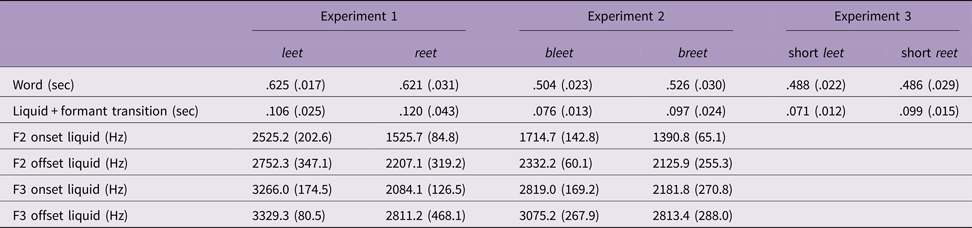
A female native speaker of English recorded the auditory stimuli consisting of two one-syllable words, leet [lit] and reet [rit], using infant-directed speech. Acoustic measurements of duration are presented in Table 1. Habituation and test trials contained 16 tokens of either leet or reet made up of 4 unique tokens semi-randomized within blocks. Each trial was 22 seconds long with an interstimulus interval (ISI) of 750 ms. Each of the novel words was associated with a novel object (Stager & Werker, Reference Stager and Werker1997).
Acoustic measurements of stimuli

Note. Parentheses denote standard deviation (SD). Stimuli for Experiment 3 was created by splicing out the /b/ onset in Experiment 2, therefore we have similar means for F2 and F3 between the two experiments.
Procedure
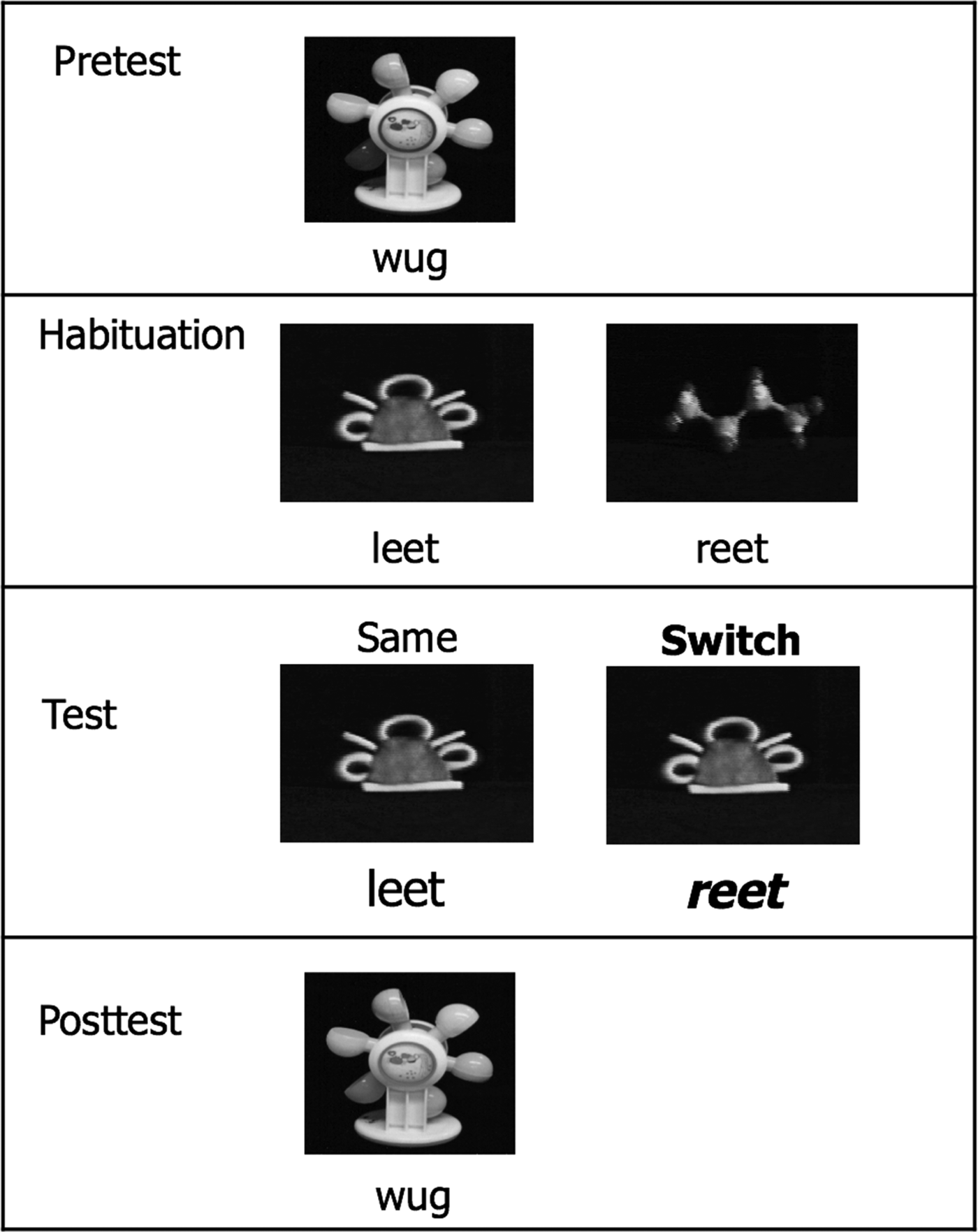
We used a modified version of the Switch procedure (Werker, Cohen, Lloyd, Casasola, & Stager, Reference Werker, Cohen, Lloyd, Casasola and Stager1998). Fourteen-month-olds were habituated to two word–object pairs (see Figure 2) and then tested on their ability to detect a mismatch in the pairing. A pre-test trial began the experiment with a non-related novel word (wug) through speakers paired with an object on a screen. Subsequently, each trial began with a silent attention-getter used to re-engage infants between trials. Once engaged, the habituation phase started with a novel object appearing with an accompanying novel word: leet paired with Object A and reet paired with Object B, counterbalanced across groups of infants. Four trials of word–object pairs comprised a ‘block’ in a semi-random order (e.g., ABAB, BAAB) and eight semi-randomized blocks comprised a habituation order, across participants. All trials were initially coded online to determine habituation. During the habituation phase, the average looking time for a particular infant across the first four-trial block was compared to subsequent four-trial blocks until looking time decreased to a pre-set criterion of 65% (as in Stager & Werker, Reference Stager and Werker1997; Fennell & Werker, Reference Fennell and Werker2003). Infants were exposed to a minimum of eight and a maximum of 24 habituation trials.
Modified version of the Switch procedure (Werker et al., Reference Werker, Cohen, Lloyd, Casasola and Stager1998). This figure illustrates the progression of this procedure in four phases. The pre-test engages the infant using a novel word and object unrelated to the body of the experiment. The habituation phase consists of 8 to 24 trials of novel word–object pairs (e.g., leet – Object A, reet – Object B, or vice versa). Two trials comprise the test phase: Same and Switch. The Same trial is identical to one of the two habituation trials. The Switch trial is a mismatch in which, for example, if leet was paired with Object A during the habituation phase, a Switch trial might pair reet with Object B. The post-test ends the experiment.

The test phase began immediately after habituation and included two test trials: Same and Switch. Same trials were identical to pairs in the habituation phase and Switch trials included a mismatch between object and label (see Figure 2). During the habituation phase, infants lose interest in the repetition of both word–object pairs. If mismatched stimulus is detected, infants will likely recover interest during the Switch trial. That is, the Switch trial is different from all other trials so it should be surprising to infants and therefore we expect longer looking times compared to the Same trial. Order of test trials and specific word–object pairing were counterbalanced across infants. After the test phase, a post-test trial, identical to pre-test, ended the procedure.
Apparatus
Testing took place in a 2.74 × 1.82 m quiet, dimly lit room. Infants sat on their parents’ laps facing a screen (122 cm wide, 91.5 cm high) approximately 1.5 m away. Images were projected onto the screen via a NEC LT245 projector. Auditory stimuli were delivered at 65 ± 5 dB over a Bose 101 speaker located directly below the screen. Infants were recorded using a Sony DCRDVD92 digital video camera.
Parents wore Bose True Noise-Cancelling Headphones, through which music was played. Habit X 1.0 (Cohen, Atkinson, & Chaput, Reference Cohen, Atkinson and Chaput2004), run on a Macintosh Power PC G5, was used to order digitized audio and visual stimuli presentations and collect looking time data. The experimenter, who was blind to the auditory stimuli and type of trial, monitored the infants’ looking behaviour via a closed-circuit television system from an adjacent testing room and coded online by pressing a designated key. Video recordings were coded offline using Supercoder (Hollich, Reference Hollich2005) and used as data in the analysis. Cronbach's alpha was calculated as the reliability statistic. To measure inter-rater reliability, 25% of the data (n = 4 infants) were coded by a second coder. Data reliability required equal or above .97, and this level of agreement was achieved (Cronbach's α = .999).
Results
We first determined whether infants recovered to the post-test by comparing looking times to the last habituation block (M: 7.40, SD: 2.62) with looking times to the post-test (M: 19.17, SD: 3.58) There was a significant effect of trial (t(15) = –11.685, p < .001, d = 2.921), suggesting that infants maintained interest in the task and recovered to the post-test.
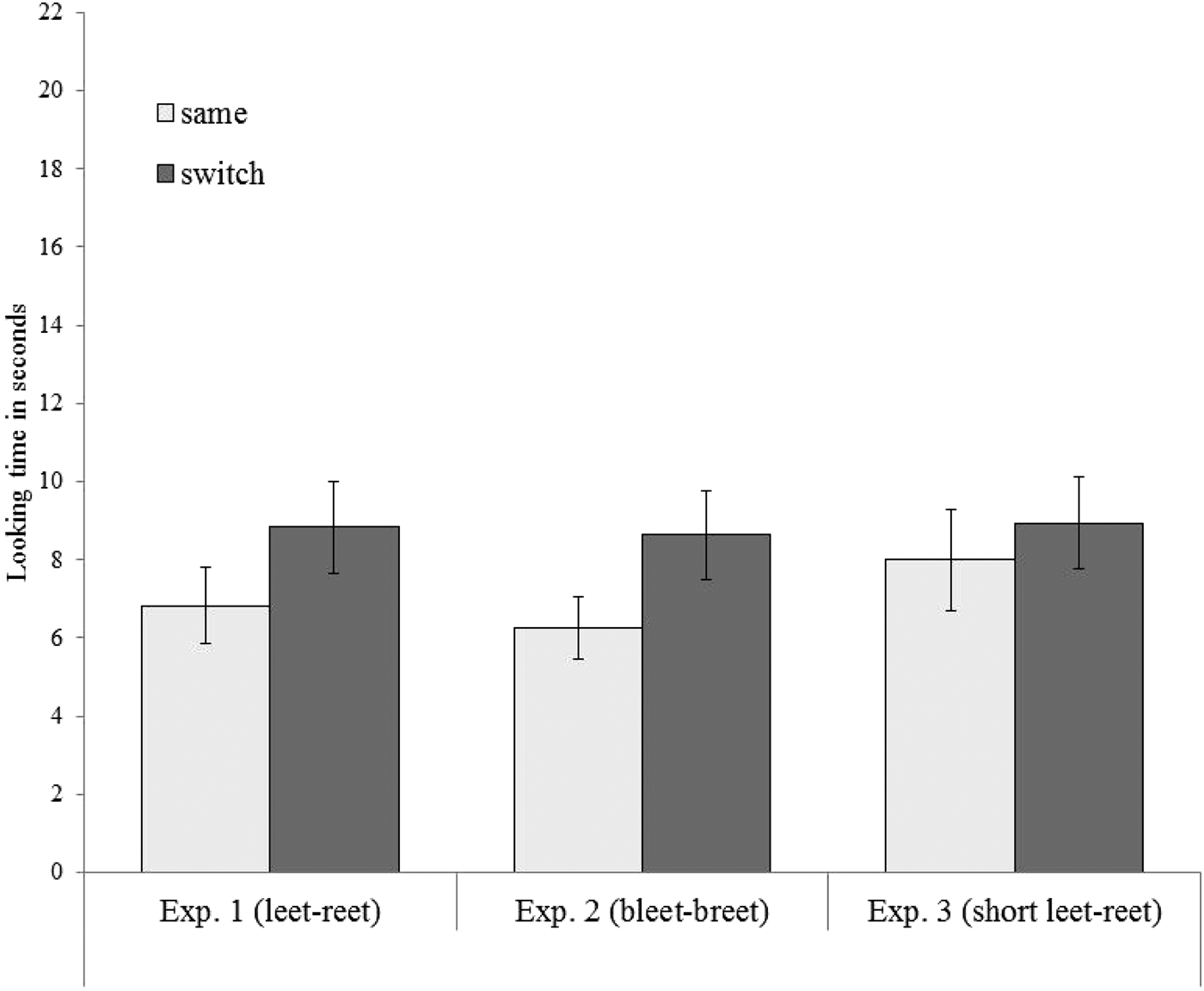
Our primary comparison was infants’ looking times during the Same and Switch test trials. A pairwise t-test showed a significant difference between the Same trial (M: 6.83, SD: 3.95) and Switch trial (M: 8.83, SD: 4.67) (t(15) = –2.253, p = .040, d = 0.594), demonstrating that infants were successful at detecting the mismatch at test (see Figure 3). Of the 16 participants, 12 looked longer at the Switch trial.
Mean looking time in seconds for Experiment 1 (leet–reet), Experiment 2 (bleet–breet), and Experiment 3 (shortened leet–reet) contrasts. Light grey denotes looks to Same trial (same) and dark grey denotes looks to Switch trial (switch). Error bars denote SE.

Discussion
The results of Experiment 1 suggest an acoustically salient contrast can override the challenge faced by novice word learners when presented with minimally different word forms (Stager & Werker, Reference Stager and Werker1997). Although 14-month-olds have difficulty detecting some minimal pairs (e.g., bin–din; Pater et al., Reference Pater, Stager and Werker2004), if the contrast is salient then infants use the acoustic information to detect a mismatch without requiring the aid of referential (e.g., Fennell & Waxman, Reference Fennell and Waxman2010) or distributional (e.g., Thiessen, Reference Thiessen2007; Thiessen & Yee, Reference Thiessen and Yee2010) information. Thus, the nature of the contrast alone can boost infants’ ability to detect it in a Switch Task. However, it is not known what specific acoustic properties of the contrast are driving infants’ ability to distinguish the minimal pair leet–reet. That is, infants could be relying on the overall duration of the segment, and/or simply having a formant pattern is sufficient for success in this task. In Experiment 2, we investigate whether infants still access the contrastive information in a minimal pair when the liquid contrast is embedded in a complex onset. When a liquid is part of a complex onset, the duration is naturally shortened by the first element of the onset (i.e., /b/).
Experiment 2
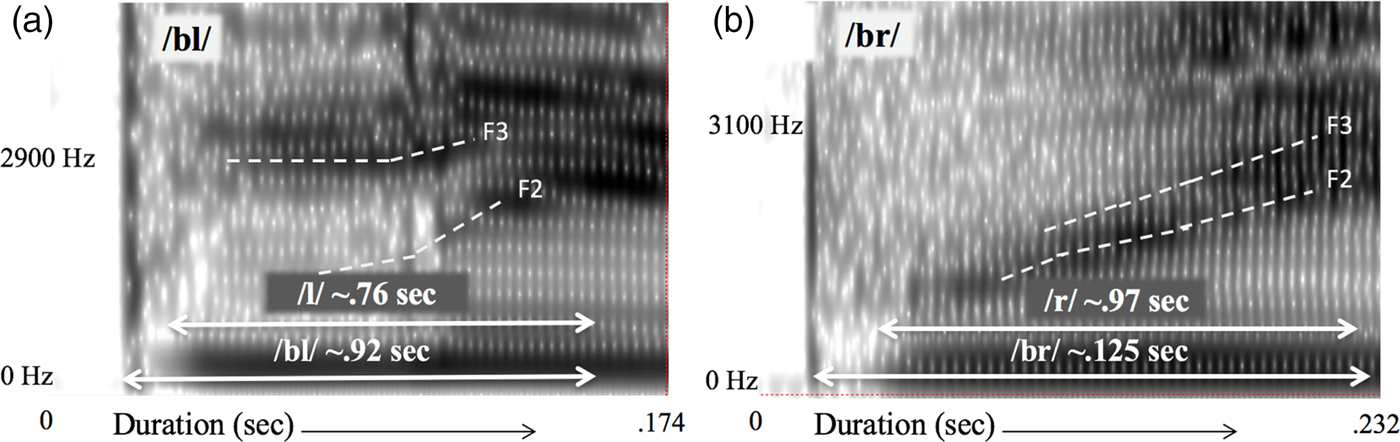
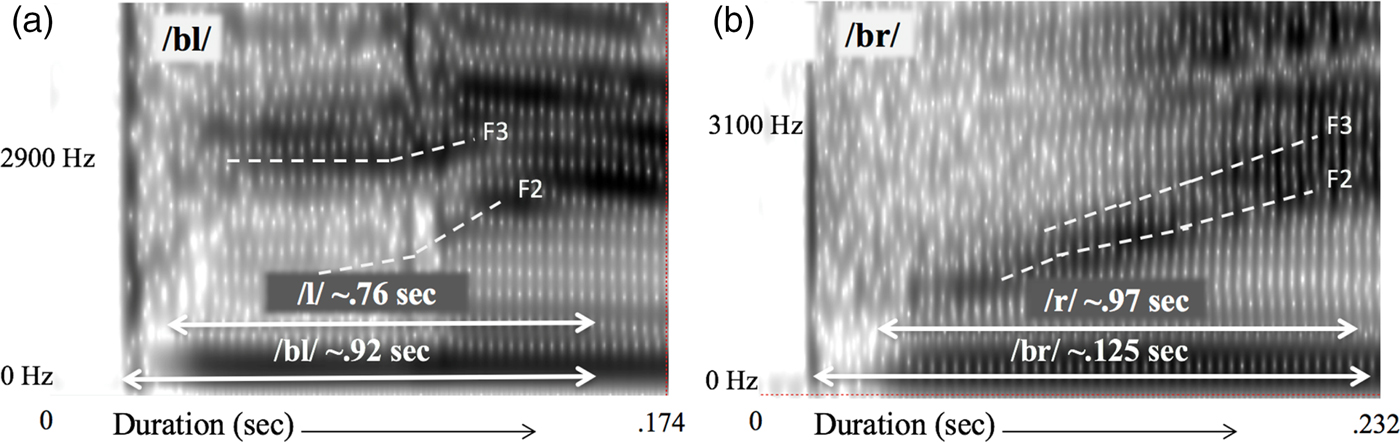
We tested 14-month-olds using stop–liquid onsets (i.e., bleet–breet), in which the contrast is the second element embedded within a complex onset. As a result, some characteristics of the liquids change (see Figure 4 and Table 1 for acoustic measurements of stimuli). In this experiment, we specifically focus on the duration of the liquid contrast to determine whether it is a factor when infants are identifying contrasts. In this experiment, if infants do not detect the switch, then the acoustic or positional differences are no longer salient enough to outweigh resource limitations.
Example: Spectrogram a: .174 sec window includes /bl/ to beginning of vowel /i/ (bleet). Spectrogram b: .232 sec window includes /bl/ to beginning of vowel /i/ (breet). These examples illustrate the duration of the liquid contrast to compare to those in Figure 1b.
Methods
Participants
Sixteen 14-month-old infants (M: 14.45, SD: 0.263; Range: 14.10–14.92) from monolingual English homes participated in this study. Twelve additional infants were tested and are reported in ‘Appendix A’). The same stopping rule applied as in Experiment 1.
Stimuli
The same speaker as in Experiment 1 recorded stimuli in infant-directed speech: bleet [blit] and breet [brit]. Each trial was 21 seconds long with an ISI of 750 ms. Onset measurements are reported in Table 1.
Procedure and apparatus
The procedure and apparatus for this experiment are identical to Experiment 1.
Results
As in Experiment 1, we ran an analysis of infants’ recovery to the post-test (M: 17.51, SD: 4.30) after the last block of habituation trials (M: 8.72, SD: 2.28). There was a significant effect of trial (t(15) = –7.499, p < .001, d = 1.875), indicating that the infants recovered to the post-test.
As in the previous experiment, a pairwise t-test comparison of Same and Switch trials showed a significant difference between looks to the Same trial (M: 6.25, SD: 3.16) and Switch trial (M: 8.63, SD: 4.56) (t(15) = –3.146, p = .007, d = 0.787) (Figure 3). Thirteen of the 16 infants looked longer to the Switch. Inter-rater reliability parameters were identical to those in Experiment 1 and yielded a score exceeding .97 (Cronbach's α = .999).
Discussion
Fourteen-month olds detect the /l/–/r/ contrast, even in the second position of an complex onset. Though the liquids in these onsets were shorter in duration (compared to the leet–reet contrast), infants nonetheless detected the mismatch in the Switch trial, suggesting that consonants with formants are salient regardless of duration. Alternatively, because the first element of the cluster includes anticipatory coarticulation information about the upcoming segment, infants may be relying on this additional source of information to distinguish between the liquids. To tease this apart, we tested whether infants detect the mismatch when the liquid maintains the same duration as when it is embedded in an onset, but without coarticulatory information in the preceding stop.
Experiment 3
To test whether infants were attending to the duration of the formant structure of the segments (Experiment 1) or were aided by coarticulatory information contained within the cluster (Experiment 2), we created a singleton onset with the duration of a liquid in a complex onset (i.e., bleet–breet) without the coarticulatory information by removing the /b/; see Table 1. We predicted that in the absence of coarticulatory cues, infants will still have available sufficient information in the formants, even though they are shorter, to distinguish between the contrasts in a word learning task. That is, we predicted infants will detect a switch in the word–object pairing.
Methods
Participants
Sixteen 14-month-old infants (M: 14.57, SD: 0.273; Range: 14.00–14.98) from monolingual English homes participated in this study. A further eight were not included in the analysis (see ‘Appendix A’ for detailed report).
Stimuli
The stimuli were created by splicing out the stop from the bleet and breet tokens using Praat (Boersma & Weenink, Reference Boersma and Weenink2010). This method of altering stimuli preserved the duration of the liquid within the onset while creating a singleton onset (see Table 1 for measurements). Three adult speakers of English reviewed each token and reported that they perceived a singleton liquid. Each trial was 20 seconds long with an ISI of 750 ms.
Procedure and apparatus
The procedure and apparatus were identical to Experiments 1 and 2.
Results
Following Experiments 1 and 2, we ran an analysis confirming infants’ recovery from the last four habituation trials (M: 8.66, SD: 2.85) to the post-test (M: 17.08, SD: 4.20). We again found a significant effect between trials (t(15) = –8.267, p <. 001, d = 2.067).
We used a pairwise t-test comparison of infants’ looking times during the Same and Switch trials as our primary analysis. This analysis showed no significant difference between the Same (M: 8.00, SD: 5.22) and Switch trials (M: 8.93, SD: 4.70) (t(15) = –0.785, p = .444) (Figure 3). A Cronbach's α = .987 score exceeded the reliability standard .97.
Contrary to our prediction, infants of 14 months were unable to detect the contrast during the test phase. When the initial stop information was removed from the words bleet and breet, infants were presented with a shortened onset liquid, contrasting only in duration with the natural stimuli in Experiment 1 (leet–reet). These results suggest that infants struggled with this contrast, with only six of the 16 infants looking longer during the Switch trial.
To determine whether there were any significant interactions across experiments, we compared Experiment 1 (leet–reet) to Experiment 3 to see if duration alone was driving infants’ success in Experiment 1, and Experiment 2 (clusters) to Experiment 3 to see if coarticulatory cues were driving success in Experiment 2. There were no significant interactions (all ps >.05; please see ‘Appendix B’), suggesting that we cannot conclusively determine whether duration or coarticulatory cues are driving performance. Rather we can only conclude that in the absence of additional acoustic information, infants are faced with a greater challenge in this task.
General Discussion
In this series of experiments, we found that 14-month-old infants succeed at learning new pairings between novel objects and words when the labels contain a minimal acoustically salient contrast. Specifically, the formant structures and coarticulatory cues provide the necessary salience for infants to detect minimal pairs. Importantly, when these cues are weakened, as was the case in our third experiment, infants no longer detect a mismatch in the pairing. However, exactly why infants do not detect the switch in Experiment 3 requires further exploration, since it could be because of the lack of sufficient duration or coarticulatory cues, or even the artificially created context. Recall that, by 10 months, infants discriminate only those contrasts experienced in their native language (Werker & Tees, Reference Werker and Tees1984). In Experiment 3, the artificially created stimuli could be treated as non-native, thereby constraining infants’ willingness to map these forms to objects (Mackenzie, Graham, Curtin, & Archer, Reference MacKenzie, Graham, Curtin and Archer2014; May & Werker, Reference May and Werker2014). Perhaps if infants have experience with a shortened liquid segment at word onset, they might succeed, or if the infants were provided with additional support through referential information (Mackenzie et al., Reference MacKenzie, Graham, Curtin and Archer2014) they might accept these forms as possible labels.
This finding complements other studies (Curtin et al., Reference Curtin, Fennell and Escudero2009; Archer et al., Reference Archer, Ference and Curtin2014) that demonstrate infants’ ability to access fine phonetic detail in minimal pairs when the particular contrast is salient due to various acoustic factors. Though previous onset contrasts (e.g., bin–din) were inaccessible to 14-month-olds, the results of our experiments show that this difficulty is not related solely to position or minimal pairs in general. Here we found that, given minimal pairs that contrast in singleton liquids (leet–reet) or liquids in complex onsets (bleet–breet), infants are able to access the contrasting information, illustrating that acoustic salience is indeed a factor in word learning.
Our interpretation of these results supports the notion that not all contrasts are equally salient or detectable, and that certain tasks at certain stages of phonological development can impede infants’ ability to access different types of information (see Werker & Curtin, Reference Werker and Curtin2005; Curtin, Byers-Heinlein, & Werker, Reference Curtin, Byers-Heinlein and Werker2011). These findings are the first demonstration of minimal contrasts in onset position that overcome the resource limitations in 14-month-olds based only on the acoustic properties of the specific contrasts (in this case, leet–reet (duration) and bleet–breet (coarticulation)) in the Switch task (Werker et al., Reference Werker, Cohen, Lloyd, Casasola and Stager1998). This suggests that some cues may provide extra processing time enhancing infants’ access to contrastive information. Related to this, Archer et al. (Reference Archer, Zamuner, Engel, Fais and Curtin2016) showed that discrimination of stop contrasts in coda position were perceived earlier if the acoustic properties of the contrasts were salient (e.g., /ab/–/ag/ but not /ap/–/ak/). Together, these findings suggest that success in a task is largely due to acoustic properties of the contrast.
Contrasts that are acoustically and perceptually salient are easier for novice word learners to access. In an exemplar-like system, tokens of linguistic input (specifically, word forms) are stored in terms of their phonetic similarity (Werker & Curtin, Reference Werker and Curtin2005; Curtin et al., Reference Curtin, Byers-Heinlein and Werker2011). In illustration, tokens such as fep and wug contrast on a number of dimensions, so clusters of fep tokens and wug tokens can be stored separately. This eases access to these word forms at test (MacKenzie, Graham, & Curtin, Reference MacKenzie, Graham and Curtin2011). However, in the case of minimal pairs, infants are challenged with accessing forms that differ by a single change in segments. In terms of storage, similar-sounding word forms are stored close together or even in potentially overlapping exemplar space. Access in these cases becomes difficult because, in a word–object association task (i.e., Switch) other sources of information are not included in the experience. In support of this notion, 17-month-olds successfully learn minimal pairs when habituated first to low-density neighbourhoods (Storkel & Rogers, Reference Storkel and Rogers2000; Hollich, Jusczyk, & Luce, Reference Hollich, Jusczyk and Luce2002). When phonological neighbourhoods have a high density, access becomes more difficult because of competition between closely stored tokens. In the case of our experiments, acoustically salient contrasts are more likely to be distinct from one another, thus separating word form clusters in exemplar space, allowing easier access.
Findings from studies show that acoustic salience (specifically duration and/or coarticulatory information) impacts minimal pair word learning, along with context, language experience, and developmental stage. By investigating the various factors that influence word learning in the early stages of language development we come further towards understanding the interplay between the acoustic signal, the resources at hand, and the demands of the task. That is, multiple factors continually influence infants’ mapping and retrieval of information while, dynamically, the system incorporates new information which feeds back into itself, creating stronger representations and a growing vocabulary, suggesting that studies need to take into account numerous factors, including the acoustic properties of the sound segments, in order to predict and provide a comprehensive view of early word learning and phonological development (Werker & Curtin, Reference Werker and Curtin2005).
Acknowledgements
This research was supported by a Social Sciences and Humanities Research Council of Canada (SSHRC) grant awarded to S. Curtin. We would like to thank Heather MacKenzie, Jennifer Ference, Erin Dodd, Melanie Khu, Jennifer Campbell, Patrick Mihalicz, the volunteer coders, and baby sitters at the Speech Development lab. We also thank the parents and infants who took part in our study.
Appendix A
Detailed report of participant data not included in the analysis.

Appendix B
Interaction results of 2 × 2 ANOVAs between Experiments 1-3 and 2-3

Means and Standard Deviations for test trials by Experiment