Introduction
Bermudagrass is a C4 perennial grass commonly found infesting sugarcane planted in coarse- and fine-textured soils. Plant reproduction occurs mostly vegetatively and to a lesser degree by seed because of poor pollination of certain bermudagrass cultivars (Hanna and Anderson Reference Hanna and Anderson2008). Dense bermudagrass infestations can reduce sugarcane and sugar yields each year of the 3-yr crop cycle by 8% to 32% (Richard Reference Richard1993; Richard and Dalley Reference Richard and Dalley2007). No selective herbicides resulted in adequate bermudagrass injury without injuring sugarcane; therefore, the fallow period is an optimal time to reduce perennial weed infestations before sugarcane is replanted (Miller et al. Reference Miller, Griffin and Richard1999; Richard Reference Richard1997a). Following harvest of the final ratoon crop, some sugarcane is treated with 1.68 kg ha–1 of glyphosate to terminate the crop (Etheredge et al. Reference Etheredge, Griffin and Salassi2009). Fallowed fields treated with repeated glyphosate applications in combination with reduced or no tillage decreased November bermudagrass groundcover 81% to 95% when compared to cultivation alone in Louisiana (Etheredge et al. Reference Etheredge, Griffin and Salassi2009). Glyphosate applied sequentially at 2.2 kg ha–1 or as a single LPOST treatment during the sugarcane fallow period reduced infestation with johnsongrass [Sorghum halepense (L.) Pers.], another perennial weed that is difficult to control, reducing densities 75% to 95% in the subsequent plant-cane crop (Richard Reference Richard1997b).
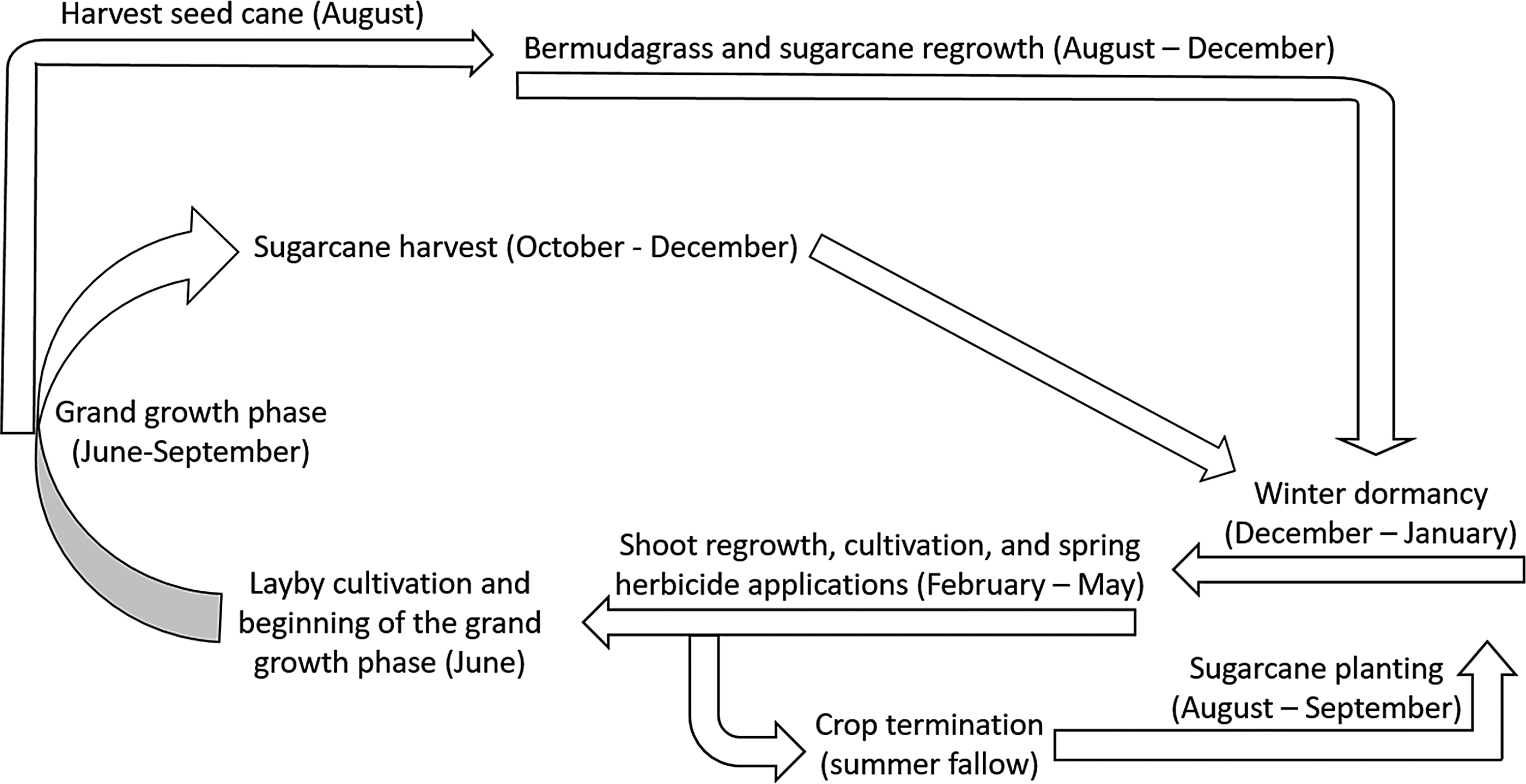
Sugarcane is vegetatively propagated and in Louisiana is cultivated on raised beds in rows that range from 1.7 to 2.4 m between row centers. A single sugarcane planting is harvested 1 yr later in fall after the initial planting (plant-cane crop) and again each year thereafter (first-, second-, and third-ratoon crops) from late September to early January for an additional 2 to 3 yr. The row-top area adjacent to the sugarcane stool is undisturbed until harvest, and bermudagrass densities can increase over time, especially during years lacking below-freezing temperatures (Richard Reference Richard1993). In Louisiana, the sugarcane crop is synchronized by cool temperatures in winter that kill aboveground tissues, and new growth emerges in late February to early March. Cultivation equipment disturbs aboveground bermudagrass stolons present in wheel furrows and on bed edges, but severed rhizomes belowground increase pest densities (Fernandez Reference Fernandez2003). Spring cultivation is necessary to repair ruts caused by harvesting equipment, reestablish eroded bed edges, incorporate fertilizer, remove winter annual weeds, and provide a clean area for soil-applied herbicides. As the growing season progresses, plants enter the critical growth phase of sugarcane development, a period of high water consumption and rapid growth (Gascho Reference Gascho1985). By June, the sugarcane canopy shades bermudagrass and causes plants to enter a temporary shade-induced dormancy until sugarcane is harvested, either for seed cane or for processing by the sugar factory. Sugarcane fields mechanically harvested for seed cane, typically during August and September, are especially vulnerable to bermudagrass reestablishment, as the combination of warm temperatures, moist soils, and abundant sunlight promotes bermudagrass reestablishment.
Seed-cane fields infested with low to moderate bermudagrass infestation levels introduce the potential for weedy vegetative propagules to spread to noninfested fields through contaminated seed cane and contribute to additional yield loss. Currently there is no selective PRE or POST herbicide that completely controls bermudagrass in sugarcane. Bermudagrass treated before emergence can be suppressed with metribuzin, clomazone, or with mixtures of clomazone plus a PSII-inhibitor herbicide like diuron or hexazinone (Richard Reference Richard1996a, Reference Richard2000). Reducing bermudagrass emergence after planting or after seed-cane harvest is necessary, because several commercially grown sugarcane cultivars (‘HoCP 96-540’, ‘L 01-283’, and ’L 03-371’) poorly compete with bermudagrass (Fontenot et al. Reference Fontenot, Griffin and Bauerle2016). Sugarcane injury to clomazone applied in spring was most apparent at 2 wk after treatment (WAT) for ‘CP 70-321’, but sugar yield was not reduced with a single spring treatment of clomazone at 1.1 to 2.2 kg ha–1 when compared to metribuzin at 2.6 kg ha–1, the industry standard (Richard Reference Richard1996b).
Topramezone and a three-way premix of mesotrione + atrazine + S-metolachlor were recently registered in sugarcane and contain active ingredients that inhibit the enzyme 4-hydroxyphenylpyruvate dioxygenase (HPPD) in plants (Shaner Reference Shaner2014). Triclopyr, a unique synthetic-auxin herbicide that controls broadleaf and some grass species, is labeled (Section 18 emergency exemption) in fields infested with divine nightshade (Solanum nigrescens Martens & Galeotti), and exhibits herbicidal activity on bermudagrass when mixed with HPPD-inhibiting herbicides (Brosnan and Breeden Reference Brosnan and Breeden2013; Orgeron et al. Reference Orgeron, Schilling, Urbatsch, Ma and Spaunhorst2018, Reference Orgeron, Spaunhorst and Gravois2019). There is limited knowledge on the crop safety and efficacy of these herbicides on bermudagrass management in a Louisiana sugarcane crop. The objectives of this study were to determine first if bermudagrass and sugarcane injury are influenced by spring herbicide application timing (EPOST vs LPOST), and second, if two-way herbicide mixtures containing HPPD- or PSII-inhibitor herbicides plus triclopyr will enhance bermudagrass injury without injuring sugarcane and reduce bermudagrass densities. Herbicide treatments were applied once, and application timings began the spring after sugarcane was harvested in August for seed cane.
Materials and Methods
Experimental Location, Design, and Field Preparation Description
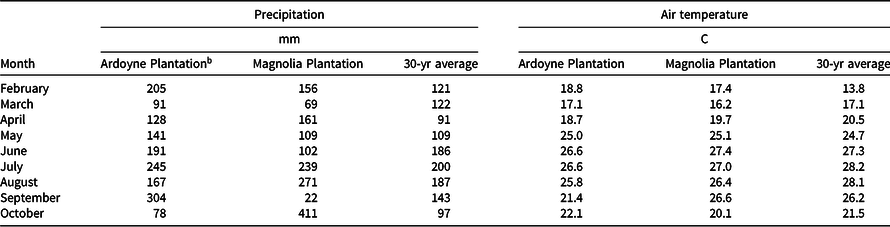
A field study was conducted in commercial sugarcane fields near Schriever, LA, to examine the effect of spring herbicide application timing and herbicide mixtures on bermudagrass and sugarcane injury. An initial experiment was conducted at Ardoyne Plantation (29.64° N, 90.84° W) in spring 2018 and was planted to ‘HoCP 09-804’. A second experiment was conducted in 2019 at Magnolia Plantation (29.70° N, 90.82° W) and planted to ‘L 01-283’. Both ‘L 01-283’ and ‘HoCP 09-804’ were categorized as early-maturing, and stalk population increased in the ratoon crop well to excellent when compared to current commercial cultivars (Gravois et al. Reference Gravois, Bischoff, LaBorde, Hoy, Regan, Pontif, Kimbeng, Hawkins, Sexton and Fontenot2010; Todd et al. Reference Todd, Dufrene, Pan, Tew, White, Hale, Duet, Verdun, Grisham, Petrie, Gravois, Waguespack and Abbott2019). At both locations, sugarcane was mechanically whole-stalk harvested for seed cane in August of the previous year and were naturally infested with bermudagrass. The soil type at the locations was a Cancienne silt loam (Fine-silty, mixed, superactive, nonacid, hyperthermic, Fluvaquent). Soil pH and percentage organic matter at Ardoyne Plantation were 6.2 and 2.7%, and at Magnolia Plantation were 7.5 and 1.8%, respectively. Monthly precipitation and average monthly air temperatures for each location are presented in Table 1. Experiments were arranged in a randomized complete-block design with four replications and a factorial arrangement of herbicide treatments and application timing. Plots consisted of three raised-bed rows that were 1.8 m wide and 4.6 m long.
Monthly precipitation and average monthly air temperatures from February through October in comparison to the 30-yr average at the Sugarcane Research Unit, Houma, Louisiana a

a Thirty-year average (1981 to 2010) obtained from National Centers for Environmental Information (2019) www.ncdc.noaa.gov.
b Weather data from Ardoyne Plantation (2018) and Magnolia Plantation (2019) were obtained from a weather station located at Ardoyne Research Farm in Schriever, LA. Ardoyne and Magnolia Plantations were located 0.2 and 7.4 km, respectively, north of the Ardoyne Research Farm.
Necrotic sugarcane tissues from freezing air temperatures were mowed at the soil surface on February 28, 2018 and March 11, 2019 to encourage new growth. Each March sugarcane was off-bar cultivated as a standard practice, where front disks chop the row middles and back disks equipped with side shields reopen the row furrow and deposit soil adjacent to sugarcane shoots, leaving an approximately 45-cm undisturbed row-top. Urea ammonium nitrate was injected at a rate of 134 kg ha–1 about 15 cm deep on each edge of the row-top in mid- and late April in 2018 and 2019, respectively. At layby, May 16, 2018 at Ardoyne Plantation and May 24, 2019 at Magnolia Plantation, row middles and edges were cultivated as described by Richard and Dalley (Reference Richard and Dalley2007), and 2.2 kg ai ha–1 of pendimethalin was broadcast directed to control annual grass species.
Treatment Application
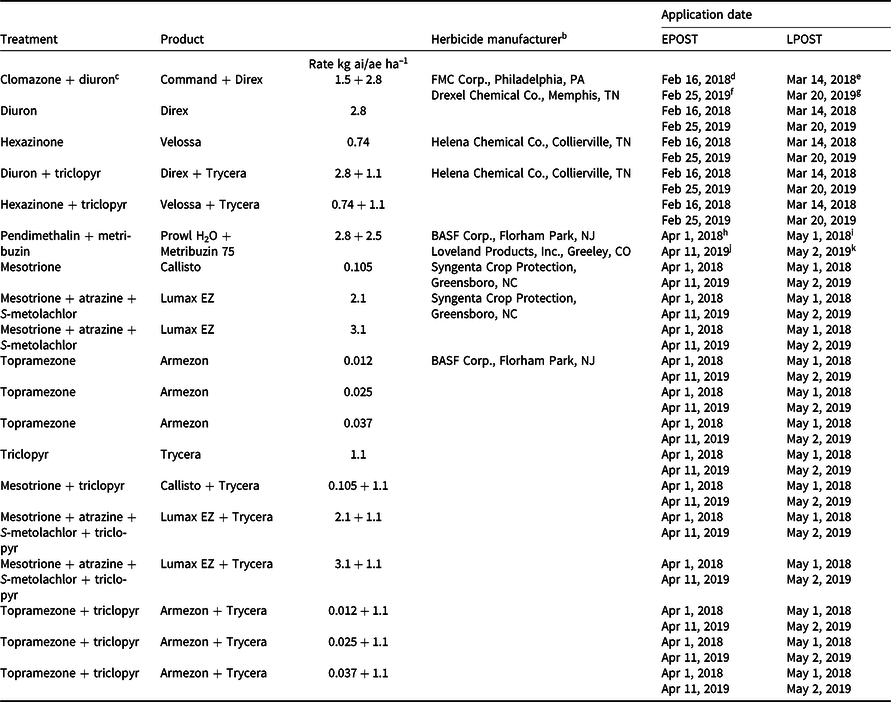
A complete list of herbicide treatments evaluated is presented in Table 2. Herbicide treatments were applied from February to May using a CO2-pressurized backpack sprayer equipped with XR11002 flat-fan nozzle tips (TeeJet®, Spraying Systems Co., Glendale Heights, IL) calibrated to deliver 187 L ha–1 at 138 kPa. All treatments included crop oil concentrate (Penetrator Plus®, 1% v/v, Collierville, TN). Treatments with clomazone, diuron, or hexazinone were applied once on February 16 (EPOST) and March 14, 2018 (LPOST), respectively, to minimize crop response and comply with herbicide label instructions. Likewise, in 2019 EPOST and LPOST treatments were applied once on February 25 and March 20, 2019, respectively. No additional herbicides were applied to EPOST or LPOST treatments with clomazone, diuron, or hexazinone until the layby cultivation in late May.
Herbicide treatments, use rates, and application date for the experiments conducted at Magnolia and Ardoyne Plantations. a

a Abbreviations: EPOST, early POST; LPOST, late POST.
b Manufacturer is listed only at first mention.
c Treatments included crop oil concentrate at 1% v/v.
d Sugarcane had not yet emerged from winter dormancy, and bermudagrass density and runner length on the undisturbed row top averaged 172 m–2 and 4 cm at the EPOST timing, respectively.
e Sugarcane stalks measured 5 cm, and bermudagrass density and runner length on the undisturbed row top averaged 231 plants m–2 and 18 cm at the LPOST timing, respectively. All plots were mowed on February 28, 2018.
f Sugarcane remained green throughout winter, and stalks measured 13 cm. Bermudagrass density and runner length on the undisturbed row top averaged 254 plants m–2 and 17 cm at the EPOST timing, respectively.
g Measurable sugarcane stalks had not reemerged from the mowing treatment on March 11, 2019. Bermudagrass density and runner length on the undisturbed row top averaged 155 plants m–2 and 9 cm at the LPOST timing, respectively.
h Sugarcane stalks measured 8 cm, and bermudagrass density and runner length on the undisturbed row top averaged 175 plants m–2 and 8 cm at the EPOST timing, respectively.
i Sugarcane stalks measured 11 cm, and bermudagrass density and runner length on the undisturbed row top averaged 430 plants m–2 and 20 cm at the LPOST timing, respectively.
j Sugarcane stalks measured 8 cm, and bermudagrass density was not determined. Bermudagrass runners on the undisturbed row top averaged 11 cm at the EPOST timing.
k Sugarcane stalks measured 13 cm, and bermudagrass density and runner length on the undisturbed row top averaged 198 plants m–2 and 12 cm at the LPOST timing, respectively
POST sugarcane tolerance has been reported for treatments that contained mesotrione, topramezone, pendimethalin, and triclopyr alone (Negrisoli et al. Reference Negrisoli, Odero, MacDonald, Sellers and Laughinghouse2019; Orgeron et al. Reference Orgeron, Schilling, Urbatsch, Ma and Spaunhorst2018; Perego et al. Reference Perego, Duarte Júnior, Rosa, Gonçalves Júnior, Queiroz and Costa2020; Zandstra et al. Reference Zandstra, Particka and Masabni2004); therefore, these treatments were applied once on April 1 and May 1, 2018 for EPOST and LPOST spring timings, respectively. In 2019 the EPOST application timing for treatments with mesotrione, topramezone, pendimethalin, and triclopyr alone was delayed until April 11 to ensure that the off-bar cultivation in early April did not reduce herbicide performance and to allow bermudagrass to recover before herbicide treatment, whereas in the same year, LPOST spring treatments were applied on May 2. No additional herbicides were applied in spring to bermudagrass before EPOST or LPOST treatments with mesotrione, topramezone, pendimethalin, and triclopyr. Pendimethalin at 2.2 kg ai ha–1 was applied to all plots at layby.
Data Collection
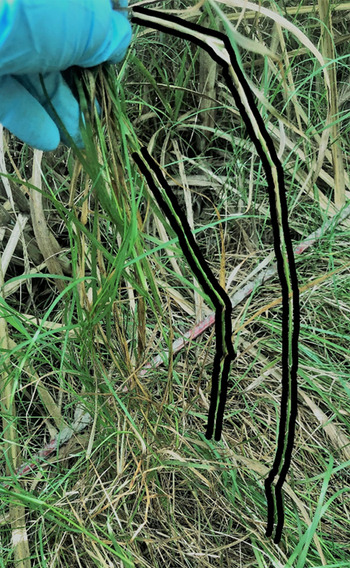
Bermudagrass and sugarcane injury was evaluated in mid-March (3 wk after clomazone, diuron, or hexazinone was applied EPOST), early April (3 wk after clomazone, diuron, or hexazinone was applied LPOST), late April (3 wk after mesotrione, topramezone, pendimethalin, and triclopyr alone were applied EPOST) and immediately before the layby cultivation in mid-May (3 wk after mesotrione, topramezone, pendimethalin, and triclopyr alone were applied LPOST) using a 0 to 100% scale, where 0 represents no bermudagrass or sugarcane foliage discoloration, and 100% was equivalent to complete foliage necrosis for bermudagrass or sugarcane. Visual assessments were compared with the nontreated control. Besides bermudagrass as the predominant weed species at both locations, yellow nutsedge (Cyperus esculentus L.) was present at Ardoyne Plantation, whereas browntop millet [Urochloa ramosa (L) Nguyen], chamber-bitter (Phyllanthus urinaria L.), doveweed [Murdannia nudiflora (L.) Brenan], ivyleaf morningglory [Ipomoea hederacea (L.) Jacq.], prostrate spurge (Euphorbia prostrata Ait.), and yellow nutsedge were present at Magnolia Plantation. Weed density was recorded in August by counting plants of each species from a 0.6-m–2 area in the center of each plot. Within the center area of each plot, two 0.3-m–2 quadrats were placed next to the sugarcane stool, one on each side of the raised bed, where soil disturbance from cultivation was limited. Total weed density was determined by summing all individual species at each location. Bermudagrass density data were recorded by counting segments of green-colored stolons, ≥2.5 cm long, that emerged from nodes and stems (Figure 1). The bermudagrass plants at these locations were observed growing erect rather than prostrate with limited nodal rooting, potentially as a result of the soil disturbance from cultivation, coupled with sugarcane crop canopy shading. In August, six sugarcane stalks were randomly selected from each plot and measured from the soil surface to the uppermost collar of the youngest leaf below the whorl to determine average stalk height. All sugarcane stalks within a plot that measured ≥1.4 m were counted at each location in August.
Bermudagrass density data were recorded by counting continuous segments of green-colored stolons located between rooted nodes and stems (≥2.5 cm long) that emerged from stolon pieces.

Statistical Analysis
Data from all treatments were checked for normality and constant variance using PROC UNIVARIATE in SAS (9.2, SAS® Institute, Cary, NC). Percent bermudagrass and sugarcane injury data were arcsine square-root transformed, and bermudagrass density, chamber-bitter density, yellow nutsedge density, and total weed density data were square-root transformed. Data transformation was not required for sugarcane stalk height and sugarcane stalk population. Data were analyzed using the PROC MIXED procedure in SAS. Replication and location were random effects, and herbicide treatment and application timing were fixed effects (Carmer et al. Reference Carmer, Nyquist and Walker1989). Treatment and application timing least-squared means were separated using an adjusted Tukey’s test with α ≤ 0.05. The herbicide treatment–by–application timing interaction for bermudagrass injury at early April and sugarcane injury at early April, late April, and mid-May evaluation timings were significant. However, the herbicide treatment–by–application timing interaction was not significant for bermudagrass density, chamber-bitter density, yellow nutsedge density, total weed density, sugarcane stalk height, and sugarcane stalk population; therefore, data for the main effects were presented separately.
Results and Discussion
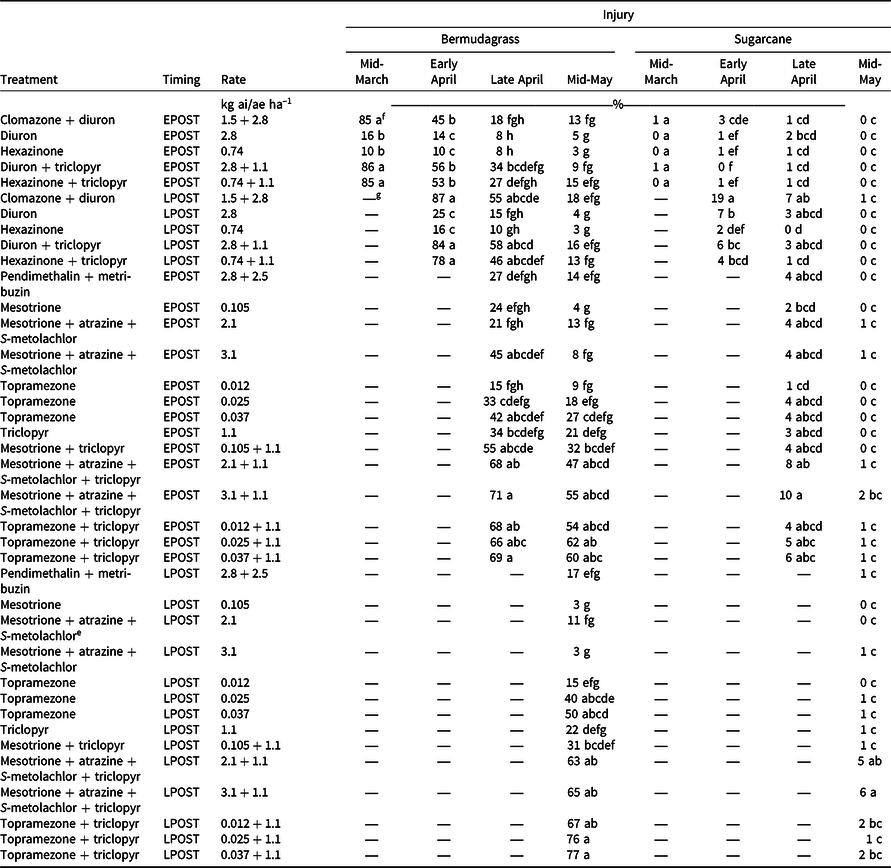
Bermudagrass and sugarcane injury varied by herbicide treatment and were generally greatest 3 wk after herbicide treatment, but commercially acceptable (≥85%) bermudagrass injury was not achieved by the layby timing (mid-May) for any herbicide applied in this study (≤77%). Clomazone plus diuron is the industry standard herbicide treatment for suppressing bermudagrass in newly planted sugarcane fields and early spring in ratoon crops (Anonymous 2020). Clomazone at 1.5 kg ha–1 plus diuron at 2.8 kg ha–1 resulted in 85% bermudagrass injury at mid-March when applied EPOST (Table 3). Diuron at 2.8 kg ha–1 or hexazinone at 0.74 kg ha–1 applied EPOST injured bermudagrass no more than 16% at mid-March. Addition of triclopyr at 1.1 kg ha–1 to diuron or hexazinone resulted in bermudagrass injury equal to the industry standard herbicide treatment (Table 3). Little to no sugarcane injury (0 to 1%) was observed in mid-March following EPOST treatments that contained diuron or hexazinone, probably because slow crop growth and cool air temperatures during February and March limited crop development as plants emerged from winter dormancy (Table 1 and Figure 2). Marginal sugarcane injury observed in mid-March was partially due to mechanical clipping of all sugarcane foliage approximately 3 cm above the soil surface that occurred late in February or early March following EPOST treatments that contained diuron or hexazinone. Newly emerged sugarcane foliage subsequent to the clipping treatment in late February/early March, was present when treatments with diuron or hexazinone were applied LPOST (March 14, 2018 and March 20, 2019). Delaying clomazone plus diuron to LPOST, when more green sugarcane foliage was present, resulted in 19% sugarcane injury, which was greater than other LPOST treatments with diuron or hexazinone or when diuron or hexazinone were mixed with triclopyr (0 to 6%) by early April (Table 3). Richard (Reference Richard1996b) reported that 1.1 to 2.2 kg ha–1 of clomazone applied in March injured ‘CP 70-321’ 4% to 31% at 4 WAT, but gross cane yield and sugar yield were similar to industry standard herbicide programs implemented during that time period. Bermudagrass injury from diuron or hexazinone applied LPOST ranged from 16% to 25% and was similar to the aforementioned herbicides applied EPOST by the early-April evaluation timing (Table 3). However, adding triclopyr to diuron or hexazinone at LPOST increased bermudagrass injury 59 to 62 percentage points when compared with diuron or hexazinone (Table 3).
Influence of EPOST and LPOST herbicide treatments on bermudagrass and sugarcane injury at Ardoyne and Magnolia Plantations in mid-March, early April, late April, and mid-May. a – f

a Abbreviations: EPOST, early POST; LPOST, late POST.
b EPOST treatments containing clomazone, diuron, or hexazinone were applied once on February 16, 2018 at Ardoyne Plantation and on February 25, 2019 at Magnolia Plantation.
c LPOST treatments containing clomazone, diuron, or hexazinone were applied once on March 14, 2018 at Ardoyne Plantation and on March 20, 2019 at Magnolia Plantation.
d EPOST treatments containing mesotrione, pendimethalin, topramezone, or triclopyr alone were applied once on April 1, 2018 at Ardoyne Plantation and on April 11, 2019 at Magnolia Plantation.
e LPOST treatments containing mesotrione, pendimethalin, topramezone, or triclopyr alone were applied once on May 1, 2018 at Ardoyne Plantation and on May 2, 2019 at Magnolia Plantation.
f Means within a column that are followed by the same letter are not statistically different according to an adjusted Tukey’s test at α ≤ 0.05. Bermudagrass and sugarcane injury data were arcsine square-root transformed, and means were back-transformed for presentation.
g Herbicide treatments were not applied for bermudagrass and sugarcane injury evaluation.
A flowchart diagram of typical field events performed during a 12-mo sugarcane growth cycle in Louisiana.

Treatments containing mesotrione, metribuzin, topramezone, or triclopyr alone were applied to actively growing sugarcane stalks that measured 8 to 13 cm at the uppermost leaf collar in April and May before the grand growth period of sugarcane development (Figure 2). Sugarcane injury varied slightly by herbicide treatment at the late-April evaluation timing and ranged from 1% to 10% and did not exceed 2% in mid-May when treatments were applied EPOST (Table 3). Sugarcane stalk height and stalk population were not influenced by herbicide treatment or application timing in this study (Tables 4 and 5). Orgeron et al. (Reference Orgeron, Spaunhorst and Gravois2019) also reported similar sugarcane stalk height and stalk population among nontreated and topramezone + triclopyr–treated sugarcane; however, sugarcane yield increased 19% with topramezone at 0.049 kg ha–1 plus triclopyr at 0.8 kg ha–1 when compared with the nontreated. By late April, bermudagrass injury from EPOST treatments with mesotrione or topramezone but without triclopyr ranged from 15% to 45% (Table 3). Unsatisfactory bermudagrass injury (3% to 50%) from LPOST treatments with mesotrione or topramezone alone were also reported by mid-May (Table 3). In some instances, mixing triclopyr with mesotrione, topramezone, or the premix of mesotrione + atrazine + S-metolachlor increased bermudagrass injury. Differences in bermudagrass injury from the triclopyr mixture were most apparent when several herbicide rates were evaluated, as was the case with topramezone from 0.012 to 0.037 kg ha–1 and the premix of mesotrione + atrazine + S-metolachlor at 2.1 to 3.1 kg ha–1 applied EPOST or LPOST. Topramezone at 0.012 kg ha–1 plus triclopyr increased bermudagrass injury 45 to 53 percentage points when compared with topramezone at 0.012 kg ha–1 and applied EPOST or LPOST (Table 3). However, increased bermudagrass injury was not observed when topramezone at 0.025 or 0.037 kg ha–1 was mixed with triclopyr and applied LPOST. Orgeron et al. (Reference Orgeron, Spaunhorst and Gravois2019) reported that nine two-way combinations of topramezone (0.012, 0.024, and 0.049 kg ha–1) plus triclopyr (0.4, 0.8, and 1.2 kg ha–1) injured ‘L 01-299’ no more than 2% and suppressed bermudagrass 48% to 92% at 28 d after treatment. However, the previous experiment was conducted in a field that probably had lower bermudagrass densities, as it had not been harvested for seed cane. Cox et al. (Reference Cox, Rana, Brewer and Askew2017) reported 4 and 8 more days of bermudagrass turf injury and stunting, over a threshold of 30%, with topramezone at 0.012 kg ha–1 plus triclopyr at 0.14 kg ha–1 when compared with topramezone at 0.012 kg ha–1, respectively. Forty-seven percentage points greater bermudagrass injury was reported in late April with the premix of mesotrione + atrazine + S-metolachlor at 2.1 kg ha–1 and mixed with triclopyr when compared with the premix at 2.1 kg ha–1 without triclopyr and applied EPOST (Table 3). Similar to topramezone at 0.025 to 0.037 kg ha–1 plus triclopyr, the premix of mesotrione + atrazine + S-metolachlor at 3.1 kg ha–1 plus triclopyr did not increase bermudagrass injury in late April more than the premix at 3.1 kg ha–1 alone when applied EPOST, but when the premix at 2.1 or 3.1 kg ha–1 plus triclopyr was applied LPOST, bermudagrass injury was 52 to 62 percentage points greater than the premix at 2.1 or 3.1 kg ha–1 at the mid-May evaluation timing (Table 3).
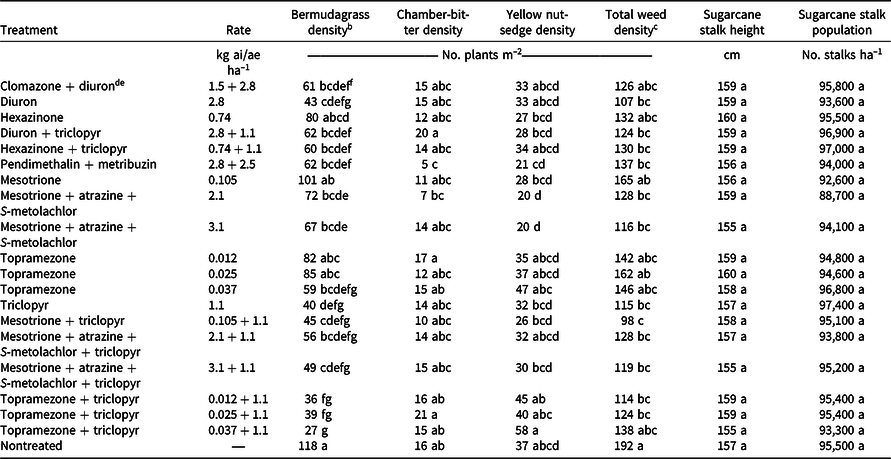
Influence of EPOST and LPOST spring herbicide applications on August bermudagrass density, chamber-bitter density, yellow nutsedge density, total weed density, sugarcane stalk height, and sugarcane stalk population at Ardoyne and Magnolia Plantations. a b

a Abbreviations: EPOST, early POST; LPOST, late POST.
b Herbicide application timings were pooled across herbicide treatments at each location.
c Bermudagrass density data were recorded by counting segments of green-colored stolons (≥2.5 cm long) that emerged from nodes, and stems.
d Total weed density consisted of bermudagrass, browntop millet, chamber-bitter, doveweed, ivyleaf morningglory, prostrate spurge, and yellow nutsedge.
e EPOST treatments containing clomazone, diuron, or hexazinone were applied once on February 16, 2018 at Ardoyne Plantation and on February 25, 2019 at Magnolia Plantation. EPOST treatments containing mesotrione, pendimethalin, topramezone, or triclopyr alone were applied once on April 1, 2018 at Ardoyne Plantation and on April 11, 2019 at Magnolia Plantation.
f Means within a column that are followed by the same letter are not statistically different according to an adjusted Tukey’s test at α ≤ 0.05. Bermudagrass, chamber-bitter, yellow nutsedge, and total weed density data were square-root transformed, and means were back-transformed for presentation. Sugarcane stalk height and stalk population data were not transformed.
g LPOST treatments containing clomazone, diuron, or hexazinone were applied once on March 14, 2018 at Ardoyne Plantation and on March 20, 2019 at Magnolia Plantation. LPOST treatments containing mesotrione, pendimethalin, topramezone, or triclopyr alone were applied once on May 1, 2018 at Ardoyne Plantation and on May 2, 2019 at Magnolia Plantation.
Influence of spring herbicide treatments on bermudagrass density, chamber-bitter density, yellow nutsedge density, total weed density, sugarcane stalk height, and sugarcane stalk population in August at Ardoyne and Magnolia Plantations. a

a Treatments were pooled across early POST and late POST application timings at each location.
b Bermudagrass density data were recorded by counting segments of green-colored stolons (≥2.5 cm long) that emerged from nodes, and stems.
c Species included for total weed density were bermudagrass, browntop millet, chamber-bitter, doveweed, ivyleaf morningglory, prostrate spurge, and yellow nutsedge, pooled across locations.
d Early POST and late POST treatments containing clomazone, diuron, or hexazinone were applied once on February 16, 2018 and March 14, 2018, respectively, at Ardoyne Plantation. Early POST and late POST treatments containing mesotrione, pendimethalin, topramezone, or triclopyr alone were applied once on April 1, 2018 and May 1, 2018, respectively, at Ardoyne Plantation.
e Early POST and late POST treatments containing clomazone, diuron, or hexazinone were applied once on February 25, 2019 and March 20, 2019, respectively, at Magnolia Plantation. Early POST and late POST treatments containing mesotrione, pendimethalin, topramezone, or triclopyr alone were applied once on April 11, 2019 and May 2, 2019, respectively, at Magnolia Plantation.
f Means within a column that are followed by the same letter are not statistically different according to an adjusted Tukey’s test at α ≤ 0.05. Bermudagrass density, chamber-bitter density, yellow nutsedge density, and total weed density data were square-root transformed, and means were back-transformed for presentation. Sugarcane stalk height and stalk population data were not transformed.
The herbicide treatment–by–application timing interaction was not significant for bermudagrass density, chamber-bitter density, yellow nutsedge density, total weed density, sugarcane stalk height, and sugarcane stalk population data recorded in August; therefore, means were separated by treatment or application timing (Tables 4 and 5). Herbicides applied LPOST reduced bermudagrass density and total weed density 24 and 8 percentage points greater than herbicides applied EPOST, respectively (Table 4). Tyagi et al. (Reference Tyagi, Sharma and Bhardwaj2012) reported that sugarcane height and cane yield were positively correlated (0.779). No increase in sugarcane stalk height or stalk population from short periods of bermudagrass suppression could reduce farm income in the short term, but such treatment may be necessary to reduce additional bermudagrass expansion and increased weed densities over a multiyear sugarcane production cycle. Triclopyr mixed with diuron or hexazinone reduced bermudagrass densities 47% to 49% when compared with the nontreated (Table 5). However, the data showed that mixing triclopyr with diuron or hexazinone did not reduce bermudagrass densities when compared with diuron or hexazinone, even though commercially acceptable bermudagrass injury (≥85%) was reported in mid-March, and suggested that a second POST application may be necessary in late April or mid-May. A second POST application at that time would exclude diuron or hexazinone so as to mitigate excessive crop injury, maximize crop growth, and comply with the 234-d preharvest interval for hexazinone (Anonymous 2013). Metribuzin would probably be an effective option for bermudagrass suppression at that stage of crop development, as evidenced by Richard (Reference Richard1993), who reported that metribuzin applied each spring at 2.7 kg ai ha–1 in early April reduced bermudagrass biomass during a 3-yr sugarcane crop cycle without reducing total sugarcane yield.
Bermudagrass densities ranged from 175 to 430 m–2 when treatments containing mesotrione, metribuzin, topramezone, and triclopyr were applied from April to May, nearly 1 yr after the last herbicide treatment was applied before sugarcane was harvested for seed cane, which represented a worst-case scenario. Unfortunately, bermudagrass densities at these levels were not uncommon in other areas where sugarcane was harvested for seed cane at these locations, and fall bermudagrass competition likely contributed to yield loss before herbicide treatments were applied from February to May. The premix of mesotrione + atrazine + S-metolachlor at 2.1 or 3.1 kg ha–1 reduced bermudagrass density 39% to 43% when compared with the nontreated (Table 5). Mixing triclopyr with the premix herbicide at 2.1 or 3.1 kg ha–1 did not reduce bermudagrass density more than either applied alone. Triclopyr mixed with mesotrione at 0.105 kg ha–1 or with topramezone at 0.012 to 0.025 kg ha–1 resulted in 54% to 56% fewer bermudagrass stolons and stems by August when compared with mesotrione or with topramezone at 0.012 or 0.025 kg ha–1 (Table 5). However, August bermudagrass densities were similar for all treatments mixed with triclopyr when compared with triclopyr alone.
The majority of sugarcane fields are naturally infested with several different weed species; however, one or two species in high densities can contribute to considerable yield loss (Ali et al. Reference Ali, Reagan, Kitchen and Flynn1985; Lence and Griffin Reference Lence and Griffin1991; Ramesha et al. Reference Ramesha, Bhanuvally, Krishnamurthy and Gaddi2018). Total weed density consisted of several weed species that commonly infest sugarcane fields in Louisiana and included bermudagrass, browntop millet, chamber-bitter, doveweed, ivyleaf morningglory, prostrate spurge, and yellow nutsedge. Yellow nutsedge was the second most abundant weed species, followed by doveweed and then chamber-bitter in this study in August (data not shown). The treatment and application timing effect was not significant for doveweed density data. Browntop millet, ivyleaf morningglory, and prostrate spurge were present at very low densities. Mesotrione and topramezone from 0.012 to 0.037 kg ha–1 failed to reduce total weed density in August more than the nontreated; however, the premix of mesotrione + atrazine + S-metolachlor at 2.1 or 3.1 kg ha–1 reduced total weed density 33% to 40% (Table 5). Greater reduction in total weed density from the premix, when compared with topramezone at 0.037 kg ha–1, was likely due to the soil-residual activity of S-metolachlor on yellow nutsedge. Mixing topramezone at 0.012 or 0.037 kg ha–1 with triclopyr resulted in 100% to 190% more yellow nutsedge when compared with the premix alone at either rate (Table 5). Reducing yellow nutsedge densities in the ratoon crop would be beneficial, because sugarcane root and shoot biomass, in a newly planted field, were reduced 71% and 62%, respectively, when competing with purple nutsedge [Cyperus rotundus (L.)] densities at 43 plants m–2 (Etheredge et al. Reference Etheredge, Griffin and Boudreaux2010). The EPOST application timing was more effective at reducing yellow nutsedge densities when compared with a LPOST timing, but did not influence chamber-bitter densities (Table 4). Most herbicide treatments did not reduce chamber-bitter densities in August; however, pendimethalin + metribuzin reduced densities by 69% when compared with the nontreated (Table 5). It is likely that competition from chamber-bitter would have a limited effect on sugarcane growth and development, because of the plants’ emergence pattern in a Louisiana sugarcane cropping system.
Practical Implications
Bermudagrass and sugarcane are both warm-season perennial grasses. Average daily maximum and minimum air temperatures during August and September months in Louisiana are 32.2 C and 22.2 C, respectively. Sugarcane harvested for seed during these periods allows for bermudagrass reestablishment before both species enter winter dormancy (Figure 2). Coupled with favorable environmental conditions for weed regrowth and lack of sugarcane canopy shading, weed densities can proliferate in fields harvested for seed, as occurred in these studies. Approximately 12,100 ha of sugarcane were harvested for seed in Louisiana in 2020 (K.A. Gravois, personal communication). The immature sugarcane growing point is mechanically clipped by rotating blades and deposited in the wheel furrow when seed cane is whole-stalk harvested, whereas most sugarcane delivered to the sugar factory is harvested green from October until January using a chopper harvester. The estimated 6,400 to 24,200 kg ha–1 range of postharvest residue (immature growing points and leaves) deposited on the soil surface following green-cane harvest has been shown to inhibit weed seedling emergence by forming a physical barrier, and if burned reduced surface-deposited weed seed emergence 56% to 97% depending on species (Hoshino et al. Reference Hoshino, Hata, Aquino, Menezes Junior, Ventura and Conti Medina2017; Richard Reference Richard1999; Spaunhorst et al. Reference Spaunhorst, Orgeron and White2019; Viator et al. Reference Viator, Johnson, Grimm and Richard2006).
Sugarcane producers currently manage bermudagrass infesting row furrows by cultivating several times before the final layby cultivation. Residual herbicides, including pendimethalin or trifluralin and metribuzin are applied at the layby cultivation to control annual weeds and suppress perennial weeds that reemerge from vegetative propagules (Jones and Griffin Reference Jones and Griffin2009). Unfortunately, freshly cultivated fields are susceptible to soil erosion following heavy rainfall, which transports soil particles to drains and ultimately to drainage canals that must be dredged to maximize field drainage. In addition, cultivation releases carbon into the atmosphere once sequestered below the soil surface (Reicosky and Archer Reference Reicosky and Archer2007). Dalley et al. (Reference Dalley, Viator and Richard2013) reported that reducing spring cultivations from four to two did not influence sugarcane or sucrose yield. Although bermudagrass infesting the wheel furrow was partially controlled by cultivation, stolons near the undisturbed 22-cm area adjacent to the sugarcane stool were not completely controlled by August with herbicide treatments evaluated in this study. Data from this study showed the flexibility of triclopyr when mixed with several currently labeled HPPD- or PSII-inhibitor herbicides in sugarcane, at rates listed in this study, particularly when applied to bermudagrass. Greater flexibility in application timing for HPPD-inhibitor herbicides mixed with triclopyr provide an opportunity for sugarcane growers to suppress bermudagrass POST in sugarcane with minimal crop injury.
Considering the prolific nature of bermudagrass, PSII-inhibitor herbicides (diuron and hexazinone) evaluated in this study that were mixed with triclopyr reduced bermudagrass densities equal to the industry standard (clomazone plus diuron) in one calendar year. Many growers apply a mixture of metribuzin plus pendimethalin or trifluralin to control annual grasses and suppress bermudagrass in April or May; however, similar bermudagrass densities were present in the pendimethalin-plus-metribuzin treatment when compared with all other herbicide treatments in August except when topramezone at 0.037 kg ha–1 plus triclopyr was applied. The lack of treatment differences in sugarcane stalk heights and stalk population was likely due to rapid bermudagrass recovery and competition with reemerging sugarcane shoots for the 6- to 9-mo period after sugarcane was harvested for seed cane and before herbicides were applied EPOST or LPOST in spring (Figure 2). Additional research is needed to investigate if fall- and spring-applied treatments with triclopyr mixtures reduce bermudagrass densities and increase sugarcane stalk heights and stalk population. Sugarcane is harvested each year for 3 or 4 yr, and it is unknown if annual applications of the aforementioned mixtures to densely populated fields could reduce weed densities over an entire production cycle (4 to 5 yr).
Acknowledgments
The author thanks Eric Petrie, Gerald McCollam, Kader Wilson, Norris Matherne, and Blake Landry for their technical assistance in conducting this research. This research was partially funded through the American Sugar Cane League of the USA, Inc., by a grant entitled “Evaluation of Newer Herbicide Chemistries”. Mention of trade names or commercial products does not imply recommendation or endorsement by the U.S. Department of Agriculture. USDA is an equal opportunity provider and employer. No conflicts of interest have been declared.