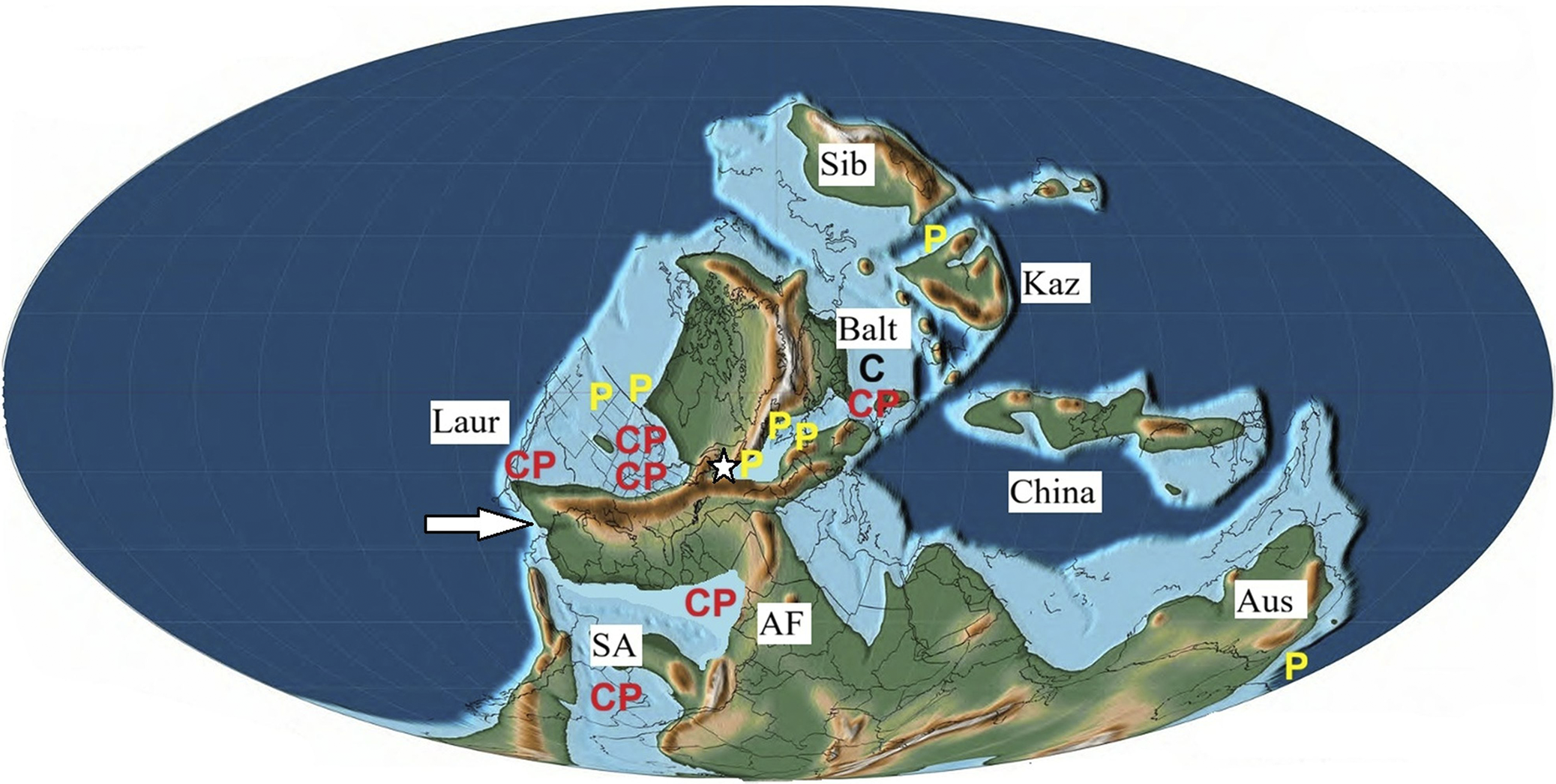
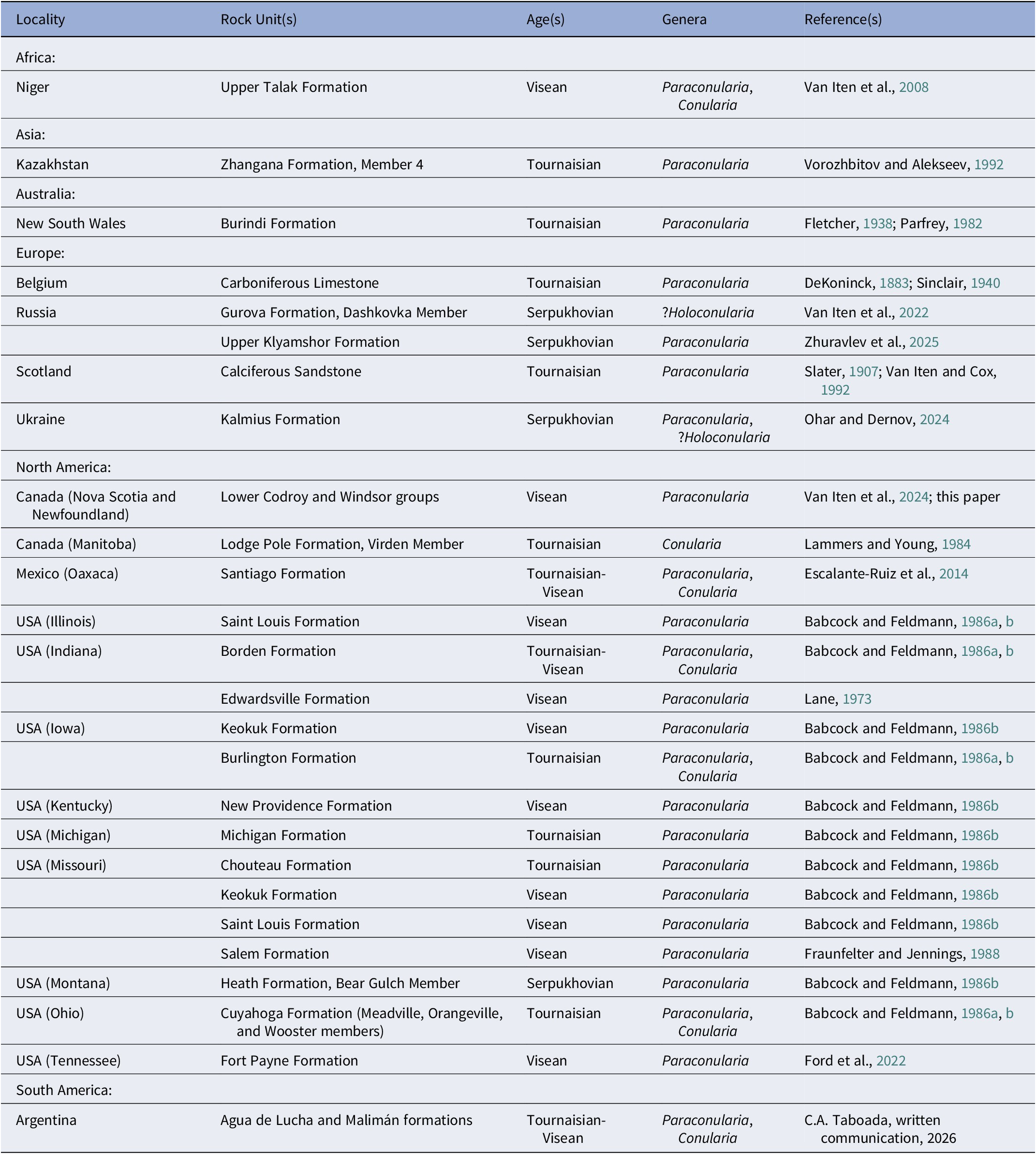
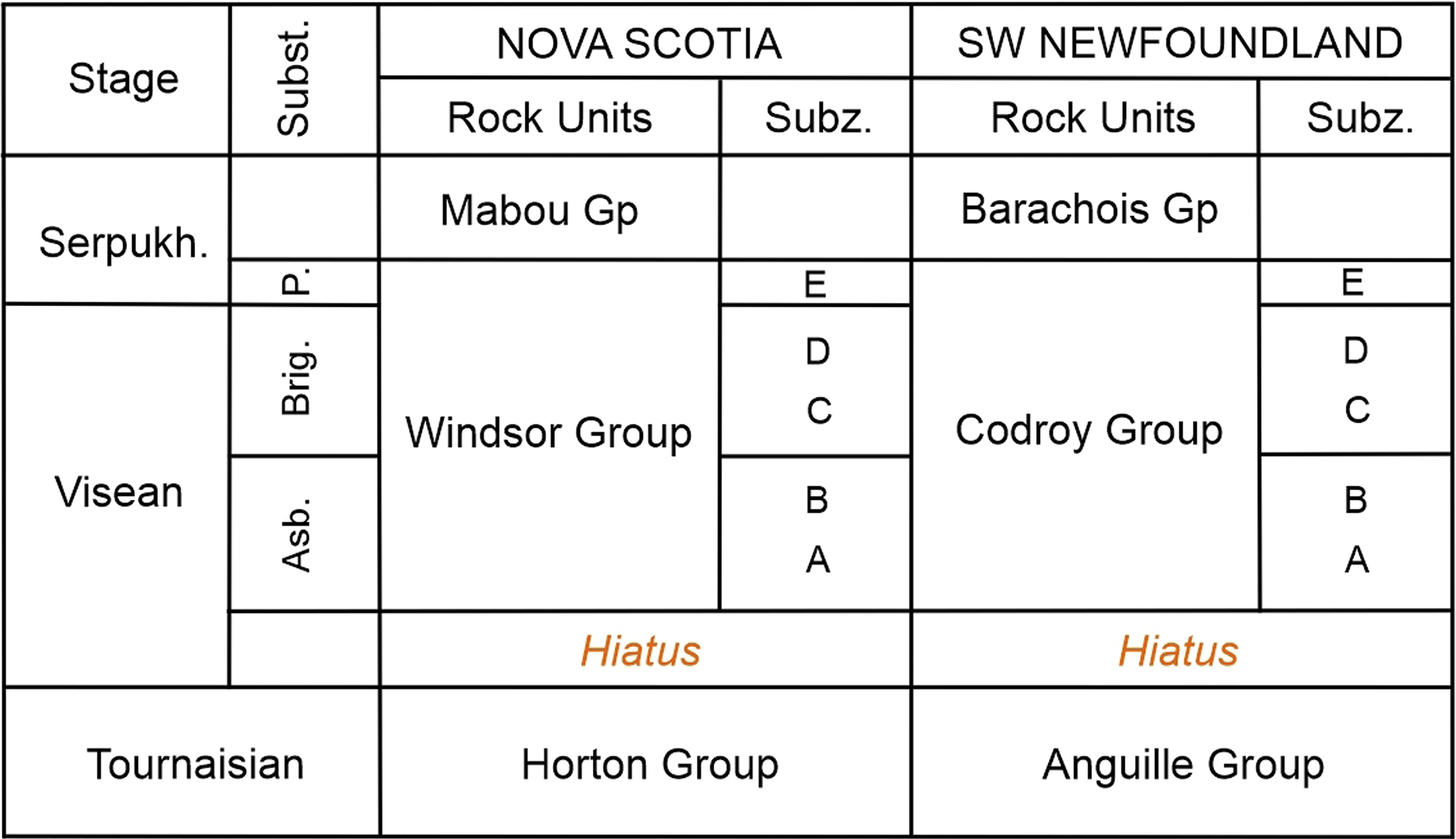
Reflecting the long-term decline in the generic diversity of order Conulariida Miller and Gurley, Reference Miller and Gurley1896 following its peak during Mid–Late Ordovician times (Leme et al., Reference Leme, Simões, Rodrigues, Van Iten and Marques2008, fig. 1; Bernad et al., Reference Bernad, Echevarría and Ros-Franch2026, figs. 1, 2), the global fossil record of conulariid cnidarians in the Mississippian System is dominated by the genus Paraconularia Sinclair, Reference Sinclair1940 (Fig. 1; Table 1). Thus, most Mississippian conulariid faunas consist of one or two species in Paraconularia plus, in some cases, Conularia Miller in Sowerby, Reference Sowerby1821 or, possibly, Holoconularia Hergarten, Reference Hergarten1985. The cosmopolitan distribution of these conulariids was facilitated by the Devonian–Carboniferous, Austropanthalassic-Rheic migration corridor (e.g., Torres-Martínez and Sour-Tovar, Reference Torres-Martínez and Sour-Tovar2023), the westernmost portion of which directly connected Gondwana to Laurentia (Fig. 1). In the Maritimes Basin of Atlantic Canada, in Nova Scotia and the Saint George’s Bay area of southwestern Newfoundland, highly fossiliferous, late Visean limestones in the Windsor (Nova Scotia) and Codroy (Newfoundland) groups contain unusually abundant, three-dimensional conulariids currently attributed to a single species, P. planicostata (Dawson, Reference Dawson1868) (e.g., Van Iten et al., Reference Van Iten, Snyder and Tollerton2024 and references cited therein). Bell (Reference Bell1929) first subdivided the Windsor Group in its type area in central Nova Scotia into five macrofaunal subzones, designated subzones A–E and later (Bell, Reference Bell1948) recognized in the Codroy Group of southwestern Newfoundland (Fig. 2). These subzones range collectively from early Asbian to Pendleian in age (P.S. Giles, written communication, 2026; Fig. 2). Paraconularia planicostata has been reported from all five subzones in Nova Scotia and from the lowermost (or A) macrofaunal subzone in southwestern Newfoundland (Bell, Reference Bell1929; Stacey, Reference Stacy1953: Bamber and Copeland, Reference Bamber and Copeland1970; Moore and Ryan, Reference Moore and Ryan1976; Giles et al., Reference Giles, Boehner and Ryan1979; Dix, Reference Dix1982; Dix and James, Reference Dix and James1987, Reference Dix and James1989; Lavoie and Sami, Reference Lavoie and Sami1998; Jutras et al., Reference Jutras, Ryan and Fitzgerald2006; Ryan and Giles, Reference Ryan, Giles, MacDonald and MacDonald2017). In the A and B subzones, which are early and late Asbian in age, respectively (P.S. Giles, written communication, 2026; Fig. 2), P. planicostata is a minor component of low-diversity macrofaunas containing abundant, stick-like trepostomes and closed articulated terebratulids (Beecheria Hall and Clarke, Reference Hall and Clarke1894). These are associated with diminutive bivalves and gastropods and, in certain cases, microbial mounds and encrustations as well as possible vestimentiferans (e.g., Bell, Reference Bell1929; Stacy, Reference Stacy1953; Dix, Reference Dix1982; Dix and James, Reference Dix and James1987, Reference Dix and James1989; von Bitter et al., Reference von Bitter, Scott and Schenk1990, Reference von Bitter, Scott and Schenk1992; Dix and Edwards, Reference Dix and Edwards1996). Notably absent in these limestones are corals, echinoderms, and (in certain cases) cephalopods, three groups of normal marine invertebrates that are present in many other limestones of Mississippian age (e.g., Ausich, Reference Ausich, Hess, Ausich, Brett and Simms1999; Krause and Meyer, Reference Krause and Meyer2004). Together with the numerical dominance of a handful of macrofossil species, the absence of the aforementioned normal marine taxa suggests that the depositional environments of at least some of the limestones in the Codroy and Windsor groups were restricted. Indeed, the original depositional environment of Paraconularia-bearing limestones in the lower Big Cove Formation (Port au Port Peninsula, southwestern Newfoundland; A macrofaunal subzone) has been interpreted in two mutually conflicting ways: as a shallow nearshore setting influenced by freshwater influx (Dix, Reference Dix1982; Dix and James, Reference Dix and James1987, Reference Dix and James1989; Dix and Edwards, Reference Dix and Edwards1996; see also Jutras et al., Reference Jutras, Ryan and Fitzgerald2006); or, alternatively, as a deep offshore, low-temperature hydrothermal-vent zone characterized by substantial variation in salinity, dissolved oxygen, and pH (von Bitter et al., Reference von Bitter, Scott and Schenk1990, Reference von Bitter, Scott and Schenk1992; see also Schenk et al., Reference Schenk, von Bitter and Matsumoto1994). Importantly, under both hypotheses, the conulariids are interpreted as opportunistic organisms capable of inhabiting and even thriving in stressed bottom environments. However, and as discussed below, many of the specimens examined in the present study show evidence of having been broken prior to or during final burial, an observation which tends to favor the shallow nearshore hypothesis (Van Iten et al., Reference Van Iten, Tollerton, Ford and Hunter2020).
Paleobiogeographical map showing the general conulariid localities of Mississippian (Tournaisian through Serpukhovian) age. Base map modified from paleogeographical map number 63 (Middle Mississippian, Visean) of Scotese (Reference Scotese2021). AF = Africa; Aus = Australia; Balt = Baltica; C (black) = Conularia (?Holoconularia) present; CP (red) = both Conularia and Paraconularia present; Kaz = Kazakhstania; Laur = Laurentia; P (yellow) = Paraconularia present; SA = South America; Sib = Siberia; white arrow = westernmost portion of the Austropanthalassic-Rheic migration corridor, which directly linked Laurentia to Gondwana (South America and Africa); white star = Maritimes Basin.

Figure 1. Long description
A global paleogeographical map in an oval projection.
* In the North, Sib is positioned at the top center, with a yellow P marker on its southeastern coast.
* To the East of Sib is Kaz, and further South is China.
* In the West, the large landmass Laur contains several markers. A white arrow on the far West points East toward the landmass. Within Laur, there are two yellow P markers in the Northwest, two red C P markers in the West-central region, and a white star in the center representing the Maritimes Basin.
* Moving East from the white star along the central mountain range, there are two yellow P markers followed by a black C and a red C P on the landmass Balt.
* In the South, the supercontinent Gondwana includes S A in the Southwest with a red C P marker, A F in the South-central region with a red C P marker to its North, and Aus in the Southeast with a yellow P marker on its southern coast.
* The map uses a color-coded system for fossil presence: black C for Conularia, yellow P for Paraconularia, and red C P for both genera.
Selected global occurrences of conulariid genera in the Mississippian System. For additional formations and localities in the USA and Canada, refer to Babcock and Feldmann (Reference Babcock and Feldmann1986b, appendix A)

Table 1. Long description
The table is organized into five columns: Locality, Rock Unit(s), Age(s), Genera, and Reference(s).
* Africa: In Niger, the Upper Talak Formation (Visean) contains Paraconularia and Conularia.
* Asia: In Kazakhstan, the Zhangana Formation Member 4 (Tournaisian) contains Paraconularia.
* Australia: In New South Wales, the Burindi Formation (Tournaisian) contains Paraconularia.
* Europe:
- Belgium: Carboniferous Limestone (Tournaisian) contains Paraconularia.
- Russia: Gurova Formation (Serpukhovian) contains ?Holoconularia; Upper Klyamshor Formation (Serpukhovian) contains Paraconularia.
- Scotland: Calciferous Sandstone (Tournaisian) contains Paraconularia.
- Ukraine: Kalmius Formation (Serpukhovian) contains Paraconularia and ?Holoconularia.
* North America:
- Canada: Nova Scotia and Newfoundland (Visean) contain Paraconularia; Manitoba (Tournaisian) contains Conularia.
- Mexico: Oaxaca (Tournaisian-Visean) contains Paraconularia and Conularia.
- U S A: Illinois, Indiana, Iowa, Kentucky, Michigan, Missouri, Montana, Ohio, and Tennessee show occurrences of Paraconularia and Conularia across Tournaisian, Visean, and Serpukhovian ages.
* South America: In Argentina, the Agua de Lucha and Malimán formations (Tournaisian-Visean) contain Paraconularia and Conularia.
Group-level stratigraphical chart for Mississippian strata in the Maritimes Basin in Nova Scotia (central Nova Scotia plus Cape Breton Island) and southwestern Newfoundland (Bay Saint George Subbasin), Atlantic Canada. Figure modified from Utting and Giles (Reference Utting and Giles2004, fig. 2), based in part on the stratigraphical chart of Waldron et al. (Reference Waldron, Giles and Thomas2017) and with additional input from P.S. Giles (written communication, 2026). ‘Hiatus’ refers to Visean strata older than Asbian in age missing (from Utting and Giles, Reference Utting and Giles2004). Asb. = Asbian; Brig. = Brigantian; Gp = Group; P. = Pendleian (three substages in the British time scale); Serpukh. = Serpukhovian; Subst. = Substage; Subz. = Subzone.

Figure 2. Long description
The chart is organized into six main columns.
* The first column, Stage, lists from top to bottom: Serpukh. (Serpukhovian), Visean, and Tournaisian.
* The second column, Subst. (Substage), aligns with the stages. For Serpukh., the substage is blank. For Visean, it is divided into P., Brig. (Brigantian), and Asb. (Asbian).
* The third and fourth columns cover Nova Scotia. Under Rock Units, the Mabou Gp (Group) aligns with Serpukh. The Windsor Group spans the Visean substages. Below this is a Hiatus in orange text, followed by the Horton Group aligning with the Tournaisian. The Subz. (Subzone) column for Nova Scotia shows subzone E at the top of the Windsor Group, followed by a combined D and C block, and a combined B and A block at the base.
* The fifth and sixth columns cover S W Newfoundland. Under Rock Units, the Barachois Gp aligns with Serpukh. The Codroy Group aligns with the Visean substages. Below this is a Hiatus in orange text, followed by the Anguille Group aligning with the Tournaisian. The Subz. column for Newfoundland mirrors the Nova Scotia subzones with E at the top, a combined D and C block, and a combined B and A block at the base of the Codroy Group.
Paraconularia planicostata has not previously been diagnosed, and earlier descriptions (Dawson, Reference Dawson1868, Reference Dawson1878, Reference Dawson1891; Bell, Reference Bell1929; Stacy, Reference Stacy1953; Babcock and Feldmann, Reference Babcock and Feldmann1986b), all based on material from Nova Scotia, are in need of revision. Recently the five type specimens, again from Nova Scotia, were refigured by Van Iten et al. (Reference Van Iten, Snyder and Tollerton2024, fig. 1). Figured in this study are specimens from Newfoundland.
Material and methods
The present study is based on direct examination of the type and other reposited specimens of Paraconularia planicostata (N = 290) from multiple formations in Nova Scotia (central Nova Scotia and Cape Breton Island) and from the lower Big Cove Formation in southwestern Newfoundland. Together, these formations occur in the A and B macrofaunal subzones of Bell (Reference Bell1929). Although P. planicostata has been reported from macrofaunal subzones C–E, field prospecting by two of the present authors (HVI and RCF) near Windsor, central Nova Scotia and at Cape Dauphin, Cape Breton Island yielded no conulariids in this interval, and we did not find any specimens in museum collections. Most of the study specimens are from formations collectively occurring in five of the 22 fault-bounded subdivisions of the Maritimes Basin in Nova Scotia, Newfoundland, New Brunswick, Prince Edward Island, and the Magdalen Islands, Québec (see Waldron et al., Reference Waldron, Giles and Thomas2017 for a geological map of the entire basin along with correlated stratigraphical columns for the 22 structural subdivisions, 13 of which are subbasins). Host limestone units and localities in Nova Scotia include: (1) the B1 limestone member of the Enon Formation and the B2 limestone member of the Loch Lomond Formation at (B1 member) or near (B2 member) Irish Cove on the southern shore of Bras d’Or Lake, Cape Breton Island (B macrofaunal subzone in the Lomond-Glengarry Subbasin; Boehner, Reference Boehner1983, Reference Boehner1988; Boehner and Prime, Reference Boehner and Prime1993; Boehner and Giles, Reference Boehner and Giles2008; Van Iten et al., Reference Van Iten, Tollerton, Ford and Hunter2020, Reference Van Iten, Snyder and Tollerton2024) (for locality map see Van Iten et al., Reference Van Iten, Snyder and Tollerton2024, fig. 2; for detailed stratigraphical cross section, see Boehner and Prime, Reference Boehner and Prime1993, fig. 9); (2) the lower part of the Meadows Road Formation at Cape Dauphin, Cape Breton Island (B macrofaunal subzone in the Sydney Subbasin; Stacy, Reference Stacy1953; Boehner and Giles, Reference Boehner and Giles2008; Ryan and Giles, Reference Ryan, Giles, MacDonald and MacDonald2017) (for locality map see Boehner and Giles, Reference Boehner and Giles2008, fig. 5); (3) the Miller Creek Formation near Windsor, central Nova Scotia (B macrofaunal subzone in the Windsor-Kennetcook Subbasin; Ryan and Giles, Reference Ryan, Giles, MacDonald and MacDonald2017; Waldron et al., Reference Waldron, Giles and Thomas2017); and (4) the Gays River Formation in the village of Upper Musquodoboit (Mosher Limestone Company Quarry) in central Nova Scotia (A macrofaunal subzone in the Musquodoboit Subbasin; Giles et al., Reference Giles, Boehner and Ryan1979; Boehner et al., Reference Boehner, Giles, Murray and Ryan1989; Lavoie and Sami, Reference Lavoie and Sami1998; Jutras et al., Reference Jutras, Ryan and Fitzgerald2006) (for locality map see Jutras et al., Reference Jutras, Ryan and Fitzgerald2006, fig. 1). Specimens from southwestern Newfoundland are from the lower part of the Big Cove Formation in the Aguathuna quarries (Aguathuna East and West) and Lead Cove near the village of Aguathuna at the eastern extremity of the Port au Port Peninsula (A macrofaunal subzone in the Bay Saint George Subbasin; Dix, Reference Dix1982; Dix and James, Reference Dix and James1987, Reference Dix and James1989; Dix and Edwards, Reference Dix and Edwards1996; von Bitter et al., Reference von Bitter, Scott and Schenk1990, Reference von Bitter, Scott and Schenk1992; Van Iten et al., Reference Van Iten, Tollerton, Ford and Hunter2020) (for locality maps see von Bitter et al., Reference von Bitter, Scott and Schenk1990, fig. 1a, and 1992, fig. 1). Lastly, although P. planicostata has been reported from the Mississippian of the Magdalen Islands in southeastern Québec (Babcock and Feldmann, Reference Babcock and Feldmann1986b), we were unable to locate any such material (see, however, the occurrence subsection of the systematic paleontology section below).
Digital color or black-and-white photography of figured specimens was conducted in the National Museum of the Czech Republic (Prague) and the Department of Geology, University of Iowa (Iowa City). Color photographs (Figs. 3, 4) were taken with a Canon EOS 6D camera using low-angle illumination and without whitening to show the narrow dark color line corresponding to the internal midline carina on the faces. Black and white photographs (Fig. 5) were taken using a Canon EOS 5DSr Digital SLR camera with Stackshot macrorail and Zerene image stacking software (again without whitening).
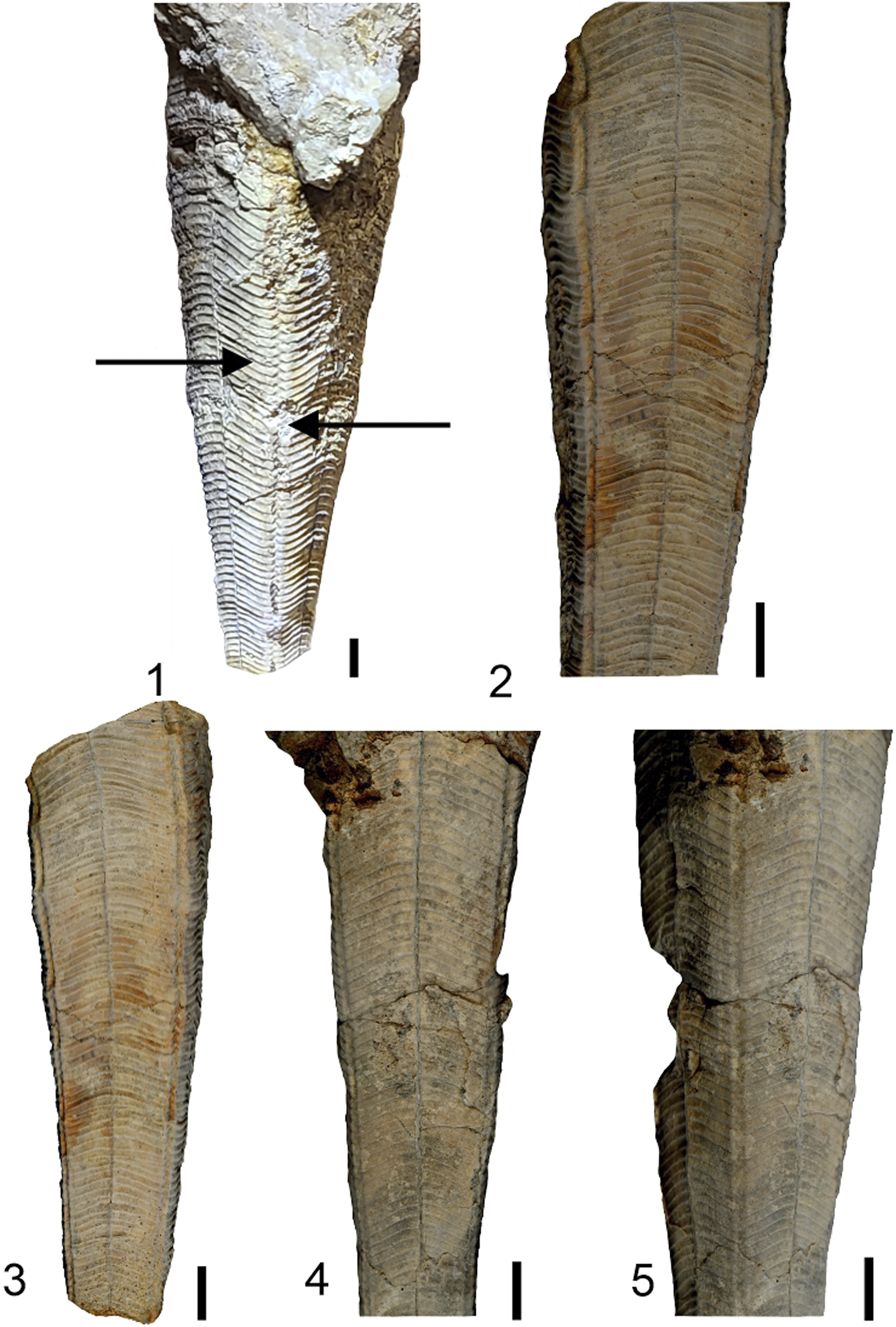
Paraconularia planicostata (Dawson, Reference Dawson1868), lower Big Cove Formation, lower Codroy Group (Mississippian, late Visean [early Asbian], A macrofaunal subzone of Bell, Reference Bell1929); Aguathuna West, Port au Port Peninsula, Bay Saint George Subbasin, southwestern Newfoundland: (1) NM S 4948, view of a corner sulcus (arrows), showing clear bending and alternation of the terminal portions of the transverse ribs, a characteristic feature of the type species of Paraconularia; (2–5) NM S 4947: (2–4) views of three different faces of the specimen, showing the trace (dark narrow line) of the internal midline carina; (5) view of one of the corners of the specimen. Specimens oriented with the oral end at the top. Scale bars = 5 mm.

Figure 3. Long description
A multi-panel photo containing five views of fossilized conulariid specimens, all oriented with the oral end at the top. Each panel includes a 5 mm scale bar at the bottom right.
* Panel 1: A light-colored, conical specimen labeled N M S 4948. Two horizontal black arrows point to a corner sulcus where transverse ribs show distinct bending and alternation at the junction.
* Panel 2: A close-up view of specimen N M S 4947 showing a flat face with fine, horizontal transverse ribs and a dark, narrow vertical line in the center representing the internal midline carina.
* Panel 3: A full-length view of the same specimen N M S 4947, showing the tapering conical shape and the consistent midline carina running vertically through the center of the face.
* Panel 4: A different face of specimen N M S 4947, displaying a slightly darker, weathered texture but maintaining the visible vertical midline carina and horizontal ribbing.
* Panel 5: A view focusing on one of the corners of specimen N M S 4947, showing the transition of the ribbing pattern across the angular edge of the fossil shell.
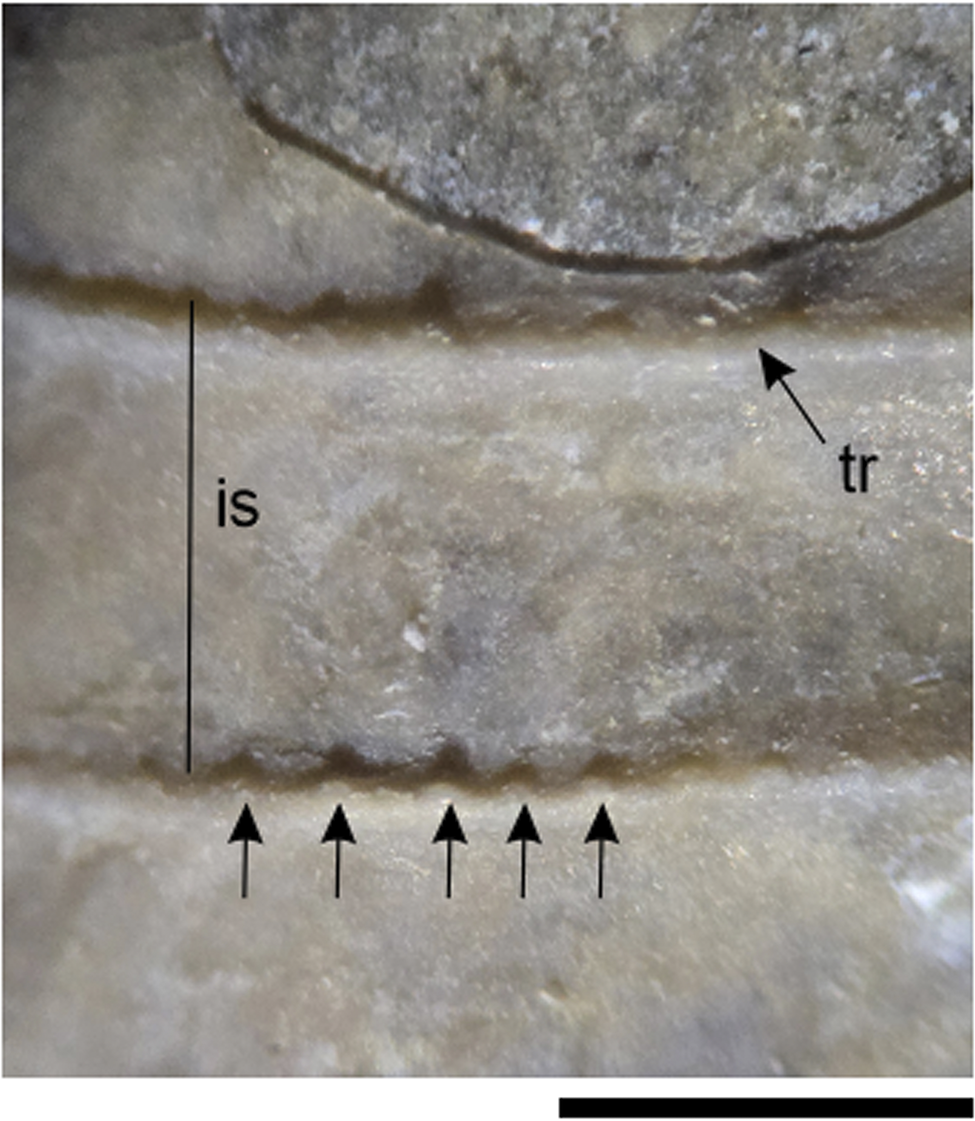
Paraconularia planicostata (Dawson, Reference Dawson1868), lower Big Cove Formation, lower Codroy Group (Mississippian, late Visean [early Asbian], A macrofaunal subzone of Bell, Reference Bell1929); Aguathuna West, Port au Port Peninsula, Bay Saint George Subbasin, southwestern Newfoundland: NM S 6198, detail of two transverse ribs (tr) and the intervening broad interspace (is) on one of the faces. Specimen oriented with the oral end at the top. The transverse ribs preserve minute nodes (arrows), but the interspaces are essentially smooth and lack longitudinal extensions of the nodes (interspace ridges). Scale bar = 1 mm.

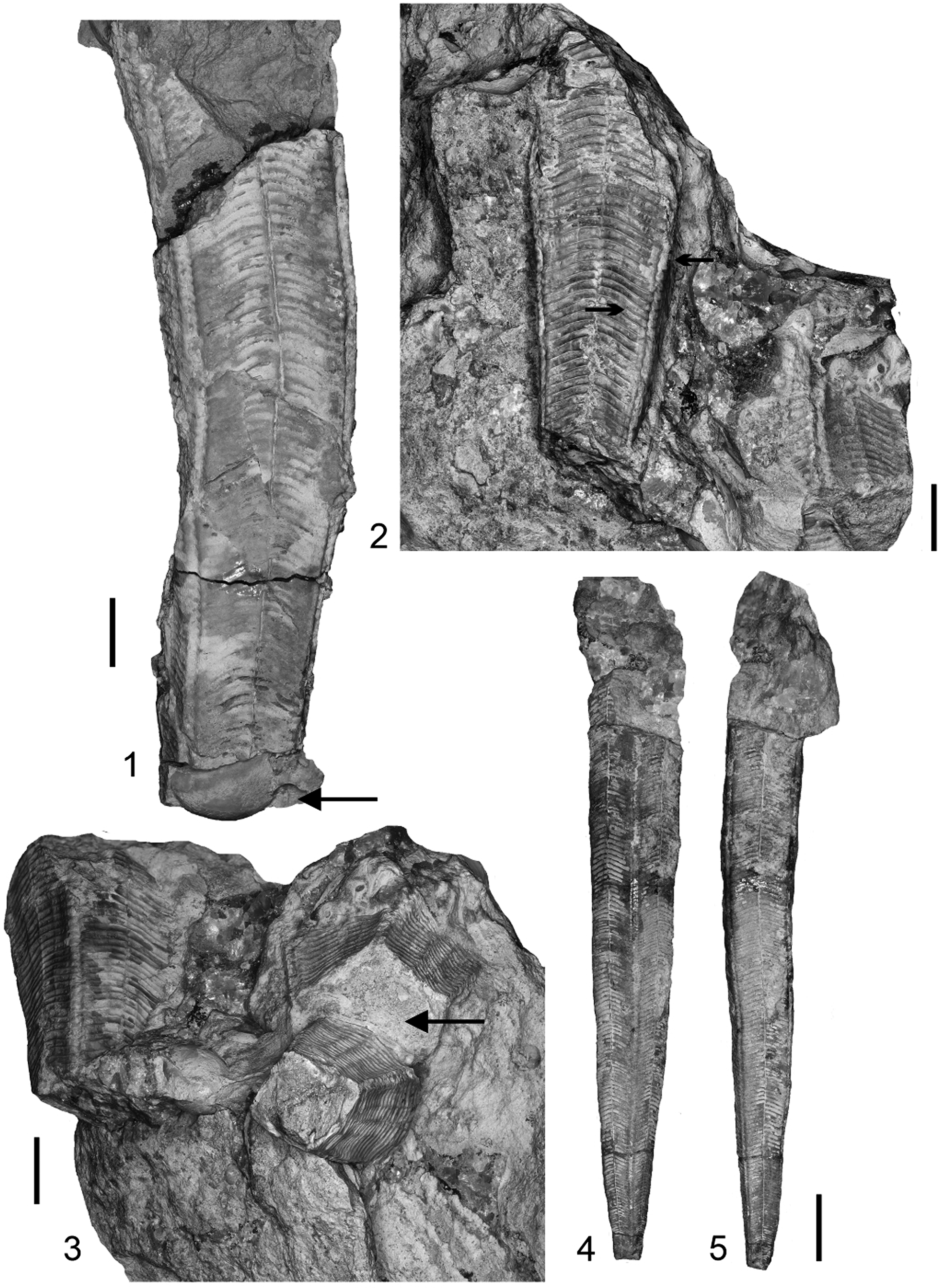
Paraconularia planicostata (Dawson, Reference Dawson1868), lower Big Cove Formation, lower Codroy Group (Mississippian, late Visean [early Asbian], A macrofaunal subzone of Bell, Reference Bell1929); Port au Port Peninsula, Bay Saint George Subbasin, southwestern Newfoundland: (1) facial view of the longest fragment of the largest specimen (total preserved length ~186 mm), originally inverted in the outcrop and with the apical end, truncated well above the former apex, partially abutting an articulated Beecheria shell (arrow) (Aguathuna East; GSC 143920a); (2) partial specimen, preserved on a small piece of limestone and exhibiting subtle interspace ridges (arrows) that line up across the transverse ribs (Aguathuna West; GSC 143921a); (3) different view of the limestone block in (2), showing a partial specimen that was broken in half (arrow) prior to final burial, with the two fragments rotated and translated relative to each other (Aguathuna West; GSC 143921b); (4, 5) corner (4) and facial (5) views of a slender specimen that has been truncated a short distance above the former apex and below the apertural margin (Lead Cove; GSC 143922). Specimens oriented with the oral end at the top. Scale bars = 6 mm (2, 3), 9.5 mm (1), 10 mm (4, 5).

Figure 5. Long description
A multi-panel photo containing five views of fossilized specimens.
Panel 1 at the top left shows a long, slender, vertically oriented fossil with a preserved length of approximately 186 mm. An arrow at the bottom proximal end points to an articulated Beecheria shell abutting the truncated apex. A vertical scale bar of 18 mm is positioned to the left.
Panel 2 at the top right displays a partial specimen embedded in limestone. Two horizontal arrows point to subtle interspace ridges lining up across the transverse ribs. A vertical scale bar of 7 mm is on the right.
Panel 3 at the bottom left shows a different view of the limestone block from panel 2. An arrow points to a specimen broken into two fragments that are rotated and translated relative to each other. A vertical scale bar of 7 mm is on the left.
Panels 4 and 5 at the bottom right show a slender specimen from two different angles. Panel 4 is a corner view and panel 5 is a facial view. Both show the specimen truncated above the apex and below the apertural margin. A vertical scale bar of 16 mm is positioned between the two views.
Repositories and institutional abbreviations
The study specimens are housed in the following institutions: (1) the Redpath Museum (McGill University), Montréal, Québec, Canada (RM(MU)); (2) the Department of Earth and Environmental Science, Acadia University, Wolfville, Nova Scotia, Canada (AC); (3) the Nova Scotia Museum of Natural History, Halifax, Canada (NSM); (4) the Geological Survey of Canada, Ottawa, Ontario (GSC); (5) the Musée de Paléontologie et de l’Evolution, Montréal, Québec, Canada (MPEP); (6) the Carnegie Museum, Pittsburgh, Pennsylvania, USA (CM); (7) the National Museum of Natural History, Washington, DC, USA (USNM); (8) the Yale Peabody Museum, New Haven, Connecticut, USA (YPM); (9) the National Museum of Natural History, Prague, Czech Republic (NM S); and (10) The Natural History Museum, London, UK (G and PG).
Systematic paleontology
Phylum Cnidaria Verrill, Reference Verrill1865
Subphylum Medusozoa Petersen, Reference Petersen, Larwood and Rosen1979
Class Scyphozoa Götte, Reference Götte1887
Order Conulariida Miller and Gurley, Reference Miller and Gurley1896
Conulariida family indet.
Genus Paraconularia Sinclair, Reference Sinclair1940
Type species
Conularia inaequicostata DeKoninck, Reference DeKoninck1883 from the Lower Mississippian (Tournaisian) Carboniferous Limestone of Belgium.
Paraconularia planicostata (Dawson, Reference Dawson1868)
Reference Dawson1868 Conularia planicostata; Dawson, p. 307, fig. 117.
Reference Dawson1878 Conularia planicostata; Dawson, p. 307, fig. 117.
Reference Dawson1891 Conularia planicostata; Dawson, p. 307, fig. 117.
Reference Bell1929 Conularia planicostata; Bell, p. 98, pl. 32, figs. 1, 2.
Reference Stacy1953 Conularia planicostata; Stacy, p. 55, pl. 4, fig. 1.
Reference Bamber and Copeland1970 Conularia planicostata; Bamber and Copeland, pl. 15, fig. 3.
Reference Alison and Carroll1972 Conularia planicostata; Alison and Carroll, p. 17.
Reference Moore and Ryan1976 Paraconularia planicostata; Moore and Ryan, pl. 5, fig. 10.
Reference Babcock and Feldmann1986a Paraconularia planicostata; Babcock and Feldmann, fig. 3.1.
Reference Babcock and Feldmann1986b Paraconularia planicostata; Babcock and Feldmann, p. 429, figs. 27.1–27.4, 27.6–27.8.
Reference Babcock, Feldmann, Hoffman and Nitecki1986c Paraconularia planicostata; Babcock and Feldmann, fig. 2G.
Reference Sendino and Darrell2008 Conularia sp. indet.; Sendino and Darrell, p. 13.
Reference Van Iten, Snyder and Tollerton2024 Paraconularia planicostata; Van Iten et al., p. 152, fig. 1.
Type specimens (5)
RM(MU) 2749, holotype from the B1 limestone member of the Enon Formation at Irish Cove, Cape Breton Island (see Van Iten et al., Reference Van Iten, Snyder and Tollerton2024, fig. 1.1); GSC 21767, hypotype from the B1 limestone member of the Enon Formation at Irish Cove, Cape Breton Island (see Bamber and Copeland, Reference Bamber and Copeland1970, pl. 15, fig. 3; Van Iten et al., Reference Van Iten, Snyder and Tollerton2024, fig. 1.3); GSC 7672a and 7672, 2 plesiotypes from the lower Windsor Group near the town of Windsor, central Nova Scotia (see Bell, Reference Bell1929, pl. 32, figs. 1, 2; Van Iten et al., Reference Van Iten, Snyder and Tollerton2024, fig. 1.4., 1.5); NSM 023GF017, hypotype from the B1 limestone member of the Enon Formation at Irish Cove, Cape Breton Island (see Moore and Ryan, Reference Moore and Ryan1976, pl. 5, fig. 10; Van Iten et al., Reference Van Iten, Snyder and Tollerton2024, fig. 1.2).
Diagnosis
Transverse ribs bell-curve-shaped or chevron-like on the faces, uninterrupted or alternating along the facial midlines, which are associated with a low, narrow, keel-like internal carina that can be displaced toward one of the two corners bounding a given face. Corner sulci neither thickened nor bearing an internal carina. Nonexfoliated transverse ribs bearing a single row of minute, closely spaced (4–8 per mm), subcircular nodes. Interspaces smooth or (in certain specimens from Newfoundland) crossed by subtle longitudinal elevations (folds) that are colinear across the transverse ribs.
Occurrence
Mississippian Windsor Group, central Nova Scotia and Cape Breton Island, Atlantic Canada; upper Visean Stage, lower and upper Asbian substage (A and B macrofaunal subzones of Bell, Reference Bell1929); can also be present in the Brigantian substage of the upper Visean Stage (C and D macrofaunal subzones of Bell, Reference Bell1929) as well as in the Pendleian substage of the lower Serpukhovian Stage (E macrofaunal subzone of Bell, Reference Bell1929). Mississippian Codroy Group, Bay Saint George Subbasin, southwestern Newfoundland, Atlantic Canada; upper Visean Stage, lower Asbian substage (A macrofaunal subzone of Bell, Reference Bell1929). Can also be present in the Windsor Group of the Magdalen Islands, Québec (Havre aux Maisons Formation, Cap Adèle Member [B macrofaunal subzone of Bell, Reference Bell1929]; see Giles, Reference Giles2008) and southeasternmost New Brunswick (Macumber and Gays River formations [A macrofaunal subzone of Bell, Reference Bell1929]; refer to stratigraphical columns B–F by Waldron et al., Reference Waldron, Giles and Thomas2017).
Revised description
Partial specimens ranging from < 10% to > 80% complete, consisting in the latter case of the four-sided periderm truncated a short distance above the former apex and below the apertural (oral) margin (Fig. 5.4, 5.5). Schott (apical wall), patches (Van Iten, Reference Van Iten1992a), and apical holdfast not observed. Maximum preserved length ~186 mm (Fig. 5.1), minimum preserved width at the apical end ~1 mm. Periderm straight, arcuate, or sinuous, with the transverse cross section square or nearly so. Angle between the two corners bordering a given face (apical angle) varying along the length of the periderm, ranging among all specimens from ~ -1° (i.e., tapering adaperturally rather than toward the apical end) to ~25°, with the apical angle being greatest near the (former) apex. Transverse ribs on the faces bell-curve-shaped (“inflected circular curve style”; Babcock and Feldmann, Reference Babcock and Feldmann1986a, fig. 3.2) or chevron-like (“inflected gothic arch style”; Babcock and Feldmann, Reference Babcock and Feldmann1986a, fig. 3.3), with the latter type defining an obtuse angle of ~140–155°, and with the former type showing (in certain cases) adapical recurvature near the facial midlines (Fig. 5.1, 5.2). Transverse ribs 3–20 per 5 mm, decreasing in spacing adapically, continuous across or alternating along the facial midlines. Transverse ribs bending adapertureward on the rounded shoulders of the corner sulci, terminating and alternating within these features (Fig. 3.1, 3.5). Corner sulci can also exhibit fine, closely spaced, adaperturally arching transverse wrinkles. Nonweathered/nonexfoliated transverse ribs exhibiting a single row of minute, subcircular nodes, 4–8 per mm (Fig. 4). Interspaces between the transverse ribs smooth (Fig. 4), irregularly wrinkled, or (in certain specimens from Newfoundland) with subtle, rounded longitudinal elevations that line up across the transverse ribs (Fig. 5.2, 5.3). Facial midlines associated with a low, narrow, keel-like internal carina that is marked on the external surface of the periderm by a deep brown or whitish line that can be displaced toward one of the two corners bordering a given face (Fig. 3.2–3.4).
Additional material (285 specimens)
AC 1001a–c, 3 specimens from the lower Big Cove Formation near the village of Aguathuna, southwestern Newfoundland; AC 0245, 0246, 0347, 1002–1040, 41 specimens from the Enon and Loch Lomond formations (B1 and B2 limestone members, respectively) and the Miller Creek Formation on Cape Breton Island and in central Nova Scotia, respectively; CM 22667, 1 specimen from the B1 limestone member of the Enon Formation at Irish Cove, Cape Breton Island (see Babcock and Feldmann, Reference Babcock and Feldmann1986b, figs. 27.6–27.8); NSM 990GF43.1, 3 specimens from the Gays River Formation in the Mosher Limestone Company Quarry in the village of Upper Musquodoboit, central Nova Scotia; NSM 024GF027.001–016, 30 specimens from the lower Meadows Road Formation at Cape Dauphin, Cape Breton Island; NSM 023GF001.001–016, 75 specimens from the B1 limestone member of the Enon Formation at Irish Cove, Cape Breton Island; GSC locality 24841, 8 specimens from an unspecified formation and limestone (probably B macrofaunal subzone in the lower Windsor Group; see Stacy, Reference Stacy1953, p. 39, 40) near the village of Baddeck, Cape Breton Island; GSC locality 24844, 6 specimens from an unspecified formation and limestone (probably B macrofaunal subzone in the lower Windsor Group; see Stacy, Reference Stacy1953, p. 39, 40) near Lewis Mountain (Middle River Settlement), Cape Breton Island; GSC 141449–141598, 143920–143922, 51 specimens from the lower Big Cove Formation near the village of Aguathuna, southwestern Newfoundland; MPEP 1618.1–5, 1619.1–5, 56 specimens from the lower Big Cove Formation near the village of Aguathuna, southwestern Newfoundland; NM S 4947, 4948, 6198, 3 specimens from the lower Big Cove Formation near the village of Aguathuna, southwestern Newfoundland; USNM 33785, 1 specimen (previously identified as Conularia crustula White, Reference White1880) from the lower Big Cove Formation near the village of Aguathuna, southwestern Newfoundland; YPM IP 209253, 1 specimen from the B1 limestone member of the Enon Formation at Irish Cove, Cape Breton Island; G 14619, 1 specimen from the lower Windsor Group near the Straight of Canso, Nova Scotia; PG 4319, 4320, 2 specimens from the lower Windsor Group near the village of Shubenacadie, central Nova Scotia; PG 4324–4327, 3 specimens from the lower Windsor Group near Bras d’Or Lake, Cape Breton Island.
Taphonomy
Although conulariid fossils in general are nearly always incomplete, Paraconularia planicostata from the lower Big Cove Formation of southwestern Newfoundland is exceptional in showing, in many cases, compelling evidence of having been truncated prior to or during final burial (Fig. 5.1, 5.3). The irregular apical and/or apertural margins of such specimens directly abut other fossils (e.g., Beecheria, gastropods, and other conulariids; Fig. 5.1), are overlapped by laminated microbial rinds, or consist of two or more, mutually adjacent fragments showing translation and rotation relative to each other (Fig. 5.3). As proposed by Van Iten et al. (Reference Van Iten, Tollerton, Ford and Hunter2020), such specimens probably underwent mechanical breakage during short-distance transport, an interpretation that favors the hypothesis, mentioned above, that the host limestone was deposited in a shallow nearshore setting subject to episodes of high physical energy.
Comparisons (genus and species levels)
Paraconularia is the longest ranging and most widespread genus of conulariid, having been found on all continents except Antarctica in strata spanning the interval from the terminal Ediacaran to the Upper Triassic (Leme et al., Reference Leme, Van Iten and Simões2022). It should be noted, however, that Paraconularia is a difficult genus to diagnose, and partly for this reason, it has been suggested that Paraconularia is paraphyletic (i.e., defined on the basis of primitive characters; Van Iten et al., Reference Van Iten, Konate and Moussa2008; see also Min et al., Reference Min, Wang, Wang and Guo2022). Nevertheless, in most species, including P. inaequicostata (the type species), the transverse ribs bend or curve adaperturally on the shoulders of the corner sulci, within which they terminate and overlap each other in zipper-like fashion (see, e.g., figures by Babcock and Feldmann, Reference Babcock and Feldmann1986b; Fig. 3.1, 3.5). Additionally, the facial midlines lack an external ridge such as that seen in Climacoconus Sinclair, Reference Sinclair1952, a close relative of Paraconularia with similar characteristics of the corner sulci (Van Iten et al., Reference Van Iten, Muir, Simões, Leme, Marques and Yoder2016). Finally, the transverse ribs of most species in Paraconularia exhibit fine, closely spaced nodes that can extend into the interspaces as extremely narrow, superficially spine-like corrugations (“adapical” and/or “adapertural spines”; Babcock and Feldmann, Reference Babcock and Feldmann1986a, fig. 2.2).
Paraconularia planicostata is one of only three species in the genus that have been shown to possess a continuous internal carina at or near the facial midlines. This structure or its mold are preserved in nearly every reposited specimen of the Canadian species. The other two species are P. crustula (White, Reference White1880) from the Pennsylvanian of the midcontinental USA and P. ulrichiana (Clarke, Reference Clarke1913) from the Lower Devonian of South America and South Africa. The midline carinae of these species were illustrated by Van Iten (Reference Van Iten1992b, text-fig. 3B; P. crustula), Babcock et al. (Reference Babcock, Feldmann, Wilson and Suárez-Riglos1987, fig. 8; P. ulrichiana), and Guedes et al. (Reference Guedes, Siviero and Scheffler2023, fig. 6A; P. ulrichiana). Paraconularia crustula differs from P. planicostata and P. ulrichiana in having carinate corners. Paraconularia ulrichiana differs from P. planicostata in having only bell-curve-like transverse ribs and in lacking nodes.
Remarks
In agreement with Dix (Reference Dix1982) and Dix and James (Reference Dix and James1987, Reference Dix and James1989), we interpret Paraconularia from the lower Big Cove Formation in southwestern Newfoundland (A macrofaunal subzone of Bell, Reference Bell1929) to be conspecific with the earlier described P. planicostata from the lower Windsor Group in Nova Scotia (A and B macrofaunal subzones of Bell, Reference Bell1929). Additionally, we predict that a report (Bell, Reference Bell1948, p. 22) of ‘Conularia’ from the ‘Cormorant limestone’ (B macrofaunal subzone) at a single locality on the southern shore of Saint George’s Bay (southwestern Newfoundland) will prove to be of P. planicostata.
Owing in large part to fragmentation and loss of the exteriormost lamellae, fewer than 10% of the specimens of Paraconularia planicostata here examined exhibit all the anatomical features noted above in the diagnosis and description. This makes it difficult to assess whether or not specimens from various parts of the Martimes Basin can be interpreted as distinct subspecies or ecophenotypic variants. Regardless, nearly all specimens from Nova Scotia and Newfoundland preserve evidence of the internal midline carina, the anatomical details of which are essentially the same at all localities. Among the most worn specimens is the holotype from the B1 limestone member of the Enon Formation at Irish Cove on Cape Breton Island (Alison and Carroll, Reference Alison and Carroll1972; Van Iten et al., Reference Van Iten, Snyder and Tollerton2024). More specifically, and like most of the specimens observed in the present study, the holotype displays neither nodes nor subtle longitudinal folds, and the corner sulci are so effaced that the adapertural bending of the transverse ribs along the shoulders of the sulci is not readily apparent. Nevertheless, the distinctive internal midline carina is preserved, and the absence of nodes on the crests of the transverse ribs could simply be an artifact of physical weathering and/or mechanical exfoliation. Probably for this reason, all previous descriptions, which are based on specimens from Nova Scotia, either do not mention the presence of nodes (Dawson, Reference Dawson1868, Reference Dawson1878, Reference Dawson1891; Stacy, Reference Stacy1953) or state that such features are absent (Bell, Reference Bell1929; Babcock and Feldmann, Reference Babcock and Feldmann1986b). Babcock and Feldmann (Reference Babcock and Feldmann1986b) also reported that the apical angles (rates of adapertural expansion) of the faces of the periderm range from 18–25°, but our observations, based on a much larger sample, indicated that it is < 1° in the apertural (oral) region of large specimens (see also Bell, Reference Bell1929; Stacy, Reference Stacy1953). Babcock and Feldmann (Reference Babcock and Feldmann1986b, p. 429) described the geometry of the transverse ribs on the faces (“rod articulation”) as being “inflected gothic arch style in the apical region” and “gothic arch style elsewhere.” Our observations indicate that the transverse ribs assigned by Babcock and Feldmann (Reference Babcock and Feldmann1986b) to the second category are in fact most like Babcock and Feldmann’s (Reference Babcock and Feldmann1986a, fig. 3.2) inflected circular curve style, although in some cases, with inflection of the transverse ribs toward the apical end of the periderm near the facial midlines. Additionally, transverse ribs displaying inflected circular curve or inflected gothic arch geometry are present in the apical region of the largest specimens. Babcock and Feldmann (Reference Babcock and Feldmann1986b) also reported that P. planicostata exhibits one pair of opposing faces (the ‘major’ faces; Sugiyama, Reference Sugiyama1942; Babcock and Feldmann, Reference Babcock and Feldmann1986a) that are wider than the other two (the ‘minor’ faces; Sugiyama, Reference Sugiyama1942; Babcock and Feldmann, Reference Babcock and Feldmann1986a). Our observations, however, indicate that differences in width between the faces are slight.
Acknowledgments
The authors thank editor R. Elias and reviewers O. Vinn and G. Young for their corrections of and/or constructive comments on the original version of our manuscript. Financial support for this study was provided by the Hanover College Faculty Development Committee (HVI) and by the Ministry of Culture of the Czech Republic (DKRVO 2024-2028/2.III.b, National Museum, 00023272) (JB). Examination and/or loans of reposited specimens of Paraconularia planicostata were facilitated by M. Coyne (Department of Invertebrate Paleontology, Geological Survey of Canada, Ottawa, Ontario), T. Fedak (Nova Scotia Museum of Natural History, Halifax, Canada), A. Howell (Redpath Museum, McGill University, Montréal, Québec, Canada), J. Loxton (Cape Breton Fossil Centre, Sydney Mines and Department of Math, Physics and Geology, Cape Breton University, Sydney, Canada), M. Snyder (Department of Earth and Environmental Science, Acadia University, Wolfville, Nova Scotia, Canada), A. Kollar (Carnegie Museum of Natural History, Pittsburgh, Pennsylvania, USA), S. Butts (Yale University Peabody Museum, New Haven, Connecticut, USA), the late F. Collier (National Museum of Natural History, Washington, DC, USA), and J. Darrell (The Natural History Museum, London, UK). HVI and RCF thank M. Snyder, J. Loxton, and T. Matheson (Department of Math, Physics and Geology, Cape Breton University, Sydney, Nova Scotia, Canada) for assistance in the field near Windsor, central Nova Scotia (MS) and at Cape Dauphin, Cape Breton Island (JL and TM). HVI also thanks P.S. Giles (Natural Resources Canada) for advice concerning the formal names and ages of Paraconularia-bearing limestones in the Windsor and Codroy groups, and G.R. Dix (Department of Earth Sciences, Carleton University, Ottawa, Ontario, Canada) for directing him to key papers on depositional environments of the lower Windsor Group. HVI and EW thank C.R. Scotese (Field Museum of Natural History and Northwestern University, Chicago, Illinois, USA) for providing them with his Middle Mississippian (Visean) paleogeographical map. One of the reposited conulariid specimens from the Gays River Formation in the village of Upper Musquodoboit, central Nova Scotia was donated by C. Mosher (Mosher Limestone Company Ltd). The specimens in Figure 5 were photographed by S. Mure-Rivaud (Department of Earth and Environmental Sciences, University of Iowa, Iowa City, USA). Finally, additional field assistance was provided by T. Van Iten, R.J. Van Iten, and H.L. Kraft.
Competing interests
The authors declare none.