



1. INTRODUCTION
With rising interest in intense short pulse laser plasma interaction, self-focusing continues to be an important issue (Sun et al., Reference Sun, Ott, Lee and Guzdar1987; Brandi et al., Reference Brandi, Manus, Mainfray and Lehner1993; Chen & Sudan, Reference Chen and Sudan1993; Esarey et al., Reference Esarey, Sprangle, Krall and Ting1997; Fiet et al., Reference Feit, Komashko, Musher, Rubenchik and Turitsyn1998; Osman et al., Reference Osman, Castillo and Hora1999; Hafizi et al., Reference Hafizi, Ting, Sprangle and Hubbard2000). In preformed plasma, it arises primarily due to relativistic mass and ponderomotive nonlinearities. For a Gaussian laser beam, these effects give rise to a refractive index profile that has maximum on laser axis and falls off monotonically away from it. The axial portion of the wavefront travels with smaller phase velocity than the marginal rays. As a result wavefront acquires a curvature and beam converges. Under certain conditions this may even give rise to complete evacuation of electrons from the axial region. The laser interaction with a gas jet target gives rise to an additional nonlinearity caused by tunnel ionization of atoms by the laser field. This nonlinearity causes defocusing of the beam. It also gives rise to super continuum generation and modification of the laser intensity profile into a ring distribution with minimum on axis (Chessa et al., Reference Chessa, Wispelaere, Dorchies, Malka, Marques, Hamoniaux, Mora and Amiranoff1999). A non-paraxial unified formalism of these processes has been developed (Liu & Tripathi, Reference Liu and Tripathi2000). The creation of a long plasma channel by a laser prepulse that can guide main laser pulse to many Rayleigh lengths has been experimentally demonstrated (Durfee & Milchberg, Reference Durfee and Milchberg1993). In rippled density plasmas, currently being employed for resonant harmonic generation, laser suffers periodic defocusing and self-focusing (Kaur & Sharma, Reference Kaur and Sharma2009). The study of self-focusing of intense laser pulses in plasmas is also relevant to laser driven electron acceleration (Esarey et al., Reference Esarey, Sprangle, Krall and Ting1996).
In the initial study on self-focusing of electromagnetic waves in magnetized laboratory plasmas, whistlers were observed to be focused above a threshold power (Stenzel, Reference Stenzel1975). These results were explained in terms of ponderomotive force induced density redistribution of the plasma caused on ion sound time scale (Sodha & Tripathi, Reference Sodha and Tripathi1977). Current laser plasma experiments employ much shorter and highly intense laser pulses where huge quasi-static magnetic fields are automatically generated. Experiments and particle in cell simulations have reported generation of transverse or azimuthal magnetic fields as well as longitudinal magnetic field (Pukhov & Myer-ter-vehn, Reference Pukhov and Myer-Ter-Vehn1996; Najmudin et al., Reference Najmudin, Tatarakis, Pukhov, Clark, Clarke, Dangor, Faure, Malka, Neely, Santala and Krushelnick2001; Tripathi et al., Reference Tripathi, Taguchi and Liu2005). Theoretical studies have shown that the presence of axial magnetic field decreases the minimum spot size and also enhances the self-focusing property of the circularly polarized (Jha et al., Reference Jha, Mishra, Upadhyaya and Raj2007) and the linearly polarized laser beam (Ghorbanalilu, Reference Ghorbanalilu2010). However, in these studies, ponderomotive effects and also the relativistic mass effect on electron cyclotron frequency have not been considered. The electron density modification due to ponderomotive effect is significant even in mildly relativistic regime. Moreover, the length at which complete electron expulsion occurs is also a sensitive function of magnetic field. Hence the modification in refractive index of the plasma due to both the relativistic and ponderomotive effects is important for determining the optimum magnetic field for enhancing the self-focusing of the laser beam.
In this paper, we study the self-focusing of laser in magnetized plasma with pulse duration shorter than the ion response time, and ponderomotive and relativistic nonlinearity being present simultaneously. In Section 2, the ponderomotive force due to laser pulse is determined for the first time including both magnetic field and relativistic mass effects. The modification in charge density due to ponderomotive force of the laser pulse in the presence of magnetic field is determined. Then plasma permittivity is obtained including both relativistic and ponderomotive effects. In Section 3, beam-width parameter equation is used to study the guide magnetic field effect on self-focusing of the laser beam. The threshold laser strength is determined for the onset of self-focusing of the laser beam. In Section 4, the results are summarized.
2. NONLINEAR PERMITTIVITY
Consider a right circularly polarized Gaussian laser beam of spot size r 0, propagating through uniform plasma of density n 0 in the presence of guide magnetic field B s ẑ. The electric and magnetic fields of the laser field are given by
 $$\vec{E} = \lpar \hat{x} + i \hat{y} \rpar A \lpar r\comma \; z \rpar \exp \left[-i \lpar {\rm {\rm {\rm \omega}}} t - k z \rpar \right] \comma $$
 $$\vec{B} = {\vec{k} \times \vec{E} \over {\rm {\rm {\rm \omega}}} } - {i\lpar \nabla A \times \lpar \hat{x} + i \hat{y}\rpar \rpar \over {\rm {\rm {\rm \omega}}}} \exp \lsqb \!\!- i\lpar {\rm {\rm {\rm \omega}}} t - kz\rpar \rsqb . $$
where k = (ω/c) (1 − (ω2p/(ω(γω − ωc)))1/2 , ωP=(4πn 0e 2/m)1/2 are the plasma frequency, ωc = eB s/mc is the electron cyclotron frequency, −e and m are the electronic charge and mass, and c is the velocity of light. At z = 0 the laser field amplitude is given by
 $$A^2=A^2_0 {\exp}\left[-r^2/r^2_0\right].$$
The laser imparts an oscillatory velocity to electrons given by
 $$\vec{v} = {eA\lpar \hat{x} + i \hat{y}\rpar \over mi\lpar {\rm {\rm {\rm \gamma}}} {\rm {\rm {\rm \omega}}} - {\rm {\rm {\rm \omega}}}_c \rpar } \exp \Big[ \!\!-\! i\lpar {\rm {\rm {\rm \omega}}} t - kz\rpar \Big] \comma $$
and exerts ponderomotive force given by
 $$\eqalign{{\vec {F_p}} & = - \displaystyle{m \over 2}\left( {\vec {v}^{\ast}} .\nabla {\gamma} {\vec {v}} \right) - \displaystyle{e \over 2}\left( {\vec {v}^{\ast}} \times {\rm {\vec {B}}} \right), \cr & =- \hat r\displaystyle{{e^2 } \over {4m{\rm \omega} ({\rm \gamma} {\rm \omega} - {\rm \omega} _c )}}\left[ \displaystyle{{2 - {{{\rm \omega} _c } / {{\rm \gamma} {\rm \omega} }}} \over {1 - {{{\rm \omega} _c } / {{\rm \gamma} {\rm \omega} }}}}\displaystyle{{\partial (AA^{\ast} )} \over {\partial r}} - \displaystyle{{{\rm \omega} _c AA^ {\ast } \over {{\rm \omega} {\rm \gamma} ^2 (1 - {{{\rm \omega} _c } / {{\rm \gamma} {\rm \omega} }})^2 }}\displaystyle{{\partial {\rm \gamma} } \over {\partial r}}} \right].}$$
Here γ is the relativistic factor deduced from the following relation
 $${\rm {\rm {\rm \gamma}}} = \left(1 + \displaystyle{{e^2 AA^{\ast} } \over m^2 {\rm {\rm {\rm \omega}}} ^2 \lpar 1 - {\rm {\rm {\rm \omega}}}_{c} /{{\rm {\rm {\rm \gamma}}} {\rm {\rm {\rm \omega}}} } \rpar ^2 c^2 } \right)^{1/2} . $$
This is a transcendental equation that can be solved numerically. The expression for γ can be written as fourth order differential equation in γ. Using Eq. (6) in Eq. (5) we get
 $$\vec{F}_p = - {\hat{r} \lpar mc^2\rpar \over 4{\rm {\rm {\rm \gamma}}} \left(1 - {\rm {\rm {\rm \omega}}}_c / {\rm {\rm {\rm \gamma}}} \right)^2} \left[2 - {{\rm {\rm {\rm \omega}}}_c \over {\rm {\rm {\rm \omega}}} {\rm {\rm {\rm \gamma}}}} - {{\rm {\rm {\rm \omega}}}_c / {\rm {\rm {\rm \omega}}} \lcub {\rm {\rm {\rm \gamma}}}^2 - 1\rcub \over 2 \lcub {\rm {\rm {\rm \gamma}}}^3 - {\rm {\rm {\rm \omega}}}_c / {\rm {\rm {\rm \omega}}} \rcub } \right]{\partial aa^{\ast} \over \partial r}. $$
For ωc → 0, this reduces to the usual expression
 $$\vec{F}_p = e\nabla {\rm {\rm {\rm \phi}}}_p\comma \; \quad {\rm {\rm {\rm \phi}}}_{\rm p} = - \displaystyle{{mc^2 } \over e} \left[\lpar 1 + a^2 \rpar ^{1/2} - 1 \right]\comma \; a = \displaystyle{{eA \over m{\rm {\rm {\rm \omega}}} c}}. $$
In the non-relativistic limit it reduces to (Sodha et al., Reference Sodha, Ghatak and Tripathi1976)
 $${\rm {\rm {\rm \phi}}}_{\rm p} = - {mc^2 \over e} {a^2 \over 4} {2 - {\rm {\rm {\rm \omega}}}_c / {\rm {\rm {\rm \omega}}} \over \lpar 1 - {\rm {\rm {\rm \omega}}}_c / {\rm {\rm {\rm \omega}}} \rpar ^2}. $$
One may note that  $\vec{F}_p$ changes sign at ω ~ ωc/2γ. The sign reversal implies that the ponderomotive force, instead of expelling electrons, attracts them when ω ≤ ωc/2γ. As we are considering ω ≥ ωc/2γ, the ponderomotive force expels electrons in our case.
The modified density is given by
 $${n_e \over n_0} = 1 - {\nabla .\vec{F}_p \over 4{\rm {\rm {\rm \pi}}} n_o e^2}. $$
The effective plasma permittivity for the right circularly polarized wave (ɛ+ = ɛxx + iɛxy where ɛxx and ɛxy are the components of plasma permittivity tensor) is given by
 $${\rm {\rm {\rm \varepsilon}}}_{+} = 1 - {{\rm {\rm {\rm \omega}}}_p^2 n_e / n_0 \over {\rm {\rm {\rm \omega}}}^2 \lpar {\rm {\rm {\rm \gamma}}} - {\rm {\rm {\rm \omega}}}_c / {\rm {\rm {\rm \omega}\rpar}}}. $$
In order to explicitly write ɛ+ in the paraxial approximation (r 2/r 02f 2), we expand γ as
 $${\rm {\rm {\rm \gamma}}} = {\rm {\rm {\rm \gamma}}}_0 + {{\rm {\rm {\rm \gamma}}}_1 r^2 \over f^2 r_0^2}. $$
Eq. (6) gives
 $${\rm {\rm {\rm \gamma}}}_0 = \left(1 + {a_0^2 {\rm {\rm {\rm \gamma}}}_0^2 \over f^2 \lpar {\rm {\rm {\rm \gamma}}}_0 - \Omega_c\rpar ^2} \right)^{1/2}\semicolon \; \quad \Omega_c = {{\rm {\rm {\rm \omega}}}_c \over {\rm {\rm {\rm \omega}}}}\comma \; $$
 $${\rm {\rm {\rm \gamma}}}_1 = - {a_0^2 {\rm {\rm {\rm \gamma}}}_0 \over 2f^2 \lpar {\rm {\rm {\rm \gamma}}}_0 - \Omega_c\rpar ^2 \left(1 + {a_0^2 \Omega_c \over f^2 \lpar {\rm {\rm {\rm \gamma}}}_0 - \Omega_c\rpar ^3} \right)}. $$
Substituting for F p in Eq. (10) and using Eq. (12) we get the normalized electron density
 $${n_e \over n_0} = 1 - {\rm {\rm {\rm \delta}}} n_0 - {\rm {\rm {\rm \delta}}} n_1 {r^2 \over r_0^2}. $$
Where
 $$\eqalign{{\rm \delta} n_0 &= c^2 \left({a_0^2 \left({4{\rm \gamma} _0^4 - 3{\rm \gamma} _0 \Omega _c - 3{\rm \gamma} _0^3 \Omega _c + 2\Omega _c^2 } \right)} \right)\cr & \qquad/\left({2{\rm \omega} _p^2 r_0^2 f^4 \left({{\rm \gamma} _0 - \Omega _c } \right)^2 } {\left({{\rm \gamma} _0^3 - {\rm \omega} _c } \right)} \right)} $$
 $$\eqalign{ &{\rm \delta} n_1 = a_0^2 c^2 \left({a_0^2 \left({4{\rm \gamma} _0^7 - 4{\rm \gamma} _0^4 \Omega _c - 6{\rm \gamma} _0^6 \Omega _c + 3{\rm \gamma} _c \Omega _c^2 + 7{\rm \gamma} _0^3 \Omega _c^2 - 4\Omega _c^3 } \right)} \right. \cr & \qquad \left. { - 2f^2 \left({{\rm \gamma} _0 - \Omega _c } \right)^2 \left({4{\rm \gamma} _0^7 - 7{\rm \gamma} _0^4 \Omega _c - 3{\rm \gamma} _0^6 \Omega _c + 3{\rm \gamma} _0 \Omega _c^2 + 5{\rm \gamma} _0^3 \Omega _c^2 - 2\Omega _c^3 } \right)} \right) \cr & \qquad \Big / \left({2\Omega _p^2 r_0^2 f^6 \left({{\rm \gamma} _0 - \Omega _c } \right) \left({{\rm \gamma} _0^3 - \Omega _c } \right)^2 \left({f^2 \left({{\rm \gamma} _0 - \Omega _c } \right)^3 + a_0^2 \Omega _c } \right)} \right.} $$
In Figure 1, we have plotted electron density (using Eq. (15)) on the axis i.e., at r = 0 as a function of normalized magnetic field (Ωc) for different values of Ωp and normalized laser spot size. The other parameters are a 0 = 1 and f = 1 At Ωp = 0,1 and r 0/λ = 3 the electron cavitations is around 60% at normalized amplitude a 0 = 1. The electron expulsion increases with increase in magnetic field due to increase in ponderomotive force. For fixed laser parameters and guide magnetic field, the electron expulsion in radial direction decreases with increase in plasma density. The electron expulsion also decreases with the increase in ωr 0/c. The laser field strength required for complete electron evacuation decreases with increase in magnetic field but increases rapidly with increase in plasma density for a given magnetic field (see Figs. 2 and 3). Using Eq. (15) in the expression for the plasma permittivity we get
 $${\rm {\rm {\rm \varepsilon}}}_{+} = {\rm {\rm {\rm \varepsilon}}}_0 - {\rm {\rm {\rm \Phi}}} {r^2 \over r_0^2}\comma \; $$
 $${\rm {\rm {\rm \varepsilon}}}_0 = 1 - {{\rm {\rm {\rm \omega}}}_p^2 \lpar 1 - {\rm {\rm {\rm \delta}}} n_0\rpar \over {\rm {\rm {\rm \omega}}}_0^2 \lpar {\rm {\rm {\rm \gamma}}}_0 - \Omega_c\rpar }\comma \; $$
 $${\rm {\rm {\rm \phi}}} = {\Omega_p^2 \lpar {\rm {\rm {\rm \gamma}}}_1 \lpar 1 - {\rm {\rm {\rm \delta}}} n_0\rpar + f^2 \lpar {\rm {\rm {\rm \gamma}}}_0 - \Omega_c\rpar {\rm {\rm {\rm \delta}}} n_1\rpar \over \lpar {\rm {\rm {\rm \gamma}}}_0 - \Omega_c\rpar ^2 f^2}. $$
For a constant magnetic field, ɛ0 and ϕ increases with a 0 However, ϕ decreases with the increase in magnetic field for constant laser field strength.
Variation of normalized charge density at r = 0 with normalized magnetic field for different values of laser beam radius and plasma density. The other parameters are f = 1 and a 0 = 1.

Variation of laser field strength required for complete electron cavitation on the axis (a 0(cavitation)) with normalized magnetic field (Ωc). The other parameters are r 0/λ = 3 and Ωp = 0.2.

Variation of laser field strength required for complete electron cavitation on the axis (a 0(cavitation)) with normalized plasma density (Ωp). The other parameters are r 0/λ = 3 and Ωc = 0.9.

3. SELF-FOCUSING
The wave equation governing A is given as (Sodha et al., Reference Sodha, Ghatak and Tripathi1976)
 $$2ik {\partial A \over \partial z} + {1 \over 2} \left(1 + {{\rm {\rm {\rm \varepsilon}}}_0 \over {\rm {\rm {\rm \varepsilon}}}_p} \right)\nabla_{\perp}^2 A + \left({{\rm {\rm {\rm \omega}}}^2 \over c^2} {\rm {\rm {\rm \varepsilon}}}_0 - k^2 \right)A=0.$$
where
 $${\rm {\rm {\rm \varepsilon}}}_p = 1-({ {\rm {\rm {\rm \omega}}} _p^2 / {\rm {\rm {\rm \gamma}}} {\rm {\rm {\rm \omega}}}^2} ).$$
Following Sodha et al. (1976) we introduce an eikonal, A = A 0 (r, z) exp [ikS (r, z)], expand S in the paraxial region as S = S 0(z) + βr 2, and introduce a function f such that β = (2/(f(1 + ɛ/ɛp) ∂f/(∂z)).
Equating coefficients of different powers of r, we obtain the normalized laser intensity distribution for z > 0 as
 $$a^2 = {{a_0^2 } \over {\,f^2 }}\exp \Big[ - r^2 /\Big( r_0^2 \, f^2 \Big) \Big]\comma \; $$
where f is the beam width parameter (f = 1 at z = 0) and a 0 = eA 0/mωc. The equation governing beam width parameter f turns out to be
 $${\partial^2 f \over \partial z^2} = {1 \over R_d^2 f^3} - {{\rm {\rm {\rm \Phi}}} \over r_0^2 {\rm {\rm {\rm \varepsilon}}}_0} f. $$
here 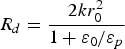 $R_d = {2kr_0^2 \over 1 + {\rm {\rm {\rm \varepsilon}}}_0 /{\rm {\rm {\rm \varepsilon}}}_p}$ is Rayleigh diffraction length. Substituting z = ξ(ωr 02/c) in Eq. (21) we get
 $${\partial^2 f \over \partial {\rm {\rm {\rm \xi}}}^2} = {1 \over 4} \left(1 + {{\rm {\rm {\rm \varepsilon}}}_0 \over {\rm {\rm {\rm \varepsilon}}}_p} \right)^2 {1 \over {\rm {\rm {\rm \varepsilon}}}_0 f^3} - {1 \over 2} \left(1 + {{\rm {\rm {\rm \varepsilon}}}_0 \over {\rm {\rm {\rm \varepsilon}}}_p} \right)\left({r_0^2 {\rm {\rm {\rm \omega}}}^2 \over c^2} \right){\Phi \over {\rm {\rm {\rm \varepsilon}}}_0} f. $$
In Figure 4, numerical results are presented to show self-focusing action as a consequence of (1) purely relativistic effect (relativistic mass increase of the plasma electrons) and (2) the combined effect of relativistic effect and radial ponderomotive expulsion of electrons. We have plotted f as a function of ξ for different values of normalized magnetic field (Ωc) for both the cases. The other parameters are a0 = 1 and Ωp = 0.2. We have 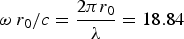 ${\rm {\rm {\rm \omega}}} \;r_{0}/c= {2{\rm {\rm {\rm \pi}}} r_0 \over {\rm {\rm {\rm \lambda}}}} = 18.84$ that corresponds to normalized spot size r 0/λ = 3. We have chosen this value as a lower limit on spot size. For Ωp = 0.1 and r 0/λ = 3, we have
 $r_{0} = 1.88 {c \over {\rm {\rm {\rm \omega}}}_p}$. When only relativistic effects are considered the plasma permittivity is obtained by substituting ne = n0 in Eq. (11) and on using ε0=1−(Ωp2/(γ0−Ωc)) and Φ=γ1Ω2p/f 2(γ0−Ωc)2 in Eq. (24) we obtain f as a function of ξ (dashed line). The periodic focusing and defocusing occur due to relative dominance of relativistic nonlinearity and diffraction effects. As the laser beam acquires smaller spot size, the diffraction divergence increases and takes over the convergence due to nonlinear refraction. This occurs in a cyclic manner. The relativistic focusing is enhanced by increasing the magnetic field. For the case when both relativistic focusing and ponderomotive effects are present (bold line), it is seen that the beam continues to focus until complete electron evacuation occurs on the axis (beyond this point theory is not valid). The distance at which the complete electron evacuation occurs (referred to as cavitation length) is an important parameter. The cavitation length can be increased by decreasing plasma density, normalized laser spot size r 0/λ and guide magnetic field. The self-focusing of the laser beam is also a sensitive function of normalized beam radius ωr 0/c as seen in Figure 5 where we have plotted f versus Ωc at a fixed ξ. Ponderomotive effects are significant at lower value of ωr 0/c.
The variation of beam width parameter (f) with normalized distance (ξ = z/(ωr 02/c)) for different values of magnetic field (Ωc = 0, 0.5, and 0.9) for two cases namely (1) when combined effect of relativistic effect and radial ponderomotive expulsion of electrons is considered (solid line) and (2) only relativistic effect is included (dashed line). The other parameters are a 0 = 1, r 0/λ = 3 and Ωp = 0.2.

The variation of beam width parameter (f) with normalized magnetic field (Ωc) for different values of normalized laser spot size (r 0/λ = 3 and 6, λ = 1 μm) at fixed axial distance z = 22.4 μm for two cases namely (1) when combined effect of relativistic effect and radial ponderomotive expulsion of electrons is considered (solid line) and (2) only relativistic effect is included (dashed line). The other parameters are a 0 = 1 and Ωp = 0.2.

The self-focusing increases with laser field strength a 0. An upper limit on a 0 is at values at which complete electron evacuation occurs. In Eq. (23) the two terms on the right-hand side denote the diffraction divergence and the self-focusing effect (due to ponderomotive and relativistic effects) respectively. For self sustained Gaussian beam, these two terms balance each other i.e., Φ=r 20/R 2d. From this value of Φ the threshold laser field strength is deduced. In Figure 6, we have plotted the normalized radius of the Gaussian beam ωpr 0/c as a function of threshold laser field strength a cr for Ωc = 0.3 and 0.5. The threshold of laser intensity for self-ducting of laser beam depends on beam radius and the applied magnetic field. It increases with the decreasing radius of the self sustained laser beam. For a fixed beam radius the threshold of laser intensity decreases with increase in magnetic field.
Normalized beam radius (ω↓pr ↓0/c) as a function of threshold laser field strength (a cr) for different values of magnetic fields (Ωc = 0.3 and 0.5).

When the laser intensity is very high (a 02 > 5), the relativistic gamma factor is numerically deduced by plotting γ versus a 02 for different values of magnetic field (see Fig. 7). Beyond a 02 > 5, at any given a 02 the values of γ differs by nearly the same constant amount (vertical separation of the curves ~0.8–1Ωc depending on the choice of a 02. Hence (Eq. (6)) can be approximately modeled as 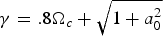 ${\rm {\rm {\rm \gamma}}} = .8\Omega_c + \sqrt{1 + a_0^2}$. For applications involving propagation of laser in an overdense plasma where a 0 ≥ 10 it is noted that for Ωc ≤ 1 the effect of guide magnetic field is not very prominent.
Relativistic gamma factor versus a 02 for different values of magnetic field (Ωc = 0, 0.4 and 0.8).

4. DISCUSSION
Relativistic and ponderomotive effects on the self-focusing of a short laser pulse in a magnetized are examined. The ponderomotive force due to circularly polarized wave is determined including relativistic mass effects on both plasma frequency and cyclotron frequency. The ponderomotive force changes sign at ω ~ ωc /2γ. For ωc/ω ≤ 1 the ponderomotive force causes electron expulsion which increases with increase in magnetic field. For fixed laser field strength and normalized beam radius the axial distance at which complete electron expulsion occurs decrease with increase in magnetic field. The laser field strength required for complete electron expulsion on the axis decreases with increase in magnetic field. At higher field strengths the relativistic gamma factor does not change significantly with magnetic field. Hence, the effect of magnetic field on self-focusing of laser beam are significant when laser field strength is comparable to ωc/ω. The electron expulsion is sensitive to plasma density. At higher plasma densities due to increase in space charge field (due to charge separation) higher laser field strengths are required for cavitation on the axis. The ponderomotive effects decrease with increase in laser beam radius and are dominant when the laser beam radius is comparable to (c/(ωp)).
The beam width parameter is sensitive to magnetic field. For fixed laser field strength and normalized beam radius the beam width parameter decreases with increase in magnetic field. A comparative study of self-focusing due to purely relativistic effect and the combined effect of relativistic effect and radial ponderomotive expulsion of electrons reveals that ponderomotive effects contribute significantly at higher magnetic field and lower plasma density. The laser spot size and the threshold laser field intensity required to balance the self-focusing effect and the diffraction divergence decreases with increase in magnetic field. Here we would like to mention that at ω ≤ ωc /2γ the ponderomotive force is attractive and leads to electron accumulation on the axis and this may reduce the self-focusing effect.
ACKNOWLEDGEMENT
One of us (A.S) would like to acknowledge the financial support of Department of Science and Technology, New Delhi, India.



