1 Introduction
The gravitational (Jeans) instability is supposed to play a crucial role in the structure formations in astrophysical systems viz. molecular clouds, planetary nebula, interstellar medium, accretion disks and in the intergalactic medium. The collapse of matter in compact stars such as white dwarf stars, neutron stars and the inner core of the Earth is also due to the presence of a strong gravitational field. At the present time, the studies of linear and nonlinear instabilities in a Fermi degenerate quantum plasma is a rapidly evolving research area because of its significant applications in dense astrophysical systems (Shukla & Eliasson Reference Shukla and Eliasson2007; Akbari-Moghanjoughi Reference Akbari-Moghanjoughi2014; Mehdian, Hajisharifi & Hasanbeigi Reference Mehdian, Hajisharifi and Hasanbeigi2014; Son Reference Son2014). Pines (Reference Pines1961) has initiated the studies of quantum plasmas. He has also discussed the quantum corrections in Chew–Goldberger–Low (CGL) theory and discussed wave propagation and the results were compared in dense plasmas. Although there are limitations in both the CGL and magnetohydrodynamic (MHD) sets of equations for describing various phenomena, these sets of equations are normally used to correlate many physical and experimental observations. The quantum effect plays a significant role in the study of dense astrophysical objects and cannot be neglected in the high-density and low-temperature regime. Haas (Reference Haas2005) discussed the quantum hydrodynamic model in the presence of a magnetic field and described the importance of the quantum correction parameter which is significant in dense astrophysical plasmas. It is well known that when the de Broglie wavelength becomes comparable to the mean particle distance, the quantum effect starts to play a significant role in the dynamics of the system. The inclusion of the quantum effect becomes essential at extremely low temperature
 $T<T_{F}$
(where
 $T_{F}=E_{F}/k_{B}$
, is the Fermi temperature with
 $E_{F}=(\hslash ^{2}/2m)(3\unicode[STIX]{x03C0}^{2})^{2/3}n^{2/3}$
the Fermi energy). To determine the regimes of classical as well as quantum media, the degeneracy parameter
 $\unicode[STIX]{x1D712}=(T_{F}/T)=(1/2)(3\unicode[STIX]{x03C0}^{2})^{2/3}(n\unicode[STIX]{x1D706}_{B})^{2/3}$
is used as a scale. In order to define a quantum plasma one should chose
 $\unicode[STIX]{x1D712}>1$
or
 $T<T_{F}$
, hence quantum effects in the plasma become dominant.
In a significant work, Haas (Reference Haas2011) has observed that when the thermodynamic temperature approaches the Fermi temperature the medium is treated as a quantum plasma and the relevant statistical distribution converts from Maxwell–Boltzmann statistics to Fermi–Dirac statistics. The quantum plasma may exist in the interiors of astrophysical compressed objects which are the end products of stellar evolution e.g. white dwarfs and neutron stars. Shukla & Eliasson (Reference Shukla and Eliasson2010) have discussed nonlinear aspects of quantum plasmas. Masood, Salimullah & Shah (Reference Masood, Salimullah and Shah2008) have investigated a quantum hydrodynamic model for a multicomponent quantum magnetoplasma with a Jeans term. Along with this, the Jeans instability of an isotropic magnetohydrodynamic (MHD) quantum plasma has been investigated by many researchers. Shukla & Stenflo (Reference Shukla and Stenflo2006) have discussed the Jeans instability of self-gravitating astrophysical quantum dusty plasmas considering the electrostatic perturbations. Lundin, Marklund & Brodin (Reference Lundin, Marklund and Brodin2008) have investigated the Jeans instability in a quantum plasma modified by spin magnetization effects and obtained the criterion of Jeans instability for low-temperature Fermi degenerate quantum plasmas. Jamil et al. (Reference Jamil, Rasheed, Rozina, Jung and Salimullah2015) have investigated the Jeans instability with exchange effects in quantum dusty magnetoplasmas. Shan & Mushtaq (Reference Shan and Mushtaq2011) have discussed role of the Jeans instability in a multicomponent quantum plasma in the presence of a Fermi pressure. Sharma & Chhajlani (Reference Sharma and Chhajlani2013) studied the influence of finite Larmor radius (FLR) effects on the Jeans instability of an infinitely conducting homogeneous quantum plasma using a quantum magnetohydrodynamic (QMHD) model. The effect of spin-induced magnetization and electrical resistivity on the Jeans instability of a viscous quantum plasma was also examined by Sharma & Chhajlani (Reference Sharma and Chhajlani2014). Prajapati & Chhajlani (Reference Prajapati and Chhajlani2014) discussed the effects of quantum corrections on the Jeans instability of self-gravitating viscoelastic quantum fluids.
For investigating instabilities in quantum plasmas, the generalized form of the classical hydrodynamic model is used which is the QMHD model. Haas (Reference Haas2005) have derived the QMHD model for an isotropic quantum plasma starting from the Wigner–Poisson equations. This model has utility in both quantum and classical regimes. The inclusion of a quantum pressure term, or Bohm potential
 $Q=(\hslash ^{2}\unicode[STIX]{x1D70C}/2m_{e}m_{i})\,\unicode[STIX]{x1D735}(\unicode[STIX]{x1D6FB}^{2}\sqrt{\unicode[STIX]{x1D70C}}/\sqrt{\unicode[STIX]{x1D70C}})$
, in the momentum transfer equation of the basic MHD model gives the equation of motion for a quantum plasma. The simple gas pressure is also converted into a Fermi pressure and all the other conditions of a quantum plasma are satisfied. In the study of many phenomena in dense dwarf stars, neutron stars and the interiors of dense and heavy planets, the quantum correction, rotation and pressure anisotropy cannot be neglected. The QMHD set of equations derived by Haas (Reference Haas2005) has been used by many researchers (Ren et al.
Reference Ren, Wu, Cao and Chu2009; Hoshoudy Reference Hoshoudy2012; Sharma & Chhajlani Reference Sharma and Chhajlani2015; Tiwari, Argal & Sharma Reference Tiwari, Argal and Sharma2015). Prajapati (Reference Prajapati2014) has examined the low-frequency waves and gravitational (Jeans) instability of a homogeneous gyrotropic, magnetized quantum plasma using the QMHD and CGL fluid models. Shukla & Stenflo (Reference Shukla and Stenflo2008) have derived quantum Hall–MHD equations for a non-uniform dense magnetoplasma with electron temperature anisotropy and discussed various aspects of CGL theory. The plasma is rarefied and collisionless in CGL theory but Shukla & Stenflo (Reference Shukla and Stenflo2008) attempt this problem considering electron temperature anisotropy and derived quantum corrections to the CGL set of equations. In a quantum plasma the temperature is very low and in the case of a white dwarf the density is very high. With such limitations, a fluid theory is to be developed from the angle of plasma physics and the present work is an attempt in this direction. The low-frequency linear waves and instabilities in a gyrotropic plasma are also discussed by Ferriere (Reference Ferriere2004).
Moreover, the presence of rotation in gravitating systems is considered to be the most important phenomenon and plays a significant role in gravitational collapse. The gravitational instability with finite rotation has been studied by many researchers in the past few years. Sharma & Singh (Reference Sharma and Singh1988) investigated the effect of rotation on gravitational instability in the presence of a variable magnetic field. Chhajlani & Vyas (Reference Chhajlani and Vyas1988) studied the gravitational instability of a thermally conducting, ionized, magnetized rotating plasma in the presence of porosity and suspended particles. Prajapati et al. (Reference Prajapati, Pensia, Kaothekar and Chhajlani2010) discussed the effects of arbitrary radiative heat-loss functions and Hall current on the self-gravitational instability of a homogeneous, viscous, rotating plasma incorporating finite electrical resistivity, finite electron inertia and thermal conductivity. Argal, Tiwari & Sharma (Reference Argal, Tiwari and Sharma2014) investigated the effect of rotation on the Jeans instability of a self-gravitating viscoelastic fluid.
Most of these studies have been carried out by assuming the medium to be isotropic and using the MHD fluid model. The MHD model does not cover the pressure anisotropy which cannot be neglected in the presence of a strong magnetic field. Chew, Goldberger & Low (Reference Chew, Goldberger and Low1956) have derived a convenient model for the double adiabatic anisotropic pressure in the presence of a strong magnetic field which is known as the CGL fluid model. Gliddon (Reference Gliddon1966) has studied the gravitational instability of an anisotropic plasma using the CGL fluid model. Bhatia (Reference Bhatia1968) has extended the study of gravitational instability of a rotating anisotropic medium and found that in the longitudinal mode of propagation, the condition of instability remains the same as the condition given by Jeans (Reference Jeans1902). Bhatia & Chhonkar (Reference Bhatia and Chhonkar1985) studied the instability in a horizontal layer of stratified compressible isotropic and anisotropic plasmas including the effect of the Coriolis force and finite ion Larmor radius simultaneously and observed that the Coriolis force has a stabilizing influence on the instability. Tandon & Talwar (Reference Tandon and Talwar1963) have discussed the stability of a rotating plasma with an anisotropic pressure. Hau & Wang (Reference Hau and Wang2013) have investigated the effects of Hall current and electron temperature anisotropy on proton firehose instabilities. Prajapati, Parihar & Chhajlani (Reference Prajapati, Parihar and Chhajlani2008) studied the self-gravitational instability of a heat-conducting plasma including the effects of rotation and pressure anisotropy. Thus we find that problems of anisotropic pressure plasmas in self-gravitating media are investigated by many authors using the CGL fluid theory.
Moreover, in a homogeneous isotropic pressure plasma, the MHD fluid model gives rise to three fundamental wave modes: slow, intermediate and fast waves, in the order of their phase speeds. The MHD fluid model is used to analyse the equilibrium and stability of the dense magnetoplasma with Fermi degenerate electrons and pressure anisotropy. The CGL fluid theory is the most convenient fluid model for stability analysis in a collisionless gyrotropic pressure plasma in the presence of a strong magnetic field where the Larmor frequency is prominent over the collision frequency. The CGL approximation in a dense quantum plasma can be adequately satisfied when the mean free path during collision is larger than the interparticle distance. In the presence of a strong magnetic field the gyroradius may be so small that the particles cannot move very far from each other and collisions are neglected (Kulsrud Reference Kulsrud2004). At small scales, gyromotion of the plasma particles in a dense plasma is governed by the anisotropic pressures and CGL fluid theory may be applied for investigating wave modes and instabilities in such a plasma. Therefore under these limitations, we are considering CGL fluid theory in a dense quantum plasma which may be applicable to many astrophysical systems.
Along with this, the presence of rotation in a dense Fermi degenerate quantum plasma gives information about a rotating Fermi gas in a dense plasmas. Kawaler, Sekii & Gough (Reference Kawaler, Sekii and Gough1999) have examined the potential of asteroseismology for exploring the internal rotation of white dwarf stars which are supposed to be composed of a Fermi degenerate quantum plasma. Szkudlarek et al. (Reference Szkudlarek, GONDEK-ROSINSKA, Ansorg and Villain2014) have observed the effect of rotation on the properties of neutron stars. The effects of quantum corrections on the Rayleigh–Taylor instability in a horizontal inhomogeneous rotating plasma is investigated by Hoshoudy (Reference Hoshoudy2009). The contribution of rotation, along with other physical effects, is observed on the Jeans instability of isotropic quantum plasmas (Jain, Sharma & Chhajlani Reference Jain, Sharma and Chhajlani2014, Reference Jain, Sharma and Chhajlani2015). Thus rotation is an important parameter to be considered in the present problem of a magnetized anisotropic pressure quantum plasma.
From above studies it is clear that none of the authors have so far studied the combined effects of rotation and quantum corrections on the gravitational instability of a magnetized anisotropic pressure plasma. Thus looking to the astrophysical applications, in the present work, we investigate the effect of rotation on the gravitational instability of an anisotropic pressure magnetized quantum plasma.
2 Basic equations of the problem
Let us consider a rotating, quantum plasma system with pressure anisotropy
 $\overleftrightarrow{\boldsymbol{P}}$
which is assumed to be embedded in the presence of a strong magnetic field
 $\boldsymbol{B}(0,0,B)$
and rotating with angular velocity
 $\unicode[STIX]{x1D734}(0,0,\unicode[STIX]{x1D6FA})$
. In the CGL approximation the momentum equation is modified by replacing the scalar pressure by the thermal pressure tensor. The thermal pressure tensor consists of pressure components parallel to the direction of the magnetic field (
 $p_{\Vert }$
) and perpendicular to the direction of the magnetic field (
 $p_{\bot }$
).
The thermal pressure tensor is represented as
 $$\begin{eqnarray}\displaystyle \overleftrightarrow{\boldsymbol{P}}=p_{\bot }\boldsymbol{I}+(p_{\Vert }-p_{\bot })\hat{\boldsymbol{n}}\hat{\boldsymbol{n}}, & & \displaystyle\end{eqnarray}$$
where
 $\hat{\boldsymbol{n}}$
is unit vector along the magnetic field and
 $\boldsymbol{I}$
is identity dyadic.
The mass transfer equation and modified momentum transfer equations are written as
 $$\begin{eqnarray}\displaystyle & \displaystyle \frac{\text{d}\unicode[STIX]{x1D70C}}{\text{d}t}+\unicode[STIX]{x1D735}\boldsymbol{\cdot }(\unicode[STIX]{x1D70C}\boldsymbol{U})=0, & \displaystyle\end{eqnarray}$$
 $$\begin{eqnarray}\displaystyle & \displaystyle \unicode[STIX]{x1D70C}\frac{\text{d}\boldsymbol{U}}{\text{d}t}=-\unicode[STIX]{x1D735}\boldsymbol{\cdot }\overleftrightarrow{\boldsymbol{P}}-\unicode[STIX]{x1D70C}\unicode[STIX]{x1D735}\unicode[STIX]{x1D719}+\frac{1}{4\unicode[STIX]{x03C0}}(\unicode[STIX]{x1D735}\times \boldsymbol{B})\times \boldsymbol{B}+\frac{\hslash ^{2}}{2m_{e}m_{i}}\unicode[STIX]{x1D70C}\unicode[STIX]{x1D735}\!\left(\frac{\unicode[STIX]{x1D6FB}^{2}\sqrt{\unicode[STIX]{x1D70C}}}{\sqrt{\unicode[STIX]{x1D70C}}}\right)\!+2\unicode[STIX]{x1D70C}(\boldsymbol{U}\times \unicode[STIX]{x1D734}). & \displaystyle \nonumber\\ \displaystyle & & \displaystyle\end{eqnarray}$$
Poisson’s equation for the gravitational potential and magnetic induction equation are
 $$\begin{eqnarray}\displaystyle & \displaystyle \unicode[STIX]{x1D6FB}^{2}\unicode[STIX]{x1D719}=4\unicode[STIX]{x03C0}G\unicode[STIX]{x1D70C}, & \displaystyle\end{eqnarray}$$
 $$\begin{eqnarray}\displaystyle & \displaystyle \frac{\unicode[STIX]{x2202}\boldsymbol{B}}{\unicode[STIX]{x2202}t}=\unicode[STIX]{x1D735}\times (\boldsymbol{U}\times \boldsymbol{B}). & \displaystyle\end{eqnarray}$$
The double adiabatic energy equations in an anisotropic pressure plasma are given by
 $$\begin{eqnarray}\displaystyle & \displaystyle \frac{\text{d}}{\text{d}t}\left(\frac{p_{\Vert }B^{2}}{\unicode[STIX]{x1D70C}^{3}}\right)=0, & \displaystyle\end{eqnarray}$$
 $$\begin{eqnarray}\displaystyle & \displaystyle \frac{\text{d}}{\text{d}t}\left(\frac{p_{\bot }}{\unicode[STIX]{x1D70C}B}\right)=0, & \displaystyle\end{eqnarray}$$
where
 $(\text{d}/\text{d}t)=(\unicode[STIX]{x2202}/\unicode[STIX]{x2202}t)+\boldsymbol{U}\boldsymbol{\cdot }\unicode[STIX]{x1D735}$
is the convective derivative operator,
 $\unicode[STIX]{x1D70C}=m_{e}n_{e}+m_{i}n_{i}$
is the global mass density and
 $\boldsymbol{U}$
is the global fluid velocity.
3 Linearized perturbation equations
The linearized perturbation equations are obtained considering first-order perturbations in each of the physical variables. We assume that each physical variable is represented as the sum of its equilibrium and perturbed parts. Thus, we write
 $\overleftrightarrow{\boldsymbol{P}}=\overleftrightarrow{\boldsymbol{P}}_{\!\!\!\mathbf{0}}+\overleftrightarrow{\boldsymbol{P}}_{\!\!\!1}$
,
 $\unicode[STIX]{x1D70C}=\unicode[STIX]{x1D70C}_{0}+\unicode[STIX]{x1D70C}_{1}$
,
 $\unicode[STIX]{x1D719}=\unicode[STIX]{x1D719}_{0}+\unicode[STIX]{x1D719}_{1}$
,
 $\boldsymbol{B}=\boldsymbol{B}_{0}+\boldsymbol{B}_{1}$
and
 $\boldsymbol{U}=\boldsymbol{U}_{0}(=0)+\boldsymbol{u}$
. The quantities with subscript ‘0’ represent the unperturbed values and
 $\overleftrightarrow{\boldsymbol{P}}_{\!\!\!1}$
,
 $\unicode[STIX]{x1D70C}_{1}$
,
 $\unicode[STIX]{x1D719}_{1}\;\boldsymbol{B}_{1}(B_{1x},B_{1y},B_{1z})$
and
 $\boldsymbol{u}(u_{x,}u_{y,}u_{z})$
represent first-order perturbations from the equilibrium values of the pressure tensor, fluid density, gravitational potential, magnetic field and fluid velocity. For simplicity we remove ‘0’ from subscripts of the equilibrium quantities.
Thus the linearized perturbation equations for a rotating anisotropic quantum plasma can be given as follows.
 $$\begin{eqnarray}\displaystyle \overleftrightarrow{\boldsymbol{P}}_{\!\!\!1}=p_{1\bot }\boldsymbol{I}+(p_{1\Vert }-p_{1\bot })\hat{\boldsymbol{n}}\hat{\boldsymbol{n}}+(p_{\Vert }-p_{\bot })(\hat{\boldsymbol{n}}\hat{\boldsymbol{n}}_{1}+\hat{\boldsymbol{n}}_{1}\hat{\boldsymbol{n}}), & & \displaystyle\end{eqnarray}$$
where
 $\hat{\boldsymbol{n}}_{1}=(\hat{i} B_{1x}+{\hat{j}}B_{1y}/B)$
,
 $p_{1\,\Vert }$
and
 $p_{1\bot }$
, are perturbations in the pressures parallel and perpendicular to the direction of the magnetic field.
The linearized equation of motion is given by
 $$\begin{eqnarray}\displaystyle \unicode[STIX]{x1D70C}\frac{\unicode[STIX]{x2202}\boldsymbol{u}}{\unicode[STIX]{x2202}t}=-\unicode[STIX]{x1D735}\boldsymbol{\cdot }\overleftrightarrow{\boldsymbol{P}}_{\!\!\!1}-\unicode[STIX]{x1D70C}\unicode[STIX]{x1D735}\unicode[STIX]{x1D719}_{1}+\frac{1}{4\unicode[STIX]{x03C0}}(\unicode[STIX]{x1D735}\times \boldsymbol{B}_{1})\times \boldsymbol{B}+\frac{\hslash ^{2}}{4m_{e}m_{i}}\unicode[STIX]{x1D735}\unicode[STIX]{x1D6FB}^{2}\unicode[STIX]{x1D70C}_{1}+2\unicode[STIX]{x1D70C}(\boldsymbol{u}\times \unicode[STIX]{x1D734}). & & \displaystyle\end{eqnarray}$$
The continuity equation is written as
 $$\begin{eqnarray}\displaystyle \frac{\unicode[STIX]{x2202}\unicode[STIX]{x1D70C}_{1}}{\unicode[STIX]{x2202}t}+(\unicode[STIX]{x1D735}\boldsymbol{\cdot }\boldsymbol{u})\unicode[STIX]{x1D70C}=0. & & \displaystyle\end{eqnarray}$$
The Poisson’s equation is
 $$\begin{eqnarray}\displaystyle \unicode[STIX]{x1D6FB}^{2}\unicode[STIX]{x1D719}_{1}=4\unicode[STIX]{x03C0}G\unicode[STIX]{x1D70C}_{1}. & & \displaystyle\end{eqnarray}$$
Two adiabatic equations for a CGL plasma are
 $$\begin{eqnarray}\displaystyle & \displaystyle \frac{p_{1\Vert }}{p_{\Vert }}+\frac{2B_{1}}{B}=\frac{3\unicode[STIX]{x1D70C}_{1}}{\unicode[STIX]{x1D70C}}, & \displaystyle\end{eqnarray}$$
 $$\begin{eqnarray}\displaystyle & \displaystyle \frac{p_{1\,\bot }}{p_{\bot }}-\frac{B_{1}}{B}=\frac{\unicode[STIX]{x1D70C}_{1}}{\unicode[STIX]{x1D70C}}. & \displaystyle\end{eqnarray}$$
The magnetic induction equation is
 $$\begin{eqnarray}\displaystyle \frac{\unicode[STIX]{x2202}\boldsymbol{B}_{1}}{\unicode[STIX]{x2202}t}=\unicode[STIX]{x1D735}\times (\boldsymbol{u}\times \boldsymbol{B}). & & \displaystyle\end{eqnarray}$$
To obtain the dispersion relation we seek the solutions of the linearized perturbation equations considering plane wave solutions of the form of
 $\exp (\text{i}k_{x}x+\text{i}k_{z}z-\text{i}\unicode[STIX]{x1D714}t)$
, where
 $k_{x}$
and
 $k_{z}$
represent the wavenumbers in the
 $x$
and
 $z$
directions, respectively, such that
 $k_{x}^{2}+k_{z}^{2}=k^{2}$
,
 $k$
being the wavenumber of the perturbations and
 $\unicode[STIX]{x1D714}$
the frequency of the harmonic disturbances. Thus substituting
 $\unicode[STIX]{x2202}/\unicode[STIX]{x2202}t=-\text{i}\unicode[STIX]{x1D714},\unicode[STIX]{x2202}/\unicode[STIX]{x2202}x=\text{i}k_{x}$
and
 $\unicode[STIX]{x2202}/\unicode[STIX]{x2202}z=\text{i}k_{z}$
into (3.1), (3.3)–(3.7) we obtain the perturbed equations, as shown in appendix A.
 $\unicode[STIX]{x1D743}(\unicode[STIX]{x1D709}_{x},\unicode[STIX]{x1D709}_{y},\unicode[STIX]{x1D709}_{z})$
being the Lagrangian displacement.
On substituting equations (A 1)–(A 8) into (3.2), with the above derivatives we obtain the following three equations in terms of the displacement components
 $\unicode[STIX]{x1D709}_{x},\unicode[STIX]{x1D709}_{y}$
and
 $\unicode[STIX]{x1D709}_{z}$
;
 $$\begin{eqnarray}\displaystyle & & \displaystyle \left\{-\unicode[STIX]{x1D714}^{2}-\frac{(p_{\Vert }-p_{\bot })}{\unicode[STIX]{x1D70C}}k_{z}^{2}-\frac{4\unicode[STIX]{x03C0}G\unicode[STIX]{x1D70C}}{k^{2}}k_{x}^{2}+\frac{B^{2}k^{2}}{4\unicode[STIX]{x03C0}\unicode[STIX]{x1D70C}}+2k_{x}^{2}\frac{p_{\bot }}{\unicode[STIX]{x1D70C}}+\frac{\hslash ^{2}k^{2}k_{x}^{2}}{4m_{e}m_{i}}\right\}\unicode[STIX]{x1D709}_{x}+2\text{i}\unicode[STIX]{x1D714}\unicode[STIX]{x1D6FA}\unicode[STIX]{x1D709}_{y}\nonumber\\ \displaystyle & & \displaystyle \qquad +\,\left\{k_{x}k_{z}\frac{p_{\bot }}{\unicode[STIX]{x1D70C}}-\frac{4\unicode[STIX]{x03C0}G\unicode[STIX]{x1D70C}}{k^{2}}k_{x}k_{z}+\frac{\hslash ^{2}k^{2}k_{x}k_{z}}{4m_{e}m_{i}}\right\}\unicode[STIX]{x1D709}_{z}=0,\end{eqnarray}$$
 $$\begin{eqnarray}\displaystyle 2\text{i}\unicode[STIX]{x1D714}\unicode[STIX]{x1D6FA}\unicode[STIX]{x1D709}_{x}-\left\{\unicode[STIX]{x1D714}^{2}+\frac{\left(p_{II}-p_{\bot }\right)}{\unicode[STIX]{x1D70C}}k_{z}^{2}-\frac{B^{2}}{4\unicode[STIX]{x03C0}\unicode[STIX]{x1D70C}}k_{z}^{2}\right\}\unicode[STIX]{x1D709}_{y}=0, & & \displaystyle\end{eqnarray}$$
 $$\begin{eqnarray}\displaystyle & & \displaystyle \left\{k_{x}k_{z}\frac{p_{\bot }}{\unicode[STIX]{x1D70C}}-\frac{4\unicode[STIX]{x03C0}G\unicode[STIX]{x1D70C}k_{x}k_{z}}{k^{2}}+\,\frac{\hslash ^{2}k^{2}k_{x}k_{z}}{4m_{e}m_{i}}\right\}\unicode[STIX]{x1D709}_{x}\nonumber\\ \displaystyle & & \displaystyle \qquad +\,\left\{-\unicode[STIX]{x1D714}^{2}+3k_{z}^{2}\frac{p_{\Vert }}{\unicode[STIX]{x1D70C}}-\frac{4\unicode[STIX]{x03C0}G\unicode[STIX]{x1D70C}k_{z}^{2}}{k^{2}}+\frac{\hslash ^{2}k^{2}k_{z}^{2}}{4m_{e}m_{i}}\right\}\unicode[STIX]{x1D709}_{z}=0.\nonumber\\ \displaystyle & & \displaystyle\end{eqnarray}$$
From equations (3.8)–(3.10) we constitute a matrix of the form of
 $[M]_{3x3}[N]_{3x1}=0$
, where
 $[M]$
is the third-order square matrix of coefficients and
 $[N]$
is the column matrix of the displacement components. To obtain the non-trivial solution of a matrix, the determinant of coefficients must vanish. After equating the determinant of coefficients to zero we obtain the following dispersion relation,
 $$\begin{eqnarray}\displaystyle & & \displaystyle \left[\left\{\unicode[STIX]{x1D714}^{2}+\frac{(p_{\Vert }-p_{\bot })}{\unicode[STIX]{x1D70C}}k_{z}^{2}+\frac{4\unicode[STIX]{x03C0}G\unicode[STIX]{x1D70C}}{k^{2}}k_{x}^{2}-V_{a}^{2}k^{2}-2k_{x}^{2}\frac{p_{\bot }}{\unicode[STIX]{x1D70C}}-\frac{\hslash ^{2}k^{2}k_{x}^{2}}{4m_{e}m_{i}}\right\}\right.\nonumber\\ \displaystyle & & \displaystyle \quad \left.\times \,\left\{\unicode[STIX]{x1D714}^{2}+\frac{\left(p_{\Vert }-p_{\bot }\right)}{\unicode[STIX]{x1D70C}}k_{z}^{2}-V_{a}^{2}k_{z}^{2}\right\}-4\unicode[STIX]{x1D6FA}^{2}\unicode[STIX]{x1D714}^{2}\right]\left(\unicode[STIX]{x1D714}^{2}-\frac{\hslash ^{2}k^{2}k_{z}^{2}}{4m_{e}m_{i}}-3k_{z}^{2}\frac{p_{\Vert }}{\unicode[STIX]{x1D70C}}+\frac{4\unicode[STIX]{x03C0}G\unicode[STIX]{x1D70C}}{k^{2}}k_{z}^{2}\right)\nonumber\\ \displaystyle & & \displaystyle \quad -\,k_{x}^{2}k_{z}^{2}\,\left(\frac{p_{\bot }}{\unicode[STIX]{x1D70C}}-\frac{4\unicode[STIX]{x03C0}G\unicode[STIX]{x1D70C}}{k^{2}}+\frac{\hslash ^{2}k^{2}}{4m_{e}m_{i}}\right)^{2}\left\{\frac{\left(p_{\Vert }-p_{\bot }\right)}{\unicode[STIX]{x1D70C}}k_{z}^{2}-V_{a}^{2}k_{z}^{2}+\unicode[STIX]{x1D714}^{2}\right\}=0,\end{eqnarray}$$
where
 $V_{a}=B/\sqrt{4\unicode[STIX]{x03C0}\unicode[STIX]{x1D70C}}$
is the Alfvén velocity. Equation (3.11) is the general dispersion relation for an anisotropic pressure, magnetized quantum plasma considering the effect of uniform rotation. The present dispersion relation depends on the pressure anisotropy, Alfvén speed, quantum diffraction terms and rotation. In the absence of the rotation and quantum effects, equation (3.11) agrees with the dispersion relation that is obtained by Gliddon (Reference Gliddon1966). If we ignore the rotation effect then this equation agrees with the dispersion relation obtained by Prajapati (Reference Prajapati2014). In the absence of the Bohm potential, equation (3.11) also reduces to an equation of Prajapati et al. (Reference Prajapati, Parihar and Chhajlani2008) ignoring the effects of heat flux corrections in their case. If we ignore the effects of both rotation and quantum correction this dispersion relation can be easily verified with the results of Singh & Kalra (Reference Singh and Kalra1986) by excluding heat flux vector in their case and also agrees with results of Bora & Nayyar (Reference Bora and Nayyar1991) excluding the effect of heat conduction in that case. In the absence of rotation and for an isotropic pressure quantum plasma we get the dispersion relation of Sharma & Chhajlani (Reference Sharma and Chhajlani2013) in some limiting cases. Thus we find that the combined effects of rotation, magnetic field and quantum corrections modify the dispersion relation of the Jeans instability in an anisotropic pressure quantum plasma. The presence of rotation may be considered as an important factor for investigating the stability of rotating self-gravitating anisotropic quantum plasmas.
For investigating small amplitude waves and linear gravitational instability in an arbitrary direction relative to the direction of the magnetic field, we now discuss the above dispersion relation in two different modes of propagation; i.e. propagation along the magnetic field and propagation perpendicular to the magnetic field.
4 Discussion of general dispersion relation
4.1 Longitudinal mode of propagation
For waves propagating along the direction of the magnetic field i.e.
 $k_{x}=0$
and
 $k_{z}=k$
the dispersion relation (3.11) reduces to
 $$\begin{eqnarray}\displaystyle \left[\left\{\unicode[STIX]{x1D714}^{2}+\frac{(p_{\Vert }-p_{\bot })}{\unicode[STIX]{x1D70C}}k^{2}-V_{a}^{2}k^{2}\right\}^{2}\!-4\unicode[STIX]{x1D6FA}^{2}\unicode[STIX]{x1D714}^{2}\right]\!\left(\unicode[STIX]{x1D714}^{2}-\frac{\hslash ^{2}k^{4}}{4m_{e}m_{i}}-3k^{2}\frac{p_{\Vert }}{\unicode[STIX]{x1D70C}}+4\unicode[STIX]{x03C0}G\unicode[STIX]{x1D70C}\right)=0.\quad & & \displaystyle\end{eqnarray}$$
In the absence of rotation, equation (4.1) is identical to equation (28) of Prajapati (Reference Prajapati2014). From the first factor of equation (4.1) we obtain,
 $$\begin{eqnarray}\displaystyle \left\{\unicode[STIX]{x1D714}^{2}+\frac{(p_{\Vert }-p_{\bot })}{\unicode[STIX]{x1D70C}}k^{2}-V_{a}^{2}k^{2}\right\}^{2}-4\unicode[STIX]{x1D6FA}^{2}\unicode[STIX]{x1D714}^{2}=0. & & \displaystyle\end{eqnarray}$$
Equation (4.2) shows the non-gravitating Alfvén mode which depends on the anisotropic pressure and rotation effects. If we neglect the effect of rotation, equation (4.2) leads to the usual firehose instability. Equation (4.2) can be also written as
 $$\begin{eqnarray}\displaystyle \left[\unicode[STIX]{x1D714}^{2}+2\unicode[STIX]{x1D6FA}\unicode[STIX]{x1D714}+\frac{(p_{\Vert }-p_{\bot })}{\unicode[STIX]{x1D70C}}k^{2}-V_{a}^{2}k^{2}\right]\left[\unicode[STIX]{x1D714}^{2}-2\unicode[STIX]{x1D6FA}\unicode[STIX]{x1D714}+\frac{(p_{\Vert }-p_{\bot })}{\unicode[STIX]{x1D70C}}k^{2}-V_{a}^{2}k^{2}\right]=0. & & \displaystyle\end{eqnarray}$$
The above equation gives the condition of the firehose instability
 $$\begin{eqnarray}\displaystyle (p_{\Vert }-p_{\bot })>\frac{B^{2}}{4\unicode[STIX]{x03C0}}\quad \text{or}\quad p_{\Vert }>\frac{B^{2}}{4\unicode[STIX]{x03C0}}+p_{\bot }. & & \displaystyle\end{eqnarray}$$
The condition of the firehose instability remains the same and the instability is unaffected by the inclusion of rotation and the quantum diffraction term. The presence of quantum statistical pressure parallel and perpendicular to the magnetic field (
 $p_{\Vert }$
and
 $p_{\bot }$
) replaces the classical pressure in the above condition of the firehose instability. Thus we find that quantum corrections have appeared in the firehose condition but the nature of the firehose condition remains unaffected due the consideration of uniform rotation and the quantum diffraction term. For isotropic pressure plasma
 $(p_{\Vert }=p_{\bot })$
the system does not exhibit the firehose instability.
In the classical limit i.e. ignoring the quantum correction term
 $(\hslash =0),$
the second factor of (4.1) gives
 $$\begin{eqnarray}\displaystyle \unicode[STIX]{x1D714}^{2}-3k^{2}\frac{p_{\Vert }}{\unicode[STIX]{x1D70C}}+4\unicode[STIX]{x03C0}G\unicode[STIX]{x1D70C}=0. & & \displaystyle\end{eqnarray}$$
The Jeans criterion of gravitational instability in this limit is
 $$\begin{eqnarray}\displaystyle 3k^{2}\frac{p_{\Vert }}{\unicode[STIX]{x1D70C}}<4\unicode[STIX]{x03C0}G\unicode[STIX]{x1D70C}. & & \displaystyle\end{eqnarray}$$
The critical Jeans wavenumber in this limit is
 $$\begin{eqnarray}\displaystyle k_{Jc1}=\left[\frac{4\unicode[STIX]{x03C0}G\unicode[STIX]{x1D70C}}{3p_{\Vert }/\unicode[STIX]{x1D70C}}\right]^{1/2}. & & \displaystyle\end{eqnarray}$$
The above condition for the Jeans instability and the expression of the critical wavenumber are identical to Gliddon (Reference Gliddon1966). These can also be compared with the classical condition of Jeans instability and critical wavenumber in an isotropic medium as obtained by Chandrasekhar (Reference Chandrasekhar1961). We find that both expressions are identical with a difference of pressure only.
In quantum limit
 $(\hslash \neq 0)$
the second factor of (4.1) is
 $$\begin{eqnarray}\displaystyle \unicode[STIX]{x1D714}^{2}-\frac{\hslash ^{2}k^{4}}{4m_{e}m_{i}}-3k^{2}\frac{p_{\Vert }}{\unicode[STIX]{x1D70C}}+4\unicode[STIX]{x03C0}G\unicode[STIX]{x1D70C}=0. & & \displaystyle\end{eqnarray}$$
The dispersion relation (4.8) shows a gravitational mode which is modified by the quantum diffraction term. The presence of rotation has no effect in this unstable gravitating mode. It is clear from equation (4.8) that the Bohm potential has a stabilizing effect on the growth rate of the Jeans instability.
From the constant term of (4.8) the Jeans criterion of instability in the quantum limit for a magnetized anisotropic pressure quantum plasma is
 $$\begin{eqnarray}\displaystyle \frac{\hslash ^{2}k^{4}}{4m_{e}m_{i}}+3k^{2}\frac{p_{\Vert }}{\unicode[STIX]{x1D70C}}<4\unicode[STIX]{x03C0}G\unicode[STIX]{x1D70C}. & & \displaystyle\end{eqnarray}$$
It is clear that the condition of Jeans instability does not depend on rotation. If the quantum pressure term is neglected then the condition of Jeans instability is identical to condition of Jeans instability that is given by Gliddon (Reference Gliddon1966). This criterion of instability has also been obtained in many previous works such as; Bhatia (Reference Bhatia1968) and Singh & Kalra (Reference Singh and Kalra1986), Prajapati et al. (Reference Prajapati, Parihar and Chhajlani2008). The critical Jeans number is also obtained by (4.9), which is similar to equation (32) of Prajapati (Reference Prajapati2014).
Now, taking the following dimensionless parameters in terms of Jeans frequency
 $\unicode[STIX]{x1D714}_{J}=\sqrt{4\unicode[STIX]{x03C0}G\unicode[STIX]{x1D70C}}$
,
 $$\begin{eqnarray}\displaystyle \unicode[STIX]{x1D714}^{\ast }=\frac{\unicode[STIX]{x1D714}}{\sqrt{4\unicode[STIX]{x03C0}G\unicode[STIX]{x1D70C}}},\quad k^{\ast }=\sqrt{\frac{p_{\Vert }/\unicode[STIX]{x1D70C}}{4\unicode[STIX]{x03C0}G\unicode[STIX]{x1D70C}}}k,\quad \unicode[STIX]{x1D6FD}^{2}=\frac{\hslash ^{2}\unicode[STIX]{x1D714}_{J}}{m_{e}m_{i}}\left(\frac{\unicode[STIX]{x1D70C}}{p_{\Vert }}\right)^{2}. & & \displaystyle\end{eqnarray}$$
On substituting the above parameters into (4.8) we obtain the following dimensionless dispersion relation
 $$\begin{eqnarray}\displaystyle \unicode[STIX]{x1D714}^{\ast 2}-\frac{\unicode[STIX]{x1D6FD}^{2}k^{\ast 4}}{4}-3k^{\ast 2}+1=0. & & \displaystyle\end{eqnarray}$$
The dispersion relation (4.11) is solved numerically and curves are plotted of the dimensionless growth rate (
 $\unicode[STIX]{x1D714}^{\ast }$
) versus wavenumber (
 $k^{\ast }$
) for the different values of dimensionless quantum diffraction parameter
 $(\unicode[STIX]{x1D6FD})$
.
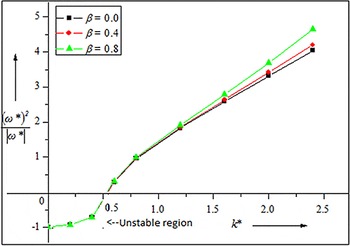
The normalized growth rate
 $(\unicode[STIX]{x1D714}^{\ast })^{2}/|\unicode[STIX]{x1D714}^{\ast }|$
versus normalized wavenumber (
 $k^{\ast }$
) for different values of the quantum diffraction parameter
 $(\unicode[STIX]{x1D6FD})$
for the longitudinal mode of propagation in the quantum limit.

Figure 1 represents the normalized growth rate
 $(\unicode[STIX]{x1D714}^{\ast })^{2}/|\unicode[STIX]{x1D714}^{\ast }|$
versus normalized wavenumber (
 $k$
*) for the longitudinal mode of propagation taking different values of the quantum diffraction parameter
 $\unicode[STIX]{x1D6FD}=0.0,0.4$
and 0.8. We found that the nature of the curves is the same as that of figure 2 of Prajapati (Reference Prajapati2014). It is observed that the critical Jeans wavenumber is approximately equal to 0.575 for
 $\unicode[STIX]{x1D6FD}=0.4$
and 0.572 for
 $\unicode[STIX]{x1D6FD}=0.8$
and is slightly decreased on increasing the quantum correction parameter. We observed that the critical Jeans wavenumber decreases and the corresponding unstable region also decreases on increasing the value of Bohm potential. The Bohm potential has a stabilizing effect on the unstable state of the Jeans instability.
4.2 Transverse mode of propagation
For waves propagating in the direction perpendicular to the magnetic field i.e.
 $k_{x}=k$
and
 $k_{z}=0$
the dispersion relation (3.11) reduces to
 $$\begin{eqnarray}\displaystyle \unicode[STIX]{x1D714}^{2}+4\unicode[STIX]{x03C0}G\unicode[STIX]{x1D70C}-V_{a}^{2}k^{2}-2k^{2}\frac{p_{\bot }}{\unicode[STIX]{x1D70C}}-\frac{\hslash ^{2}k^{4}}{4m_{e}m_{i}}-4\unicode[STIX]{x1D6FA}^{2}=0. & & \displaystyle\end{eqnarray}$$
In the classical limit, equation (4.12) reduces to
 $$\begin{eqnarray}\displaystyle \unicode[STIX]{x1D714}^{2}+4\unicode[STIX]{x03C0}G\unicode[STIX]{x1D70C}-V_{a}^{2}k^{2}-2k^{2}\frac{p_{\bot }}{\unicode[STIX]{x1D70C}}-4\unicode[STIX]{x1D6FA}^{2}=0. & & \displaystyle\end{eqnarray}$$
From equation (4.13) it is clear that the dispersion relation depends on rotation in the classical limit in a transverse Alfvén mode of propagation. From the constant term of equation (4.13) we derive the condition of Jeans instability. The condition of Jeans instability is
 $$\begin{eqnarray}\displaystyle 4\unicode[STIX]{x03C0}G\unicode[STIX]{x1D70C}>V_{a}^{2}k^{2}+2k^{2}\frac{p_{\bot }}{\unicode[STIX]{x1D70C}}+4\unicode[STIX]{x1D6FA}^{2}. & & \displaystyle\end{eqnarray}$$
The critical Jeans wavenumber in the classical limit in the transverse mode is
 $$\begin{eqnarray}\displaystyle k_{Jc2}=\left[\frac{4\unicode[STIX]{x03C0}G\unicode[STIX]{x1D70C}-4\unicode[STIX]{x1D6FA}^{2}}{V_{a}^{2}+2{\displaystyle \frac{p_{\bot }}{\unicode[STIX]{x1D70C}}}}\right]^{1/2}. & & \displaystyle\end{eqnarray}$$
If we ignore the effect of rotation, this condition of the Jeans instability is identical to the condition of the instability given by Gliddon (Reference Gliddon1966). Thus, the Jeans criterion of instability is modified due to the presence of rotation in the transverse mode of the classical regime.
The dispersion relation (4.12) shows a gravitating mode for a rotating, magnetized, anisotropic pressure quantum plasma for the transverse mode of propagation. If the effects of rotation and the quantum correction parameter are ignored in equation (4.12) then this is identical to the dispersion relation that is obtained by Gliddon (Reference Gliddon1966). On neglecting the effect of rotation, the dispersion relation (4.12) reduces to the equation obtained by Prajapati (Reference Prajapati2014). The condition of Jeans instability for the transverse mode is derived from the constant term of equation (4.12) which is
 $$\begin{eqnarray}\displaystyle 4\unicode[STIX]{x03C0}\,G\unicode[STIX]{x1D70C}>V_{a}^{2}k^{2}+2k^{2}\frac{p_{\bot }}{\unicode[STIX]{x1D70C}}+4\unicode[STIX]{x1D6FA}^{2}+\frac{\hslash ^{2}k^{4}}{4m_{e}m_{i}}. & & \displaystyle\end{eqnarray}$$
The condition of Jeans instability depends on rotation and the Bohm potential. The condition of the Jeans instability given by equation (4.16) is different than the critical condition of the Jeans instability that was obtained in the classical limit for the transverse mode. If we neglect the influence of the quantum correction then the condition of the Jeans instability will be identical to the condition which is obtained in the classical limit.
Now, in order to study the effect of rotation along with the quantum correction parameter on the growth rate of the Jeans instability, numerical calculations have been performed using the dimensionless form of the dispersion relation (4.12) that is
 $$\begin{eqnarray}\displaystyle \unicode[STIX]{x1D714}^{\ast 2}+1-V_{a}^{\ast 2}k^{\ast 2}-2k^{\ast 2}-\frac{k^{\ast 4}Q^{\ast }}{4}^{2}-4\unicode[STIX]{x1D6FA}^{\ast 2}=0, & & \displaystyle\end{eqnarray}$$
where we have used the following dimensionless parameters,
 $$\begin{eqnarray}\displaystyle \left.\begin{array}{@{}c@{}}\displaystyle \unicode[STIX]{x1D714}^{\ast }=\frac{\unicode[STIX]{x1D714}}{\sqrt{4\unicode[STIX]{x03C0}G\unicode[STIX]{x1D70C}}},\quad k^{\ast }=\frac{k\sqrt{p_{\bot }/\unicode[STIX]{x1D70C}}}{\sqrt{4\unicode[STIX]{x03C0}G\unicode[STIX]{x1D70C}}},\quad \unicode[STIX]{x1D6FA}^{\ast }=\frac{\unicode[STIX]{x1D6FA}}{\sqrt{4\unicode[STIX]{x03C0}G\unicode[STIX]{x1D70C}}},\\ \displaystyle V^{\ast }=\frac{V_{a}}{\sqrt{p_{\bot }/\unicode[STIX]{x1D70C}}},\quad Q^{\ast }=\frac{\hslash \sqrt{4\unicode[STIX]{x03C0}G\unicode[STIX]{x1D70C}}}{p_{\bot }/\unicode[STIX]{x1D70C}\sqrt{m_{e}m_{i}}}.\end{array}\right\} & & \displaystyle\end{eqnarray}$$
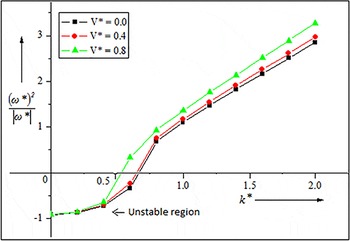
In figure 2, we show the normalized wavenumber versus growth rate for
 $V^{\ast }=0.0$
, 0.4, 0.8,
 $\unicode[STIX]{x1D6FA}^{\ast }=0.2$
and
 $Q^{\ast }=0.5$
. It is observed that the unstable region decreases on increasing the Alfvén velocity, the inclusion of the magnetic field decreases the growth rate of the Jeans instability of a rotating anisotropic pressure quantum plasma. In the presence of rotation and the quantum correction parameter, the magnetic field has a stabilizing effect on the growth rate of the Jeans instability.
The normalized growth rate
 $(\unicode[STIX]{x1D714}^{\ast })^{2}/|\unicode[STIX]{x1D714}^{\ast }|$
versus normalized wavenumber (
 $k^{\ast }$
) for different values of Alfvén velocity
 $(V^{\ast })$
for the transverse mode of propagation in the quantum limit.

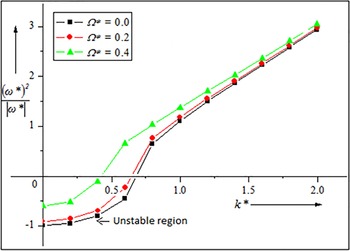
The normalized growth rate
 $(\unicode[STIX]{x1D714}^{\ast })^{2}/|\unicode[STIX]{x1D714}^{\ast }|$
versus normalized wavenumber (
 $k^{\ast }$
) for different values of angular velocity
 $(\unicode[STIX]{x1D6FA}^{\ast })$
for the transverse mode of propagation in the quantum limit.

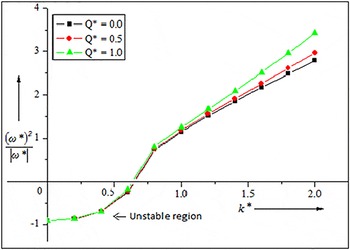
The normalized growth rate
 $(\unicode[STIX]{x1D714}^{\ast })^{2}/|\unicode[STIX]{x1D714}^{\ast }|$
versus normalized wavenumber (
 $k^{\ast }$
) for different values of the quantum correction parameter
 $(Q^{\ast })$
for the transverse mode of propagation in the quantum limit.

In figure 3 we have depicted the dimensionless growth rate
 $(\unicode[STIX]{x1D714}^{\ast })^{2}/|\unicode[STIX]{x1D714}^{\ast }|$
of the instability against the dimensionless wavenumber to show the effect of rotation variation together with fixed values of the Alfvén velocity and quantum correction parameter. The curves are plotted for
 $\unicode[STIX]{x1D6FA}^{\ast }=0.0$
, 0.2, 0.4,
 $V^{\ast }=0.4$
and
 $Q^{\ast }=0.5$
. From figure 3 we conclude that the unstable region decreases on increasing the angular frequency. The critical wavenumber decreases due to the inclusion of uniform rotation. Therefore, rotation stabilizes the growth rate of the Jeans instability in the transverse mode of propagation. In figure 4, curves are plotted of normalized wavenumber (
 $k^{\ast }$
) versus growth rate
 $(\unicode[STIX]{x1D714}^{\ast })^{2}/|\unicode[STIX]{x1D714}^{\ast }|$
for various values of the dimensionless quantum correction parameter
 $Q^{\ast }=0.0$
, 0.5, 1.0 with constant values of
 $\unicode[STIX]{x1D6FA}^{\ast }=0.2$
and
 $V^{\ast }=0.4$
. We observed that the unstable region decreases on increasing the value of the quantum correction parameter or the Bohm potential, which thus have a stabilizing effect on the growth rate of the Jeans instability of an anisotropic, rotating magnetized quantum plasma.
5 Conclusion
To summarize, we have investigated the combined effects of uniform rotation, pressure anisotropy and magnetic field on the gravitational instability of a gravitating quantum plasma. The modified QMHD model is used and the basic equations are perturbed. A general dispersion relation is obtained using normal mode analysis. The dispersion relation of a gravitational, rotating and magnetized quantum plasma is discussed in the quantum and classical plasma regimes. It is found that the classic condition of the firehose instability remains unaffected due to the presence of uniform rotation and the quantum diffraction term. The gravitating mode is independent of the firehose instability. On comparing our results with known results (Gliddon Reference Gliddon1966; Prajapati Reference Prajapati2014), we found that in the transverse mode, the critical Jeans wavenumber and the growth rates have been modified owing to the effect of rotation. The presence of quantum corrections, rotation and magnetic field have a stabilizing influence on the growth rate of the Jeans instability.
The present analysis may be important to the studies of dense astrophysical gravitational systems where rotation and quantum effects, along with pressure anisotropy, are supposed to be significant.
Appendix A
 $$\begin{eqnarray}\displaystyle \unicode[STIX]{x1D735}\boldsymbol{\cdot }\overleftrightarrow{\boldsymbol{P}}_{\!\!\!1} & = & \displaystyle \left[\text{i}k_{x}p_{1\bot }+\frac{(p_{\Vert }-p_{\bot })}{B}\text{i}k_{z}B_{1x}\right]\hat{i} +\frac{(p_{\Vert }-p_{\bot })}{B}\text{i}k_{z}B_{1y}{\hat{j}}\nonumber\\ \displaystyle & & \displaystyle +\,\left[\text{i}k_{z}p_{1\Vert }+\frac{(p_{\Vert }-p_{\bot })}{B}\text{i}k_{x}B_{1x}\right]\hat{k}\end{eqnarray}$$
 $$\begin{eqnarray}\displaystyle & \displaystyle \unicode[STIX]{x1D70C}_{1}=-\unicode[STIX]{x1D70C}(\text{i}k_{x}\unicode[STIX]{x1D709}_{x}+\text{i}k_{z}\unicode[STIX]{x1D709}_{z}) & \displaystyle\end{eqnarray}$$
 $$\begin{eqnarray}\displaystyle & \displaystyle k^{2}\unicode[STIX]{x1D719}_{1}=-4\unicode[STIX]{x03C0}G\unicode[STIX]{x1D70C}(\text{i}k_{x}\unicode[STIX]{x1D709}_{x}+\text{i}k_{z}\unicode[STIX]{x1D709}_{z}) & \displaystyle\end{eqnarray}$$
 $$\begin{eqnarray}\displaystyle & \displaystyle \frac{p_{1\,\Vert }}{p_{\Vert }}=-\text{i}k_{x}\unicode[STIX]{x1D709}_{x}-3\text{i}k_{z}\unicode[STIX]{x1D709}_{z} & \displaystyle\end{eqnarray}$$
 $$\begin{eqnarray}\displaystyle & \displaystyle \frac{p_{1\,\bot }}{p_{\bot }}=-2\text{i}k_{x}\unicode[STIX]{x1D709}_{x}-\text{i}k_{z}\unicode[STIX]{x1D709}_{z}. & \displaystyle\end{eqnarray}$$
The
 $x,y$
and
 $z$
components of
 $\unicode[STIX]{x1D735}\boldsymbol{\cdot }\overleftrightarrow{\boldsymbol{P}}_{\!\!\!1}$
are,
 $$\begin{eqnarray}\displaystyle & \displaystyle (\unicode[STIX]{x1D735}\boldsymbol{\cdot }\overleftrightarrow{\boldsymbol{P}}_{\!\!\!1})_{x}=(2k_{x}^{2}\unicode[STIX]{x1D709}_{x}+k_{x}k_{z}\unicode[STIX]{x1D709}_{z})p_{\bot }-(p_{\Vert }-p_{\bot })k_{z}^{2}\unicode[STIX]{x1D709}_{x}, & \displaystyle\end{eqnarray}$$
 $$\begin{eqnarray}\displaystyle & \displaystyle (\unicode[STIX]{x1D735}\boldsymbol{\cdot }\overleftrightarrow{\boldsymbol{P}}_{\!\!\!1})_{y}=-(p_{\Vert }-p_{\bot })k_{z}^{2}\unicode[STIX]{x1D709}_{y}, & \displaystyle\end{eqnarray}$$
 $$\begin{eqnarray}\displaystyle & \displaystyle (\unicode[STIX]{x1D735}\boldsymbol{\cdot }\overleftrightarrow{\boldsymbol{P}}_{\!\!\!1})_{z}=3k_{z}^{2}\unicode[STIX]{x1D709}_{z}p_{\Vert }+k_{z}k_{x}\unicode[STIX]{x1D709}_{x}p_{\bot }. & \displaystyle\end{eqnarray}$$