Introduction
Transit workers are a blue-collar occupational group with elevated rates of smoking compared to the general population (Cunradi, Chen, & Lipton, Reference Cunradi, Chen and Lipton2009; Escoto et al., Reference Escoto, French, Harnack, Toomey, Hannan and Mitchell2010). Based on data from the 2004–2012 U.S. National Health Interview Survey (NHIS), the age-adjusted smoking prevalence amongst workers classified in the transportation and material moving occupational group is 27.8%; amongst all working adults, prevalence was 19.0% (Syamlal, Mazurek, Hendricks, & Jamal, Reference Syamlal, Mazurek, Hendricks and Jamal2015). Although urban transit workers typically have access to free or low-cost smoking cessation services through their health insurance as a union-negotiated employee benefit, elevated rates of smoking amongst this occupational group suggests these services may not be appropriately tailored and are thereafter underutilised (Cunradi, Moore, Battle, & Yerger, Reference Cunradi, Moore, Battle and Yerger2015). Moreover, African Americans constitute approximately 25% of those employed as bus drivers in the US (U.S. Bureau of Labor Statistics, October 2013). This is salient to smoking and cessation for several reasons. First, African Americans experience excessive rates of tobacco-related health consequences, such as lung cancer, compared to other racial/ethnic groups (Haiman et al., Reference Haiman, Stram, Wilkens, Pike, Kolonel and Henderson2006). Second, African Americans may be more likely to have concerns about cessation pharmacotherapy than whites (Fu et al., Reference Fu, Burgess, Ryn, Hatsukami, Solomon and Joseph2007; Yerger, Wertz, McGruder, Froelicher, & Malone, Reference Yerger, Wertz, McGruder, Froelicher and Malone2008), and less likely to use nicotine replacement therapy (NRT) during a past-year quit attempt (Fu et al., Reference Fu, Sherman, Yano, Van Ryn, Lanto and Joseph2005). Given that unaided quit attempts are less successful than aided quit attempts (Fiore et al., Reference Fiore, Jaén, Baker, Bailey, Benowitz and Curry2008; Song, Landau, Gorin, & Keithly, Reference Song, Landau, Gorin and Keithly2014; Zhu, Melcer, Sun, Rosbrook, & Pierce, Reference Zhu, Melcer, Sun, Rosbrook and Pierce2000), linking transit workers with effective cessation programmes that they will utilise is a crucial step towards reducing tobacco-related disparities. Fagan and colleagues (Reference Fagan, Moolchan, Lawrence, Fernander and Ponder2007) propose that understanding the relationship between tobacco-related disparities amongst racial/ethnic minorities and social and structural systems that influence disparities is necessary for developing integrative approaches to address this issue in a comprehensive manner.
Social and structural aspects of the transit workplace environment may have an impact on smoking behaviours and serve to impede smoking cessation. For example, transit operators are subject to traffic congestion, inflexible route schedules, limited access to bathroom breaks, and interactions with hostile or violent passengers (Chen & Cunradi, Reference Chen and Cunradi2008; Greiner & Krause, Reference Greiner and Krause2006). For some workers, smoking is seen as an easily accessible response to stress due to the perceived calming effect of nicotine (Cunradi et al., Reference Cunradi, Moore, Battle and Yerger2015). These beliefs, in turn, would have a negative effect on readiness to change. Non-standard work schedules (e.g., afternoon, midnight, or split-shift) and work-related fatigue pose barriers to participating in HMO cessation classes or activities (Cunradi et al., Reference Cunradi, Moore, Battle and Yerger2015). Despite the greater risk for insomnia amongst smokers (Jaehne et al., Reference Jaehne, Unbehaun, Feige, Lutz, Batra and Riemann2012), a barrier to cessation amongst transit workers is concern that cessation pharmacotherapy will cause insomnia (Cunradi et al., Reference Cunradi, Moore, Battle and Yerger2015). Lastly, the occupational culture of transit workers promotes workplace socialising before, following, or in-between shifts at the bus garage or maintenance facility (Cunradi et al., Reference Cunradi, Moore, Battle and Yerger2015). These relationships underlie the importance of coworker support for quitting amongst transit workers.
Previous research on socioeconomic disparities in smoking cessation indicate smokers with lower levels of education are less likely to stay quit compared to those with higher levels of education (Ham et al., Reference Ham, Przybeck, Stickland, Luke, Bierut and Evanoff2011). Differences in cessation rates by education, however, may be partially attributed to differences in quit attempts. For example, in an analysis of data from four Western countries (US, UK, Canada, and Australia) collected between 2002–2006/2007 Reid et al. found that smokers with higher levels of education were more likely to intend to quit, make a quit attempt, and be abstinent for at least 1 and 6 months (Reid, Hammond, Boudreau, Fong, & Siahpush, Reference Reid, Hammond, Boudreau, Fong and Siahpush2010). Based on cross-sectional analysis of data from the 2000 NHIS, no significant differences in quit attempts by socioeconomic status were found amongst diverse racial/ethnic groups, but success in quitting (i.e., becoming a former smoker) was positively related to socioeconomic position (Barbeau, Krieger, & Soobader, Reference Barbeau, Krieger and Soobader2004). Additionally, in an analysis of decades of NHIS and Tobacco Use Supplement to the Current Population Survey (TUS CPS) data, Zhuang et al. found that about half of the difference in cessation rate between lower and higher education smokers can be attributed to the difference in quit attempt rate and half to the difference in success rate (Zhuang, Gamst, Cummins, Wolfson, & Zhu, Reference Zhuang, Gamst, Cummins, Wolfson and Zhu2015).
Cross-sectional analysis of the 2006 TUS CPS found that amongst blue-collar workers, menthol smokers were more likely to make a past-year quit attempt compared to non-menthol smokers (Alexander, Crawford, & Mendiondo, Reference Alexander, Crawford and Mendiondo2010). Amongst motor freight workers who were current tobacco users, not working the day shift and being in the precontemplation/contemplation stage for intention to quit were associated with lower odds of participation in a worksite-based health intervention to promote cessation and improve weight management (Sorensen, Quintiliani, Pereira, Yang, & Stoddard, Reference Sorensen, Quintiliani, Pereira, Yang and Stoddard2009). Regarding sleep adequacy, bivariate analysis showed that programme participants were less likely to report adequate sleep compared to non-participants (Sorensen et al., Reference Sorensen, Stoddard, Quintiliani, Ebbeling, Nagler and Yang2010). Choi and colleagues reported that amongst smokers employed as unionised operating engineers, those who were not thinking of quitting within the next 30 days and reported higher smokeless tobacco use were more likely to drop out of a workplace cessation intervention (Choi et al., Reference Choi, Waltje, Ronis, Noonan, Hong and Richardson2014). Identifying the factors associated with quit attempts amongst blue-collar occupational groups can therefore contribute to a fuller understanding of the pathways to cessation, and can help inform workplace cessation participation. The purpose of this study is to analyse the factors associated with past-year cessation activities amongst a multiethnic sample of transit workers who are current smokers. Specifically, we sought to determine if employment-related factors, such as working the day shift, and tobacco-related factors, such as nicotine dependence, would affect the likelihood of participating in cessation activities.
Methods
Study Design and Participants
Data for this project were collected as part of a mixed-methods study aimed at identifying perceived and structural barriers to transit workers’ participation in health insurance-sponsored cessation treatment. The study was conducted with the cooperation and support of the Alameda-Contra Costa Transit District (AC Transit), a public transit agency based in Oakland, California, USA, and the elected leaders of the Amalgamated Transit Union (ATU) at the local level. As a formative part of the research, focus groups were conducted amongst current and former smokers; results are reported elsewhere (Battle, Cunradi, Moore, & Yerger, Reference Battle, Cunradi, Moore and Yerger2015; Cunradi et al., Reference Cunradi, Moore, Battle and Yerger2015). We next conducted a cross-sectional survey on tobacco use. All workers who were employed with the transit agency at the time of the study and were members of the ATU bargaining unit were eligible to participate. Amongst 1,572 eligible workers, 935 completed the survey (59% participation rate). Estimated smoking prevalence was approximately 20% (Cunradi, Moore, & Battle, under review). The analyses herein are limited to transit workers who indicated that they are current smokers (n = 190).
Procedures
Members of the research team posted flyers advertising the survey, and the days and hours of data collection, at each transit agency facility. With the cooperation of the transit agency and the union, the research team attempted to distribute self-administered questionnaires to all eligible employees across three bus garages, a large bus maintenance facility, a training centre, and the headquarters of the agency. Members of the research team were available on-site at each location's break room to collect completed surveys, answer questions, and distribute $25 incentive gift cards to survey participants. The voluntary, confidential nature of study participation was emphasised in the survey materials and during verbal interactions with participants. The agency provided the researchers with an Excel database of employee names and identification numbers. When a worker turned in a completed survey to a research team member, their name was electronically checked off in the database using Google Nexus computer tablets. This helped to limit the possibility that duplicate surveys might inadvertently be obtained from the same participant. No identifying information (name, employee ID number) appeared on the collected surveys. Data collection began in January 2014 and concluded in March 2014. Informed consent was obtained. All procedures were approved by the Institutional Review Board of the Pacific Institute for Research and Evaluation.
Measures
Smoking Status
Smoking status was determined using the questions, ‘Have you smoked or used the following at least 100 times in your lifetime: cigarettes, cigarillos, cigars, e-cigarettes, hookahs, smokeless tobacco (dip), snus, or chewing tobacco (spit)?’, and ‘How often do you currently smoke?’ Response categories were: not at all; some days; every day. Current smokers were participants who answered affirmatively to the first question, and indicated that they smoked some days or every day. This measure was adapted from the 2010–2011 TUS CPS (U.S. Department of Commerce & Census Bureau, 2012).
Outcome – Cessation Activities
Current smokers who had tried to quit in the past 12 months were asked if they had used or tried any of the following: Group smoking cessation programme on my own; group smoking cessation programme through health insurance; nicotine patch, gum, or nasal spray; smoking quitlines; online quit support; Chantix/varenicline or Wellbutrin/Bupropion; and cold turkey. The list of quit activities included standard items included on the TUS CPS (e.g., NRT) and items adapted by the authors (e.g., group smoking cessation programme through health insurance). Smokers who indicated that they had attempted cessation for at least 1 day using any of these methods were categorised as having participated in cessation activities; all other smokers constituted the reference group.
Independent Variables
Employment-related factors
For job classification, workers were categorised as bus operators; those who were in maintenance or clerical positions served as the reference group. Length of employment was categorised as up to 5 years; 5–10 years; 11–15 years; and more than 15 years (reference group). Usual shift was categorised as day shift; afternoon shift; night shift; and split, rotating, irregular, or extra board (reference group). An extra board shift is filled by an on-call worker to cover for someone who has reported sick for their shift, is on vacation, or is otherwise absent from work. Coworker support for quitting were measured with the question, ‘How often has a coworker said something encouraging to you when you tried to quit smoking?’ Response categories were several times; a few times; never/not at all (reference group) (Sorensen, Emmons, Stoddard, Linnan, & Avrunin, Reference Sorensen, Emmons, Stoddard, Linnan and Avrunin2002).
Sociodemographic characteristics
For gender, each respondent was coded as female or male (reference group). The age of each respondent was categorised as 20–39 years, 40–49 years, 50–55 years, and those older than 55 years (reference group). Respondent race/ethnicity was coded as non-Hispanic Black; Latino/Hispanic; Asian/South Asian; multiethnic or other; and non-Hispanic white (reference group). Respondents were asked about the highest level of education they had completed. Education was coded as those who had up to 12 years of schooling, including a high school diploma or GED, and those who had at least some college education (reference group). The former category included four workers who did not complete high school. Marital status was categorised as being married/cohabiting; separated, divorced, or widowed; or single and never married (reference group).
Tobacco-related factors
These measures were adapted from the TUS CPS (U.S. Department of Commerce & Census Bureau, 2012). Intention to quit was measured by asking smokers, ‘Are you seriously thinking about trying to quit using all tobacco products? Response categories were No, I am not (pre-contemplation); Yes, I will be trying to quit in the next 6 months (contemplation); Yes, I will be trying to quit in the next 30 days (preparation); and Yes, I am currently trying to quit (action) (Prochaska et al., Reference Prochaska, Velicer, Rossi, Goldstein, Marcus and Rakowski1994). For analyses, a dichotomous variable was created in which those in the precontemplation and contemplation stages were compared to those in the preparation and action stages (reference group). To obtain age of initiation, smokers were asked, ‘How old were you when you first started using tobacco product(s) fairly regularly?’ For analyses, a dichotomous variable was created based on mean age of smoking initiation (i.e., regular uptake of smoking prior to age 19, and 19 years and older) (Gould, Watt, West, Cadet-James, & Clough, Reference Gould, Watt, West, Cadet-James and Clough2016). Those who reported smoking every day were categorised as daily smokers; those who reported smoking some days were categorised as intermittent smokers. Menthol preference was obtained by asking, ‘Do you usually smoke menthol or non-menthol cigarettes?’ Response categories were menthol; non-menthol; and no usual type. To obtain an indicator of nicotine dependence, a single question from the Fagerström Nicotine Dependence Scale (Fagerstrom & Schneider, Reference Fagerstrom and Schneider1989) was used to ask smokers about usual time to first cigarette smoked after waking up. Those that smoked within 30 minutes were categorised as nicotine dependent; those who first smoked later than 30 minutes were categorised as non-dependent (reference group).
Barriers to quitting
In response to the question ‘When you have tried to quit smoking, what has gotten in the way of you quitting?’ smokers were asked to check all that apply from the following list: inconvenient time of day for quit smoking classes; inconvenient place where quit smoking classes are offered; not clear on what my insurance covered; concerns/issues with quit smoking medications; could not get quit smoking medications without taking class; not having enough information about the different options available to help me quit; not mentally ready to quit because I like smoking; and not mentally ready to quit because I am afraid. This measure was created by the authors following the project's formative qualitative research with transit workers on barriers to participation in HMO smoking cessation (Battle et al., Reference Battle, Cunradi, Moore and Yerger2015; Cunradi et al., Reference Cunradi, Moore, Battle and Yerger2015).
Insomnia symptoms
A single item-based on the DSM-12D measurement of insomnia symptoms was used (Spitzer, Williams, Kroenke, & Linzer, Reference Spitzer, Williams, Kroenke and Linzer1994). Participants were asked, ‘During the past 12 months, how often have you had trouble going to sleep or staying asleep?’ Response categories were often; sometimes; rarely; and never (reference group).
Statistical Analyses
Frequencies and descriptive statistics were calculated for sample characteristics (sociodemographic and employment-related factors), past-30 day tobacco use and participation in past-year cessation activities. Cross tabulations of participation in past-year cessation activities by each of the sociodemographic and employment-related independent variables was performed. Chi square tests of independence were used to analyse the degree of association between each set of cross-tabulated categories, with the Bonferroni correction applied. A series of logistic regression models were developed to test the factors associated with participation in past-year cessation activities. This included employment-related factors (job classification, usual shift, frequency of coworker support for quitting); tobacco-related factors (daily smoking, menthol preference, age of regular smoking uptake, nicotine dependence, intention to quit); and frequency of insomnia symptoms. In all, nine separate models were estimated. Odds ratios and 95% confidence intervals were computed for each factor with adjustment for age, gender, race/ethnicity, and education. All analyses were conducted using IBM SPSS Statistics v. 20 (SPSS, Inc., Chicago, IL). Missing data on independent variables ranged from 1.5%–4.0%. Missing data were not imputed.
Results
Sample Characteristics
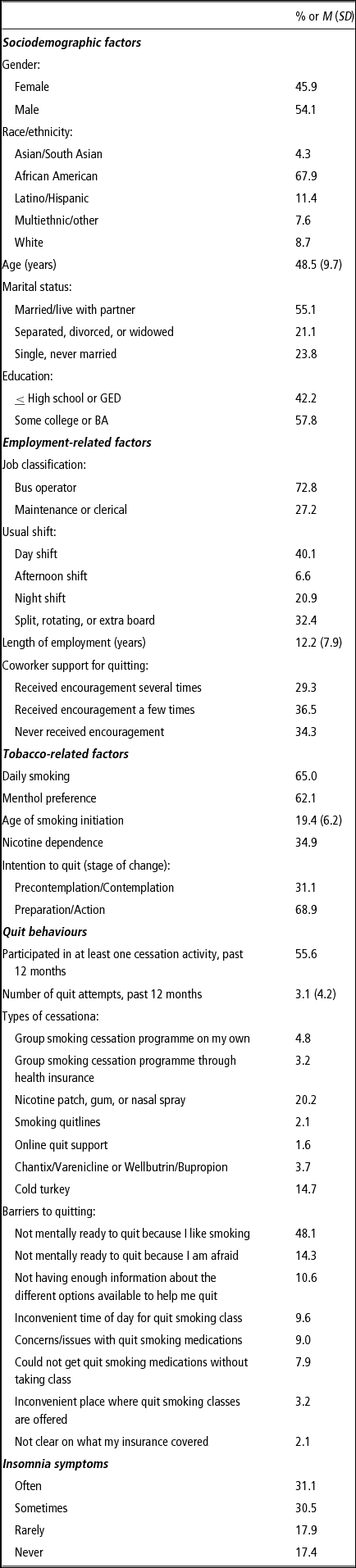
Sample characteristics are shown in Table 1. Mean participant age was 48.5 years (SD 9.7). Approximately 73% were bus operators, 68% were African American, and 46% were female. Average age of smoking initiation was 19.4 years (SD 6.2). Approximately 65% smoked daily, and 35% were intermittent smokers. Most cigarette users (62.1%) usually smoked menthol brands; 31% smoked non-menthol, and 6.9% stated no usual type.
Sample characteristics of transit workers who are current smokers (n = 190)

Cessation Activities and Barriers to Quitting
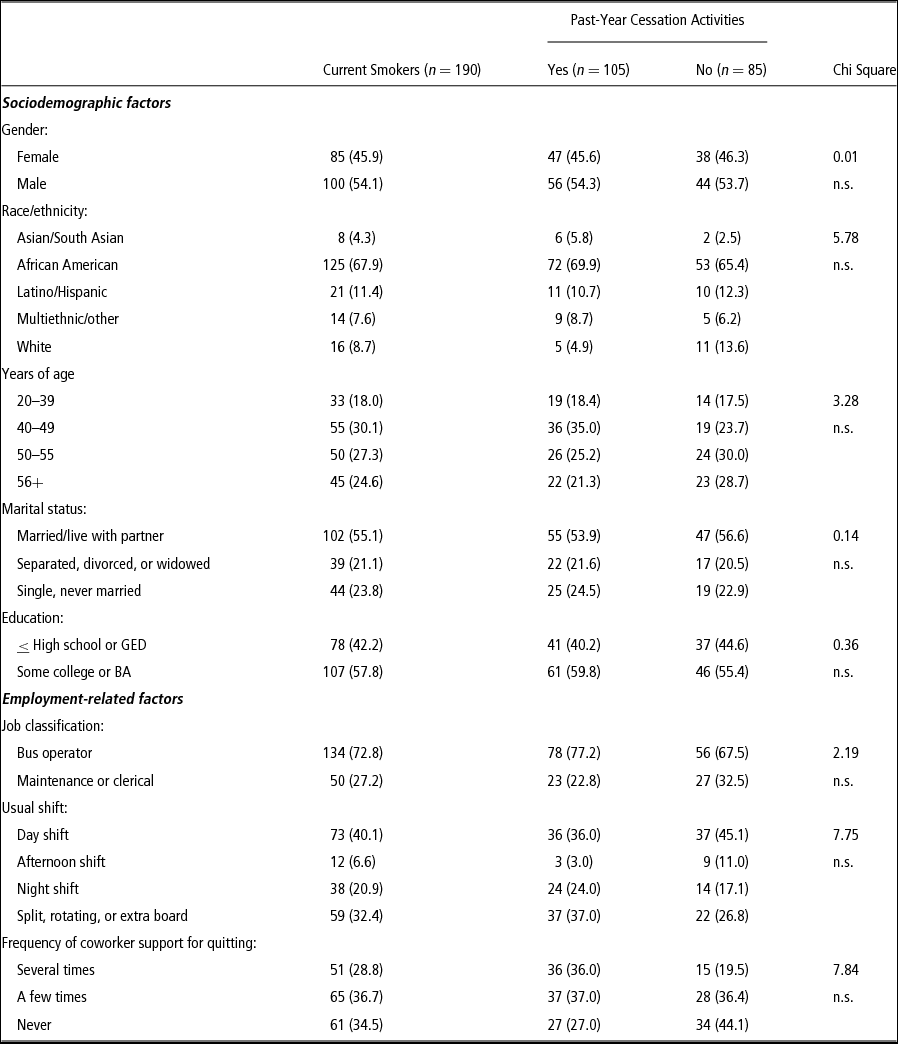
Most smokers (55.6%) had participated in at least one cessation activity in the past year. On average, these smokers made 3.1 quit attempts (SD 4.2). The most commonly reported cessation activities were use of nicotine patch, gum, or nasal spray (20.2%), followed by quitting cold turkey (14.7%), group smoking cessation programme on my own (4.8%), Chanitx/Varenicline or Wellbutrin/Bupropion (3.7%), group smoking cessation programme through health insurance (3.2%), smoking quitlines (2.1%), and online quit support (1.6%). The most commonly cited barrier to quitting was ‘Not mentally ready to quit because I like smoking’, which was endorsed by 48.1% of smokers. Results of the bivariate analysis showed that characteristics of smokers who participated in past-year cessation activities did not significantly differ from those who did not (Table 2).
Sample characteristics by cessation activities amongst transit workers, number (%).

Numbers may not add up to 190 due to missing data. n.s = not significant.
Factors Associated with Participation in Cessation Activities
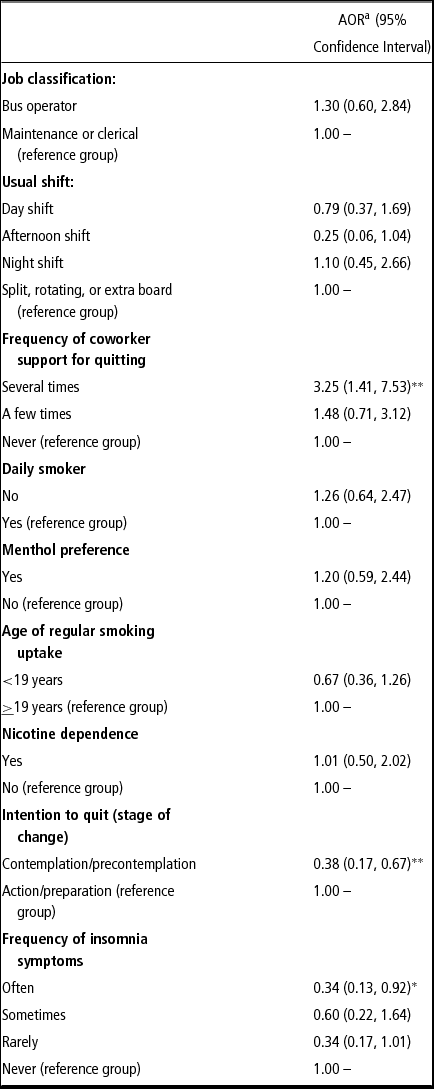
Results of the logistic regression analyses are shown in Table 3. In terms of employment-related factors, the results showed that coworker support for quitting was significantly associated with participation in past-year cessation activities. Smokers who reported receiving coworker encouragement for quitting several times were more than three times as likely to have participated in cessation activities compared to those that reported never receiving coworker encouragement (AOR = 3.25; 95% CI 1.41, 7.53). Neither job classification nor usual shift were associated with the outcome. Regarding tobacco-related factors, workers in the contemplation/precontemplation stage of change (intention to quit) were significantly less likely to have engaged in cessation activities than those in the action/preparation stage (AOR = 0.38; 95% CI 0.17, 0.67). Nicotine dependence, age at smoking initiation, daily vs. intermittent tobacco use, and menthol preference were not associated with the likelihood of participation in cessation activities. Lastly, frequency of insomnia symptoms was associated with cessation participation. Compared to workers who reported never having sleep trouble, those who reported often having sleep trouble during the past 12 months were less likely to participate in cessation activities (AOR = 0.34; 95% CI 0.13, 0.92).
Adjusted odds ratio (AOR), correlates of participation in past-year cessation activities amongst transit workers

a Adjusted for gender, age, race/ethnicity, and education. *p < 0.05; **p < 0.01.
Discussion
Amongst a sample of urban transit workers, most current smokers (55%) made one or more quit attempts in the past year. This percentage is similar to those reported in studies of blue-collar workers (Barbeau et al., Reference Barbeau, Goldman, Roelofs, Gagne, Harden and Conlan2005; Okechukwu, Krieger, Sorensen, Li, & Barbeau, Reference Okechukwu, Krieger, Sorensen, Li and Barbeau2009), low-income housing residents (Tucker-Seeley, Selk, Adams, Allen, & Sorensen, Reference Tucker-Seeley, Selk, Adams, Allen and Sorensen2015), non-daily smokers who participated in the 2009–2010 National Adult Tobacco Survey (Schauer, Malarcher, & Berg, Reference Schauer, Malarcher and Berg2014), and employed US adults (Yong, Luckhaupt, Li, & Calvert, Reference Yong, Luckhaupt, Li and Calvert2014). Whilst about 20% reported using NRT, few workers used other cessation pharmacotherapy (e.g., varenicline). This finding was echoed in our focus group discussions, in which smokers expressed apprehension about using these medications (Battle et al., Reference Battle, Cunradi, Moore and Yerger2015; Cunradi et al., Reference Cunradi, Moore, Battle and Yerger2015). Similarly, few workers reported using group smoking cessation programmes, quitlines, or online support. Given that most smokers made at least one past-year quit attempt, the findings suggest these workers would likely benefit from tailored intervention to boost quit attempts and thereafter cessation rates.
Interestingly, when asked about obstacles to quitting, nearly half endorsed the statement, ‘Not mentally ready to quit because I like smoking’. A study based on an urban multiethnic sample of daily smokers found that the two most common barriers to quitting were perceiving it to be too difficult and not wanting to quit (Rosenthal et al., Reference Rosenthal, Carroll-Scott, Earnshaw, Sackey, O'Malley and Santilli2013). These perceptions about obstacles seem consistent with the current study's finding that smokers who were in the precontemplation/contemplation stage of change for intention to quit were about 60% less likely to participate in cessation activities compared to smokers in the action/preparation stage of change. These results are in accord with previous studies in which intention to quit smoking is significantly associated with quit attempts (Diemert, Bondy, Brown, & Manske, Reference Diemert, Bondy, Brown and Manske2013; Smit, Fidler, & West, Reference Smit, Fidler and West2011).
Our results indicate that smokers who receive frequent coworker encouragement for quitting were three times as likely to participate in cessation activities compared to those who did not receive coworker encouragement. This suggests that coworkers can be made aware about the positive impact of their encouragement on smokers who are trying to quit, and that this support can be leveraged in the workplace to further smokers’ participation in cessation activities (Sorensen et al., Reference Sorensen, Emmons, Stoddard, Linnan and Avrunin2002). Coworker encouragement for quitting may be especially important in unionised workplace settings such as public transit agencies in which workers have established personal relationships with fellow workers through the course of their employment (Sorensen et al., Reference Sorensen, Quintiliani, Pereira, Yang and Stoddard2009). For example, workers who repair or maintain transit vehicles typically work in teams, with scheduled break and lunch times, which provides the opportunity for frequent interpersonal interactions. Similarly, transit operators usually go on and off duty at the bus garage, where they spend time in the Gillie room (i.e., break room) socialising, eating, and playing cards or dominos before, after and in between scheduled shifts. Characteristics of the transit agency work environment are thus quite conducive for promoting coworker encouragement for quitting.
In this study, smokers who reported that they often had trouble going to sleep or staying asleep were significantly less likely to participate in cessation activities compared to workers who did not report having insomnia symptoms. Previous research has shown that smokers are at increased risk for insomnia and poor sleep quality compared to non-smokers (Jaehne et al., Reference Jaehne, Unbehaun, Feige, Lutz, Batra and Riemann2012). Moreover, insomnia symptoms predict smoking cessation failure (Augustson et al., Reference Augustson, Wanke, Rogers, Bergen, Chatterjee and Synder2008; Brower & Perron, Reference Brower and Perron2011). Smokers with sleep disturbance who plan to quit may need additional support, such as behavioural sleep intervention, to increase their likelihood of achieving smoking abstinence (Fucito et al., Reference Fucito, Redeker, Ball, Toll, Ikomi and Carroll2014).
The current study found that nicotine dependence, age at smoking initiation, daily vs. intermittent tobacco use, and menthol preference were not associated with the likelihood of participation in cessation activities. This is in contrast to findings from the 2003 and 2006–2007 waves of the TUS-CPS, which showed that smokers with a menthol preference were more likely to make a past-year quit attempt than non-menthol smokers whether or not controlling for nicotine dependence (Levy et al., Reference Levy, Blackman, Tauras, Chaloupka, Villanti and Niaura2011). An analysis of the US 2009–2010 National Adult Tobacco Survey, however, found no association between age at smoking initiation or menthol preference and the likelihood of having made a past-year quit attempt amongst non-daily smokers (Schauer et al., Reference Schauer, Malarcher and Berg2014). Future studies should investigate whether or not these tobacco-related factors predict cessation participation amongst transit workers.
This study has a number of strengths and limitations. Regarding strengths, the current study is to our knowledge the first to report on factors associated with cessation activities amongst urban transit workers. This is important because transit workers constitute a substantial sector of the workforce that are at risk for a constellation of health-related problems, including obesity (French et al., Reference French, Harnack, Hannan, Mitchell, Gerlach and Toomey2010), physical inactivity (Das, Petruzzello, & Ryan, Reference Das, Petruzzello and Ryan2014), and smoking (Cunradi et al., Reference Cunradi, Chen and Lipton2009). These findings therefore add to both the occupational health and smoking cessation literatures. In addition, this study contributes to knowledge about tobacco-related disparities amongst this occupational group. For example, most blue-collar cessation studies have been conducted amongst occupational groups that are overwhelmingly white and male (e.g., motor freight workers; operating engineers; building trades workers; and apprentices) (Barbeau et al., Reference Barbeau, Li, Calderon, Hartman, Quinn and Markkanen2006; Duffy et al., Reference Duffy, Ronis, Richardson, Waltje, Ewing and Noonan2012; Okechukwu et al., Reference Okechukwu, Krieger, Sorensen, Li and Barbeau2009; Sorensen et al., Reference Sorensen, Barbeau, Stoddard, Hunt, Goldman and Smith2007; Reference Sorensen, Stoddard, Quintiliani, Ebbeling, Nagler and Yang2010). Most workers (68%) in the current study are African American, and nearly half are female. In terms of limitations, the cross-sectional study design precludes causal inference. Longitudinal study design will be needed to assess the temporal relationship between independent and outcome variables observed in this study. Due to survey time constraints, no data were collected on certain potentially important covariates (e.g., alcohol use). The findings herein also need to be considered within the context of the study's limited geography. For example, California adult smoking prevalence, estimated at 11.7%, is the second lowest in the U.S. (California Department of Public Health. California Tobacco Control Program, 2015). Furthermore, there is evidence that the California Tobacco Control Program has had a significant impact on cessation outcomes at the population level (Tang, Abramsohn, Park, Cowling, & Al-Delaimy, Reference Tang, Abramsohn, Park, Cowling and Al-Delaimy2010). Lastly, since the study was based at one public transit agency, it is unknown to what extent the findings are generalisable to transit workers employed at other jurisdictions or locations. Additional studies are needed to determine whether the findings here can be replicated amongst workers at other transit agencies.
In conclusion, efforts to increase quit attempts amongst transit workers who smoke is an important first step towards addressing tobacco-related disparities in this sector of the workforce. Further research is needed to more fully understand the meaning of tobacco and the role it plays in the lives of transit workers in order to boost quit attempts. Work stress, for example, may be a strong trigger for smokers in this population (Cunradi et al., Reference Cunradi, Moore, Battle and Yerger2015). Given the multiethnic composition of the transit workforce, attention is needed as to how the intersection of race and ethnicity with occupation influences quitting, relapse and treatment behaviours (Fagan et al., Reference Fagan, Moolchan, Lawrence, Fernander and Ponder2007). Similarly, women are a growing sector of the transit workforce. A gendered approach is needed to address the determinants of smoking behaviours amongst women (Amos, Greaves, Nichter, & Bloch, Reference Amos, Greaves, Nichter and Bloch2012; Greaves, Reference Greaves2014). As with other unionised blue-collar groups that have elevated tobacco use but low rates of using cessation resources available through their health benefits, interventions are needed to increase participation (Yzer et al., Reference Yzer, Weisman, Mejia, Hennrikus, Choi and DeSimone2015). Tailored approaches should address the cessation-related concerns amongst transit workers and the characteristics of the workplace environment that may hinder or promote participation in order to maximise success (Battle et al., Reference Battle, Cunradi, Moore and Yerger2015; Cunradi et al., Reference Cunradi, Moore, Battle and Yerger2015).
Acknowledgements
The authors gratefully acknowledge the support and cooperation of the Alameda-Contra Costa Transit District and the Amalgamated Transit Union.
Financial Support
This work was supported by the Tobacco-Related Disease Research Program, Office of the President, University of California Grant number 21RT-0113.
Conflict of Interest
None.
Ethical Standards
The authors assert that all procedures contributing to this work comply with the ethical standards of the relevant national and institutional committees on human experimentation and with the Helsinki Declaration of 1975, as revised in 2008.