Introduction
The lepidopteran maize stemborer Busseola fusca (Fuller) (Lepidoptera: Noctuidae) is a major pest of maize at higher altitudes (1160–2500 m above sea level (masl)) in Ethiopia (Gebre-Amlak, Reference Gebre-Amlak1985), with two or three generations annually (Yitaferu et al., Reference Yitaferu, Gebre-Amlak and Lakra1994). The maize plant is subjected to attack by the maize stemborer from seedling to maturity. A reduction in yield results from stand losses due to the destruction of the growing point (dead heart injury) in young maize plants and the tunnelling of the larvae in the stem, thereby weakening the stalk. The development of ears may be ruined by the tunnelling and feeding of the caterpillars, and by ear-rotting micro-organisms introduced while feeding (Azerefegne, 1991). Gebre-Amlak et al. (Reference Gebre-Amlak, Sigvald and Pettersson1989) reported crop losses ranging from 0 to 26% by the first generation and from 22.5 to 100% by the second generation of B. fusca in Awassa, southern Ethiopia. Similarly, Asmare (2001) reported that two stemborer species, B. fusca and Chilo partellus (Swinhoe), respectively, caused 22–47% losses in sorghum at Sirinka and 21–50% at Cheffa in Ethiopia.
Various insecticides have been recommended for the control of cereal stemborers. However, the use of persistent and broad-spectrum pesticides has raised a number of concerns (Westbom et al., Reference Westbom, Ahmed, Negussie, Negussie, Mathiasson and Björklund2008). Moreover, financially constrained smallholding farmers cannot afford to buy pesticides and application equipment. For these reasons, attention is being given to the use of ecologically safe and cheaper methods such as botanicals against various pests of crops.
Millettia ferruginea (Hochst.) Baker, locally known as ‘Birbira’, is a large tree growing to a height of 35 m. It is endemic to Ethiopia and widely distributed. It performs well in moist lowland as well as in dry, moist and wet semi-highland agroclimatic zones of 1000–2500 masl (Azene, 2007). Furthermore, M. ferruginea is a multi-purpose tree and highly valued by farmers. It is extensively used in agroforestry (e.g. as a shade tree in coffee farms) and for erosion control (Teketay and Tegineh, Reference Teketay and Tegineh1991; Tadesse et al., Reference Tadesse, Legesse and Olsson2000; Azene, 2007). It is also an N2-fixing leguminous tree species with a positive effect on intercropped crops. The leaves of M. ferruginea can be used as fodder for ruminants. In addition, its wood can be used as firewood, as local building material, to make tool handles and household utensils, and for fencing (Azene 2007; Berhanu et al., 2013). Birbira seed extract is traditionally used as a herbal fish poison in Ethiopia, where mature pods and seeds are ground to fine powder and spread over the water surface for stunning fish (Siegenthaler, 1980; Abebe, 2004; Karunamoorthi et al., Reference Karunamoorthi, Bishaw and Mulat2009). It may also have a role for the management of insect pests (Damte and Chichaybelu, Reference Damte and Chichaybelu2002; Jembere et al., 2006, Reference Jembere, Namukobe, Benard and Dagne2007; Eyob et al., Reference Eyob, Azerefegne, Tameru, Temesgen and Blomme2010). Furthermore, seed oil extracted from M. ferruginea has a potential application for biodiesel and glycerol production (Berhanu and Amare, Reference Berhanu and Amare2012).
Over 25 flavonoids, 50 isoflavonoids, 12 chalcones and miscellaneous compounds have been reported from the Millettia genus alone (Bekele, 1988). Rotenone is one of the dominant compounds found in the seed, stem and bark of M. ferruginea (Bekele, 1988; Jembere et al., Reference Jembere, Namukobe, Benard and Dagne2007; Takemoto and Arita, Reference Takemoto and Arita2009). The aim of this study was to investigate the efficacy of the aqueous crude seed extract of M. ferruginea against the African maize stemborer B. fusca.
Materials and methods
Site description and plot design
The study was conducted at the Research and Farm Centre of Hawassa University, Hawassa. The maize variety A511 was planted twice in 6 × 10 m plots on 2 and 17 June 2006. The plantings were deliberately delayed until the month of June to attain high infestation from the second-generation maize stemborers. The spacing within and between the rows was 30 and 75 cm, respectively, and the plots within the blocks were spaced 1 m apart. The experiment was performed in a randomized complete block design with four replications.
Plant extract preparation
Birbira (M. ferruginea) pods containing seeds were collected from mature trees in Gedeo Zone, southern Ethiopia. The seeds were dried in a well-ventilated area under shade and then ground to a fine powder. The seed powder was soaked in water for 24 h at a concentration of 10 g/100 ml, and the mixture was filtered with cheesecloth as described by Jembere (Reference Jembere2002). The original 10% extract was further diluted to lower concentrations of 1, 3 and 5%. The treatments were applied using a Cooper Pegler CP15 manual knapsack sprayer at a rate of 300 l/ha.
Field treatments and parameters evaluated
The crude water extract of M. ferruginea at concentrations of 1, 3, 5 and 10% was applied two or three times on maize plants. In addition, two other treatments, untreated control and insecticide treated, were included for comparison. The insecticide lambda-cyhalothrin (Karate® 5% emulsifiable concentrate (EC), a synthetic pyrethroid) was applied at a rate of 16 g a.i./ha.
Both the insecticide and seed extracts were applied into the funnel of the maize plants. The maize plants were inspected daily for signs of infestation, and the first applications of the treatments with Millettia and the insecticide were made when one or two of the leaves showed typical B. fusca-induced damage. The maize plants were 5 weeks old when the first applications were made, and the second and third applications were made at 10-day intervals.
Data on plant population, leaf infestation, bored stem and dead heart were collected weekly from the middle 12 rows, leaving the border rows of each plot. Percentages of various infestations were computed by dividing the number of plants showing damage to the stand count.
A total of 20 stalks were randomly sampled from the border rows of each plot and dissected 72 h after spraying to record the number of larvae. At harvest, data were collected on final plant population and percentage of stand losses computed in comparison with the insecticide-treated plots. In addition, 20 plants were randomly selected from each plot and dissected. The length of the larval tunnel in each stem was measured, and the proportion of the tunnel length to the total plant height was calculated.
Ears collected from the inner 12 rows of each plot were threshed and yield converted to quintals per hectare, and adjusted at a 13% moisture level. The percentage of grain yield loss in the control and Millettia treatments was calculated using the formula:
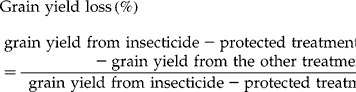 $$Grain yield loss\,(\%)\, = \frac {grain yield from insecticide - protected treatment - grain yield from the other treatments}{grain yield from insecticide - protected treatment}\times 100. $$
Statistical analyses
Data were subjected to analysis of variance, and means were separated using Tukey's test at P= 0.05 (SAS Institute, Inc., 2000). The plant population data that showed high variability were square-root transformed prior to analysis of variance.
Results
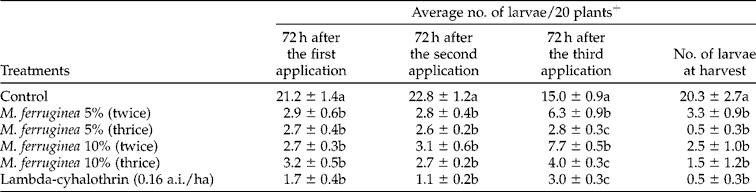
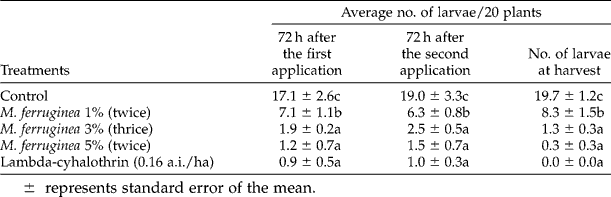
The results for maize plants planted on 2 and 17 June were similar. The aqueous seed extract of M. ferruginea significantly reduced the number of B. fusca larvae in maize plants compared with the untreated plots (Tables 1 and 2). Larval populations in maize plants treated with 3, 5 and 10% Millettia extracts applied two or three times were not different from the lambda-cyhalothrin-treated plants during the first and second sampling periods that were conducted 72 h after the first and second applications. The plots sprayed three times (Table 1) had fewer larvae compared with those given two applications during the third sampling date. The number of larvae was high in maize plants treated with 1% Millettia, although they were fewer than the untreated plants (Table 2). The lowest number of larvae at all times was recorded for the commercial insecticide applied twice (Tables 1 and 2).
Survival of Busseola fusca larvae following application of the aqueous extract of Millettia ferruginea seed powder on maize planted on 2 June 2006

Means followed by the different letters within a column are significantly different according to Tukey's test (P< 0.05).
+ ± represents standard error of the mean.
Survival of Busseola fusca larvae following application of the aqueous extract of Millettia ferruginea seed powder on maize planted on 17 June 2006
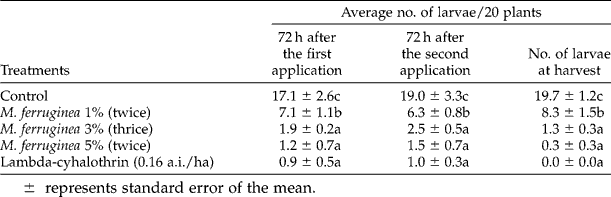
Means followed by the different letters within a column are significantly different according to Tukey's test (P< 0.05).
± represents standard error of the mean.
At harvest, the 3, 5 and 10% Millettia treatments had few live B. fusca larvae in maize stalks ( < 3 larvae per 20 plants) and significantly differed from the control (21 larvae per 20 plants) and 1% Millettia (six to eight larvae per 20 plants) treatments (Tables 1 and 2). On the other hand, these Millettia treatments did not differ from the treatment with the commercial insecticide in the number of larvae at harvest (Table 1). During all the dissection periods, larval populations were higher in the untreated plots.
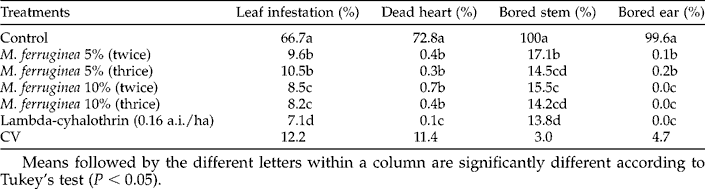
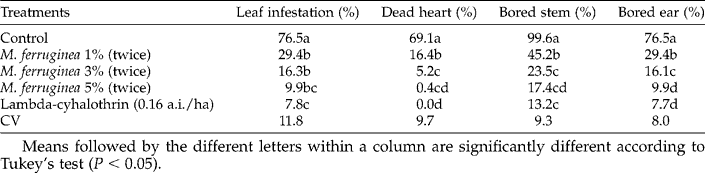
The unsprayed plots of maize planted on 2 June had about 66% leaf infestation at an early stage and 73% of them developed dead heart (Table 3). Similarly, the unsprayed plots of maize planted on 17 June showed 77% leaf infestation and 69% dead heart (Table 4). At harvest, almost all the stems and ears of the plants in the unsprayed plots had been bored (Tables 3 and 4).
Effect of the aqueous extract of Millettia ferruginea seed powder on damage caused by Busseola fusca on maize planted on 2 June 2006
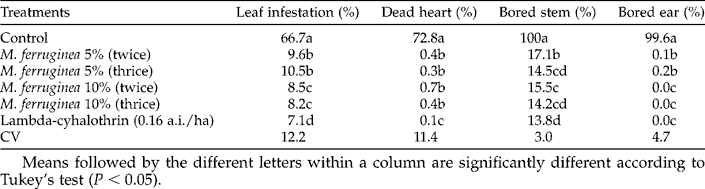
CV, coefficient of variation.
Means followed by the different letters within a column are significantly different according to Tukey's test (P< 0.05).
Effect of the aqueous extract of Millettia ferruginea seed powder on damage caused by Busseola fusca on maize planted on 17 June 2006
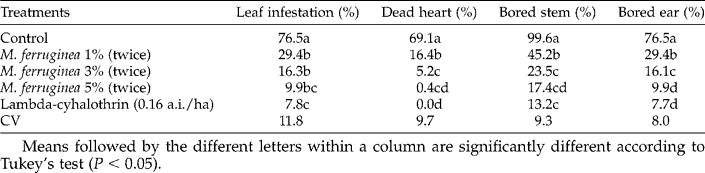
CV, coefficient of variation.
Means followed by the different letters within a column are significantly different according to Tukey's test (P< 0.05).
Millettia ferruginea-treated maize had significantly lower leaf infestation, dead heart, bored ear and bored stem compared with the untreated control (Tables 3 and 4). Maize treated with 5 and 10% Millettia extract applied two or three times had about 10% leaf infestation and few dead hearts and bored ears ( < 1%). There was no significant difference in the levels of these infestations between the 5% Millettia, 10% Millettia and the commercial insecticide treatments (Tables 3 and 4). Leaf infestation for the 1% Millettia treatment was higher than that for the commercial insecticide and 3 and 5% Millettia treatments. The 1 and 3% Millettia treatments were less effective in reducing the various damage symptoms caused by the stemborer and sustained 29 and 16% leaf infestation, 16 and 5% dead heart, and 45 and 24% bored stem, respectively (Table 4).
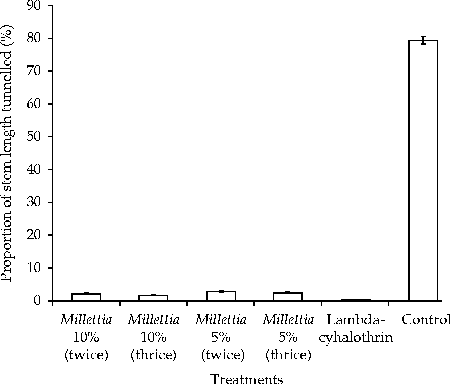
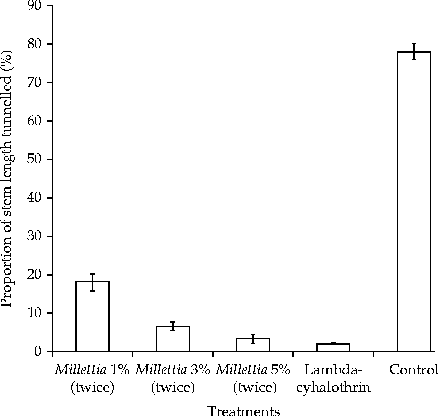
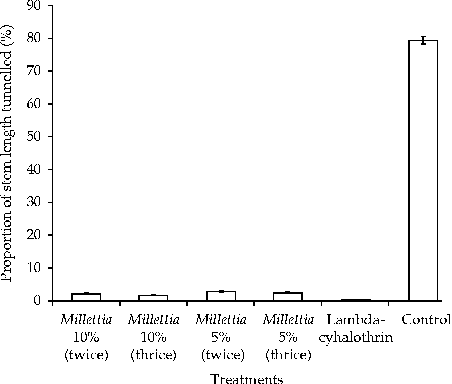
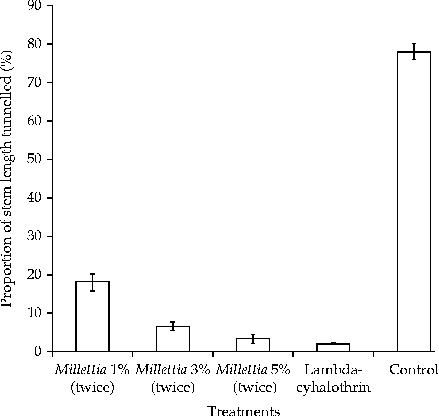
More than 80% of the stem length of the untreated maize was internally tunnelled by feeding larvae, whereas maize treated with 3, 5 and 10% Millettia and lambda-cyhalothrin had shorter proportions of stem tunnelling ( < 7%) (Figs 1 and 2). In contrast, maize treated with 1% Millettia had substantial proportions of stem tunnelling, although less than the untreated control (Fig. 2).
Extent of stem tunnelling by Busseola fusca on Millettia ferruginea-protected, lambda-cyhalothrin-protected and unprotected maize plots planted on 2 June 2006.
Extent of stem tunnelling by Busseola fusca on Millettia ferruginea-protected, lambda-cyhalothrin-protected and unprotected maize plots planted on 17 June 2006.
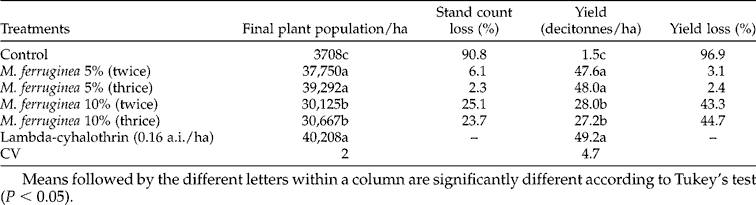
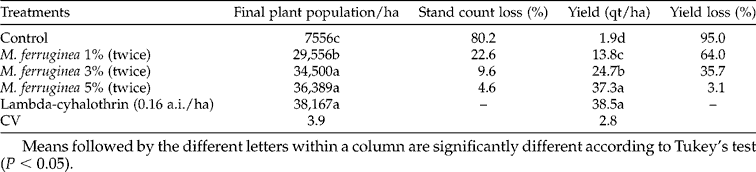
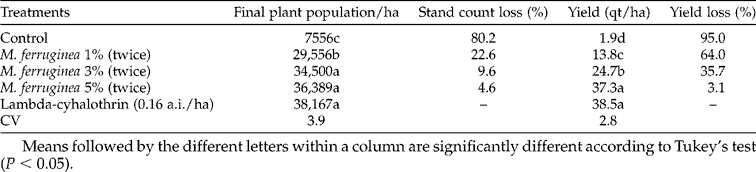
Millettia-treated plots had better plant population than the untreated control, which suffered 80–90% stand loss (Tables 5 and 6). Among the Millettia treatments, 5% Millettia had the highest plant population during both planting periods and did not differ from the insecticide-protected maize (Tables 5 and 6). The sprays of 10% Millettia were accumulated in the maize leaf whorl, causing rotting of the growing point, resulting in the killing of about 25% of maize plants (Table 5). In contrast, at lower concentrations of 1 and 3% Millettia, 22.6 and 9.6% of maize plants were lost, respectively, due to B. fusca-induced damage (Table 6).
Effect of the aqueous extract of Millettia ferruginea seed powder on the plant population, stand count loss and yield of maize due to infestation by Busseola fusca on maize planted on 2 June 2006
CV, coefficient of variation.
Means followed by the different letters within a column are significantly different according to Tukey's test (P< 0.05).
Effect of the aqueous extract of Millettia ferruginea on the plant population, stand count loss and yield of maize due to infestation by Busseola fusca on maize planted on 17 June 2006
CV, coefficient of variation.
Means followed by the different letters within a column are significantly different according to Tukey's test (P< 0.05).
Maize treated with the commercial insecticide produced the highest yield (49.2 decitonnes/ha for 2 June planting and 38.5 decitonnes/ha for 17 June planting) and the lowest yield was from the untreated plots (1.5 decitonnes/ha with about 97% yield loss for 2 June planting and 1.9 decitonnes/ha with 95% yield loss for 17 June planting) (Tables 5 and 6). The Millettia treatments increased the yield relative to the untreated control, although they sustained varying losses compared with the commercial insecticide (Table 6). For maize planted on 2 June, yields from 5% Millettia extract applied two or three times were comparable with those from the insecticide treatment (yield 47.6 and 48.0 decitonnes/ha, respectively). In contrast, 10% extract of Millettia produced only 28.0 and 27.2 decitonnes/ha when applied two and three times, respectively, and percentage losses amounted to 43.3 and 44.7% compared with the insecticide treatment (Table 6). Yields from the 1% Millettia (13.8 decitonnes/ha) and 3% Millettia (24.7 decitonnes/ha) treatments were low, and the losses amounted to 64 and 36%, respectively, while the yield loss from the 5% Millettia treatment was about 3%.
Discussion
The efficacy of various concentrations of the aqueous seed extract of Millettia was evaluated against the maize stemborer on late-planted maize in the presence of high pest populations. Late-planted maize suffers 23–100% yield loss by the second generation of B. fusca (Gebre-Amlak et al., Reference Gebre-Amlak, Sigvald and Pettersson1989). During the present study, the untreated maize plants were severely damaged. The infestation was so severe that more than 80% of the plants eventually died due to the combined effect of dead heart and stem tunnelling. The few maize cobs harvested were riddled with larvae and less than 2 decitonnes/ha yield was harvested.
The Millettia treatments reduced the larval population and damage in the maize plants while plant growth and plant survival improved, which ultimately increased maize yield. Increased frequency of applications and concentrations also increased the efficacy of Millettia and resulted in less damage by B. fusca except for the 10% application, which had a negative effect on the plant population.
The lower concentrations (1 and 3%) of Millettia extract significantly reduced the number of surviving larvae and damage to maize compared with the untreated plots, but were not as effective as the insecticide and 5% Millettia extract treatments. The results were consistent for both plantings, as the 5% Millettia extract was as effective as the commercial insecticide with negligible infestation, damage and yield loss. In both planting periods, the yield of maize treated with the 5% extract of Millettia was not different from that of maize treated with the insecticide.
There have been several studies on the efficacy of various botanicals against maize stemborers. Gebre-Amlak and Azerefegne (Reference Gebre-Amlak and Azerefegne1999) studied the insecticidal activity of chinaberry, endod and pepper tree seeds against the maize stemborer in southern Ethiopia and obtained a significant reduction in the levels of B. fusca-induced damage in maize, with a significant increase in yield. However, it was concluded that more than two applications were required to have an effective control.
The efficacy of M. ferruginea has been tested against many insect pests. A laboratory study showed that water extracts of M. ferruginea seed powder at different concentration levels (10–40% w/v) caused 93–100% mortality against the different castes of adult Macrotermes termites at all concentration levels (Getahun and Jembere, Reference Getahun and Jembere2006). Birbira seed water extract also caused 45–60% mortality on the sorghum chaffer Pachnoda interrupta (Oliver) within 24–48 h, which was found to be significantly higher than the mortality caused by the standard insecticide, carbaryl, applied at the recommended rate (1.5 kg/400 l of water) (Jembere et al., 2006).
Eyob et al. (Reference Eyob, Azerefegne, Tameru, Temesgen and Blomme2010) reported that M. ferruginea caused a significantly higher level of mortality on the enset root mealybug (Cataenococcus ensete Williams and Matile-Ferrero) than Schinus molle L., Melia azedarach L. and Phytolacca dodecandra L. Damte and Chichaybelu (Reference Damte and Chichaybelu2002) also tested the toxicity of Millettia seed against the Adzuki bean beetle Callosobruchus chinensis L., which gave complete protection of stored chickpea for 6 months in the laboratory. The seed powder from M. ferruginea also caused 100% mortality in the bean weevil Zabrotes subfasciatus (Boheman) (Jembere et al., Reference Jembere, Namukobe, Benard and Dagne2007).
Millettia ferruginea, and other species within the same genus, has been of interest to researchers because of its wide range of traditional uses to treat many diseases and also to manage pests. The Millettia genus has been reported to contain flavonoids, isoflavonoids, chalcones and miscellaneous compounds (Bekele, 1988). Immature seeds of M. ferruginea yielded three rotenoids (rotenone, tephrosin and 12α-hydroxyrotenone), four pyrano-isoflavones (ferrugone, durmillone, calopogonium isoflavone A and barbigerone) and three novel C-prenylated isoflavones (preferrugone, predurmillone and prebarbigerone) (Dagne and Bekele, Reference Dagne and Bekele1990). George (1980) reported that rotenoids have been used as insecticides since 1848, when they were applied to plants to control leaf-eating caterpillars. Thus, rotenone, a non-specific botanical insecticide with some acaricidal properties, is not only used in home gardens for insect control, but also used for lice and tick control on pets and for fish eradications as part of water body management (George, 1980; Saxena, Reference Saxena and Shemilt1983; Jembere, Reference Jembere2002; Hien et al., Reference Hien, Gortnizka and Kraemer2003). It is also one of the dominant compounds found in Millettia seeds (Bekele, 1988; Dagne and Bekele, Reference Dagne and Bekele1990; Jembere et al., Reference Jembere, Namukobe, Benard and Dagne2007) that might possess insecticidal properties against the stemborer, although the other compounds could be equally important.
Jembere et al. (2006) reported that the water extract of M. ferruginea seeds is the most active among the different extracts. The present study showed that the aqueous crude seed extract of M. ferruginea is extremely effective in reducing the larval populations of B. fusca and damage in maize, and achieving yield increase. The preparation of the crude water extract is simple, inexpensive and can be easily adopted by farmers for the management of maize stemborers. Therefore, the aqueous crude seed extract of M. ferruginea at 5% concentration applied two to three times is recommended for the control of B. fusca in maize.